
Prefilled Syringe Inspection Systems Market Size and Share
Market Overview
| Study Period | 2020 - 2031 |
|---|---|
| Market Size (2026) | USD 0.69 Billion |
| Market Size (2031) | USD 1.04 Billion |
| Growth Rate (2026 - 2031) | 8.57 % |
| Fastest Growing Market | Asia-Pacific |
| Largest Market | Asia-Pacific |
| Market Concentration | Medium |
Major Players *Disclaimer: Major Players sorted in no particular order Image © Mordor Intelligence. Reuse requires attribution under CC BY 4.0. | |
Prefilled Syringe Inspection Systems Market Analysis by Mordor Intelligence
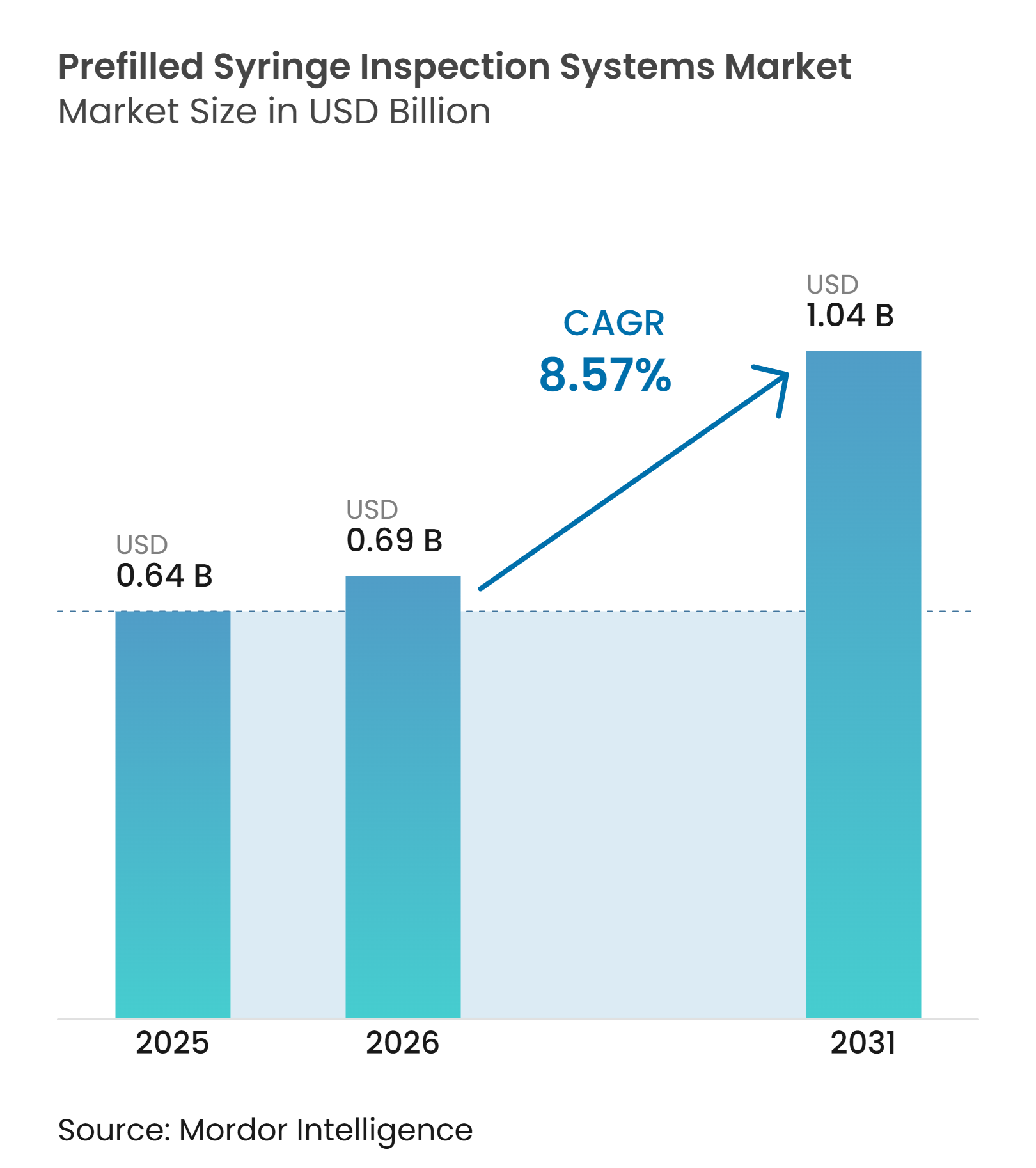
The Prefilled syringe inspection systems market size is projected to expand from USD 0.64 billion in 2025 and USD 0.69 billion in 2026 to USD 1.04 billion by 2031, registering a CAGR of 8.57% between 2026 to 2031. Demand is supported by the wider commercial use of biologics, GLP-1 receptor agonists, fusion proteins, and biosimilars in prefilled syringe formats. Manufacturers need systems that can inspect viscous products, polymer containers, plungers, needle shields, and closure components at production speed. Regulatory requirements for individual container inspection and documented defect classification are raising the value of automated data capture. The Prefilled syringe inspection systems market also benefits from recurring work after installation, including software upgrades, defect-library expansion, recipe qualification, and throughput optimization. Competition increasingly centers on AI capability, ready-to-use syringe handling, and the ability to support validation at regulated fill-finish sites.
Key Report Takeaways
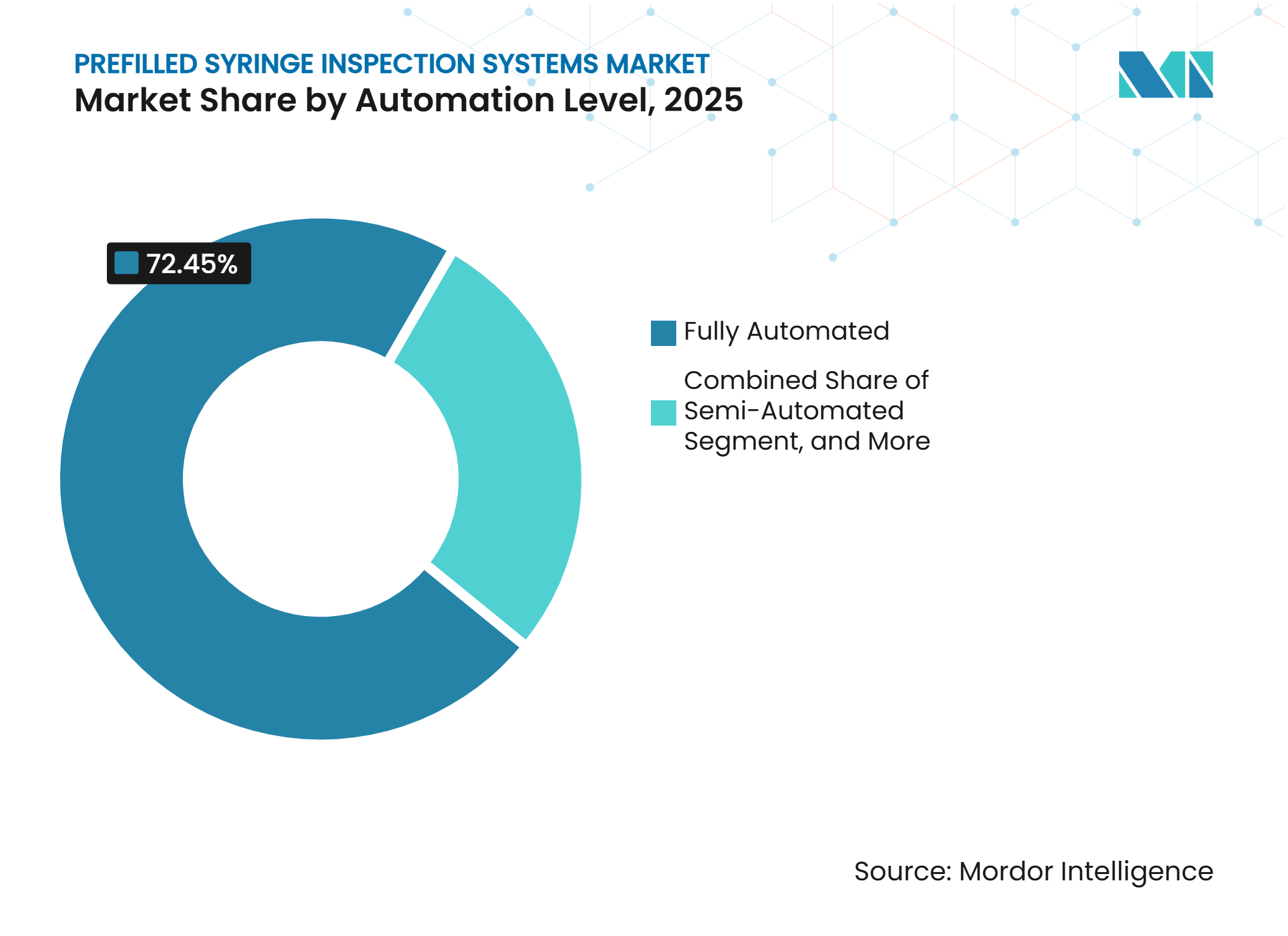
- By automation level, fully automated systems held 72.45% revenue share in 2025 and are projected to expand at a 9.24% CAGR through 2031.
- By inspection technology, automated visual inspection and machine vision held 47.71% revenue share in 2025, while headspace gas analysis is projected to expand at a 9.22% CAGR through 2031.
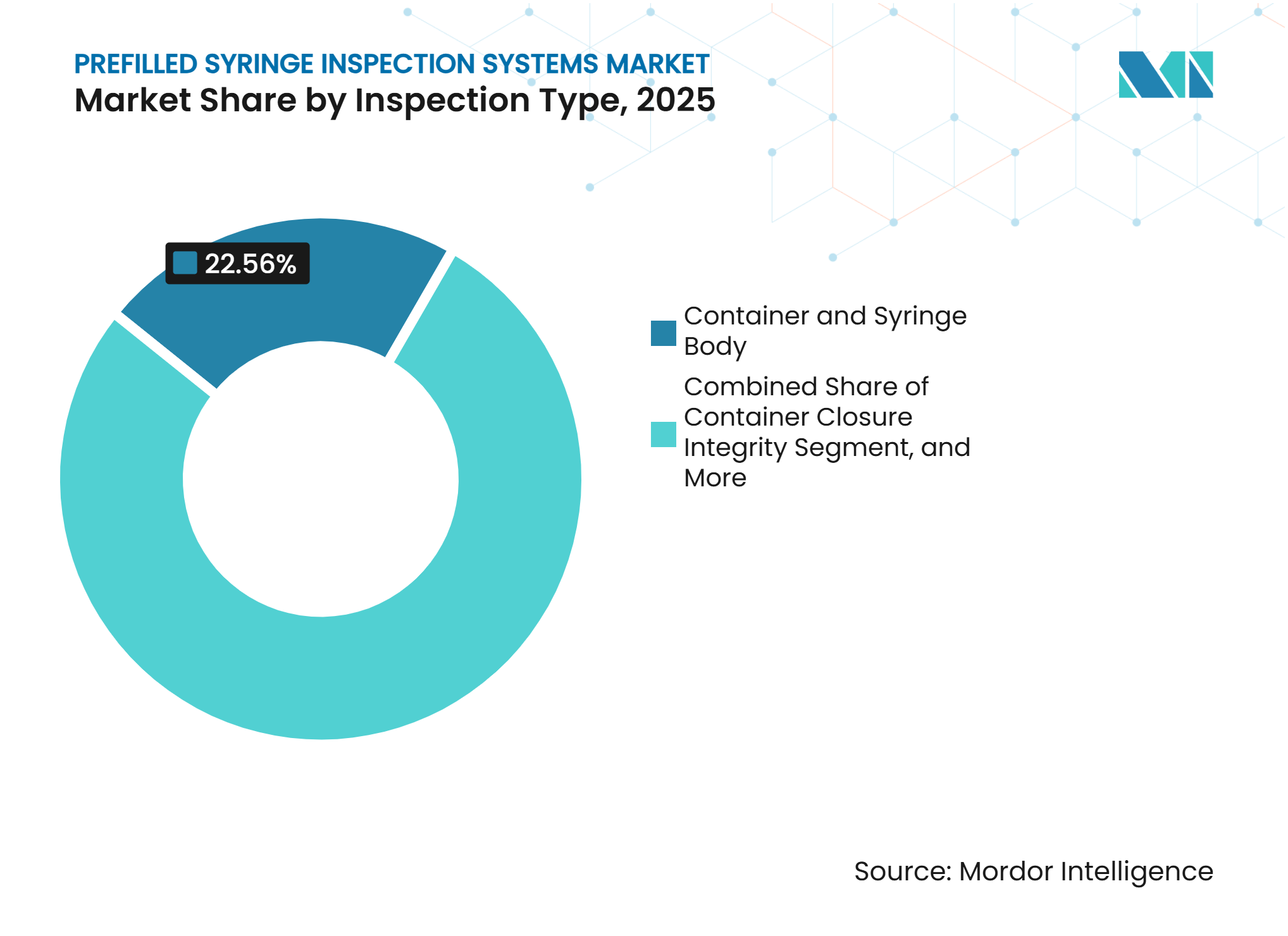
- By inspection type, container and syringe body inspection held 22.56% revenue share in 2025, while container closure integrity is projected to expand at an 8.84% CAGR through 2031.
- By end-user, pharmaceutical companies held 44.71% revenue share in 2025, while biopharmaceutical companies are projected to expand at an 8.93% CAGR through 2031.
- By geography, Asia-Pacific held 30.41% revenue share in 2025 and is projected to expand at a 9.37% CAGR through 2031.
Note: Market size and forecast figures in this report are generated using Mordor Intelligence’s proprietary estimation framework, updated with the latest available data and insights as of January 2026.
Market Trends and Insights
Drivers Impact Analysis of Prefilled Syringe Inspection Systems Market*
| Driver | (~) % Impact on CAGR Forecast | Geographic Relevance | Impact Timeline |
|---|---|---|---|
| Expansion of Biologics and Self-Administration Injectables | +2.1% | Global, led by North America, Europe, and Asia-Pacific biologics fill-finish hubs | Medium term (2-4 years) |
| Documented 100% Inspection and Data Integrity Requirements | +1.8% | Global, with core demand in Europe and North America and expansion into Asia-Pacific, Middle East and Africa | Short term (≤ 2 years) |
| AI-Enabled Defect Classification and False-Reject Reduction | +1.5% | Global, with the highest technology intensity in North America, Germany, and Japan | Medium term (2-4 years) |
| Ready-to-Use Nesting and High-Throughput Fill-Finish Lines | +0.9% | North America and Europe, with spillover into Asia-Pacific | Medium term (2-4 years) |
| Increasing Use of Contract Manufacturing for Sterile Injectables | +0.8% | Global, concentrated in the United States, Europe, and India CDMOs | Medium term (2-4 years) |
| Rising Adoption of Polymer Prefilled Syringes | +0.7% | North America and Europe lead, while Asia-Pacific is expanding | Long term (≥ 4 years) |
| Source: Mordor Intelligence | |||
Expansion of Biologics and Self-Administration Injectables
The wider use of biologics is increasing both the volume and complexity of syringe inspection at commercial fill-finish facilities. Monoclonal antibodies, GLP-1 receptor agonists, fusion proteins, and biosimilars commonly require a validated method for each product. That work includes recipe qualification, defect-library development, fill-level verification, and controls suited to viscosity, particulate profile, and container material. A molecule offered in conventional prefilled syringes, autoinjectors, and wearable injectors can require separate qualification work at every manufacturing site because device configurations differ. Stevanato Group and Syntegon introduced the MLD Advanced platform for ready-to-use cartridges and syringes, with the platform directed toward higher-volume biologic products, including GLP-1 formulations.[1] These requirements support system upgrades as products move from clinical batches to commercial output in the Prefilled Syringe Inspection Systems market.
Documented 100% Inspection and Data Integrity Requirements
Regulators have made individual inspection and documented defect handling central to sterile manufacturing control. EU GMP Annex 1 requires each filled parenteral container to be inspected individually and requires manufacturers to establish defect classification, batch trending, and validated inspection methods.[2] These obligations favor automated systems because they can capture inspection data at production speed and retain records for quality review. The rule also raises the value of maintained defect libraries used to train personnel, configure inspection systems, and assess ongoing performance. The U.S. framework requires written procedures and investigation of unexplained discrepancies, including failures involving a batch or its components.[3] The prefilled syringe inspection systems market, therefore, gains support from compliance needs as well as capacity expansion.
AI-Enabled Defect Classification and False-Reject Reduction
AI-enabled inspection is becoming more important when conventional rules cannot handle variable product and container conditions. Static vision rules can struggle to distinguish silicone oil droplets from actual particulate matter in high-viscosity biologics. They can also be affected by refraction artifacts in cyclic olefin polymer and cyclic olefin copolymer barrels at high inspection speeds. Antares Vision Group described a dual-layer AI approach in its VRI VI-060S system, including a layer that separates bubbles from particulate matter and another that supports recipe adaptation during format changes. Lower false rejects can be particularly valuable when a rejected biologic unit carries high product value, while faster recipe adaptation can improve CDMO utilization. These requirements make AI software a more important part of the prefilled syringe inspection systems market.
Ready-to-Use Nesting and High-Throughput Fill-Finish Lines
Ready-to-use nested syringes require coordinated de-nesting, inspection, reject handling, and re-nesting within an automated sequence. A removed syringe can create missing positions, nest imbalance, and transport instability if the line does not manage that condition correctly. Syntegon states that its AIM Direct system includes gap compensation to restore the nest after inspection-based removal and can process up to 400 syringes per minute. Brevetti CEA presented its K15 DR for glass and plastic syringes with no-contact handling and output of up to 600 units per minute. These systems address material damage and handling risks that conventional linear equipment cannot readily manage at commercial throughput. The combination of nesting and higher throughput creates a direct equipment need for the Prefilled syringe inspection systems market.
Restraints Impact Analysis of Prefilled Syringe Inspection Systems Market*
| Restraint | (~) % Impact on CAGR Forecast | Geographic Relevance | Impact Timeline |
|---|---|---|---|
| High Capital, Validation, and Integration Cost | -1.4% | Global, most acute in emerging Asia-Pacific markets, South America, and Middle East and Africa | Medium term (2-4 years) |
| Complex Inspection of Transparent and Viscous Products | -0.8% | Global, concentrated in biologics-intensive markets in North America, Europe, and Japan | Long term (≥ 4 years) |
| Scarcity of Validated Defect Libraries for New Formulations | -0.6% | Global, particularly North America and Europe as biologics innovation hubs | Medium term (2-4 years) |
| Glass-to-Glass Handling Risk in Nested Syringe Lines | -0.4% | North America and Europe in core ready-to-use fill-finish operations, with growing Asia-Pacific exposure | Short term (≤ 2 years) |
| Source: Mordor Intelligence | |||
High Capital, Validation, and Integration Cost
A fully automated syringe inspection installation requires spending on hardware, software, integration engineering, and validation. The IQ/OQ/PQ process can take 12-18 months, which delays the point at which capital spending becomes recognized equipment revenue. The burden is greater for smaller manufacturers and newer CDMOs with limited batch revenue or broad product portfolios. Each client product can require a separate inspection recipe that must be maintained after certain maintenance events or regulatory changes. Leasing and validation-as-a-service models can ease initial cost pressure, but proprietary data formats can make later supplier changes difficult. These conditions can slow procurement in price-sensitive facilities within the prefilled syringe inspection systems market.
Complex Inspection of Transparent and Viscous Products
Viscous biologic formulations can limit the movement that rotation-based visual inspection uses to identify particles. Products dosed above 100 mg/mL can make slow-settling contaminants harder to separate from container-surface anomalies during a standard inspection cycle. Polymer barrels can create refraction and birefringence effects that produce false positives or hide defects at seams and barrel-plunger interfaces. A study in the PDA Journal reported a correlation coefficient of R² ≥0.98 for headspace carbon dioxide analysis against helium leak testing across standard vial formats. Comparable commercial-scale validation evidence for polymer syringe containers remains less developed in the supplied material, leaving less certainty for difficult products. This gap raises deployment risk for the Prefilled syringe inspection systems market.
*Our forecasts treat driver/restraint impacts as directional, not additive. The impact forecasts reflect baseline growth, mix effects, and variable interactions.
Prefilled Syringe Inspection Systems Market Segment Analysis
By Automation Level:
Fully Automated Systems Set the Commercial StandardFully automated systems held 72.45% share in 2025 and are projected to expand at a 9.24% CAGR through 2031. Their position as the largest and fastest-expanding option shows that full automation is now the standard choice for many commercial lines. Automated data capture makes batch-level defect trending and record retention more manageable. The prefilled syringe inspection systems market relies on these systems for repeatable inspection across long production runs.
Semi-automated equipment remains useful for lower-volume biologics and Phase II and Phase III clinical supply, where batches are less frequent, and product formats can often change. It can suit high-mix specialty production where the financial and validation burden of a full line is harder to justify. Manual and benchtop platforms continue to support quality control laboratories, disputed-batch review, and reference inspection activity. They are also used for advanced therapy products where individual units have exceptional value and handling requires close oversight. Companies moving a product from clinical supply to commercial production at global manufacturing sites often require a new automated inspection qualification at each relevant site. This transition creates a defined upgrade opportunity within the Prefilled syringe inspection systems market for suppliers that can support method development and validation.



By Inspection Technology:
Automated Visual Inspection Leads While Headspace Gas Analysis AdvancesAutomated visual inspection and machine vision held 47.71% share in 2025, making it the primary modality across container types and fill-finish settings. It can assess particles, cosmetic defects, fill level, closure presence, and plunger position in a single pass. This breadth can reduce the number of systems needed for routine control. Headspace gas analysis is projected to expand at a 9.22% CAGR through 2031. USP <1207> identifies deterministic approaches for package integrity evaluation, supporting their use in container closure integrity programs. The technology is particularly relevant for gas-sensitive products and lyophilized biologics.
High-voltage leak detection can identify certain microcracks and pinhole defects in glass syringe lines through an electrical-field-based inspection approach. It complements visual inspection rather than replacing it, because both methods address different failure modes and product requirements. The ECA Academy’s 2025 position paper integrated prefilled syringes into its container closure integrity testing framework and discussed validated process controls and risk-based sampling for mechanically closed systems. Laser and 3D systems support dimensional checks of flanges, barrels, concentricity, and needle insertion depth where two-dimensional imaging is insufficient. X-ray equipment addresses foreign matter and applications where conventional lighting does not produce adequate contrast. This technology mix broadens the capability and application scope of the Prefilled syringe inspection systems market.
By Inspection Type:
Container and Syringe Body Inspection Anchors VolumeContainer and syringe body inspection held 22.56% share in 2025, reflecting the basic checks required for each unit. Barrel geometry, surface condition, flange integrity, and needle shield presence form the core inspection scope. Particle and foreign matter inspection remains necessary under visible particulate expectations. Fill-level and product inspection also support documented control of filled sterile containers. Container closure integrity is projected to expand at an 8.84% CAGR through 2031. It is vital for biologics, where closure failure can compromise sterility or stability after release.
The 2025 ECA Academy paper placed prefilled syringes within container closure integrity validation and process-performance qualification discussions. This increases the need for clear validation records during commercial batch release and subsequent quality review. Closure and component inspection become more demanding in autoinjectors, safety devices, and needle-shielded syringes because each format adds components requiring presence or positioning checks. Label and identification inspection follow applicable serialization, anti-counterfeiting, unique device identification, and barcode verification requirements in regulated product settings. Stopper position verification and overfill detection provide added capability for specialized applications that need supplementary control layers. These requirements support multi-function systems in the Prefilled syringe inspection systems industry and reinforce demand across the Prefilled syringe inspection systems market.

By End-User:
Pharmaceutical Companies Lead While Biopharmaceutical Companies Add CapacityPharmaceutical companies held 44.71% share in 2025 because they operate large installed bases of commercial injection lines. Their demand includes retrofits and upgrades for established injectable product families. Many are adding AI defect classification to systems first qualified with rule-based vision. They are also adding high-voltage leak detection or headspace analysis modules to installed lines. Biopharmaceutical companies are projected to expand at an 8.93% CAGR through 2031. Each commercial biologic can require a new inspection platform, product recipe, defect library, and validation process.
CDMOs are important buyers because their capital programs can create broad equipment demand across various client products and container formats. PCI Pharma Services stated that its U.S. automated visual inspection infrastructure supports high annual volumes of prefilled syringes and cartridges. The company announced a significant San Diego project for a ready-to-use syringe and cartridge filling line, expected to commence in the coming years. Contract research organizations are smaller buyers and generally need semi-automated or benchtop equipment for clinical supply, reference testing, and small-batch studies. Their requirements differ from commercial buyers, but they can create later conversion opportunities when development programs enter larger-scale manufacturing. These purchasing patterns add breadth to the Prefilled syringe inspection systems market.
Geography Analysis
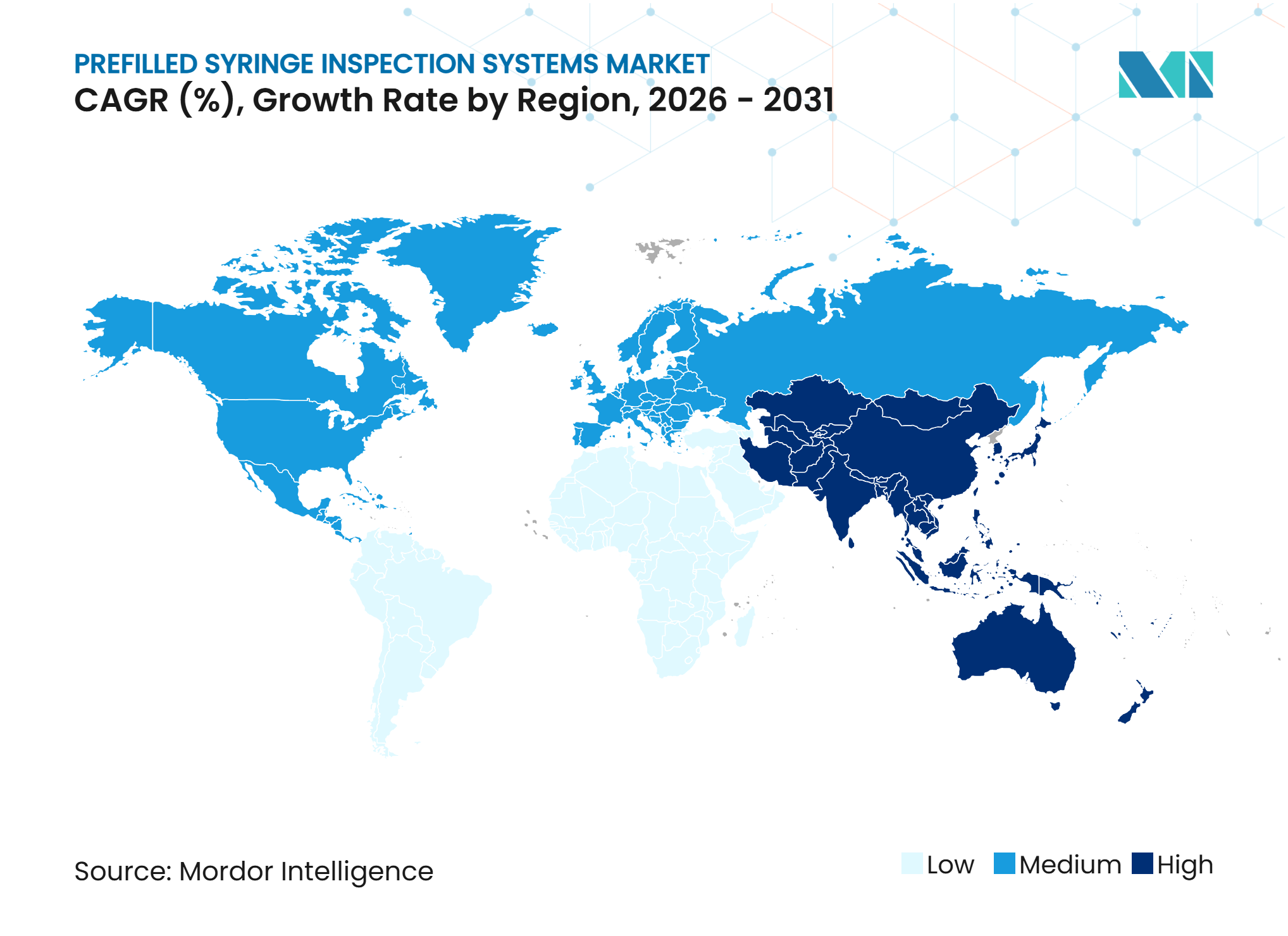
North America maintained a leading revenue position through 2025, supported by the large U.S. base of FDA-regulated commercial fill-finish facilities. Its commercial biologics footprint drives recurring inspection upgrades, including software improvements and added inspection modules for established injectable products. FDA quality requirements make documented investigation of contamination and defect findings important for manufacturers serving the United States. This compliance setting supports investment in validated automation across the prefilled syringe inspection systems market. Curia Global opened its expanded Albuquerque campus in September 2026 with 2 isolated filling lines and automated visual inspection. Canada and Mexico add demand through CDMO activity, nearshoring, and pharmaceutical manufacturing growth.
Europe is technology-dense because several inspection OEMs are based in Germany, Italy, and Austria near important pharmaceutical manufacturing customers. EU GMP Annex 1 has been fully operational since 2023, supporting continued investment in automated systems and validated defect classification. The regional prefilled syringe inspection systems market size is supported more by upgrade cycles than greenfield deployment. Germany, France, and Italy have substantial commercial syringe manufacturing activity and a concentration of specialized engineering expertise. Buyers focus on AI recipe management, leak-detection retrofits, and data-integrity software that supports modern quality documentation. The United Kingdom, Spain, and Nordic biologics sites also provide steady maintenance and upgrade demand.
Asia-Pacific held 30.41% of the Prefilled syringe inspection systems market share in 2025 and is projected to expand at a 9.37% CAGR through 2031. The region is investing in quality infrastructure and production capacity as manufacturers seek to support regulated injectable and biologics supply. Manufacturers in China and India are improving their ability to meet documentation and inspection expectations for regulated production. India’s pharmaceutical clusters are moving from manual inspection toward automated platforms under continuing compliance scrutiny. The Prefilled syringe inspection systems market is also supported by developing capacity in South Korea and Southeast Asia. South America remains at an earlier stage, with Brazil serving as a key demand center for domestic biologics programs. The Middle East and Africa is at an earlier stage, with localization efforts in Saudi Arabia and the United Arab Emirates supporting equipment interest.
Competitive Landscape
Market Concentration
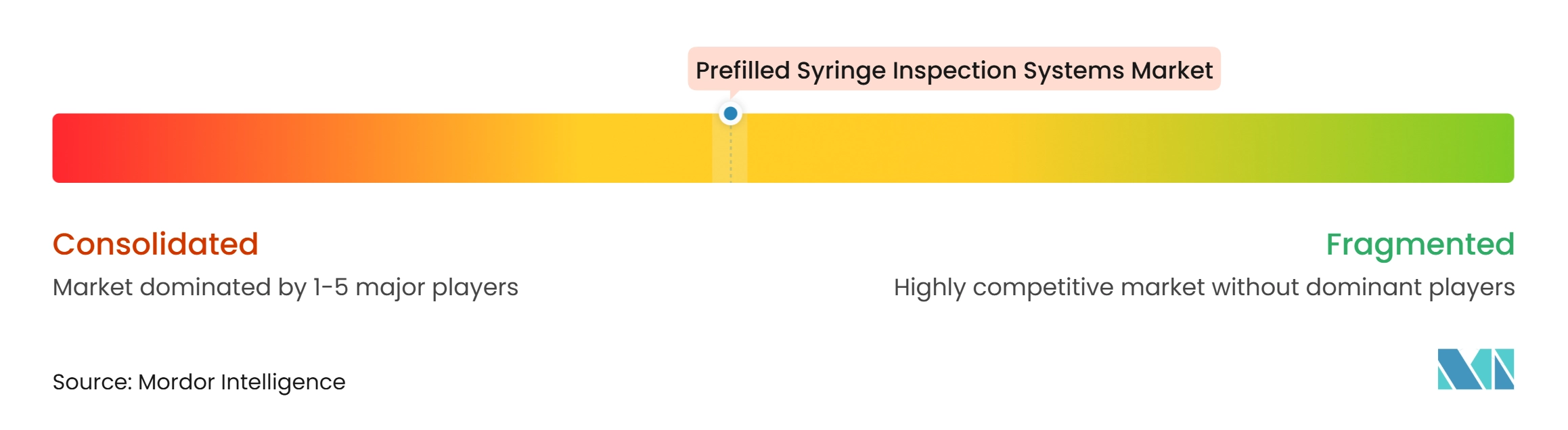
The prefilled syringe inspection systems market is moderately consolidated in high-speed commercial applications, where validated installations create significant supplier credibility. Antares Vision Group, Syntegon Technology, Körber, Brevetti CEA, and Stevanato Group’s engineering division set performance benchmarks in regulated facilities. These suppliers compete on validated inspection performance, software capabilities, defect library depth, and precise handling of ready-to-use nests. Crane NXT completed its acquisition of Antares Vision S.p.A. on April 1, 2026, placing it in the Detection and Traceability Technologies segment. The transaction combines inspection and traceability capabilities within a broader platform. It supports the use of inspection event data alongside serialization and authentication infrastructure.
Suppliers are moving beyond throughput as a single basis for competition in the Prefilled syringe inspection systems market. Tier-1 systems commonly operate in the 400-600 units-per-minute range, reducing the value of speed as the sole differentiator. AI software, defect-library depth, and ready-to-use handling precision therefore carry greater weight in buyer decisions. Incumbents benefit from long histories of customer validation and accumulated process data that newer entrants cannot readily replicate. Körber introduced ALVA at Interpack 2026 for high-mix, low-volume operations with frequent product changes KÖRBER. Brevetti CEA presented the K15 DR for glass and plastic syringes, using no-contact and friction-free handling.
Asian suppliers, including Shanghai Tofflon Science and Technology and Jekson Vision, compete through pricing and local service in mid-tier applications. They target first-time automation buyers facing regulatory pressure and conventional small-molecule syringe production requirements. Their position is less established in complex biologic applications that require high-viscosity inspection, polymer container handling, and advanced recipe management. Minebea Intec, WIPOTEC, and Cognex also participate through checkweighing, weight control, and machine-vision components. Inspection data remains concentrated in proprietary vendor platforms, which can increase customer switching costs and limit interoperability. An open format connecting inspection systems with manufacturing execution systems could become a point of competition.
Prefilled Syringe Inspection Systems Industry Leaders
-
Antares Vision Group
-
Stevanato Group S.p.A.
-
Syntegon Technology GmbH
-
Körber AG
-
Brevetti CEA S.p.A.
- *Disclaimer: Major Players sorted in no particular order
Prefilled Syringe Inspection Systems Market Companies Covered in this Report
- Antares Vision Group
- Stevanato Group S.p.A.
- Syntegon Technology GmbH
- Korber AG
- Brevetti CEA S.p.A.
- ATS Corporation
- Mettler-Toledo International Inc.
- Cognex Corporation
- Optel Group
- Jekson Vision
- ACG
- Omron Corporation
- Thermo Fisher Scientific Inc.
- WIPOTEC GmbH
- Marchesini Group S.p.A.
- CMP Pharma S.r.l.
- Proditec S.L.
- Minebea Intec GmbH
- Keyence Corporation
- DAIICHI JITSUGYO VISWILL CO., LTD.
- Shanghai Tofflon Science and Technology Co., Ltd.
- SaintyCo
Recent Industry Developments in Prefilled Syringe Inspection Systems Market
- September 2026: Curia Global opened its expanded manufacturing campus in Albuquerque, New Mexico, following a USD 200 million investment that added 70,000 square feet and 2 new isolated filling lines, including a flexible syringe, cartridge, and vial line, supported by automated visual inspection and packaging infrastructure. The expansion adds sterile injectable supply capacity for clinical and commercial biologics production, with batch capabilities up to 1,000 liters.
- May 2026: Körber introduced ALVA at Interpack 2026 in Düsseldorf, an adaptive fully automatic inspection machine designed for high-mix low-volume pharmaceutical manufacturing. ALVA enables reliable inspection of syringes, vials, and cartridges across frequent product and format changes without compromising inspection performance or requiring extended requalification cycles.
- May 2026: Brevetti CEA exhibited the K15 DR at Interpack 2026, a tub-and-nest integrated inspection system for glass and plastic syringes processing up to 600 units per minute through no-contact, friction-free handling with worm-screw-free transport, eliminating glass-to-glass contact across the full de-nesting, inspection, and re-nesting workflow.
- April 2026: Antares Vision Group debuted the CY Series automatic visual inspection and leak detection system for liquids in prefilled syringes at Interphex NYC 2026. The system integrates high-voltage container closure integrity testing, fill-level verification, and AI-powered detection of microcracks, pinholes, reflective and non-reflective particles, and component defects across flanges, needle shields, and plungers.
Global Prefilled Syringe Inspection Systems Market Report Scope
The Prefilled Syringe Inspection Systems Market comprises automated and semi-automated machines that conduct comprehensive visual and physical inspections of prefilled syringes used for injectable drugs, biologics, and vaccines. These systems detect particulates, fill-level inaccuracies, air bubbles, container and closure defects, plunger misalignment, needle and cap integrity issues, and labeling or printing errors to ensure dose accuracy, sterility, and regulatory compliance.
The Prefilled Syringe Inspection Systems Market Report is Segmented by Automation Level (Fully Automated, Semi-Automated, and Manual/Benchtop), Inspection Technology (Automated Visual Inspection and Machine Vision, High-Voltage Leak Detection, Headspace Gas Analysis, X-Ray Inspection, Laser and 3D Inspection, and Other Inspection Technologies), Inspection Type (Container and Syringe Body, Fill-Level and Product, Particle and Foreign Matter, Closure and Component, Container Closure Integrity, Label and Identification, and Other Inspection Type), End-User (Pharmaceutical Companies, Biopharmaceutical Companies, Contract Development and Manufacturing Organizations, Contract Research Organizations, and Other End-Users), and Geography (North America, South America, Europe, Asia-Pacific, and Middle East and Africa). The Market Forecasts are Provided in Terms of Value (USD).
Segmentation Overview
| Fully Automated |
| Semi-Automated |
| Manual / Benchtop |
| Automated Visual Inspection and Machine Vision |
| High-Voltage Leak Detection |
| Headspace Gas Analysis |
| X-Ray Inspection |
| Laser and 3D Inspection |
| Other Inspection Technologies |
| Container and Syringe Body |
| Fill-Level and Product |
| Particle and Foreign Matter |
| Closure and Component |
| Container Closure Integrity |
| Label and Identification |
| Other Inspection Types |
| Pharmaceutical Companies |
| Biopharmaceutical Companies |
| Contract Development and Manufacturing Organizations |
| Contract Research Organizations |
| Other End-Users |
| North America | United States | |
| Canada | ||
| Mexico | ||
| South America | Brazil | |
| Argentina | ||
| Rest of South America | ||
| Europe | Germany | |
| United Kingdom | ||
| France | ||
| Italy | ||
| Spain | ||
| Rest of Europe | ||
| Asia-Pacific | China | |
| Japan | ||
| India | ||
| South Korea | ||
| ASEAN | ||
| Rest of Asia-Pacific | ||
| Middle East and Africa | Middle East | Saudi Arabia |
| Turkey | ||
| United Arab Emirates | ||
| Rest of the Middle East | ||
| Africa | South Africa | |
| Rest of Africa | ||
| By Automation Level | Fully Automated | ||
| Semi-Automated | |||
| Manual / Benchtop | |||
| By Inspection Technology | Automated Visual Inspection and Machine Vision | ||
| High-Voltage Leak Detection | |||
| Headspace Gas Analysis | |||
| X-Ray Inspection | |||
| Laser and 3D Inspection | |||
| Other Inspection Technologies | |||
| By Inspection Type | Container and Syringe Body | ||
| Fill-Level and Product | |||
| Particle and Foreign Matter | |||
| Closure and Component | |||
| Container Closure Integrity | |||
| Label and Identification | |||
| Other Inspection Types | |||
| By End-User | Pharmaceutical Companies | ||
| Biopharmaceutical Companies | |||
| Contract Development and Manufacturing Organizations | |||
| Contract Research Organizations | |||
| Other End-Users | |||
| By Geography | North America | United States | |
| Canada | |||
| Mexico | |||
| South America | Brazil | ||
| Argentina | |||
| Rest of South America | |||
| Europe | Germany | ||
| United Kingdom | |||
| France | |||
| Italy | |||
| Spain | |||
| Rest of Europe | |||
| Asia-Pacific | China | ||
| Japan | |||
| India | |||
| South Korea | |||
| ASEAN | |||
| Rest of Asia-Pacific | |||
| Middle East and Africa | Middle East | Saudi Arabia | |
| Turkey | |||
| United Arab Emirates | |||
| Rest of the Middle East | |||
| Africa | South Africa | ||
| Rest of Africa | |||
Key Questions Answered in the Report
What is the size of the prefilled syringe inspection systems market?
The prefilled syringe inspection systems market was USD 0.69 billion in 2026 and is projected to reach USD 1.04 billion by 2031, registering an 8.57% CAGR.
What is driving demand for prefilled syringe inspection equipment?
Biologics, self-administered injectables, documented individual inspection requirements, AI-enabled classification, and ready-to-use nesting support demand in the Prefilled syringe inspection systems market.
Which automation level leads prefilled syringe inspection?
Fully automated systems held 72.45% share in 2025 and are projected to expand at a 9.24% CAGR through 2031, reflecting their central role in commercial-scale quality control.
Which inspection technology is expanding fastest?
Headspace gas analysis is projected to expand at a 9.22% CAGR through 2031, supported by container closure integrity applications for sensitive and gas-dependent sterile products.
Which end users are adding inspection capacity?
Pharmaceutical companies led with 44.71% share in 2025, while biopharmaceutical companies are projected to expand at an 8.93% CAGR through 2031 as new biologic products enter commercial production at global manufacturing sites.
Which region is expanding fastest for syringe inspection systems?
Asia-Pacific held 30.41% share in 2025 and is projected to expand at a 9.37% CAGR through 2031, supported by investments in the Prefilled syringe inspection systems market.