
Precision Grinding Wheels Market Size and Share
Market Overview
| Study Period | 2021 - 2031 |
|---|---|
| Market Size (2026) | USD 5.67 Billion |
| Market Size (2031) | USD 7.51 Billion |
| Growth Rate (2026 - 2031) | 5.78 % |
| Fastest Growing Market | Asia-Pacific |
| Largest Market | Asia-Pacific |
| Market Concentration | Low |
Major Players *Disclaimer: Major Players sorted in no particular order Image © Mordor Intelligence. Reuse requires attribution under CC BY 4.0. | |
Precision Grinding Wheels Market Analysis by Mordor Intelligence
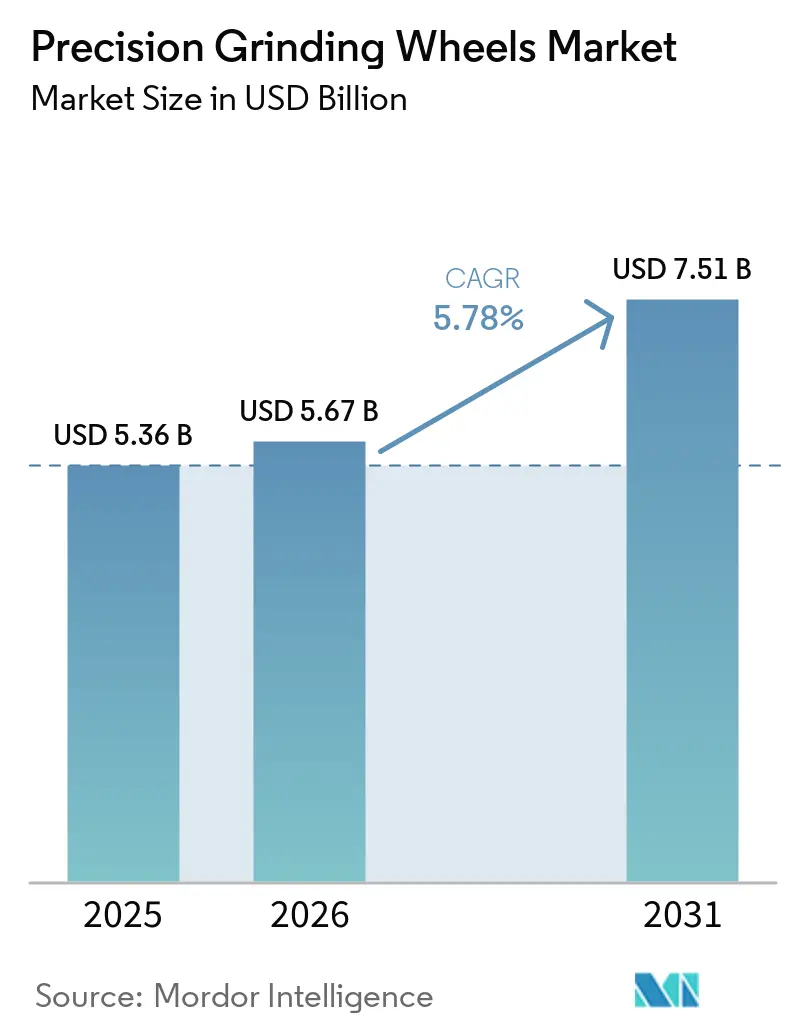
The Precision Grinding Wheels Market size was valued at USD 5.36 billion in 2025 and is estimated to grow from USD 5.67 billion in 2026 to reach USD 7.51 billion by 2031, at a CAGR of 5.78% during the forecast period (2026-2031). Demand is moving toward wheels that can maintain tight tolerances and consistent surface quality in automotive, aerospace, electronics, and industrial applications. This favors suppliers that can combine abrasive materials, wheel design, and process support for a specific production requirement. The precision grinding wheels market is also being shaped by automation, which increases machine duty cycles and places greater importance on reliable wheel performance. Synthetic diamond export controls introduced by China in November 2025 added supply uncertainty for superabrasive producers and strengthened the case for alternative sourcing. The resulting emphasis on Cubic Boron Nitride (CBN), diamond, process engineering, and qualified supply is changing how suppliers compete in the precision grinding wheels market.
Key Report Takeaways
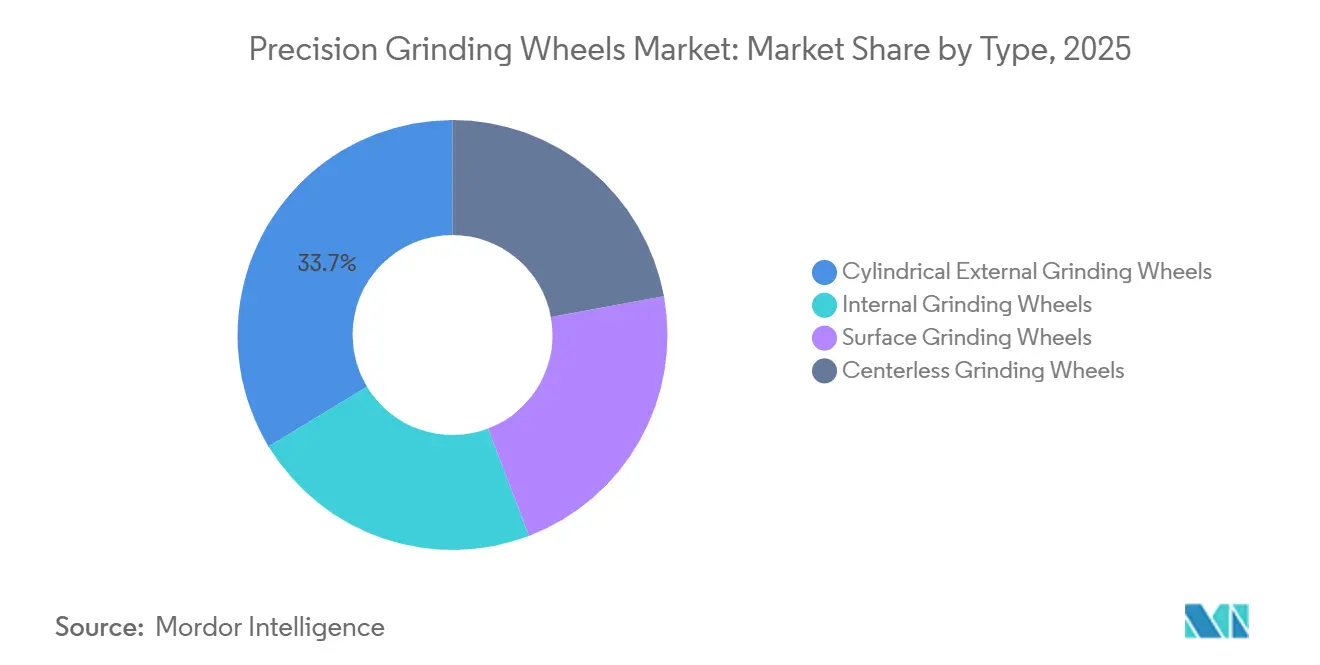
- By type, cylindrical external grinding wheels held 33.67% of the precision grinding wheels market share in 2025, while internal grinding wheels are projected to advance at a 6.45% CAGR through 2031.
- By material, aluminum oxide held 42.34% of the precision grinding wheels market share in 2025, while cubic boron nitride is projected to advance at a 6.77% CAGR through 2031.
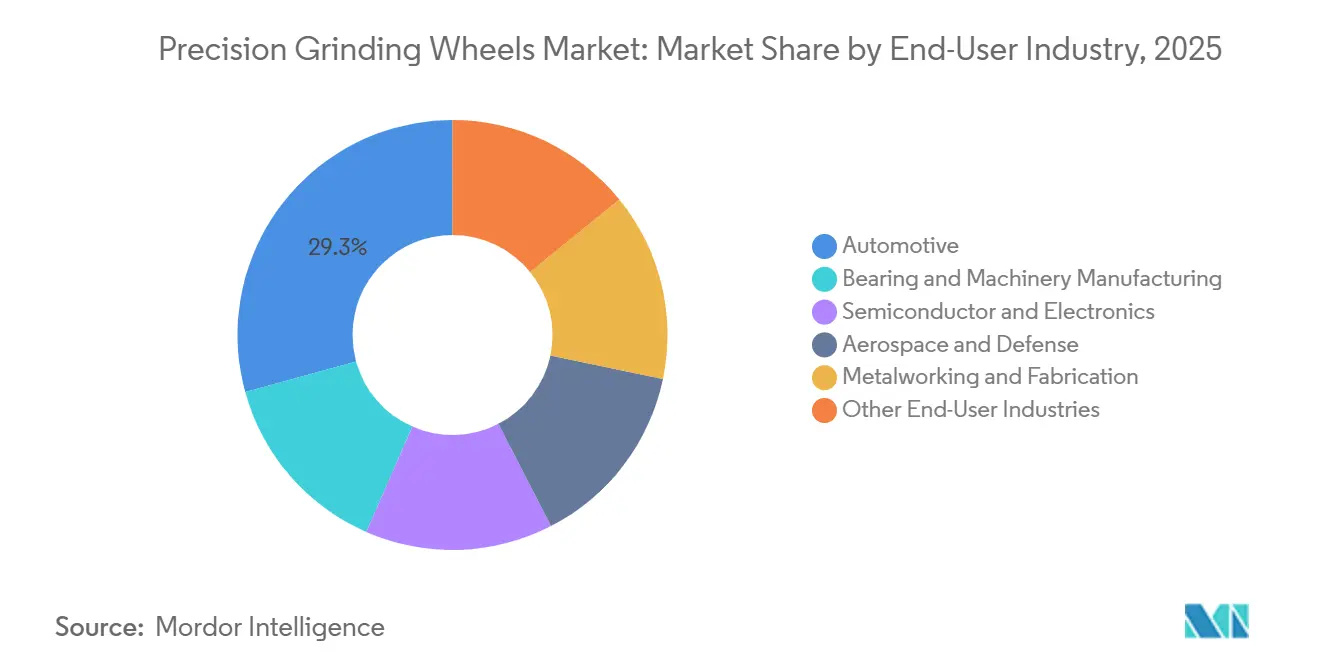
- By end-user industry, automotive held 29.28% of the precision grinding wheels market share in 2025, while aerospace and defense is projected to advance at a 7.04% CAGR through 2031.
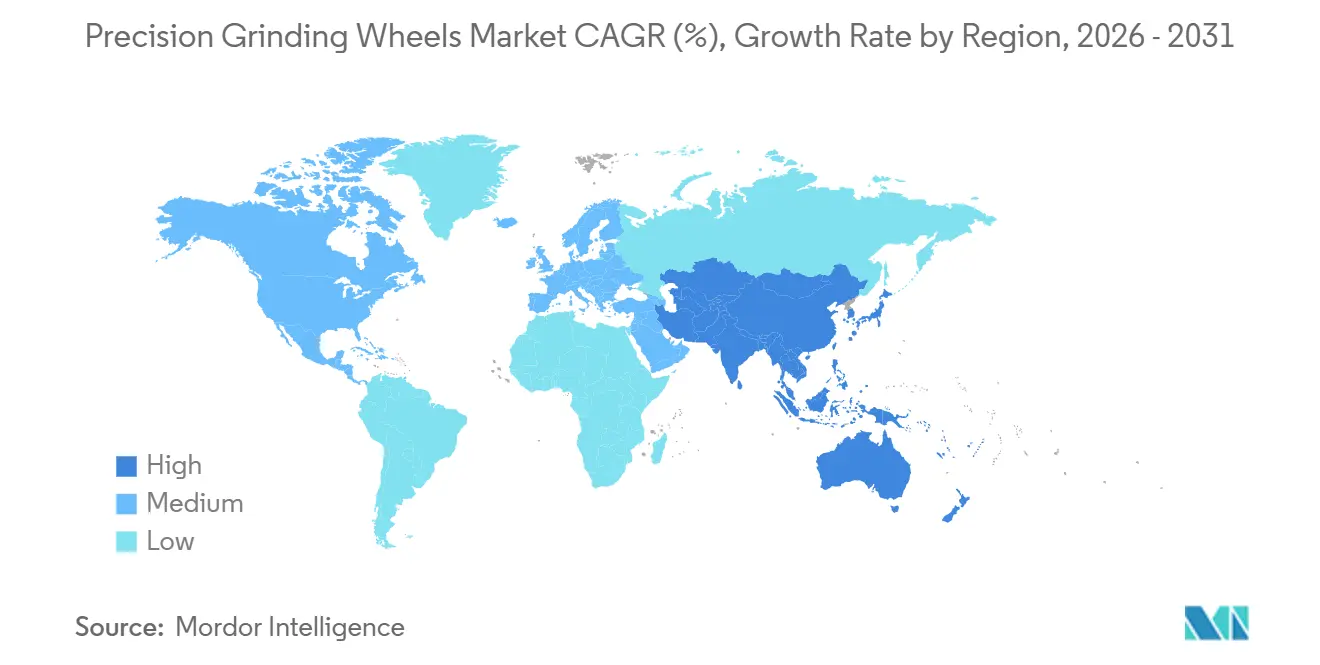
- By geography, Asia-Pacific held 38.93% of the precision grinding wheels market share in 2025 and is projected to advance at a 6.93% CAGR through 2031.
Note: Market size and forecast figures in this report are generated using Mordor Intelligence’s proprietary estimation framework, updated with the latest available data and insights as of January 2026.
Market Trends and Insights
Drivers Impact Analysis of Precision Grinding Wheels Market*
| Driver | (~) % Impact on CAGR Forecast | Geographic Relevance | Impact Timeline |
|---|---|---|---|
| Rising Demand for Tight-Tolerance Components | +1.3% | Global, concentrated in North America, Europe, and APAC | Long term (≥ 4 years) |
| Adoption of CBN and Diamond Superabrasives | +1.2% | Global, with fastest adoption in Japan, South Korea, and Germany | Medium term (2-4 years) |
| Automation and CNC Grinding Adoption | +1.0% | North America & EU, spillover to APAC | Medium term (2-4 years) |
| Expansion of Aerospace, Medical and Semiconductor Manufacturing | +0.9% | North America, EU, and APAC core | Long term (≥ 4 years) |
| Co-Optimization of Wheels, Machines and Process Parameters | +0.7% | Global, with early gains in Germany, Japan, and the United States | Medium term (2-4 years) |
| Source: Mordor Intelligence | |||
Rising Demand for Tight-Tolerance Components
Precision manufacturers need tighter dimensional control in aerospace, semiconductor, optical, and composite-material applications. A 2026 review identified efficiency, surface integrity, and form accuracy as central challenges in ultra-precision grinding of hard-brittle materials. The review identified semiconductor wafers, large-aperture optics, and aerospace composites as major application areas for these processes. It also identified machine-learning-enabled wheel monitoring and electrolytic in-process dressing as useful technologies for improving process control. Damage-free wafer grinding requires fine diamond grains, controlled porosity, and in-process measurement, which raises the technical threshold for wheel suppliers. These needs support demand in the precision grinding wheels market for application-specific wheels rather than general-purpose products.
Adoption of CBN and Diamond Superabrasives
The precision grinding wheels market is shifting toward CBN and diamond products in applications where tolerance, cycle time, and wheel life are critical. JTEKT Corporation documented that its nanoVi vitrified-bond diamond wheel for silicon carbide power-semiconductor wafer thinning delivered a service life 2.3 times that of conventional wheels. The result came from optimization of abrasive grains, bonding agents, and pore ratios. China implemented export licensing controls on synthetic diamond micropowder, single crystals, wire saws, and precision grinding wheels effective November 8, 2025. These controls added a supply-chain consideration to wheel selection for manufacturers dependent on Chinese diamond inputs. The precision grinding wheels market, therefore, faces stronger incentives to qualify alternative materials and sources while retaining process performance.
Automation and CNC Grinding Adoption
Computer Numerical Control (CNC) grinding is increasingly combined with robotics, in-process gauging, and adaptive control. This arrangement turns a manually supervised operation into a controlled production cell with more consistent output. Automated cells can run for longer periods, which increases wheel usage and makes predictable wear behavior more important. The precision grinding wheels market benefits when suppliers provide process guidance alongside the wheel because the user must align wheel behavior with machine settings. German grinding companies have adopted systems that record empirical operating knowledge as experienced workers leave the workforce. This approach reflects the skilled-worker shortage described by the German Machine Tool Builders' Association (VDW)[1].
Expansion of Aerospace, Medical and Semiconductor Manufacturing
Aerospace and defense are projected to advance at a 7.04% CAGR through 2031, which supports demand for wheels used on turbine blades, landing gear, and transmission components. These applications require controlled tolerances and repeatable surface integrity. The AS9100 quality management system requires process records and component traceability, which can make documented wheel wear and dressing behavior important during supplier qualification. China’s GB/T 44687-2024 standard took effect in April 2025 and established technical requirements for diamond wheels used in semiconductor wafer edge chamfering and end-face thinning. The standard covers requirements for wheels across metal, resin, ceramic, and composite bond types. Such qualifications create demand in the precision grinding wheels market for suppliers that can demonstrate repeatable wheel performance.
Restraints Impact Analysis of Precision Grinding Wheels Market*
| Restraint | (~) % Impact on CAGR Forecast | Geographic Relevance | Impact Timeline |
|---|---|---|---|
| High Cost of Superabrasive Wheels and Specialized Dressing | -1.5% | Global, most acute in price-sensitive markets of South America and MEA | Short term (≤ 2 years) |
| Skilled Operator and Process-Engineering Shortages | -1.0% | North America, Europe, and emerging APAC (India, Southeast Asia) | Medium term (2-4 years) |
| Wheel-to-Wheel Variability in Semiconductor Consumable Qualification | -0.7% | APAC core (Japan, South Korea, Taiwan), spillover to North America | Long term (≥ 4 years) |
| Source: Mordor Intelligence | |||
High Cost of Superabrasive Wheels and Specialized Dressing
CBN and diamond wheels cost more than conventional aluminum oxide wheels, which can limit their adoption by smaller manufacturers. The initial investment also includes dressing equipment that can retain wheel profiles at micron-level accuracy. China’s 2025 export licensing controls on synthetic diamond inputs have added uncertainty around delivery schedules and material costs. This is especially difficult in price-sensitive applications where customers focus on the purchase price instead of lifecycle performance. The precision grinding wheels market must therefore address the gap between a wheel’s initial cost and its expected production benefit. Suppliers are more likely to win adoption when they can show a stable process and an acceptable qualification path.
Skilled Operator and Process-Engineering Shortages
Precision grinding requires an operator to understand workpiece metallurgy, wheel bond behavior, coolant conditions, and machine motion. A change in one of these factors can affect burn, chatter, surface damage, and wheel life. The German Machine Tool Builders' Association reported that grinding companies used automation programs and knowledge-documentation systems to reduce reliance on experienced operators. The shortage shifts attention toward suppliers that can provide application engineering and help customers establish stable operating conditions. It can also slow automation projects in facilities that lack the staff to commission and maintain advanced cells. The precision grinding wheels market is, therefore, more favorable to vendors that can combine wheel supply with technical support.
*Our forecasts treat driver/restraint impacts as directional, not additive. The impact forecasts reflect baseline growth, mix effects, and variable interactions.
Precision Grinding Wheels Market Segment Analysis
By Type:
Internal Grinding Wheels Sets the Pace Beneath Cylindrical External Grinding Wheels DominanceCylindrical external grinding wheels held 33.67% of the precision grinding wheels market share in 2025. The segment serves crankshaft, camshaft, bearing-race, shaft, and hydraulic-component production. Its position reflects the broad use of cylindrical parts across automotive and industrial machinery manufacturing. External grinding remains important where producers need repeatable dimensions at high production volumes. It also provides a stable base for established bonded abrasive products. The precision grinding wheels market size for this type benefits from continued demand for precision-engineered rotating components.
Internal grinding wheels are projected to advance at a 6.45% CAGR through 2031. Electric vehicle designs need hollow precision shafts, bore-intensive motor housings, and compact bearing assemblies that require internal grinding geometries. This supports a shift in tooling investment toward applications that cannot be served by external wheels. Surface grinding wheels and centerless grinding wheels continue to serve broad metalworking and bearing applications. Their demand is more closely tied to industrial utilization and high-volume component production. Certification and traceability requirements remain relevant across all wheel types because automotive and aerospace customers require controlled production processes.

By Material:
Cubic Boron Nitride Leads the Superabrasive Shift, Aluminum Oxide Anchors RevenueAluminum oxide held 42.34% of the precision grinding wheels market share in 2025. Its position is supported by its cost-performance balance in general metalworking, ferrous surface grinding, and bearing manufacturing. The material remains relevant for many mid-precision applications where the benefit of a superabrasive is not required. It is also widely used where suppliers need a familiar and economical wheel specification. This base helps maintain aluminum oxide’s role within the precision grinding wheels market. Its use remains distinct from the high-performance requirements that favor cubic boron nitride or diamond.
Cubic boron nitride is projected to advance at a 6.77% CAGR through 2031. It is used in demanding hardened-steel applications involving camshafts, gearboxes, and bearing races. Cubic boron nitride provides a suitable option where thermal stability and longer dressing intervals are important. Silicon carbide continues to serve non-ferrous materials, ceramics, and carbides, including workpieces used in electronics and semiconductor manufacturing. Diamond wheels are used for wafer thinning and optical lens grinding, and China’s semiconductor wheel standard covers their use in wafer edge chamfering and end-face thinning. Other materials, including hybrid-bond and 3D-structured composite abrasives, remain an area of development for advanced suppliers.
By End-User Industry:
Aerospace and Defense Outpaces Automotive DemandAutomotive held 29.28% of revenue in 2025. The segment uses grinding wheels for engine components, transmission gears, wheel bearings, and other precision parts. Electric vehicles reduce demand for some conventional camshaft and valve-train applications. However, they create requirements for motor shafts, rotor cores, and power-electronics housings. The change supports a shift toward higher-performance wheel materials rather than a simple loss of grinding activity.
Aerospace and defense is projected to advance at a 7.04% CAGR through 2031. The segment requires wheels for turbine blades, landing gear, and helicopter transmission components. These uses depend on close tolerances and controlled surface quality under AS9100 quality management requirements. The semiconductor and electronics industry also needs precise wafer thinning and edge finishing as wafer specifications become more demanding. Metalworking and fabrication, bearing and machinery manufacturing, and other end-user industries continue to provide broad demand linked to industrial output and maintenance activity. Medical device manufacturing can support higher wheel value where suppliers must demonstrate validated process capability and surface-finish control.
Geography Analysis
APAC Precision Grinding Wheels Market
Asia-Pacific held 38.93% of revenue in 2025 and is projected to advance at a 6.93% CAGR through 2031. The region combines automotive production, semiconductor fabrication, and precision equipment manufacturing. China supplies major automotive and semiconductor manufacturing demand. Japan contributes demand from precision bearings, semiconductor equipment, and machinery. India is becoming both a consumption location and a production base for grinding wheel suppliers. The precision grinding wheels market size in the region also reflects electronics demand in South Korea and the Association of Southeast Asian Nations (ASEAN) countries, including Vietnam.
India Precision Grinding Wheels Market
Tyrolit AG broke ground on a Pune facility to provide local retipping and finishing for CBN and diamond wheels. The site also functions as a technical and training center for India’s precision manufacturing base. CUMI commenced commercial production at its Hosur facility in March 2026, doubling annual cutting and grinding wheel capacity from 45 million to more than 90 million wheels. The facility uses supervisory control and data acquisition (SCADA)-based process controls, automated press lines, and unmanned oven handling. These developments strengthen local capacity and technical service in the Asia-Pacific.
The Americas and EMEA Precision Grinding Wheels Market
North America and Europe remain technically demanding regions where aerospace, automotive engineering, and precision manufacturing support premium wheel demand. Saint-Gobain completed a 47,000 square foot administration building at its Worcester, Massachusetts, abrasives campus in January 2026[2]. European demand is also supported by brake-disc requirements associated with Euro 7. South America and Middle East and Africa remain smaller contributors with demand from automotive production, metalworking, steel processing, mining equipment maintenance, petrochemical fabrication, and construction. Limited training infrastructure and competition from lower-cost imports can slow the adoption of superabrasive products in these areas.
Competitive Landscape
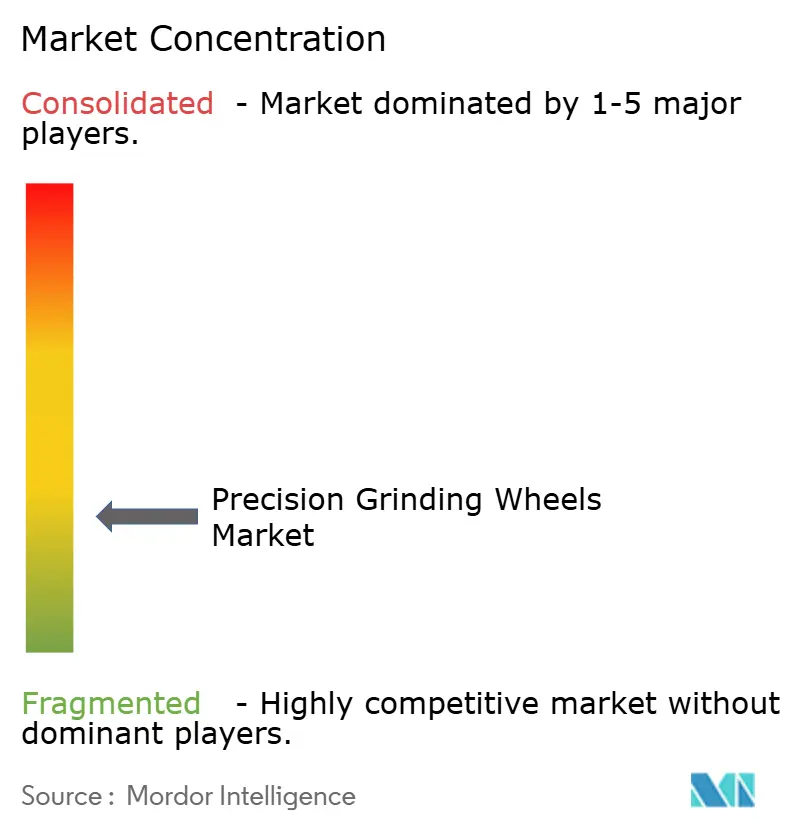
The precision grinding wheels market is highly fragmented, with the top five players including Saint-Gobain, 3M, Tyrolit AG, NORITAKE CO., LIMITED, and CUMI. Saint-Gobain, Tyrolit AG, and Winterthur Technology Group compete across a broad range of products and geographic markets. KREBS & RIEDEL Schleifscheibenfabrik GmbH & Co. KG, NORITAKE CO., LIMITED, and Asahi Diamond Industrial Co., Ltd. compete in specialized superabrasive applications. Competition is increasingly based on material expertise, application engineering, wheel consistency, and customer qualification support. This makes it harder for suppliers that only compete on purchase price. The precision grinding wheels market is also affected by the need to secure diamond inputs and qualify alternative supply arrangements.
Winterthur Technology Group became independent after Nimbus acquired 3M’s Precision Grinding & Finishing Division in April 2026. The company used GrindingHub 2026 to show 3D-based grinding tool manufacturing and new superabrasive specifications. Saint-Gobain Surface Solutions and AV&R signed a June 2025 partnership to develop robotic abrasive surface-finishing systems for aerospace manufacturers. The partnership incorporated Norton abrasive products into AV&R robotic systems used in more than 7 European countries. An AV&R robotic cell was installed at Saint-Gobain’s European Grinding Technology Centre in Norderstedt, Germany. These moves show how the precision grinding wheels market is moving toward integrated solutions that connect wheels, automation, and customer process development.
Saint-Gobain Abrasives (Shanghai) Co., Ltd. acquired a 25% equity stake in Kingshark New Material Technology (Chongqing) Co., Ltd. in 2024. The investment expanded its reach in non-woven, bonded, and superabrasive products in the Asia-Pacific. KREBS & RIEDEL Schleifscheibenfabrik GmbH & Co. KG offers electroplated CBN and diamond wheels and dressing tools for applications that require specialized dimensions and repeatable performance. Regulatory requirements can provide an additional barrier because suppliers must meet aerospace and semiconductor process expectations. Suppliers that can deliver documented wheel performance can preserve a stronger position in premium applications. The precision grinding wheels market, therefore, remains defined by a balance between large, diversified suppliers and focused technical specialists.
Precision Grinding Wheels Industry Leaders
-
Saint-Gobain
-
3M
-
Tyrolit AG
-
NORITAKE CO., LIMITED
-
CUMI
- *Disclaimer: Major Players sorted in no particular order
Precision Grinding Wheels Market Companies Covered in this Report
- 3M
- Asahi Diamond Industrial Co., Ltd.
- August Rüggeberg GmbH & Co. KG
- CUMI
- Hindustan Abrasives
- Klingspor AG
- KREBS & RIEDEL Schleifscheibenfabrik GmbH & Co. KG
- KURE GRINDING WHEE
- LACH DIAMANT
- NORITAKE CO., LIMITED
- Saint-Gobain
- SAK ABRASIVES LIMITED
- Sterling Abrasives Limited
- Tyrolit AG
- Wendt (India) Limited
Recent Industry Developments in Precision Grinding Wheels Market
- March 2026: CUMI (Carborundum Universal Limited) commenced commercial production at its new Hosur facility, increasing annual cutting and grinding wheel capacity from 45 million to more than 90 million wheels. The capacity expansion strengthened CUMI’s ability to meet growing demand for precision cutting and grinding wheels across industrial manufacturing and engineering applications.
- June 2025: Saint-Gobain Surface Solutions and AV&R signed a strategic partnership to develop robotic abrasive surface-finishing systems for aerospace manufacturers, integrating Norton abrasive products into AV&R’s robotic platforms. The collaboration combines advanced abrasives with automated precision finishing, supporting higher consistency and productivity in aerospace grinding applications.
Global Precision Grinding Wheels Market Report Scope
Precision grinding wheels are abrasive tools engineered to achieve tight dimensional tolerances, accurate geometries, and high-quality surface finishes during grinding operations. They are used for controlled material removal in applications where component accuracy, consistency, and surface quality are critical.
The Precision Grinding Wheels Market is segmented by type, material, end-user industry, and geography. By type, the market is segmented into cylindrical external grinding wheels, internal grinding wheels, surface grinding wheels, and centerless grinding wheels. By material, the market is segmented into aluminum oxide, silicon carbide, cubic boron nitride, diamond, and other materials. By end-user industry, the market is segmented into automotive, aerospace and defense, metalworking and fabrication, bearing and machinery manufacturing, semiconductor and electronics, and other end-user industries. The report also covers the market size and forecasts for precision grinding wheels in 15 countries across major regions. For each segment, the market sizing and forecasts have been done on the basis of value (USD).
Segmentation Overview
| Cylindrical External Grinding Wheels |
| Internal Grinding Wheels |
| Surface Grinding Wheels |
| Centerless Grinding Wheels |
| Aluminum Oxide |
| Silicon Carbide |
| Cubic Boron Nitride |
| Diamond |
| Other Materials |
| Automotive |
| Aerospace and Defense |
| Metalworking and Fabrication |
| Bearing and Machinery Manufacturing |
| Semiconductor and Electronics |
| Other End-User Industries |
| Asia-Pacific | China |
| India | |
| Japan | |
| South Korea | |
| ASEAN Countries | |
| Rest of Asia-Pacific | |
| North America | United States |
| Canada | |
| Mexico | |
| Europe | Germany |
| United Kingdom | |
| France | |
| Italy | |
| NORDIC Countries | |
| Rest of Europe | |
| South America | Brazil |
| Argentina | |
| Rest of South America | |
| Middle East and Africa | Saudi Arabia |
| South Africa | |
| Rest of Middle East and Africa |
| By Type | Cylindrical External Grinding Wheels | |
| Internal Grinding Wheels | ||
| Surface Grinding Wheels | ||
| Centerless Grinding Wheels | ||
| By Material | Aluminum Oxide | |
| Silicon Carbide | ||
| Cubic Boron Nitride | ||
| Diamond | ||
| Other Materials | ||
| By End-User Industry | Automotive | |
| Aerospace and Defense | ||
| Metalworking and Fabrication | ||
| Bearing and Machinery Manufacturing | ||
| Semiconductor and Electronics | ||
| Other End-User Industries | ||
| By Geography | Asia-Pacific | China |
| India | ||
| Japan | ||
| South Korea | ||
| ASEAN Countries | ||
| Rest of Asia-Pacific | ||
| North America | United States | |
| Canada | ||
| Mexico | ||
| Europe | Germany | |
| United Kingdom | ||
| France | ||
| Italy | ||
| NORDIC Countries | ||
| Rest of Europe | ||
| South America | Brazil | |
| Argentina | ||
| Rest of South America | ||
| Middle East and Africa | Saudi Arabia | |
| South Africa | ||
| Rest of Middle East and Africa | ||
Key Questions Answered in the Report
What is the size of the precision grinding wheels market?
The precision grinding wheels market stands at USD 5.67 billion in 2026 and is forecast to reach USD 7.51 billion by 2031.
What is driving demand for precision grinding wheels?
Tighter component tolerances, automated CNC cells, aerospace production, semiconductor processing, and demand for CBN and diamond wheels are supporting demand.
Which type is projected to advance fastest through 2031?
Internal grinding wheels are projected to advance at a 6.45% CAGR through 2031, supported by motor housings, hollow shafts, and compact bearing applications.
Which material is projected to advance fastest through 2031?
Cubic boron nitride is projected to advance at a 6.77% CAGR through 2031 as users seek thermal stability and longer dressing intervals.