
Power Conversion System Market Size and Share
Market Overview
| Study Period | 2021 - 2031 |
|---|---|
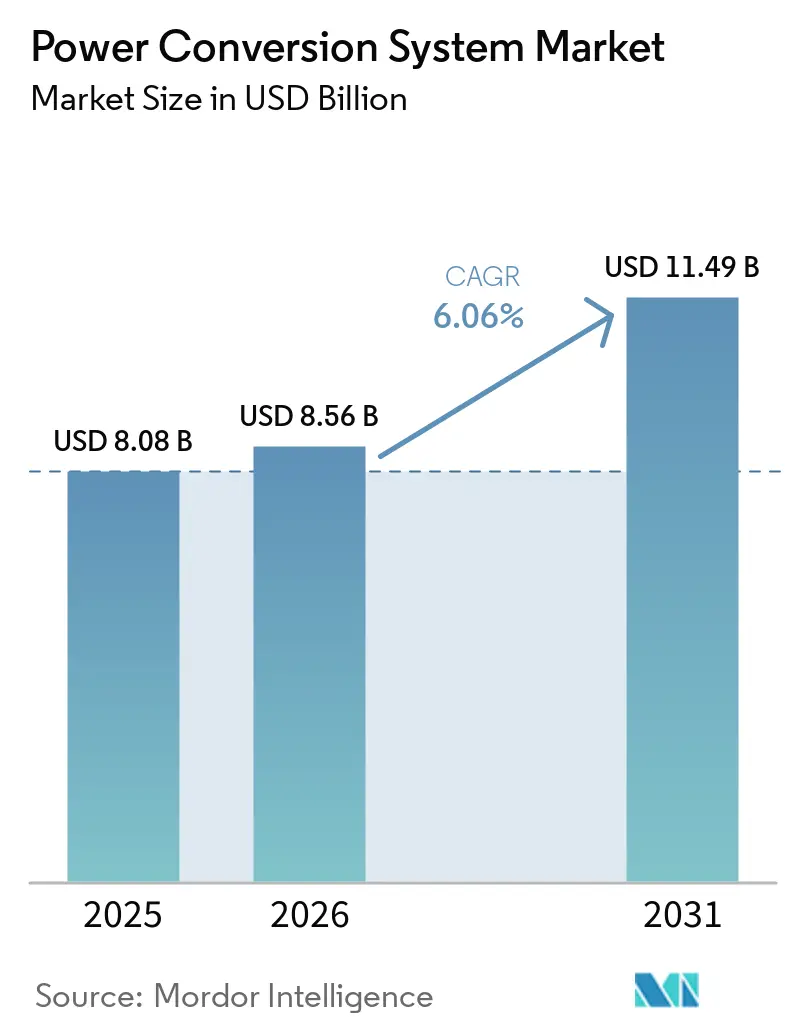
| Market Size (2026) | USD 8.56 Billion |
| Market Size (2031) | USD 11.49 Billion |
| Growth Rate (2026 - 2031) | 6.06 % |
| Fastest Growing Market | Asia-Pacific |
| Largest Market | Asia-Pacific |
| Market Concentration | Medium |
Major Players *Disclaimer: Major Players sorted in no particular order Image © Mordor Intelligence. Reuse requires attribution under CC BY 4.0. | |
Power Conversion System Market Analysis by Mordor Intelligence
The Power Conversion System Market size is projected to be USD 8.08 billion in 2025, USD 8.56 billion in 2026, and reach USD 11.49 billion by 2031, growing at a CAGR of 6.06% from 2026 to 2031. Battery storage deployment, higher power needs in AI data centers, and wider use of silicon carbide and gallium nitride devices support this expansion. The power conversion system market is shifting toward equipment that can manage higher voltages, bidirectional flows, and more demanding grid functions. Solar projects increasingly pair generation with storage, which raises the number and capability of converters used at each site[1]. Data center operators are also moving toward high-voltage DC distribution to limit power losses and reduce the amount of copper needed in large facilities. Suppliers with proven grid-code compliance, cybersecurity controls, and access to transformer-compatible designs are better positioned to win large projects.
Key Report Takeaways
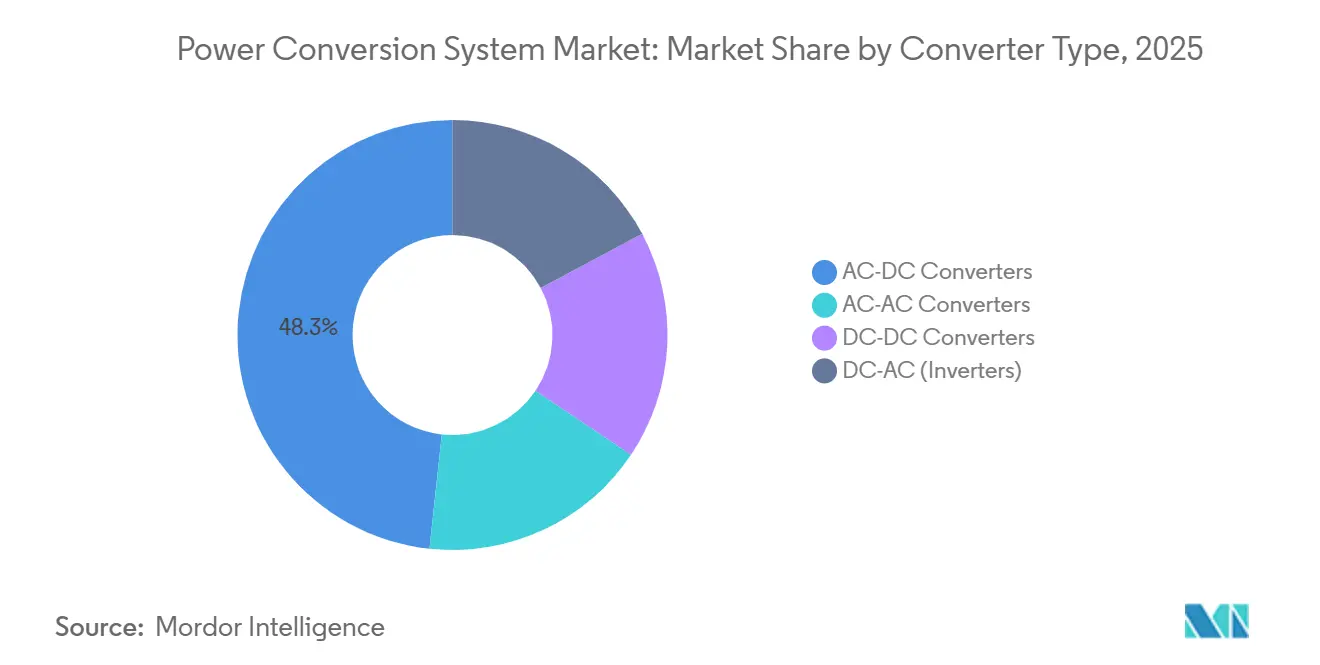
- By converter type, AC-DC converters held 48.3% of the power conversion system market share in 2025, while DC-DC converters are expected to grow at a 6.9% CAGR through 2031.
- By application, BESS accounted for 44.8% of the power conversion system market size in 2025 and is expected to advance at an 8.2% CAGR through 2031.
- By component, power semiconductors held 39.4% revenue share in 2025, while the segment is forecast to expand at a 6.4% CAGR through 2031.
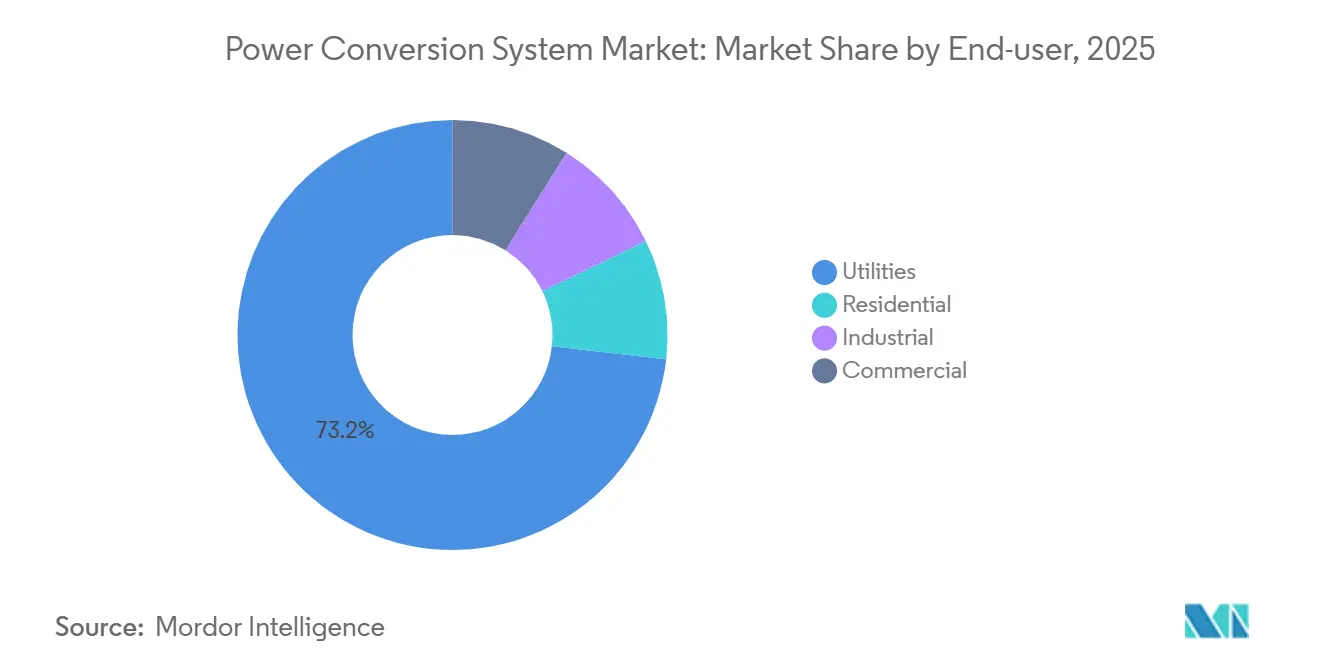
- By end user, utilities held 73.2% revenue share in 2025 and are expected to grow at a 6.3% CAGR through 2031.
- By geography, Asia-Pacific held 58.1% revenue share in 2025 and is expected to grow at a 6.5% CAGR through 2031.
Note: Market size and forecast figures in this report are generated using Mordor Intelligence’s proprietary estimation framework, updated with the latest available data and insights as of January 2026.
Market Trends and Insights
Drivers Impact Analysis of Power Conversion System Market*
| Driver | (~) % Impact on CAGR Forecast | Geographic Relevance | Impact Timeline |
|---|---|---|---|
| Surging utility-scale solar PV build-out | +1.50% | Global, with concentration in China, US, India, Middle East | Medium term (2-4 years) |
| Distributed data-center power-density spike | +1.20% | North America & Asia-Pacific core, spill-over to Europe | Short term (≤ 2 years) |
| Wide-bandgap semiconductor cost inflection | +1.00% | Global | Medium term (2-4 years) |
| Evolution of global micro- and mini-grids | +0.50% | Sub-Saharan Africa, South & Southeast Asia, Latin America | Long term (≥ 4 years) |
| EV fast-charging infrastructure mandates | +0.80% | EU, North America, China, South Korea | Short to medium term (≤ 3 years) |
| Eco-design & circular-economy regulations | +0.30% | EU primarily, with spillover to UK, Australia | Medium term (2-4 years) |
| Source: Mordor Intelligence | |||
Surging Utility-Scale Solar PV Build-out
Utility-scale solar remains a major source of new demand in the power conversion system market. SEIA projected 211 GWdc of utility-scale solar additions in the United States between 2026 and 2031, while 5.9 GWdc was deployed in the first quarter of 2026 despite tariff pressure. Every solar project requires DC-AC conversion, and co-located storage adds AC-DC and DC-DC equipment to the same installation. This raises converter content per unit of grid capacity as solar-plus-storage becomes more common. The expected move toward 2 kV DC solar systems requires new inverter platforms and can also create replacement demand for existing equipment. Grid-interconnection standards, including IEEE 1547-2018 and IEC 61727, favor suppliers that can demonstrate consistent performance across utility projects.
Distributed Data-Center Power-Density Spike
AI-focused data centers are increasing the required performance of power conversion equipment in the power conversion system market. Research published in Energies reported that AI training and inference racks can approach 1 MW, compared with traditional racks near 10 kW[2]. The move to 800 VDC distribution can carry 85% more power through the same conductor size and reduce copper needs by 45% in large facilities. Texas Instruments and NVIDIA introduced an 800 VDC architecture in March 2026 with a gallium-nitride DC-DC bus converter rated at 97.6% peak efficiency and more than 2,000 W/in³ power density[3]. These designs favor suppliers that can produce efficient DC-DC converters at high switching frequencies. Data center electricity demand rose 17% in 2025, providing a firm demand base for power equipment suppliers serving hyperscale and colocation facilities.
Wide-Bandgap Semiconductor Cost Inflection
Wide-bandgap semiconductors are changing product design choices across the power conversion system market. Silicon carbide is widely used in traction inverters and utility-scale storage, while gallium nitride is gaining use in data center power supplies, point-of-load converters, and on-board chargers. These materials support higher switching frequencies, higher power density, and improved efficiency compared with conventional silicon devices. GE Vernova introduced its 1.5 kV FlexInverter for utility-scale energy storage in January 2025 with silicon carbide technology, showing that the material has moved into large storage applications. Lower silicon carbide prices after electric vehicle inventory normalization improved the economics of using the technology in solar inverters. Manufacturers that incorporate silicon carbide and gallium nitride early can improve efficiency without changing the operating role of the converter.
EV Fast-Charging Infrastructure Mandates
EV charging rules are creating more demand for bidirectional conversion equipment in the power conversion system market. The European Union’s Alternative Fuels Infrastructure Regulation requires ISO 15118-2 compliance for newly installed public AC charging points from January 2026. It will require ISO 15118-20 for vehicle-to-grid capable chargers from January 2027. In June 2026, UL amended UL 2594 to require ISO 15118-20 vehicle-to-grid interoperability testing for newly submitted North American DC fast chargers. These requirements increase the technical content of chargers because they require controlled power flow in both directions. They also link EV charging more closely with battery storage, because connected vehicles can act as distributed energy resources when grid conditions permit.
Restraints Impact Analysis of Power Conversion System Market*
| Restraint | (~) % Impact on CAGR Forecast | Geographic Relevance | Impact Timeline |
|---|---|---|---|
| Transformer & cable supply-chain tightness | -1.50% | North America primarily, spill-over to Europe and Asia | Short to medium term (≤ 3 years) |
| Converter firmware cybersecurity risks | -0.40% | Global, with acute sensitivity in EU and North America | Short term (≤ 2 years) |
| Capital-intensive grid-code compliance | -0.70% | Global, especially EU, Australia, and emerging markets adopting new grid codes | Medium term (2-4 years) |
| Skilled-labor shortages in power electronics | -0.50% | North America, Europe, and rapidly growing APAC markets | Long term (≥ 4 years) |
| Source: Mordor Intelligence | |||
Transformer & Cable Supply-Chain Tightness
Transformer and cable shortages can delay project schedules in the power conversion system market because converters must be integrated with the wider electrical system. The International Energy Agency reported that cable procurement lead times had increased to 2 to 3 years since 2021, while large power transformer prices rose 75% in real terms since 2019. These limits affect renewable projects, data centers, EV charging networks, and grid replacement work at the same time. Project developers may therefore align converter orders with transformer availability rather than purchase converters first. More demanding grid codes and limited power-electronics engineering labor add cost and extend project design cycles. Modular equipment that works across a broader set of transformer voltages can help suppliers reduce the impact of these delays.
Converter Firmware Cybersecurity Risks
Cybersecurity is becoming a procurement issue for grid-connected equipment in the power conversion system market. Forescout Research identified 46 vulnerabilities in solar inverter products from Sungrow, Growatt, and SMA Solar Technology in March 2025. The disclosed issues included weaknesses that could enable unauthorized code execution or unsafe firmware updates. The U.S. Cybersecurity and Infrastructure Security Agency also issued a 2025 advisory on inverter vulnerabilities that could allow remote control of affected units. A coordinated attack on many connected converters could disrupt generation and complicate grid balancing during peak demand. Cybersecurity requirements for internet-connected energy equipment are increasing compliance work for vendors and due diligence work for buyers.
*Our forecasts treat driver/restraint impacts as directional, not additive. The impact forecasts reflect baseline growth, mix effects, and variable interactions.
Power Conversion System Market Segment Analysis
By Converter Type:
AC-DC Leads While DC-DC Demand RisesAC-DC converters held 48.3% of revenue in 2025, making them the largest converter category in the power conversion system market. Their position reflects the continuing need to convert grid-supplied alternating current for batteries and direct-current loads. Utility-scale storage and renewable projects use AC-DC equipment when charging batteries from the grid or from renewable generation. DC-AC inverters support solar export and battery discharge to the grid. AC-AC converters serve industrial variable-frequency drives and some offshore wind applications.
DC-DC converters are forecast to grow at a 6.9% CAGR through 2031, the fastest rate in this segmentation. The growth is tied to 800 VDC data center designs and multistage conversion in high-power EV fast chargers. Both applications require high-efficiency conversion at high switching frequencies and compact physical dimensions. Texas Instruments’ 800 V-to-6 V gallium-nitride bus converter reached 97.6% peak efficiency at more than 2,000 W/in³ in March 2026. This performance requirement increases the value of silicon carbide and gallium nitride designs.

By Application:
BESS Sets the Pace for DemandBESS accounted for 44.8% of the power conversion system market size in 2025 and is projected to expand at an 8.2% CAGR through 2031. This gives BESS the largest power conversion system market share and the fastest growth among applications. Storage systems require converters to control charging, discharging, grid support, and protection functions. Grid-forming, black-start, and inertia-emulation roles require more advanced control capability for each installed megawatt. Sungrow’s SC210HX power conversion systems received Germany’s VDE FNN Prototype Certificate in July 2026 for grid-forming performance[4].
Renewable energy systems and EV charging infrastructure are the next major application groups, supported by solar deployment and charging rules. Electric utilities and power plants remain important, although transmission equipment usually has longer replacement cycles. Data centers and telecommunications currently make a smaller contribution, but power needs per AI rack are increasing the amount of conversion equipment required at each facility. In July 2026, Sungrow introduced the EnerNeo 3 MW solid-state transformer for AI data centers, which directly converts 10-13.8 kV AC to 800 V DC. The power conversion system market is therefore gaining demand from systems that combine medium-voltage intake with dedicated DC distribution.
By Component:
Power Semiconductors Shape PerformancePower semiconductors accounted for 39.4% of component revenue in 2025 and are projected to grow at a 6.4% CAGR through 2031. They are the largest component category in the power conversion system market because they determine switching, efficiency, and thermal performance. Silicon carbide and gallium nitride devices increase the value of semiconductor content in higher-performance converters. Their use also reduces energy losses and can support smaller equipment footprints. The result is revenue growth even where the increase in converter unit volumes is more modest.
Controllers and integrated circuits are the next important component group because advanced converters require digital control. These devices support grid-forming functions, bidirectional vehicle-to-grid operation, and thermal management. Capacitors, inductors, transformers, and other passive parts remain exposed to supply constraints. EN 50743:2025 introduced material-efficiency assessment requirements for power-electronics components in Europe. These requirements add circular-economy considerations to component selection.
By End User:
Utilities Hold the Largest PositionUtilities held 73.2% of revenue in 2025 and are projected to grow at a 6.3% CAGR through 2031. Utilities, therefore, retained the largest end-user position in the power conversion system market. Grid-scale renewable generation and storage projects continue to require large converter systems. SEIA projected U.S. utility-scale BESS deployments of 70 GWh in 2026, associated with USD 25.2 billion in capital investment. Such projects require power conversion hardware between batteries, generation assets, and the grid.
Industrial users rely on converters for variable-speed drives in manufacturing and heavy industry. Commercial demand comes from behind-the-meter storage, solar-plus-storage systems, and EV fleet charging depots. These uses often require one converter platform to manage several power flows. Residential revenue is smaller, but it provides an early setting for compact bidirectional equipment. Sungrow launched its PowerHarbor all-in-one battery inverter in June 2026, with 10 kW to 30 kW ratings and storage expansion to 120 kWh.
Geography Analysis
APAC Power Conversion System Market
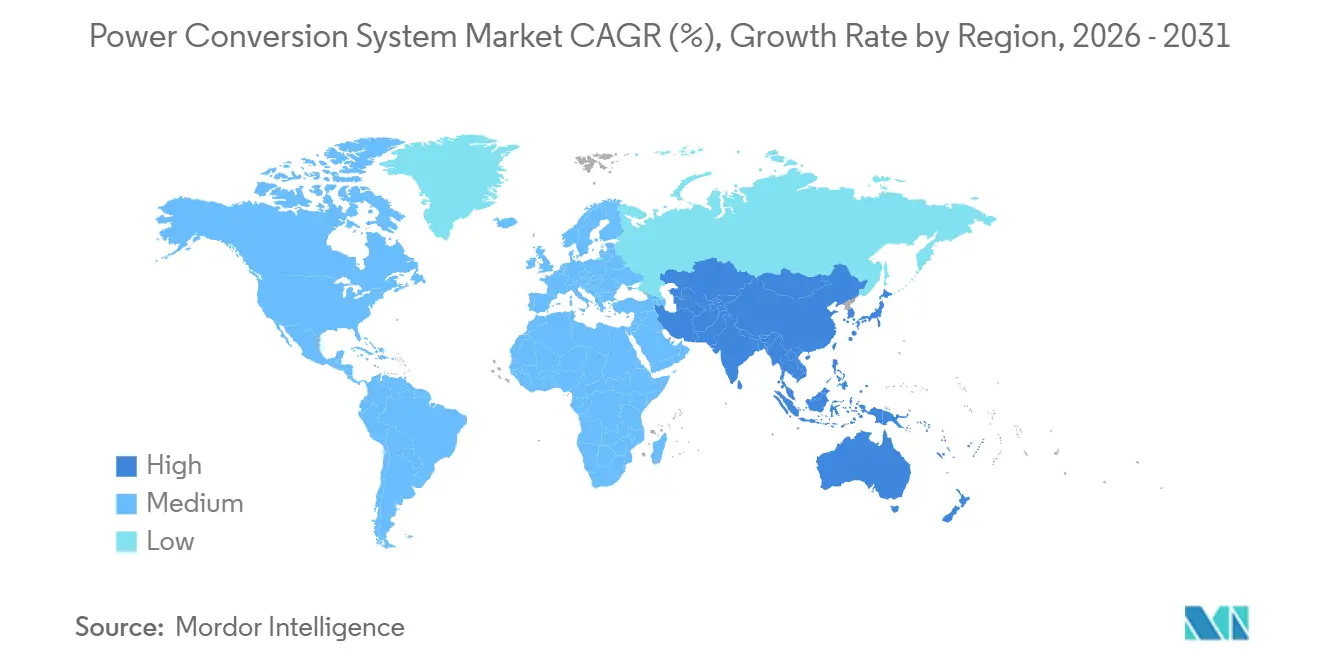
Asia-Pacific held 58.1% of revenue in 2025 and is projected to grow at a 6.5% CAGR through 2031. This gives the region the leading regional revenue position and the fastest regional growth rate. China combines large-scale converter manufacturing with major battery storage deployment and grid modernization. India is building demand through renewable energy additions and microgrid electrification programs. South Korea, Japan, Vietnam, and Indonesia add demand through manufacturing, grid expansion, and distributed power needs.
North America and Europe Power Conversion System Market
North America and Europe make up the next major block of revenue in the power conversion system market. In North America, the Federal Communications Commission added foreign-made power inverters to its Covered List in July 2026, encouraging domestic manufacturing plans. Announced investments could lift U.S. annual PV inverter and PCS manufacturing capacity above 100 GWac by the end of 2027 if completed. Europe has a substantial converter manufacturing base and demanding rules for charging, product sustainability, and external power supplies. These requirements favor equipment that meets regulatory and grid-code specifications from the start of the design process.
MEA and South America Power Conversion System Market
South America and the Middle East and Africa are expanding through utility-scale renewable projects, storage systems, and grid modernization. Saudi Arabia is also creating large orders, including Sineng’s February 2026 contract to supply 3 GW of PV inverters for the PIF 6 project. In Sub-Saharan Africa, modular solar-plus-storage microgrids can support remote electrification where extending the central grid is difficult.
Competitive Landscape
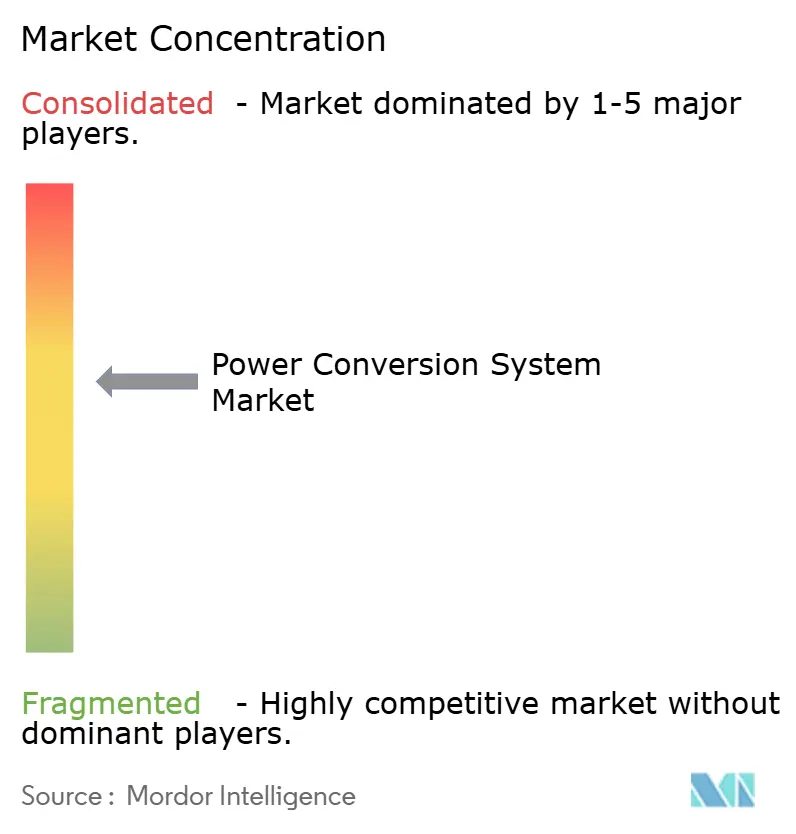
The power conversion system market is moderately consolidated. ABB, Siemens Energy, GE Vernova, Hitachi Energy, Sungrow, Delta Electronics, Schneider Electric, and Huawei compete for major projects through product capability, certification coverage, and financial standing. Sungrow received the VDE FNN Prototype Certificate for its SC210HX systems in July 2026, supporting access to German grid-forming storage projects. Comparable approval requirements include UL listings in North America and IEC 62477 compliance in global projects. These standards make certification a practical condition for market access.
Acquisitions have helped established companies broaden their portfolios in the power conversion system market. ABB acquired Gamesa Electric’s power electronics division in 2025 and launched its Proteus portfolio in June 2026, including 4.7 MVA central inverters rated at 99.45% conversion efficiency. Hitachi Energy acquired Spain-based Eks Energy in early 2025 to add PCS and inverter capability for battery storage and renewable integration. These moves bring grid-forming design, silicon carbide technology, and digital control capabilities into larger suppliers. They give utilities and developers access to broader equipment portfolios from fewer vendors.
New data center architectures are creating competition between traditional converter suppliers and semiconductor companies. Texas Instruments, Navitas, and Wolfspeed can provide reference designs that reduce system-design work for data center developers. Sungrow’s EnerNeo platform and SolarEdge’s DC uninterruptible power supply designs show how specialists are seeking positions in data center power conversion. Sungrow and TÜV Rheinland published quantitative reliability standards for PV inverters in July 2026, which can strengthen performance-based differentiation.
Power Conversion System Industry Leaders
-
Huawei Technologies Co., Ltd.
-
Sungrow Power Supply Co., Ltd.
-
ABB Ltd.
-
Schneider Electric SE
-
Hitachi Energy Ltd.
- *Disclaimer: Major Players sorted in no particular order
Power Conversion System Market Companies Covered in this Report
- ABB Ltd.
- AcBel Polytech Inc.
- Delta Electronics, Inc.
- Eaton Corporation plc
- GE Vernova, Inc.
- Hitachi Energy Ltd.
- Huawei Technologies Co., Ltd.
- LS Energy Solutions LLC
- Power Electronics S.A.
- Schneider Electric SE
- Siemens Energy AG
- SMA Solar Technology AG
- Sungrow Power Supply Co., Ltd.
- XP Power Ltd.
Recent Industry Developments in Power Conversion System Market
- July 2026: Sungrow launched EnerNeo, a self-developed 3 MW solid-state transformer for AI data center applications, directly converting 10-13.8 kV AC to 800 V DC at 98.5% conversion efficiency and 312 kW/m² power density. The company simultaneously signed framework procurement agreements with HEC Technology and ZDATA.
- July 2026: Sungrow’s SC210HX series Power Conversion Systems received Germany’s VDE FNN Prototype Certificate from TÜV Rheinland, becoming the first energy storage PCS to pass the specified German grid-connection and grid-forming performance requirements.
- July 2026: Sungrow and TÜV Rheinland jointly published quantitative long-term reliability standards for PV inverters, 2 PfG 3325 and 2 PfG 3328 Part 2, at Intersolar Europe 2026 in Munich.
- June 2026: ABB launched its Proteus power conversion portfolio at Intersolar Europe 2026, including 4.7 MVA central inverters at 99.45% conversion efficiency and bidirectional PCS for utility-scale BESS.
Global Power Conversion System Market Report Scope
Power conversion systems are power-electronic systems that convert electrical energy between AC and DC, or between different voltage and frequency levels. They control the flow, quality, and direction of electrical power for applications such as energy storage, renewable energy, electric vehicles, industrial systems, and grid infrastructure.
The Power Conversion System (PCS) market is segmented by converter type, application, component, end user, and geography. By converter type, the market is segmented into AC-DC, DC-DC, DC-AC, and AC-AC. By application, the market is segmented into battery energy storage systems (BESS), renewable energy, EV charging, electric utilities, and data centers. By component, the market is segmented into power semiconductors, controllers, capacitors, transformers, and other components. By end user, the market is segmented into utilities, industrial, commercial, and residential. The report also covers the market size and forecasts for the global Power Conversion System market across 26 countries in key regions. For each segment, the market sizing and forecasts have been provided on the basis of value (USD).
Segmentation Overview
| AC-DC Converters |
| DC-DC Converters |
| DC-AC (Inverters) |
| AC-AC Converters |
| Battery Energy Storage Systems (BESS) |
| Renewable Energy Systems |
| Electric Vehicles & Charging Infrastructure |
| Electric Utilities & Power Plants |
| Data Centers & Telecommunication |
| Other Applications |
| Power Semiconductors |
| Controllers & ICs |
| Capacitors & Inductors |
| Transformers |
| Others |
| Utilities |
| Industrial |
| Commercial |
| Residential |
| North America | United States |
| Canada | |
| Mexico | |
| Europe | Germany |
| France | |
| Italy | |
| Spain | |
| United Kingdom | |
| Poland | |
| Russia | |
| Rest of Europe | |
| Asia-Pacific | China |
| India | |
| Japan | |
| South Korea | |
| Australia | |
| Indonesia | |
| Vietnam | |
| Thailand | |
| Rest of Asia-Pacific | |
| South America | Brazil |
| Argentina | |
| Chile | |
| Rest of South America | |
| Middle East and Africa | Saudi Arabia |
| United Arab Emirates | |
| Egypt | |
| South Africa | |
| Morocco | |
| Rest of Middle East and Africa |
| By Converter Type | AC-DC Converters | |
| DC-DC Converters | ||
| DC-AC (Inverters) | ||
| AC-AC Converters | ||
| By Application | Battery Energy Storage Systems (BESS) | |
| Renewable Energy Systems | ||
| Electric Vehicles & Charging Infrastructure | ||
| Electric Utilities & Power Plants | ||
| Data Centers & Telecommunication | ||
| Other Applications | ||
| By Component | Power Semiconductors | |
| Controllers & ICs | ||
| Capacitors & Inductors | ||
| Transformers | ||
| Others | ||
| By End-user | Utilities | |
| Industrial | ||
| Commercial | ||
| Residential | ||
| By Geography | North America | United States |
| Canada | ||
| Mexico | ||
| Europe | Germany | |
| France | ||
| Italy | ||
| Spain | ||
| United Kingdom | ||
| Poland | ||
| Russia | ||
| Rest of Europe | ||
| Asia-Pacific | China | |
| India | ||
| Japan | ||
| South Korea | ||
| Australia | ||
| Indonesia | ||
| Vietnam | ||
| Thailand | ||
| Rest of Asia-Pacific | ||
| South America | Brazil | |
| Argentina | ||
| Chile | ||
| Rest of South America | ||
| Middle East and Africa | Saudi Arabia | |
| United Arab Emirates | ||
| Egypt | ||
| South Africa | ||
| Morocco | ||
| Rest of Middle East and Africa | ||
Key Questions Answered in the Report
What is driving demand for power conversion systems?
Battery storage, utility-scale solar, AI data center power needs, and EV charging requirements are expanding demand for conversion equipment.
How large is the power conversion system market?
The power conversion system market size is USD 8.56 billion in 2026 and is forecast to reach USD 11.49 billion by 2031 at a 6.06% CAGR.
Which application has the strongest growth outlook?
BESS held 44.8% of revenue in 2025 and is expected to grow at an 8.2% CAGR through 2031.
Why are DC-DC converters gaining importance?
800 VDC data center systems and high-power EV chargers need compact, efficient DC-DC conversion at high switching frequencies.
Which region leads demand for power conversion systems?
Asia-Pacific held 58.1% of revenue in 2025 and is projected to grow at a 6.5% CAGR through 2031.
What limits project deployment?
Transformer and cable availability, grid-code compliance, and cybersecurity requirements can delay procurement and installation.