
Potassium Nitrate Market Size and Share
Market Overview
| Study Period | 2022 - 2032 |
|---|---|
| Market Size (2027) | USD 2.34 Billion |
| Market Size (2032) | USD 2.92 Billion |
| Growth Rate (2027 - 2032) | 4.51 % |
| Fastest Growing Market | Asia-Pacific |
| Largest Market | Asia-Pacific |
| Market Concentration | Medium |
Major Players *Disclaimer: Major Players sorted in no particular order Image © Mordor Intelligence. Reuse requires attribution under CC BY 4.0. | |
Potassium Nitrate Market Analysis by Mordor Intelligence
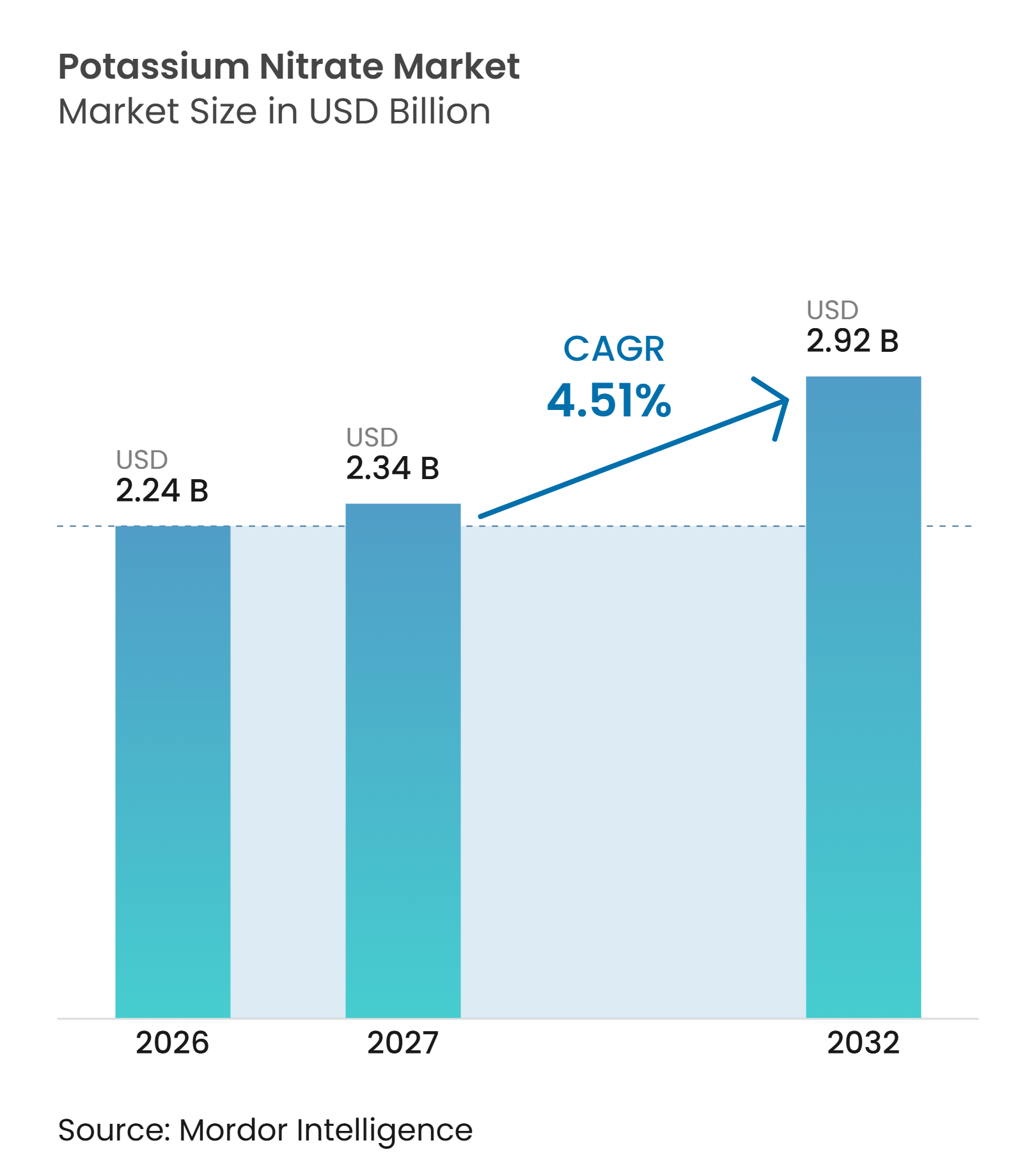
The Potassium Nitrate Market size was valued at USD 2.24 billion in 2026 and is estimated to grow from USD 2.34 billion in 2027 to USD 2.92 billion by 2032, at a CAGR of 4.51% during the forecast period (2027-2032). The potassium nitrate market serves agriculture, food processing, glass production, and solar thermal storage, providing multiple sources of demand. Specialty crop production remains central, as chloride-sensitive crops require a water-soluble source of potassium and nitrogen. Producers position their grades around fertigation, controlled application, and industrial purity requirements. Supply advantages remain concentrated among producers with access to nitrate salts or potash feedstocks. Renewable energy and photovoltaic glass applications provide additional demand channels, although agriculture remains the principal driver.
Key Report Takeaways
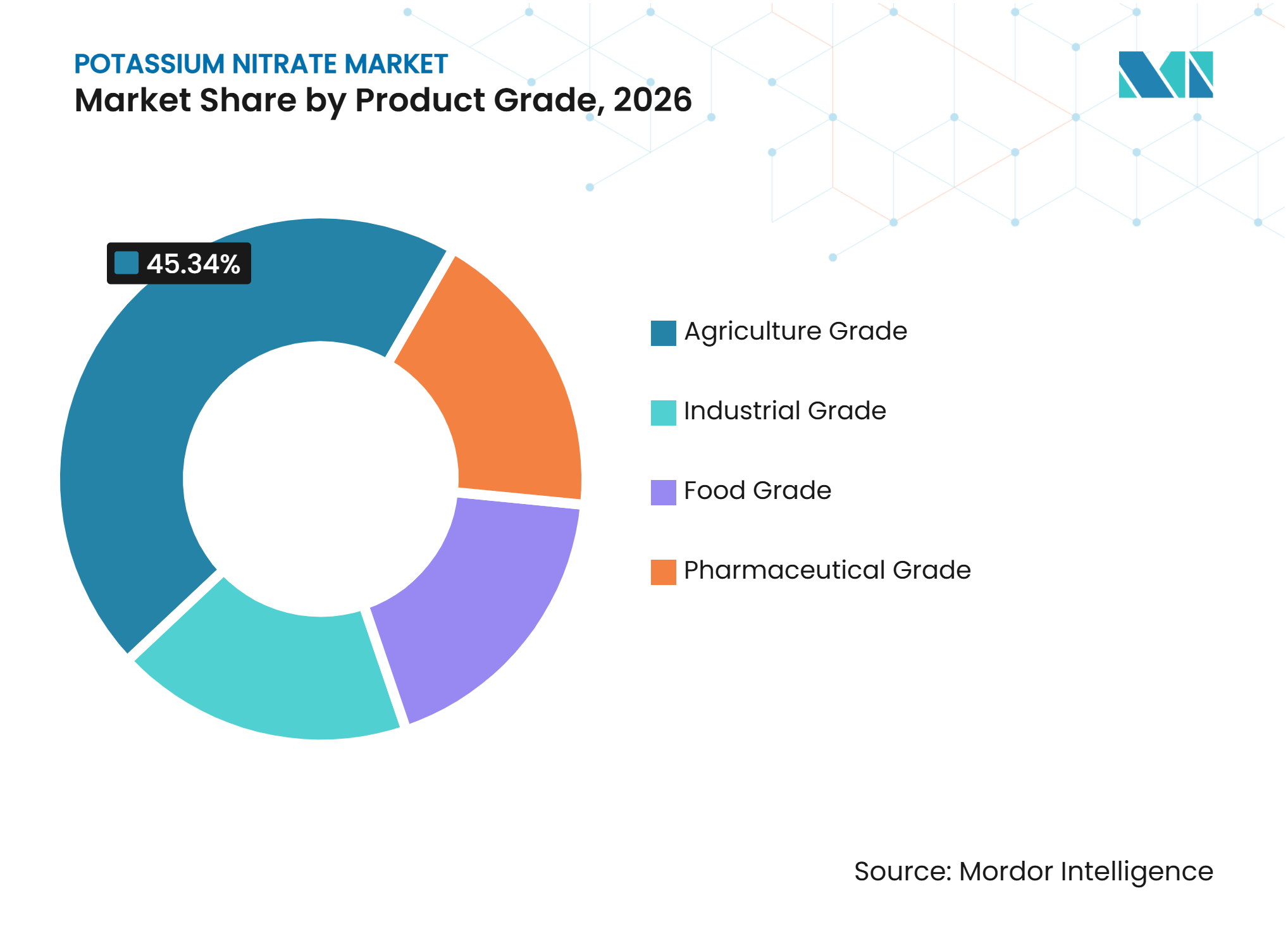
- By product grade, Agriculture Grade held 45.34% of the potassium nitrate market share in 2026, while Food Grade is projected to grow at a 5.27% CAGR through 2032.
- By form, Powdered potassium nitrate accounted for 47.17% of the potassium nitrate market share in 2026, while Granular potassium nitrate is forecast to expand at a 5.62% CAGR through 2032.
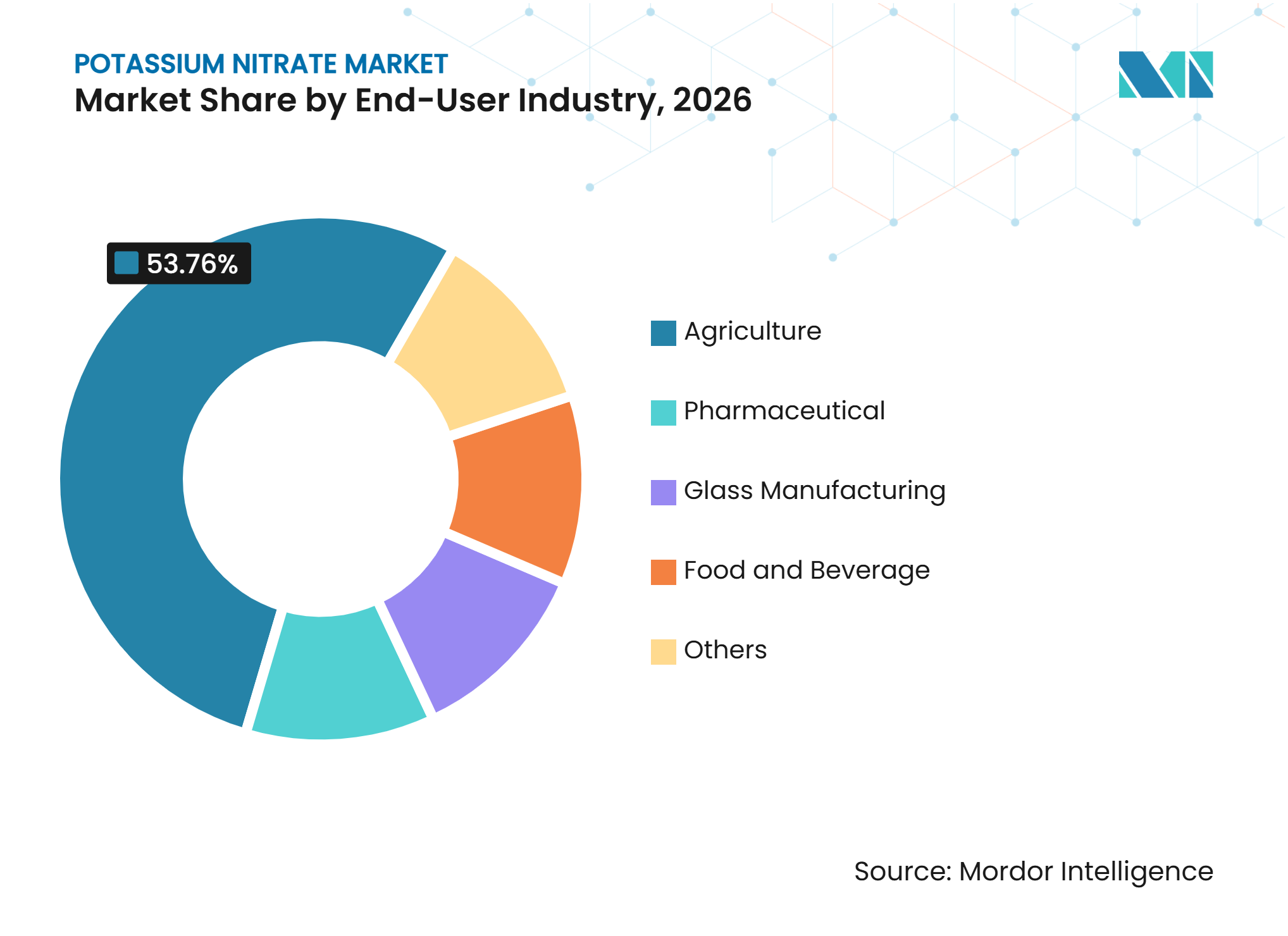
- By end-user industry, Agriculture captured 53.76% of the potassium nitrate market size in 2026 and is projected to advance at a 6.08% CAGR through 2032.
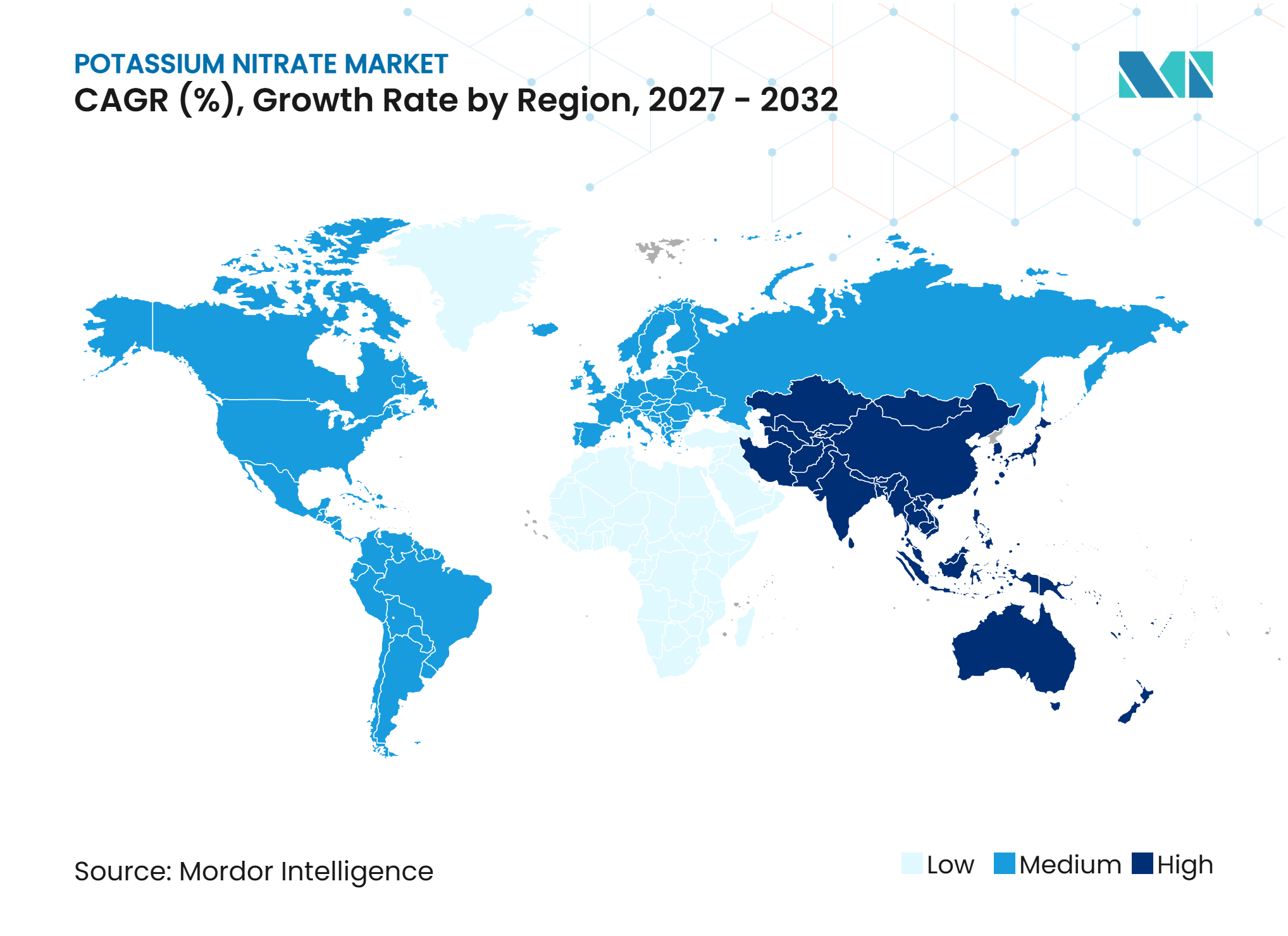
- By geography, Asia-Pacific represented 38.51% of the potassium nitrate market share in 2026 and is forecast to grow at a 5.81% CAGR through 2032.
Note: Market numbers in this report are based on Mordor Intelligence's proprietary estimation framework, which combines nine months of actuals with Q4 projections for base year 2026.
Market Trends and Insights
Drivers Impact Analysis of Potassium Nitrate Market*
| Drivers | (~) % Impact on CAGR Forecast | Geographic Relevance | Impact Timeline |
|---|---|---|---|
| Specialty Crop Intensification and Chloride Sensitivity | +1.6% | Global, with intensity in Asia-Pacific and the Mediterranean | Long term (≥ 4 years) |
| Fertigation, Hydroponics and Protected Cultivation | +1.2% | Asia-Pacific, with spillover to South America and the Middle East and North Africa | Long term (≥ 4 years) |
| Nutrient-Runoff and Water-Efficiency Requirements | +0.7% | North America, Europe, and water-stressed Asia-Pacific regions | Medium term (2-4 years) |
| Photovoltaic Glass and Solar Thermal Storage Applications | +0.4% | China, the Middle East and North Africa | Medium term (2-4 years) |
| Seasonal Procurement Ahead of Peak Horticulture Demand | +0.3% | Global, with the strongest effect in the Mediterranean and North America | Short term (≤ 2 years) |
| Source: Mordor Intelligence | |||
Specialty Crop Intensification and Chloride Sensitivity
Potassium nitrate provides chloride-free potassium and nitrogen for crops that respond poorly to chloride in the root zone. Tomatoes, strawberries, citrus, and tobacco require closely managed nutrition programs, as chloride exposure can affect marketable yield and product quality. This requirement makes the potassium nitrate market less dependent on changes in commodity potash pricing for these crops. Growers serving fresh-produce channels use precise nutrient programs to maintain quality, consistency, and harvest timing. This demand is supported by the shift toward fruit and vegetable production, which has higher input requirements. Food and Agriculture Organization (FAO) data show that global inorganic fertilizer use reached 197 million tons in 2024, while potassium consumption increased by 12% over the preceding decade[1].
Fertigation, Hydroponics and Protected Cultivation
Fertigation uses irrigation systems to apply dissolved nutrients at planned intervals, making solubility and compatibility essential. Potassium nitrate is well-suited to this application because it provides potassium and nitrate nitrogen in a single solution. ICL identifies fertigation as a demand factor for its Growing Solutions business, which reported USD 2.063 billion in sales during 2025, up 6% from the preceding year. Protected cultivation also supports the use of water-soluble nutrition, as growers require repeatable delivery through micro-irrigation systems. FAO reported more than 2 million hectares of protected cultivation in China, including plastic tunnels and glass greenhouses. These systems support demand for grades that dissolve rapidly and can be applied without disrupting irrigation equipment.
Nutrient-Runoff and Water-Efficiency Requirements
Water-use limits and nutrient-management regulations encourage growers to assess both the timing and placement of fertilizer applications. Potassium nitrate offers immediately available nitrate nitrogen, which can be incorporated into planned fertigation schedules. Germany tightened its urea application requirements in 2025, reducing the incorporation window from 4 hours to 1 hour for cases covered by the rule. The EU Nitrates Directive and related national regulations have increased attention to nutrient loss management. A combined potassium and nitrogen source may also reduce the number of nutrient-application events in water-constrained production areas. These requirements support the potassium nitrate market in situations where crop value justifies a specialty nutrition program.
Photovoltaic Glass and Solar Thermal Storage Applications
Potassium nitrate has industrial uses in glass processing and thermal storage systems for concentrating solar power plants. Solar Salt, a mixture of sodium nitrate and potassium nitrate, is used as a heat-transfer and storage medium in commercial concentrating solar power facilities. A 2025 scientific review examined nitrate salt mixtures for thermal energy storage and reported progress toward higher-temperature operation. A related 2025 study reported operation at 600°C in a 100 kg-scale hot tank. China reached 1 GW of concentrating solar power capacity by mid-2025, creating an industrial channel for molten-salt materials. Photovoltaic glass applications also drive demand for potassium nitrate, which is used in ion-exchange toughening processes.
Restraints Impact Analysis of Potassium Nitrate Market*
| Restraints | (~) % Impact on CAGR Forecast | Geographic Relevance | Impact Timeline |
|---|---|---|---|
| Potassium Chloride and Ammonia Feedstock Volatility | -0.8% | Global, with acute exposure in Europe and North America | Medium term (2-4 years) |
| Price Premium Versus Muriate of Potash (MOP) and Sulfate of Potash (SOP) in Broad-Acre Crops | -0.6% | Global, with intensity in South America and South Asia | Long term (≥ 4 years) |
| Oxidizer Handling, Storage and Transport Requirements | -0.3% | North America, Europe, and Asia-Pacific markets with established regulatory frameworks | Medium term (2-4 years) |
| Source: Mordor Intelligence | |||
Potassium Chloride and Ammonia Feedstock Volatility
Potassium nitrate production depends on potassium chloride and nitric acid, linking producers to volatile fertilizer and ammonia inputs. SQM reported sales of 517.5 thousand metric tons of potassium nitrate and sodium potassium nitrate in 2025, down 3% from the prior year. Changes in feedstock costs can affect procurement plans, producer margins, and contract pricing. European producers also face shifts in the nitrogen fertilizer trade. The European Union imposed higher tariffs on Russian and Belarusian agricultural products and fertilizers from July 2025, with tariff levels set to rise through 2028. These conditions can limit the use of long-term fixed-price agreements and reduce supply predictability.
Price Premium Versus Muriate of Potash (MOP) and Sulfate of Potash (SOP) in Broad-Acre Crops
Potassium nitrate carries a price premium over muriate of potash and sulfate of potash in many applications. Nutrien reported average offshore potash net selling prices of USD 252 per ton in 2025 and USD 286 per ton in North America[2]. Broad-acre grain growers generally select lower-cost sources unless crop, soil, or regulatory requirements call for specialty nutrition. This limits the use of potassium nitrate among the largest global consumers of potassium. Demand remains concentrated in premium horticulture, protected cultivation, and selected industrial uses. Exposure to crop prices and weather events can also reduce growers' ability to invest in specialty inputs.
*Our forecasts treat driver/restraint impacts as directional, not additive. The impact forecasts reflect baseline growth, mix effects, and variable interactions.
Potassium Nitrate Market Segment Analysis
By Product Grade:
Agriculture Grade Provides the Largest Demand BaseAgriculture Grade held 45.34% of the potassium nitrate market share in 2026. This grade supports fertigation programs for chloride-sensitive crops across the Mediterranean, Middle Eastern, and East Asian horticultural regions. Its position reflects the scale of crop nutrition demand and the practical value of a water-soluble source of potassium and nitrogen. Farm programs that use potassium nitrate for sensitive crops are less likely to switch to standard potash products. Industrial Grade supports glass strengthening, molten-salt preparation, and pyrotechnic applications. SQM identified specialty plant nutrition as a priority, with expected output growth of 2% to 4% in 2026 under stable pricing conditions.
Food Grade is projected to record the fastest product-grade expansion at a 5.27% CAGR through 2032. It is used in selected meat, cheese, preservation, and specialty processing applications. European food rules affect this demand because the European Commission lowered maximum permitted nitrate levels for certain foods under Regulation (EU) 2023/915. The regulatory change requires food manufacturers to review formulations and compliance procedures. Pharmaceutical Grade remains a smaller segment, but it supports premium product lines because its production requires defined purity and traceability standards. Grade-specific certification requirements can protect suppliers with established quality management processes.



By Form:
Powdered Grades Lead Established ApplicationsPowdered potassium nitrate accounted for 47.17% of the potassium nitrate market share in 2026. It is widely used for fertigation tank preparation, water-soluble fertilizer production, and industrial blending. The fine particle format dissolves quickly, which supports time-sensitive crop nutrition programs. Its handling requires moisture-resistant packaging and controlled storage conditions. Crystalline material is used where clarity and dissolution consistency are important. Prilled material supports selected blending and pyrotechnic applications in which physical stability during transport is critical.
Granular potassium nitrate is forecast to grow at a 5.62% CAGR through 2032. The format is compatible with precision spreading equipment and controlled-release blending for high-value crops and turf. Haifa Group opened a specialty fertilizer mixing unit in Brazil during 2025 with a capacity of 30,000 tons and planned to raise capacity to 40,000 tons. The investment reflects demand for tailored crop nutrition blends rather than stand-alone commodity products. Producers can use granular formats to improve product positioning in local distribution channels. The form mix is expected to remain tied to the growth of fertigation, foliar application, and precision spreading practices.
By End-User Industry:
Agriculture Combines Scale with Faster GrowthAgriculture represented 53.76% of the potassium nitrate market share in 2026. The segment is also projected to grow at a 6.08% CAGR through 2032. Demand is linked to crops such as strawberries, peppers, cucumbers, and tobacco, where chloride can harm yield or quality. This makes potassium nitrate a functional input rather than a direct substitute for standard commodity potash. Yara reported global crop nutrition deliveries of 6,273 kilotons in the second quarter of 2025, compared with 6,100 kilotons in the second quarter of 2024. Crop nutrition requirements continue to support the largest component of the potassium nitrate industry.
Glass Manufacturing is an important industrial outlet because potassium nitrate is used in the tempering process for automotive, architectural, and solar-panel glass. Concentrating solar power facilities create an additional demand route for potassium nitrate-containing molten salt. Pharmaceutical applications use high-purity potassium nitrate in compounding and manufacturing processes that require controlled specifications. Food and Beverage demand is subject to changes in preservative rules and customer reformulation practices. The Others category includes pyrotechnics and black-powder uses, which contribute output but have lower value than agricultural and pharmaceutical grades. Each end-user group requires different grades, handling practices, and quality controls.

Geography Analysis
Asia-Pacific: Strong Scale Across Agricultural and Industrial Uses
Asia-Pacific accounted for 38.51% of the potassium nitrate market in 2026 and is forecast to expand at a 5.81% CAGR through 2032. China combines large protected cultivation areas with domestic nitrate production and growing demand for molten salt used in concentrating solar power. The region also has a broad base of horticultural production that uses water-soluble and chloride-free nutrients. The Food and Agriculture Organization (FAO) documented China's substantial protected cultivation footprint, which supports the continued use of fertigation and micro-irrigation systems. China's customs rules require declarations for dangerous goods, creating compliance requirements for potassium nitrate imports and distribution. The region's greenhouse, floriculture, and export-vegetable systems support ongoing demand for specialized agricultural grades.
North America: Service-Led Distribution Supports Specialty Demand
North America has high-value horticultural clusters in California, Florida, and Mexico's Sonora region. These production areas use protected cultivation, efficient irrigation, and advisory services to manage crop quality. SQM reported Specialty Plant Nutrition revenue of USD 982.4 million in 2025, an increase of 4.3%, and described its strategy of serving premium markets. Nutrien reported more than USD 7.3 billion in crop nutrient and crop protection retail sales during 2025. Integrated retail models connect product supply with agronomic advice and precision application services. Federal storage and explosives compliance requirements also shape the logistics model for certain oxidizer mixtures in the region.
Europe, South America, and the Middle East and Africa: Different Routes to Growth
Europe faces higher nitrogen-input costs following the EU's fertilizer tariff measures, while specialty horticulture and glass applications sustain demand for potassium nitrate. Compliance with food additive limits and nutrient-management rules affects grade selection and demand in the region. Brazil and Argentina present demand linked to specialty crop production and blending capacity. Haifa Group's Brazilian mixing facility demonstrates the value of local formulation in South American crop-nutrition channels. The Middle East and Africa hold an export-oriented supply position, supported by Jordan's Dead Sea potash resources. Arab Potash outlined its strategy to increase value-added production and global market presence in 2025. KEMAPCO's voluntary nitrous oxide abatement project also addresses carbon-related compliance requirements for exports to Europe.
Competitive Landscape
Market Concentration
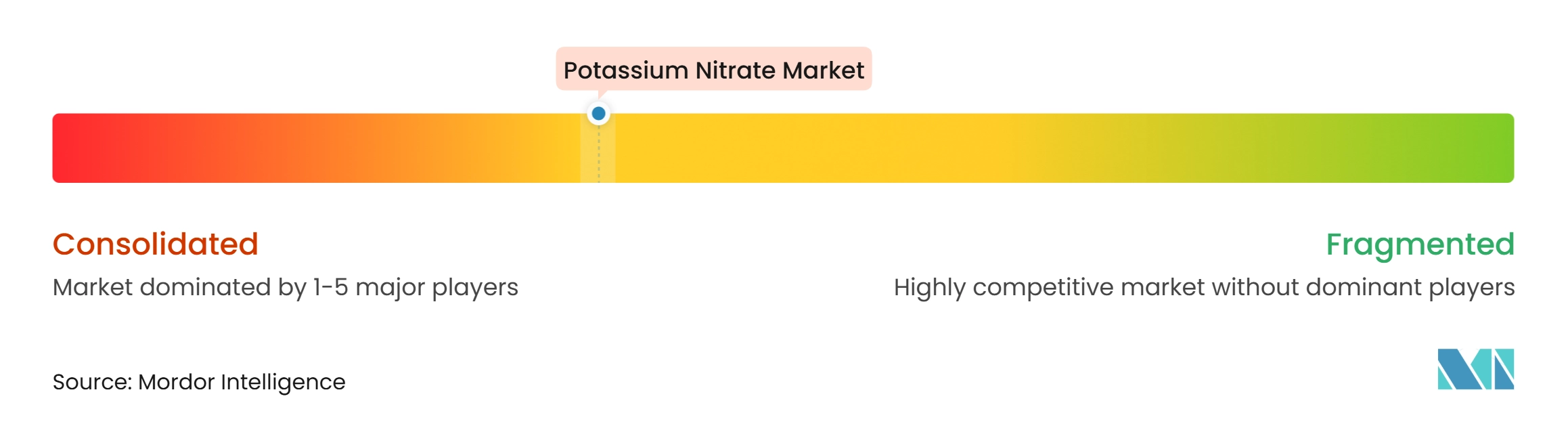
The potassium nitrate market is moderately consolidated. SQM, ICL Group, Haifa Group, and KEMAPCO have established positions in agricultural and specialty grades. Chinese producers compete across industrial and agricultural segments, supported by economies of scale and access to local supply. Feedstock integration is important, as access to nitrate salts or potash resources supports cost control and supply reliability. SQM sold 517.5 thousand metric tons of potassium nitrate and sodium potassium nitrate in 2025. ICL reported USD 2.063 billion in Growing Solutions sales for 2025, up 6%, and commissioned a water-soluble fertilizer plant in India in 2026.
Competition is also shaped by product support, local formulation, quality assurance, and distribution reach. Haifa operates through 18 international subsidiaries, providing a platform for crop-specific fertilizer advice and local market access. Its 2025 Brazilian mixing investment reflects a move toward regional customization and higher-value blends. ICL's India facility is another example of a supplier placing manufacturing closer to an expanding specialty-nutrition customer base. These strategies reduce reliance on imported finished products and improve service responsiveness, while also strengthening competition in markets where growers expect tailored nutrient programs.
Quality and compliance are becoming more important across pharmaceutical, food, industrial, and low-carbon supply channels. Producers that meet traceability, purity, and handling requirements can maintain their position in specialized applications. KEMAPCO's nitrous oxide abatement initiative addresses carbon concerns linked to European trade requirements. EuroChem commissioned a 70,000-ton-per-year 13-0-46 fertilizer facility in Nevinnomyssk in 2025, with an investment exceeding RUB 8 billion (USD 88 million).
Potassium Nitrate Industry Leaders
-
SQM S.A.
-
Haifa Negev technologies LTD
-
KEMAPCO
-
Wentong Potassium Salt Group Co., Ltd.
-
Qinghai Salt Lake Industry Co., Ltd
- *Disclaimer: Major Players sorted in no particular order
Potassium Nitrate Market Companies Covered in this Report
- Akshay Group
- EuroChem Group
- GFS Chemicals
- Haifa Negev technologies LTD
- ICL Group
- K+S Aktiengesellschaft
- KEMAPCO
- Migao Corporation
- Nutrien Ltd.
- Qinghai Salt Lake Industry Co., Ltd
- SQM S.A.
- The Mosaic Company
- Uralchem
- Wentong Potassium Salt Group Co., Ltd.
- Yara International ASA
Recent Industry Developments in Potassium Nitrate Market
- September 2026: EuroChem Group announced plans to invest approximately USD 2.2 billion to expand and modernize its Usolskiy Potash Complex in Russia's Perm region through 2029, targeting an annual potassium chloride capacity of over 3 million tons. This expansion is intended to reduce input costs for potassium nitrate production through the EuroChem-Migao joint venture in China.
- March 2026: ICL Group filed its 2025 Annual Report on Form 20-F with the SEC, reporting Growing Solutions segment sales of USD 2.063 billion, up 6% year over year. The company also announced the commissioning of a new water-soluble fertilizer plant in India in 2026, which will support potassium nitrate supply for the region.
Global Potassium Nitrate Market Report Scope
Potassium nitrate (KNO₃), commonly known as saltpeter or niter, is a chemical compound consisting of potassium cations and nitrate anions. It appears as a colorless, transparent, or white crystalline powder. The compound is water-soluble and oxidizing, which makes it useful in a range of industrial and agricultural applications. Potassium nitrate occurs naturally in mineral deposits and can also be produced synthetically through chemical processes.
The potassium nitrate market is segmented by product grade, form, end-user industry, and geography. By product grade, the market is segmented into agriculture grade, industrial grade, food grade, and pharmaceutical grade. By form, the market is segmented into crystalline, granular, prilled, and powdered. By end-user industry, the market is segmented into agriculture, pharmaceutical, glass manufacturing, food and beverage, and others. The report also covers market sizes and forecasts for potassium nitrate across 15 countries in major regions. The market sizes and forecasts are provided in terms of value (USD).
Segmentation Overview
| Agriculture Grade |
| Industrial Grade |
| Food Grade |
| Pharmaceutical Grade |
| Crystalline |
| Granular |
| Prilled |
| Powdered |
| Agriculture |
| Pharmaceutical |
| Glass Manufacturing |
| Food and Beverage |
| Others |
| Asia-Pacific | China |
| India | |
| Japan | |
| South Korea | |
| ASEAN Countries | |
| Rest of Asia-Pacific | |
| North America | United States |
| Canada | |
| Mexico | |
| Europe | Germany |
| United Kingdom | |
| France | |
| Italy | |
| NORDIC Countries | |
| Rest of Europe | |
| South America | Brazil |
| Argentina | |
| Rest of South America | |
| Middle East and Africa | Saudi Arabia |
| South Africa | |
| Rest of Middle East and Africa |
| By Product Grade | Agriculture Grade | |
| Industrial Grade | ||
| Food Grade | ||
| Pharmaceutical Grade | ||
| By Form | Crystalline | |
| Granular | ||
| Prilled | ||
| Powdered | ||
| By End-User Industry | Agriculture | |
| Pharmaceutical | ||
| Glass Manufacturing | ||
| Food and Beverage | ||
| Others | ||
| By Geography | Asia-Pacific | China |
| India | ||
| Japan | ||
| South Korea | ||
| ASEAN Countries | ||
| Rest of Asia-Pacific | ||
| North America | United States | |
| Canada | ||
| Mexico | ||
| Europe | Germany | |
| United Kingdom | ||
| France | ||
| Italy | ||
| NORDIC Countries | ||
| Rest of Europe | ||
| South America | Brazil | |
| Argentina | ||
| Rest of South America | ||
| Middle East and Africa | Saudi Arabia | |
| South Africa | ||
| Rest of Middle East and Africa | ||
Key Questions Answered in the Report
What is current market size of Potassium Nitrate Market?
The Potassium Nitrate Market size was valued at USD 2.24 billion in 2026 and is estimated to grow from USD 2.34 billion in 2027 to USD 2.92 billion by 2032, at a CAGR of 4.51% during the forecast period (2027-2032).
Why is granular potassium nitrate growing faster than other forms?
Granular material is projected to expand at a 5.62% CAGR through 2032 because it suits precision spreading and customized crop-nutrition blends.
Which end-user creates the most demand for potassium nitrate?
Agriculture accounts for 53.76% of demand in 2026 and is forecast to grow at a 6.08% CAGR through 2032.
Why is Asia-Pacific important for potassium nitrate suppliers?
Asia-Pacific holds a 38.51% share in 2026 and is forecast to grow at a 5.81% CAGR through 2032, supported by protected cultivation and industrial demand.