
Potassium Formate Market Size and Share
Market Overview
| Study Period | 2022 - 2032 |
|---|---|
| Market Size (2027) | USD 0.82 Billion |
| Market Size (2032) | USD 1.03 Billion |
| Growth Rate (2027 - 2032) | 4.59 % |
| Fastest Growing Market | Asia-Pacific |
| Largest Market | North America |
| Market Concentration | Medium |
Major Players *Disclaimer: Major Players sorted in no particular order Image © Mordor Intelligence. Reuse requires attribution under CC BY 4.0. | |
Potassium Formate Market Analysis by Mordor Intelligence
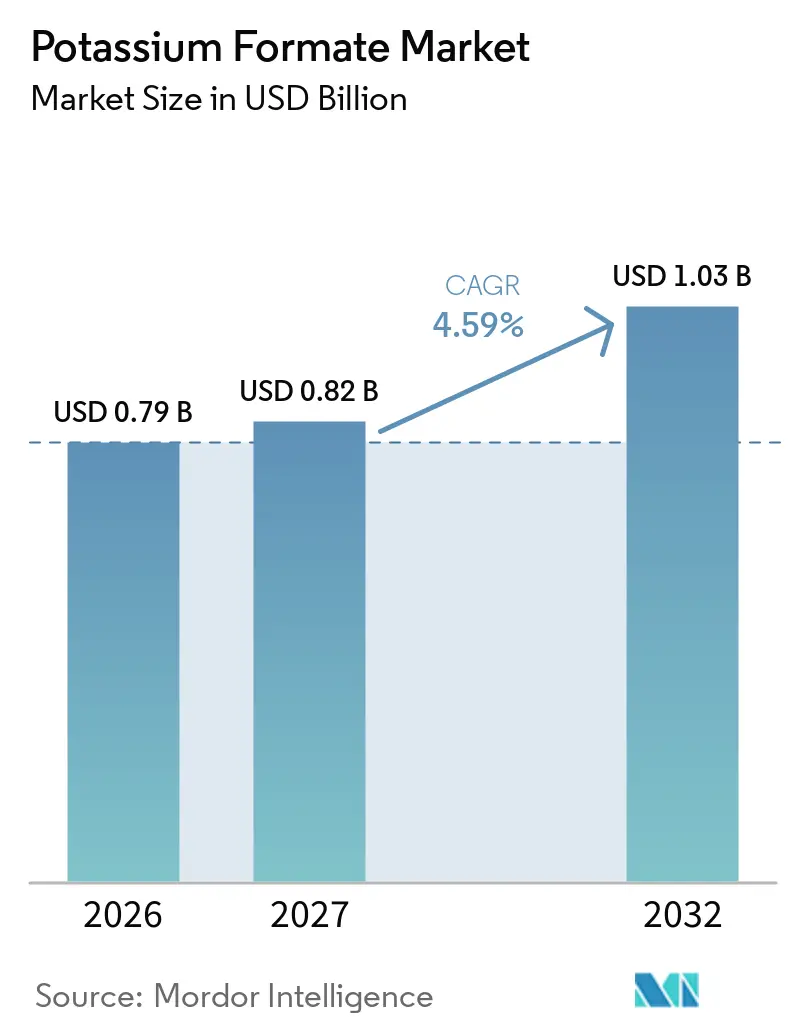
The potassium formate market size was valued at USD 0.79 billion in 2026 and is estimated to grow from USD 0.82 billion in 2027 to USD 1.03 billion by 2032, at a CAGR of 4.59% during the forecast period (2027-2032). The potassium formate market is driven by demand from oilfield fluid management, winter safety programs, and industrial thermal systems. Its advantages include high solution density, biodegradability, and shale-inhibition properties unmatched by common halide brines, glycols, or sodium formate. Deepwater and unconventional wells are extending into high-pressure, high-temperature reservoirs where solids-free brines are a technical requirement. Stricter limits on chloride deicers in Europe and North America are also generating demand tied to airport and public infrastructure budgets, independent of energy prices. Growth in secondary refrigeration, data-center cooling, and heat pumps represents an additional demand stream, as nonflammable, corrosion-inhibited fluids can simplify compliance in food-grade and public-safety applications.
Key Report Takeaways
- By form, liquid or brine held 69.34% of the potassium formate market share in 2026 and is projected to grow at a 5.08% CAGR through 2032.
- By application, drilling and completion fluids accounted for 35.62% of the potassium formate market share in 2026, while deicing agents are forecast to expand at a 5.16% CAGR through 2032.
- By end-user industry, oil and gas held 44.28% of spending in 2026, while industrial applications are forecast to grow at a 5.62% CAGR through 2032.
- By geography, North America accounted for 37.81% of global revenue in 2026, while Asia-Pacific is projected to grow at a 5.54% CAGR through 2032.
Note: Market numbers in this report are based on Mordor Intelligence's proprietary estimation framework, which combines nine months of actuals with Q4 projections for base year 2026.
Market Trends and Insights
Drivers Impact Analysis of Potassium Formate Market*
| Drivers | (~) % Impact on CAGR Forecast | Geographic Relevance | Impact Timeline |
|---|---|---|---|
| High Pressure High Temperature (HPHT) and Extended-Reach Drilling Requiring Solids-Free Brines | +2.0% | Global, led by North America, the North Sea, and the Asia-Pacific offshore fields | Long term (≥ 4 years) |
| Environmental Substitution of Chloride-Based Deicers | +0.8% | North America and Europe, with spillover to Asia-Pacific | Medium term (2-4 years) |
| Aviation Runway Safety and Corrosion-Reduction Requirements | +0.5% | Global hub airports in North America, Nordic Europe, and Asia-Pacific | Medium term (2-4 years) |
| Growth of Low-Temperature Heat-Transfer and Cooling Systems | +0.7% | Europe and Asia-Pacific, with early adoption in North America | Medium term (2-4 years) |
| Qualification of Low-Salt Potassium Inputs for Specialty Agriculture | +0.4% | Asia-Pacific, including India and China, and South America | Long term (≥ 4 years) |
| Source: Mordor Intelligence | |||
High-Pressure High-Temperature (HPHT) and Extended-Reach Drilling Requiring Solids-Free Brines
Potassium formate brine is used in high-pressure, high-temperature (HPHT) drilling because it meets density, environmental, and reservoir-protection requirements within a single fluid system. A 2025 Society of Petroleum Engineers paper described a manganese tetroxide-weighted potassium formate drill-in fluid at 14.9 pounds per gallon (ppg) in the offshore Madura Strait. All 4 development wells exceeded their absolute open-flow expectations, while HPHT fluid loss remained below 10 mL per 30 minutes. The potassium formate market benefits when operators require solids-free base brines to protect productive formations and sustain well productivity. A separate 2025 study found that purpose-built lubricant additives can improve the tribological performance of manganese tetroxide-weighted potassium formate brine in extended-reach drilling. Higher-density capability expands the range of reservoirs in which formate systems can compete with cesium formate or halide fluids.
Environmental Substitution of Chloride-Based Deicers
Municipal and airport operators face increasing pressure to reduce chloride use because it can persist in soils, harm aquatic life, and damage concrete and steel. A 2025 study covering 17 years of runoff data from Milwaukee Mitchell International Airport found toxicity exceedances associated with propylene glycol, acetate, and chloride deicers. The same study reported that formate-based pavement deicers had lower chronic toxicity endpoints[1]. This evidence supports the use of potassium formate where environmental conditions influence public procurement specifications. Electro Carbon began supplying ECOWAY50 to 5 Quebec airports in January 2025, positioning carbon-negative potassium formate within airport environmental purchasing criteria. The potassium formate market can therefore draw on infrastructure procurement cycles that are less directly tied to commodity chemical pricing.
Aviation Runway Safety and Corrosion-Reduction Requirements
Airport deicer selection operates within a narrow certification framework that limits the range of usable substitutes. The SAE AMS 1435 standard sets requirements for freezing-point depression, surface wetting, and metal corrosion. Formate salts can lower freezing points to minus 50 degrees Celsius, remove ice quickly, and generate lower chemical oxygen demand in wastewater treatment than acetate alternatives. Once a fluid has been qualified, airports must undergo a new approval process before replacing it with another product. This creates longer procurement cycles and supports recurring demand for approved formate fluids. The potassium formate market also benefits because airport maintenance needs and winter operating protocols continue even when spot chemical prices fluctuate.
Growth of Low-Temperature Heat-Transfer and Cooling Systems
Potassium formate solutions are used in closed-loop secondary cooling systems that have traditionally relied on glycol-water mixtures. A 2025 study of a frostless heat-source tower heat pump reported 15-20% efficiency gains under elevated-temperature and high-humidity conditions when potassium formate antifreeze was used. The study also reported a 25-30% reduction in corrosion risk and regeneration energy consumption. These operating characteristics are relevant in data-center cooling and industrial refrigeration, where energy use continues throughout a facility's life. Food-grade formulations extend the use of potassium formate in food-processing refrigeration, where incidental-contact requirements can limit the use of other fluids. Expansion in cold-chain networks and heat-pump installations gives the potassium formate market a demand base beyond oilfield applications.
Restraints Impact Analysis of Potassium Formate Market*
| Restraints | (~) % Impact on CAGR Forecast | Geographic Relevance | Impact Timeline |
|---|---|---|---|
| Premium Cost Versus Chloride, Glycol, and Sodium Formate Alternatives | -1.5% | Global, with greater exposure in price-sensitive Asia-Pacific and Middle East markets | Medium term (2-4 years) |
| Raw-Material and Energy Cost Volatility | -0.9% | Global, especially Europe, and markets are dependent on the Chinese formic acid supply | Short term (≤ 2 years) |
| Crystallization, Compatibility, and Grade-Qualification Complexity | -0.5% | Global, especially cold-climate deicing and high-purity applications | Medium term (2-4 years) |
| Source: Mordor Intelligence | |||
Premium Cost Versus Chloride, Glycol, and Sodium Formate Alternatives
Potassium formate carries a cost premium over chloride-based and glycol alternatives, which can limit its direct adoption in applications where buyers face no technical or environmental restrictions. In oil and gas, brine recyclability and lower formation-damage risk can offset part of the initial cost, but buyers generally require field evidence before assigning value to these benefits. In deicing, the cost gap may narrow as production scales and lower-carbon production routes develop. Secondary roads and logistics facilities tend to favor chloride salts unless specifications require a lower-impact material. The potassium formate market remains more protected in high-pressure, high-temperature (HPHT) drilling, while agricultural and preservative applications are more exposed to lower-cost functional alternatives.
Raw-Material and Energy Cost Volatility
Formic acid is the primary precursor to potassium formate, and changes in its availability and energy inputs can affect producer margins. Conventional supply routes are exposed to Chinese environmental enforcement and energy tariff changes, and the availability of potassium hydroxide also affects production economics. A 2024 supply disruption led to an 18% increase in formic acid prices, demonstrating that technical demand does not eliminate upstream cost exposure. In May 2025, OCOchem commissioned a 60-tons-per-year CO2 electrolysis pilot plant to produce potassium formate from CO2 and renewable electricity. The company states that each ton produced through this route avoids and removes a combined 7.2 tons of CO2 compared with conventional synthesis. Wider adoption will depend on whether these routes reach cost parity with conventional supply, which will influence the feedstock mix of the potassium formate market.
*Our forecasts treat driver/restraint impacts as directional, not additive. The impact forecasts reflect baseline growth, mix effects, and variable interactions.
Potassium Formate Market Segment Analysis
By Form:
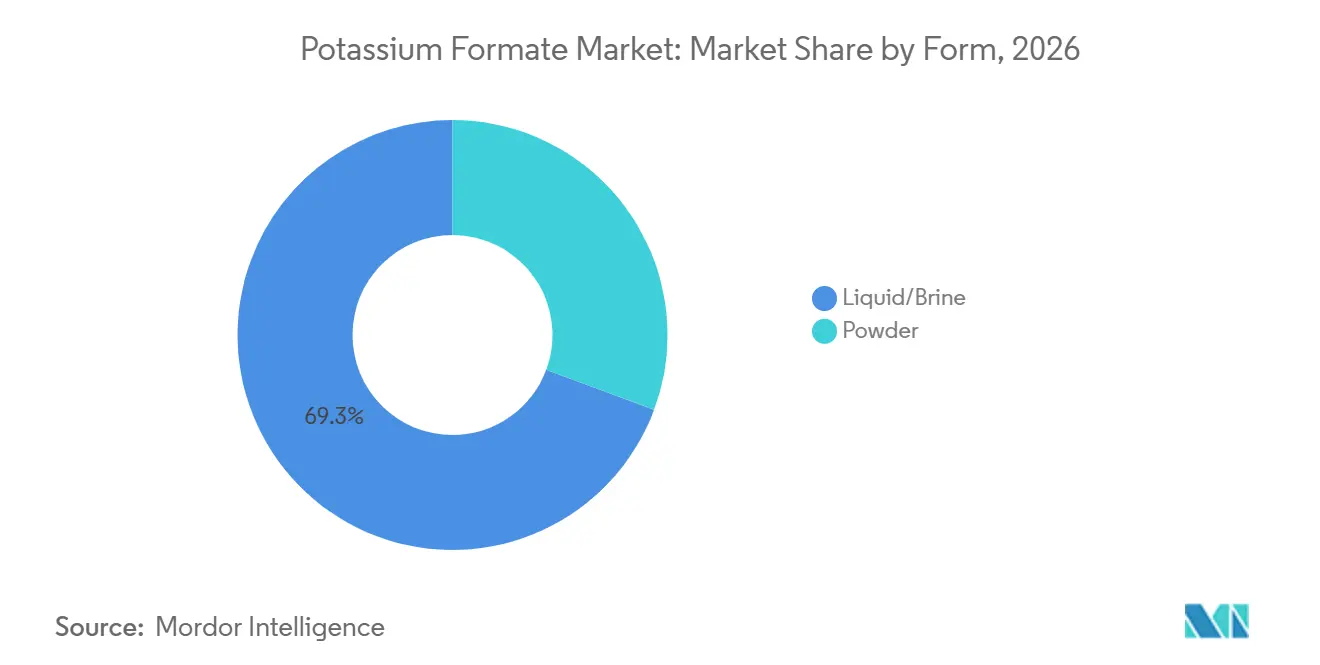
Liquid or Brine Leads Through Integrated Fluid HandlingLiquid or brine accounted for 69.34% of the potassium formate market in 2026 and is projected to expand at a 5.08% CAGR through 2032. This form is suited to oilfield systems built around bulk delivery, on-site blending, direct pumping, and brine recovery. Offshore and unconventional drilling teams can use liquid brine without a dissolution step, which reduces handling time at sites with high operating costs. A 2025 Scientific Reports study showed that controlled alcohol additives can improve the operating properties of potassium brines for well completion, lowering crystallization temperatures and enabling use in more demanding wells.
Powder serves a smaller, distinct need in remote supply routes and locations with limited bulk-liquid infrastructure. It is also used in aviation deicing operations that rely on granular spreading equipment or local brine preparation. Free-flowing powder products are designed for automated dispensing at airports and cold-climate field sites. As local supply chains mature, some powder quantities are likely to shift toward liquid products. That shift would follow investments in storage, transport, and recovery systems rather than any change in the basic technical role of formate. It would support more efficient logistics in the potassium formate market.

By Application:
Drilling and Completion Fluids Retain the Largest RoleDrilling and completion fluids held 35.62% of total revenue in 2026. Deepwater, HPHT, and extended-reach wells continue to require clear, solids-free brines that reduce formation damage and support productive flow. Potassium formate is used where operators need density, reservoir protection, and environmental performance in a single fluid. The oilfield application also benefits from service models that include handling, filtration, and recovery, which can make fluid selection less dependent on the chemical's initial purchase price.
Heat-transfer fluids are gaining use in secondary refrigeration and heat-pump systems, particularly where disposal and food-grade considerations limit the use of glycol. Potassium formate is also used in specialty fertilizer products for chloride-sensitive crops. Perstorp describes Amicult K42 as a chloride-free liquid potassium formate fertilizer containing 42% K2O[2]. Preservative, leather-tanning, and food-grade antimicrobial uses remain smaller but stable. Deicing agents are forecast to see the highest growth, at a 5.16% CAGR through 2032, driven by certified airport procurement and lower-carbon production pathways. These applications broaden the potassium formate market beyond drilling-led demand and help diversify its customer base.
By End-User Industry:
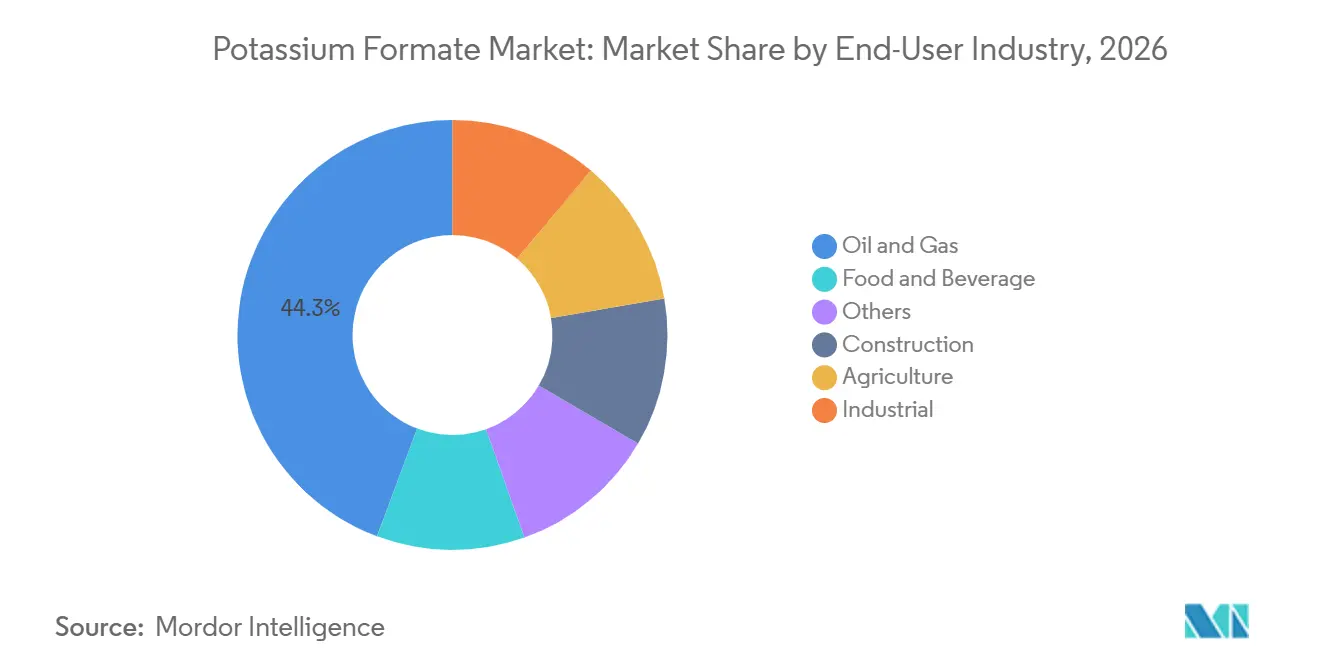
Oil and Gas Supports Recurring SpendingOil and gas held 44.28% of total spending in 2026. Demand comes from well construction and workover programs that typically use a managed fluid lifecycle, including on-site handling, filtration, and recovery. This model drives repeat purchasing and can reduce exposure to one-time commodity price fluctuations. Construction uses include concrete admixtures and formwork release agents. Food and beverage uses include preservation and antimicrobial applications, where demand is smaller but steady.
Industrial uses are forecast to grow at a 5.62% CAGR through 2032, the highest rate among end-user groups. This category includes heat-transfer fluids, refrigerants, and process cooling systems. Data centers, industrial refrigeration, and district-heating systems represent a broader set of operating environments for formate fluids. The material can appeal to users seeking non-toxic, biodegradable alternatives to glycol and halide fluids. Agriculture remains a smaller opportunity, centered on high-value horticulture and chloride-sensitive soils. These end uses reduce the potassium formate market's reliance on upstream drilling programs and broaden its demand channels.
Geography Analysis
North America Potassium Formate Market
North America accounted for 37.81% of the potassium formate market in 2026. The region combines deepwater completion activity in the Gulf of America with a large airport network that uses certified runway fluids on seasonal schedules. The United States supplies most regional demand through oilfield activity and airport operations. Quebec airports began using Electro Carbon's ECOWAY50 in January 2025, adding a new source of deicing demand in Canada. Mexico presents a developing oilfield opportunity as offshore exploration in the Gulf of Mexico expands.
Europe Potassium Formate Market
Europe remains a mature market with technically demanding applications in aviation and offshore oil and gas. Nordic airports have used formate-based pavement deicers for more than a decade. North Sea operators use potassium formate and cesium-potassium blends in challenging completion programs. Environmental requirements for offshore drilling fluids in Norway have supported the adoption of formate in the North Sea. This framework is influencing discussions in the UK Continental Shelf and Dutch offshore areas. Europe also presents growth potential in heat-transfer fluids, as energy-efficiency programs support more heat-pump installations, providing the potassium formate market with another established regional base.
APAC Potassium Formate Market
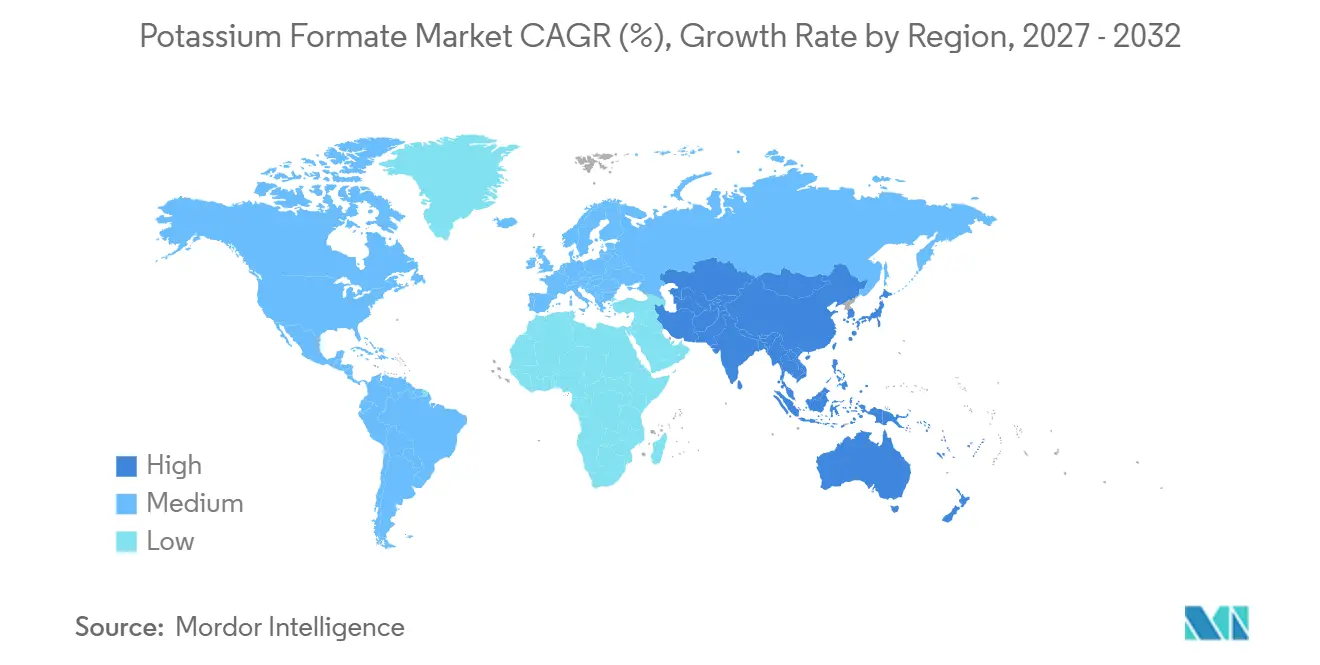
Asia-Pacific is projected to grow at a CAGR of 5.54% through 2032, the strongest regional growth rate in the potassium formate market. China combines shale-gas drilling requirements with a growing interest in high-density, HPHT-compatible brines. India presents an agricultural opportunity for specialty inputs in high-value horticulture.
Competitive Landscape
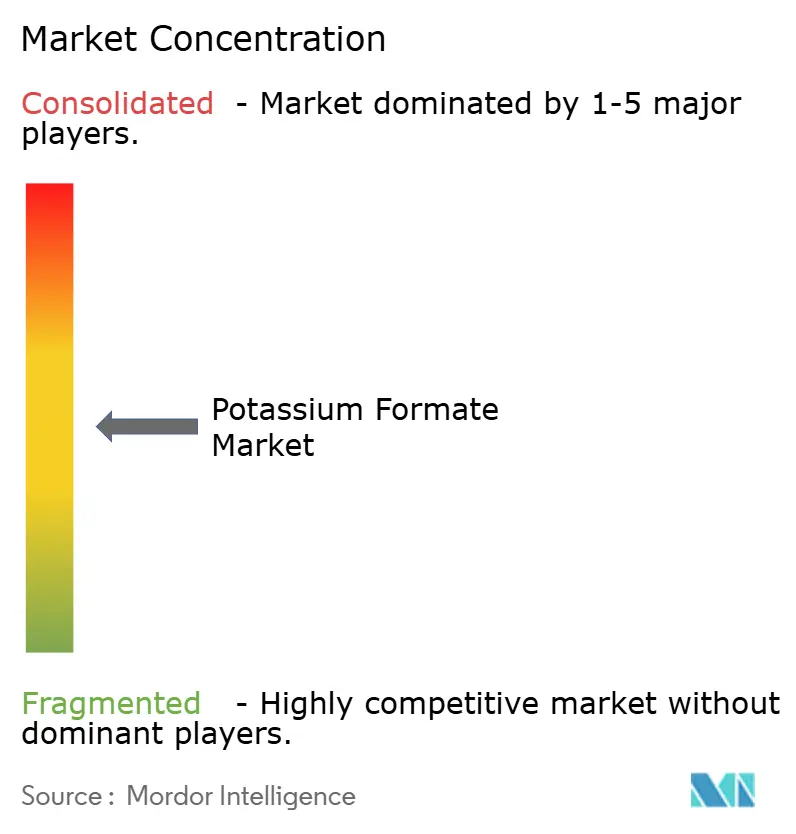
The potassium formate market is moderately fragmented, with key players including BASF, TETRA Technologies, Perstorp, Clariant, and ADDCON. BASF competes through formic acid integration and global production capacity. Perstorp offers oilfield fluid products, runway deicers, and agricultural formulations. These supplier positions indicate that production capability alone is insufficient in applications requiring technical qualification, a factor that remains relevant across the potassium formate market.
Competition is centered on feedstock access, application certifications, customer service, and lower-carbon product options. SAE AMS 1435 certification is particularly important for airport deicing, while oilfield users value support for fluid recovery and recycling. OCOchem's May 2025 pilot plant demonstrated one supplier's effort to develop a CO₂-based production route for potassium formate. Electro Carbon's January 2025 supply to Quebec airports illustrated how lower-carbon products can enter airport procurement channels. These developments increased the importance of lifecycle emissions alongside fluid performance.
Food-grade heat-transfer fluids represent another opportunity, as product qualification can differentiate suppliers in food-processing settings. India and Southeast Asia present a local production opportunity, given that regional capacity remains limited. TETRA has identified completion fluids as a core platform in its ONE TETRA 2030 strategy, which targets more than doubling revenue and tripling Adjusted EBITDA by 2030. This strategy emphasizes specialty fluid chemistry and lifecycle services over commodity output. New entrants must establish technical performance, reliable supply, and accepted certifications before competing in the highest-value applications. The potassium formate market, therefore, still offers room for specialists, even as established suppliers maintain strong positions.
Potassium Formate Industry Leaders
-
BASF
-
Perstorp
-
TETRA Technologies, Inc.
-
CLARIANT
-
ADDCON GmbH
- *Disclaimer: Major Players sorted in no particular order
Potassium Formate Market Companies Covered in this Report
- ADDCON GmbH
- American Elements
- BASF
- CLARIANT
- Dynalene, Inc.
- Eastman Chemical Company
- Esseco Industrial S.p.A
- Hangzhou Focus Chemical Co., Ltd
- Hawkins
- Nachurs Alpine Solutions
- Perstorp
- proviron
- SLB
- TETRA Technologies, Inc.
- Thermo Fisher Scientific Inc.
Recent Industry Developments in Potassium Formate Market
- May 2026: ADDCON GmbH, controlled by Esseco Industrial, acquired Perstorp's European runway de-icer business, bringing the Pergrip Run KF certified potassium formate deicer portfolio under ADDCON's ownership, alongside its existing VIAFORM and AVIFORM lines. This consolidated two AMS 1435-certified potassium formate brands into a single entity.
- October 2025: OCOchem completed its first commercial shipment of potassium formate, formulated for winter runway and driveway deicing. This was the first industrial sale of potassium formate produced from CO2, water, and renewable electricity through the Carbon FluX Electrolyzer platform, establishing a CO2-based production route for potassium formate.
Global Potassium Formate Market Report Scope
Potassium formate is a water-soluble white organic salt (HCOOK) derived from formic acid and potassium hydroxide. It is used as a de-icing agent, a high-density oil drilling fluid, and a low-toxicity heat transfer or desiccant medium. As a de-icing agent, it is applied to airport runways and road surfaces to prevent ice formation. In oil drilling, it serves as a completion and workover fluid due to its high density. As a heat-transfer medium, it is used in industrial cooling and heating systems, while its desiccant properties make it suitable for moisture-control applications.
The potassium formate market is segmented by form, application, end-user industry, and geography. By form, the market is segmented into liquid/brine and powder. By application, the market is segmented into deicing agents, drilling and completion fluids, fertilizer additives, heat-transfer fluids, preservatives, and others. By end-user industry, the market is segmented into construction, oil and gas, agriculture, industrial, food and beverage, and others. The report also covers market sizes and forecasts for potassium formate across 15 countries in major regions. The market sizes and forecasts are provided in terms of value (USD).
Segmentation Overview
| Liquid/Brine |
| Powder |
| Deicing Agents |
| Drilling and Completion Fluids |
| Fertilizer Additives |
| Heat-Transfer Fluids |
| Preservatives |
| Others |
| Construction |
| Oil and Gas |
| Agriculture |
| Industrial |
| Food and Beverage |
| Others |
| Asia-Pacific | China |
| India | |
| Japan | |
| South Korea | |
| ASEAN Countries | |
| Rest of Asia-Pacific | |
| North America | United States |
| Canada | |
| Mexico | |
| Europe | Germany |
| United Kingdom | |
| France | |
| Italy | |
| NORDIC Countries | |
| Rest of Europe | |
| South America | Brazil |
| Argentina | |
| Rest of South America | |
| Middle East and Africa | Saudi Arabia |
| South Africa | |
| Rest of Middle East and Africa |
| By Form | Liquid/Brine | |
| Powder | ||
| By Application | Deicing Agents | |
| Drilling and Completion Fluids | ||
| Fertilizer Additives | ||
| Heat-Transfer Fluids | ||
| Preservatives | ||
| Others | ||
| By End-User Industry | Construction | |
| Oil and Gas | ||
| Agriculture | ||
| Industrial | ||
| Food and Beverage | ||
| Others | ||
| By Geography | Asia-Pacific | China |
| India | ||
| Japan | ||
| South Korea | ||
| ASEAN Countries | ||
| Rest of Asia-Pacific | ||
| North America | United States | |
| Canada | ||
| Mexico | ||
| Europe | Germany | |
| United Kingdom | ||
| France | ||
| Italy | ||
| NORDIC Countries | ||
| Rest of Europe | ||
| South America | Brazil | |
| Argentina | ||
| Rest of South America | ||
| Middle East and Africa | Saudi Arabia | |
| South Africa | ||
| Rest of Middle East and Africa | ||
Key Questions Answered in the Report
What is current market size of Potassium Formate Market?
The potassium formate market size was valued at USD 0.79 billion in 2026 and is estimated to grow from USD 0.82 billion in 2027 to USD 1.03 billion by 2032, at a CAGR of 4.59% during the forecast period (2027-2032).
Which application is growing fastest through 2032?
Deicing agents are forecast to expand at a 5.16% CAGR through 2032, supported by certified airport procurement and lower-impact deicing requirements.
Which region is expanding fastest?
Asia-Pacific is projected to grow at a 5.54% CAGR through 2032, supported by shale-gas drilling, cooling systems, and airport deicing demand.
What limits wider adoption of potassium formate?
Higher costs than chloride, glycol, and sodium formate alternatives, along with feedstock and energy-price volatility, can limit adoption in price-sensitive uses.