
Potassium Chloride Market Size and Share
Market Overview
| Study Period | 2021 - 2031 |
|---|---|
| Market Size (2026) | USD 27.75 Billion |
| Market Size (2031) | USD 35.64 Billion |
| Growth Rate (2026 - 2031) | 5.13 % |
| Fastest Growing Market | Asia-Pacific |
| Largest Market | Asia-Pacific |
| Market Concentration | Medium |
Major Players *Disclaimer: Major Players sorted in no particular order Image © Mordor Intelligence. Reuse requires attribution under CC BY 4.0. | |
Potassium Chloride Market Analysis by Mordor Intelligence
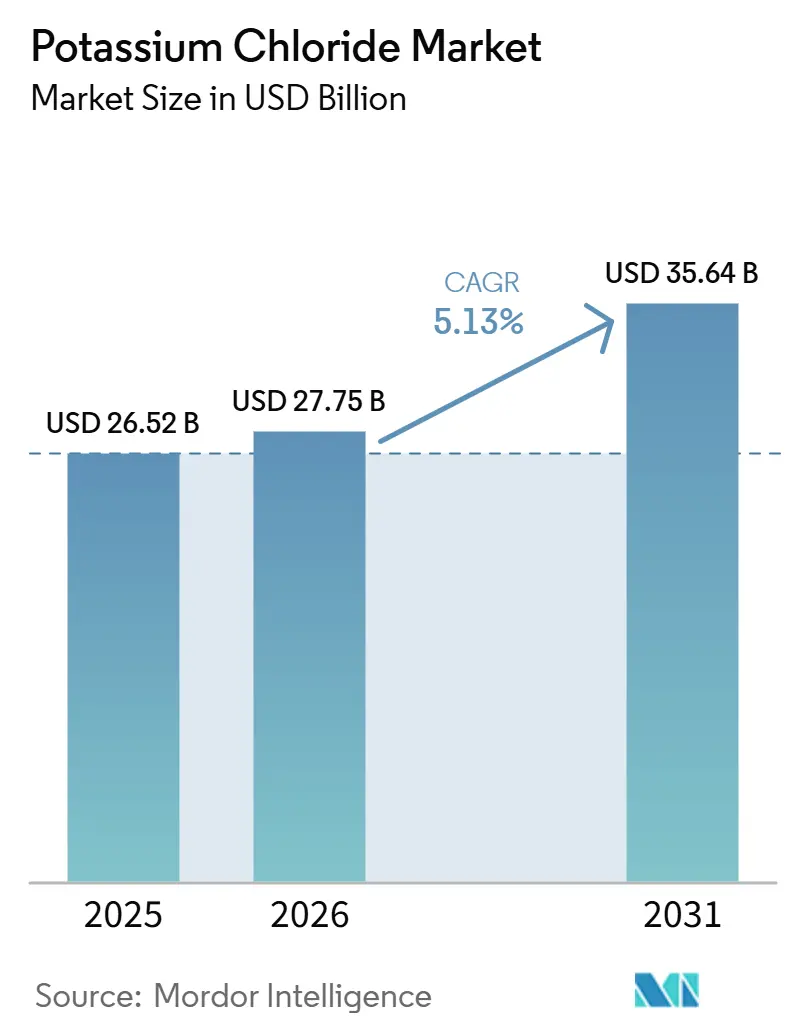
The potassium chloride market size was estimated at USD 26.52 billion in 2025 and is estimated to grow from USD 27.75 billion in 2026 to USD 35.64 billion by 2031, at a CAGR of 5.13% during the forecast period (2026-2031). Global potash fertilizer consumption reached 41.6 million tons of K₂O in 2025, up from 40.6 million tons in 2024, with Asia and South America recording the largest increases. Agricultural demand supports the potassium chloride market, while supply additions from Laos and Russia are expected to increase global potash capacity from 66.1 million tons of K₂O in 2025 to 77.4 million tons by 2029. The addition of potash to the U.S. Critical Minerals List in November 2025 strengthened the case for investment in domestic and allied supply sources. The potassium chloride market also presents a growing opportunity in specialty applications, as chemical, food, and pharmaceutical users require higher-purity material than bulk fertilizer buyers. Trade restrictions and the concentration of export supply in Canada, Russia, and Belarus continue to influence procurement decisions and producer strategies.
Key Report Takeaways
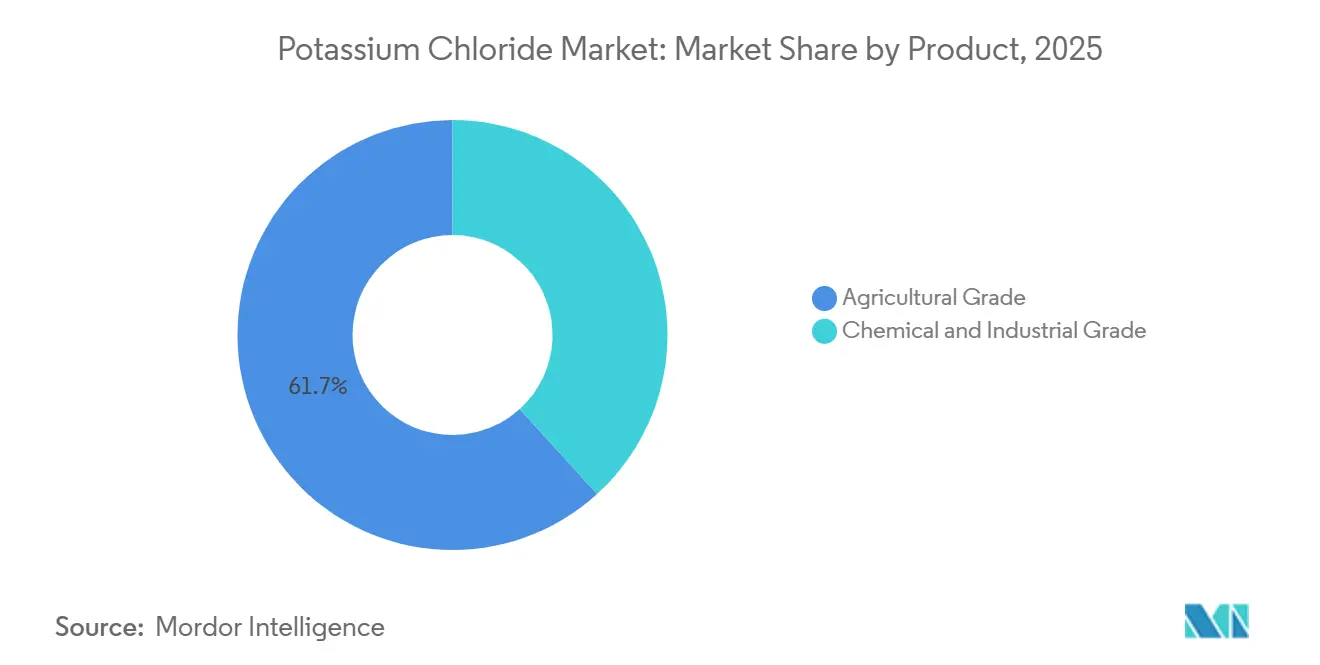
- By product, agricultural grades held 61.74% revenue share in 2025, while chemical and industrial grades are forecast to expand at a 6.04% CAGR through 2031.
- By crop, cereals accounted for 38.63% share in 2025, while fruits and vegetables are projected to grow at a 6.07% CAGR through 2031.
- By form, granular captured 57.11% of the market in 2025, while crystalline is forecast to advance at a 5.84% CAGR through 2031.
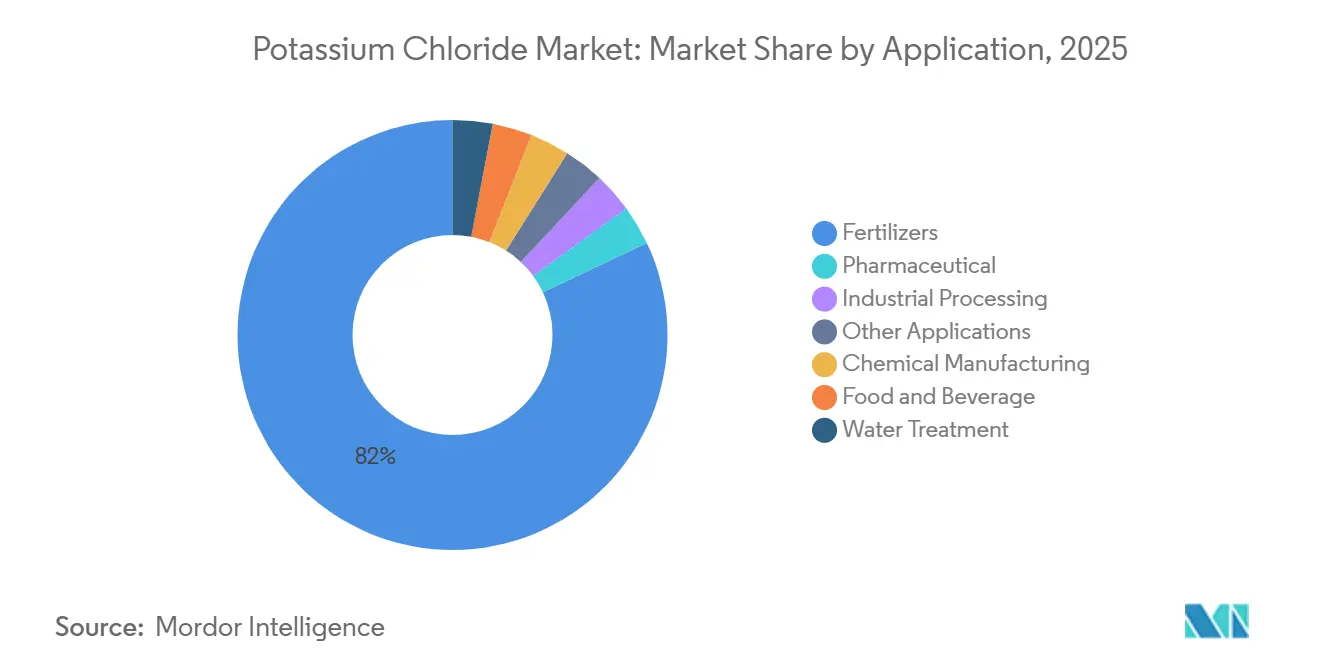
- By application, fertilizers accounted for 82.03% in 2025, while chemical manufacturing is projected to grow at a 5.95% CAGR through 2031.
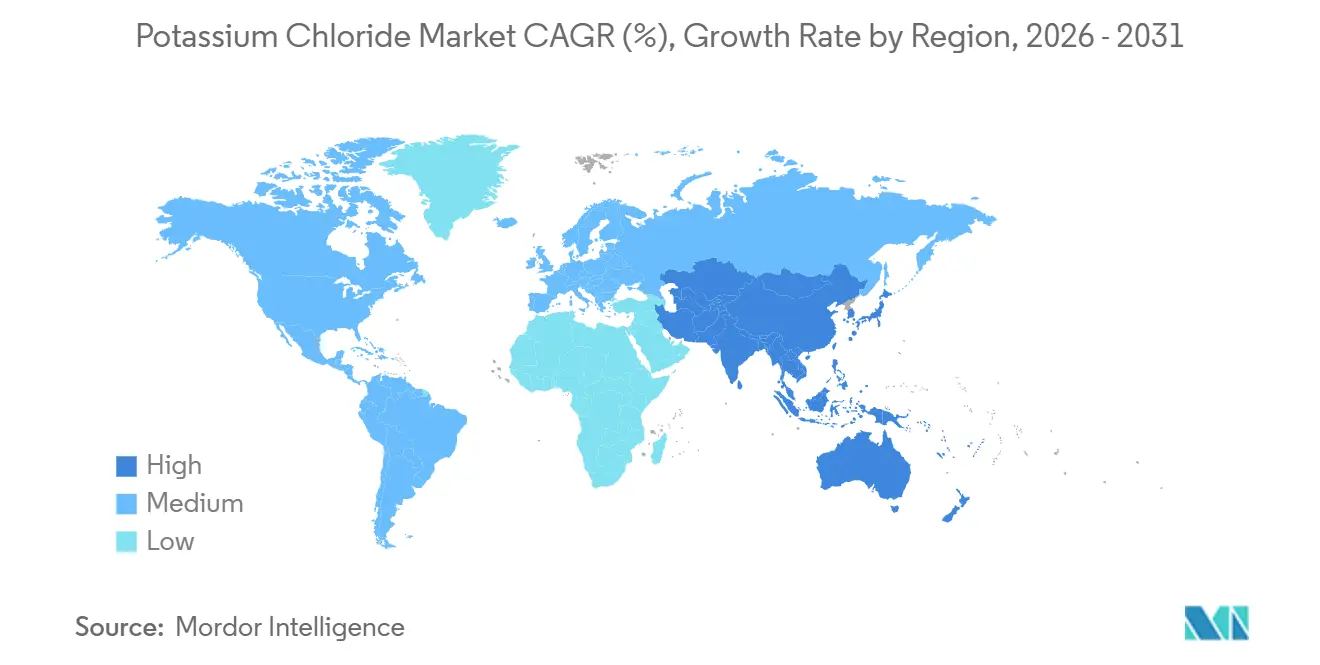
- By geography, Asia-Pacific held 45.22% share in 2025 and is forecast to grow at a 6.15% CAGR through 2031.
Note: Market size and forecast figures in this report are generated using Mordor Intelligence’s proprietary estimation framework, updated with the latest available data and insights as of January 2026.
Market Trends and Insights
Drivers Impact Analysis of Potassium Chloride Market*
| Drivers | (~) % Impact on CAGR Forecast | Geographic Relevance | Impact Timeline |
|---|---|---|---|
| Rising Potassium Fertilizer Demand from Crop Production | +1.5% | Global, the highest intensity in Asia-Pacific and South America | Long term (≥ 4 years) |
| Agricultural-Grade KCl Use for Yield and Soil Fertility | +1.2% | APAC core, South America, Sub-Saharan Africa | Medium term (2-4 years) |
| Food Security Programs Supporting Fertilizer Use | +0.9% | South Asia, Southeast Asia, West Africa | Short term (≤ 2 years) |
| Precision Agriculture and Balanced Nutrient Management | +0.7% | North America, Europe, Japan, South Korea | Medium term (2-4 years) |
| High-Purity KCl Demand in Chemical and Food Uses | +0.6% | North America, EU, China | Long term (≥ 4 years) |
| Source: Mordor Intelligence | |||
Rising Global Demand for Potassium Fertilizers Driven by Increasing Crop Production
The potassium chloride market depends on growers replacing potassium removed from intensively farmed soils. Higher corn yields in parts of the U.S. Corn Belt increased K₂O removal during 2024 and 2025, which led extension guidance to place greater emphasis on potassium application. Global potash fertilizer consumption reached 41.6 million tons of K₂O in 2025, with Asia and South America posting the strongest incremental demand. The potassium chloride market benefits when crop output rises faster than available farmland, as potassium use per hectare becomes more important. This effect is strongest in cereal, oilseed, and export crop systems that require repeated nutrient replacement. It also gives suppliers an opportunity to link product availability with agronomic support and soil-testing programs.
Expanding Use of Agricultural-Grade Potassium Chloride to Improve Crop Yield and Soil Fertility
Agricultural-grade KCl supports crop management because potassium affects water use, stomatal function, and the movement of sugars within plants. A 2025 Agronomy Journal study found that variable-rate potassium application reduced yield variability where soil-test potassium differed substantially across fields. The potassium chloride market retains a broad agricultural base because KCl remains less costly than sulfate of potash for large cereal and oilseed farms. India's Nutrient Based Subsidy system supports access to phosphatic and potassic fertilizers for a large smallholder base. As yield targets increase, higher application rates can support demand even when planted acreage changes little. Producers with dependable supply and suitable granular products are positioned to serve this continuing need.
Government Food Security Initiatives Supporting Fertilizer Consumption
Government support reduces the immediate effect of fertilizer price changes on farm purchasing decisions. India approved INR 41,534 crore (USD 4.95 billion) for Kharif 2026 Nutrient-Based Subsidy rates for phosphatic and potassic fertilizers, an 11.6% increase from Kharif 2025[1]. The allocation covers 24 grades of fertilizer, including muriate of potash. Pakistan's Punjab Kissan Card program supported potassium purchases in 2025 and 2026, and a 2026 study linked participation in farm input subsidy programs with improved household food security. These policies help preserve fertilizer use in markets where farmers face higher input import costs. The potassium chloride market, therefore, has a more stable demand base in subsidized farm economies than price signals alone would suggest.
Growing Adoption of Precision Agriculture and Balanced Nutrient Management Practices
Precision farming changes potassium use differently across mature and developing agricultural systems. In North America, digital tools can reduce unnecessary applications, but soil testing can also identify fields that need higher rates. A 2026 Applied Water Science study found that precision fertigation can improve potassium use efficiency while reducing runoff in irrigated smallholder systems. The potassium chloride market can benefit from broader adoption of nutrient management practices, as more farms shift from blanket applications to field-specific recommendations. Granular and coated products can be useful where variable-rate equipment is widely available. Demand for high-purity KCl also extends beyond farming, as chemical and food users require material that meets stricter quality specifications.
Restraints Impact Analysis of Potassium Chloride Market*
| Restraints | (~) % Impact on CAGR Forecast | Geographic Relevance | Impact Timeline |
|---|---|---|---|
| Potash Price Volatility and Fertilizer Affordability | -0.8% | Global, most acute in import-dependent markets, such as India, Brazil, and Southeast Asia | Short term (≤ 2 years) |
| Environmental Concerns Over Chloride-Based Fertilizers | -0.4% | EU, North America, Japan, South Korea | Long term (≥ 4 years) |
| Trade Restrictions and Sanctions Affecting Supply | -0.7% | EU, Belarus, Russia corridor, North America | Medium term (2-4 years) |
| Source: Mordor Intelligence | |||
Volatility in Potash Prices Affects Fertilizer Affordability and Purchasing Decisions
The potassium chloride market remains sensitive to price changes because importing countries have limited ability to quickly replace major supply sources. China's 2025 annual import contract settled at USD 346 per ton Cost and Freight (CFR), raising the global cost baseline. Canada supplied 79% of U.S. potash imports through 2024, reflecting the scale of North American supply dependence. Higher prices can reduce farmers' purchasing power in the absence of public support and increase the fiscal burden on governments that maintain fertilizer subsidies. Planned capacity growth may ease supply pressure, but several major projects are not expected to begin production before 2029.
Environmental Concerns Regarding Excessive Use of Chloride-Based Fertilizers
Chloride buildup can limit KCl use in crops and in soil conditions sensitive to salinity. A 2025 study of rain-fed potato fields found that basal KCl application increased chloride concentrations in the root zone and reduced tuber yield in loam soils[2]. The potassium chloride market faces a gradual substitution risk in high-value horticulture and organic production, where buyers may choose sulfate of potash or blended nutrient programs. This concern is more pronounced in arid areas with high evapotranspiration, and in the European Union, Japan, and South Korea, where quality-focused cultivation plays a larger role. Bulk cereal and oilseed systems are expected to retain KCl use, as alternative potassium sources are more expensive.
*Our forecasts treat driver/restraint impacts as directional, not additive. The impact forecasts reflect baseline growth, mix effects, and variable interactions.
Potassium Chloride Market Segment Analysis
By Product:
Agricultural Grade Leads Demand, Industrial Grade ExpandsAgricultural-grade KCl held 61.74% of the potassium chloride market share in 2025. Its cost advantage over sulfate of potash and its compatibility with blended NPK fertilizers support use across Asia, South America, and Sub-Saharan Africa. Agricultural-grade products remain central to the potassium chloride market because bulk farm buyers prioritize nutrient value, handling, and delivered cost. China's agricultural-grade production is concentrated in Qinghai and Xinjiang. Broad-acre cereal and oilseed producers continue to favor KCl where chloride sensitivity is not a material agronomic concern.
The chemical and industrial grade segment is projected to grow at a CAGR of 6.04% from 2026 to 2031. Demand from potassium hydroxide production, chlor-alkali processes, drilling fluids, and battery-related chemical applications supports the potassium chloride market in this segment. Higher purity standards, trace-metal requirements, and contracted supply arrangements support a price premium over commodity agricultural material. Producers that can refine KCl for both fertilizer and industrial uses have greater flexibility in product placement. Belaruskali, ICL, and K+S have operations capable of serving this broader product mix. This capability may become more important as specialty demand grows faster than agricultural demand.

By Crop:
Fruits and Vegetables Grow Faster Than CerealsCereals accounted for 38.63% of segment revenue in 2025. Wheat, corn, and rice require large absolute quantities of potash due to their extensive global acreage, making this segment the primary base for the potassium chloride market. The scale of cereal production makes access to cost-effective KCl important for food production systems. Demand is driven by planting cycles, crop prices, soil nutrient removal, and public fertilizer policy.
Fruits and vegetables are forecast to grow at a 6.07% CAGR from 2026 to 2031. Potassium supports sugar movement, cell turgor, and post-harvest quality, which are important for commercial horticulture. Urbanizing economies in Southeast Asia and the Gulf markets are driving increased demand for fresh produce and fertilizer. Oilseeds provide another source of demand, particularly in Brazil's soybean areas. Mosaic opened a blending facility in Palmeirante, Tocantins, in July 2025 to serve expanding agricultural activity in the MATOPIBA (Maranhão, Tocantins, Piauí, and Bahia) corridor. Fiber and sugar crops also use potassium programs that can improve yield and sucrose performance.
By Form:
Granular KCl Dominates, Crystalline KCl Serves Specialty UsesGranular KCl captured 57.11% of segment revenue in 2025. The form is widely used because it creates less dust, stores more easily in humid conditions, and works with bulk blending and spreading equipment. Its production cost is also lower than that of crystalline and powder forms. These features make granular material the standard choice for large agricultural procurement programs. The potassium chloride market benefits from this established distribution network in price-sensitive farm markets.
Crystalline KCl is forecast to grow at a 5.84% CAGR from 2026 to 2031. The potassium chloride market size for crystalline material is tied to industrial and pharmaceutical uses that require solution clarity and strict purity controls. Pharmaceutical KCl supports hypokalemia treatment and is used in intravenous electrolyte products. Food-grade KCl can also be used as a sodium substitute in processed foods. Research published in 2025 identified continued use of potassium salt substitution in China's food sector under the Healthy China Action Plan. Powder and other forms retain smaller roles in food processing and water-softening applications.
By Application:
Fertilizers Remain Central, Chemical Manufacturing Grows FasterFertilizers accounted for 82.03% of total revenue in 2025. KCl has no equally cost-effective substitute for delivering potassium across broad-acre crop systems. This large base limits the impact of short-term changes in industrial demand on total sales. Fertilizer consumption is supported by the need to replace nutrients removed at harvest. Subsidy programs and distribution networks also help protect this application from large demand declines.
Chemical manufacturing is projected to expand at a 5.95% CAGR from 2026 to 2031. The potassium chloride market supports this segment by supplying feedstock for potassium hydroxide, potassium carbonate, potassium permanganate, specialty glass, and water-treatment products. Food and beverage applications are also growing as lower-sodium formulations incorporate food-grade KCl. Pharmaceutical and industrial processing applications require quality systems that commodity producers may not have. ISO and pharmacopeia requirements create a barrier for suppliers seeking to enter specialty segments. This supports product differentiation even when the broader potassium chloride market remains driven by fertilizer demand.
Geography Analysis
APAC Potassium Chloride Market
Asia-Pacific held 45.22% of regional revenue in 2025 and is projected to grow at a 6.15% CAGR from 2026 to 2031. China's large intensive farming base and strategic stockpiling support regional demand. China consumed an estimated 13 million tons of KCl annually, representing 47% of the Asian total. Its 2025 import contract at USD 346 per ton Cost and Freight (CFR) set the regional procurement benchmark. India consumed an estimated 3.1 million tons and uses subsidies to reduce exposure to global price fluctuations. Its Kharif 2026 allocation confirms a continuing policy commitment to fertilizer access.
North America and Europe Potassium Chloride Market
North America is the second-largest regional potassium chloride market. Canada produced an estimated 15,000 metric tons of K₂O in 2025, accounting for 30% of global potash supply. The European market is shaped by K+S production in Germany and Canada, as well as continuing restrictions on Belarusian potash. K+S is advancing the Bethune ramp-up and the Werra 2060 program, which represent significant capacity investments for its supply network.
South America and MEA Potassium Chloride Market
South America is a growth area for the potassium chloride market, as Brazil relies heavily on imported potash. Mosaic expects Brazilian fertilizer demand to reach a record high in 2026 as planted acreage expands and crop yields rebuild soil nutrient levels. Argentina's demand follows soybean and corn planting cycles, while Colombia and Peru are developing horticulture and coffee production. The Middle-East and Africa remain the smallest region by revenue share. Fertilizer support programs and lower historical potassium application rates present a longer-term opportunity. Growth depends on rural infrastructure, agronomic services, and reliable fertilizer distribution.
Competitive Landscape
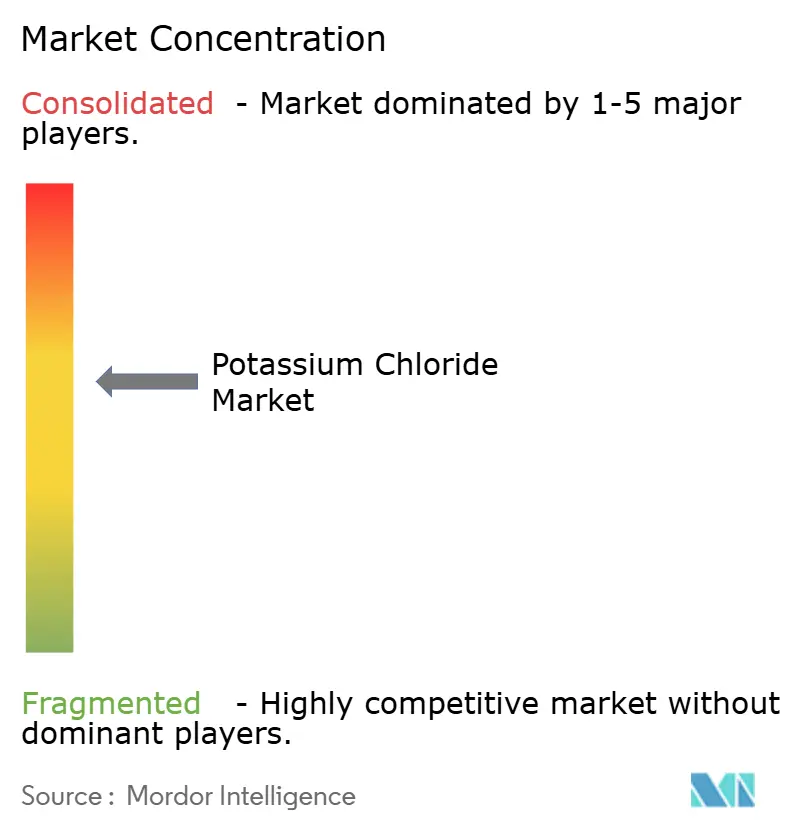
The potassium chloride market is moderately consolidated. Canada, Russia, and Belarus account for more than two-thirds of global potash export quantities, giving a small number of producing regions significant influence over trade flows. Nutrien reported record offshore potash sales quantities in 2025 and potash adjusted EBITDA of USD 2.25 billion. The company also mined 49% of its ore tons autonomously in 2025, reflecting its focus on operating efficiency. Producers that combine low-cost output with dependable export logistics hold a competitive advantage in this market.
Mosaic sold its Carlsbad, New Mexico, operation in May 2026 and concentrated muriate of potash production in Saskatchewan. The company is also expanding its Brazilian distribution network. These moves reflect how producers are balancing mine portfolios with access to high-demand agricultural regions. Specialty KCl represents a distinct competitive space, as food-grade and pharmaceutical-grade materials require certified processes and consistent purity.
The removal of U.S. restrictions on Belaruskali in March 2026 did not reopen European trade routes, as European Union sanctions remained in effect. This difference gives some U.S.-linked buyers more sourcing options than European buyers. Chinese procurement entities are seeking multi-year arrangements with Laos-based producers to diversify supply. ICL's Dead Sea operations and Arab Potash Company's Jordanian production remain relevant to Middle-Eastern and South Asian customers due to their geographic locations. EuroChem's Russian mines add significant private capacity outside Uralkali. Competition in the potassium chloride market is moving beyond quantity, with custom granules, coated products, and certified grades offering producers opportunities to improve margins.
Potassium Chloride Industry Leaders
-
Nutrien
-
The Mosaic Company
-
Uralkali PJSC
-
Belaruskali
-
K+S Aktiengesellschaft
- *Disclaimer: Major Players sorted in no particular order
Potassium Chloride Market Companies Covered in this Report
- Arab Potash Company
- Belaruskali
- Borealis AG
- Compass Minerals
- Coromandel International Limited
- EuroChem Group
- Gujarat State Fertilizers & Chemicals Ltd. (GSFC)
- ICL
- Intrepid Potash, Inc.
- K+S Aktiengesellschaft
- Nutrien
- SINOCHEM GROUP CO., LTD.
- SQM
- The Mosaic Company
- Uralkali PJSC
- Yara International ASA
Global Potassium Chloride Market Report Scope
Potassium chloride is a metal halide salt with the chemical formula KCl. It is used primarily as a medical treatment for low potassium levels, as an agricultural fertilizer, and as a low-sodium table salt substitute. It plays an essential role in regulating fluid balance, nerve signals, and heart function in the human body.
The potassium chloride market is segmented by product, crop, form, application, and geography. By product, the market is segmented into agricultural grade and chemical and industrial grade. By crop, the market is segmented into cereals, fruits and vegetables, oilseeds, and fiber and sugar. By form, the market is segmented into granular, powder, crystalline, and other forms. By application, the market is segmented into fertilizers, chemical manufacturing, food and beverage, water treatment, pharmaceutical, industrial processing, and other applications. The report also covers market size and forecasts for potassium chloride across 16 countries in major regions. The market sizes and forecasts are provided in terms of value (USD).
Segmentation Overview
| Agricultural Grade |
| Chemical and Industrial Grade |
| Cereals |
| Fruits and Vegetables |
| Oilseeds |
| Fiber and Sugar |
| Granular |
| Powder |
| Crystalline |
| Other Forms |
| Fertilizers |
| Chemical Manufacturing |
| Food and Beverage |
| Water Treatment |
| Pharmaceutical |
| Industrial Processing |
| Other Applications |
| Asia-Pacific | China |
| India | |
| Japan | |
| South Korea | |
| Rest of Asia-Pacific | |
| North America | United States |
| Canada | |
| Mexico | |
| Europe | Germany |
| United Kingdom | |
| France | |
| Italy | |
| Russia | |
| Rest of Europe | |
| South America | Brazil |
| Argentina | |
| Rest of South America | |
| Middle-East and Africa | Saudi Arabia |
| South Africa | |
| Rest of Middle-East and Africa |
| By Product | Agricultural Grade | |
| Chemical and Industrial Grade | ||
| By Crop | Cereals | |
| Fruits and Vegetables | ||
| Oilseeds | ||
| Fiber and Sugar | ||
| By Form | Granular | |
| Powder | ||
| Crystalline | ||
| Other Forms | ||
| By Application | Fertilizers | |
| Chemical Manufacturing | ||
| Food and Beverage | ||
| Water Treatment | ||
| Pharmaceutical | ||
| Industrial Processing | ||
| Other Applications | ||
| By Geography | Asia-Pacific | China |
| India | ||
| Japan | ||
| South Korea | ||
| Rest of Asia-Pacific | ||
| North America | United States | |
| Canada | ||
| Mexico | ||
| Europe | Germany | |
| United Kingdom | ||
| France | ||
| Italy | ||
| Russia | ||
| Rest of Europe | ||
| South America | Brazil | |
| Argentina | ||
| Rest of South America | ||
| Middle-East and Africa | Saudi Arabia | |
| South Africa | ||
| Rest of Middle-East and Africa | ||
Key Questions Answered in the Report
What is current market size of Potassium Chloride Market?
The potassium chloride market size was estimated at USD 26.52 billion in 2025 and is estimated to grow from USD 27.75 billion in 2026 to USD 35.64 billion by 2031, at a CAGR of 5.13% during the forecast period (2026-2031).
Which product category leads potassium chloride demand?
Agricultural-grade KCl led with a 61.74% revenue share in 2025 because it provides a cost-effective potassium source for broad-acre crops.
What is the largest application for potassium chloride?
Fertilizers accounted for an 82.03% share in 2025, reflecting the need to replace potassium removed from agricultural soils.
Which region is growing fastest for potassium chloride demand?
Asia-Pacific held a 45.22% share in 2025 and is projected to expand at a 6.15% CAGR through 2031.