
Polarization Imaging Systems For Industrial Inspection Market Size and Share
Market Overview
| Study Period | 2020 - 2031 |
|---|---|
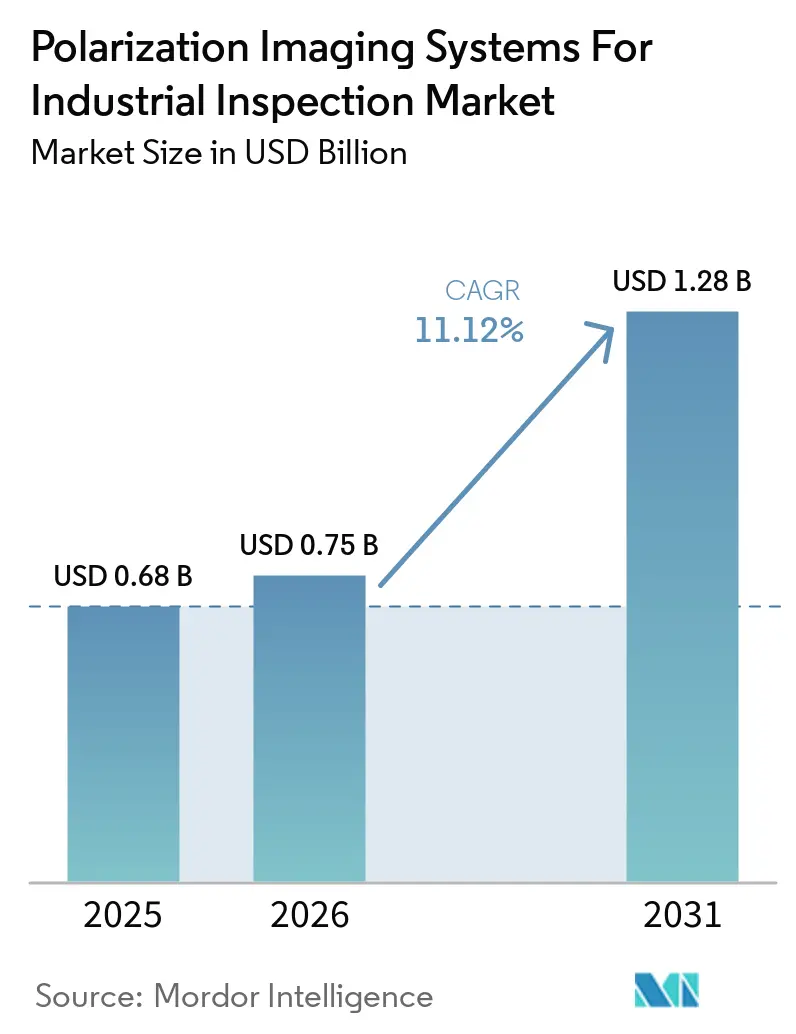
| Market Size (2026) | USD 0.75 Billion |
| Market Size (2031) | USD 1.28 Billion |
| Growth Rate (2026 - 2031) | 11.12 % |
| Fastest Growing Market | Asia-Pacific |
| Largest Market | Asia-Pacific |
| Market Concentration | Medium |
Major Players *Disclaimer: Major Players sorted in no particular order Image © Mordor Intelligence. Reuse requires attribution under CC BY 4.0. | |
Polarization Imaging Systems For Industrial Inspection Market Analysis by Mordor Intelligence
The Polarization Imaging Systems for Industrial Inspection Market size is projected to expand from USD 0.69 billion in 2025 and USD 0.76 billion in 2026 to USD 1.28 billion by 2031, registering an CAGR of 11.12% between 2026 and 2031. Manufacturers are replacing intensity-based cameras when standard optics cannot detect smaller defect targets. Polarimetric inspection is moving from specialized metrology into production-line infrastructure, especially in high-throughput facilities. A missed stress fracture or fiber misalignment can lead to product failures after shipment. Sony Polarsens IMX250MZR and IMX264MZR sensors support single-shot capture through on-chip polarizers at 0°, 45°, 90°, and 135°, which reduces integration work for equipment manufacturers.
Key Report Takeaways
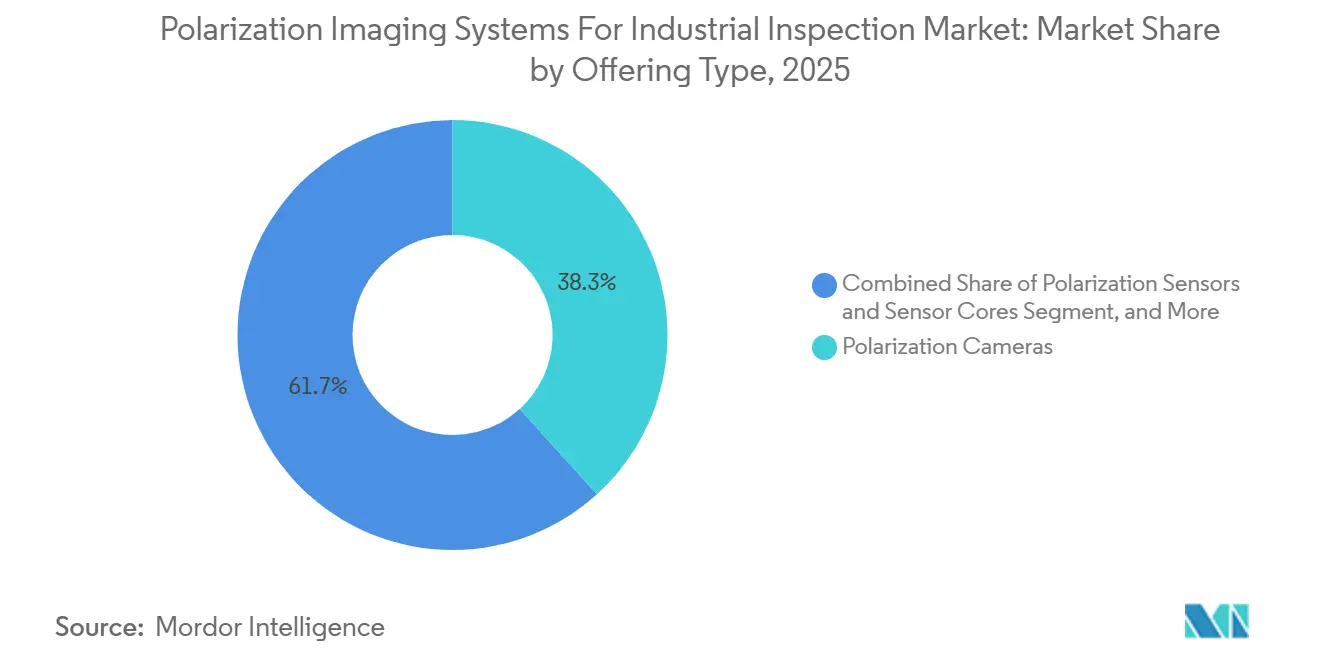
- By offering type, Polarization Cameras held 38.27% of the Polarization Imaging Systems for Industrial Inspection Market share in 2025, while Software and Analytics is projected to expand at an 11.47% CAGR through 2031.
- By system architecture, PC-Based Vision Systems held 36.43% share in 2025, while Edge-Processed Systems are projected to expand at an 11.83% CAGR through 2031.
- By polarization measurement, Linear Polarization held 48.57% share of the Polarization Imaging Systems for Industrial Inspection Market in 2025, while Full Stokes Polarization is projected to expand at an 11.68% CAGR through 2031.
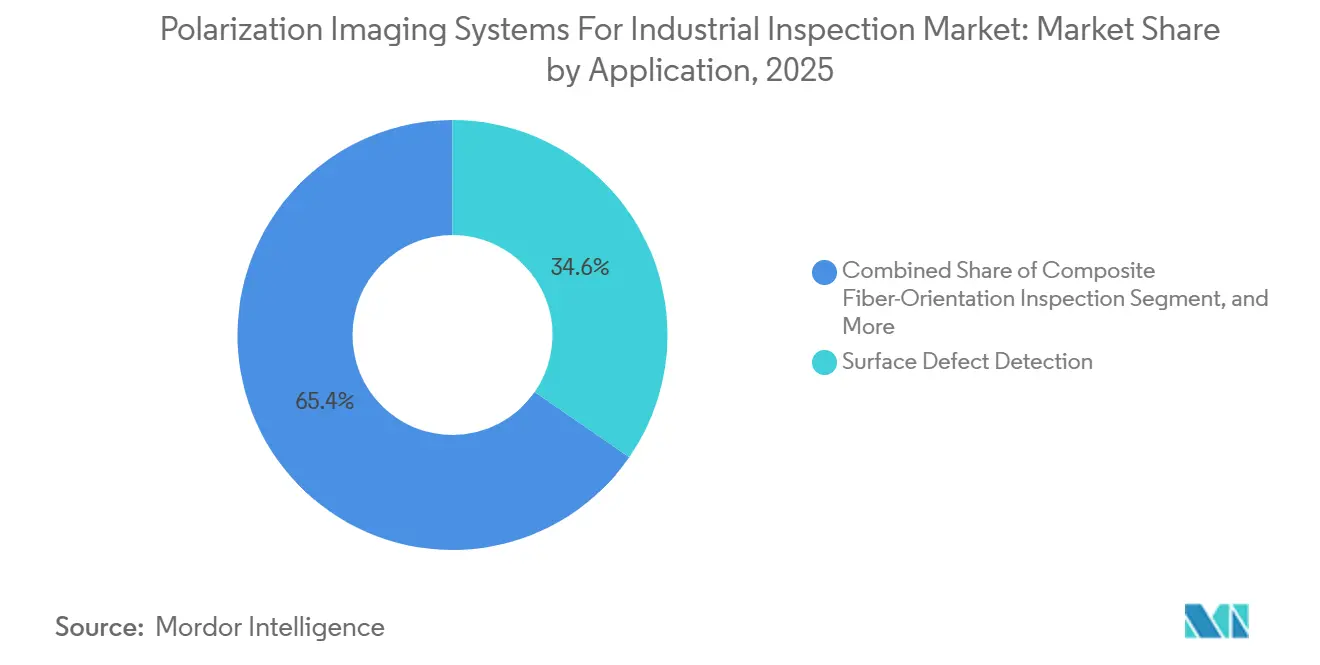
- By application, Surface Defect Detection held 34.63% share in 2025, while Composite Fiber-Orientation Inspection is projected to expand at an 11.77% CAGR through 2031.
- By end-user industry, Electronics and Semiconductor Manufacturing held 24.87% share in 2025, while Composite Materials Manufacturing is projected to expand at an 11.92% CAGR through 2031.
- By geography, Asia-Pacific held 42.68% of the Polarization Imaging Systems for Industrial Inspection Market share in 2025 and is projected to expand at an 11.59% CAGR through 2031.
Note: Market size and forecast figures in this report are generated using Mordor Intelligence’s proprietary estimation framework, updated with the latest available data and insights as of January 2026.
Global Polarization Imaging Systems For Industrial Inspection Market Trends and Insights
Drivers Impact Analysis*
| Driver | (~) % Impact on CAGR Forecast | Geographic Relevance | Impact Timeline |
|---|---|---|---|
| Expansion of Automated Quality Control | +3.5% | Global, with concentrated gains in Asia-Pacific for semiconductors and EVs, and North America and Europe for automotive and aerospace | Short term (≤ 2 years) |
| Demand for Non-Destructive Stress and Defect Detection | +2.8% | Global, especially Asia-Pacific wafer fabs and glass lines, with demand in Europe and North America for aerospace and defense | Short term (≤ 2 years) |
| Industry 4.0 and Inline Inspection Integration | +2.4% | North America and Europe, with rapidly increasing adoption in Asia-Pacific | Medium term (2-4 years) |
| Inspection of Transparent and Reflective Materials | +1.6% | Global, with early use in European glass and pharmaceutical production and Asia-Pacific displays and photovoltaics | Medium term (2-4 years) |
| Single-Shot Polarimetry for Moving Parts | +1.2% | North America and Europe for high-speed packaging and automotive paint lines, and Asia-Pacific electronics assembly | Medium term (2-4 years) |
| Production-Speed Composite Fiber Verification | +0.9% | North America and Europe for aerospace and defense, and Asia-Pacific for EV and automotive composites | Long term (≥ 4 years) |
| Source: Mordor Intelligence | |||
Expansion of Automated Quality Control
Automated optical inspection incorporates polarimetric sensing as a standard imaging channel. High-speed production lines need cameras that reveal signals unavailable through intensity or color imaging. These signals include subsurface stress in molded parts, scratches concealed by glare, and uneven birefringence in optical films. A 2025 Applied Optics study reported a 96.02% defect-recognition rate on complex curved surfaces when polarization imaging was paired with CMC color-difference analysis. The study reported a 4.12% false-positive rate, compared with 55% for standard intensity-based methods.[1]“Integrating Polarization Imaging and CIELCH Color Metrics for Robust Defect Inspection on Complex Surfaces,” Applied Optics, opg.optica.org. This performance difference supports investment decisions based on reduced defect costs rather than solely on engineering preference. The polarization imaging systems for industrial inspection market are therefore gaining relevance in quality programs where missed defects create material downstream costs.
Demand for Non-Destructive Detection of Stress and Defects
Polarimetric non-destructive testing addresses inspection tasks that X-ray and ultrasonic methods cannot always support at full production throughput. The systems reveal residual birefringent stress in glass, transparent polymers, and semiconductor wafers without sample preparation. They also allow inspection without stopping the production line. The polarization imaging systems for the industrial inspection market benefit when this evidence can be collected without interrupting throughput. A 2025 U.S. patent described a semiconductor inspection apparatus that uses a polarization camera to scan test wafers for polarization characteristics and uniformity across multilayer wiring.[2]“Inspection Apparatus for Semiconductor Device,” United States Patent 12701955, patents.us. Birefringence can show subsurface stress gradients rather than only surface defects. This capability supports inspection of battery separator films and display backlight guide plates, where internal anomalies can cause failures during use.
Industry 4.0 and Inline Inspection Integration
Inline polarimetric inspection provides a data layer that conventional intensity-based inspection cannot provide with the same detail. It can feed process-control loops with information on coating condition, stress, and optical uniformity. Research using SVS-Vistek polarization cameras demonstrated full-area monitoring of thin-film coatings in roll-to-roll production.[3]“Real-Time Imaging-Ellipsometry with a Polarization Camera in R2R-Applications,” Flexible and Printed Electronics, doi.org. The work measured coating uniformity and layer thickness at inline frame rates. Semiconductor facilities also require compatibility with OPC-UA and SECS/GEM, while European manufacturers often require PROFINET integration. Edge computation can send a process-control decision in under 10 ms, allowing adjustments before defective output builds up.
Inspection of Transparent and Reflective Materials
Glass substrates, optical films, pharmaceutical vials, and photovoltaic encapsulants are difficult to inspect with conventional cameras. Specular reflections can obscure the surface and material features that need review. Polarimetric imaging suppresses the specular component while collecting diffuse, birefringent, and depolarized signals. A 2026 study validated layer-thickness estimation from polarization ratios in roll-to-roll battery electrolyte coatings on copper foil. Display manufacturers in Asia-Pacific are tightening birefringence requirements for OLED substrates. European automotive glazing producers are also applying polarimetric stress verification after tempering, which broadens the relevant production volume.
Restraints Impact Analysis*
| Restraint | (~) % Impact on CAGR Forecast | Geographic Relevance | Impact Timeline |
|---|---|---|---|
| High Initial System and Integration Cost | -0.7% | Global, with the greatest pressure in South America, Southeast Asia, and the Middle East and Africa | Short term (≤ 2 years) |
| Shortage of Polarimetric Imaging and Machine-Vision Expertise | -0.4% | Global, especially emerging manufacturing hubs in Southeast Asia and South America | Medium term (2-4 years) |
| Calibration Drift Across Lighting, Angles, and Production Batches | -0.3% | Global, with particular difficulty in high-temperature glass and composite manufacturing | Medium term (2-4 years) |
| Limited Customer-Specific Training Data for Defect Models | -0.2% | Global, particularly for new adopters in emerging end-user applications | Long term (≥ 4 years) |
| Source: Mordor Intelligence | |||
High Initial System and Integration Cost
A production-ready polarimetric station requires more than a camera. It also requires matched lighting, polarization-aware optics, real-time Stokes computation, and host-control integration. The combined system cost is frequently 3 to 5 times that of a comparable intensity-based automated optical inspection installation. Large manufacturers can spread that cost across higher output volumes. Mid-scale producers in South America and Southeast Asia often face tighter capital budgets despite similar quality demands from automotive and electronics customers. Changes in part geometry, material, or lighting can also require skilled reconfiguration, although IATF 16949 and ISO 9001 requirements encourage documented and repeatable inspection practices.
Shortage of Polarimetric Imaging and Machine-Vision Expertise
The shortage of specialists, in the polarization imaging systems for industrial inspection market, limits adoption outside a small group of technically advanced users. Production deployment requires knowledge of Mueller matrices, Stokes vectors, illumination geometry, and optical calibration. These capabilities are not usually taught in standard machine-vision or factory-automation programs. As a result, cameras can perform below their specifications when operators cannot configure the system correctly. Basler’s 2025 annual report described an investment in integrated, application-ready vision systems rather than standalone components. Integrated systems can reduce the configuration burden, but formal training and certification remain important for reliable implementation.
*Our forecasts treat driver/restraint impacts as directional, not additive. The impact forecasts reflect baseline growth, mix effects, and variable interactions.
Segment Analysis
By Offering Type: Cameras Lead While Software Expands the Value Chain
Polarization Cameras held 38.27% of the Polarization Imaging Systems for Industrial Inspection Market share in 2025. Their position reflects upgrades to existing GigE Vision and USB3 Vision installations. Facilities can adopt compatible camera modules without replacing downstream infrastructure. Sony IMX250MZR and IMX264MZR sensors offer four simultaneous polarization directions. Allied Vision, JAI, LUCID Vision Labs, Daheng Imaging, and Baumer Optronic use these sensor families in relevant products. Their use has established a practical reference design for industrial camera suppliers. The camera segment, therefore, fits both replacement projects and new machine-vision installations.
Software and Analytics is projected to expand at an 11.47% CAGR from 2026 to 2031. Its momentum reflects the importance of extracting Stokes parameters and classifying defects after sensor hardware becomes more widely available. Deep learning can help turn the resulting data into inspection decisions. A 2026 Light: Science and Applications demonstration showed real-time, full-Stokes hyperspectral polarimetric reconstruction with a deep-learning-enabled infrared meta-sensor. Polarization Sensors and Sensor Cores serve equipment makers that embed sensing in custom instruments. Polarizing Filters, Retarders, and Optics support rheometers, inline ellipsometers, and hyperspectral systems. Complete Inspection Systems and Services appeal to pharmaceutical and food producers that favor validated turnkey equipment and documented processes.



By System Architecture: Edge Processing Supports Faster Line Decisions
PC-Based Vision Systems held 36.43% of the Polarization Imaging Systems for Industrial Inspection Market share in 2025. Their installed base benefits from mature host-computing hardware and established full-Stokes processing libraries. These systems can use conventional x86 computing platforms for detailed analysis. Standalone Camera Systems are used in embedded and cost-sensitive deployments. They typically complete limited calculations, such as Degree of Linear Polarization and Angle of Linear Polarization, inside the camera. That capability supports surface-defect detection and reflection suppression. Cloud-Connected Inspection Systems remain limited where production decisions cannot accommodate network delays.
Edge-Processed Systems is projected to expand at an 11.83% CAGR from 2026 to 2031. Lines operating at 500 to 1,000 parts per minute require defect decisions close to the sensor. Transferring data to a remote server can create unacceptable delays. Allied Vision’s Alecs platform combines industrial imaging with NVIDIA edge-AI processing in an IP67 enclosure. The platform supports camera-level defect classification without a separate industrial PC. Edge designs also reduce dependence on a central network connection. This can avoid a single operational failure point when network disruption would otherwise stop a production line. This operational requirement is central to the polarization imaging systems for industrial inspection market for continuous manufacturing settings.
By Polarization Measurement: Full Stokes Broadens Inspection Capability
Linear Polarization held 48.57% of the Polarization Imaging Systems for Industrial Inspection Market share in 2025. Sony Polarsens-based cameras support this method through four simultaneous polarization angles. The cameras generate Degree of Linear Polarization and Angle of Linear Polarization data directly. Linear data is suitable for many surface-inspection tasks. It can reduce glare on metallic and coated surfaces. It also supports the detection of scratches and other visible defects. Circular Polarization serves narrower applications involving optical activity in chiral pharmaceutical compounds and certain birefringent polymers.
Full Stokes Polarization is projected to expand at an 11.68% CAGR from 2026 to 2031. It captures S₀, S₁, S₂, and S₃, including circular-polarization information. This additional channel can support inspection tasks that linear systems cannot resolve. Research on carbon fiber-reinforced composites showed that THz polarimetric response can provide subsurface information for delamination assessment. Facilities using linear inspection can add full-Stokes analytics to address a second set of challenges. This approach can expand the utility of installed hardware. It also raises the value of software and calibration capabilities within the polarization imaging systems for industrial inspection market. The polarization imaging systems for industrial inspection market can use that software layer to extend existing inspection deployments.
By Application: Composite Inspection Moves Into Production Lines
Surface Defect Detection held 34.63% of the Polarization Imaging Systems for Industrial Inspection Market share in 2025. The application is widely used because glare suppression can improve contrast for scratches, micro-cracks, and contamination. Stress and Birefringence Analysis is important for glass, optical components, and transparent polymers. In these materials, mechanical and thermal stress affect product quality. Research from TU Wien demonstrated inline imaging ellipsometry with polarization cameras for coatings from 0 to 500 nm thick. Transparent Material and Glass Inspection serves high-value applications where polarimetric information is essential. Measurement, Metrology, and Material Characterization support related specialized inspection needs.
Composite Fiber-Orientation Inspection is projected to expand at an 11.77% CAGR from 2026 to 2031. A 2024 Sensors study found that Sony IMX250MZR-based polarization vision achieved sub-degree angular accuracy for fiber orientation in dry and cured CFRP materials. This supports measurement at production speed rather than only laboratory qualification. EV battery structural casings increasingly use CFRP or glass-fiber composites. Automotive manufacturers are extending fiber-orientation verification requirements to battery-enclosure suppliers. The use case therefore reaches into the EV supply chain. It also makes fiber-angle verification a production quality requirement for more components. The polarization imaging systems for industrial inspection market is supported when composite checks are included in normal production workflows.
By End-User Industry: Electronics Leads While Composites Accelerate
Electronics and Semiconductor Manufacturing held 24.87% of the Polarization Imaging Systems for Industrial Inspection Market share in 2025. Wafer stress mapping is a core use case in this customer group. Other uses include package-level birefringence screening and display-glass inspection. A 2025 U.S. patent described a polarization-camera method for scanning test wafers and measuring reflected-light properties. The method included layer exposure through a milling device. Automotive and Electric Vehicle Manufacturing also uses polarimetry for metallic-panel inspection. The segment additionally requires verification of lightweight composite structures. The polarization imaging systems for the industrial inspection market serve this need across both metallic finishes and composite parts.
Composite Materials Manufacturing is projected to expand at an 11.92% CAGR from 2026 to 2031. Aerospace primes and Tier 1 automotive suppliers are increasingly requiring fiber-angle inspection as a documented manufacturing step. A 2025 Composites Part B study validated polarization-based quantitative fiber-orientation analysis against X-ray computed tomography. This paired validation supports the use of polarimetric data in regulated quality reviews. Glass Manufacturing and Plastics and Polymer Manufacturing provide further opportunities for stress and surface inspection. Pharmaceutical and Medical Device Manufacturing require vial and blister-pack inspection. Packaging, Energy and Utilities, and Food and Beverage Manufacturing can use glare suppression to improve foreign-body and surface-defect detection.
Geography Analysis
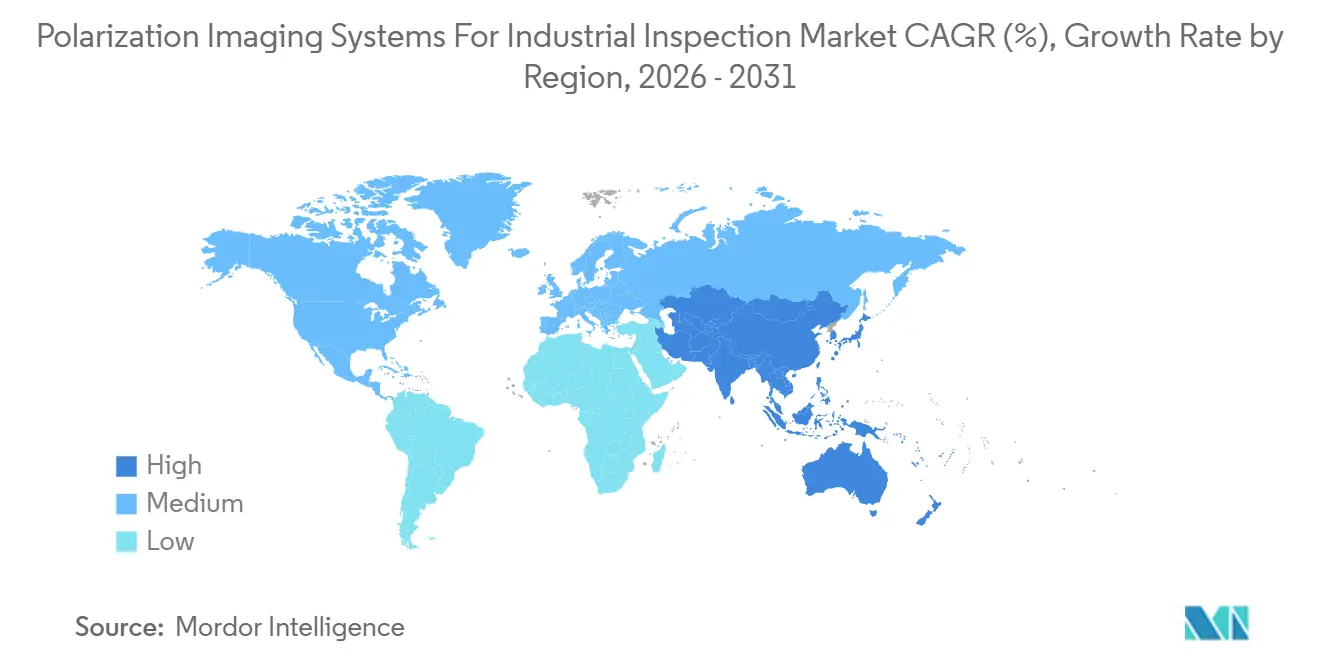
Asia-Pacific held 42.68% of the Polarization Imaging Systems for Industrial Inspection Market share in 2025 and is projected to expand at an 11.59% CAGR through 2031. South Korea, Japan, and Taiwan support demand through semiconductor and display manufacturing. Wafer stress mapping and panel birefringence inspection are established quality steps in these locations. China is moving from imported equipment toward locally developed platforms. These platforms combine polarization cameras with unified Stokes-parameter calibration software. This change supports Chinese equipment makers that aim to compete in system integration. The polarization imaging systems for the industrial inspection market can consequently benefit from a broader group of system suppliers in the region. EV and battery production also increases demand for inspection of electrode coatings and separator films.
North America and Europe are major regions with different demand patterns. North America benefits from semiconductor manufacturing investment and aerospace composite inspection. Domestic fab buildout supports demand for wafer-related inspection equipment. FAA structural certification requirements also support composite verification in aerospace. A3 released GigE Vision 3.0 in May 2026, adding RDMA over Converged Ethernet. The standard allows cameras to send data directly to system memory without CPU intervention. LUCID Vision Labs’ Triton10 line applies the GigE Vision 3.0 RDMA streaming specification in commercial hardware.
Europe is strong in automotive composite inspection, pharmaceutical and photovoltaic coating inspection, and glass manufacturing. Germany has a notable role in automotive composite applications. Austria, Germany, and the Netherlands contribute coating and photovoltaic demand. TU Wien’s work with SVS-Vistek cameras has informed inline coating inspection installationsx. South America, the Middle East and Africa, and emerging Southeast Asian economies remain smaller opportunities. Brazil and Argentina offer entry points through automotive assembly and agricultural processing. The Middle East has niche demand in petrochemical and energy infrastructure. South Africa offers structured opportunities through mining and automotive activity, while export-customer quality requirements remain an important adoption mechanism across these regions.

Competitive Landscape
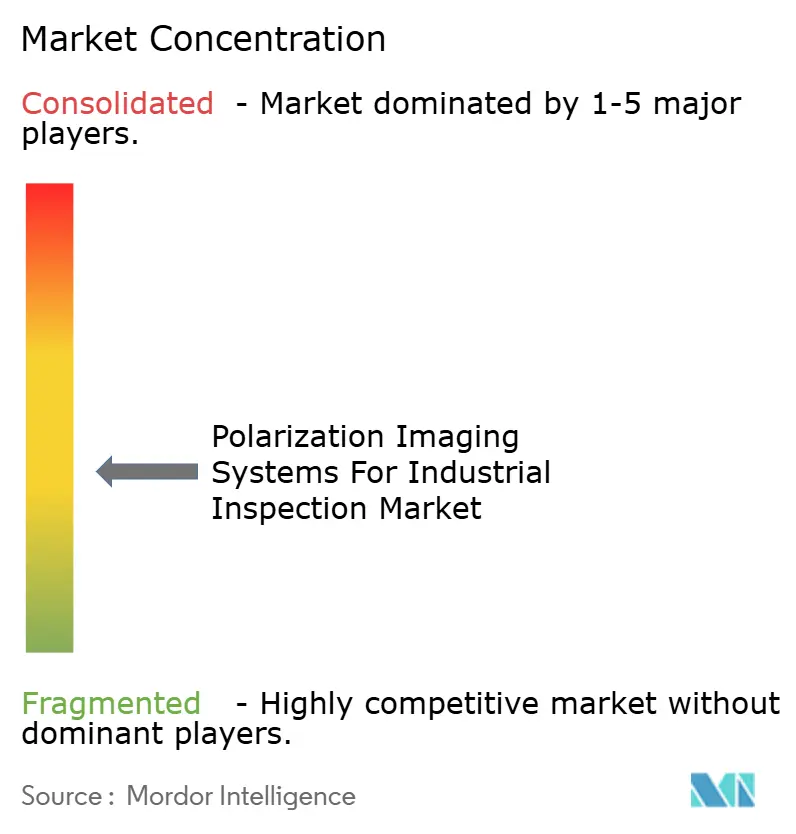
The polarization imaging systems for the industrial inspection market are moderately fragmented. Allied Vision Technologies, Basler AG, Teledyne DALSA, JAI, and IDS Imaging Development Systems compete alongside Photron, Hinds Instruments, and Alkeria. Larger suppliers combine polarimetric products with wider industrial imaging portfolios. Specialized suppliers focus on demanding measurement applications. Basler reported 2025 revenue of EUR 224.5 million (USD 244.7 million), incoming orders of EUR 237.1 million (USD 258.4 million), and an EBIT margin of 7.9%. The company linked demand to projects in battery production, logistics automation, and AI hardware inspection. These results reflected an improving environment for industrial vision suppliers. The polarization imaging systems for the industrial inspection market draw on this wider industrial-vision demand base.
Competition is moving beyond sensor specifications because many manufacturers use the same Sony Polarsens CMOS foundation. Software completeness, edge processing, and application-specific calibration now carry more weight. Allied Vision showed the Alecs open smart camera platform at Automate 2026. It combines industrial image acquisition and NVIDIA edge-AI processing in one IP67 housing. Basler and Orbbec announced a March 2026 partnership for industrial 3D vision solutions for factory and logistics automation. Their first product, the Basler Stereo mini 3D camera, supports AMR navigation and bin-picking workflows. These moves show how suppliers are widening their automation offerings.
Photron’s RHEO-Iris integration with Anton Paar MCR rheometers enables high-speed birefringence measurement at up to 250 full frames per second. This approach serves a specialized measurement application rather than a broad camera platform. Suppliers in Asia-Pacific are also building interoperability layers across camera brands. Automated calibration and drift-compensation software remains an important opportunity in the polarization imaging systems for industrial inspection market. Manual recalibration uses engineering time and can delay new part introduction. Suppliers that provide drift detection, remote firmware updates, and traceable calibration records can improve inspection reliability. The polarization imaging systems for industrial inspection market can reward suppliers that make these processes easier for plant teams. The polarization imaging systems for industrial inspection industry is therefore competing on system performance and support, not only camera hardware. The polarization imaging systems for industrial inspection industry also benefits when service models extend revenue beyond hardware replacement cycles.
Polarization Imaging Systems For Industrial Inspection Industry Leaders
Teledyne DALSA, Inc.
Allied Vision Technologies GmbH
JAI A/S
IDS Imaging Development Systems GmbH
Basler AG
- *Disclaimer: Major Players sorted in no particular order

Recent Industry Developments
- August 2026: LUCID Vision Labs launched the Triton TRI055N, a 5.0 MP GigE camera featuring onsemi's AR0521 backside-illuminated CMOS sensor with 2592 × 1944 resolution, 69.2 dB dynamic range, and up to 22.1 fps, expanding the company's inspection-grade GigE portfolio for cost-sensitive, high-dynamic-range applications in electronics assembly and packaging inspection.
- August 2026: LUCID Vision Labs announced the Triton 10 8K line scan camera, combining 10GigE performance with GigE Vision 3.0 RDMA support and an IP67 Factory Tough enclosure, targeting high-bandwidth industrial applications including automated optical inspection, material sorting, print inspection, and surface inspection.
- June 2026: Allied Vision showcased the Alecs open smart camera platform at Automate 2026 in Chicago, integrating industrial image acquisition with NVIDIA edge-AI processing in a single IP67 housing, enabling on-camera deep-learning-based defect classification with eVision AI software and eliminating the requirement for a separate host PC.
- May 2026: The Association for Advancing Automation officially released GigE Vision 3.0, incorporating RDMA over Converged Ethernet, enabling machine vision cameras to stream data directly to system memory without CPU intervention and supporting bandwidths to 400G.


Global Polarization Imaging Systems For Industrial Inspection Market Report Scope
Polarization Imaging Systems for Industrial Inspection Market refers to cameras, sensors, and integrated machine-vision solutions that capture and analyze the polarization state of light (e.g., Stokes parameters, degree, and angle of polarization) to reveal surface, subsurface, and material properties invisible to conventional intensity-only imaging. These systems include polarization cameras (on-chip polarizers or external polarizers), polarization light sources, lenses, and software for inline stress analysis, defect detection, and material differentiation.
The Polarization Imaging Systems for Industrial Inspection Market Report is Segmented by Offering Type (Polarization Cameras, Polarization Sensors and Sensor Cores, Polarizing Filters, Retarders, and Optics, Complete Inspection Systems, Software and Analytics, and Services), System Architecture (Standalone Camera Systems, PC-Based Vision Systems, Edge-Processed Systems, and Cloud-Connected Inspection Systems), Polarization Measurement (Linear Polarization, Circular Polarization, and Full Stokes Polarization), Application (Surface Defect Detection, Stress and Birefringence Analysis, Composite Fiber-Orientation Inspection, Transparent Material and Glass Inspection, and Measurement, Metrology, and Material Characterization), End-User Industry (Electronics, Automotive, Glass, Plastics, Composites, Aerospace, Packaging, Food, Pharma, Energy, Others), and Geography (North America, South America, Europe, Asia-Pacific, Middle East and Africa). Forecasts are Provided in Terms of Value (USD).
| Polarization Cameras |
| Polarization Sensors and Sensor Cores |
| Polarizing Filters, Retarders, and Optics |
| Complete Inspection Systems |
| Software and Analytics |
| Services |
| Standalone Camera Systems |
| PC-Based Vision Systems |
| Edge-Processed Systems |
| Cloud-Connected Inspection Systems |
| Linear Polarization |
| Circular Polarization |
| Full Stokes Polarization |
| Surface Defect Detection |
| Stress and Birefringence Analysis |
| Composite Fiber-Orientation Inspection |
| Transparent Material and Glass Inspection |
| Measurement, Metrology, and Material Characterization |
| Electronics and Semiconductor Manufacturing |
| Automotive and Electric Vehicle Manufacturing |
| Glass Manufacturing |
| Plastics and Polymer Manufacturing |
| Composite Materials Manufacturing |
| Aerospace and Defense Manufacturing |
| Packaging and Container Manufacturing |
| Food and Beverage Manufacturing |
| Pharmaceutical and Medical Device Manufacturing |
| Energy and Utilities |
| Other Industrial Manufacturing |
| North America | United States | |
| Canada | ||
| Mexico | ||
| South America | Brazil | |
| Argentina | ||
| Rest of South America | ||
| Europe | Germany | |
| United Kingdom | ||
| France | ||
| Italy | ||
| Spain | ||
| Rest of Europe | ||
| Asia-Pacific | China | |
| Japan | ||
| India | ||
| South Korea | ||
| ASEAN | ||
| Rest of Asia-Pacific | ||
| Middle East and Africa | Middle East | Saudi Arabia |
| United Arab Emirates | ||
| Turkey | ||
| Rest of the Middle East | ||
| Africa | South Africa | |
| Nigeria | ||
| Rest of Africa | ||
| By Offering Type | Polarization Cameras | ||
| Polarization Sensors and Sensor Cores | |||
| Polarizing Filters, Retarders, and Optics | |||
| Complete Inspection Systems | |||
| Software and Analytics | |||
| Services | |||
| By System Architecture | Standalone Camera Systems | ||
| PC-Based Vision Systems | |||
| Edge-Processed Systems | |||
| Cloud-Connected Inspection Systems | |||
| By Polarization Measurement | Linear Polarization | ||
| Circular Polarization | |||
| Full Stokes Polarization | |||
| By Application | Surface Defect Detection | ||
| Stress and Birefringence Analysis | |||
| Composite Fiber-Orientation Inspection | |||
| Transparent Material and Glass Inspection | |||
| Measurement, Metrology, and Material Characterization | |||
| By End-User Industry | Electronics and Semiconductor Manufacturing | ||
| Automotive and Electric Vehicle Manufacturing | |||
| Glass Manufacturing | |||
| Plastics and Polymer Manufacturing | |||
| Composite Materials Manufacturing | |||
| Aerospace and Defense Manufacturing | |||
| Packaging and Container Manufacturing | |||
| Food and Beverage Manufacturing | |||
| Pharmaceutical and Medical Device Manufacturing | |||
| Energy and Utilities | |||
| Other Industrial Manufacturing | |||
| By Geography | North America | United States | |
| Canada | |||
| Mexico | |||
| South America | Brazil | ||
| Argentina | |||
| Rest of South America | |||
| Europe | Germany | ||
| United Kingdom | |||
| France | |||
| Italy | |||
| Spain | |||
| Rest of Europe | |||
| Asia-Pacific | China | ||
| Japan | |||
| India | |||
| South Korea | |||
| ASEAN | |||
| Rest of Asia-Pacific | |||
| Middle East and Africa | Middle East | Saudi Arabia | |
| United Arab Emirates | |||
| Turkey | |||
| Rest of the Middle East | |||
| Africa | South Africa | ||
| Nigeria | |||
| Rest of Africa | |||


Key Questions Answered in the Report
What is the size of the Polarization Imaging Systems for Industrial Inspection Market?
The market was USD 0.76 billion in 2026 and is projected to reach USD 1.28 billion by 2031 at an 11.12% CAGR.
What is driving adoption of polarization imaging for industrial inspection?
Automated quality control, non-destructive stress detection, inline process integration, and inspection of reflective or transparent materials support adoption.
Which offering type leads polarization imaging for industrial inspection?
Polarization Cameras led the offering mix with 38.27% share in 2025, while Software and Analytics is projected to expand at an 11.47% CAGR.
Why are edge-processed inspection systems gaining use?
Edge systems can make local inspection decisions for high-speed lines and reduce reliance on cloud connectivity or separate industrial PCs.
Which region leads demand for polarization imaging systems?
Asia-Pacific led with 42.68% share in 2025 and is projected to expand at an 11.59% CAGR through 2031.
Which applications support composite inspection demand?
Fiber-orientation inspection supports CFRP quality control in automotive, EV battery enclosure, and aerospace component production. These needs support adoption across the polarization imaging systems for industrial inspection market.
Page last updated on:





