
Plug-in (Balcony) Solar PV Market Size and Share
Market Overview
| Study Period | 2022 - 2032 |
|---|---|
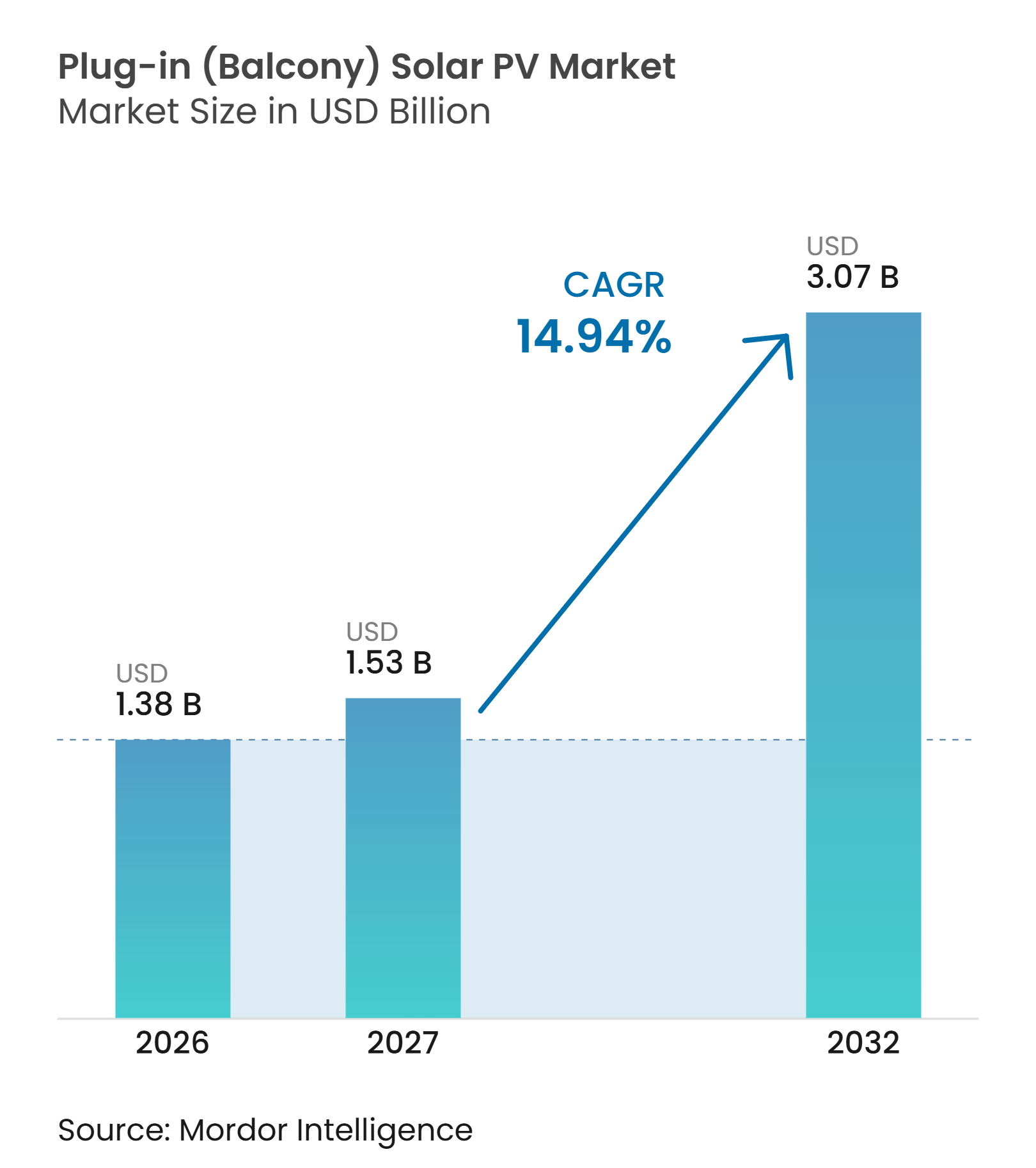
| Market Size (2027) | USD 1.53 Billion |
| Market Size (2032) | USD 3.07 Billion |
| Growth Rate (2027 - 2032) | 14.94 % |
| Fastest Growing Market | Asia-Pacific |
| Largest Market | Europe |
| Market Concentration | High |
Major Players *Disclaimer: Major Players sorted in no particular order Image © Mordor Intelligence. Reuse requires attribution under CC BY 4.0. | |
Plug-in (Balcony) Solar PV Market Analysis by Mordor Intelligence
The Plug-in Solar PV Market size was valued at USD 1.38 billion in 2026 and is estimated to grow from USD 1.53 billion in 2027 to reach USD 3.07 billion by 2032, at a CAGR of 14.94% during the forecast period (2027-2032). The Global Plug-in (Balcony) Solar PV market is moving beyond early urban trials as simplified rules make small residential systems easier to buy and connect. Regulatory changes in Europe have reduced the administrative burden for households, while product standards are beginning to provide clearer safety and connection requirements. Falling kit prices have widened access for renters and apartment residents who cannot install rooftop systems. Storage is becoming more important because it helps households use more of their own generation during evening demand. Manufacturers are responding with modular batteries, direct retail channels, and energy management features that make small systems more useful in daily household use.
Key Report Takeaways
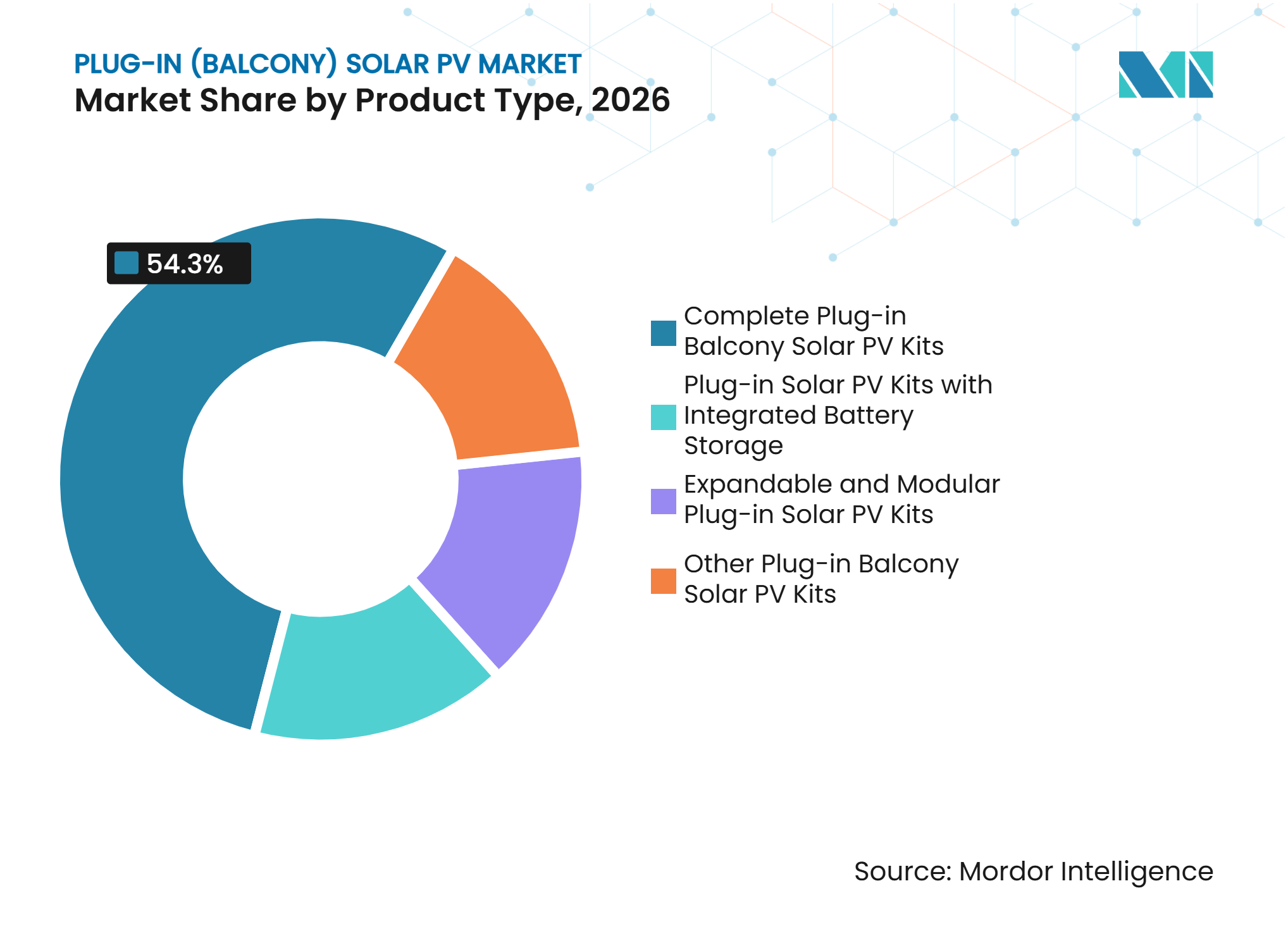
- By product type, Complete Plug-in Balcony Solar PV Kits held 54.3% of the 2026 revenue share, while Plug-in Solar PV Kits with Integrated Battery Storage are projected to grow at a 15.5% CAGR through 2032.
- By installed capacity, 600-800 W systems held 34.7% of Plug-in Balcony Solar PV market size in 2026, while Above-1,000 W systems are projected to grow at a 15.2% CAGR through 2032.
- By mounting type, Balcony Railing-Mounted Systems held 43.2% of the 2026 revenue share, while Terrace and Flat-Surface-Mounted Systems are projected to grow at a 15.7% CAGR through 2032.
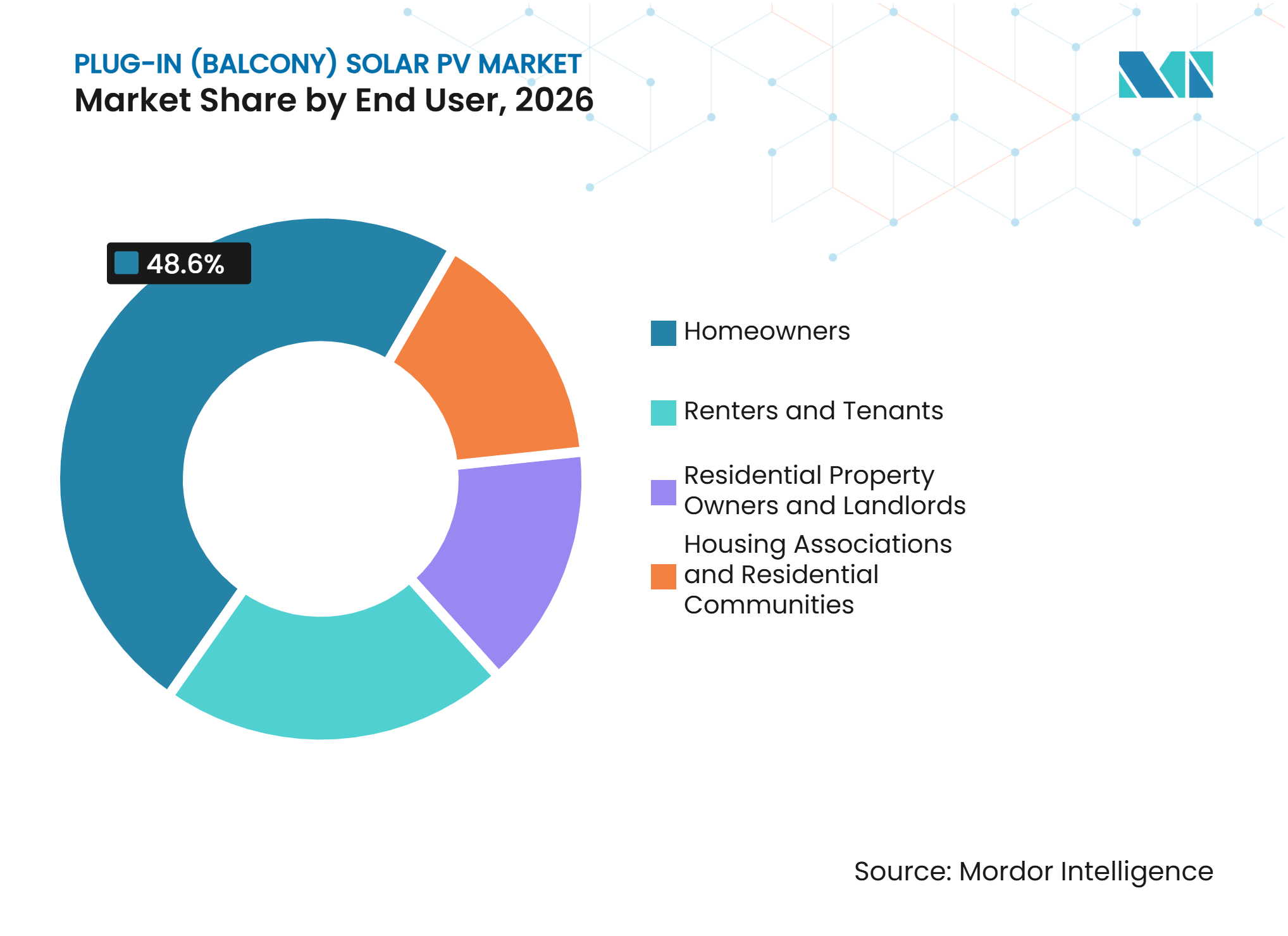
- By end user, Homeowners held 48.6% of the 2026 revenue share, while Renters and Tenants are projected to grow at a 16.1% CAGR through 2032.
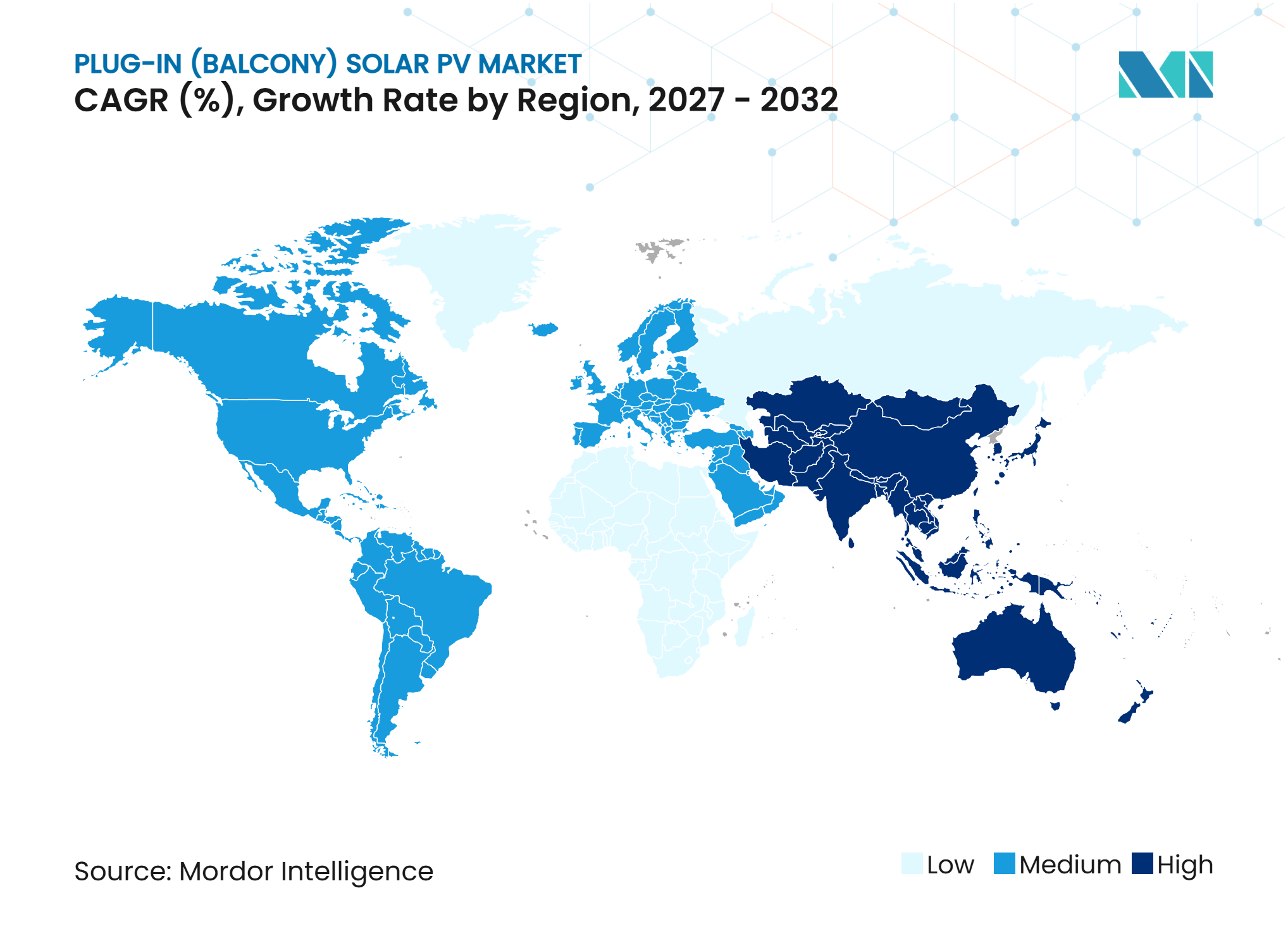
- By geography, Europe held 68.5% of the 2026 revenue share in Plug-in Balcony Solar PV industry, while Asia-Pacific is projected to grow at a 16.4% CAGR through 2032.
Note: Market numbers in this report are based on Mordor Intelligence's proprietary estimation framework, which combines nine months of actuals with Q4 projections for base year 2026.
Market Trends and Insights
Drivers Impact Analysis of Plug-in (Balcony) Solar PV Market*
| Driver | (~) % Impact on CAGR Forecast | Geographic Relevance | Impact Timeline |
|---|---|---|---|
| Simplified Plug-in PV Rules and Registration | +3.5% | Europe, with spillover to Asia-Pacific | Short term (≤ 2 years) |
| Apartment and Renter Access to Distributed Solar | +2.8% | Europe and high-density Asia-Pacific cities | Medium term (2-4 years) |
| Rising Residential Electricity Costs and Self-Consumption Economics | +4.0% | Global, with strongest relevance in Europe and Australia | Medium term (2-4 years) |
| Integrated Storage for Evening Load Shifting | +2.5% | Europe, with spillover to Asia-Pacific | Medium term (2-4 years) |
| Direct-to-Consumer and Hardware-Retail Distribution | +1.8% | Europe and North America | Medium term (2-4 years) |
| Multi-MPPT Optimization for Shaded and Irregular Facades | +1.2% | Global, especially dense urban areas | Long term (≥ 4 years) |
| Source: Mordor Intelligence | |||
Simplified Plug-in PV Rules and Registration
Germany’s Solar Package I permits plug-in solar devices with inverter output of up to 800 VA and module capacity of up to 2,000 Wp, subject to an online entry in the Marktstammdatenregister. The Global Plug-in (Balcony) Solar PV market benefits when a household can complete registration without waiting for grid operator approval. Germany’s Verband der Elektrotechnik Elektronik Informationstechnik e.V. (VDE) published DIN VDE V 0126-95 in December 2025, establishing dedicated requirements for construction, performance, and electrical connection of plug-in solar devices. The standard permits household-socket connection where the socket base and electrical installation meet safety requirements. EU Directive 2024/1711 also calls on member states to support plug-in systems of up to 800 W, giving national reforms a clearer legal basis. These measures give suppliers a more predictable route to develop compliant products for European households.[1][2]
Apartment and Renter Access to Distributed Solar
German tenants and apartment owners have held a legally enforceable right to install balcony power plants since October 2024, with refusal limited to exceptional and substantiated circumstances. The rule expands access to solar generation for residents who do not own a roof or a detached home. This change gives the Global Plug-in (Balcony) Solar PV market a route into rental housing that conventional rooftop solar has not consistently served. It also makes the Global Plug-in (Balcony) Solar PV market more relevant to the large share of households living in multifamily housing. France has confirmed that plug-and-play kits can qualify for individual self-consumption, although the application of NF C15-100 remains unclear for standard socket connections. The Dutch House of Representatives passed a November 2026 motion directing the government to develop a balcony solar framework by spring 2027. Suppliers are therefore placing greater emphasis on light, portable equipment that residents can take with them when they move.[2]
Rising Residential Electricity Costs and Self-Consumption Economics
The European Commission’s 2025 guidance on renewable network tariffs identifies small-scale renewable generation to reduce household energy bills. A balcony system allows households to use electricity at the point of generation instead of drawing the same volume from the grid. The Global Plug-in (Balcony) Solar PV market therefore relies on a simple proposition, particularly in regions with high retail power prices. This relationship gives the Global Plug-in (Balcony) Solar PV market a clear link to changing household energy costs. The appeal does not depend on a major construction project or a long installation period. The Commission’s guidance asks national regulators to avoid tariff designs that disadvantage micro-generators, which supports the economic case for household solar. China faces a different adoption environment because lower residential tariffs reduce the savings available from self-consumption, even as its manufacturers supply equipment to export markets.[3]
Integrated Storage for Evening Load Shifting
Storage addresses the gap between daytime solar generation and household demand that often rises in the evening. It also helps systems operate within grid-feed limits while directing stored electricity to appliances behind the meter. The Global Plug-in (Balcony) Solar PV market is increasingly shaped by products that combine a microinverter, battery, and control software in one unit. Storage-led product design is becoming a central part of the Global Plug-in (Balcony) Solar PV market. Anker introduced the SOLIX Solarbank 3 Pro in April 2025 with 2,688 Wh capacity, expansion capability to 16 kWh, and energy management designed for dynamic tariffs. EcoFlow’s STREAM series uses coordinated batteries to route power to household loads, which increases the practical use of solar output within a compliant system. As more households choose air conditioning, induction cooking, or washing during evening hours, storage changes the value of a balcony system from bill reduction alone to flexible on-site power use.
Restraints Impact Analysis of Plug-in (Balcony) Solar PV Market*
| Restraint | (~) % Impact on CAGR Forecast | Geographic Relevance | Impact Timeline |
|---|---|---|---|
| Inconsistent National Connection and Safety Standards | -1.5% | Europe and North America | Medium term (2-4 years) |
| Landlord, Condominium and Structural-Load Permissions | -1.2% | Global, with strong relevance in Asia-Pacific high-rise housing and Southern Europe | Medium term (2-4 years) |
| Low Winter Yield and Balcony Orientation Constraints | -0.8% | Northern and Central Europe and North America | Long term (≥ 4 years) |
| Battery Economics, Conversion Losses and Limited Cycling | -0.9% | Global | Medium term (2-4 years) |
| Source: Mordor Intelligence | |||
Inconsistent National Connection and Safety Standards
A unified EU technical standard for grid-connected generators below 800 W has not yet been established. EU grid connection requirements cover generators with 800 W AC or more, leaving lower-power systems subject to national rules. This patchwork raises the cost of developing a single product range for several countries. France’s NF C15-100, effective from September 2025, states that electrical generators should not connect to terminal circuits through standard socket outlets. The application of that wording to plug-and-play equipment remains unresolved, which creates uncertainty for suppliers and buyers. In the United States, UL 3700 provides an investigation outline for interactive plug-in PV equipment, while local authorities can still interpret connection practices differently.
Landlord, Condominium and Structural-Load Permissions
Legal rights to install a system do not remove every practical permission issue. Renters may still need to consult a landlord, building manager, condominium association, or property management company before mounting equipment. Sealed balconies, building rules, and concerns about the appearance of facades can limit installations in high-rise housing. Heavy glass-based modules can also require a review of railing strength and structural loading. These limits are particularly relevant in China, Vietnam, Japan, and South Korea, where high-rise housing is common. Lower household electricity prices in China add a further barrier because they lengthen the financial return available from self-consumption.
*Our forecasts treat driver/restraint impacts as directional, not additive. The impact forecasts reflect baseline growth, mix effects, and variable interactions.
Plug-in (Balcony) Solar PV Market Segment Analysis
By Product Type:
Complete Kits Lead While Storage Systems Extend Household UseComplete Plug-in Balcony Solar PV Kits held 54.3% of the Global Plug-in (Balcony) Solar PV market share in 2026. These products give first-time buyers a direct entry point because they typically combine 2 panels, a microinverter, and a cable in one package. Their appeal rests on limited setup work and the absence of a major home alteration. Stiftung Warentest found in May 2025 that 8 balcony kit models could be set up in less than 30 minutes. The systems are particularly relevant for urban residents who want a straightforward route to self-consumption. Complete kits also fit the direct-to-consumer retail approach used by many specialist sellers.
Plug-in Solar PV Kits with Integrated Battery Storage are forecast to grow at a 15.5% CAGR from 2027 to 2032. These systems combine battery capacity with a microinverter and controls, allowing users to retain more daytime generation for later use. EcoFlow’s STREAM Ultra X launched in August 2025 with 3.84 kWh capacity, while Growatt’s NEXA 2000 brought 4 Maximum Power Point Tracking (MPPT) channels and expandable capacity into the category. Expandable systems also reduce the pressure to make a final capacity decision at the first purchase. Jackery, Zendure, and BLUETTI have used modular designs that can grow with household needs. Other configurations, including decorative and building-integrated options, remain smaller but can serve properties where standard panels are not suitable.



By Installed Capacity:
600-800 W Systems Set the Current Reference PointThe 600-800 W segment held 34.7% of the 2026 revenue share, reflecting the 800-volt-ampere (VA) inverter ceiling applied in Germany and several European markets. The rule establishes a familiar design point for manufacturers and buyers in the largest regional demand center. A system in this range can match the needs of many households without exceeding the plug-in threshold. It also supports standardized panels, microinverters, cables, and mounting kits. Regulatory clarity therefore reinforces the position of this capacity band. The Global Plug-in (Balcony) Solar PV industry has built many mainstream products around this compliant configuration.
Above-1,000 W systems are expected to grow at a 15.2% CAGR through 2032. This tier benefits from markets with higher allowable limits and from modular storage systems that accept more PV input than their grid-feed limit. Utah’s HB 340 established a 1,200 W limit for plug-in solar equipment in 2025, offering a separate route for larger systems. Higher input capacity can also serve direct appliance loads through storage, rather than sending all output to the grid. At the other end of the range, compact systems below 400 W remain useful for starter applications and constrained spaces. The 400-600 W and 800-1,000 W categories serve households that may upgrade as their confidence in self-consumption grows.
By Mounting Type:
Railing Systems Remain the Standard Entry FormatBalcony Railing-Mounted Systems held 43.2% of the 2026 revenue in Plug-in Balcony Solar PV industry. The format reflects the fact that railings are the most available mounting surface in apartment housing. Railing installation can support a compact system without changing the roof or adding a large new structure to the property. TÜV SÜD states that users should check the balcony structure, suitable mounting hardware, and secure fastening before installation. These checks matter because building materials, railing condition, and loading capacity vary across housing stock. The railing format remains the default choice for many buyers in the Global Plug-in (Balcony) Solar PV market. This format gives the Global Plug-in (Balcony) Solar PV market a consistent entry option for apartment residents.
Terrace and Flat-Surface-Mounted Systems are projected to grow at a 15.7% CAGR through 2032. They extend the addressable base to homeowners, commercial premises, and users with outdoor space but no interest in rooftop modification. This broadens the category beyond apartment railings and supports demand in North America, South America, and Asia-Pacific. Wall-mounted systems can be useful where glass railings or enclosed balconies prevent conventional hanging hardware. Flexible modules offer another option for difficult surfaces and can support more portable system designs. Fence, garden, and floor-mounted products similarly allow suppliers to reach detached and semi-detached properties.
By End User:
Homeowners Provide Scale and Renters Add New DemandHomeowners held 48.6% of the 2026 revenue share. This group has historically faced fewer approval barriers because owners can make decisions about their own homes more directly. Homeowners can also select from balcony, terrace, wall, fence, and garden mounting options. Their installations may start with a small kit and expand when electricity use, storage needs, or available space justify it. Products with modular batteries are suited to this staged purchase path. The segment continues to provide the largest installed base for the Global Plug-in (Balcony) Solar PV market. It also gives the Global Plug-in (Balcony) Solar PV market a stable base for modular upgrades.
Renters and Tenants are expected to grow at a 16.1% CAGR through 2032. German tenant rights have made this group more accessible by limiting the circumstances in which a landlord can refuse installation. Portable, no-drill systems make the proposition more practical for residents who expect to move. The segment has a different purchasing logic from the homeowner group because flexibility and simple removal can matter as much as maximum generation. Landlords may also become a separate purchasing channel when they install systems to improve the appeal of rental properties. Housing associations and residential communities can support collective buying and more standardized installation practices, as reflected in Vietnam’s BSS4VN pilot.

Geography Analysis
Europe: Regulatory Frameworks Support Broad Adoption
Europe held 68.5% of the Global Plug-in (Balcony) Solar PV market share in 2026. Germany has set the regional direction through simplified registration, an 800 VA limit, tenant installation rights, and the December 2025 DIN VDE V 0126-95 standard. Italy has operated a formal approach under ARERA Delibera 315/2020 for systems up to 800 W, while Austria and Belgium have adopted compatible approaches. The EU Electricity Market Design Directive supports national policies that encourage systems of up to 800 W. France remains an important opportunity, although NF C15-100 has created uncertainty over standard-socket connections. The Netherlands is a notable next step because Parliament directed the government in November 2026 to establish a legal and technical framework by spring 2027.
Asia-Pacific: Regulations and Urban Housing Create Different Routes to Demand
Asia-Pacific is forecast to grow at a 16.4% CAGR from 2027 to 2032. China’s National Energy Administration issued its distributed PV development management ordinance in January 2025 and announced plans in July 2025 for 2 standards covering balcony PV product requirements and applications. These steps build a domestic regulatory base in a country whose manufacturers already have a strong export role. China’s domestic adoption is constrained by lower residential electricity prices, sealed balconies, and property management restrictions. Vietnam offers a different model through the BSS4VN pilot in Ho Chi Minh City, which combines Deutsche Gesellschaft für Internationale Zusammenarbeit (GIZ) coordination, Hoymiles microinverter technology, local developers, and policy development. Australia’s high household electricity prices and the approval of Anker SOLIX’s X1 storage system by the Clean Energy Council support interest in storage-enabled residential products, while India represents an early channel for compact systems.
North America, South America, and Middle East and Africa: Early Frameworks and Selective Opportunities
North America remains an early-stage region, but Utah’s HB 340 took effect in May 2025 and exempted plug-in solar systems up to 1,200 W from interconnection agreements and utility approval requirements. APsystems launched the EZ1 for direct consumer purchase in the United States in February 2026, and EcoFlow made STREAM available in Utah. Underwriters Laboratories (UL) 3700 offers a testing reference for interactive plug-in PV equipment, although the National Electrical Code does not yet provide explicit provisions for every plug-in connection scenario. South America offers a medium-term route through Brazil and Chile, where Growatt presented Brazil-specific Wi-Fi configurations for its NEO microinverter series in 2025. The Middle East and Africa remain at an early stage, but high-rise development, sustainability policies, and cooling demand in the UAE and Saudi Arabia can support selective self-consumption use cases. Across these regions, market progress will depend on clearer utility rules, product certification, and practical distribution channels. These requirements will shape the next stage of the Global Plug-in (Balcony) Solar PV market.
Competitive Landscape
Market Concentration
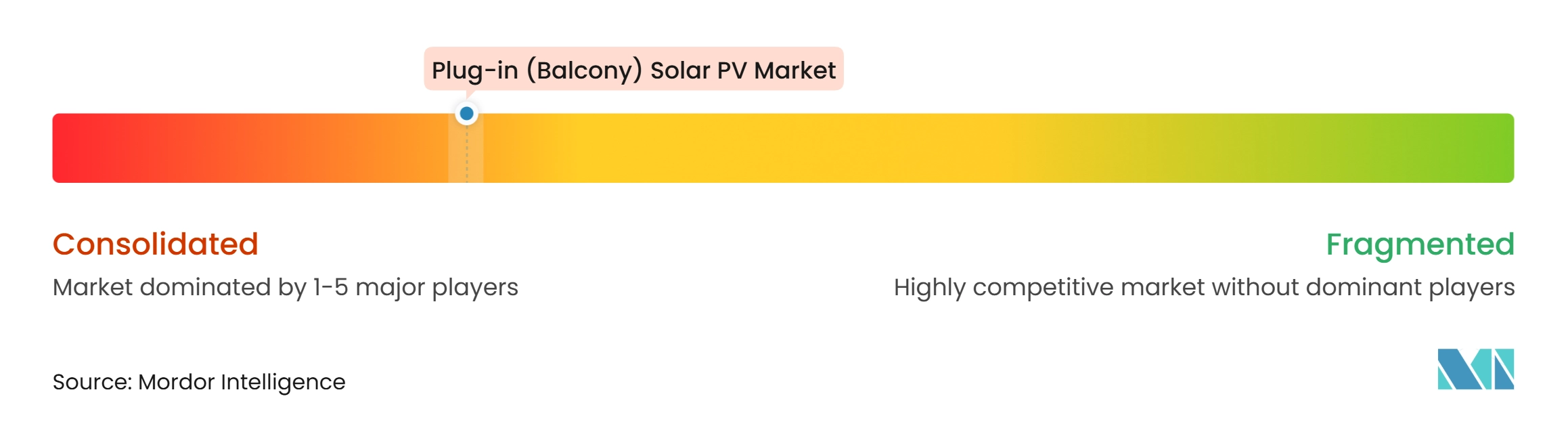
The Global Plug-in (Balcony) Solar PV market is highly consolidated, with Chinese manufacturers supplying many of the microinverters, batteries, and integrated storage products used in Europe. European online specialists remain important because they package these components into locally suitable kits and provide mounting hardware and local-language customer support. Hoymiles stated that it ranked first in global microinverter shipments in 2024, excluding the United States, and had equipped more than 1 million European balconies by September 2025. This position reflects its importance as a hardware supplier, even where another company owns the customer relationship. Larger suppliers have an advantage in product testing, technical support, and keeping product lines aligned with evolving national requirements. The Global Plug-in (Balcony) Solar PV market therefore combines global hardware supply with regional retail and compliance capabilities. This structure keeps the Global Plug-in (Balcony) Solar PV market dependent on both product engineering and local execution.
Competition is increasingly centered on integrated storage and software rather than a basic panel-and-inverter package. Anker launched the Solarbank 3 Pro in April 2025 with energy management features and expandable capacity. EcoFlow introduced the STREAM series in the same month, using an AI-powered solar network to coordinate battery units and household loads. Growatt launched the NEXA 2000 in May 2025 with 4 Maximum Power Point Tracking (MPPT) channels, 2,600 W PV input, and modular expansion to 8 kWh. These releases show a move toward systems that can manage generation, stored energy, and appliance use within a single consumer product. This direction changes competition in the Global Plug-in (Balcony) Solar PV market. This shift creates a higher bar for firms that offer hardware without controls, storage integration, or a clear retail support model.
Specialized products still provide room for differentiation where standard rail-mounted systems do not fit. Kleines Kraftwerk DE offers flexible modules aimed at glass balconies and curved surfaces, while modular storage suppliers address households that want to expand capacity over time. Verband der Elektrotechnik, Elektronik und Informationstechnik (VDE)’s product standard may favor companies that can maintain documented compliance across a growing product range. At the same time, the insolvency proceedings involving Priwatt GmbH and WeDoSolar GmbH show that direct consumer platforms face difficult retail economics. Brands that combine certified products, reliable service, and practical installation choices are better positioned to hold customer confidence.
Plug-in (Balcony) Solar PV Industry Leaders
-
Anker Innovations Technology Co., Ltd.
-
Growatt New Energy Technology Co., Ltd.
-
Marstek Energy Co., Ltd.
-
EcoFlow Technology Inc.
-
Zendure USA Inc.
- *Disclaimer: Major Players sorted in no particular order
Plug-in (Balcony) Solar PV Market Companies Covered in this Report
- Alpha ESS Co., Ltd.
- Altenergy Power System Inc. (APsystems)
- Anker Innovations Technology Co., Ltd.
- DAH Solar Co., Ltd.
- EcoFlow Technology Inc.
- Growatt New Energy Technology Co., Ltd.
- Hoymiles Power Electronics Inc.
- Jackery Inc.
- Kleines Kraftwerk DE GmbH
- Marstek Energy Co., Ltd.
- Ningbo Deye Inverter Technology Co., Ltd.
- Plugin Energy GmbH
- Priwatt GmbH
- Shenzhen PowerOak Newener Co., Ltd. (BLUETTI)
- Solakon GmbH
- Sunshare Technology Co., Ltd.
- TSUNESS Co., Ltd.
- WeDoSolar GmbH
- Yuma GmbH
- Zendure USA Inc.
Recent Industry Developments in Plug-in (Balcony) Solar PV Market
- November 2026: The Dutch House of Representatives passed a motion directing the government to develop a legal and technical framework for balcony solar by spring 2027.
- May 2026: BLUETTI launched the Balco 260 in France and Germany at EUR 889 equivalent to USD 977.90, an all-in-one balcony storage system with a 2,560 Wh Lithium Iron Phosphate (LFP) battery, 4 Maximum Power Point Tracking (MPPT) channels, 96.1% system efficiency, and AI energy management with dynamic tariff optimization. Wider European rollout, including the Netherlands and Austria, was announced for late 2026.
- February 2026: APsystems officially launched the EZ1 plug-in microinverter for direct consumer purchase in the United States.
- December 2025: VDE published DIN VDE V 0126-95, the first dedicated product standard for plug-in solar devices. The standard sets requirements for safety, construction, and connection, including household-socket connection provisions.
Global Plug-in (Balcony) Solar PV Market Report Scope
A plug-in (balcony) solar PV (photovoltaic) system is a small, compact solar power setup designed for apartments, renters, or homeowners who cannot install a traditional rooftop array. It functions more like a household appliance than a permanent utility installation.
The plug-in (balcony) solar PV market is segmented into product type, installed capacity, mounting type, end user, and geography. By product type, the market is segmented into complete plug-in balcony solar PV kits, plug-in solar PV kits with integrated battery storage, expandable and modular plug-in solar PV kits, and other plug-in balcony solar PV kits. By installed capacity, the market is divided into below 400 W, 400–600 W, 600–800 W, 800–1,000 W, and above 1,000 W. By mounting type, the market is divided into balcony railing-mounted systems, balcony floor-mounted systems, wall-mounted systems, terrace and flat-surface-mounted systems, fence and garden-mounted systems, and other mounting configurations. By end user, the market is segmented into homeowners, renters and tenants, residential property owners and landlords, and housing associations and residential communities. The report also covers the market size and forecasts for the global plug-in (balcony) solar PV market across 25 countries in key regions. For each segment, the market sizing and forecasts have been provided on the basis of value (USD).
Segmentation Overview
| Complete Plug-in Balcony Solar PV Kits |
| Plug-in Solar PV Kits with Integrated Battery Storage |
| Expandable and Modular Plug-in Solar PV Kits |
| Other Plug-in Balcony Solar PV Kits |
| Below 400 W |
| 400–600 W |
| 600–800 W |
| 800–1,000 W |
| Above 1,000 W |
| Balcony Railing-Mounted Systems |
| Balcony Floor-Mounted Systems |
| Wall-Mounted Systems |
| Terrace and Flat-Surface-Mounted Systems |
| Fence and Garden-Mounted Systems |
| Other Mounting Configurations |
| Homeowners |
| Renters and Tenants |
| Residential Property Owners and Landlords |
| Housing Associations and Residential Communities |
| North America | United States |
| Canada | |
| Mexico | |
| Europe | Germany |
| France | |
| Italy | |
| Spain | |
| United Kingdom | |
| Norway | |
| Netherlands | |
| Russia | |
| Rest of Europe | |
| Asia-Pacific | China |
| India | |
| Australia | |
| Indonesia | |
| Vietnam | |
| Thailand | |
| Rest of Asia-Pacific | |
| South America | Brazil |
| Argentina | |
| Chile | |
| Rest of South America | |
| Middle East and Africa | Saudi Arabia |
| United Arab Emirates | |
| Egypt | |
| Nigeria | |
| Oman | |
| Rest of Middle East and Africa |
| By Product Type | Complete Plug-in Balcony Solar PV Kits | |
| Plug-in Solar PV Kits with Integrated Battery Storage | ||
| Expandable and Modular Plug-in Solar PV Kits | ||
| Other Plug-in Balcony Solar PV Kits | ||
| By Installed Capacity | Below 400 W | |
| 400–600 W | ||
| 600–800 W | ||
| 800–1,000 W | ||
| Above 1,000 W | ||
| By Mounting Type | Balcony Railing-Mounted Systems | |
| Balcony Floor-Mounted Systems | ||
| Wall-Mounted Systems | ||
| Terrace and Flat-Surface-Mounted Systems | ||
| Fence and Garden-Mounted Systems | ||
| Other Mounting Configurations | ||
| By End User | Homeowners | |
| Renters and Tenants | ||
| Residential Property Owners and Landlords | ||
| Housing Associations and Residential Communities | ||
| By Geography | North America | United States |
| Canada | ||
| Mexico | ||
| Europe | Germany | |
| France | ||
| Italy | ||
| Spain | ||
| United Kingdom | ||
| Norway | ||
| Netherlands | ||
| Russia | ||
| Rest of Europe | ||
| Asia-Pacific | China | |
| India | ||
| Australia | ||
| Indonesia | ||
| Vietnam | ||
| Thailand | ||
| Rest of Asia-Pacific | ||
| South America | Brazil | |
| Argentina | ||
| Chile | ||
| Rest of South America | ||
| Middle East and Africa | Saudi Arabia | |
| United Arab Emirates | ||
| Egypt | ||
| Nigeria | ||
| Oman | ||
| Rest of Middle East and Africa | ||
Key Questions Answered in the Report
How large is the plug-in (balcony) solar PV market in 2027
The plug-in (balcony) solar PV market size is USD 1.53 billion in 2027 and is forecast to reach USD 3.07 billion by 2032 at a 14.94% CAGR.
Which product type has the largest share of plug-in balcony solar PV sales?
Complete Plug-in Balcony Solar PV Kits lead with a 54.3% share in 2026 because they offer an accessible entry point for first-time buyers.
Why are balcony solar storage kits growing faster than complete kits?
Storage kits are projected to grow at a 15.5% CAGR through 2032 because they can shift daytime generation to evening appliance demand.
Which region is expected to grow fastest for plug-in balcony solar PV?
Asia-Pacific is expected to grow at a 16.4% CAGR through 2032, supported by evolving standards, pilot projects, and urban household demand.
What capacity range is most common for plug-in balcony systems?
The 600-800 W range led with 34.7% share in 2026, reflecting the 800 VA ceiling used in Germany and several European markets.
Can renters install plug-in balcony solar PV systems?
Rules vary by country, but Germany has strengthened tenant installation rights since October 2024, helping Renters and Tenants reach a projected 16.1% CAGR through 2032.