
Plethysmograph Market Size and Share
Market Overview
| Study Period | 2020 - 2031 |
|---|---|
| Market Size (2026) | USD 94.15 Million |
| Market Size (2031) | USD 128.04 Million |
| Growth Rate (2026 - 2031) | 6.34 % |
| Fastest Growing Market | Asia-Pacific |
| Largest Market | North America |
| Market Concentration | Medium |
Major Players *Disclaimer: Major Players sorted in no particular order Image © Mordor Intelligence. Reuse requires attribution under CC BY 4.0. | |
Plethysmograph Market Analysis by Mordor Intelligence
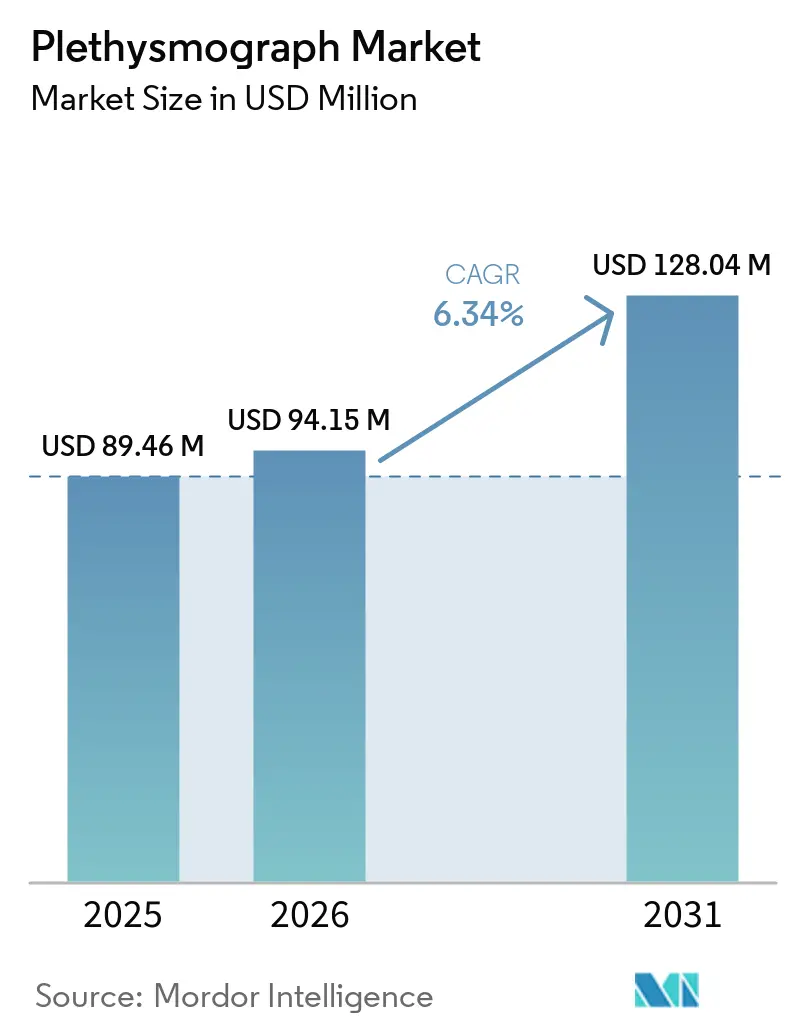
The plethysmograph market is projected to expand from USD 89.46 million in 2025 and USD 94.15 million in 2026 to USD 128.04 million by 2031, registering a CAGR of 6.34% between 2026 and 2031. The plethysmograph market is being supported by the heavy global burden of COPD and asthma, with published medical literature pointing to a very large patient base today and a further rise in prevalence over the long term. Demand also stays firm because clinicians need total lung capacity and airway resistance data that simpler breathing tests do not consistently capture in patients with air trapping and other complex disease patterns. That clinical need keeps pricing resilient for advanced systems and also supports recurring revenue tied to software, service, and workflow tools in established hospital networks. The plethysmograph market is also being shaped by a shift toward compact and calibration-reduced platforms, which make outpatient deployment more practical and improve the value case for distributed respiratory testing. Competitive activity remains centered on sensor accuracy, software integration, and networked service models, while the clearest opportunities for the plethysmograph market sit in outpatient respiratory care, vascular diagnostics, and faster-growing Asian healthcare systems.
Key Report Takeaways
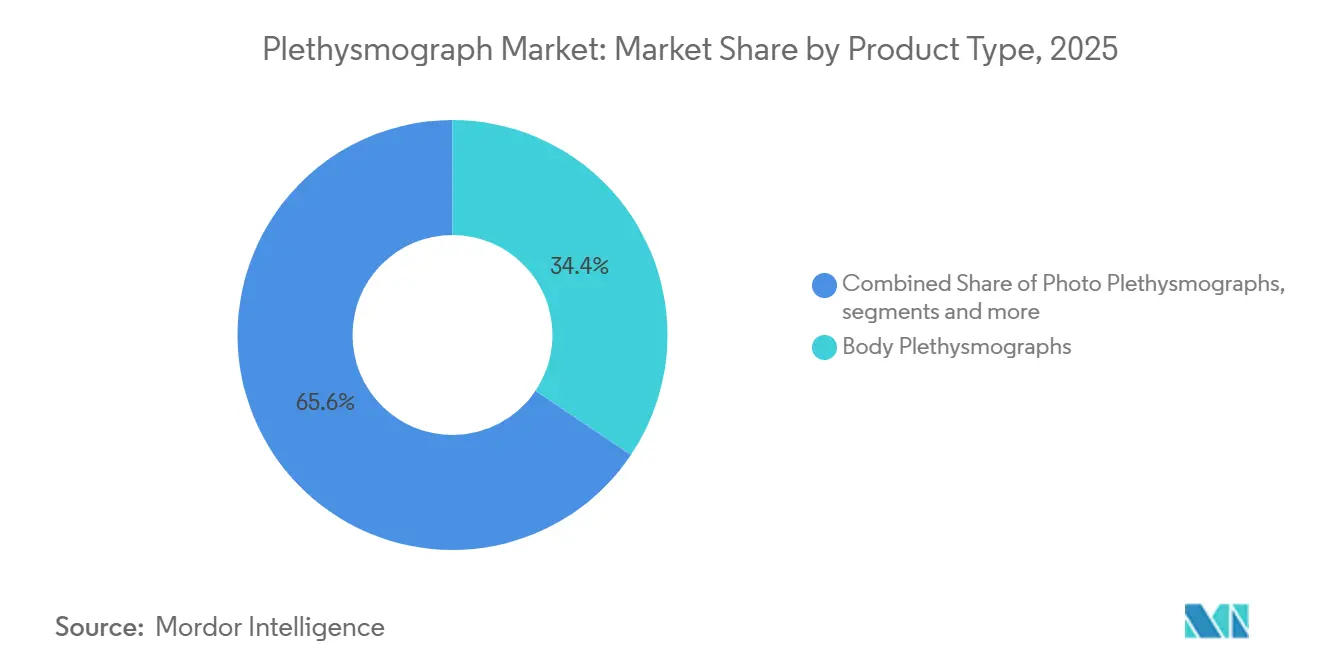
- By product type, body plethysmographs held 34.41% share in 2025, while air plethysmographs are projected to expand at 7.73% CAGR through 2031.
- By application, pulmonary function testing accounted for 38.52% of the plethysmograph market in 2025, while cardiovascular disease diagnosis is forecasted to grow at 7.14% CAGR through 2031.
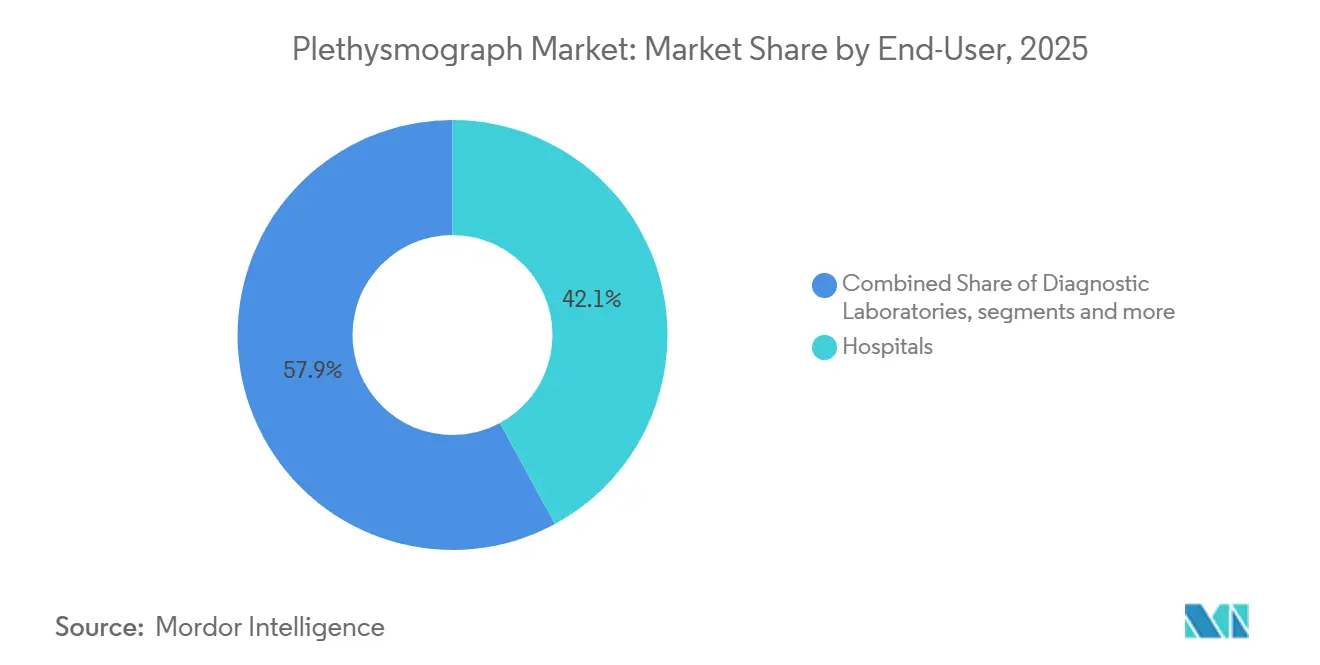
- By end-user, hospitals held 42.11% of the plethysmograph market share in 2025, while pulmonary care centers are projected to advance at 8.04% CAGR through 2031.
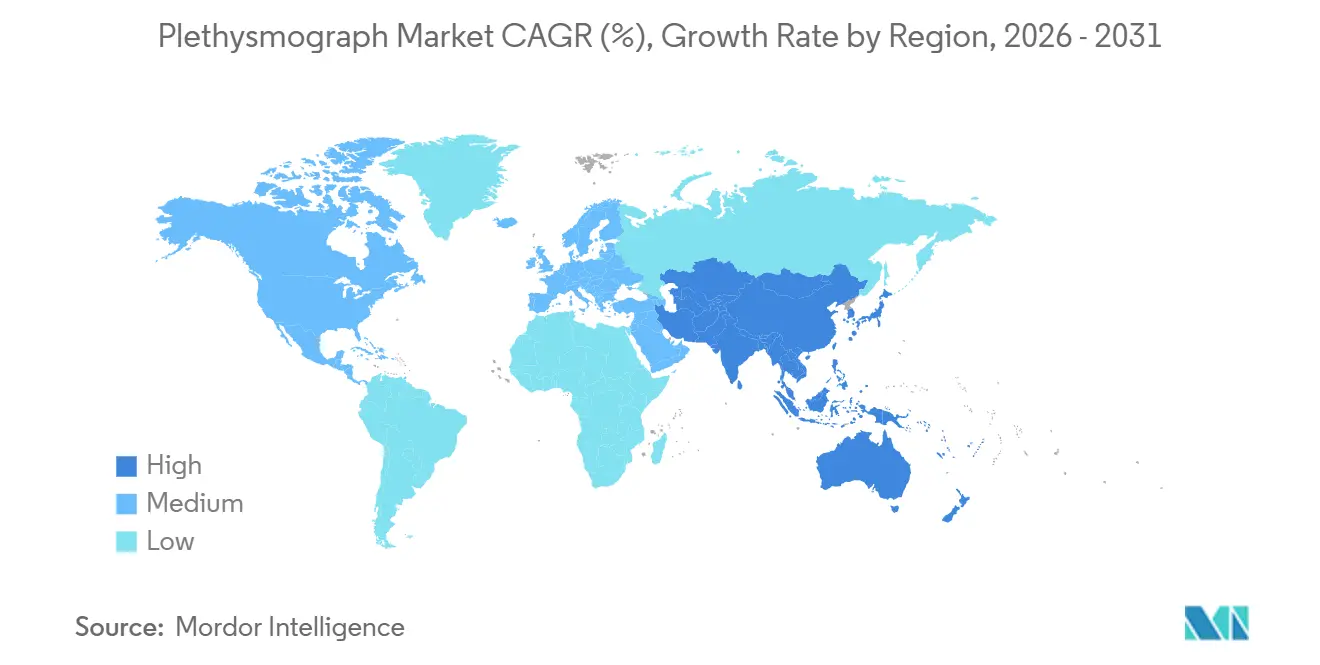
- By geography, North America led with 45.31% share in 2025, while Asia-Pacific is expected to record the fastest growth at 9.11% CAGR through 2031.
Note: Market size and forecast figures in this report are generated using Mordor Intelligence’s proprietary estimation framework, updated with the latest available data and insights as of January 2026.
Market Trends and Insights
Drivers Impact Analysis of Plethysmograph Market*
| Driver | (~) % Impact on CAGR Forecast | Geographic Relevance | Impact Timeline |
|---|---|---|---|
| Rising Burden of COPD, Asthma, and Other Complex Respiratory Disorders | +1.8% | Global | Long term (≥ 4 years) |
| Growing Demand for Gold-Standard Lung Volume Measurement in Pulmonary Labs | +1.4% | North America & Europe | Medium term (2-4 years) |
| Wider Adoption of Portable and Point-of-Care Respiratory Diagnostics | +0.9% | APAC core, spill-over to MEA | Short term (≤ 2 years) |
| Expanding Use in Occupational and Pre-Employment Respiratory Screening | +0.8% | North America, EU, Middle East | Medium term (2-4 years) |
| Shift Toward Calibration-Reduced Ultrasonic and Digital Plethysmography Platforms | +0.5% | Global | Medium term (2-4 years) |
| More Contract Research and Clinical Trial Demand for Lung Function Endpoints | +0.3% | North America, Europe | Long term (≥ 4 years) |
| Source: Mordor Intelligence | |||
Rising Burden of COPD, Asthma, and Other Complex Respiratory Disorders
The plethysmograph market has a strong demand floor because COPD and asthma already affect an estimated 650 million children and adults worldwide, which keeps diagnostic needs broad across both mature and developing care systems. The same medical literature indicates that the prevalence of these respiratory conditions is expected to more than double by 2050, which means care systems are preparing for a larger future pool of patients who require deeper lung assessment than routine spirometry provides.[1] The economic burden adds urgency, with the CHEST Journal estimating that direct global COPD costs were USD 3.9 trillion in 2025 and will rise to USD 24.4 trillion by 2050, making accurate diagnosis a practical cost-control tool rather than an optional add-on.[2] The plethysmograph market benefits because body-based lung-volume testing detects trapped gas behind obstructions and structural damage that gas dilution techniques can miss in patients who often drive the highest treatment burden. As a result, the plethysmograph market is expanding on the back of a disease pattern that is clinically complex, financially costly, and unlikely to ease over the forecast period.
Growing Demand for Gold-Standard Lung Volume Measurement in Pulmonary Labs
The plethysmograph market is also being supported by the continued preference for body plethysmography when clinicians need a noninvasive reference method for lung-volume measurement in difficult respiratory cases. A 2025 peer-reviewed analysis highlighted its higher sensitivity for restrictive ventilatory defects associated with long COVID, which broadens its relevance beyond long-established COPD and asthma testing pathways.[3] The same quality advantage is carried into drug development, because clinical programs increasingly need outcome measures that capture total lung capacity and airway resistance with greater precision than simpler spirometric markers. The plethysmograph market, therefore, gains an additional buyer group in contract research organizations, academic hospitals, and phase II and phase III trial sites that need calibrated systems for protocol consistency.
Wider Adoption of Portable and Point-of-Care Respiratory Diagnostics
The plethysmograph market is gradually moving beyond the traditional full-booth laboratory model as compact platforms reduce the space burden that historically limited placement to purpose-built pulmonary labs. Portable system design matters because it opens a path into community clinics, outpatient specialty centers, and occupational settings that could not justify large fixed installations under older workflow assumptions. Company material from ndd and SCHILLER shows how calibration-reduced and ultrasonic flow technologies are being positioned around simpler setup, lower maintenance demands, and faster readiness for testing. That operating model improves the appeal of the plethysmograph market in decentralized care because staff can spend less time on warm-up, calibration, and repeated quality checks, which directly affects throughput and total ownership cost. The recent launch of nddHub further shows how vendors are trying to extend value from device sales into fleet oversight, performance monitoring, and network-level quality control across multiple sites. As these digital and portable features spread, the plethysmograph market becomes easier to scale in outpatient settings without losing the quality discipline expected in formal respiratory testing.
Expanding Use in Occupational and Pre-Employment Respiratory Screening
The plethysmograph market is finding another source of demand in occupational health, where employers and clinical evaluators need stronger baseline respiratory documentation before workers enter exposure-heavy roles. A 2026 perspective in the American Journal of Respiratory and Critical Care Medicine emphasized the evidentiary role of spirometry in work ability and impairment assessment, which supports the broader move toward more defensible baseline lung-function records. The plethysmograph market benefits because these programs are shifting from periodic reactive monitoring toward baseline testing that can stand up to later clinical and legal review. This use case is especially relevant in regions with large industrial workforces and exposure concerns, where respiratory assessment is increasingly tied to risk management rather than only to treatment decisions. The result is a broader installed-base opportunity for the plethysmograph market in pre-employment and occupational medical centers that need more robust pulmonary documentation.
Restraints Impact Analysis of Plethysmograph Market*
| Restraint | (~) % Impact on CAGR Forecast | Geographic Relevance | Impact Timeline |
|---|---|---|---|
| High Capital Cost and Facility Footprint of Body Plethysmograph Systems | -1.5% | Emerging markets, APAC core | Long term (≥ 4 years) |
| Limited Skilled Technicians for Correct Test Execution and Interpretation | -0.8% | Global, more acute in MEA, South Asia | Medium term (2-4 years) |
| Reimbursement Variability Across Care Settings and Countries | -0.6% | North America, Western Europe, APAC core | Medium term (2-4 years) |
| Infection Control, Cleaning, and Patient Throughput Constraints in Shared Labs | -0.4% | Global | Short term (≤ 2 years) |
| Source: Mordor Intelligence | |||
High Capital Cost and Facility Footprint of Body Plethysmograph Systems
The plethysmograph market still faces a meaningful adoption barrier because traditional body systems remain expensive capital purchases for small hospitals, private practices, and lower-resource diagnostic networks. PulmOne’s 2025 ownership-cost analysis shows that the burden extends beyond acquisition and includes HVAC needs, calibration service contracts, and per-test workflow demands that can limit daily volume. These economics become harder to justify when utilization is uneven, since providers must recover depreciation and service costs through testing volumes that are often lower outside major academic centers. The plethysmograph market, therefore, sees slower penetration in sites that cannot rely on high-volume pulmonary workups or broad payer support, even when clinicians recognize the diagnostic value of full lung-volume testing. Compact designs can ease part of this problem, but the plethysmograph market remains exposed to a capital equation that still favors larger institutions.
Limited Skilled Technicians for Correct Test Execution and Interpretation
The plethysmograph market is also held back by an operator skills gap, because reliable testing depends on correct patient coaching, repeatability checks, and accurate interpretation rather than on hardware alone. This issue matters across the plethysmograph market because poor technique reduces throughput, increases repeat tests, and weakens confidence in results, especially in centers that do not have credentialed respiratory specialists on site. Infection control and cleaning add another layer of friction in shared labs, since enclosed testing environments and reusable components require disciplined room turnover and device sanitation protocols. Those practical steps can slow appointment flow and make smaller sites question whether they can support enough daily volume to justify a full system. Until staffing depth and workflow consistency improve more broadly, the plethysmograph market will continue to grow below its clinical potential in several under-resourced settings.
*Our forecasts treat driver/restraint impacts as directional, not additive. The impact forecasts reflect baseline growth, mix effects, and variable interactions.
Plethysmograph Market Segment Analysis
By Product Type:
Body Plethysmographs Hold the Core Base While Air Systems Grow FasterBody plethysmographs captured 34.41% of the plethysmograph market size in 2025, which reflects their established role in measuring total lung capacity, residual volume, and airway resistance in formal respiratory testing environments. A 2025 peer-reviewed review also reinforced the clinical position of plethysmography-derived total lung capacity in COPD evaluation by showing a strong correlation with residual volume and hyperinflation severity. This keeps the plethysmograph market anchored in high-acuity lung assessment, where the accuracy of lung-volume measurement matters more than the convenience of lower-cost substitutes. It also supports durable demand from hospital laboratories that need reference-grade results for diagnosis, staging, and follow-up.
Air plethysmographs are forecasted to be the fastest-growing product type at 7.73% CAGR from 2026 to 2031, which shows how the plethysmograph market is broadening beyond its traditional respiratory core. Photo plethysmographs and impedance plethysmographs also retain meaningful roles, with photoplethysmography expanding through monitoring applications and impedance-based systems showing clinical utility in lower-extremity artery disease assessment. Venous occlusion and research-oriented systems remain smaller, but they still serve trial work and specialized physiology testing where precise blood-flow response data are needed.

By Application:
Pulmonary Function Testing Keeps the Largest Share, While Cardiovascular Use ExpandsPulmonary function testing accounted for 38.52% of the plethysmograph market size in 2025, which shows that respiratory diagnostics still form the core demand base for the category. The plethysmograph market continues to benefit from the fact that accredited respiratory laboratories rely on consistent protocols and repeatable quality standards, which makes technology substitution slower in this application than in some simpler testing categories. As long as respiratory disease burden remains high, pulmonary function testing should remain the foundation of the plethysmograph market.
Cardiovascular disease diagnosis is expected to be the fastest-growing application at 7.14% CAGR through 2031, reflecting a wider clinical appreciation for plethysmography in peripheral arterial disease, venous insufficiency, and related hemodynamic assessment. A 2025 multicenter study showed that combining ankle-brachial index with pulse volume wave parameters improved peripheral arterial disease diagnostic sensitivity to 85.4%, compared with 67% for a single-parameter ABI approach. The plethysmograph market is therefore gaining from a broader buyer universe that now includes cardiology and vascular medicine alongside pulmonology.
By End-User:
Hospitals Lead the Installed Base While Pulmonary Care Centers Gain SpeedHospitals held 42.11% of the plethysmograph market share in 2025, which reflects the capital intensity of the equipment and the long-standing concentration of advanced testing inside academic and teaching centers. The hospital setting remains important because it offers the physical space, staff depth, and patient mix needed to support full-scale plethysmography with acceptable utilization levels. Diagnostic laboratories remain a stable secondary group in the plethysmograph market because they can aggregate referral volumes and support dedicated respiratory workflows without carrying the full overhead structure of inpatient facilities.
Pulmonary care centers are forecasted to grow at 8.04% CAGR through 2031, showing how the plethysmograph market is gradually following respiratory care into lower-cost outpatient settings. The plethysmograph market is better suited to this channel now because compact systems and remote monitoring tools make distributed deployment more practical than it was under older full-lab models. Other end-users, including pharmaceutical companies and contract research organizations, are also adding demand where respiratory endpoints require controlled and repeatable lung-function data.
Geography Analysis
North America Plethysmograph Market
North America accounted for 45.31% of the plethysmograph market share in 2025, which made it the largest regional contributor to revenue. The region benefits from dense pulmonology laboratory networks, broader use of established pulmonary billing codes, and a care environment that supports more formal respiratory workups than many other markets. The United States remains the main country anchor because large hospitals and academic centers can support both the capital cost and the staffing requirements associated with advanced lung-function testing. The plethysmograph market also holds up well in North America because occupational assessment, specialty pulmonary care, and research activity all reinforce the installed base rather than depending on one demand channel alone.
Europe Plethysmograph Market
Europe remained the second-largest regional market in 2025 and continued to show steady demand from established respiratory testing systems. The plethysmograph market in Europe benefits from structured clinical practice, strong specialist referral pathways, and a long-standing role for lung-volume measurement in COPD and restrictive disease workups. A 2025 peer-reviewed analysis also linked body plethysmography to higher sensitivity in restrictive ventilatory defects associated with long COVID, which supports continued clinical use across hospital respiratory services. At the same time, the full enforcement environment around the EU Medical Device Regulation in 2024 has raised compliance demands related to clinical evidence, quality systems, and post-market oversight. That regulatory pressure favors better-resourced suppliers in the plethysmograph market and makes it harder for smaller vendors to sustain participation without heavier investment in compliance.
The Americas, EMEA and APAC Plethysmograph Market
Asia-Pacific is projected to record the fastest plethysmograph market growth at 9.11% CAGR through 2031. The plethysmograph market in the region is being lifted by healthcare infrastructure expansion, a large burden of chronic respiratory disease, and a rising need for specialist diagnostics outside the most established urban hospitals. Outside Asia-Pacific, demand in the Middle East and Africa remains concentrated in the GCC and select academic centers, while South America is led by private hospital demand and occupational health use, where capital budgets allow. The plethysmograph market, therefore, shows a clear regional split, with mature demand concentrated in North America and Europe, and faster incremental expansion coming from Asia-Pacific and selected emerging healthcare systems.
Competitive Landscape
The plethysmograph market is moderately concentrated, with a relatively small group of specialist respiratory and cardiopulmonary diagnostics companies setting the pace in advanced systems. ndd Medizintechnik AG, SCHILLER-GANSHORN, COSMED Srl, MGC Diagnostics, and a group of regional suppliers compete less on price than on measurement reliability, software depth, and service continuity. The plethysmograph market still leaves room for smaller players, but the need for regulatory compliance, quality assurance, and installed-base support limits how quickly new entrants can scale in premium clinical settings. This means competition tends to favor vendors that can pair credible hardware with durable service infrastructure and usable digital workflow tools.
A major theme in the plethysmograph market is the shift from stand-alone hardware competition to platform competition. ndd Medical Technologies signaled a shift in May 2026 with the launch of nddHub, which adds real-time performance monitoring and centralized fleet management across healthcare networks rather than only selling devices one unit at a time. MGC Diagnostics has expanded its position through both workflow and adjacent respiratory testing, including Ascent cardiorespiratory diagnostic software with 510(k) substantial equivalence determination and the U.S. launch of Fenom Flo for point-of-care airway inflammation assessment. These moves show that the plethysmograph market is rewarding vendors that make systems easier to integrate into broader respiratory and cardiopulmonary pathways.
Another important factor is that the plethysmograph market now places more value on digital support, guided testing, and networked oversight than it did a few years ago. ndd’s EasyOne Sky launch in November 2024, with guided coaching and cloud integration, reflected the broader push to reduce operator variability and improve quality monitoring across multiple sites. That matters because staffing shortages and throughput pressure can weaken utilization even when clinical need is clear, so vendors that simplify execution gain a practical advantage. The plethysmograph market is therefore likely to remain moderately concentrated, with leadership shaped by software-enabled workflow, regulatory discipline, and the ability to serve both hospital and decentralized care models.
Plethysmograph Industry Leaders
-
Vyaire Medical, Inc.
-
SCHILLER AG
-
MGC Diagnostics Corporation
-
COSMED Srl
-
ndd Medizintechnik AG
- *Disclaimer: Major Players sorted in no particular order

Plethysmograph Market Companies Covered in this Report
- ACI Medical LLC
- BioTekna Srl
- COSMED Srl
- D.E. Hokanson, Inc.
- ELCAT GmbH
- GANSHORN Medizin Electronic GmbH
- Geratherm Medical
- Life Measurement, Inc.
- Medisoft, Inc.
- Medline Industries
- MGC Diagnostics
- Mindray
- Morgan Scientific
- ndd Medizintechnik AG
- Nihon Kohden
- Perimed
- PulmOne Advanced Medical Devices Ltd.
- Schiller
- SCIREQ Scientific Respiratory Equipment Inc.
- Siemens Healthineers
- Vyaire Medical
Recent Industry Developments in Plethysmograph Market
- May 2026: ndd Medical Technologies launched nddHub, a web-based portal powered by nddCloud, offering real-time respiratory testing performance monitoring and centralized fleet management across healthcare networks. The platform enables COPD screening trend tracking and care-gap identification at a system level, representing a strategic pivot from device sales to data-as-a-service monetization.
- February 2026: MGC Diagnostics launched Fenom Flo in the United States, the only portable fractional exhaled nitric oxide (FeNO) device cleared by the FDA for a 6-second breath test in adults and pediatric patients aged 7 and older. The point-of-care launch expands MGC's cardiorespiratory diagnostics portfolio into inflammatory airway assessment, strengthening its positioning in pulmonary specialty clinics.
- October 2025: COSMED acquired Bioparhom as part of efforts to increase the firm’s strength in body composition and metabolic assessment technologies. This move is indicative of strategic investments in innovative cardiopulmonary and physiological diagnostic technologies in relation to respiratory monitoring, pulmonary function testing, and plethysmography-related assessment technologies in Europe.
Global Plethysmograph Market Report Scope
According to the report’s scope, the plethysmograph market comprises devices used to measure changes in blood flow, limb volume, and lung function for diagnosing cardiovascular, vascular, and respiratory disorders. Market growth is driven by the rising prevalence of chronic diseases, increasing demand for non-invasive diagnostics, and advancements in plethysmography technologies.
The plethysmograph market is segmented into product type, application, end-user, and geography. By product type, the market is segmented into body plethysmographs, photo plethysmographs, impedance plethysmographs, air plethysmographs, venous occlusion plethysmographs, and other product types. By application, the market is segmented into pulmonary function testing, cardiovascular disease diagnosis, peripheral vascular disease monitoring, sleep disorder assessment, blood flow measurement, and other applications. By end-user, the market is segmented into hospitals, diagnostic laboratories, pulmonary care centers, ambulatory surgical centers, and other end-users. By geography, the market is segmented into North America, Europe, Asia-Pacific, and the Rest of the World. The report also covers the estimated market sizes and trends for 13 countries across major regions globally. The report offers values (USD) for all the above segments.
Segmentation Overview
| Body Plethysmographs |
| Photo Plethysmographs |
| Impedance Plethysmographs |
| Air Plethysmographs |
| Venous Occlusion Plethysmographs |
| Other Product Types |
| Pulmonary Function Testing |
| Cardiovascular Disease Diagnosis |
| Peripheral Vascular Disease Monitoring |
| Sleep Disorder Assessment |
| Blood Flow Measurement |
| Other Applications |
| Hospitals |
| Diagnostic Laboratories |
| Pulmonary Care Centers |
| Ambulatory Surgical Centers |
| Other End-Users |
| North America | United States |
| Canada | |
| Mexico | |
| Europe | Germany |
| United Kingdom | |
| France | |
| Italy | |
| Spain | |
| Rest of Europe | |
| Asia-Pacific | China |
| Japan | |
| India | |
| Australia | |
| South Korea | |
| Rest of Asia-Pacific | |
| Rest of the World |
| By Product Type | Body Plethysmographs | |
| Photo Plethysmographs | ||
| Impedance Plethysmographs | ||
| Air Plethysmographs | ||
| Venous Occlusion Plethysmographs | ||
| Other Product Types | ||
| By Application | Pulmonary Function Testing | |
| Cardiovascular Disease Diagnosis | ||
| Peripheral Vascular Disease Monitoring | ||
| Sleep Disorder Assessment | ||
| Blood Flow Measurement | ||
| Other Applications | ||
| By End-User | Hospitals | |
| Diagnostic Laboratories | ||
| Pulmonary Care Centers | ||
| Ambulatory Surgical Centers | ||
| Other End-Users | ||
| By Geography | North America | United States |
| Canada | ||
| Mexico | ||
| Europe | Germany | |
| United Kingdom | ||
| France | ||
| Italy | ||
| Spain | ||
| Rest of Europe | ||
| Asia-Pacific | China | |
| Japan | ||
| India | ||
| Australia | ||
| South Korea | ||
| Rest of Asia-Pacific | ||
| Rest of the World | ||
Key Questions Answered in the Report
What is the expected growth path for the plethysmograph market demand through 2031?
The plethysmograph market is projected to move from USD 89.46 million in 2025 to USD 94.15 million in 2026 to USD 128.04 million by 2031 at a 6.34% CAGR, supported by rising respiratory disease burden and wider use across outpatient and vascular settings.
Why do body plethysmographs still lead revenue?
Body plethysmographs remained the largest product type with 34.41% Share in 2025 because they provide total lung capacity, residual volume, and airway resistance data that clinicians need in complex respiratory cases.
Which application is expanding the fastest?
Cardiovascular disease diagnosis is forecasted to grow at 7.14% CAGR through 2031 as plethysmography gains traction in peripheral arterial disease and venous assessment workflows.
Why is Asia-Pacific growing faster than other regions?
The plethysmograph market is projected to grow fastest in Asia-Pacific at a 9.11% CAGR, because healthcare infrastructure is expanding, and portable, lower-friction systems are better suited to distributed respiratory testing needs.