
Plasterboard Liner Paper Market Size and Share
Market Overview
| Study Period | 2021 - 2031 |
|---|---|
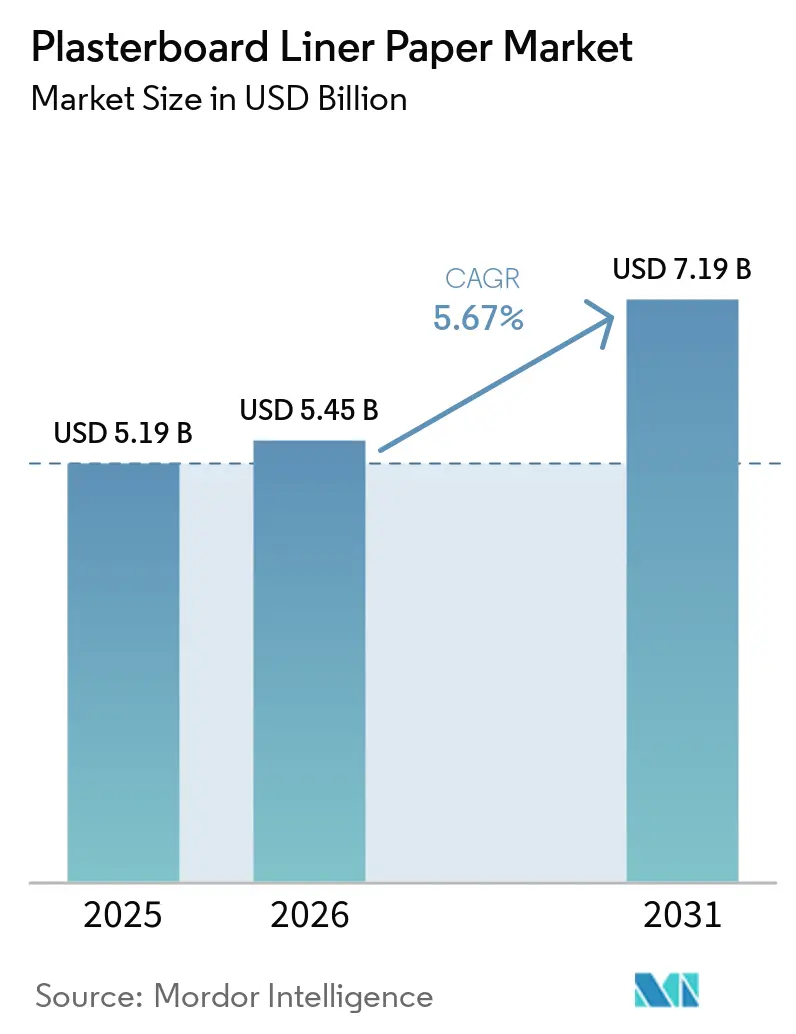
| Market Size (2026) | USD 5.45 Billion |
| Market Size (2031) | USD 7.19 Billion |
| Growth Rate (2026 - 2031) | 5.67 % |
| Fastest Growing Market | Asia-Pacific |
| Largest Market | Asia-Pacific |
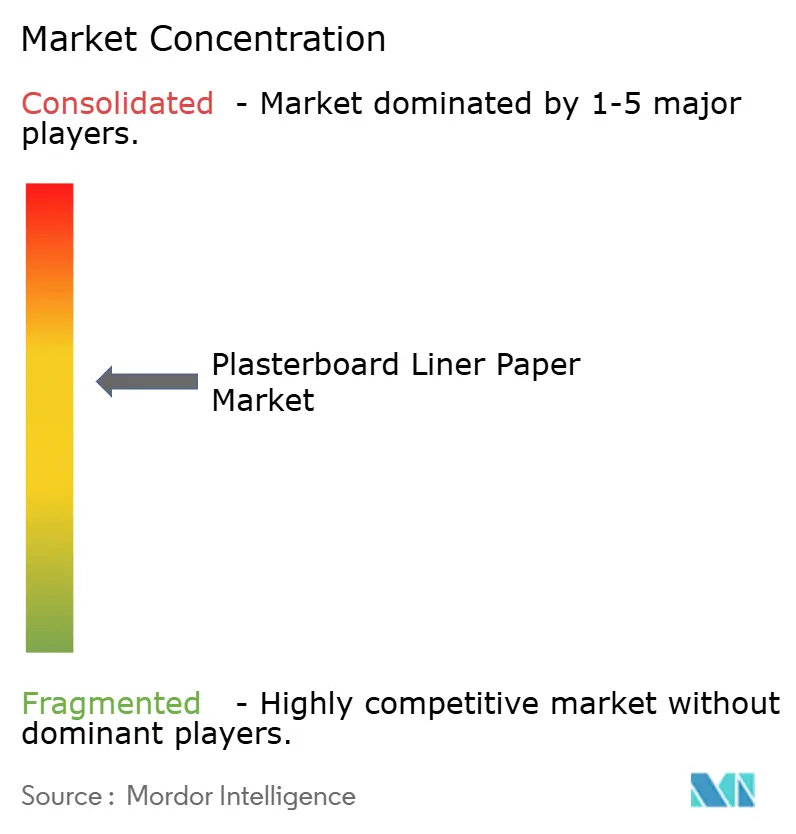
| Market Concentration | Medium |
Major Players *Disclaimer: Major Players sorted in no particular order Image © Mordor Intelligence. Reuse requires attribution under CC BY 4.0. | |
Plasterboard Liner Paper Market Analysis by Mordor Intelligence
The plasterboard liner paper market size was estimated at USD 5.19 billion in 2025 and is estimated to grow from USD 5.45 billion in 2026 to USD 7.19 billion by 2031, at a CAGR of 5.67% during the forecast period (2026-2031). Residential construction, commercial fit-outs, and renovation activity support demand for liner grades used in gypsum board systems. Building regulations increasingly favor materials with recycled content, which is changing supplier qualification requirements in the plasterboard liner paper market. The shift from masonry to lightweight drywall construction is also raising demand for consistent, technically capable paper grades. Fire, moisture, acoustic, and surface-finish requirements are making liner selection more specific for board manufacturers. These conditions favor suppliers that can combine reliable fiber supply, stable paper formation, and verified environmental documentation.
Key Report Takeaways
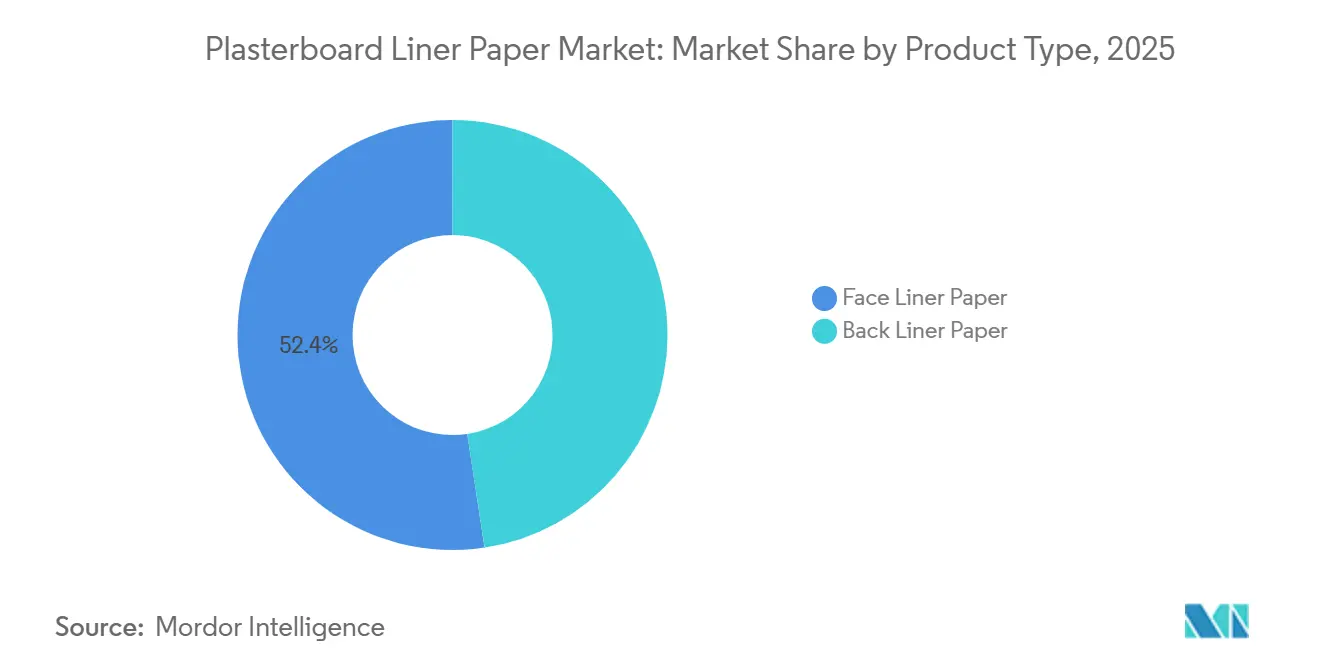
- By product type, face liner paper held 52.37% of the plasterboard liner paper market share in 2025 and is forecast to expand at a CAGR of 5.87% through 2031.
- By fiber type, recycled fiber paper held 58.15% of the plasterboard liner paper market share in 2025 and is forecast to expand at a CAGR of 6.73% through 2031.
- By plasterboard type, standard plasterboard held 55.03% of the plasterboard liner paper market share in 2025, while fire-resistant plasterboard is forecast to expand at a CAGR of 6.34% through 2031.
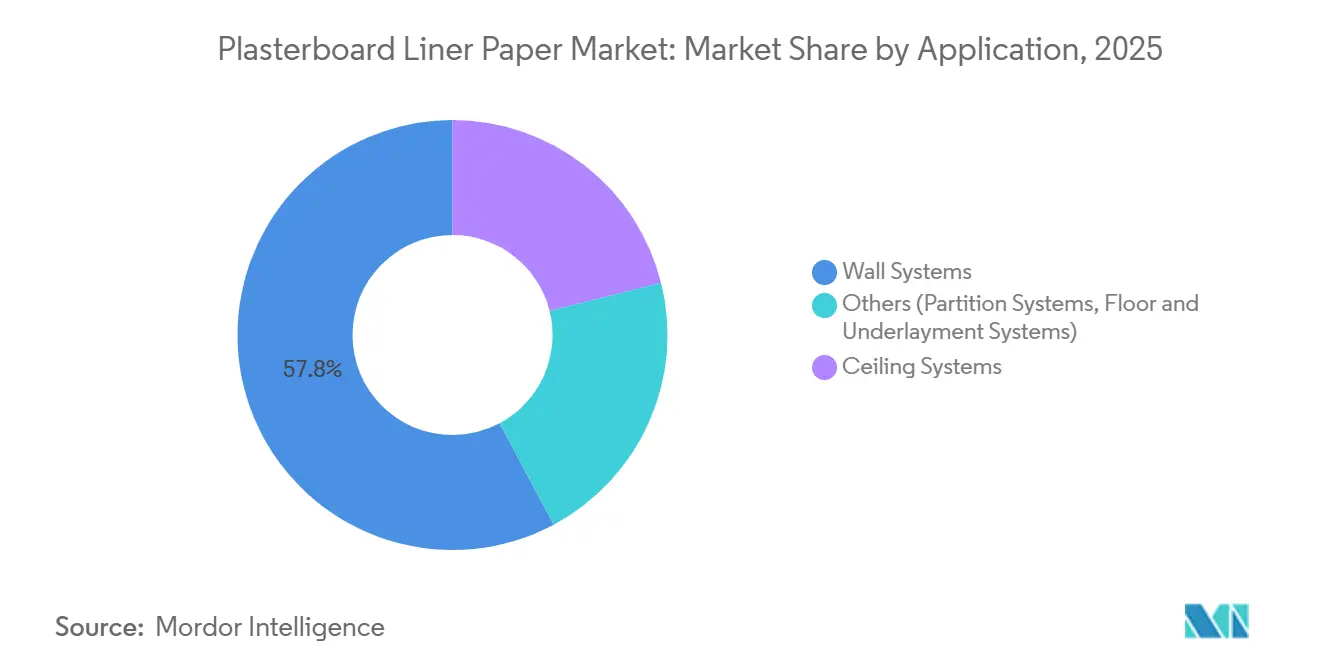
- By application, wall systems accounted for 57.81% of the plasterboard liner paper market size in 2025, while ceiling systems are forecast to grow at a CAGR of 6.12% through 2031.
- By geography, Asia-Pacific held 38.14% of the plasterboard liner paper market share in 2025 and is forecast to grow at a CAGR of 6.09% through 2031.
Note: Market size and forecast figures in this report are generated using Mordor Intelligence’s proprietary estimation framework, updated with the latest available data and insights as of January 2026.
Market Trends and Insights
Drivers Impact Analysis of Plasterboard Liner Paper Market*
| Drivers | (~) % Impact on CAGR Forecast | Geographic Relevance | Impact Timeline |
|---|---|---|---|
| Residential and Commercial Drywall Demand | +1.5% | Global, concentrated in Asia-Pacific and North America | Short term (≤ 2 years) |
| Fire, Moisture, and Acoustic Board Specifications | +1.0% | North America and Europe | Medium term (2-4 years) |
| Recycled-Content and Circular Construction Procurement | +0.8% | Europe, Asia-Pacific, the Middle-East, and Africa | Medium term (2-4 years) |
| Renovation and Energy-Efficiency Upgrades | +0.7% | Europe and North America | Medium term (2-4 years) |
| Lightweighting of Gypsum Boards and Liner Grammage | +0.5% | North America and Europe | Long term (≥ 4 years) |
| Closed-Loop Recovery of Gypsum Board Paper | +0.4% | Europe and Japan | Long term (≥ 4 years) |
| Source: Mordor Intelligence | |||
Residential and Commercial Drywall Demand
Residential construction in Asia-Pacific is increasing demand for plasterboard liner paper across high-volume gypsum board production lines. China's Evaluation Standard for Green Buildings requires new commercial projects to achieve at least one certification star from 2025, encouraging board manufacturers to use liner formulations with verified recycled content. India's National Building Code 2025 strengthened the use of fire-rated wall assemblies and increased demand for performance-grade liner. High-speed board lines operating above 120 meters per minute require more consistent paper formation, which limits the use of lower-specification grades. As a result, the plasterboard liner paper market favors suppliers that can maintain quality at the production speeds used in expanding Asian board plants.
Fire, Moisture, and Acoustic Board Specifications
Fire, moisture, and acoustic requirements are increasing the technical role of paper in gypsum board construction. Compartmentation rules in Hong Kong and Singapore became stricter following high-rise fire incidents in 2024, and Type X board is becoming a baseline specification in multi-family and commercial projects. Fire-rated board requires face liners with higher grammage and stable surface sizing to control gypsum slurry movement and maintain adhesion during fire exposure. EN 520 classifications also distinguish gypsum board types based on different liner-bonding requirements. Suppliers that support multiple functions with a single liner chemistry can help converters reduce the number of paper grades they must source. This gives technically qualified suppliers a stronger position in the plasterboard liner paper market, particularly where board makers serve multiple regulated applications.
Recycled-Content and Circular Construction Procurement
Green construction procurement is shifting recycled fiber content from a product feature to a documented purchasing requirement. SCG Packaging produces plasterboard liners in Thailand using 100% recycled paper pulp and holds certification under Thailand's Carbon Footprint Reduction Label. In 2025, PORR, Saint-Gobain, and Saubermacher opened Austria's first gypsum-to-gypsum recycling facility in Stockerau, with the capacity to incorporate up to 40% recycled gypsum into new Saint-Gobain plasterboard panels. Such closed-loop board production supports recycled-fiber liner because the design and procurement process gives greater weight to traceable circular inputs. This development also supports the recovery of gypsum board paper, particularly where collection systems can separate board waste from mixed construction waste. In the plasterboard liner paper market, suppliers with verifiable recycled-content credentials are better positioned to meet institutional purchasing requirements.
Renovation and Energy-Efficiency Upgrades
Building renovation programs support liner demand because drywall systems are widely used in interior upgrades, thermal improvements, and acoustic work. Directive (EU) 2024/1275 requires European Union member states to submit national building renovation trajectories by May 2026 and aims for a zero-emission building stock by 2050[1]. Renovation can replace masonry assemblies with lightweight drywall, which increases liner use per renovated area compared with work that only adds floor space. The United Nations Environment Program (UNEP) states that global investment in building energy efficiency must exceed USD 5.9 trillion by 2030 to stay on a net-zero pathway. Thermal and acoustic retrofit work can therefore support gypsum board assemblies even when new construction activity is lower. Demolition from renovation can also provide recoverable paper and gypsum, linking demand for new liner with the long-term development of circular raw-material systems.
Restraints Impact Analysis of Plasterboard Liner Paper Market*
| Restraints | (~) % Impact on CAGR Forecast | Geographic Relevance | Impact Timeline |
|---|---|---|---|
| Construction-Cycle Sensitivity | -0.7% | Global, concentrated in North America and Europe | Short term (≤ 2 years) |
| Recovered Fiber Quality and Availability Constraints | -0.5% | Europe and North America | Medium term (2-4 years) |
| Contaminant Carryover in Closed-Loop Board Recycling | -0.3% | Europe and Japan | Long term (≥ 4 years) |
| Drying-Energy and Water-Quality Exposure | -0.2% | Global, concentrated in energy-intensive manufacturing locations | Medium term (2-4 years) |
| Source: Mordor Intelligence | |||
Construction-Cycle Sensitivity
Demand for plasterboard liner paper is closely linked to housing starts and commercial construction permits, making the market sensitive to construction cycles. Restrictive interest-rate conditions during 2024 and 2025 reduced housing starts in the United States and created related credit pressure in Canada and several European markets. When construction activity declines, board producers typically draw on existing safety stocks before reducing liner orders, which can cause liner demand to decline more sharply than the underlying construction market for 2 to 3 quarters. Recovery can also lag a construction rebound by 6 to 9 months, requiring producers to manage working capital during this period. Independent mills tend to be more exposed than integrated paper groups due to narrower end-market options and smaller supply-chain buffers.
Recovered Fiber Quality and Availability Constraints
Recovered fiber quality remains an ongoing operational constraint for recycled grades in the plasterboard liner paper market. Collection rates plateaued in several European Union member states after 2023, reducing the consistency of mixed recovered paper streams available to mills. Paper lots with elevated stickies, residual ink, or ash require additional cleaning and can increase processing costs. These quality issues can also reduce grammage consistency, which is a critical factor for high-speed gypsum board lines, as uneven density can lead to gypsum slurry penetration failures. European packaging regulations can direct higher-quality sorted fiber toward food-contact packaging applications that carry premium prices, leaving lower grades available for liner production. As a result, recycled-fiber suppliers face a greater need for cleaning capacity, diversified fiber sourcing, and tighter controls on incoming materials.
*Our forecasts treat driver/restraint impacts as directional, not additive. The impact forecasts reflect baseline growth, mix effects, and variable interactions.
Plasterboard Liner Paper Market Segment Analysis
By Product Type:
Face Liner Drives Demand While Back Liner Supports Grammage ReductionFace liner paper held 52.37% of the plasterboard liner paper market share in 2025 and is projected to grow at a CAGR of 5.87% through 2031. It requires controlled porosity so that the gypsum slurry can achieve mechanical interlock without passing unevenly through the sheet. It also requires a smooth external surface for painting, wallpapering, and adhesive bonding. Pre-decorated boards and fire-rated panels add to the specification requirements for face liner, as these products require paper with surface chemistry tailored to the intended board performance. The segment's scale makes face liner central to demand across the plasterboard liner paper market.
Back liner paper accounts for the balance of product demand and serves different performance requirements. Tensile strength in both the machine and cross directions is more important than surface appearance for this grade. This makes back liner a major focus for grammage-reduction efforts, as board producers seek to reduce material use without sacrificing strength. A lighter back liner can reduce fiber consumption and improve conversion economics if it maintains the required physical properties. Across both grades, suppliers are moving toward better formation and density control as customers compare paper performance by square meters of board covered rather than by tons supplied alone.

By Fiber Type:
Recycled Fiber Expands Through Certified Circular SupplyRecycled fiber paper held 58.15% of the plasterboard liner paper market share in 2025 and is forecast to grow at a CAGR of 6.73% through 2031. Cost remains a key consideration, but certified recycled content is becoming an additional commercial requirement. SCG Packaging operates a plasterboard liner production facility in Thailand that uses 100% recycled pulp and holds the Carbon Footprint Reduction Label. This type of documentation helps paper suppliers respond to construction buyers who include recycled content in their qualification criteria. Recycled fiber is therefore gaining a stronger role in the plasterboard liner paper market, where circular procurement is established.
Virgin fiber paper remains important in applications where tensile uniformity and moisture resistance are essential. These requirements are most stringent for fire-rated and moisture-resistant boards, where variability in recovered fiber can pose an adhesion risk. Blended fiber paper offers an intermediate option for producers seeking to increase recycled content without losing qualification for demanding board applications. This approach allows gradual changes in fiber composition as processing and cleaning methods improve.
By Plasterboard Type:
Fire-Resistant Board Raises Performance RequirementsStandard plasterboard accounted for 55.03% of the plasterboard liner paper market share in 2025. Its position reflects its widespread use in residential interior partitions, where building codes do not require enhanced board performance. Standard board supports great demand for liner because it is used across routine wall and ceiling work. Board makers serving this segment continue to emphasize supply reliability, consistent strength, and cost control. The high installed base of conventional interior construction keeps standard board important in the plasterboard liner paper market, and its leading position provides broad demand for both face and back liner grades.
Fire-resistant plasterboard is projected to grow at a CAGR of 6.34% through 2031, the highest rate within the plasterboard type classification. Adoption is increasing in mixed-use, high-rise, and mass-timber projects that require Type X or Type F performance. These boards require liner with specific adhesion, tensile, and surface-performance characteristics. Moisture-resistant boards are gaining traction in bathroom and kitchen renovations, while acoustic, impact-resistant, and composite boards serve institutional and hospitality projects.
By Application:
Ceiling Systems Grow Faster as Acoustic Needs IncreaseWall systems accounted for 57.81% of the plasterboard liner paper market share in 2025. Vertical partitions create substantial board demand across residential and commercial construction. Wall-system liner spans a wide range, from commodity back liner used on non-visible surfaces to higher-performance face liner used for painted walls. This range makes walls both the largest application and one of the most price-sensitive areas of demand. Large project demand means that construction cycles strongly affect orders for wall-system board. Wall systems remain the primary outlet for the plasterboard liner paper market despite the broad range of quality requirements.
Ceiling systems are forecast to grow at a CAGR of 6.12% through 2031. Demand is supported by acoustic ceiling assemblies in open-plan offices and education facilities. Gypsum board ceilings also form part of fire-protection systems used with mass-timber structures. Pre-decorated ceiling tiles increase demand for paper formation and whiteness. The United Nations Environment Programme (UNEP) reports that global green building certifications nearly tripled over the past decade, supporting the importance of performance areas such as acoustics in building decisions. Partition, floor, and underlayment applications provide an additional, steadier source of liner demand.
Geography Analysis
APAC Plasterboard Liner Paper Market
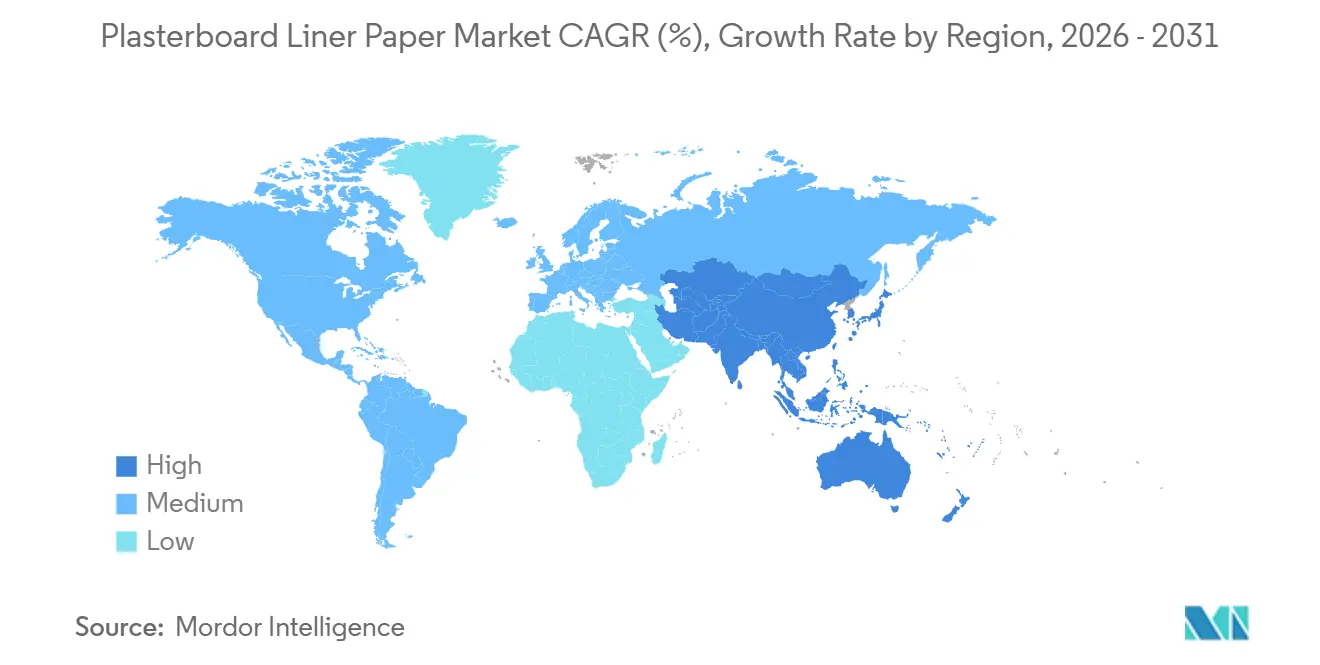
Asia-Pacific held 38.14% of the plasterboard liner paper market share in 2025 and is forecast to grow at a CAGR of 6.09% through 2031. China remains the largest national consumer in the region, supported by a USD 27.7 billion infrastructure allocation and green-building certification requirements for new commercial projects. India's National Building Code 2025 is expected to support fire-rated wall assemblies and demand for higher-performance liners. Vietnam, Indonesia, and Thailand are increasing drywall use as urban construction shifts from traditional masonry systems. This regional growth profile positions Asia-Pacific as the primary region of expansion for the plasterboard liner paper market.
North America Plasterboard Liner Paper Market
North America is the second-largest regional market, supported by residential construction, commercial retrofits, and industrial and logistics development. Knauf Group opened a EUR 130 million (USD 143 million) wallboard plant in Wheatland County, Alberta, Canada[2]. The added board capacity extends contracted liner demand in Western Canada. CGC Inc. launched Sheetrock UltraLight PRO Panels in February 2025, which are up to 8.9% lighter than comparable half-inch panels and reduce lifecycle greenhouse gas emissions by up to 37% per thousand square feet (MSF) versus the industry average. Mexico also contributes through nearshoring-related industrial construction and commercial interior fit-outs that have increased since 2024.
EMEA and South America Plasterboard Liner Paper Market
Europe's liner demand is shaped by renovation requirements and established recovered-fiber systems. Directive 2024/1275/EU requires national renovation trajectories by May 2026 and supports the long-term use of drywall across major European markets. South America remains a smaller market, with Brazil and Argentina identified as the main sources of demand. The Middle-East and Africa present longer-term potential through Saudi Arabia's Vision 2030 program and South Africa's urban housing shortfall.
Competitive Landscape
The plasterboard liner paper market is moderately consolidated. Large integrated paper groups serve institutional customers across major geographies and manage supply chain requirements at scale. International Paper completed its acquisition of DS Smith in January 2025, creating a combined group with operations in more than 30 countries and USD 18.6 billion in net sales. The transaction altered liner supply relationships across North America, Europe, the Middle-East, and Africa. As part of the European Commission approval process, International Paper agreed to divest specific DS Smith operations in France, Portugal, and Spain. These divestments partly limit the increase in supply concentration within those national markets.
SCG Packaging is a supplier in Southeast Asia, with its product offering linked to recycled pulp and carbon-footprint certification. The company's liner production illustrates how verified recycled content can support participation in circular construction procurement. Knauf Group expanded gypsum board capacity in Canada in 2026, which may strengthen regional demand for liner supply across the board production chain. CGC's lighter panel launch also indicates that board manufacturers are seeking material efficiency while maintaining product performance. These developments place greater attention on liner strength, formation consistency, and the ability to support lighter board designs.
Competitive strategies are increasingly based on long-term supply arrangements and joint work with gypsum board manufacturers. These arrangements can reduce exposure to short-term spot demand and make supply planning more predictable during construction cycles. Suppliers that can qualify recycled-fiber grades for fire-rated board applications may be better positioned in higher-growth board categories. Independent verification of recycled content and carbon documentation is becoming more important for institutional procurement in Europe and North America. Producers that cannot provide this documentation may have weaker access to preferred supplier lists, even if their prices are competitive.
Plasterboard Liner Paper Industry Leaders
-
SCG PACKAGING
-
Visy
-
WEIG Group
-
DS Smith
-
W. Hamburger GmbH
- *Disclaimer: Major Players sorted in no particular order
Plasterboard Liner Paper Market Companies Covered in this Report
- Alier S.A.
- American Gypsum Company, LLC
- ASIA PAPER MFG.CO.,LTD
- DS Smith
- Georgia-Pacific Gypsum LLC
- International Paper
- Knauf Gips KG
- PAPCEL, a.s.
- Republic Paperboard Company, LLC
- SCG PACKAGING
- Sure Paper Co., Ltd.
- Visy
- W. Hamburger GmbH
- WEIG Group
- Yoshino Gypsum Co., Ltd.
Recent Industry Developments in Plasterboard Liner Paper Market
- June 2026: Knauf Group, through its subsidiary USG/CGC, opened a new EUR 130 million (~USD 143 million) wallboard manufacturing plant in Wheatland County, Alberta, Canada. The facility adds gypsum board capacity in Western Canada and extends contracted demand for liner paper across the region.
- January 2025: International Paper completed its acquisition of DS Smith, creating a combined entity with operations in more than 30 countries. The merger reshaped liner paper supply chain relationships across North America and EMEA. DS Smith was retained as a wholly-owned subsidiary with its own operational leadership.
Global Plasterboard Liner Paper Market Report Scope
Plasterboard liner paper is a heavy-duty specialty paper used as the outer facing and backing surfaces that encase the gypsum core of drywall or plasterboard. It provides structural strength, fire resistance, and a smooth surface for finishing.
The plasterboard liner paper market is segmented by product type, fiber type, plasterboard type, application, and geography. By product type, the market is segmented into face liner paper and back liner paper. By fiber type, the market is segmented into recycled fiber paper, virgin fiber paper, and others (blended fiber paper). By plasterboard type, the market is segmented into standard plasterboard, moisture-resistant plasterboard, fire-resistant plasterboard, and others (acoustic, impact-resistant, and specialty plasterboard). By application, the market is segmented into wall systems, ceiling systems, and others (partition systems, floor and underlayment systems). The report also covers market size and forecasts for plasterboard liner paper across 15 countries in major regions. The market sizes and forecasts are provided in terms of value (USD).
Segmentation Overview
| Face Liner Paper |
| Back Liner Paper |
| Recycled Fiber Paper |
| Virgin Fiber Paper |
| Others (Blended Fiber Paper) |
| Standard Plasterboard |
| Moisture-Resistant Plasterboard |
| Fire-Resistant Plasterboard |
| Others (Acoustic, Impact-Resistant and Specialty Plasterboard) |
| Wall Systems |
| Ceiling Systems |
| Others (Partition Systems, Floor and Underlayment Systems) |
| Asia-Pacific | China |
| India | |
| Japan | |
| South Korea | |
| ASEAN Countries | |
| Rest of Asia-Pacific | |
| North America | United States |
| Canada | |
| Mexico | |
| Europe | Germany |
| United Kingdom | |
| France | |
| Italy | |
| NORDIC Countries | |
| Rest of Europe | |
| South America | Brazil |
| Argentina | |
| Rest of South America | |
| Middle-East and Africa | Saudi Arabia |
| South Africa | |
| Rest of Middle-East and Africa |
| By Product Type | Face Liner Paper | |
| Back Liner Paper | ||
| By Fiber Type | Recycled Fiber Paper | |
| Virgin Fiber Paper | ||
| Others (Blended Fiber Paper) | ||
| By Plasterboard Type | Standard Plasterboard | |
| Moisture-Resistant Plasterboard | ||
| Fire-Resistant Plasterboard | ||
| Others (Acoustic, Impact-Resistant and Specialty Plasterboard) | ||
| By Application | Wall Systems | |
| Ceiling Systems | ||
| Others (Partition Systems, Floor and Underlayment Systems) | ||
| By Geography | Asia-Pacific | China |
| India | ||
| Japan | ||
| South Korea | ||
| ASEAN Countries | ||
| Rest of Asia-Pacific | ||
| North America | United States | |
| Canada | ||
| Mexico | ||
| Europe | Germany | |
| United Kingdom | ||
| France | ||
| Italy | ||
| NORDIC Countries | ||
| Rest of Europe | ||
| South America | Brazil | |
| Argentina | ||
| Rest of South America | ||
| Middle-East and Africa | Saudi Arabia | |
| South Africa | ||
| Rest of Middle-East and Africa | ||
Key Questions Answered in the Report
What is current market size of Plasterboard Liner Paper Market?
The plasterboard liner paper market size was estimated at USD 5.19 billion in 2025 and is estimated to grow from USD 5.45 billion in 2026 to USD 7.19 billion by 2031, at a CAGR of 5.67% during the forecast period (2026-2031).
Which product type leads to demand for plasterboard liner paper?
Face liner paper led with a 52.37% share in 2025 and is forecast to grow at a CAGR of 5.87% through 2031.
Why is recycled fiber important for plasterboard liner production?
Recycled fiber paper held a 58.15% share in 2025 and is forecast to grow at a 6.73% CAGR, supported by circular procurement and verified recycled-content requirements.
Which plasterboard category is growing fastest?
Fire-resistant plasterboard is forecast to grow at a CAGR of 6.34% through 2031 as building rules increase the use of rated assemblies.