
Plant Growth-Promoting Rhizobacteria (PGPR) Market Size and Share
Market Overview
| Study Period | 2022 - 2032 |
|---|---|
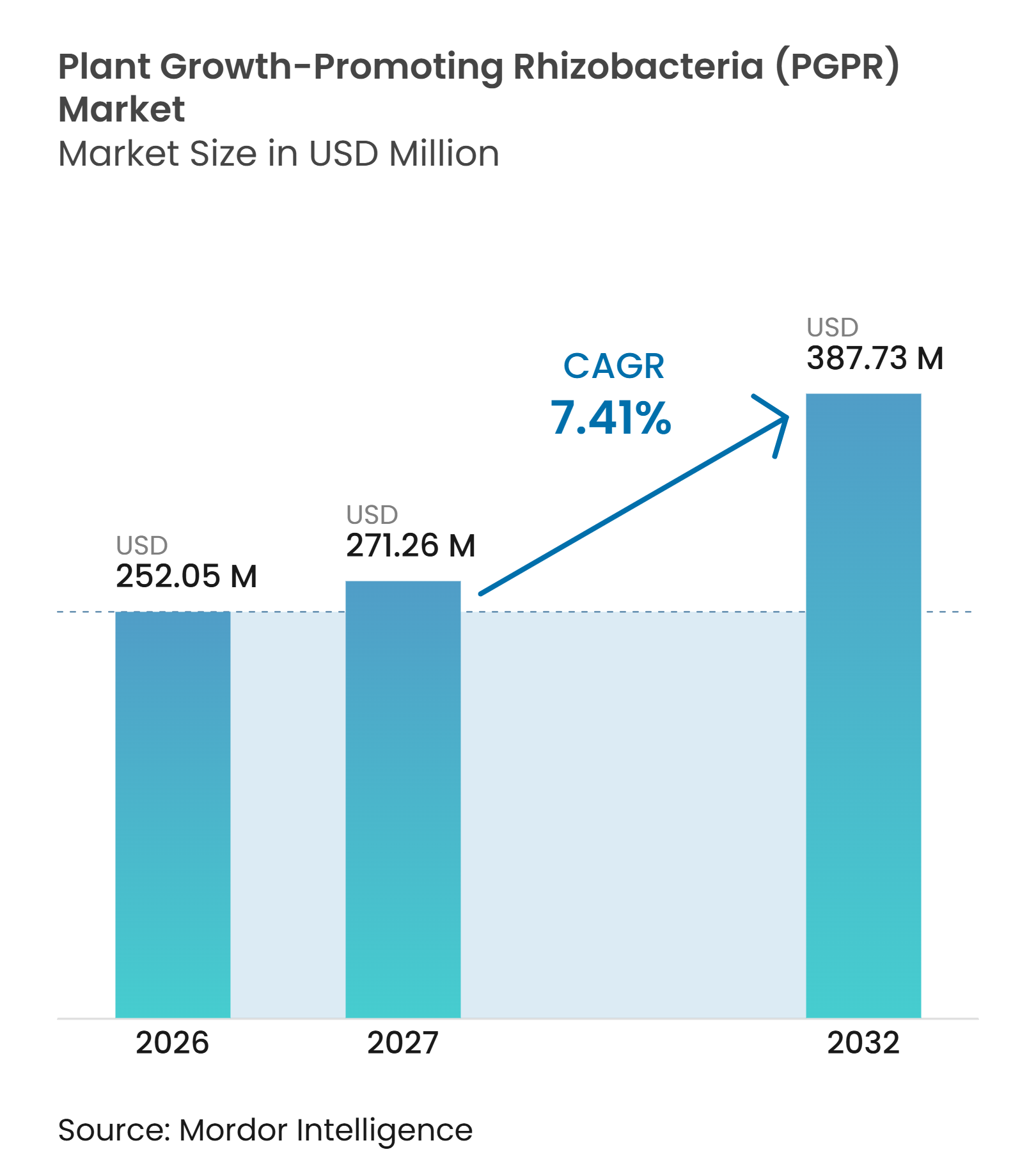
| Market Size (2027) | USD 271.26 Million |
| Market Size (2032) | USD 387.73 Million |
| Growth Rate (2027 - 2032) | 7.41 % |
| Fastest Growing Market | South America |
| Largest Market | Asia-Pacific |
| Market Concentration | Medium |
Major Players *Disclaimer: Major Players sorted in no particular order Image © Mordor Intelligence. Reuse requires attribution under CC BY 4.0. | |
Plant Growth-Promoting Rhizobacteria (PGPR) Market Analysis by Mordor Intelligence
The plant growth-promoting rhizobacteria (PGPR) market size was valued at USD 252.05 million in 2026 and is estimated to grow from USD 271.26 million in 2027 to USD 387.73 million by 2032. The market is projected to grow at a 7.41% CAGR during 2027–2032. The PGPR market is moving past a simple fertilizer-replacement pitch as growers look for evidence on nutrient use, crop establishment, and stress response. Fertilizer costs and concern about nutrient losses are encouraging trials of formulations that support nitrogen fixation or phosphorus solubilization. Sustainable farming commitments made by food companies also create procurement demand for inputs with a documented agronomic profile. Suppliers that can show performance by crop, soil type, and climate are better placed to secure repeat purchases. Products that stay viable through longer distribution routes help with a practical constraint in warm markets that have limited cold-chain capacity.
Key Report Takeaways
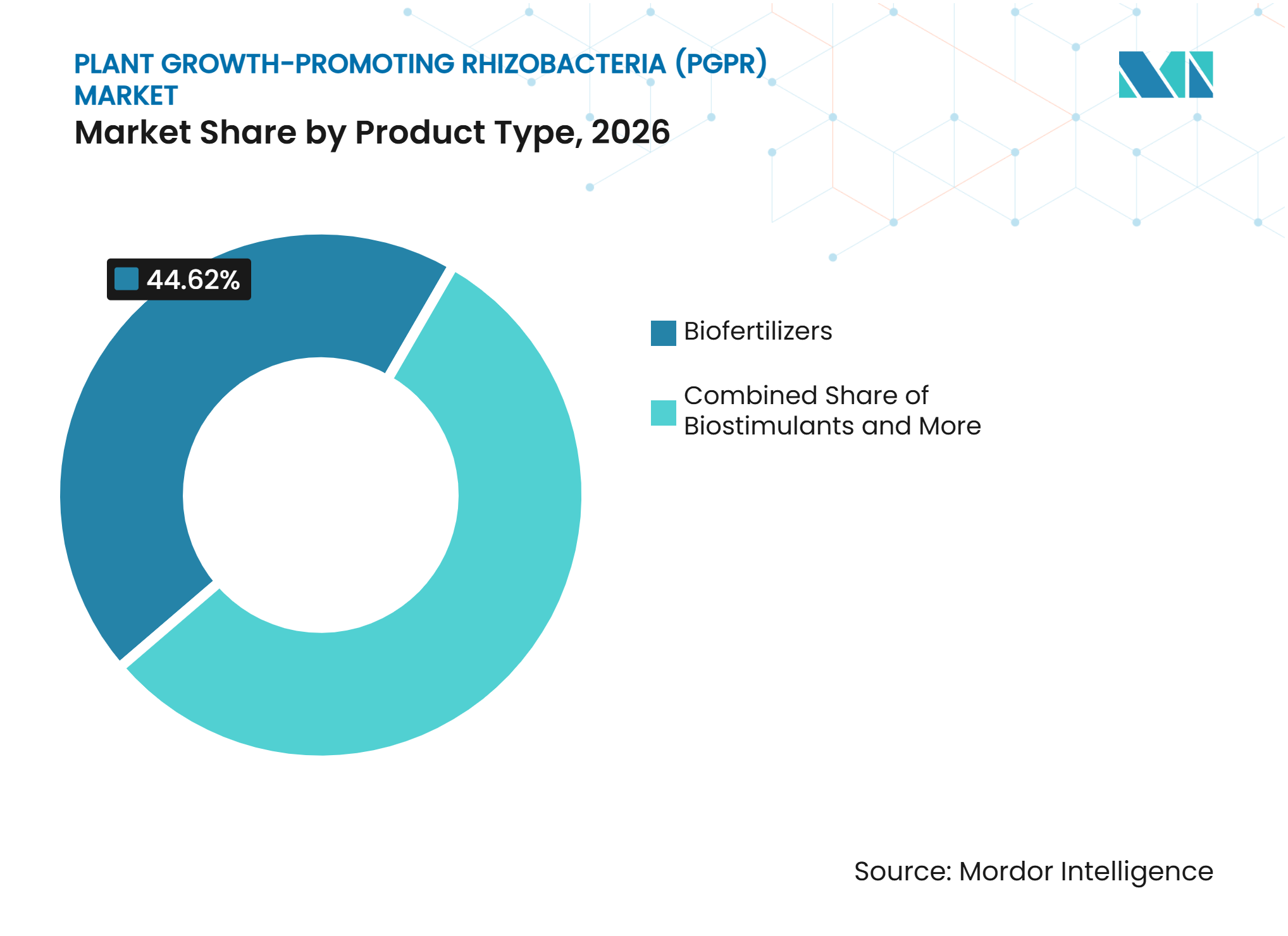
- By product type, biofertilizers accounted for 44.62% of the plant growth-promoting rhizobacteria (PGPR) market size in 2026. Biostimulants are projected to grow at an 8.2% CAGR during 2027–2032.
- By crop type, grains and cereals held 42.42% of the plant growth-promoting rhizobacteria (PGPR) market share in 2026. Fruits and vegetables are projected to grow at an 8.5% CAGR during 2027–2032.
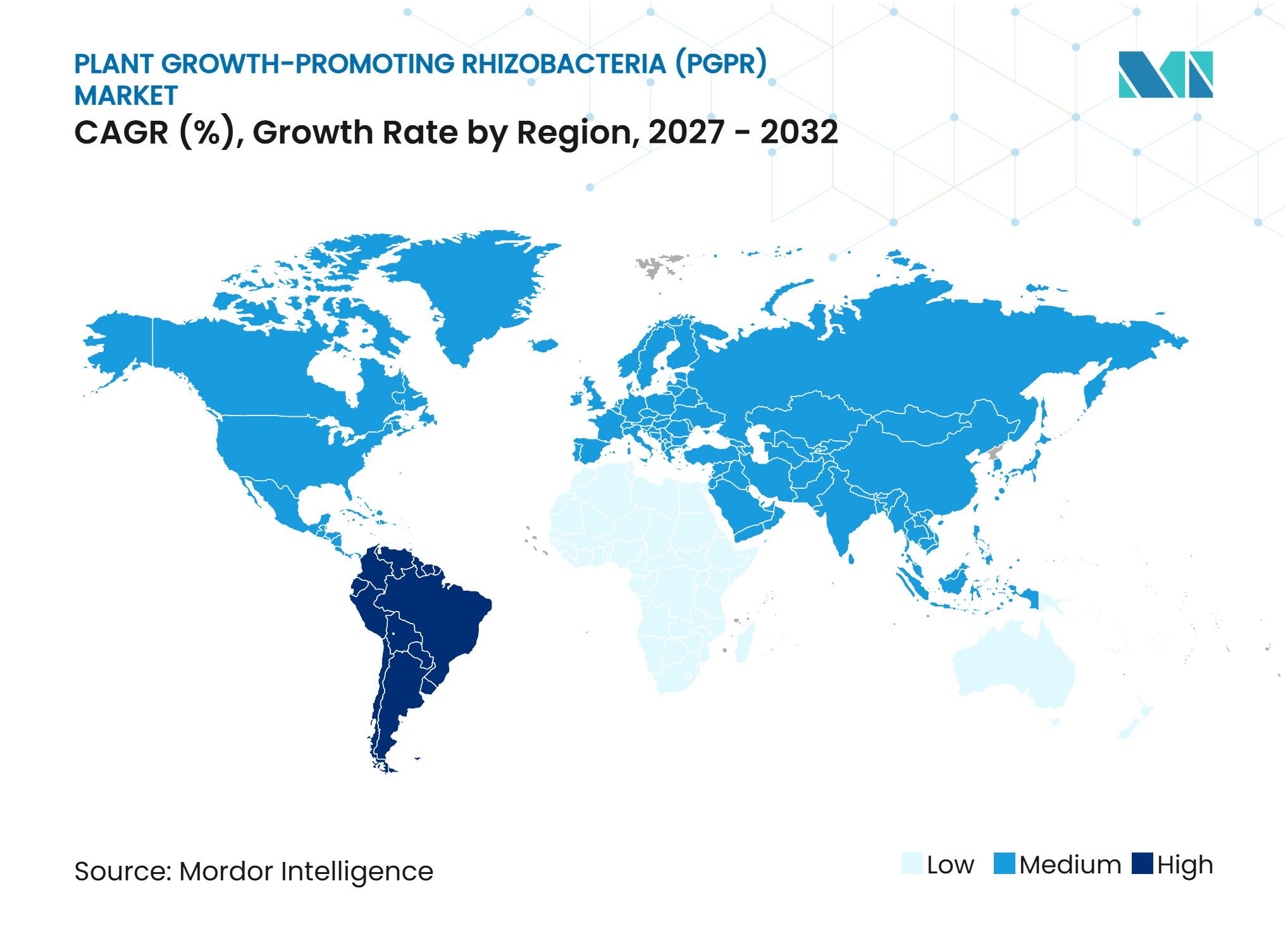
- By geography, the Asia-Pacific region accounted for 31.23% of the PGPR market share in 2026. South America is projected to grow at a 9.2% CAGR during 2027–2032.
Note: Market numbers in this report are based on Mordor Intelligence's proprietary estimation framework, which combines nine months of actuals with Q4 projections for base year 2026.
Market Trends and Insights
Drivers Impact Analysis of Plant Growth-Promoting Rhizobacteria (PGPR) Market*
| Driver | (~) % Impact on CAGR Forecast | Geographic Relevance | Impact Timeline |
|---|---|---|---|
| Demand for PGPR-Based Nutrient-Use Efficiency | +0.85% | Global, with strong relevance in North America, South America, Europe, Asia-Pacific, and Africa because PGPR products are commercialized around nitrogen fixation and nutrient solubilization. | Medium term (2–4 years) |
| Commercial Need for Abiotic-Stress Resilience | +0.65% | Global, especially drought-prone areas of North America, South America, Asia-Pacific, Africa, and southern Europe. | Medium term (2–4 years) |
| Expansion of PGPR Seed-Treatment and In-Furrow Delivery | +0.60% | North America, South America, Europe, and Asia-Pacific, where seed treatment and in-furrow application are established crop-input practices. | Short term (≤ 2 years) |
| PGPR-Based Biological Disease Suppression in Integrated Programs | +0.45% | Europe, North America, South America, Asia-Pacific, and Africa, with particular relevance to fruits, vegetables, cereals, and seed treatment. | Medium term (2–4 years) |
| Crop- and Geography-Specific PGPR Product Positioning | +0.40% | Global, because performance depends on crop genotype, soil properties, climate, native microbiota, and application method. | Medium term (2–4 years) |
| Stabilized Formulations and Longer Viability Windows | +0.35% | Global, particularly markets with long distribution routes, high temperatures, or inconsistent farm-level storage. | Long term (≥ 4 years) |
| Source: Mordor Intelligence | |||
Demand for PGPR-Based Nutrient-Use Efficiency
Rising fertilizer costs and concern about nitrogen leaching are increasing interest in biological products that complement conventional crop nutrition. PGPR formulations can be positioned around biological nitrogen fixation and phosphorus solubilization, which gives growers a reason to test them within existing fertility programs. In the United States, the Plant Biostimulant Act of 2025, introduced in the Senate in May 2025, proposes a federal definition for plant biostimulants and would exclude biological biostimulants from regulation as plant regulators under the Federal Insecticide, Fungicide, and Rodenticide Act (FIFRA)[1]. The PGPR market benefits when rules define functional claims and reduce uncertainty for manufacturers and distributors. Where classification remains product-specific, suppliers face longer planning cycles before they can establish label claims. The commercial result is a stronger case for products that can document nutrient-use benefits under local growing conditions.
Commercial Need for Abiotic-Stress Resilience
Drought, heat, and salinity increasingly influence crop-input decisions across major agricultural regions. Growers assess formulations that support root development and water-use management as risk-management tools, not only as yield enhancers. In Argentina, wheat trials run by the Biologicals Network of the Argentine No-Till Farmers Association (Aapresid) recorded a 10% yield increase from a PGPR seed treatment in fields at Arroyo Venado, as reported by Ámbito in June 2025. The network’s technical lead advised that biologicals add the most value when they target a specific problem, such as weak root development or anticipated climate stress. That result applies to the trial conditions and cannot be generalized to all crops or products. The PGPR market gains where suppliers match evidence to a defined climate zone and crop. Such evidence can support higher-value sales when growers have recurring exposure to water or heat stress.
Expansion of PGPR Seed-Treatment and In-Furrow Delivery
Seed treatment and in-furrow placement allow growers to use PGPR within operating steps that are already familiar. These delivery methods place bacteria near emerging roots during the crop-establishment period. XiteBio Technologies Inc announced in February 2026 that SoyRhizo XV, a concentrated liquid soybean inoculant with a lower seed-applied use rate designed to work alongside other seed treatments, had received Canadian Food Inspection Agency (CFIA) registration, following its U.S. launch in 2025. Novozymes A/S introduced its ProPort System to seed treaters for the 2026 season after testing in 2025, giving treaters up to 14 days to use opened rhizobia products compared with the industry standard of 24 hours. The PGPR market benefits when compatibility and handling improvements lower operational barriers for seed treaters. These formats also give distributors a clearer service model than stand-alone products that need separate field applications.
PGPR-Based Biological Disease Suppression in Integrated Programs
Some PGPR formulations are marketed for both plant growth support and suppression of soil-borne pests or diseases. This dual function can fit integrated crop programs because the product is positioned beside, rather than as a direct replacement for, conventional controls. In Brazil, the label for Koppert’s Chevelle, registered with the Ministry of Agriculture and Livestock (MAPA) as a microbiological nematicide and revised in July 2025, states that Bacillus amyloliquefaciens strain UMAF6614 colonizes crop roots and forms a protective biofilm, and positions the product as a complement to integrated nematode management. The example shows how a biocontrol claim can widen the commercial use case for a microbial formulation. The PGPR market gains from this approach only when the product’s registration and label claims support the intended use. In the European Union, the European Commission adopted its Chemicals Omnibus proposal in July 2025, which would allow criteria for adding new microorganisms to Component Material Category (CMC) 7 of the Fertilising Products Regulation (Regulation (EU) 2019/1009) for microbial biostimulants.
Restraints Impact Analysis of Plant Growth-Promoting Rhizobacteria (PGPR) Market*
| Restraint | (~) % Impact on CAGR Forecast | Geographic Relevance | Impact Timeline |
|---|---|---|---|
| Inconsistent Field Efficacy Across Crops and Environments | -0.80% | Global, because soil chemistry, moisture, temperature, crop genotype, native microbiota, and application timing vary substantially between farms. | Short term (≤ 2 years) |
| Viability, Shelf-Life, and Cold-Chain or Handling Risk | -0.45% | Global, especially in high-temperature markets and long or fragmented agricultural supply chains. | Short term (≤ 2 years) |
| Fragmented and Claim-Dependent Regulatory Pathways | -0.40% | Particularly relevant in the European Union, United States, Canada, India, Brazil, and other markets with separate fertilizer, biostimulant, and biopesticide routes. | Medium term (2–4 years) |
| Weak Standardization of Product Quality and Performance Claims | -0.30% | Global, especially in fragmented distribution channels across North America, Europe, Asia-Pacific, South America, and Africa. | Medium term (2–4 years) |
| Source: Mordor Intelligence | |||
Inconsistent Field Efficacy Across Crops and Environments
Variable field performance can limit repeat purchases when a grower does not observe a meaningful outcome in the first season. Soil composition, moisture, temperature, crop genotype, existing microbial populations, and application timing can all influence results. A December 2025 commentary by University of Illinois researchers in Agricultural & Environmental Letters found that grouping living microbial inoculants with non-living biostimulants creates regulatory challenges, and that the use of “biostimulants” by researchers and regulators but “biologicals” by industry and farmers confuses discussion of these products. The PGPR market faces a commercial challenge when product identity and expected outcome are unclear at the farm level. Regionally diverse trial networks can help suppliers define where a product should be used and where it should not. Clearer boundaries for product claims can therefore be as important as broad promotional reach.
Viability, Shelf-Life, and Cold-Chain or Handling Risk
Viability losses can occur after a product leaves the manufacturing site and before bacteria reach the rhizosphere. High ambient temperatures and inconsistent storage can make this risk more acute in tropical markets and long or fragmented supply chains. A review published in the Journal of Integrative Agriculture in September 2025 reported that annual inoculant sales in Brazil reach approximately 120 million doses and identified quality control as a production challenge, particularly as on-farm inoculant production spreads to larger farms. The PGPR market can lose credibility when label specifications do not translate into active cells at the point of application. Packaging, carrier selection, and storage guidance must therefore be part of the commercial proposition. Suppliers that can document viable-cell performance through the distribution chain have a stronger basis for defending product quality.
*Our forecasts treat driver/restraint impacts as directional, not additive. The impact forecasts reflect baseline growth, mix effects, and variable interactions.
Plant Growth-Promoting Rhizobacteria (PGPR) Market Segment Analysis
By Product Type:
Biofertilizers Lead as Biostimulants Grow FasterBiofertilizers accounted for 44.62% of the PGPR market share in 2026. Their position comes from established use of Rhizobium, Bradyrhizobium, and Azospirillum inoculants in soybean, pulse, and cereal systems. These products are generally bought for their primary nutrient-availability function, including biological nitrogen fixation or phosphorus solubilization. Existing distribution networks in row crops help sustain their use across major producing regions. Their commercial role provides suppliers with a familiar entry point to introduce additional biological products.
The biostimulants segment is projected to grow at an 8.2% CAGR during 2027–2032, the fastest among all product types. Its growth is linked to formulations positioned around plant physiological processes, nutrient-use efficiency, and tolerance to environmental stress. In the European Union, Regulation (EU) 2019/1009 places plant biostimulants under Product Function Category (PFC) 6, although eligibility depends on the applicable conformity route and microorganism requirements. Biopesticides remain a smaller product type, but a relevant registration can open seed-treatment or other crop-protection applications. In October 2025, the U.S. Environmental Protection Agency (EPA) established an exemption from the requirement of a tolerance for residues of Priestia megaterium strain SYM36613, a microbial fungicide petitioned by Indigo Ag, Inc. for soil and seed application, in or on all food commodities[2].



By Crop Type:
Broad-Acre Demand Supports Grains as Horticulture ExpandsGrains and cereals held 42.42% of the PGPR market share in 2026. Wheat, maize, and rice systems offer a broad base of cultivated area and established seed-treatment infrastructure. Products used on these crops must fit large-scale application practices and demonstrate value under variable field conditions. Familiarity with inoculant use in staple crop systems supports the segment’s current scale. The segment also provides a practical setting for products that can be applied at planting without extra field passes.
The fruits and vegetables segment is projected to grow at an 8.5% CAGR during 2027–2032, the fastest among all crop types. Intensive horticulture can support products that target crop quality, root health, and more consistent performance. Buyers in these systems also place greater weight on residues and crop uniformity, which favors microbial products that fit within residue-management programs. Pulses and oilseeds remain an important source of demand, especially for soybeans. Turf, ornamentals, and other crops are smaller categories with more specialized use conditions.
Geography Analysis
Asia-Pacific accounted for 31.23% of the PGPR market share in 2026. China and India give the region a large base of cultivated area and crop-input demand. India presents a distinct opportunity because climate stress, smallholder farming, and public support for natural farming are driving interest in biological tools. The Union Cabinet approved the National Mission on Natural Farming in November 2024 with an outlay of INR 2,481 crore (about USD 295 million) through fiscal year 2025–26, including plans for 10,000 Bio-input Resource Centers to supply natural farming inputs locally[3].
South America is projected to grow at a 9.2% CAGR during 2027–2032, the fastest among all regions. Brazil has an established soybean inoculant base, which gives the region practical experience with microbial products in broad-acre agriculture. The country has more than 600 registered inoculant products, and at least 60% are designated for soybean cultivation. In Argentina, the National Agrifood Health and Quality Service (SENASA) issued Resolution No. 458/2025, which, according to the Chamber of Agricultural Health and Fertilizers (CASAFE), digitizes registration procedures for phytosanitary products, including bioinputs, and recognizes evaluations from countries with regulatory convergence. These conditions improve the commercial environment for products with a clear crop fit and regulatory pathway.
North America is supported by mature seed-treatment practices, active investment in biological inputs, and the biopesticide framework of the U.S. Environmental Protection Agency (EPA). Europe is shaped by the Fertilizing Products Regulation and the pending question of how additional microorganisms may qualify under Component Material Category (CMC) 7. The Middle East and Africa remain smaller in value, but drought and salinity present a clear use case for formulations designed for stress conditions. South Africa, Kenya, and Nigeria are relevant to future adoption as smallholder access to biological inputs improves. Across regions, product stability and credible local validation decide whether interest turns into repeat purchasing.
Competitive Landscape
Market Concentration
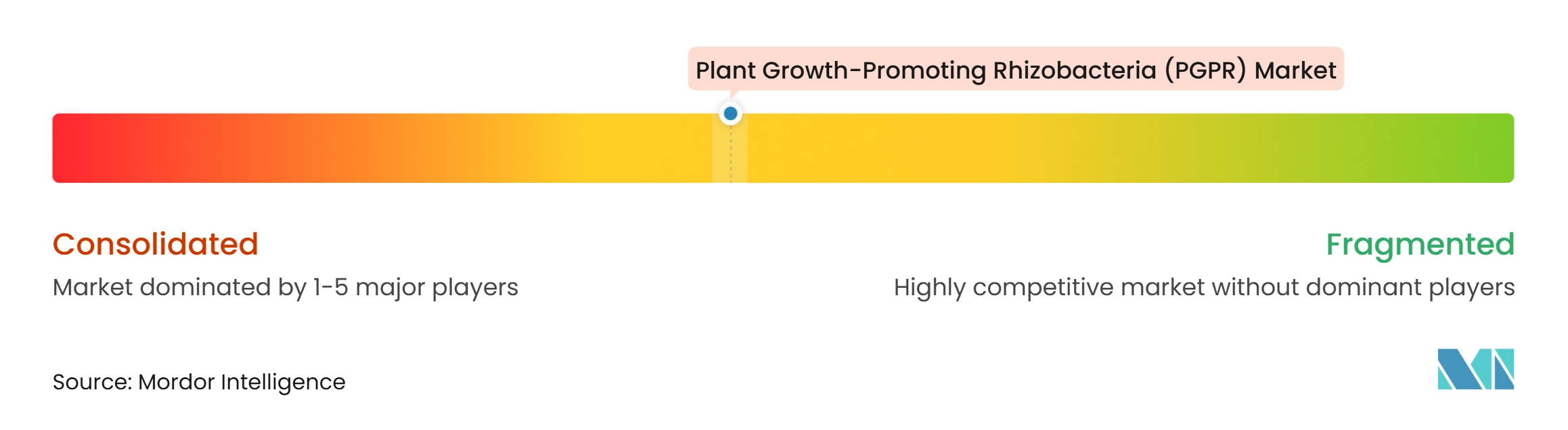
The PGPR market includes Novozymes A/S, Corteva Agriscience, Lallemand Inc, Rizobacter Argentina SA, XiteBio Technologies Inc, Impello Biosciences, TERRAMAX, INC, J.R. Simplot Company (Innvictis Crop Care, LLC), Premier Tech Ltd, Koppert Biological Systems B.V., AGROVA Kereskedelmi és Szolgáltató Korlátolt Felelősségű Társaság, and Biocultivos SA. Competition is based on product portfolio, strain documentation, stable formulation, local technical support, and access to established sales channels. Leading suppliers are shifting from legacy inoculants to products that address nutrient availability, stress response, or plant health needs. The market’s moderate concentration comes from the presence of large suppliers alongside a fragmented group of crop- and region-focused businesses.
Novozymes A/S announced in June 2026 that Rovensa Next would take over commercial responsibility for selected agricultural biosolutions in the United States from the 2027 growing season, including its soybean, corn, pulse, and peanut inoculant brands. The agreement shows how a supplier can widen access through a distributor with reach into both specialty-crop and broad-acre markets. Corteva Agriscience published its Biologicals Update 2026 in March 2026, introducing Harbest alongside its BlueN and Kinsidro Grow+ products. These actions show that leading companies are pairing products with distribution and agronomic-service capabilities.
Technology differentiates companies by improving shelf life, tank-mix compatibility, or suitability for seed-treatment workflows. XiteBio Technologies Inc.’s 2026 Canadian registration for SoyRhizo XV demonstrates the value of registration and workflow compatibility in the commercial seed-treatment channel. Fermentation know-how and private-label relationships can help suppliers serve markets where branded biological products are still developing. Regulatory capability also remains an entry barrier because companies must manage different requirements for fertilizer, biostimulant, and biopesticide claims. Company-level share data for PGPR products is limited because most suppliers report biologicals within broader crop-input or biosolutions segments.
Plant Growth-Promoting Rhizobacteria (PGPR) Industry Leaders
-
Novozymes A/S
-
Corteva Agriscience
-
Rizobacter Argentina S.A.
-
Lallemand Inc.
-
Premier Tech Ltd.
- *Disclaimer: Major Players sorted in no particular order
Plant Growth-Promoting Rhizobacteria (PGPR) Market Companies Covered in this Report
- Novozymes A/S
- Corteva Agriscience
- Lallemand Inc
- Rizobacter Argentina SA
- XiteBio Technologies Inc
- Impello Biosciences
- TERRAMAX, INC
- J.R. Simplot Company (Innvictis Crop Care, LLC)
- Premier Tech Ltd
- Koppert Biological Systems B.V.
- AGROVA Kereskedelmi és Szolgáltató Korlátolt Felelősségű Társaság
- Biocultivos SA
Recent Industry Developments in Plant Growth-Promoting Rhizobacteria (PGPR) Market
- June 2026: Novozymes A/S and Rovensa Next announced a U.S. distribution agreement under which Rovensa Next is to commercialize selected Novozymes A/S agricultural biosolutions, including Optimize, NodPro, Cell-Tech, TagTeam, BioniQ, JumpStart, and QuickRoots, beginning with the 2027 growing season.
- October 2025: The U.S. Environmental Protection Agency (EPA) published a final rule exempting residues of the soil- and seed-applied microbial fungicide Priestia megaterium strain SYM36613 from the requirement of a tolerance in or on all food commodities.
- November 2024: Lallemand Inc, through its Lallemand Plant Care division, launched LALRISE SHINE DS in the United States, a dry seed treatment based on the plant growth-promoting rhizobacterium Bacillus velezensis and designed to improve crop establishment through better root vigor and nutrient availability.
Global Plant Growth-Promoting Rhizobacteria (PGPR) Market Report Scope
The Plant Growth-Promoting Rhizobacteria (PGPR) Market Report is Segmented by Product Type (Biofertilizers, Biopesticides, and Biostimulants), by Crop Type (Grains and Cereals, Pulses and Oilseeds, Fruits and Vegetables, Turf and Ornamentals, and Other Crops), and by Geography (North America, South America, Europe, Asia-Pacific, Middle East, and Africa). The Market Forecasts are Provided in Terms of Value (USD).
Segmentation Overview
| Biofertilizers |
| Biopesticides |
| Biostimulants |
| Grains and Cereals |
| Pulses and Oilseeds |
| Fruits and Vegetables |
| Turf and Ornamentals |
| Other Crops |
| North America | United States |
| Canada | |
| Mexico | |
| Rest of North America | |
| South America | Brazil |
| Argentina | |
| Chile | |
| Colombia | |
| Peru | |
| Rest of South America | |
| Europe | Germany |
| United Kingdom | |
| France | |
| Spain | |
| Italy | |
| Russia | |
| Rest of Europe | |
| Asia-Pacific | China |
| Japan | |
| India | |
| Australia | |
| Singapore | |
| South Korea | |
| Rest of Asia-Pacific | |
| Middle East | Saudi Arabia |
| United Arab Emirates | |
| Turkey | |
| Rest of Middle East | |
| Africa | South Africa |
| Kenya | |
| Nigeria | |
| Rest of Africa |
| By Product Type | Biofertilizers | |
| Biopesticides | ||
| Biostimulants | ||
| By Crop Type | Grains and Cereals | |
| Pulses and Oilseeds | ||
| Fruits and Vegetables | ||
| Turf and Ornamentals | ||
| Other Crops | ||
| By Geography | North America | United States |
| Canada | ||
| Mexico | ||
| Rest of North America | ||
| South America | Brazil | |
| Argentina | ||
| Chile | ||
| Colombia | ||
| Peru | ||
| Rest of South America | ||
| Europe | Germany | |
| United Kingdom | ||
| France | ||
| Spain | ||
| Italy | ||
| Russia | ||
| Rest of Europe | ||
| Asia-Pacific | China | |
| Japan | ||
| India | ||
| Australia | ||
| Singapore | ||
| South Korea | ||
| Rest of Asia-Pacific | ||
| Middle East | Saudi Arabia | |
| United Arab Emirates | ||
| Turkey | ||
| Rest of Middle East | ||
| Africa | South Africa | |
| Kenya | ||
| Nigeria | ||
| Rest of Africa | ||
Key Questions Answered in the Report
How big is the PGPR market in 2027?
The PGPR market is estimated at USD 271.26 million in 2027 and is anticipated to reach USD 387.73 million by 2032.
What was the value of the PGPR market in 2026?
The PGPR market was valued at USD 252.05 million in 2026.
Which crop group is growing fastest for PGPR products?
Fruits and vegetables are projected to grow at an 8.5% CAGR during 2027–2032.
Which region is projected to grow fastest?
South America is projected to grow at a 9.2% CAGR during 2027–2032, supported by established soybean inoculant use and evolving regulation.