
Physical AI Platforms Market Size and Share
Market Overview
| Study Period | 2020 - 2031 |
|---|---|
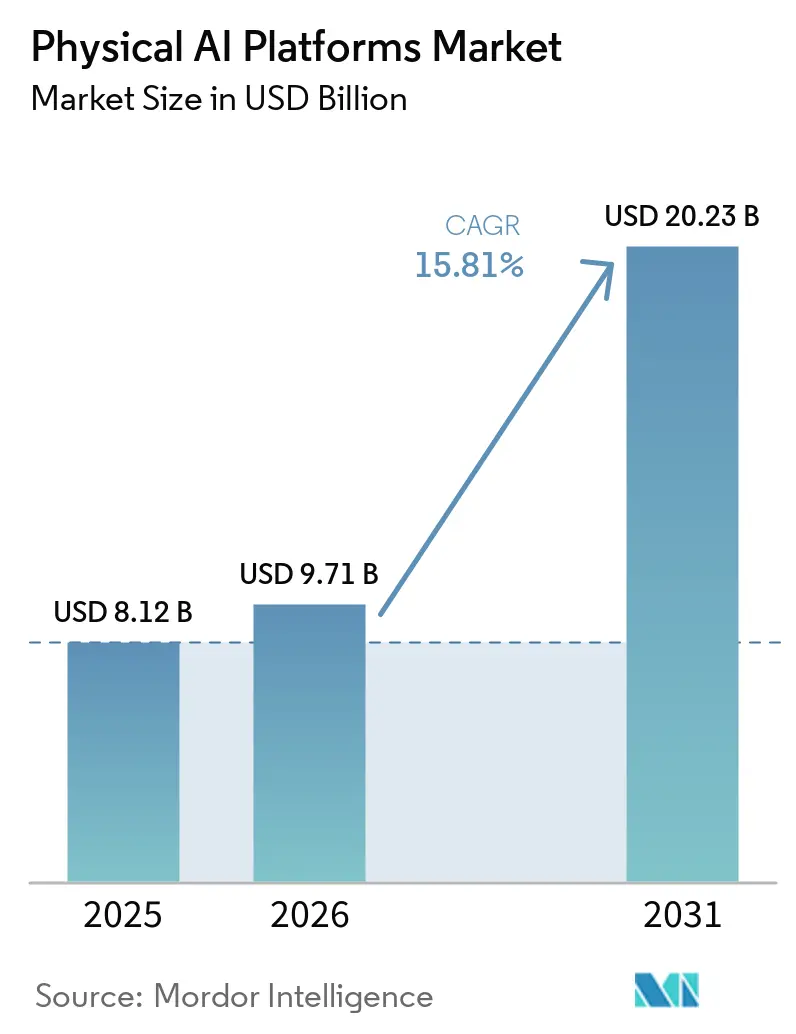
| Market Size (2026) | USD 9.71 Billion |
| Market Size (2031) | USD 20.23 Billion |
| Growth Rate (2026 - 2031) | 15.81 % |
| Fastest Growing Market | Asia-Pacific |
| Largest Market | North America |
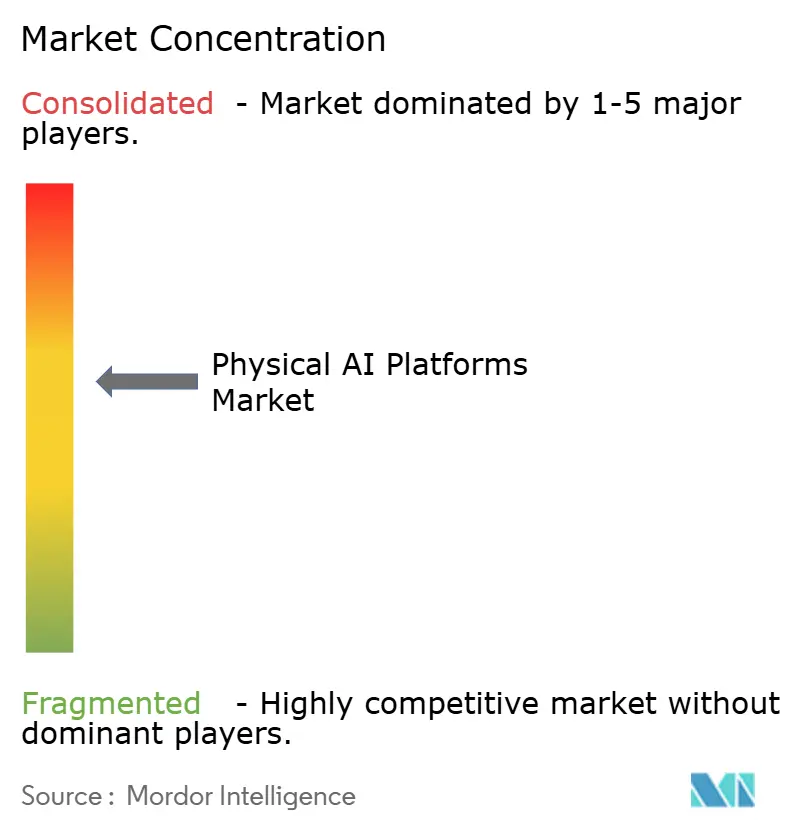
| Market Concentration | Medium |
Major Players *Disclaimer: Major Players sorted in no particular order Image © Mordor Intelligence. Reuse requires attribution under CC BY 4.0. | |
Physical AI Platforms Market Analysis by Mordor Intelligence
The Physical AI Platforms Market size was valued at USD 8.12 billion in 2025 and estimated to expand from USD 9.71 billion in 2026 to reach USD 20.23 billion by 2031, at a CAGR of 15.81% during the forecast period 2026-2031. The market combines simulation tools, edge computing, robotics software, and intelligent machines that can perceive, plan, and act in changing settings. Early spending remains centered on computing hardware, sensors, and actuators, while software demand is expected to rise as developers deploy models, simulations, and control systems across larger robot fleets. Manufacturing adoption, defense investment, and logistics automation support demand, but integration work, safety approval, and limited training data can slow deployment. The Physical Artificial Intelligence (AI) Platforms Market also favors vendors that can lower implementation costs, support safety processes, and develop reusable training data and software across different machines.
Key Report Takeaways
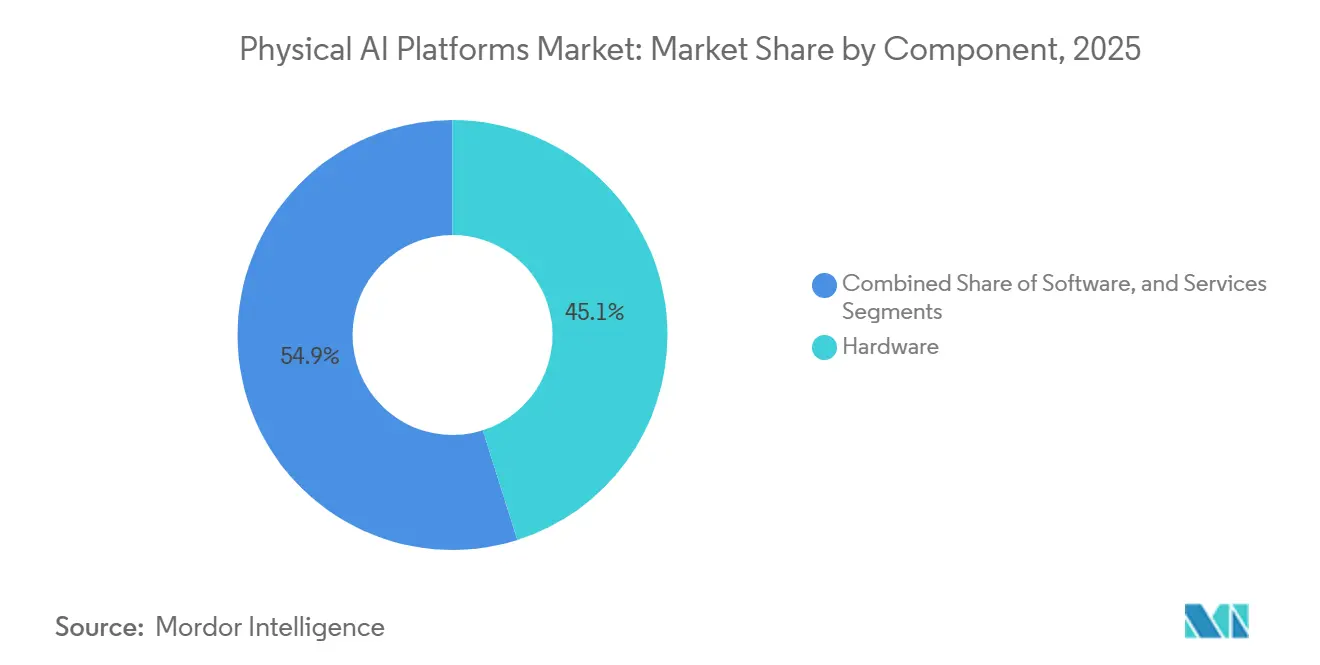
- By component, hardware held 45.12% of the Physical AI Platforms Market share in 2025, while software is projected to expand at a 17.16% CAGR through 2031.
- By platform product, Robotics Software Platforms accounted for 29.87% of the Physical Artificial Intelligence Platforms Market in 2025, while AI Model Development Platforms are projected to expand at a 19.02% CAGR through 2031.
- By deployment, on-device deployment held a 58.96% share of the Physical Artificial Intelligence (AI) Platforms Market in 2025, while cloud-based deployment is projected to expand at a 17.02% CAGR through 2031.
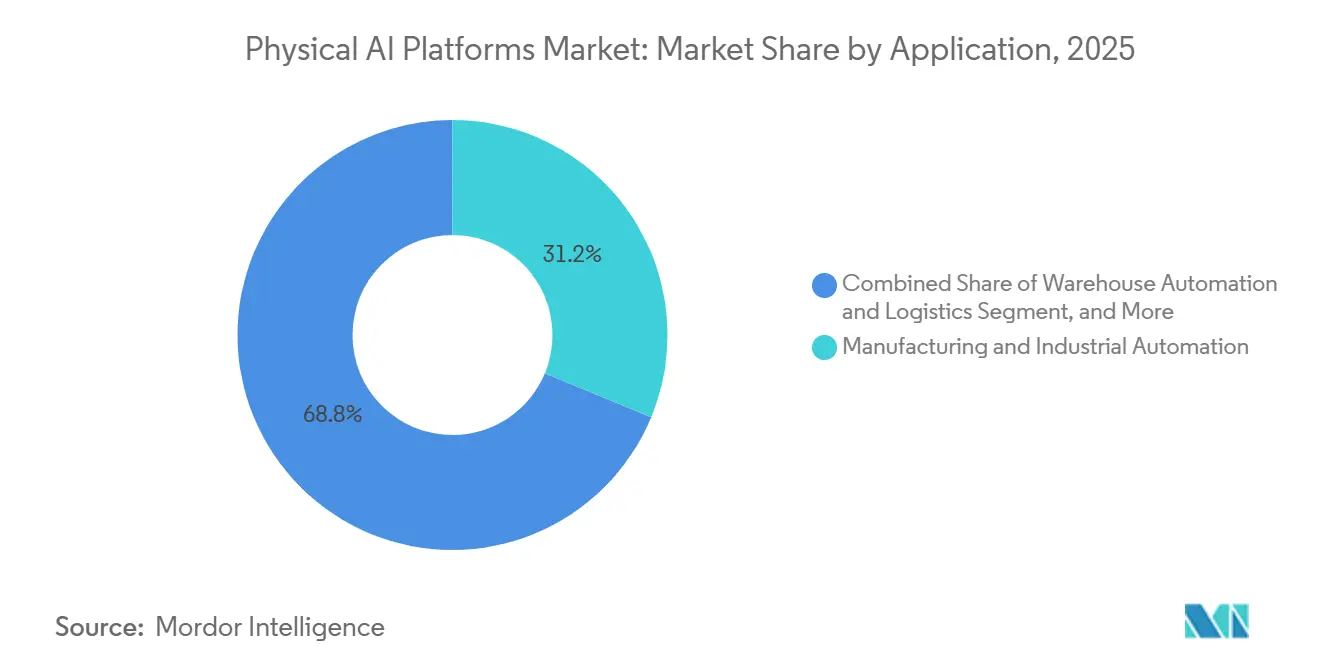
- By application, manufacturing and industrial automation accounted for 31.24% of the Physical AI Platforms Market in 2025, while aerospace, defense, and security is projected to expand at an 18.19% CAGR through 2031.
- By end user, automotive manufacturers held 23.86% of the Physical Artificial Intelligence Platforms Market in 2025, while healthcare providers are projected to expand at a 16.74% CAGR through 2031.
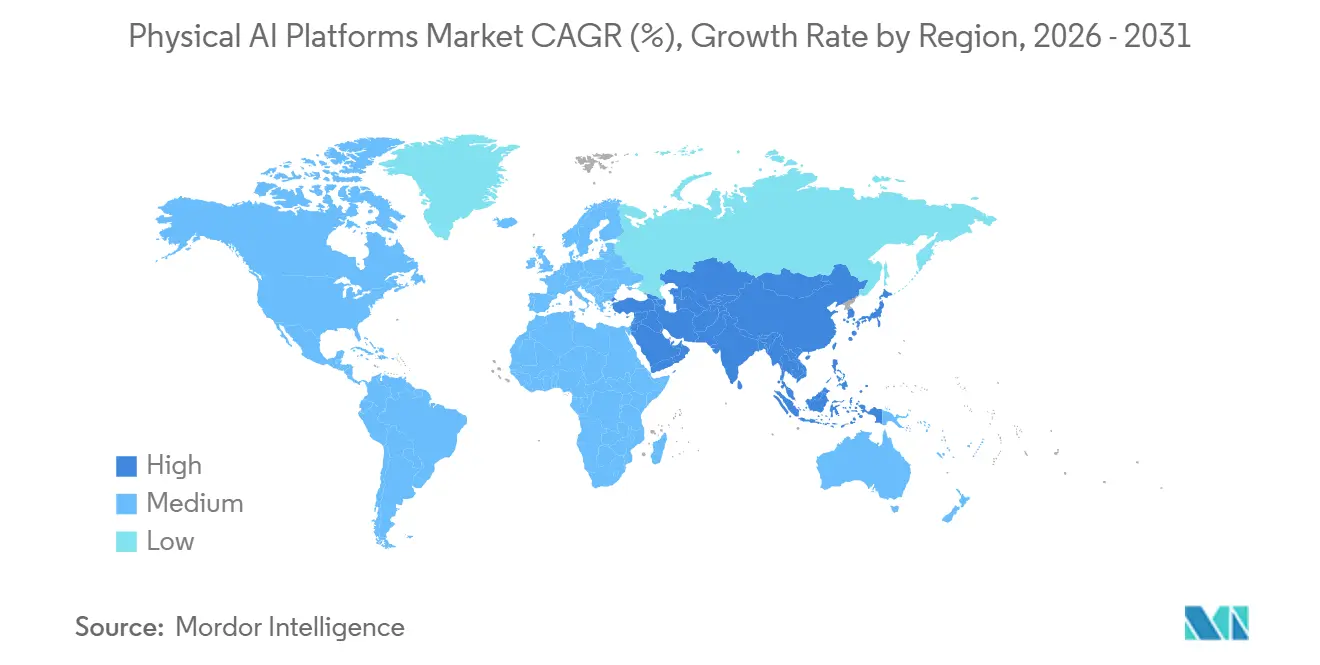
- By geography, North America held a 34.58% share of the Physical AI Platforms Market in 2025, while Asia-Pacific is projected to expand at a 17.24% CAGR through 2031.
Note: Market size and forecast figures in this report are generated using Mordor Intelligence’s proprietary estimation framework, updated with the latest available data and insights as of January 2026.
Market Trends and Insights
Drivers Impact Analysis of Physical AI Platforms Market*
| DRIVER | (~) % IMPACT ON CAGR FORECAST | GEOGRAPHIC RELEVANCE | IMPACT TIMELINE |
|---|---|---|---|
| Commercialization of Humanoid Robots, AMRs, and Cobots | +4.2% | Global, with early concentration in North America and Asia-Pacific | Short term (≤ 2 years) |
| Demand for Adaptive Manufacturing and Autonomous Logistics | +3.0% | Global, core in North America, Europe, and East Asia | Medium term (2-4 years) |
| Maturation of Edge AI Inference and Multimodal Perception | +2.6% | Global, strongest in Asia-Pacific and North America | Short term (≤ 2 years) |
| Simulation-First Development and Digital Twin Adoption | +2.0% | Global, early gains in Europe and North America | Medium term (2-4 years) |
| Scarcity of Labor for Unstructured Physical Work | +1.5% | Global, highest in East Asia, Europe, and North America | Medium term (2-4 years) |
| Expansion of Safety-Critical Autonomy in Defense and Infrastructure | +1.1% | North America and Europe, spillover to the Middle East | Medium term (2-4 years) |
| Source: Mordor Intelligence | |||
Commercialization of Humanoid Robots, AMRs, and Cobots
Commercial use of humanoid robots, autonomous mobile robots, and collaborative robots is a major source of demand for the Physical AI Platforms Market. Developers moved from research prototypes to early pilots in warehouses, logistics sites, and light manufacturing during 2024 and 2025. Deployment remained concentrated among a small group of companies and in repetitive tasks such as tote handling and material transport. This pattern makes the current opportunity more dependent on technically capable early users than on broad deployment across factories. NVIDIA Jetson Thor was adopted by Boston Dynamics for Atlas and by Agility Robotics for Digit, linking the compute layer with the choice of simulation, models, and safety tools.[1]Boston Dynamics, “Building the Future of Robotics With NVIDIA,” Boston Dynamics, bostondynamics.com
Demand for Adaptive Manufacturing and Autonomous Logistics
Fixed automation is less suited to changes in product mix, floor layouts, and supply conditions. Physical AI platforms allow machines to respond to misaligned parts, unfamiliar products, and changing work areas without extensive reprogramming. This changes the value proposition from cycle-time reduction alone to operating flexibility across the factory and warehouse. ABB, FANUC, KUKA, and Yaskawa use NVIDIA Omniverse libraries and Isaac frameworks to test applications through digital twins and connect Jetson modules to controllers for local AI inference.[2]NVIDIA, “Physical AI for Industrial Robotics,” NVIDIA Blog, nvidia.com Warehouse buyers increasingly consider the ability to increase throughput ceilings, not only direct labor replacement, when reviewing automation investments. This shifts the purchase case toward supply-chain capital spending and broadens the set of projects that can support the Physical AI Platforms Market.
Maturation of Edge AI Inference and Multimodal Perception
Edge inference allows robots to make decisions locally instead of waiting for a cloud response. This capability is important when machines manipulate objects in dynamic settings where delay can create safety or quality problems. NVIDIA stated that IGX Thor delivers up to 2,070 FP4 TFLOPs of AI performance and includes a safety island suitable for IEC 61508 SIL 2 use. Event-based sensing and compressed models can help edge systems process changes in physical environments with lower compute demand. Qualcomm and Intel provide alternative edge hardware for lower-power, cost-sensitive applications. Their presence supports software providers that can operate across different processor architectures rather than relying on one hardware platform.
Simulation-First Development and Digital Twin Adoption
Simulation-first workflows help developers address the difficulty of collecting enough physical data for rare and high-risk conditions. NVIDIA described its Physical AI Data Factory Blueprint as a workflow for curation, augmentation, and evaluation of training data from limited real-world inputs. FieldAI, Hexagon Robotics, Skild AI, and Teradyne Robotics were identified as adopters, with availability through Microsoft Azure and Nebius platforms. Siemens Simcenter supports digital representations of power systems, actuators, sensors, and control logic within a robot system. GKN Aerospace Engine Systems used virtual validation to reduce robotic process programming from weeks to days. Teams still need to address the gap between simulated and real conditions by incorporating varied dynamics, state history, and disturbance modeling during training.
Restraints Impact Analysis of Physical AI Platforms Market*
| RESTRAINT | (~) % IMPACT ON CAGR FORECAST | GEOGRAPHIC RELEVANCE | IMPACT TIMELINE |
|---|---|---|---|
| High Integration Costs and Long Commissioning Cycles | -3.0% | Global, most severe in Europe and Asia-Pacific SME base | Short term (≤ 2 years) |
| Certification, Liability, and Functional Safety Complexity | -1.9% | Europe, strongest, North America and Asia-Pacific expanding | Medium term (2-4 years) |
| Non-Standardized Hardware and Software Interfaces | -1.2% | Global | Medium term (2-4 years) |
| Insufficient Real-World 3D Training Data and Edge-Case Reliability | -0.8% | Global | Long term (≥ 4 years) |
| Source: Mordor Intelligence | |||
High Integration Costs and Long Commissioning Cycles
Integrating physical AI into production sites requires more than buying machines and processors. Custom fixtures, sensor calibration, safety validation, network changes, and staff training can extend commissioning beyond 12 to 18 months in complex settings. Advanced humanoid systems had unit prices between USD 150,000 and USD 500,000, while mainstream manufacturing economics require costs between USD 20,000 and USD 50,000. Actuation components represented 40% to 60% of the total bill of materials. Integration risk also falls heavily on systems integrators, while certified partners remain limited in many locations. Industrial customers often require 99.99% uptime, a standard that general-purpose humanoids have mainly demonstrated in narrow and repetitive work.
Certification, Liability, and Functional Safety Complexity
Safety requirements can extend deployment schedules beyond the time needed to complete technical development. ISO 10218:2025 revised the industrial robot safety standard and will apply to CE-marked products under the European Machinery Regulation during the expected 2027 transition.[3]International Organization for Standardization, “ISO 10218-1:2025,” ISO, iso.org ISO/IEC TS 22440 addresses functional safety considerations for AI machine-control components. Developers must test how models perform when operating conditions differ from training conditions or when uncertainty increases. Unclear liability rules can delay procurement in healthcare, public spaces, and critical infrastructure. NVIDIA introduced the ANAB-accredited Halos AI Systems Inspection Lab as a pre-certification route, but qualified inspection capacity remains limited.
*Our forecasts treat driver/restraint impacts as directional, not additive. The impact forecasts reflect baseline growth, mix effects, and variable interactions.
Physical AI Platforms Market Segment Analysis
By Component:
Hardware Leads Early Deployments While Software Builds Long-Term ValueHardware accounted for 45.12% of the Physical AI Platforms Market share in 2025 because processors, actuators, and sensors accounted for a large share of early deployment costs. Edge inference systems are an important area of competition within this category. NVIDIA Jetson Thor supports current humanoid and autonomous mobile robot programs with local AI processing and a safety-capable architecture. Qualcomm Snapdragon platforms and Intel modules address lower-power and more cost-sensitive deployments. Hardware demand remains linked to the number of robots entering commercial use across manufacturing, logistics, and other controlled environments.
Software is projected to expand at a 17.16% CAGR through 2031, making it the fastest-growing component in the Physical AI Platforms Market. Foundation models, simulation software, fleet management, and robot control systems can be reused across larger installed hardware bases. This reuse supports recurring revenue opportunities that do not depend entirely on new machine purchases. Services include systems integration, robotics-as-a-service offerings, remote monitoring, and lifecycle support. Buyers increasingly seek deployment-ready systems rather than standalone capabilities. The Physical Artificial Intelligence (AI) Platforms Market therefore has a longer-term value pool in software and services, even while hardware spending remains substantial.



By Platform Product:
Model Development Expands Beyond Established Robotics SoftwareRobotics Software Platforms accounted for 29.87% of the Physical Artificial Intelligence Platforms Market share in 2025. Their position reflects the broad installed base of middleware, motion planning, robot operating systems, and fleet-management applications. These tools are used in industrial facilities and logistics sites where machines need predictable coordination. Established software platforms also support integration with existing controllers and operating processes. Their role remains important because customers need reliable orchestration across mixed fleets and equipment suppliers. This installed base provides a durable starting point for suppliers that can add AI capabilities without disrupting deployed systems.
AI Model Development Platforms are projected to expand at a 19.02% CAGR through 2031. Vision-language-action models require tools for training, evaluation, deployment, and policy updates across machines. NVIDIA integrated Isaac GR00T and Hugging Face LeRobot to connect robotics and AI developer communities through an open-source environment. Simulation and digital twin platforms help users validate autonomous forklifts and other mobile systems before physical deployment. KION Group, Accenture, and Siemens used NVIDIA Mega Omniverse Blueprint in work related to warehouse digital twins for GXO. Edge platforms serve deployments where latency, connectivity, or data residency limit cloud inference. Other product types include cloud platforms, robotics middleware, and operating systems that coordinate edge and cloud resources.
By Deployment:
On-Device Processing Leads as Cloud Training ExpandsOn-device deployment accounted for 58.96% of the Physical AI Platforms Market in 2025. Robots operating around people, parts, and moving equipment require decisions without cloud round-trip delays. Many industrial users also keep operational data on-site because of security and data sovereignty requirements. Local inference, therefore, remains central to manipulation, navigation, and immediate safety actions. On-device systems use compact model variants that fit the installed machine's compute and power limits. This structure supports continuing demand for high-performance edge processors, sensors, and embedded control software.
Cloud-based deployment is projected to expand at a 17.02% CAGR through 2031. The cloud supports training, fleet analytics, world simulation, and periodic model updates that exceed the capacity of individual robots. Split-inference designs train and refresh large models in the cloud, then deploy smaller policies at the edge. NVIDIA OSMO supports orchestration across the development and deployment workflow. SoftBank and Yaskawa demonstrated flexible-object handling that combined cloud infrastructure with production manufacturing systems.[4]SoftBank, “SoftBank and Yaskawa Physical AI Demonstration,” SoftBank, softbank.jp Wider 5G coverage and stronger edge computing can reduce the practical divide between cloud-based and on-device arrangements. The Physical Artificial Intelligence Platforms Market can consequently benefit from both local execution and centralized development environments.
By Application:
Manufacturing Provides Scale While Defense Advances FastestManufacturing and industrial automation held a 31.24% share of the Physical AI Platforms Market in 2025. Factories offer repeated workflows, measurable performance goals, and controlled layouts that support early deployment. Automotive and electronics facilities use robots for material movement, assembly, inspection, and complex handling tasks. Warehouse automation and logistics form the second-largest application area because fulfillment operators need reliable movement and sorting across high volumes. Autonomous vehicles and mobility also use physical AI for perception and decision-making in trucks, delivery systems, and mobile robots. These applications create demand for common layers of sensing, simulation, policy development, and fleet control.
Aerospace, defense, and security are projected to expand at an 18.19% CAGR through 2031. The US Department of Defense established a USD 13.4 billion FY2026 autonomy budget, including USD 9.4 billion for unmanned aerial vehicles, USD 1.7 billion for autonomous surface systems, and USD 1.2 billion for autonomy-enabling software.[5]US Department of Defense, “Fiscal Year 2026 Budget Materials,” US Department of Defense, defense.gov Healthcare uses include surgical, rehabilitation, and elder-care robotics, while agriculture uses include selective harvesting, field inspection, and autonomous operation. CMR Surgical and Medtronic were among robotics companies identified in NVIDIA's 2026 physical AI ecosystem. The Physical AI Platforms Market also serves security and infrastructure settings where remote inspection and autonomous operation can improve access to difficult locations. Different application needs raise the value of adaptable models rather than fixed task programming.
By End User:
Automotive Adoption Supports Volume While Healthcare AcceleratesAutomotive manufacturers held a 23.86% share of the Physical Artificial Intelligence (AI) Platforms Market in 2025. This position reflects the sector's long history of industrial robot use and its recent interest in flexible, visually aware systems. BMW established a Physical AI center in Landshut, Germany, to develop learning-capable systems that capture their surroundings and act autonomously. The approach allows skills developed for one robot to transfer across different form factors. Automotive users can therefore apply physical AI to vehicle production as well as to wider mobility development. The sector's established engineering processes make it an important environment for validating repeatable deployments.
Healthcare providers are projected to expand at a 16.74% CAGR through 2031. Surgical robotics, rehabilitation equipment, and elder-care systems are supporting demand in hospitals and care settings. Japan is an important setting for care robots, where NVIDIA Isaac GR00T was being fine-tuned for semi-humanoid elder-care applications. Electronics and semiconductor manufacturers are the second-largest end-user group because flexible automation can support precision work and changing production runs. Logistics and warehousing operators are deploying humanoids and autonomous mobile robots in fulfillment centers. Government and defense organizations, energy and mining companies, and small and medium-sized enterprises remain earlier-stage users for remote inspection, autonomy, and specialized operations.
Geography Analysis
North America Physical AI Platforms Market
North America accounted for 34.58% of the Physical AI Platforms Market in 2025. The region brings together platform developers, mature cloud infrastructure, advanced robotics programs, and growing defense procurement. NVIDIA, Figure AI, and Agility Robotics are based in the United States, as are many developers of simulation and robotics software. The USD 13.4 billion US FY2026 autonomy budget created a dedicated federal spending line for autonomous systems. NVIDIA's Isaac and GR00T ecosystems benefit from a developer base that bridges robotics development and foundation-model work. Canada supports automotive integration and applied robotics research. Mexico offers a developing deployment base as cross-border manufacturing and supply-chain localization advance.
Europe Physical AI Platforms Market
Europe has a strong position in the Physical Artificial Intelligence Platforms Market because Germany has a deep industrial automation base, and the region is investing in sovereign AI computing. KUKA launched its AMP platform at NVIDIA GTC 2026 and deployed an alpha version at KTPO's 285-robot Jeep Wrangler and Gladiator body shop in Ohio.[6]KUKA, “KUKA AMP,” KUKA, kuka.com Forschungszentrum Jülich developed the Automaton Engine, an edge AI chip that uses low-bit precision processing for deterministic robotics inference. NEURA Robotics raised to USD 1.4 billion in the June 2026 Series C round and reported an order book and strategic deployment pipeline exceeding USD 1 billion. ISO 10218:2025 and the European Machinery Regulation raise the value of safety architectures designed for CE-marked products. The United Kingdom, France, Italy, and Spain support activity in aerospace, logistics, and healthcare robotics. Russia's participation remains limited by geopolitical conditions and export controls.
APAC, South America and MEA Physical AI Platforms Market
Asia-Pacific is projected to expand at a 17.24% CAGR through 2031, the fastest rate in the Physical AI Platforms Market. Japan and China are the leading engines of regional growth. Kawasaki Heavy Industries, OMRON, Fujitsu, and SoftBank adopted NVIDIA's physical AI stack for manufacturing, mobility, and infrastructure uses in Japan. Yaskawa Electric also validated cloud-to-edge policy workflows with NVIDIA in July 2026. Japan's labor shortages in manufacturing, information technology, and healthcare encourage adoption beyond direct cost considerations. Tencent released the Hy-Embodied foundation model series and an updated Tairos embodied AI platform in July 2026. South Korea is applying physical AI in electronics and automotive production, while India, Australia, Singapore, South America, the Middle East, and Africa remain earlier-stage locations for industrial, agriculture, mining, and infrastructure use cases.

Competitive Landscape
The Physical AI Platforms Market is moderately concentrated in the compute-platform layer and fragmented across application software, middleware, and implementation services. NVIDIA has an integrated offering that includes computer hardware, Isaac simulation, GR00T models, Cosmos world models, OSMO orchestration, and Halos safety capabilities. This stack provides developers with a common technical foundation for building and validating robots. Industrial companies are adopting this infrastructure while developing their own application and orchestration layers. KUKA AMP shows this approach by combining platform orchestration with established industrial robot expertise. The NEURA Robotics financing round also showed investor interest in platform ecosystems that link robots, AI, and industrial deployment. These dynamics favor suppliers that can integrate different machines and software components.
Companies are focusing on sectors with complex physical tasks and limited current adoption. Elder care, precision agriculture, and small-batch manufacturing offer opportunities for models trained in domain-specific data. Physical Intelligence, Inc. shows how the quality of a robot policy can provide differentiation without owning the underlying hardware. Covariant's integration into Amazon's robotics environment shows the value of embedding models within a large deployment base that generates operational data. Chinese platform companies pose a competitive challenge because they can combine lower engineering costs with large deployment environments. Vendors serving European defense and critical infrastructure customers also need to address IEC 62443 cybersecurity and ISO 13849 functional safety requirements.
NVIDIA's Halos AI Systems Inspection Lab extends competition into functional safety processes for autonomous vehicles and robotics. The program works with inspection and certification organizations, including TÜV Rheinland, TÜV SÜD, and UL Solutions. This helps developers organize pre-certification work alongside hardware and software development. ABB, FANUC, KUKA, and Yaskawa continue to add physical AI features to extensive robot installations. Their installed equipment and customer relationships allow them to offer integration pathways for established industrial users. Software specialists can compete by supporting multiple hardware backends and by improving model performance for specific tasks. The Physical Artificial Intelligence (AI) Platforms Market, therefore, includes both infrastructure leaders and specialized providers with different routes to differentiation.
Physical AI Platforms Industry Leaders
NVIDIA Corporation
Microsoft Corporation
Alphabet Inc.
ABB Ltd.
Siemens AG
- *Disclaimer: Major Players sorted in no particular order
Physical AI Platforms Market Companies Covered in this Report
- NVIDIA Corporation
- Microsoft Corporation
- Alphabet Inc.
- ABB Ltd.
- Siemens AG
- Amazon Web Services, Inc.
- Rockwell Automation, Inc.
- Qualcomm Technologies, Inc.
- Scale AI, Inc.
- Intel Corporation
- FANUC Corporation
- Yaskawa Electric Corporation
- KUKA AG
- Boston Dynamics, Inc.
- Figure AI, Inc.
- Agility Robotics, Inc.
- Physical Intelligence, Inc.
- Covariant, Inc.
- NEURA Robotics GmbH
- Teradyne, Inc.
- OMRON Corporation
- Hexagon AB

Recent Industry Developments in Physical AI Platforms Market
- July 2026: KUKA AG deployed the alpha version of KUKA AMP, its Physical AI fleet orchestration platform, at KTPO's 285-robot automotive body shop in Ohio, the facility producing every globally sold Jeep Wrangler and Gladiator body, marking the first production-environment validation of a dedicated physical AI orchestration platform at automotive scale.
- July 2026: SoftBank and Yaskawa Electric demonstrated a flexible-object handling system for industrial robots using SoftBank's Physical AI GPU cloud infrastructure, with NVIDIA collaboration, validating cloud-to-edge policy workflows for production-grade manufacturing applications.
- June 2026: NEURA Robotics GmbH raised to USD 1.4 billion in a Series C round led by Tether, with participation from Qualcomm Technologies, NVIDIA, Amazon, Bosch, and Schaeffler, valuing the company between USD 9 billion and USD 12 billion. The company's orderbook and strategic deployment pipeline exceeded USD 1 billion at the time of the announcement.
- June 2026: Agility Robotics announced a planned SPAC merger with Churchill Capital Corp XI at a USD 2.5 billion valuation, expected to generate over USD 620 million in proceeds, including USD 200 million from institutional investors led by Foxconn, to fund production scaling of the next-generation Digit v5 humanoid and expansion of commercial deployments.


Global Physical AI Platforms Market Report Scope
The Physical AI Platforms Market encompasses the ecosystem of software platforms, development frameworks, simulation environments, middleware, and computing infrastructure that enable artificial intelligence systems to perceive, reason, and interact with the physical world. These platforms support the development and deployment of intelligent robots, autonomous machines, industrial automation systems, smart vehicles, and other embodied AI applications by integrating capabilities such as computer vision, sensor fusion, motion planning, digital twins, edge computing, and real-time decision-making. The market serves industries such as manufacturing, logistics, healthcare, transportation, defense, and smart infrastructure.
The Physical AI Platforms Market Report is Segmented by Component (Hardware, Software, and Services), Platform Product (Robotics Software Platforms, Simulation and Digital Twin Platforms, AI Model Development Platforms, Edge AI Platforms, and Other Platform Products), Deployment (On-Device, and Cloud-Based), Application (Manufacturing and Industrial Automation, Warehouse Automation and Logistics, Autonomous Vehicles and Mobility, Healthcare and Medical Robotics, Agriculture and Agricultural Robotics, Aerospace, Defense, and Security, and Other Applications), End-User Industry (Automotive Manufacturers, Electronics and Semiconductor Manufacturers, Logistics and Warehousing Operators, Healthcare Providers, and Other End-User Industries), and Geography (North America, South America, Europe, Asia-Pacific, Middle East, and Africa). The Market Forecasts are Provided in Terms of Value (USD).
| Hardware |
| Software |
| Services |
| Robotics Software Platforms |
| Simulation and Digital Twin Platforms |
| AI Model Development Platforms |
| Edge AI Platforms |
| Other Platform Products (Cloud-Based Physical AI Platforms, Robotics Middleware Frameworks, Autonomous Machine Operating Systems) |
| On-Device |
| Cloud-Based |
| Manufacturing and Industrial Automation |
| Warehouse Automation and Logistics |
| Autonomous Vehicles and Mobility |
| Healthcare and Medical Robotics |
| Agriculture and Agricultural Robotics |
| Aerospace, Defense, and Security |
| Other Applications (Energy, Mining, and Utilities, Construction and Infrastructure, Retail, Hospitality, and Smart Buildings, Consumer and Household Robotics) |
| Automotive Manufacturers |
| Electronics and Semiconductor Manufacturers |
| Logistics and Warehousing Operators |
| Healthcare Providers |
| Other End-User Industries (Government and Defense Organizations, Energy and Mining Companies, Small and Medium-Sized Enterprises) |
| North America | United States |
| Canada | |
| Mexico | |
| South America | Brazil |
| Argentina | |
| Chile | |
| Rest of South America | |
| Europe | Germany |
| United Kingdom | |
| France | |
| Italy | |
| Spain | |
| Russia | |
| Rest of Europe | |
| Asia-Pacific | China |
| Japan | |
| South Korea | |
| India | |
| Australia | |
| Singapore | |
| Rest of Asia-Pacific | |
| Middle East | Saudi Arabia |
| United Arab Emirates | |
| Israel | |
| Turkey | |
| Rest of Middle East | |
| Africa | South Africa |
| Egypt | |
| Rest of Africa |
| By Component | Hardware | |
| Software | ||
| Services | ||
| By Platform Product | Robotics Software Platforms | |
| Simulation and Digital Twin Platforms | ||
| AI Model Development Platforms | ||
| Edge AI Platforms | ||
| Other Platform Products (Cloud-Based Physical AI Platforms, Robotics Middleware Frameworks, Autonomous Machine Operating Systems) | ||
| By Deployment | On-Device | |
| Cloud-Based | ||
| By Application | Manufacturing and Industrial Automation | |
| Warehouse Automation and Logistics | ||
| Autonomous Vehicles and Mobility | ||
| Healthcare and Medical Robotics | ||
| Agriculture and Agricultural Robotics | ||
| Aerospace, Defense, and Security | ||
| Other Applications (Energy, Mining, and Utilities, Construction and Infrastructure, Retail, Hospitality, and Smart Buildings, Consumer and Household Robotics) | ||
| By End-User Industry | Automotive Manufacturers | |
| Electronics and Semiconductor Manufacturers | ||
| Logistics and Warehousing Operators | ||
| Healthcare Providers | ||
| Other End-User Industries (Government and Defense Organizations, Energy and Mining Companies, Small and Medium-Sized Enterprises) | ||
| By Geography | North America | United States |
| Canada | ||
| Mexico | ||
| South America | Brazil | |
| Argentina | ||
| Chile | ||
| Rest of South America | ||
| Europe | Germany | |
| United Kingdom | ||
| France | ||
| Italy | ||
| Spain | ||
| Russia | ||
| Rest of Europe | ||
| Asia-Pacific | China | |
| Japan | ||
| South Korea | ||
| India | ||
| Australia | ||
| Singapore | ||
| Rest of Asia-Pacific | ||
| Middle East | Saudi Arabia | |
| United Arab Emirates | ||
| Israel | ||
| Turkey | ||
| Rest of Middle East | ||
| Africa | South Africa | |
| Egypt | ||
| Rest of Africa | ||


Key Questions Answered in the Report
What is the size of the Physical AI Platforms Market?
The Physical AI Platforms Market was valued at USD 8.12 billion in 2025 and is estimated at USD 9.71 billion in 2026. The Physical AI Platforms Market is forecast to reach USD 20.23 billion by 2031 at a 15.81% CAGR. Simulation, edge computing, robotics software, and machines that can respond to changing conditions are central parts of this spending.
Which component leads spending on physical AI platforms?
Hardware led with 45.12% share in 2025 because edge computing, sensors, and actuators make up much of early deployment cost. In the Physical AI Platforms Market, software is projected to expand fastest at a 17.16% CAGR because model development, simulation, fleet management, and control functions can support a wider installed base of machines.
What applications are increasing adoption of physical AI platforms?
Manufacturing and industrial automation led with 31.24% share in 2025. The Physical AI Platforms Market also serves warehouse automation, logistics, autonomous mobility, healthcare, agriculture, aerospace, defense, and security. Aerospace, defense, and security is projected to record the fastest expansion at an 18.19% CAGR through 2031.
Why is on-device processing important for robots?
On-device deployment held 58.96% share in 2025 because robots often need local, low-latency decisions and users may require data to stay within their facilities. The Physical AI Platforms Market uses local processing for manipulation, navigation, and immediate safety actions, while cloud environments support model training, simulation, fleet analytics, and updates.
Which region is expected to expand fastest?
Asia-Pacific is projected to expand at a 17.24% CAGR through 2031, supported by activity in Japan, China, and South Korea. The Physical AI Platforms Market benefits in Japan from deployments across manufacturing, mobility, and infrastructure, while China is developing embodied AI models and data platforms for industrial use.
What limits wider use of physical AI platforms?
High integration costs, 12-18 month commissioning cycles, safety certification, fragmented interfaces, and limited real-world training data can delay broader deployment. The Physical AI Platforms Market also needs validated tools that help customers manage safety, data, system integration, and model behavior before scaling beyond narrow work settings.
Page last updated on:


 Your data is secure and never sold or shared.


