
Philippines Commercial Real Estate Market Size and Share
Market Overview
| Study Period | 2021 - 2032 |
|---|---|
| Forecast Data Period | 2027 - 2032 |
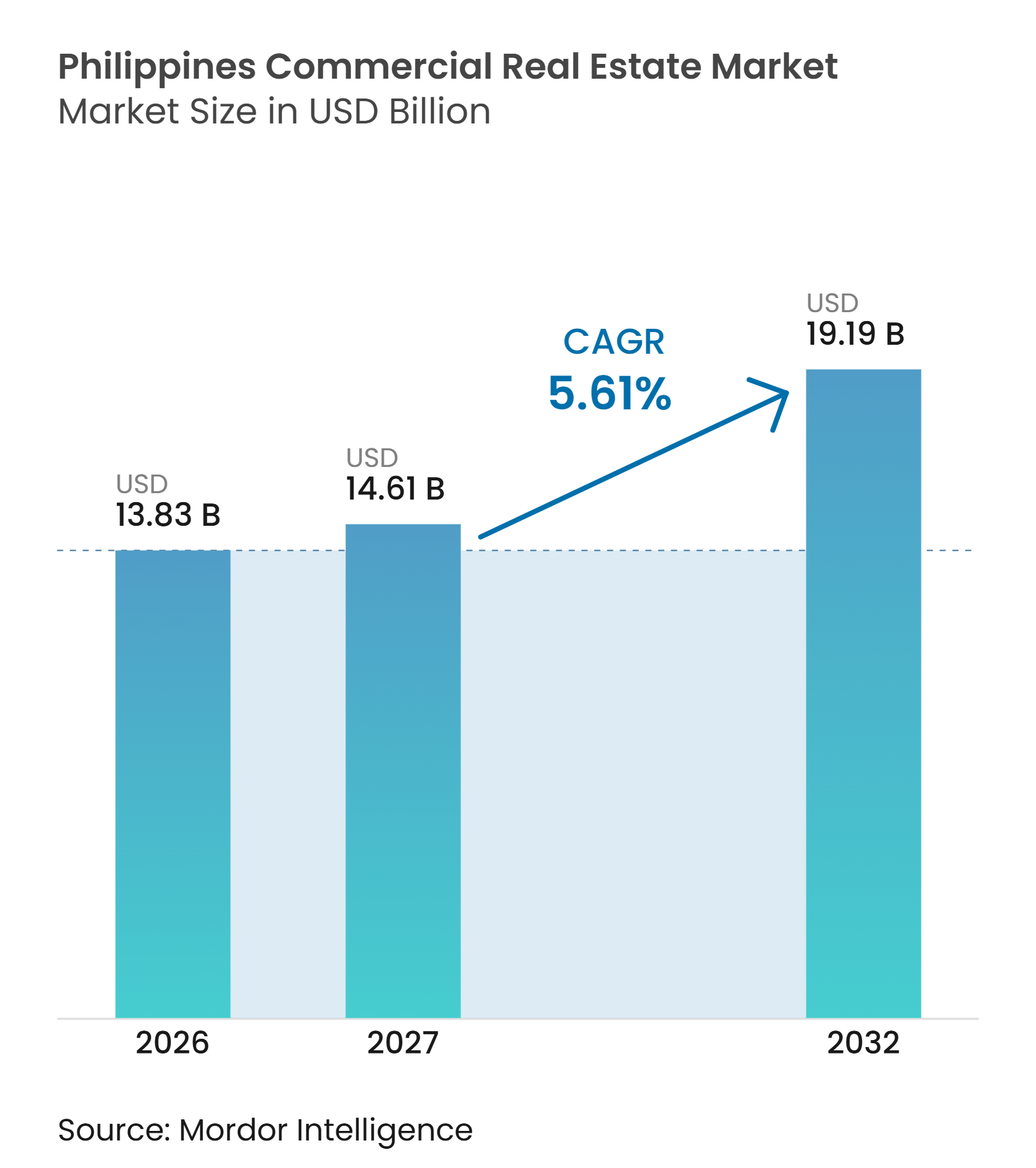
| Base Year Market Size (2026) | USD 13.83 Billion |
| Market Size (2027) | USD 14.61 Billion |
| Market Size (2032) | USD 19.19 Billion |
| Growth Rate (2027 - 2032) | 5.61 % |
| Market Concentration | Medium |
Major Players *Disclaimer: Major Players sorted in no particular order Image © Mordor Intelligence. Reuse requires attribution under CC BY 4.0. | |
Philippines Commercial Real Estate Market Analysis by Mordor Intelligence
The Philippines Commercial Real Estate Market size was USD 13.83 billion in 2026, is projected to be USD 14.61 billion in 2027, and will reach USD 19.19 billion by 2032, growing at a CAGR of 5.61% from 2027 to 2032.
The Philippines commercial real estate industry is supported by demand from global capability centers, logistics tenants, retailers, and hospitality operators. Global capability centers are shifting office demand toward high-quality, PEZA-accredited buildings in Makati, Bonifacio Global City, and Ortigas[1]. Logistics demand is rising in Luzon as e-commerce firms, manufacturers, and third-party logistics providers seek modern distribution facilities. Retail landlords are concentrating on food and beverage tenants and experiential formats, while REIT transactions are helping property groups recycle capital into logistics, hotels, and mixed-use developments.
Key Report Takeaways
- By property type (rental), offices held a 44.5% share of the Philippines commercial real estate industry in 2026, representing a significant portion of the Philippines commercial real estate market size, while rental logistics is forecast to grow at a 6.12% CAGR through 2032.
- By end user, corporates and SMEs held 81.2% of the Philippines commercial real estate market share in 2026 and are forecast to grow at a 6.22% CAGR through 2032 within the Philippines commercial real estate market size.
- By region, NCR (Metro Manila) held 62.2% of the Philippines commercial real estate market share in 2026, while Central Luzon is forecast to grow at a 6.55% CAGR through 2032 within the Philippines commercial real estate industry size.
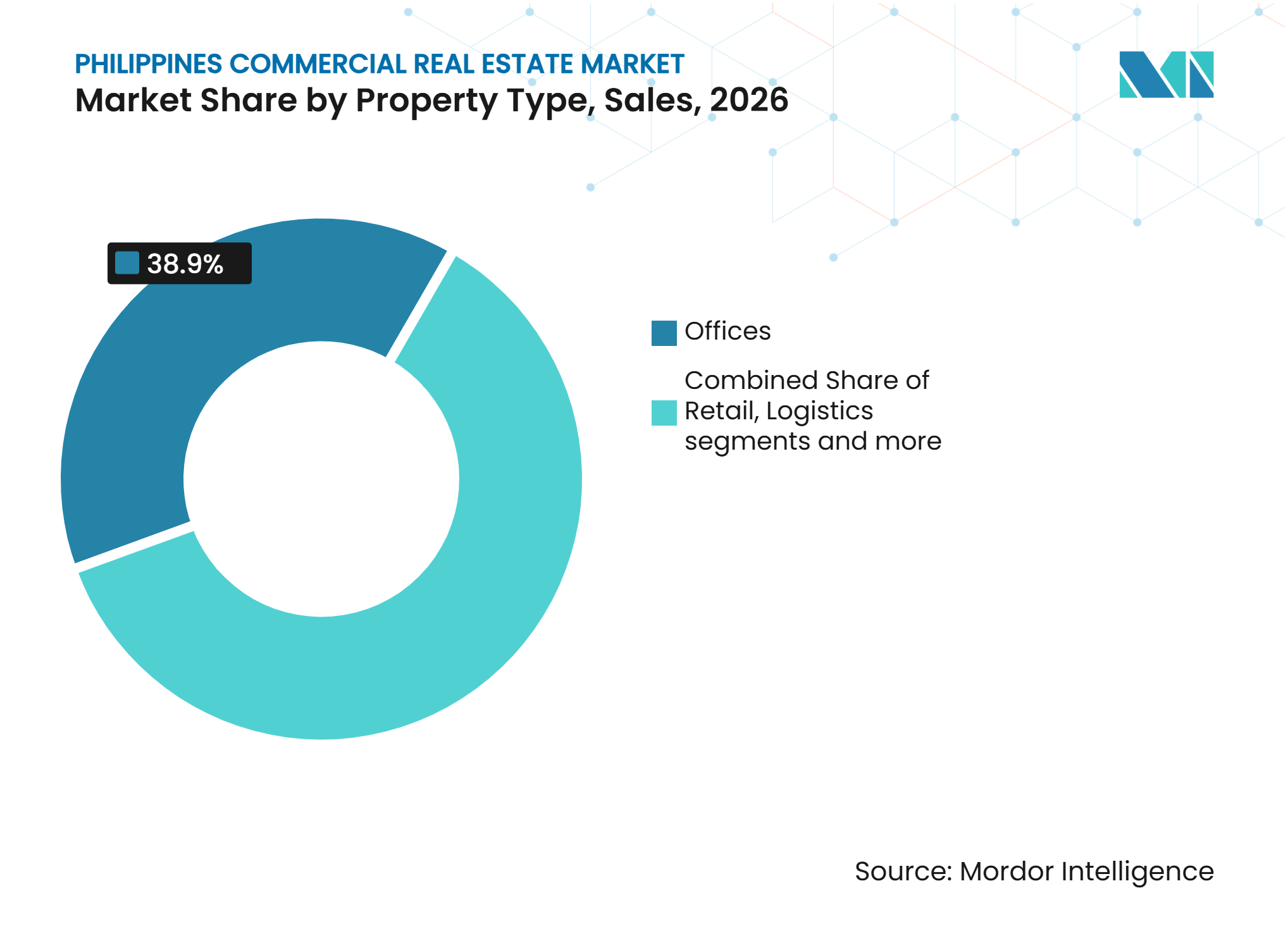
- By property type (sales), offices held 38.9% of the Philippines commercial real estate market share in 2026, while logistics assets are forecast to grow at a 6.31% CAGR through 2032 within the Philippines commercial real estate industry.
Note: Market numbers in this report are based on Mordor Intelligence's proprietary estimation framework, which combines nine months of actuals with Q4 projections for base year 2026.
Market Trends and Insights
Drivers Impact Analysis of Philippines Commercial Real Estate Market*
| Drivers | (~) % Impact on CAGR Forecast | Geographic Relevance | Impact Timeline |
|---|---|---|---|
| IT-BPM and GCC Expansion | +1.4% | Metro Manila, Pampanga, Cebu, and Iloilo | Medium term (2-4 years) |
| E-Commerce and 3PL Warehouse Demand | +1.2% | CALABARZON, Central Luzon, Cebu, and Davao | Short term (≤ 2 years) |
| Organized Retail and Consumer Spending | +0.8% | Metro Manila, Cebu, Davao, and Iloilo | Medium term (2-4 years) |
| Tourism and Domestic Travel | +0.6% | Metro Manila, Cebu, Clark, Mindanao, and the Visayas | Medium term (2-4 years) |
| Transport Infrastructure Expansion | +0.5% | Central Luzon and the SLEX corridor | Long term (≥ 4 years) |
| Green Building Demand | +0.3% | Metro Manila, Cebu, and Iloilo | Medium term (2-4 years) |
| Source: Mordor Intelligence | |||
GCC Momentum Reshapes Office Demand from Volume to Specification
Global capability centers are changing office requirements in the Philippines commercial real estate market. These occupiers seek smaller, high-quality floor plates rather than large spaces designed for rapid headcount expansion. The supplied research identifies PEZA accreditation as an important location factor because tax incentives affect site selection for IT-BPM and global capability center tenants. The Philippines has substantial scope for further global capability center entry from financial services, technology, and health care firms. This shift gives owners of certified Grade A buildings an advantage in Makati, Bonifacio Global City, Ortigas, Pampanga, Cebu, and Iloilo. The same demand pattern raises the standard for office supply. Buildings without current PEZA approvals, flexible layouts, and energy performance credentials may lose prospective tenants even when they are located in established business districts. The Philippines commercial real estate market therefore depends less on aggregate office stock and more on the quality of available space. LEED, BERDE, and EDGE Zero Carbon credentials are increasingly relevant to occupiers that must report environmental performance to multinational parent companies. This can encourage upgrades to older assets rather than purely new construction.
E-Commerce Growth Propels Logistics Warehousing to Market-Leading Returns
E-commerce and third-party logistics networks are increasing demand for modern warehouses in the Philippines commercial real estate market. Users need high-clearance facilities, cold storage, cross-docking areas, and access to major highways. CALABARZON and Central Luzon are important because they connect manufacturing bases with Metro Manila consumption centers. Build-to-suit arrangements can reduce vacancy risk because a tenant commits before construction is completed. RLX expanded its relationship with SPX Express across logistics sites in Calamba, Sucat, Pampanga, and Rizal, illustrating how tenant-led warehouse development can deepen across Luzon. Infrastructure investment adds another layer of support for logistics development. The SCTEX Hacienda Luisita Interchange project is intended to improve access to industrial hubs in Tarlac. The North-South Commuter Railway and airport-related investment in Clark can also improve connections between production, warehousing, offices, and hotels. These projects may widen the range of locations that can serve large distribution networks. As a result, the Philippines commercial real estate market is becoming less dependent on sites immediately adjacent to Metro Manila[2].
Retail Premiumization and F&B Expansion Sustain Organized Mall Demand
Organized retail supports the Philippines commercial real estate market through food and beverage demand, premium retail formats, and redevelopment of existing malls. Retail property groups are focusing on visitor experience because online commerce has changed the role of physical stores. The supplied research notes that food and beverage tenants are expected to remain a major source of mall space absorption in Metro Manila. This favors operators that can curate tenant mixes, manage common spaces, and refresh assets in mature locations. Mall owners are also using REIT structures to diversify their capital sources and improve portfolio flexibility. Several developers are adapting through investments in mixed-use districts and differentiated retail assets. Ayala Land has continued to add commercial and hospitality properties to AREIT, while Robinsons Land has introduced mall assets to RL Commercial REIT. These moves show that retail properties are being managed as income-producing assets within broader portfolios rather than as stand-alone developments. In the Philippines commercial real estate market, this approach can support selective redevelopment where new greenfield supply may not be justified. Retail demand remains linked to household spending, tenant quality, and accessible urban locations.
Tourism and Domestic Travel Support Integrated Hospitality Development
Tourism and domestic travel are supporting investment in hotels, resorts, and integrated developments. Hotel projects can combine rooms, retail, dining, offices, and event facilities to diversify revenue across several demand sources. The Department of Tourism is relevant to this segment because visitor arrivals, destination promotion, and accommodation policy affect hotel development conditions. The supplied draft identified Metro Manila, Cebu, Clark, the Visayas, and Mindanao as major areas of hospitality interest. International airport access remains important because it connects hotel demand to both foreign arrivals and domestic travel[3]. Hotel investors are also balancing opportunity against high land and construction costs. This favors midscale formats and regional destinations where land acquisition can be more manageable than in central Makati or Bonifacio Global City. Integrated estates can spread development risk across hotels, retail, and commercial components. The Philippines commercial real estate market can benefit where infrastructure projects make tourism destinations easier to reach. Development decisions still depend on room demand, site access, incentives, and the ability to control construction costs.
Restraints Impact Analysis of Philippines Commercial Real Estate Market*
| Restraints | (~) % Impact on CAGR Forecast | Geographic Relevance | Impact Timeline |
|---|---|---|---|
| Office Vacancy in Selected Business Districts | -0.8% | Metro Manila and Cebu | Short term (≤ 2 years) |
| High Land and Construction Costs | -0.7% | National, especially Makati and Bonifacio Global City | Short term (≤ 2 years) |
| Zoning and Regulatory Delays | -0.5% | National, especially Metro Manila | Medium term (2-4 years) |
| Typhoon, Flooding, and Disaster Exposure | -0.4% | Luzon, Metro Manila coastal zones, and the Visayas | Long-term (≥ 4 years) |
| Source: Mordor Intelligence | |||
Office Vacancy and Approval Delays Limit Near-Term Leasing Recovery
High office vacancy in selected Metro Manila districts remains a near-term constraint for the Philippines commercial real estate market. The supplied research places Metro Manila office vacancy at 19.5% in Q3 2026 and links the weaker leasing outlook to geopolitical uncertainty, high interest rates, and new supply. Prime assets can use this period to attract tenants seeking an upgrade, while fringe locations face a more difficult leasing environment. Flexible workspace can absorb some demand from firms that do not want long lease commitments. It does not replace the space needs of large office occupiers that still require long-term premises. Approvals can add to the challenge for developers and tenants. PEZA proclamation timing is particularly relevant to global capability centers and IT-BPM firms that require fiscal incentives. Delays can lead occupiers to defer a decision or examine another location. Landlords need to coordinate early with regulators, building teams, and prospective tenants to reduce this risk. The Philippines commercial real estate market will benefit most when new supply matches a confirmed occupier requirement rather than a speculative assumption.
Cost Pressure and Climate Exposure Raise Development Requirements
Construction costs and land values create pressure across commercial projects. The supplied research cites higher steel, concrete, sand, and petroleum-related costs, together with currency pressure, as constraints on project feasibility. High land values in established central business districts make speculative schemes especially difficult to justify. Developers are responding by recycling capital through REITs, partnering on infrastructure-linked locations, and considering asset-light structures. These methods can reduce the upfront capital tied to a project. Climate exposure adds a longer-term financial consideration. Typhoons, flooding, and coastal risk can increase insurance costs and require stronger site design, drainage, and building resilience. The OECD has identified climate-related vulnerability as a significant economic issue for the Philippines. Developers and lenders therefore need to assess location risk alongside conventional leasing and construction assumptions. Resilience investment may become a more prominent factor in the Philippines commercial real estate market, particularly for coastal districts, reclamation areas, and logistics assets exposed to disruption.
*Our forecasts treat driver/restraint impacts as directional, not additive. The impact forecasts reflect baseline growth, mix effects, and variable interactions.
Philippines Commercial Real Estate Market Segment Analysis
By Property Type (Rental):
Offices Lead Revenue While Logistics AdvancesOffices held 44.5% of rental value in 2026, making them the largest property category in the Philippines commercial real estate market. The segment reflects the continued importance of CBD-based leasing by IT-BPM firms, financial institutions, professional services companies, and global capability centers. Makati and Bonifacio Global City combine established corporate addresses with Grade A office supply. High vacancy gives some occupiers an opportunity to upgrade premises without a proportional increase in rent. This supports prime offices while older and peripheral buildings face weaker leasing conditions. Global capability centers often prioritize certification, flexible layout, and PEZA status. Managed offices give smaller companies access to Grade A settings without a lengthy lease. Retail, hospitality, and specialty properties provide further diversity to rental income in mixed-use projects.
Rental logistics is forecast to grow at a 6.12% CAGR through 2032. Demand is tied to e-commerce fulfillment, manufacturing activity, third-party logistics expansion, cold storage needs, and cross-docking operations. Build-to-suit leases can reduce speculative exposure because a tenant commits before construction is completed. Warehouse developers must secure sites with efficient truck access, resilient utilities, and workable approval processes. Green certification is increasingly relevant to office rental decisions as multinational tenants apply ESG requirements to property selection. Flexible configurations, energy monitoring, reliable connectivity, and tenant services can help older buildings retain demand. The strongest assets will be those that address tenant requirements before construction is complete. This is encouraging more disciplined development across the Philippines commercial real estate market.



By End-User:
Corporates and SMEs Define Demand and Drive Grade UpgradesCorporates and SMEs held 81.2% of rental value in 2026 and represent the largest end-user group in the Philippines commercial real estate market. Commercial property demand is therefore generated mainly by businesses rather than households. Corporate users occupy offices, warehouses, retail spaces, hotels, and mixed-use developments. Their decisions reflect location, total occupancy cost, labor access, power reliability, and transport connections. Global capability centers add a focus on building quality, ESG credentials, and fiscal incentives. Metro Manila remains the main base for corporate headquarters and established office users. Pampanga, Cebu, Iloilo, and Davao can attract demand where they combine skilled labor, PEZA accreditation, lower occupancy costs, and improving infrastructure.
Corporates and SMEs are forecast to grow at a 6.22% CAGR through 2032. Expansion is linked to offshore operations, technology services, financial services, health care support functions, and logistics networks. Smaller firms can use managed offices that offer furnished premises, connectivity, and flexible terms. Larger users still need contiguous floors and long-term agreements for service centers and distribution hubs. Provincial Grade A projects can relieve pressure where large suitable blocks are limited in central Metro Manila. Individuals and households have a smaller commercial role through community retail, neighborhood services, and leisure-related properties. Government bodies and educational institutions can provide stable occupancy in provincial mixed-use developments. Corporate occupiers will continue to set the direction of the Philippines commercial real estate market.
By Property Type (Sales):
Offices Lead Transactions and Logistics AcceleratesOffices held 38.9% of sales value in 2026, making them the largest transaction category in the Philippines commercial real estate market. Office assets have a long history within institutional portfolios and REIT structures. Sponsors can use a REIT to transfer stabilized properties, access capital, and reinvest in new projects. This can support portfolio management without requiring a developer to hold every completed asset indefinitely. It is particularly useful for groups with offices, retail, hotels, and mixed-use projects. AREIT has added mall and hotel assets, while Robinsons Land has transferred mall properties to RL Commercial REIT. MREIT has also added income-generating properties through a property-for-share transaction.
Logistics assets are forecast to grow at a 6.31% CAGR through 2032, the fastest rate among sales property types. Institutional investors value their links to e-commerce, manufacturing, and distribution networks. Facilities with strong highway access, clear title, utility capacity, and long-term tenants can be attractive to buyers. Other property types include industrial land, data center sites, hospitality properties, and specialized facilities. Data centers may benefit from policy support for foreign investment and demand for digital infrastructure. Hospitality deals can be linked to tourism and airport access. Industrial land sales can help developers recover capital early in a project cycle. These formats add depth to the Philippines commercial real estate market even though their liquidity can differ from established office assets.

Geography Analysis
NCR (Metro Manila)
NCR held 62.2% of rental value in 2026 and remains the core commercial center of the Philippines. Its scale is supported by headquarters activity, established business districts, professional services, IT-BPM operations, and retail destinations. Office demand is strongest in Makati, Bonifacio Global City, and Ortigas, where occupiers value Grade A supply, access to talent, and PEZA accreditation. Elevated vacancy still limits rental growth in some districts and favors tenants that want to upgrade. Retail performance is tied to consumer foot traffic, food and beverage demand, and the ability of operators to refresh tenant mixes. SM Prime reported 96% mall occupancy in the first half of 2026, indicating continuing demand for established retail locations. Urban logistics serves last-mile delivery, while larger fulfillment activity often shifts to Calabarzon. Climate resilience is material because coastal and flood-prone locations require careful insurance, drainage, and building design. Renewable energy adoption in Ortigas office properties is one way to meet tenant ESG requirements.
Central Luzon
Central Luzon is forecast to grow at a 6.55% CAGR through 2032, supported by the Clark-Pampanga-Tarlac corridor. BCDA has advanced investment and transport initiatives in Clark and New Clark City. Better road, rail, and airport links can lower the practical distance between Central Luzon and Metro Manila. This supports distribution users, manufacturers, global capability centers, and hospitality operators. Pampanga is becoming more relevant for office occupiers that need alternatives to NCR. Ayala Land and Leonio Land Holdings began development of Alviera Central Business District in Porac, Pampanga, which combines commercial, office, lifestyle, institutional, and hospitality uses. This type of mixed-use project can create local demand but requires sustained infrastructure delivery and tenant absorption.
Calabarzon and Rest of Philippines
Calabarzon is a major logistics extension of NCR, with industrial parks and production sites serving electronics, FMCG, and e-commerce users. Its road connections and proximity to Metro Manila support warehouse and manufacturing demand. Ayala Land's Metro Nuvali project in Santa Rosa illustrates the potential for commercial districts, professional services, and lifestyle retail. Cebu, Davao, and Iloilo offer distinct office, retail, tourism, and hospitality opportunities. Cebu has the strongest profile among these cities for IT-BPM and global capability center operations. International flight access can improve hotel feasibility by connecting destinations to visitor markets. The supplied research indicates that international brands are expected to account for more than 60% of new hotel supply in the Visayas-Mindanao region. Projects must account for weather exposure, infrastructure capacity, and the seasonal nature of tourism demand. Strong regional projects combine local demand with reliable air, road, and utility connections.
Competitive Landscape
Market Concentration
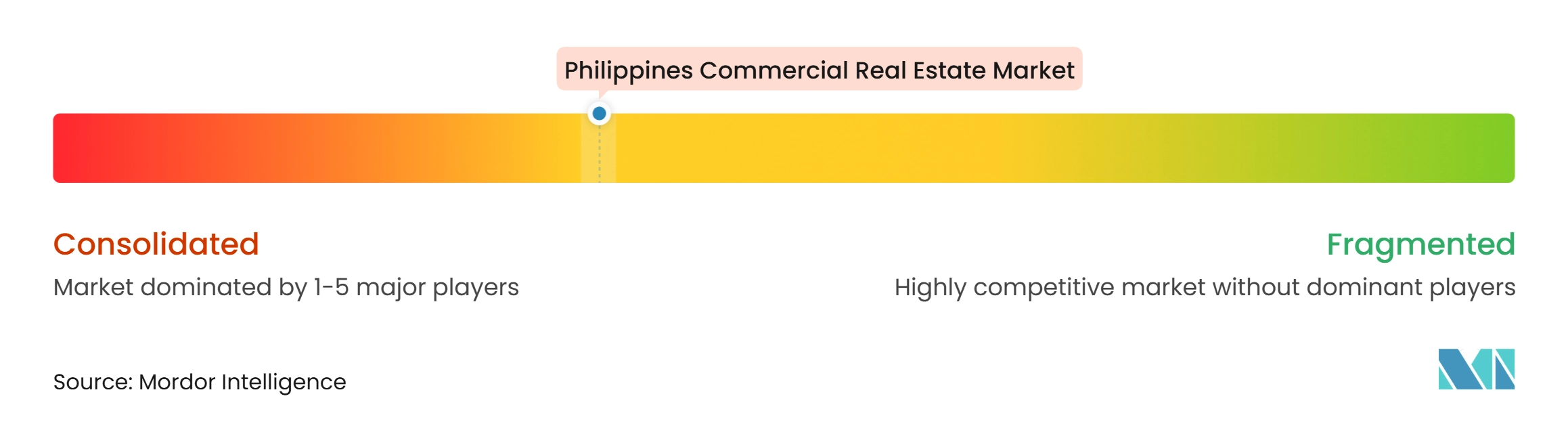
The Philippines Commercial Real Estate Market is moderately consolidated, with competition led by large diversified property groups such as SM Prime Holdings, Inc., Ayala Land, Inc., Megaworld Corporation, and Robinsons Land Corporation. These companies operate across offices, retail, townships, hospitality, and other property segments, enabling diversified revenue streams and supporting long-term land acquisition, infrastructure coordination, and asset management. Real Estate Investment Trust (REIT) platforms have emerged as important competitive tools, allowing developers to recycle capital from mature assets and reinvest in logistics, provincial commercial developments, data centers, and hotels while retaining recurring income.
Ayala Land, Inc. has expanded AREIT, Inc. through property infusions that include malls and hotels alongside office assets. MREIT, Inc. completed a property-for-share swap that added 12 income-generating properties and 303,936 m² of gross leasable area (GLA). Robinsons Land Corporation also transferred six mall assets to RL Commercial REIT as part of its portfolio strategy. These initiatives show how capital recycling, portfolio diversification, and recurring income help sustain development capacity in the face of high construction costs.
Competition is also intensifying across logistics, managed offices, sustainable buildings, and provincial markets. Robinsons Logistix and Industrials, Inc. signed an expanded warehouse lease with SPX Express, while RL Clark Logistix is developing a logistics hub in Clark Freeport Zone. Daiichi Properties secured Leadership in Energy and Environmental Design (LEED) Operations and Maintenance certifications for three Bonifacio Global City properties, including LEED O+M Platinum certification for The Finance Centre. These developments indicate that competition increasingly depends on asset quality, sustainability credentials, tenant services, and strategic locations, rather than portfolio size alone.
Philippines Commercial Real Estate Industry Leaders
-
Ayala Land, Inc.
-
SM Prime Holdings, Inc.
-
Megaworld Corporation
-
Robinsons Land Corporation
-
Filinvest Land, Inc.
- *Disclaimer: Major Players sorted in no particular order
Philippines Commercial Real Estate Market Companies Covered in this Report
- Ayala Land, Inc.
- SM Prime Holdings, Inc.
- Megaworld Corporation
- Robinsons Land Corporation
- Filinvest Land, Inc.
- D.M. Wenceslao and Associates, Inc.
- DoubleDragon Corporation
- Vista Land and Lifescapes, Inc.
- Aboitiz InfraCapital Inc.
- Federal Land, Inc.
- Shang Properties, Inc.
- Century Properties Group Inc.
- Arthaland Corporation
- Italpinas Development Corporation
- AyalaLand Logistics Holdings Corp.
- Robinsons Logistix and Industrials, Inc.
- AREIT, Inc.
- RL Commercial REIT, Inc.
- MREIT, Inc.
- Filinvest REIT Corp.
- DDMP REIT, Inc.
Recent Industry Developments in Philippines Commercial Real Estate Market
- September 2026: MREIT, Inc. completed a property-for-share swap with Megaworld Corporation, Travelers International Hotel Group Inc., and Southwoods Mall Inc., adding 12 income-generating properties with 303,936 m² of gross leasable area.
- August 2026: BCDA broke ground on the SCTEX Hacienda Luisita Interchange expansion project, designed to improve access to industrial hubs including TARI Estate and Luisita Industrial Park in Tarlac, with completion targeted in Q2 2027.
- May 2026: Robinsons Land Corporation, FedEx, and BCDA broke ground on a 15-hectare logistics hub within Clark Freeport Zone, to be developed by RL Clark Logistix Inc.
Philippines Commercial Real Estate Market Report Scope
Segmentation Overview
| Offices |
| Retail |
| Logistics |
| Other Property Types (industrial real estate, hospitality real estate, etc.) |
| By Property Type | Offices |
| Retail | |
| Logistics | |
| Other Property Types (industrial real estate, hospitality real estate, etc.) |
Key Questions Answered in the Report
What is the projected value of the Philippines commercial real estate sector by 2032?
The sector is projected to reach USD 19.19 billion by 2032, expanding at a 5.61% CAGR from 2027.
Which property category leads rental value in the Philippines?
Offices lead rental value with a 44.5% share in 2026, supported by corporate, IT-BPM, and global capability center demand.
Which Philippine commercial property category is growing fastest?
Logistics Sales are expected to grow at a 6.31% CAGR in sales, while rental logistics and warehousing is expected to grow at a 6.12% CAGR through 2032.s
Why is Central Luzon attracting commercial property investment?
Central Luzon is forecast to grow at a 6.55% CAGR due to logistics activity, Clark-related investment, and improving transport links.
What are the main risks facing commercial developers in the Philippines?
Major risks include office vacancy, higher land and construction costs, approval delays, and exposure to typhoons and flooding.
How are REITs changing Philippine commercial property ownership?
REITs allow developers to transfer stabilized office, retail, and hotel assets, recycle capital, and fund new logistics, hospitality, and mixed-use projects.