
Philippines Cartonboard Market Size and Share
Market Overview
| Study Period | 2020 - 2031 |
|---|---|
| Forecast Data Period | 2026 - 2031 |
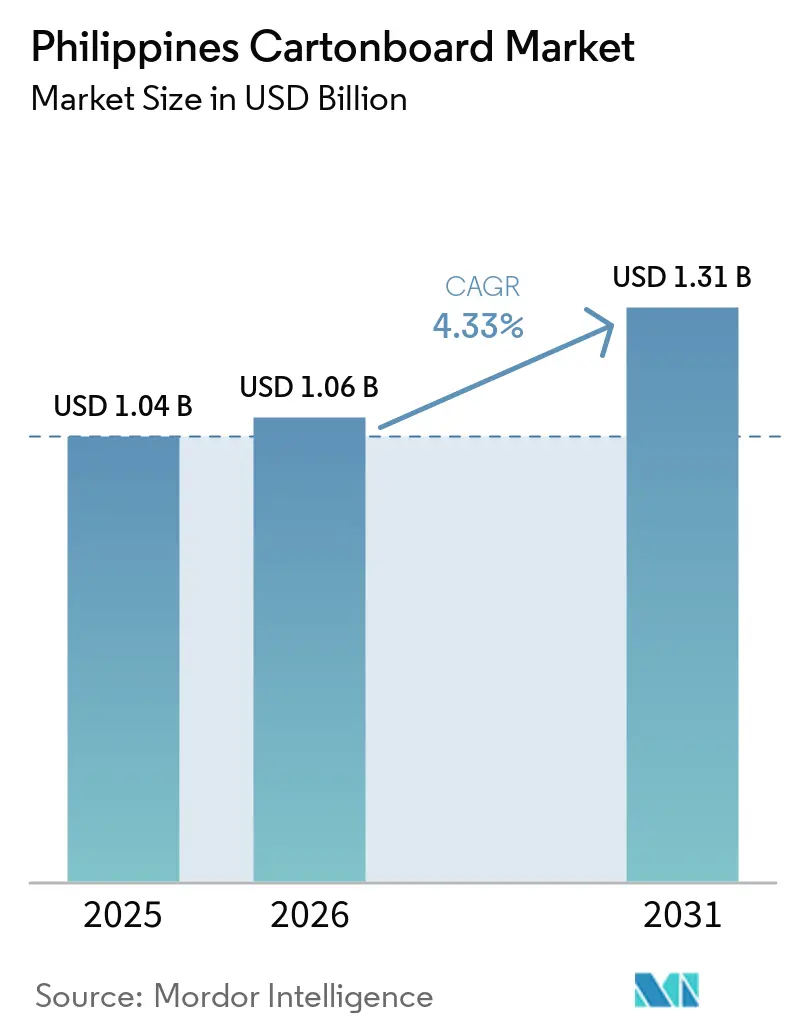
| Base Year Market Size (2025) | USD 1.04 Billion |
| Market Size (2026) | USD 1.06 Billion |
| Market Size (2031) | USD 1.31 Billion |
| Growth Rate (2026 - 2031) | 4.33 % |
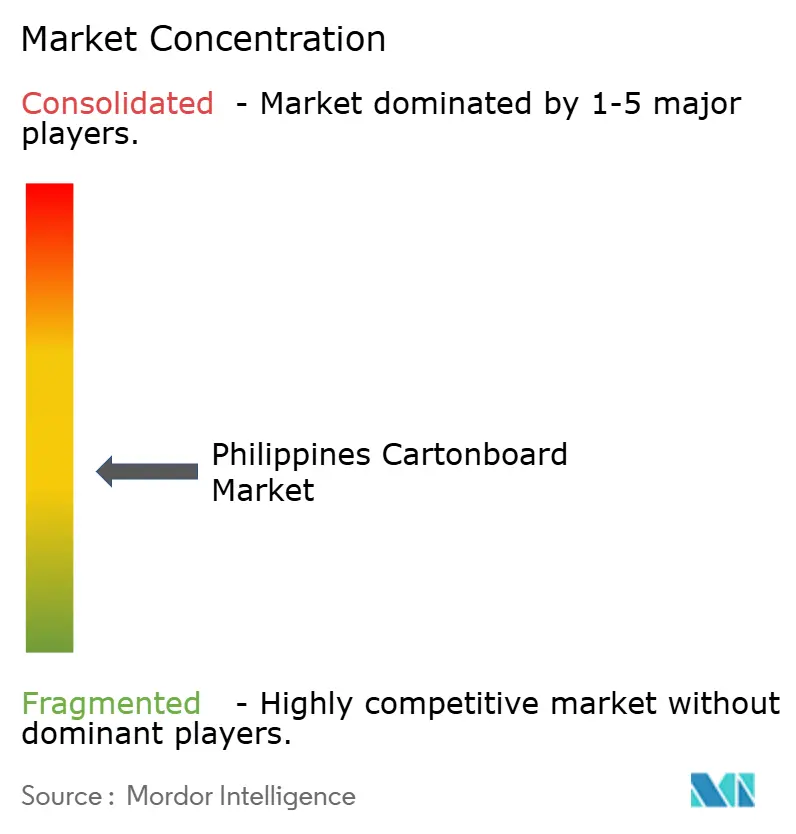
| Market Concentration | Medium |
Major Players *Disclaimer: Major Players sorted in no particular order Image © Mordor Intelligence. Reuse requires attribution under CC BY 4.0. | |
Philippines Cartonboard Market Analysis by Mordor Intelligence
The Philippines Cartonboard Market size is projected to expand from USD 1.04 billion in 2025 and USD 1.06 billion in 2026 to USD 1.31 billion by 2031, registering a CAGR of 4.33% between 2026 and 2031.
Demand in the Philippines cartonboard market remains closely tied to everyday FMCG turnover, food and beverage production, and modern retail activity across Luzon. Stricter packaging compliance and a wider move toward fiber-based formats are supporting a gradual shift away from plastic in secondary and outer packs. The rise of online retail is also increasing demand for cartons and sleeves that can protect goods through inter-island shipping and repeated handling. The Philippines cartonboard market still depends heavily on imported premium grades, so pricing and lead times remain sensitive to overseas fiber costs and regional mill availability. Competition therefore centers on technical service, converting quality, and supply reliability, which leaves room for capable converters to grow through better design, print execution, and specialty board handling.
Key Report Takeaways
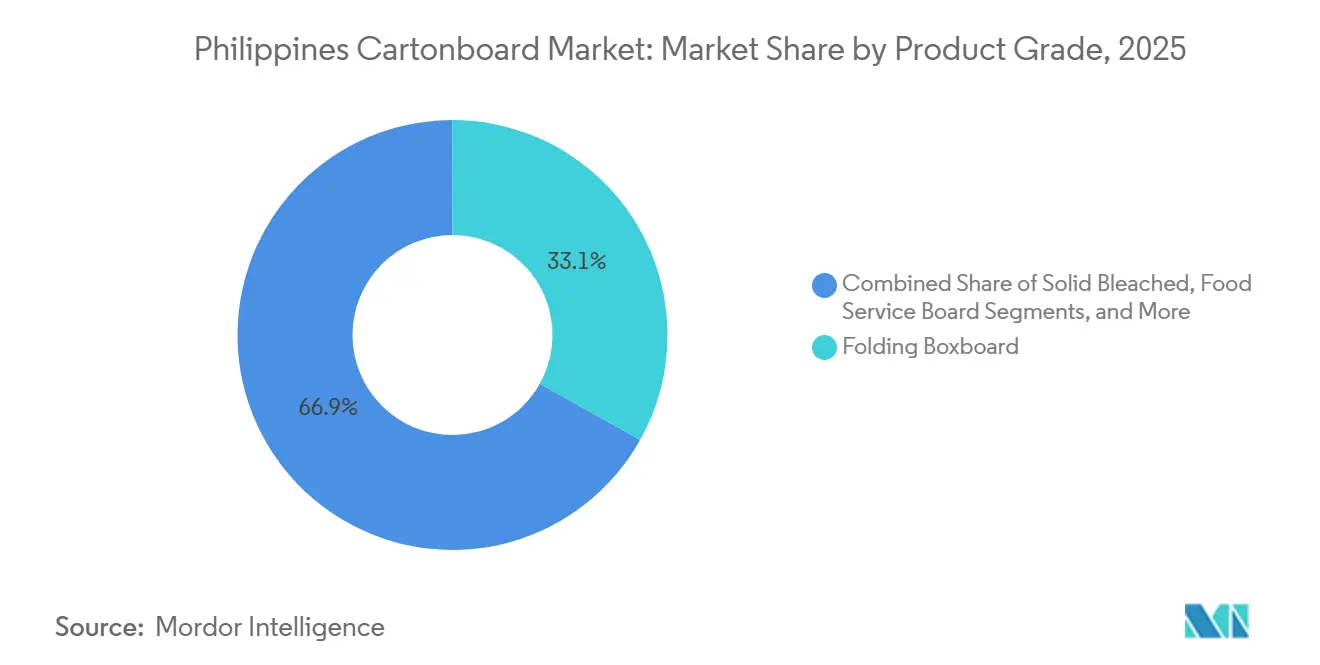
- By product grade, Folding Boxboard held 33.12% of the Philippines cartonboard market share in 2025, while Liquid Packaging Board is projected to expand at a 5.51% CAGR through 2031.
- By packaging format, Folding Cartons accounted for 56.78% share of the Philippines cartonboard market size in 2025, while Liquid Packaging is projected to expand at a 5.55% CAGR through 2031.
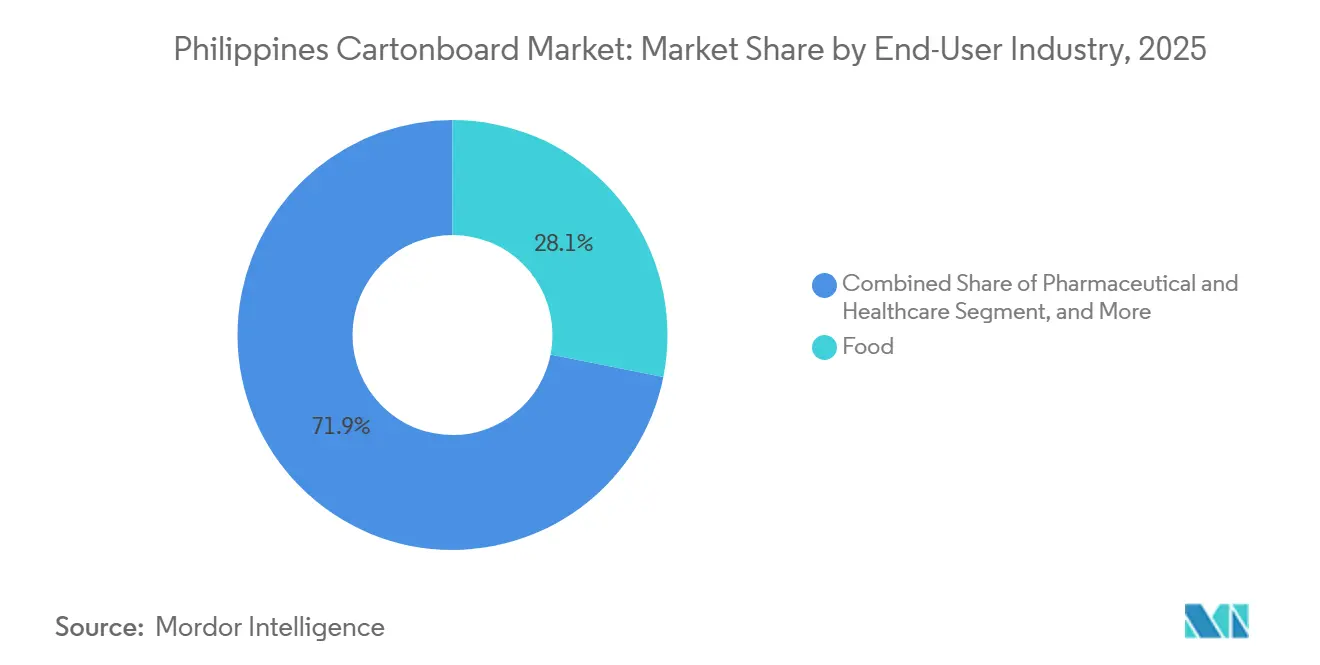
- By end-user industry, Food held 28.12% share in 2025 in the Philippines cartonboard market, while Pharmaceutical and Healthcare is projected to expand at a 5.43% CAGR through 2031.
Note: Market size and forecast figures in this report are generated using Mordor Intelligence’s proprietary estimation framework, updated with the latest available data and insights as of January 2026.
Philippines Cartonboard Market Trends and Insights
Drivers Impact Analysis*
| Driver | (~) % Impact on CAGR Forecast | Geographic Relevance | Impact Timeline |
|---|---|---|---|
| Rising Demand for Premium Retail and Shelf-Ready Packaging | +1.2% | National, concentrated in Metro Manila, Cebu, and Davao modern retail hubs | Short term (≤ 2 years) |
| Expansion of Packaged Food and Beverage Consumption | +1.0% | National, with industrial anchor in Central Luzon and CALABARZON | Medium term (2-4 years) |
| Growth in Aseptic and Shelf-Stable Carton Applications | +0.7% | National, with highest pull from Metro Manila and Cebu, with emerging demand in Mindanao cities | Medium term (2-4 years) |
| E-Commerce-Driven Secondary Packaging Demand | +0.6% | National, with epicenter in Metro Manila and growing spillover into Visayas and Mindanao | Short term (≤ 2 years) |
| Rising Sustainability Preference for Fiber-Based Packaging | +0.4% | National, with early adopters concentrated in Metro Manila and organized retail chains | Medium term (2-4 years) |
| Brand Migration From Plastic to Paperboard Cartons | +0.3% | National, with compliance pressure strongest among large obliged enterprises in Metro Manila | Long term (≥ 4 years) |
| Source: Mordor Intelligence | |||
Rising Demand For Premium Retail And Shelf-Ready Cartonboard Packaging
Modern trade in the Philippines has pushed retail presentation standards higher, which is raising the need for shelf-ready carton formats with better print quality and stronger structural finish. Organized retail groups and presentation-led store formats are encouraging brand owners to move beyond plain secondary outers and into higher-grammage folding boxboard and coated substrates in more categories. Imported products from Thailand and Indonesia already arrive in cleaner shelf-ready formats, and that is quietly raising the presentation benchmark for domestic manufacturers that sell into the same aisles. Retailers are also expanding private-label products in larger presentation-focused packs, which supports more folding carton use rather than flexible pouch substitution. This matters for the Philippines cartonboard market because it supports higher board value per converted unit, even when underlying consumer demand remains steady. It also keeps print quality, display readiness, and shelf consistency central to converter selection in food, personal care, and healthcare packaging.[1]
Expansion Of Packaged Food And Beverage Consumption
Expansion in packaged food and beverage output continues to anchor the Philippines cartonboard market because it creates recurring demand across cartons, sleeves, and liquid packs. In 2026, the food and beverage manufacturing sector is projected to grow 5%, which supports carton demand in biscuits, ready meals, dairy, and pantry staples that need printable and protective secondary packaging. Shelf-stable meals and soups are especially relevant because these categories depend on packaging that protects product quality and supports clear labeling during storage and distribution. This pattern also matters because food processing investment in Central Luzon and CALABARZON usually pulls packaging demand with it, which strengthens order flow for converters near industrial corridors. The demand base is therefore broad rather than concentrated in a single food line, which makes the Philippines cartonboard market more resilient to changes in one category alone. It also reinforces the role of cartonboard as a practical packaging substrate for products that move through both modern retail and traditional trade.[2]
Growth In Aseptic And Shelf-Stable Carton Applications
Liquid Packaging Board remains a smaller base within the Philippines cartonboard market, but it carries stronger headroom because aseptic formats are still less developed than in several nearby markets. Tetra Pak has been active in the country for decades, yet the local liquid carton opportunity is still opening across beverage and ambient food uses. The company is preparing smaller aseptic formats suited to local price points, which indicates that suppliers still see room to widen category access through more affordable pack sizes. Tetra Pak also collected more than 700 tonnes of used cartons in the Philippines in 2024, which shows that collection systems are scaling alongside expected volume growth. Paper-based retort and aseptic formats are gaining more attention in ambient food because they reduce pack weight and lower transport intensity compared with metal packaging. This gives the Philippines cartonboard market a clearer runway in shelf-stable beverages and foods where convenience, logistics efficiency, and storage flexibility all matter.[3]
E-Commerce-Driven Secondary Packaging Demand
E-commerce is increasing the need for secondary packaging in the Philippines cartonboard market because shipments move through longer and more fragmented logistics routes across the archipelago. Packages often pass through several handling points before delivery, so stiffness, structural integrity, and moisture resistance matter more than they do in simpler mainland distribution systems. That requirement supports folding cartons, sleeves, and tray formats that can protect products without adding too much shipping weight. In July 2026, Cebu Daily News reported that 1 in 3 businesses in Visayas and Mindanao now ship goods to Luzon through e-commerce channels, which points to a broader packaging pull outside the traditional Metro Manila base. In 2026, packaging industry participants also identified e-commerce as the main factor behind annual volume growth in the wider processing and packaging sector. The result is a steady need for better paperboard solutions across both established urban markets and fast-growing regional shipping corridors.[4]
Restraints Impact Analysis*
| Restraint | (~) % Impact on CAGR Forecast | Geographic Relevance | Impact Timeline |
|---|---|---|---|
| Volatility in Imported Fiber and Pulp Costs | -0.6% | National, with strongest pressure on converters in Metro Manila and Batangas port-adjacent clusters | Medium term (2-4 years) |
| Limited Local Integrated Cartonboard Capacity | -0.5% | National, with the structural gap most visible in premium grades where no domestic mill produces virgin-fiber board | Long term (≥ 4 years) |
| Moisture Sensitivity and Barrier Performance Constraints | -0.3% | National, with higher incidence in Mindanao and island provinces with humid logistics environments | Medium term (2-4 years) |
| Price Competition From Alternative Packaging Substrates | -0.2% | National, with the strongest pressure in price-sensitive categories in general trade and sari-sari store formats | Short term (≤ 2 years) |
| Source: Mordor Intelligence | |||
Volatility In Imported Fiber And Pulp Costs
The Philippines cartonboard market remains exposed to imported fiber and pulp costs because the converting base does not have a local virgin-board hedge. When global paper inputs or freight rates rise, converters feel margin pressure quickly because premium board grades are sourced from overseas suppliers. That pressure is harder to absorb for mid-tier converters that compete on price in foodservice, household, and mass FMCG contracts. In 2026, the DTI rejected a proposal for a safeguard duty on imported corrugating medium paper, which left local buyers fully exposed to international pricing cycles. The effect on the Philippines cartonboard market is not only higher input uncertainty, but also slower investment decisions when working capital is already stretched. It also makes customer contract pricing more difficult in a market where raw material swings can reach converters faster than they can pass costs forward.
Limited Local Integrated Cartonboard Capacity
Limited integrated board capacity is a structural brake on the Philippines cartonboard market because domestic mills do not produce virgin-fiber cartonboard grades at scale. The BOI PAPELS study identified 22 paper mills with combined capacity of 1.65 million tons a year, but that installed base is concentrated in recycled grades rather than premium cartonboard. This leaves Folding Boxboard, Solid Bleached Board, and Liquid Packaging Board dependent on imports from regional and global suppliers. The issue is not only mill investment, because the country also lacks the pulpwood base needed for a fully integrated virgin-fiber chain. Converters therefore carry larger safety stocks for pharma and premium food orders, which raises inventory costs and widens the cost gap against markets with integrated mill systems. For the Philippines cartonboard market, that structural import dependence is likely to remain in place throughout the current forecast period.
*Our forecasts treat driver/restraint impacts as directional, not additive. The impact forecasts reflect baseline growth, mix effects, and variable interactions.
Segment Analysis
By Product Grade: Folding Boxboard Commands Share While Liquid Board Accelerates
Folding Boxboard held 33.12% of the Philippines cartonboard market share in 2025, which kept it well ahead of other product grades in the Philippines cartonboard market. Its lead comes from balanced cost, dependable converting behavior, and wide use across food, cosmetics, pharmaceutical, and tobacco secondary packs. Converters also favor this grade because coated imported supply is available from established overseas mills, which helps them maintain print standards for branded retail packaging. In the Philippines cartonboard industry, that combination of versatility and converting ease makes Folding Boxboard the default choice for a wide range of mainstream consumer applications. Solid Bleached Board stays important in premium tobacco and healthcare packs where brightness, print precision, and tamper-evident structures matter.
White-Lined Chipboard keeps a price-led role in household and general merchandise packaging, while Solid Unbleached Board serves heavier retail displays and laminated outer packs. Liquid Packaging Board is projected to grow at 5.51% CAGR through 2031, which makes it the fastest-moving grade in the Philippines cartonboard market. That momentum reflects stronger aseptic beverage interest, a wider push toward fiber-based formats, and rising attention to used-carton recovery systems. The expansion of smaller aseptic pack options should also help the grade reach more price-sensitive use cases without changing its core value proposition. Food Service Board remains smaller, but it is gaining relevance as urban takeaway and delivery demand lift paperboard cups, clamshells, and carry containers in Metro Manila and Cebu.

By Packaging Format: Folding Cartons Dominate While Liquid Packaging Gains Speed
Folding Cartons accounted for 56.78% share of the Philippines cartonboard market size in 2025, which made them the core format across the Philippines cartonboard market. Their position stays durable because they are the standard secondary pack for modern retail, pharmacy shelves, cosmetics displays, and many FMCG launches. The format also travels well across several end uses, which gives converters a stable production base even when category demand shifts from one sector to another. Organized retail expansion outside Metro Manila is extending folding carton demand deeper into Visayas and Mindanao, which broadens the addressable base for the Philippines cartonboard market. Sleeve and Tray formats serve a narrower role, but they remain important where shelf presence, display-readiness, and structural rigidity are part of the brand brief.
Liquid Packaging is projected to grow at 5.55% CAGR through 2031, which gives it the strongest momentum among formats in the Philippines cartonboard market. That growth is tied to aseptic dairy, juice, plant-based beverages, and a wider opening for ambient food applications that need practical shelf-stable distribution. Paper-based retort formats are drawing more interest because they cut pack weight and lower carbon intensity compared with metal cans. Other packaging formats, including foodservice containers and cups, are also expanding as restaurant chains and delivery platforms shift away from polystyrene and other rigid plastics. The overall format mix therefore remains led by folding cartons, but the faster movement is clearly shifting toward liquid and specialty paperboard applications that support convenience and packaging compliance.
By End-User Industry: Food Anchors Demand While Healthcare Builds Momentum
Food held 28.12% share in 2025, which kept it as the largest end-user base in the Philippines cartonboard market. Demand comes from biscuits, noodles, canned fish, processed dairy, and other packaged staples that require printable and protective paperboard packs. Beverage adds steady volume through UHT milk, juice, and other aseptic applications that are better suited to lightweight shelf-stable formats. Tobacco remains relevant for premium print grades because regulatory labeling and pack integrity place strict demands on substrate quality. The food and beverage base therefore gives the Philippines cartonboard market a stable demand floor across both mass and branded categories.
Pharmaceutical and Healthcare is projected to grow at 5.43% CAGR through 2031, which makes it the fastest-growing end-user segment in the Philippines cartonboard market. That pace reflects tighter packaging requirements for prescription products, higher demand for tamper-evident formats, and wider use of carton-based secondary packs with stronger print consistency. Cosmetics and Toiletries also support growth as brands add sleeves and cartons to improve presentation and align with plastic reduction efforts. The other end-user group, which includes toys, apparel, automotive, household, electrical, and foodservice uses, gives the Philippines cartonboard market a broader and more resilient demand base. This mix matters because it lowers dependence on any single vertical even when one category faces short-term consumer pressure.
Geography Analysis
The demand base remained centered in Metro Manila and the National Capital Region, where converting activity, organized retail, and FMCG decision-making are most concentrated. CALABARZON and Central Luzon form the main industrial belts for the Philippines cartonboard market because they host large food, beverage, and pharmaceutical manufacturing sites. These corridors also benefit from port access and stronger logistics links, which matter in a market that depends on imported premium board. In 2026, industry data presented at ProPak Philippines showed that total packaging volume is moving from 78.5 billion units in 2024 to 91.8 billion units by 2029, which reinforces the medium-term demand path for paperboard packaging. This concentration means Luzon continues to shape specification trends, service standards, and inventory planning for the national market.
Visayas and Mindanao are smaller demand centers today, but they are becoming more important to the Philippines cartonboard market as inter-island commerce expands. In July 2026, Cebu Daily News reported that 1 in 3 businesses in Visayas and Mindanao now ship goods to Luzon through e-commerce channels, which raises the need for transit-ready secondary packaging. Food processing in Mindanao, especially in canned fish, tropical fruit, and coconut-based products, creates an end-use base that still has room for deeper cartonboard penetration. Collection programs for used beverage cartons are also expanding beyond Metro Manila, which should support wider acceptance of aseptic formats over time.
Within Southeast Asia, the Philippines cartonboard market is a higher-growth but more supply-constrained importer than Thailand and Indonesia, where integrated mill capacity is stronger. That import dependence makes local converters price takers when regional mills tighten availability or freight costs rise. Premium board still needs to come in from Japan, China, Thailand, and Europe, which keeps supply planning closely tied to overseas production conditions. As a result, geography in the Philippines cartonboard market is less about provincial demand shares and more about how industrial clusters, ports, and inter-island distribution shape conversion economics.
Competitive Landscape
The Philippines cartonboard market has a dual-tier structure with global integrated board producers at the supply end and a fragmented domestic converting base at the customer-facing end. Premium grades are supplied mainly by companies such as Tetra Pak International, Stora Enso, Mayr-Melnhof Karton, Metsä Board, Oji Holdings, and Graphic Packaging through regional hubs and trading channels. Local converters, including United Pulp and Paper Co., Majestic Printing and Packaging Corporation, Flexo Manufacturing Corporation, and Packtica Inc., compete more on service, turnaround time, and finishing capability than on raw material scale. The BOI PAPELS study showed that domestic mill capacity exists in paper and paperboard, but not in integrated virgin-fiber cartonboard, which keeps the supply chain import dependent. This structure leaves room for converters that can offer stronger design support, digital print flexibility, and specialty board handling in the Philippines cartonboard market.
Strategic moves in 2025 and 2026 show that leading suppliers are building regional support systems instead of Philippine manufacturing assets. Tetra Pak opened a Customer Innovation Centre in Bangkok in 2025 and then opened its Product Development Centre in Rayong in 2026, which gives Philippine food and beverage companies access to product and pack development without a local plant. Smurfit Westrock also reported improving demand and customer wins in its EMEA and APAC business in the first quarter of 2026, alongside rising containerboard pricing in the region. These moves suggest competitive advantage is being built through technical collaboration, responsiveness, and regional supply coordination rather than through simple price competition.
Certification and compliance are also becoming more important in the Philippines cartonboard market, especially for food and pharmaceutical work where customers want stable quality systems. That favors the smaller set of converters that can meet strict print, traceability, and pack integrity requirements on a repeat basis. The overall competitive tone remains fragmented because no single local converter controls more than a low-single-digit share of the national converting base, while premium board supply is divided across several international producers. For that reason, the Philippines cartonboard market is still open to share gains through better execution, stronger customer service, and deeper specialization in high-value carton applications. This also means market leadership is shaped more by capability depth and customer trust than by headline capacity alone.
Philippines Cartonboard Industry Leaders
-
Tetra Pak International S.A.
-
SIG Group AG
-
Stora Enso Oyj
-
Billerud AB
-
Metsä Board Corporation
- *Disclaimer: Major Players sorted in no particular order
Recent Industry Developments
- July 2026: Cebu Daily News reported that 1 in 3 businesses in Visayas and Mindanao now ship goods to Luzon via e-commerce platforms, underscoring the growing inter-island packaging demand for folding cartons and secondary packaging formats with transit-grade specifications.
- April 2026: Smurfit Westrock reported Q1 2026 EMEA and APAC revenue growth alongside improving demand profiles and customer wins, with containerboard prices increasing in March-April 2026 driven by higher energy costs and better regional demand, indicating tightening supply conditions that will transmit into premium cartonboard pricing for Southeast Asian converters including those in the Philippines.
- April 2026: The DTI issued Department Administrative Order No. 26-02, signed March 26, 2026, and published April 1, 2026, rejecting PULPAPEL's proposal for a definitive safeguard duty on imported corrugating medium paper following a Tariff Commission recommendation, leaving Philippine converters fully exposed to global recovered-fiber pricing cycles and keeping domestic cartonboard input costs structurally import-linked.
Philippines Cartonboard Market Report Scope
The Philippines Cartonboard Market encompasses the production, distribution, and application of cartonboard materials for packaging. Key product grades in the market include Solid Bleached Board, Solid Unbleached Board, Folding Boxboard, White-Lined Chipboard, Liquid Packaging Board, and Food Service Board. These grades are used across various packaging formats, including folding cartons, liquid packaging, sleeves, trays, cups, and foodservice containers. Due to their recyclability, printability, and sustainable packaging attributes, these cartonboard solutions are widely used across sectors such as food, beverage, pharmaceuticals, tobacco, cosmetics, and more.
The Philippines Cartonboard Market Report is Segmented by Product Grade (Solid Bleached Board, Solid Unbleached Board, Folding Boxboard, White-Lined Chipboard, Liquid Packaging Board, and Food Service Board), Packaging Format (Folding Cartons, Liquid Packaging, Sleeve and Tray, and Other Packaging Formats), End-User Industry (Food, Beverage, Pharma and Healthcare, Tobacco, Cosmetics, and Other End-User Industries). The Market Forecasts are in Value (USD).
| Solid Bleached Board |
| Solid Unbleached Board |
| Folding Boxboard |
| White-Lined Chipboard |
| Liquid Packaging Board |
| Food Service Board |
| Folding Cartons |
| Liquid Packaging |
| Sleeve and Tray |
| Other Packaging Formats (Cups, Foodservice Containers) |
| Food |
| Beverage |
| Pharmaceutical and Healthcare |
| Tobacco |
| Cosmetics and Toiletries |
| Other End-User Industries (Toy, Apparel, Automotive, Household, Electrical, Foodservice) |
| By Product Grade | Solid Bleached Board |
| Solid Unbleached Board | |
| Folding Boxboard | |
| White-Lined Chipboard | |
| Liquid Packaging Board | |
| Food Service Board | |
| By Packaging Format | Folding Cartons |
| Liquid Packaging | |
| Sleeve and Tray | |
| Other Packaging Formats (Cups, Foodservice Containers) | |
| By End-User Industry | Food |
| Beverage | |
| Pharmaceutical and Healthcare | |
| Tobacco | |
| Cosmetics and Toiletries | |
| Other End-User Industries (Toy, Apparel, Automotive, Household, Electrical, Foodservice) |
Key Questions Answered in the Report
What is the current and forecast value of the Philippines cartonboard sector?
The Philippines cartonboard market size is projected to expand from USD 1.04 billion in 2025 and USD 1.06 billion in 2026 to USD 1.31 billion by 2031, at a 4.33% CAGR over 2026-2031.
Which product grade leads demand in the Philippines cartonboard space?
Folding Boxboard led with 33.12% share in 2025 because it balances cost, print quality, and converting performance across food, cosmetics, pharmaceutical, and tobacco packaging.
Which packaging format is growing the fastest in the country?
Liquid Packaging is projected to grow at a 5.55% CAGR through 2031, supported by aseptic dairy, juice, plant-based beverages, and shelf-stable food applications.
Why is e-commerce important for cartonboard demand in the Philippines?
E-commerce raises the need for stronger secondary packaging because products move through inter-island logistics chains with more handling points, which favors cartons, sleeves, and trays with better structural performance.
Which end-user segment is showing the fastest momentum?
Pharmaceutical and Healthcare is projected to grow at a 5.43% CAGR through 2031 as packaging needs tighten around print consistency, tamper evidence, and traceability.
What is the biggest structural challenge for local converters?
The main challenge is import dependence for premium board grades, which exposes converters to overseas fiber costs, freight changes, and regional mill availability while local integrated virgin-fiber capacity remains limited.