
Philippines Bonsai Market Size and Share
Market Overview
| Study Period | 2021 - 2031 |
|---|---|
| Forecast Data Period | 2026 - 2031 |
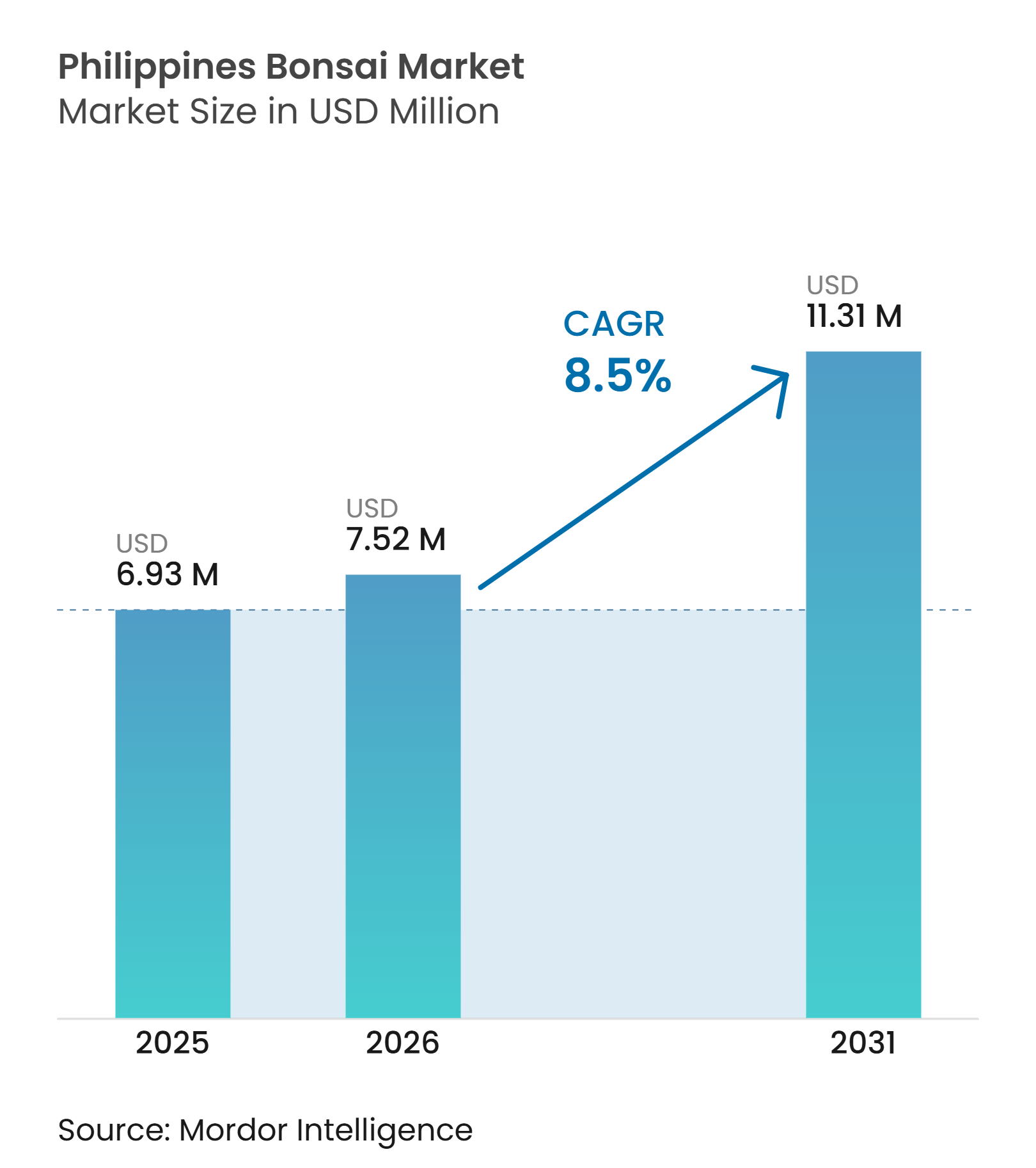
| Base Year Market Size (2025) | USD 6.93 Million |
| Market Size (2026) | USD 7.52 Million |
| Market Size (2031) | USD 11.31 Million |
| Growth Rate (2026 - 2031) | 8.50 % |
| Market Concentration | Low |
Major Players *Disclaimer: Major Players sorted in no particular order Image © Mordor Intelligence. Reuse requires attribution under CC BY 4.0. | |
Philippines Bonsai Market Analysis by Mordor Intelligence
The Philippines bonsai market size was valued at USD 6.93 million in 2025 and is forecast to grow from USD 7.52 million in 2026 to USD 11.31 million by 2031, at a CAGR of 8.5% during the forecast period. The market is expanding beyond its traditional collector base, with compact homes, digital selling, and commercial interiors creating distinct demand pools. Urban buyers view trained trees as manageable living décor, while experienced collectors continue to seek distinctive tropical specimens and imported varieties. Social-commerce platforms and nationwide courier services are expanding the reach of growers and specialist nurseries beyond established bonsai-producing areas, including Benguet, Batangas, and Davao. The market remains fragmented, with demand and supply distributed across specialty nurseries, informal growers, social-commerce sellers, and general plant retailers. Import requirements, wet-season plant-health risks, and price competition from informal sellers pose operational challenges for retailers, particularly those handling imported or premium bonsai varieties.
Key Report Takeaways
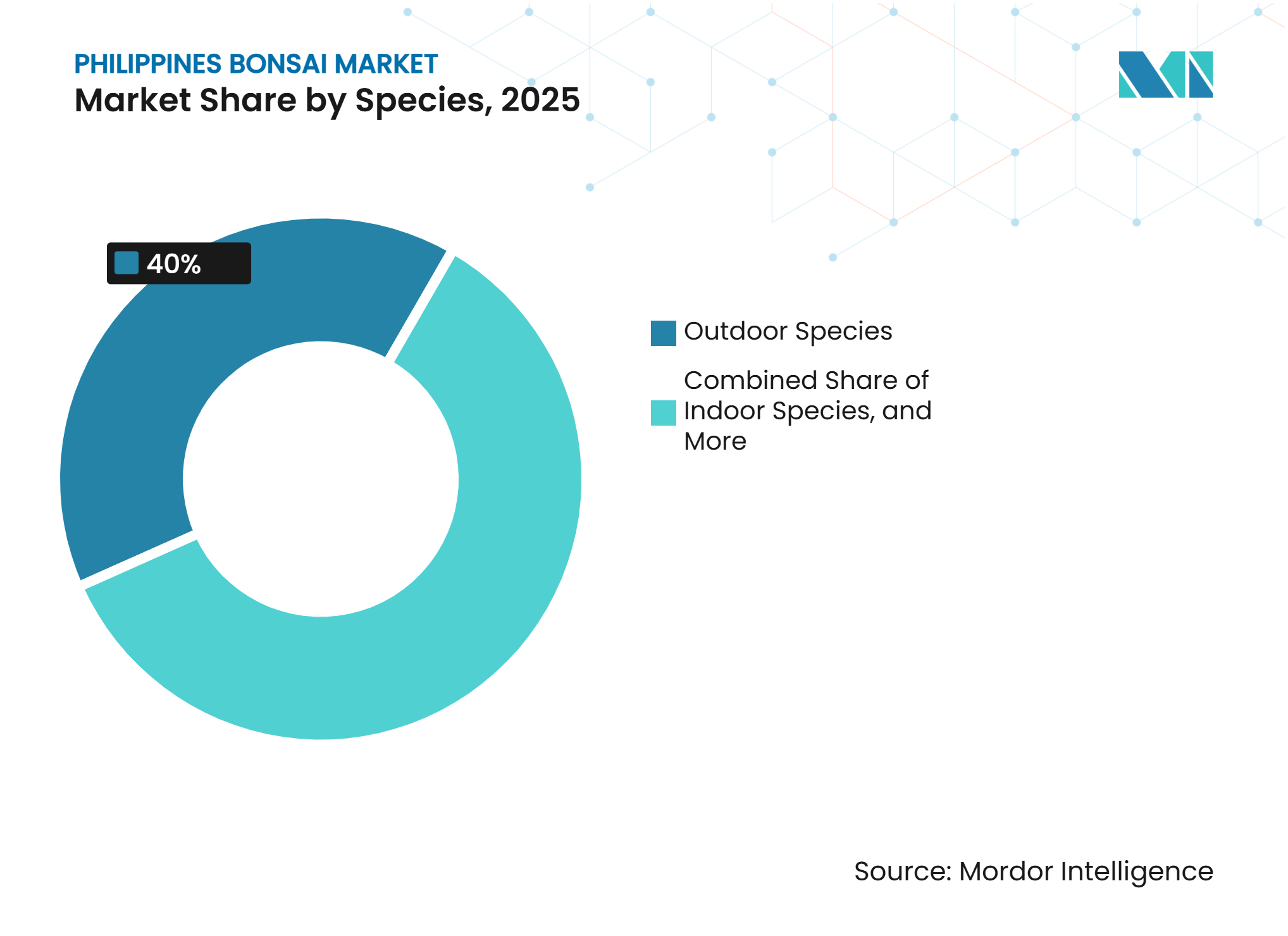
- By species, outdoor species accounted for 40% of the Philippines bonsai market share in 2025, while indoor species is forecast to grow at a CAGR of 10.8% from 2026 to 2031.
- By distribution channel, offline channels accounted for 62% of the Philippines bonsai market size in 2025, while online channels are forecast to grow at a CAGR of 13.2% from 2026 to 2031.
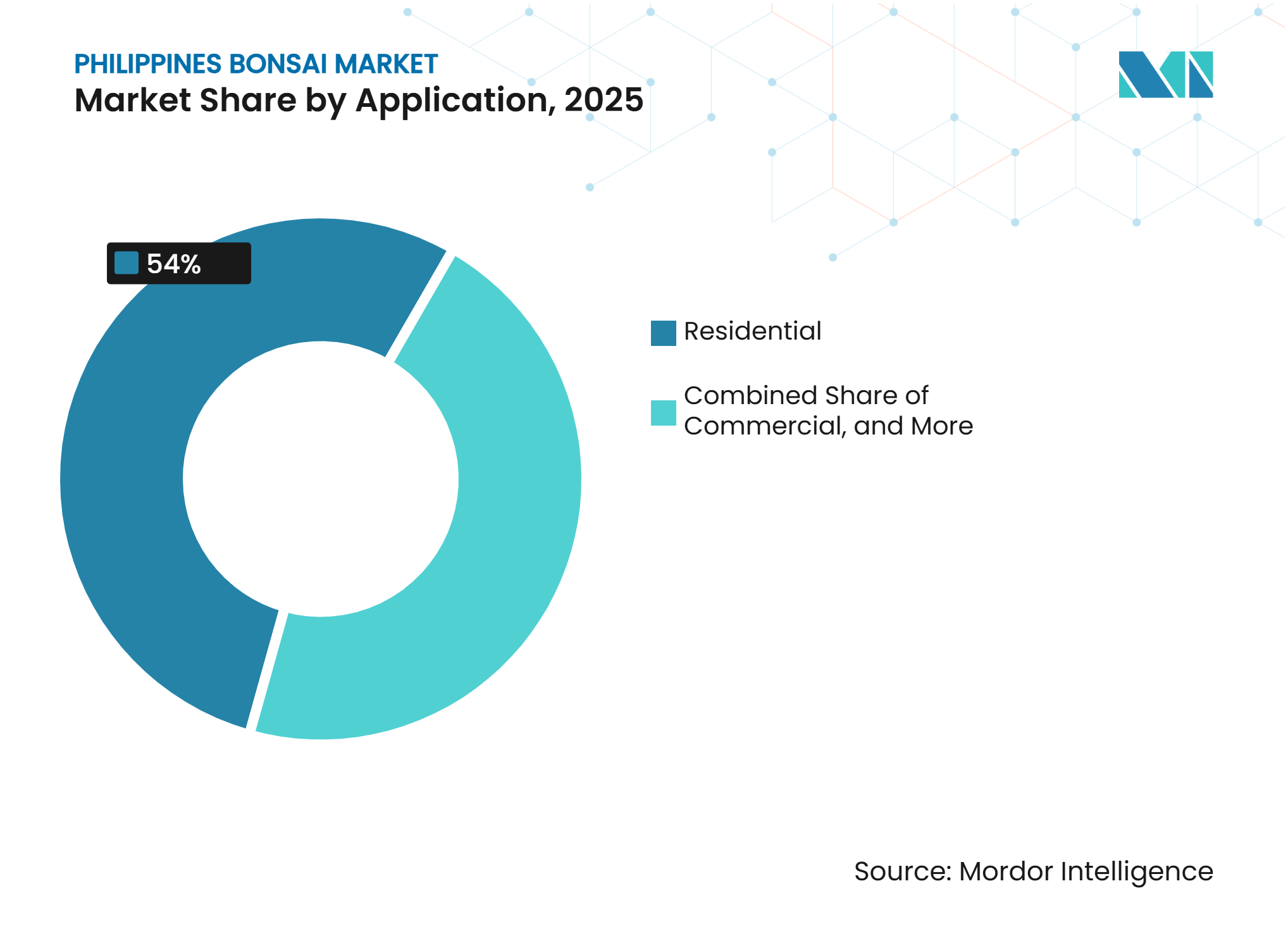
- By application, residential accounted for 54% of the market share in 2025, while commercial is forecast to grow at a CAGR of 10.1% from 2026 to 2031.
Note: Market size and forecast figures in this report are generated using Mordor Intelligence’s proprietary estimation framework, updated with the latest available data and insights as of January 2026.
Market Trends and Insights
Drivers Impact Analysis of Philippines Bonsai Market*
| Driver | (~) % Impact on CAGR Forecast | Geographic Relevance | Impact Timeline |
|---|---|---|---|
| Social Commerce Discovery and Nationwide Parcel Delivery | +1.8% | National, strongest in Metro Manila, Cebu, and Davao, with expanding courier reach in Visayas and Mindanao | Short term (≤ 2 years) |
| Expansion of Apartment and Office Plant Culture | +1.2% | National Capital Region core and secondary urban centers across Luzon and Visayas | Short term (≤ 2 years) |
| Premium Demand for Philippine Tropical Species | +1.5% | National, with export-facing signals from Benguet, Batangas, and Davao | Medium term (2-4 years) |
| Corporate Wellness, Gifting, and Biophilic Interiors | +0.9% | National Capital Region office corridors, Cebu, and Davao business districts | Medium term (2-4 years) |
| Growth of Mall-Based Exhibitions and Hobby Communities | +0.8% | Metro Manila and provincial malls in Luzon and Visayas | Short term (≤ 2 years) |
| Ornamental Grower Support and Nursery Input Availability | +0.6% | National, with activity in Bulacan, Benguet, and Department of Agriculture Region III nurseries | Long term (≥ 4 years) |
| Source: Mordor Intelligence | |||
Social Commerce Discovery and Nationwide Parcel Delivery
Social commerce has reduced the distance between bonsai growers in Benguet, Batangas, and Davao and buyers nationwide. TikTok Shop reported more than 200% sales growth for local sellers in 2025, while its #SarilingAtin initiative generated more than 12 million live-session views[1]. Live selling allows buyers to examine trunk form, nebari structure, and visible plant condition before purchasing. This format addresses a practical limitation of static listings, which often cannot convey the quality of a trained tree. Nationwide parcel delivery further enables growers and specialist nurseries to serve buyers outside major bonsai-producing areas, expanding access to a wider range of species, sizes, and styles. Sellers can also use care videos and follow-up content to build ongoing customer relationships. The Philippines bonsai market benefits as social commerce and nationwide delivery improve buyer access and confidence, supporting repeat spending on trees, soil, pots, tools, and maintenance.
Expansion of Apartment and Office Plant Culture
Compact urban homes suit bonsai because a trained tree needs less space than many conventional ornamental plants. A condominium resident can keep a single specimen on a balcony, shelf, or windowsill without needing a large garden. The care cycle also creates recurring demand for soil media, fertilizers, wire, tools, and replacement pots. The World Bank identified high-potential urban growth corridors across Luzon, Visayas, and Mindanao in its December 2025 Philippines Economic Update[2]. This wider urban pattern gives the Philippines bonsai market an addressable base beyond the National Capital Region. Curated collections of compact Fukien Tea, Ficus ginseng, and desktop-scale Serissa can lower the space barrier for first-time buyers and support adoption in apartments and offices. As urban living spaces become more compact, bonsai's small footprint and recurring care requirements can broaden its appeal among urban households and workplaces, supporting market growth beyond traditional garden settings.
Premium Demand for Philippine Tropical Species
Chinese Banyan, Bantigue, Makopa, and Orange Jasmine can carry collector value because they are locally adapted tropical trees. Their local origin gives sellers a point of difference from imported Japanese species and generic starter Ficus. The Philippines bonsai market has room for documented native selections positioned between high-cost imports and low-priced starter plants. DOST-PCAARRD worked with the National Seed Industry Council Ornamental and Medicinal Plants Varietal Improvement Group in 2025 to advance research and development on ornamental species, including Hibiscus and Hoya varieties[3]. The work broadens the domestic ornamental genetic base available to growers and can support the development of locally adapted plant material for specialized cultivation. The 2026 World Bonsai Convention also identified the Philippines among active Asian sourcing markets for finished specimens and raw planting materials. Together, stronger domestic plant resources and international sourcing interest can create opportunities for growers to differentiate premium tropical bonsai and expand their value beyond entry-level ornamental plants.
Corporate Wellness, Gifting, and Biophilic Interiors
Commercial buyers use bonsai as a reception accent, an executive office feature, a hotel lobby element, and a prestige gift. These uses can generate larger orders than a typical household purchase and create repeat demand during gift cycles or plant replacement. Ayala Corporation received WELL v2 Platinum Certification for its headquarters in Makati in 2025. LIMA Tower One in Batangas also received WELL Core Gold Certification in 2025. These examples indicate that live-plant features have a place in certified workplace design. As businesses invest in workplace aesthetics and employee-oriented environments, bonsai can serve as a compact decorative element that fits offices, hospitality spaces, and corporate gifting programs. The Philippines bonsai market can benefit as suppliers expand beyond one-time tree sales to offer maintenance, replacement, and leasing services, creating recurring commercial revenue opportunities.
Restraints Impact Analysis of Philippines Bonsai Market*
| Restraint | (~) % Impact on CAGR Forecast | Geographic Relevance | Impact Timeline |
|---|---|---|---|
| Imported Tree Quarantine and Documentation Friction | -1.2% | National, with the highest burden on Metro Manila-based commercial importers | Short term (≤ 2 years) |
| Tropical Pest, Fungal, and Wet-Season Loss Risk | -1.0% | National, most severe from June through October across Luzon and Visayas | Short term (≤ 2 years) |
| Skilled Care Bottlenecks Outside Major Urban Centers | -0.7% | Provincial areas, most acute in Mindanao and Visayas outside Davao and Cebu | Medium term (2-4 years) |
| Fragility, Delivery Damage, and After-Sales Care Gaps | -0.6% | National, with greatest risk on inter-island courier routes to Visayas and Mindanao | Medium term (2-4 years) |
| Source: Mordor Intelligence | |||
Imported Tree Quarantine and Documentation Friction
Commercial importers must obtain Sanitary and Phytosanitary Import Clearance from the Bureau of Plant Industry National Plant Quarantine Services Division before each shipment. Category IV planting commodities also require a Pest Risk Analysis, and importers must maintain registration under Department of Agriculture Department Circular No. 04, series of 2016. These requirements add lead time, inspection costs, and documentation work to imported Japanese black pine, Shimpaku juniper, and other premium trees. Larger importers can spread fixed compliance costs over several shipments, while smaller retailers face a higher burden per shipment. This difference can limit emerging specialists' ability to use imported varieties to distinguish their offerings. The Philippines bonsai market consequently directs some buyers toward locally grown tropical alternatives and reduces the wider availability of verified imported supply.
Tropical Pest, Fungal, and Wet-Season Loss Risk
Ornamental plants in the Philippines face pressure from Colletotrichum species, which are linked with anthracnose across 106 plant hosts in the country. Phytophthora and Sclerotium infections also thrive in wet and humid conditions. Containerized bonsai are particularly exposed to root rot and waterlogging because their root zones are restricted, and drainage can be limited. Losses from June through October affect growers, retailers, couriers, and buyers, particularly when a damaged tree arrives without clear after-sales guidance. Padongay Bonsai Nursery demonstrates the value of controlled propagation and disease-managed specimens for nationwide shipping, although similar capabilities are not available to every operator. The Philippines bonsai market therefore favors growers that invest in disease management, packaging, and practical customer care materials.
*Our forecasts treat driver/restraint impacts as directional, not additive. The impact forecasts reflect baseline growth, mix effects, and variable interactions.
Philippines Bonsai Market Segment Analysis
By Species:
Outdoor Species Lead as Indoor Species Record the Fastest GrowthOutdoor species accounted for 40% of the share in 2025. Year-round tropical conditions support Bougainvillea, Ficus microcarpa, Lagerstroemia, and native specimens for terraces, gardens, and courtyards. These trees appeal to buyers with outdoor space who can accommodate larger pots or more established material. Their suitability to the local climate supports their broad availability in the Philippines bonsai market. Deciduous species, including elm, tamarind, and Serissa, serve a smaller group of collectors seeking foliage changes and detailed styling work. The local climate does not naturally provide the dormancy cycle that wide deciduous varieties require, making their care more demanding. Needle species such as Japanese black pine and Shimpaku juniper command higher unit prices but face import and supply constraints. Native tropical species offer a distinct advantage as they are locally adapted and hold collector appeal that imported trees do not replicate.
The indoor species is forecast to grow at a 10.8% CAGR from 2026 to 2031, making it the fastest-growing species group. Demand for indoor plants in the Philippines bonsai market is supported by Metro Manila condominium households that prefer compact Fukien Tea, Ficus ginseng, and Chinese Banyan. These varieties fit small living spaces and can be managed indoors with adequate light and humidity. Their format helps new buyers start with a tree that appears more manageable than a larger outdoor specimen. DOST-PCAARRD reported new registered Hibiscus and Hoya varieties in 2025 through its ornamental research work with the National Seed Industry Council. An expanding domestic species base can reduce some growers' reliance on imported needle trees. Sellers can further strengthen indoor demand by pairing documented tropical material with simple care guides and recurring maintenance offers, making the Philippines bonsai market more accessible to new buyers.



By Distribution Channel:
Offline Channels Lead as Online Channels Record the Fastest GrowthOffline channels accounted for 62% of the share in 2025. Buyers often want to inspect trunk character, nebari spread, pot proportion, and visible health before purchasing a trained tree. A photograph alone may not communicate those qualities with sufficient confidence for a high-value specimen. Specialty destinations such as Izumi Bonsai in Metro Manila and Bonsai Ichiba PH in Tanauan serve as both retail spaces and gathering points for collectors. Workshops, displays, and informal events give these operators reasons to return beyond a single transaction. The Philippines bonsai market continues to rely on these physical experiences for trust-building and higher-consideration purchases. Offline retailers can protect their position by incorporating product education and post-purchase assistance into the customer visit.
Online channels are forecast to grow at a 13.2% CAGR from 2026 to 2031. The Bangko Sentral ng Pilipinas reported that digital retail payments represented 57.4% of total monthly retail payment volume in 2024. Digital payments reduce a previous barrier to buying plants online and support transactions across income groups. Sellers such as Padongay Bonsai Nursery and Bonsai AgriPreneur Garden can reach customers nationwide without opening a store in Metro Manila. This shift gives the Philippines bonsai market a wider supply geography while placing product discovery on social platforms. Livestream selling can supplement product photographs by showing plant condition and addressing care questions in real time. QR-based provenance records, clear care instructions, and courier-safe packaging could help online sellers build buyer trust. The Philippines bonsai market can use these tools to make remote purchase decisions more reliable for both beginners and experienced buyers.
By Application:
Residential Leads and Commercial Records the Fastest GrowthResidential application accounted for 54% of the share in 2025. The segment reflects the long-standing base of hobbyists and home-decor buyers. Purchase values range from PHP 200 to PHP 500 (USD 3.6 to USD 8.9) for starter Ficus sold on social platforms, to collector specimens that cost several thousand pesos at specialty gardens and exhibitions. This range allows entry-level demand and high-value collector demand to coexist. Residential demand remains central to the Philippines bonsai market as it gives growers a broad base for common species and starter material. Sellers can build on this base by offering care support that reduces the risk of early plant loss.
Commercial use is forecast to grow at a 10.1% CAGR from 2026 to 2031. The Philippines bonsai market for commercial applications benefits from biophilic design adoption in offices, hotels, and healthcare facilities. Ayala Corporation's WELL v2 Platinum certification in Makati and LIMA Tower One's WELL Core Gold certification in Batangas were both recorded in 2025. These projects indicate that property operators are incorporating live-plant features into workplace and building programs. Each trained bonsai is visually distinct, giving commercial users an alternative to standardized indoor greenery. This distinction supports its use in reception areas, executive spaces, and hospitality settings. Leasing and maintenance subscriptions may be more suitable for commercial buyers than a one-time purchase. Such services can provide the Philippines bonsai market with recurring revenue that is less dependent on seasonal tree transactions.

Geography Analysis
The Philippines bonsai market spans an archipelago of more than 7,641 islands, but demand is concentrated rather than evenly distributed. Metro Manila and the nearby provinces of Rizal, Cavite, Laguna, and Bulacan form the primary demand cluster. This area combines high condominium density, specialty retailers, exhibition sites, and established office corridors. Izumi Bonsai in Metro Manila and Bonsai AgriPreneur Garden in San Pablo City serve this cluster with premium trees, workshops, and care services. Delivery platforms expand retail access for buyers in Metro Manila, Rizal, Cavite, and Bulacan, reducing reliance on in-person garden visits. Offline activity is strongest in this cluster, where buyers can attend exhibitions and inspect plants directly. Philippine Bonsai Society Inc. exhibitions at venues such as Greenhills Mall give the category high visibility among urban consumers. The 2020 Census recorded that 54% of the Philippine population lived in urban barangays, while the National Capital Region had a population density of 21,765 persons per square kilometer.
Cebu and Davao anchor demand in Visayas and Mindanao. Their role is supported by provincial bonsai clubs affiliated with the Bonsai and Suiseki Alliance of the Philippines and its network of 68 clubs. Local hobby groups provide venues for education, display, and collector interaction outside Metro Manila. Provincial growers face limited capital, high input costs, labor shortages, and pest exposure, according to a 2025 survey of 28 ornamental gardens in the Negros Island Region. These constraints can limit the depth of local supply and specialist care services. Buyers outside the largest urban centers may therefore rely more on online sourcing from Luzon-based nurseries, reinforcing the strong growth expected in online distribution. The World Bank's 2025 assessment of urban growth corridors across Luzon, Visayas, and Mindanao also supports a wider urban customer base for the Philippines bonsai market.
Supply follows a clear north-to-south production pattern. Benguet, particularly Buguias, supports cold-climate nurseries such as Padongay Bonsai Nursery, which propagates Japanese black pine, red pine, Hinoki, and Shimpaku juniper. These species suit highland growing conditions and can be shipped nationwide. Tanauan in Batangas supports a mid-elevation production cluster represented by Bonsai Ichiba PH's farm and marketplace. The Philippines bonsai market is also gaining collector recognition internationally. The 2026 World Bonsai Convention identified the Philippines as an active Asian sourcing market for finished bonsai and raw planting material. This recognition points to an opportunity for growers that can document specimens and meet phytosanitary requirements. The same Bureau of Plant Industry framework that restricts imports can support compliant outbound trade.
Competitive Landscape
Market Concentration
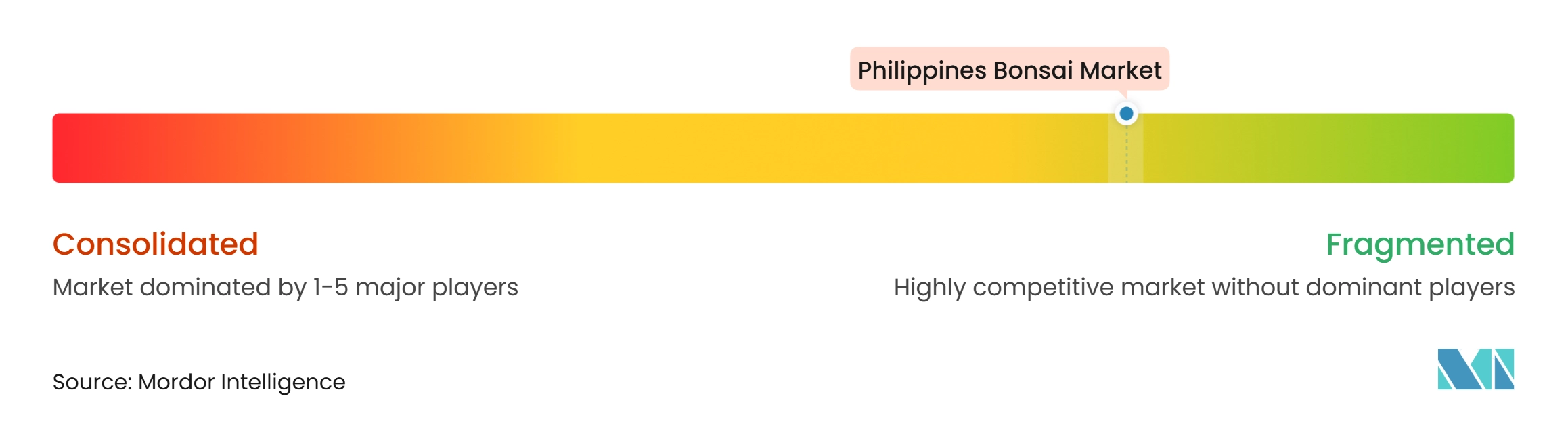
The Philippines bonsai market is fragmented, with Izumi Bonsai, PinasFlower.com, Bonsai Ichiba PH, Padongay Bonsai Nursery, and Shopleaf Plant Studio among the notable operators. The remaining market share is spread across informal growers, social-commerce sellers, specialty gardens, and general flower-delivery platforms. This structure limits the advantage of national scale and keeps opportunities open for focused operators. Species differentiation, community relationships, and reliable care education are important sources of competitive strength. Operators with a recognizable tropical species or an engaged livestream audience can reduce exposure to basic price competition. Destination specialists such as Izumi Bonsai focus on a premium showroom experience and imported Japanese and tropical trees. Digital-first retailers, including Florista.PH, BunchesBaskets.ph, and Flourish_ph use social discovery and nationwide courier delivery to reach buyers beyond physical retail areas.
Informal Facebook Live and TikTok sellers constitute a significant share of the online competition. Their low-overhead model can reduce entry-level prices, but these sellers often provide limited species documentation or after-sales guidance. This can lower price expectations for starter varieties and make it harder for specialist stores to justify their premium. Import compliance creates a clear distinction between informal sellers and operators that meet official requirements. The Bureau of Plant Industry requires import clearance, pest-risk procedures, and registration for commercial imports of planting material. Izumi Bonsai and Bonsai Ichiba PH can use their ability to manage compliant premium supply as part of a differentiated offer. The Philippines bonsai market, therefore, has room for retailers that combine verified sourcing with detailed care materials and reliable fulfillment.
The reviewed operators do not appear to have fully integrated authenticated provenance records, QR-based care instructions, livestream selling, and digital payment into a single bonsai platform. This leaves room for a technology-enabled service model built around confidence in a tree's origin, condition, and care requirements. The Philippines bonsai market could also support more commercial leasing programs and maintenance subscriptions. These services would give offices, hotels, and other buyers a way to maintain living displays without having to develop internal horticultural expertise. Province-level training services represent another area of opportunity, as care knowledge is less accessible outside major urban centers. The Department of Agriculture High Value Crops Development Program provides a framework for nursery inputs and grower support, helping ornamental producers access propagation materials and capacity-building programs. In February 2025, the program and DENSO Philippines Corporation signed a memorandum covering agricultural innovation, greenhouse management, crop care, and data-driven farming technology. The arrangement includes access to DENSO's showcase farm in Ibaan, Batangas, and may support relevant training and the transfer of crop-management technology. These initiatives can improve the capability base available to bonsai nurseries. The Philippines bonsai industry remains open to specialists that can convert these capabilities into dependable plant quality and recurring service revenue.
Philippines Bonsai Industry Leaders
-
Izumi Bonsai
-
PinasFlower (BIGFISH MANILA, INC.)
-
Bonsai Ichiba PH
-
Padongay Bonsai Nursery
-
Shopleaf Plant Studio
- *Disclaimer: Major Players sorted in no particular order
Philippines Bonsai Market Companies Covered in this Report
- Izumi Bonsai
- PinasFlower.com (BIGFISH MANILA, INC.)
- PhFlower.com
- RegaloManila.com
- GreenHeart
- Shopleaf Plant Studio
- Flowershop.ph
- BunchesBaskets.ph
- Flourish_ph
- Florista.PH
- Bonsai Ichiba PH
- Padongay Bonsai Nursery
- Bonsai AgriPreneur Garden
Recent Industry Developments in Philippines Bonsai Market
- September 2025: The Department of Agriculture organized the 2nd Annual Philippine Horticulture and Urban Agriculture Summit, Pagsibol 2025, highlighting horticulture and urban agriculture as potential pillars of the national agricultural strategy. The Bureau of Plant Industry also committed to scaling up ornamental plant production, strengthening the production base for ornamental plants in the Philippines.
- March 2025: DOST-PCAARRD collaborated with the Bureau of Plant Industry’s National Seed Industry Council Varietal Improvement Group to strengthen research and development for ornamental and medicinal plants. The initiative supported the registration of new Hibiscus and Hoya varieties and strengthened the domestic ornamental plant base, creating opportunities for further diversification of locally cultivated plant varieties.
- February 2025: The Department of Agriculture’s High Value Crops Development Program (HVCDP) partnered with DENSO Philippines Corporation through a Memorandum of Understanding to advance agricultural innovation, greenhouse management, crop care, and data-driven farming technologies. The partnership includes training, technology transfer, and access to DENSO’s showcase farm in Ibaan, Batangas, to support ornamental plant producers in adopting improved cultivation and crop-management practices.
Philippines Bonsai Market Report Scope
Our study defines the Vietnam bonsai market as the annual value of miniature, living woody plants intentionally trained to mimic mature trees, along with the pots, soils, and pruning inputs sold with them. Values represent consumer-level spending through specialty nurseries and general retail channels in Vietnam and are expressed in USD.
The Philippines Bonsai Market Report is Segmented by Species (Indoor Species, Outdoor Species, Needle Tree Species, and Deciduous Tree Species), by Distribution Channel (Online and Offline), and by Application (Residential, Commercial, and Others (Institutional Gifts and Art Fairs)). The Market Forecasts are Provided in Terms of Value (USD).
Segmentation Overview
| Indoor Species |
| Outdoor Species |
| Needle Tree Species |
| Deciduous Tree Species |
| Online |
| Offline |
| Residential |
| Commercial |
| Others (Institutional Gifts and Art Fairs) |
| By Species | Indoor Species |
| Outdoor Species | |
| Needle Tree Species | |
| Deciduous Tree Species | |
| By Distribution Channel | Online |
| Offline | |
| By Application | Residential |
| Commercial | |
| Others (Institutional Gifts and Art Fairs) |
Key Questions Answered in the Report
What is the market size of the Philippines bonsai market?
The Philippines bonsai market is forecast to grow from USD 7.52 million in 2026 to USD 11.31 million by 2031, at a CAGR of 8.5% from 2026 to 2031.
What is driving demand for bonsai in the Philippines?
Compact urban homes, social commerce, nationwide delivery, and commercial biophilic interiors are broadening demand beyond traditional collectors.
Which species is forecast to grow fastest in the Philippines bonsai market?
Indoor species is forecast to grow at a CAGR of 10.8% from 2026 to 2031, supported by demand for compact plant formats suitable for condominium living and other space-constrained settings.
Which distribution channel is growing fastest in the Philippines bonsai market?
Online channels are forecast to grow at a CAGR of 13.2% from 2026 to 2031, supported by social selling, digital payments, and expanding courier coverage.
What opportunities exist for commercial bonsai suppliers?
Commercial is forecast to grow at a CAGR of 10.1% from 2026 to 2031, creating opportunities for suppliers offering bonsai leasing, maintenance, replacement, and corporate gifting services.