
Pharmaceutical Label Verification Systems Market Size and Share
Market Overview
| Study Period | 2020 - 2031 |
|---|---|
| Market Size (2026) | USD 216.18 Million |
| Market Size (2031) | USD 319.34 Million |
| Growth Rate (2026 - 2031) | 8.12 % |
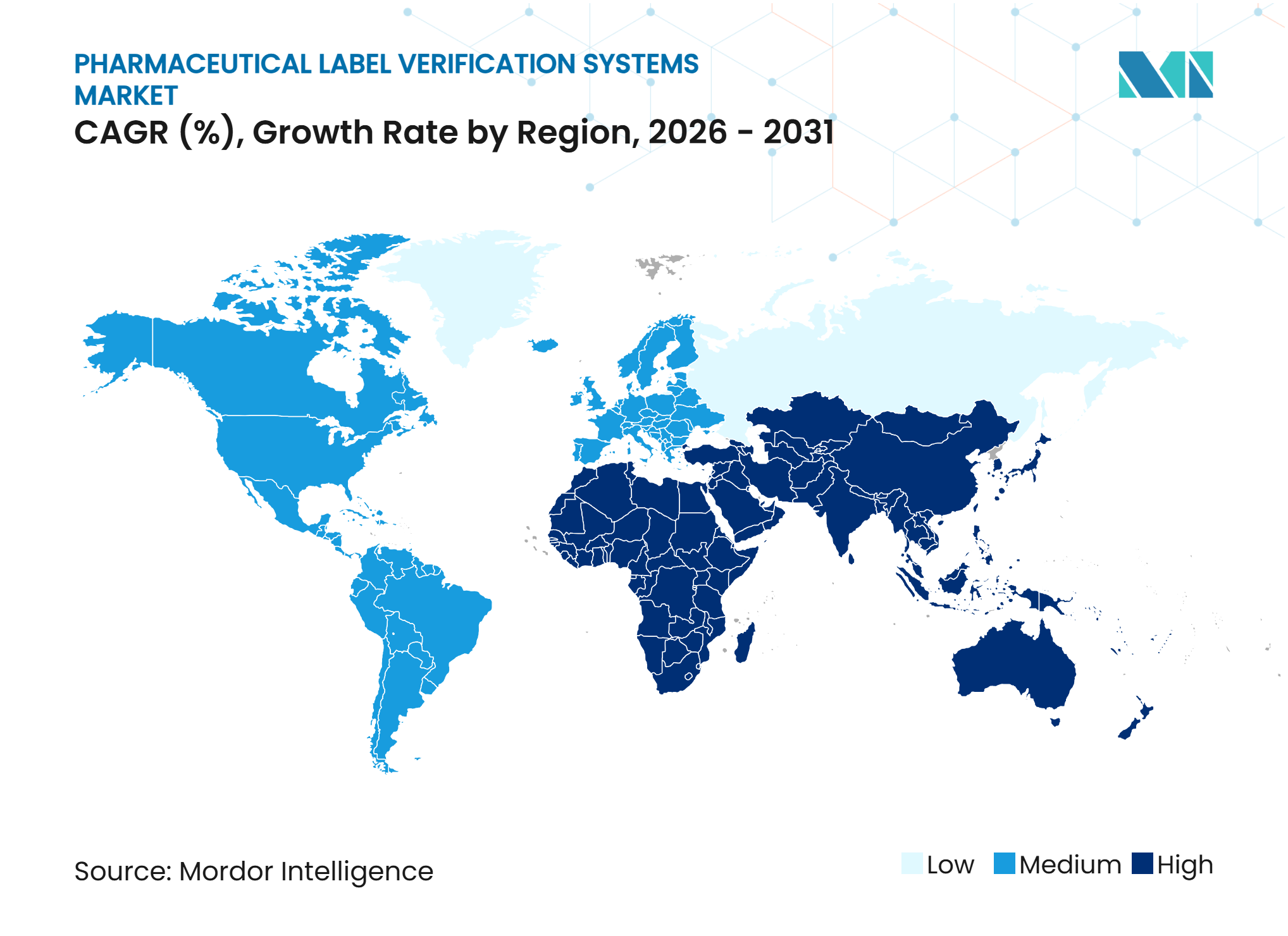
| Fastest Growing Market | Asia-Pacific |
| Largest Market | North America |
| Market Concentration | Medium |
Major Players *Disclaimer: Major Players sorted in no particular order Image © Mordor Intelligence. Reuse requires attribution under CC BY 4.0. | |
Pharmaceutical Label Verification Systems Market Analysis by Mordor Intelligence
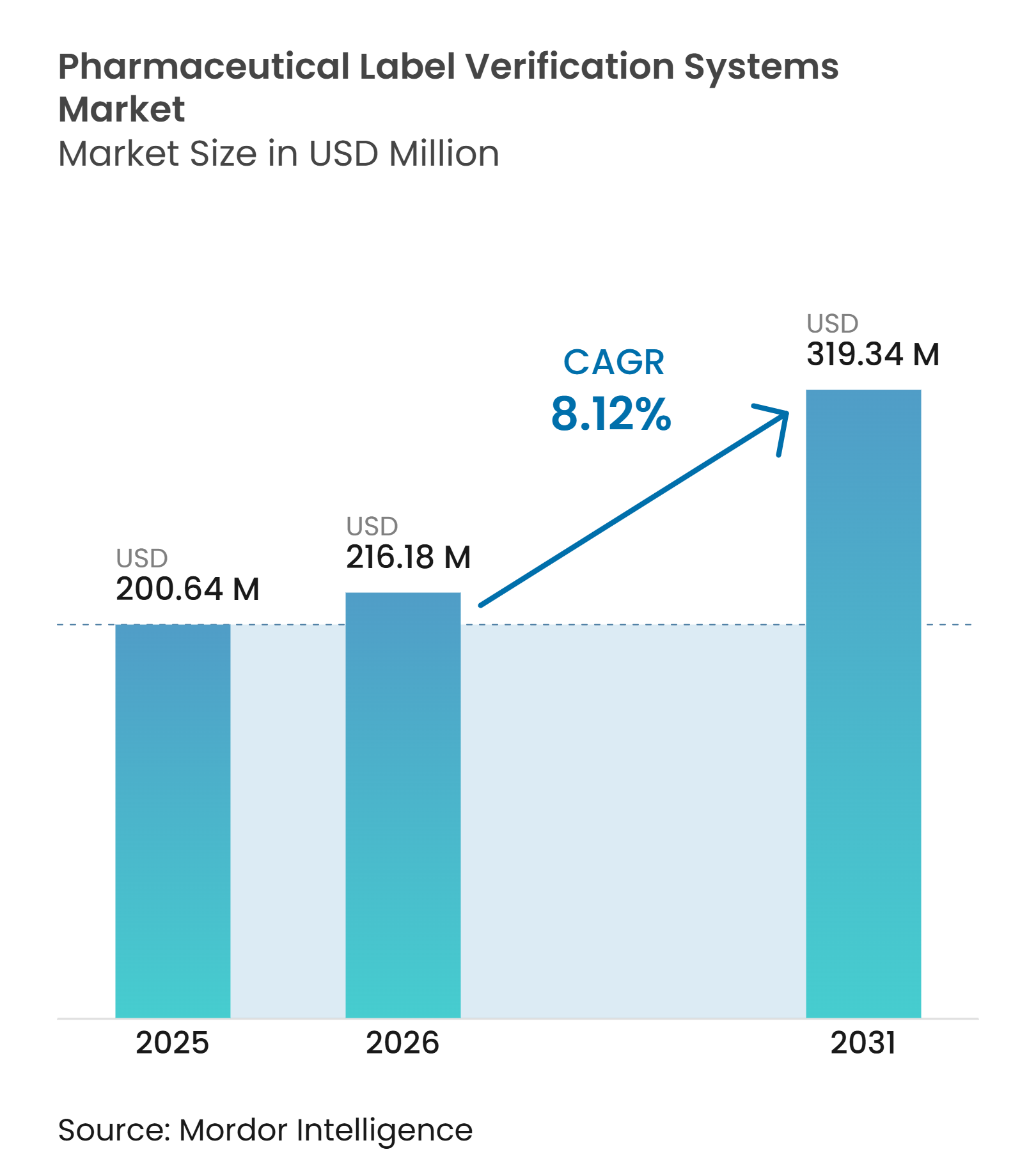
The pharmaceutical label verification systems market size was valued at USD 200.64 million in 2025 and estimated to grow from USD 216.18 million in 2026 to reach USD 319.34 million by 2031, at a CAGR of 8.12% during the forecast period (2026-2031). The pharmaceutical label verification systems market is supported by wider serialization requirements and the rising complexity of packaging for injectable medicines. Packaging lines need reliable checks for codes, printed information, label position, and tamper-evident features. These requirements make label verification a core compliance investment rather than a periodic inspection activity. Demand also reflects the need to reduce exposure to recalls and keep packaging lines operating efficiently. Suppliers are responding through integrated equipment, AI-enabled inspection, and systems designed for varied production formats.
Key Report Takeaways
- By technology, 2D/3D Machine Vision held 39.91% of the pharmaceutical label verification systems market share in 2025, while AI-Based Vision Inspection is projected to expand at a 9.32% CAGR through 2031.
- By verification function, Barcode and QR Code Verification held 28.81% of the pharmaceutical label verification systems market share in 2025, while Tamper-Evident and Component-Presence Verification are expected to expand at a 9.57% CAGR through 2031.
- By packaging format, Vials and Ampoules held 25.59% share in 2025, while Prefilled Syringes and Cartridges are projected to grow at a 9.39% CAGR through 2031.
- By end-user, Pharmaceutical Manufacturers accounted for 58.88% share in 2025, while Biopharmaceutical Manufacturers are projected to grow at a 9.46% CAGR through 2031.
- By deployment, Inline Systems held 64.43% share in 2025, while Printer-Integrated Systems are expected to advance at a 8.91% CAGR through 2031.
- By geography, North America held 32.21% share in 2025, while Asia-Pacific is projected to grow at a 9.43% CAGR through 2031.
Note: Market size and forecast figures in this report are generated using Mordor Intelligence’s proprietary estimation framework, updated with the latest available data and insights as of January 2026.
Market Trends and Insights
Drivers Impact Analysis of Pharmaceutical Label Verification Systems Market*
| Driver | (~) % Impact on CAGR Forecast | Geographic Relevance | Impact Timeline |
|---|---|---|---|
| Mandatory Serialization and Traceability | +2.5% | Global | Short term (≤ 2 years) |
| Automated Vision Inspection Adoption | +1.8% | Global | Medium term (2-4 years) |
| Biologics, Injectables, and Complex Packaging Growth | +1.4% | North America and Europe, growing in Asia-Pacific | Medium term (2-4 years) |
| Contract Manufacturing and High-Mix Production Expansion | +0.9% | Global, strongest in North America, Asia-Pacific, and Europe | Medium term (2-4 years) |
| MES, QMS, and Enterprise Traceability Integration | +0.7% | North America and Europe | Long term (≥ 4 years) |
| Digital Batch Release Using Machine-Readable Evidence | +0.4% | North America and Europe, with early gains in Asia-Pacific | Long term (≥ 4 years) |
| Source: Mordor Intelligence | |||
Mandatory Serialization and Traceability Mandates Drive Technology Investment
Serialization rules have moved from one-time deadlines to routine operating requirements for pharmaceutical packaging sites. The United States applied enhanced drug distribution security requirements to manufacturers from May 27, 2025, and to wholesale distributors from August 27, 2025. The requirements place greater emphasis on complete and accurate product-tracing information across the supply chain. A barcode error at a labeling station can therefore create an incorrect event record and require investigation before the product moves further. The pharmaceutical label verification systems market benefits from reliable code verification, which supports packaging operations before records enter trading-partner systems. This compliance role gives the pharmaceutical label verification systems market a stable base of demand across regulated packaging lines. ISO 16791:2026 sets out requirements for machine-readable coding of medicinal products from manufacturing through dispensing, providing procurement teams with a common technical reference.
Rising Adoption of Automated Vision Inspection Reshapes Quality Control
AI-enhanced vision inspection helps identify subtle defects that conventional rule-based systems may classify as uncertain. These defects can include artwork changes, label-position variation, and anomalies on reflective packaging materials. In regulated settings, AI supplements documented acceptance criteria and formal quality oversight. It does not replace the validation process or the review of inspection outcomes. Cognex reported that more than 100 customers used its OneVision beta platform to move from single-line projects to multi-site rollouts during 2025.[1] The company introduced the In-Sight 3900 in May 2026, stating that it can inspect up to 4× faster than the previous generation and supports resolutions up to 25 megapixels.
Growth of Biologics, Injectables, and Complex Packaging Expands Demand
Biologics and sterile injectable therapies require packaging formats that create more demanding inspection conditions. Vials, prefilled syringes, and cartridges can require checks across curved surfaces, reflective materials, and more than 1 side of a container. The Food and Drug Administration approved 23 novel drugs during the first half of 2026, adding to the near-term commercialization workload for manufacturers. WuXi Biologics reported that complex modalities represented more than half of its 1,064 integrated client projects as of June 30, 2026. Its portfolio included 78 Phase III projects and 28 commercial manufacturing projects, indicating sustained demand for equipment that manages different container presentations. The pharmaceutical label verification systems market benefits from these needs, as verification must cover product presentation, closure components, labels, and serialization information.
Expansion of Contract Manufacturing and High-Mix Production Intensifies Need
Contract manufacturing sites often package products for several sponsors on the same production infrastructure. Each sponsor can require separate serialization databases, approved artwork, and destination-specific requirements. This increases the operational consequences of a single verification failure. Printer-Integrated Systems are expected to grow at an 8.91% CAGR through 2031 because they verify label integrity as labels are printed and applied. Körber introduced the ALVA adaptive inspection machine in May 2026 for high-mix, low-volume pharmaceutical settings, including CDMOs and advanced therapy manufacturers. The system was designed for automated changeovers and scales from clinical development to commercial production.
Restraints Impact Analysis of Pharmaceutical Label Verification Systems Market*
| Restraint | (~) % Impact on CAGR Forecast | Geographic Relevance | Impact Timeline |
|---|---|---|---|
| High Validation and Integration Costs | -1.8% | Global | Short term (≤ 2 years) |
| Algorithm Configuration Across Variable Packaging Substrates | -1.2% | Global | Medium term (2-4 years) |
| Data Integrity and Cybersecurity Exposure | -0.9% | North America and Europe | Medium term (2-4 years) |
| Skilled-Service and Change-Control Bottlenecks | -0.7% | Global | Long term (≥ 4 years) |
| Source: Mordor Intelligence | |||
High Validation and Integration Costs Constrain Deployment Pace
A new system in a GxP production environment requires installation, operational, and performance qualification. This process can take 12-18 months while the existing equipment remains in operation. Integration with MES, QMS, and serialization platforms can add configuration work for each packaging line. Smaller manufacturers and CDMOs may lack dedicated validation teams and may need external specialist support. The Food and Drug Administration issued final guidance on computer software assurance in February 2026 that addressed questions about production and quality management software. The pharmaceutical label verification systems market still faces lengthy implementation cycles when systems must connect to multiple platforms across multiple regulatory territories.
Algorithm Configuration Across Variable Packaging Substrates Limits Scalability
Label material, adhesive, surface curvature, print method, and variable-data layouts each affect the image that a vision system must interpret. Artwork changes also require controlled updates to inspection recipes at affected packaging stations. Holograms, color-shifting inks, foil laminates, and embossed tamper-evident features can require specific lighting arrangements. These conditions increase equipment configuration work and may add capital cost at each installation. AI-based systems can learn substrate-specific visual patterns, but acceptance criteria in GMP environments remain less standardized than for rule-based systems. Manufacturers with limited internal technical resources often need service agreements that cover ongoing algorithm maintenance.
*Our forecasts treat driver/restraint impacts as directional, not additive. The impact forecasts reflect baseline growth, mix effects, and variable interactions.
Pharmaceutical Label Verification Systems Market Segment Analysis
By Technology:
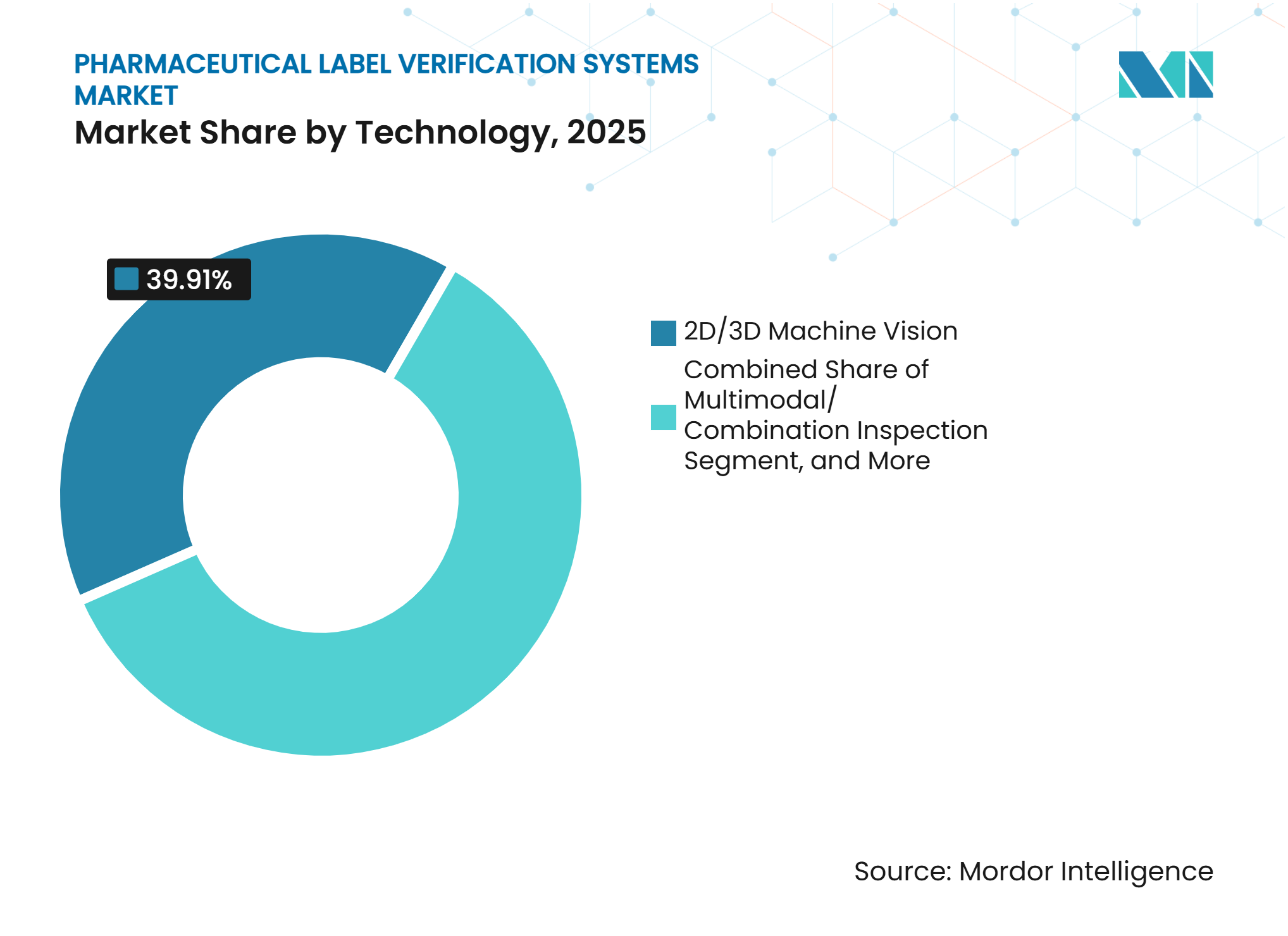
Machine Vision Holds the Largest Position, While AI-Based Inspection Leads Growth2D/3D Machine Vision held 39.91% of technology demand in 2025. Its position reflects established validation practices and compatibility with existing primary and secondary packaging lines. Pharmaceutical manufacturers use these systems to assess codes, label placement, print quality, and other visible packaging attributes. Long supplier qualification records also support continued use at established facilities. The technology serves a broad range of line formats and production speeds. Its installed base gives buyers a familiar starting point when they upgrade packaging equipment.
OCR/OCV Technology verifies human-readable variable information such as lot numbers, expiration dates, and country-specific labeling text. Barcode Verification Technology verifies unit-level serialization codes and supports the accuracy of records used in trading-partner networks. AI-Based Vision Inspection is projected to grow at a 9.32% CAGR through 2031, the highest rate among technology categories. Deep learning models can assess a variety of defects at commercial line speeds. Cognex uses a cloud-to-edge model that trains models in OneVision and deploys them on local equipment, including the In-Sight 3900 and In-Sight 6900.



By Verification Function:
Barcode Verification Leads, While Tamper Evidence Gains MomentumBarcode and QR Code Verification accounted for 28.81% of demand in 2025. It remains essential because serialization programs require packaging lines to capture and report unit-level code reads. Reliable code performance supports product tracing and helps prevent downstream data errors. OCR and OCV Verification cover human-readable details, including lot numbers, expiration dates, and regulatory text. These checks are important because errors in printed information can directly affect patient safety. Print Quality and Variable-Data Verification also address deterioration in print heads and irregular ink supply during production.
Tamper-Evident and Component-Presence Verification is expected to grow at a 9.57% CAGR through 2031. Injectable biologics can require simultaneous checks of closure integrity, label application, and serialization readability. Label Presence, Position, and Orientation Verification identifies missing, wrinkled, or misaligned labels resulting from application equipment issues. The broader verification scope requires more coordinated hardware and software than a basic code read. Antares Vision Group developed its BFC AI blister-filling vision system in collaboration with IMA Group to inspect tablet presence, color, shape, and headspace in blister packaging.[2] This approach extends inspection from label surfaces to the product presentation within primary packaging.
By Packaging Format:
Vials Led Current Demand, While Prefilled Syringes Increase Inspection NeedsVials and Ampoules held 25.59% of packaging-format demand in 2025. These formats remain widely used for injectable vaccines, antibiotics, and parenteral nutrition products. Established production processes support well-defined verification routines for these containers. Curved surfaces and reflective materials still require effective optics and container handling. Bottles support oral liquids and some parenteral preparations. Blister Packs require checks of cavity count, foil integrity, and variable-data printing for oral solid-dose medicines.
Prefilled Syringes and Cartridges are projected to expand at a 9.39% CAGR through 2031. Their growth is linked to GLP-1 therapies, monoclonal antibodies, and self-administered biologics in ready-to-use presentations. These formats need checks for label quality, plunger position, needle-shield integrity, and container geometry. Cartons, Pouches and Sachets, and Other Packaging Formats serve secondary and tertiary packaging needs, where label presence and barcode readability are primary checks. Antares Vision Group developed the ETFS-300 Automatic Labeling System for syringe labeling, print inspection, label application, and plunger-rod insertion verification.
By End-User:
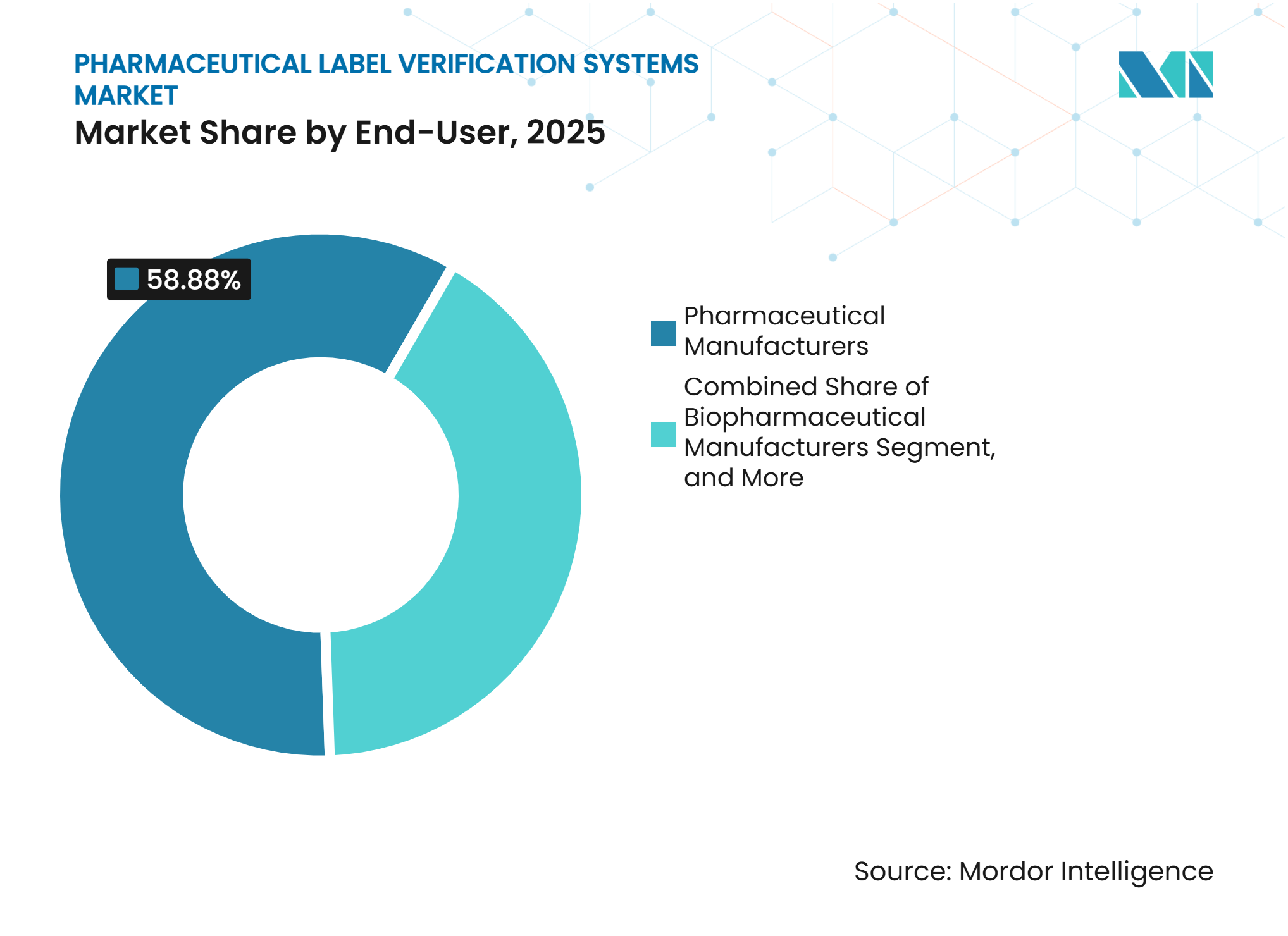
Pharmaceutical Manufacturers Remain the Core Buyers, While Biopharma Expands FasterPharmaceutical Manufacturers accounted for 58.88% of end-user demand in 2025. Their demand reflects the large installed base of commercial packaging operations subject to serialization and labeling controls. Enforcement has shifted attention from implementation deadlines to the consistency of routine operating records. Manufacturers require systems that work across primary and secondary packaging steps. Their facilities often need upgrades that integrate with existing control and quality systems. This installed base keeps conventional pharmaceutical manufacturers at the center of equipment demand.
Biopharmaceutical Manufacturers are projected to grow at a 9.46% CAGR through 2031. Sterile injectable biologics, cell therapies, and gene therapies require verification that reflects their complex physical presentation. CMOs and CPOs also manage multiple sponsor products, serialization databases, changeovers, and regulatory territories on shared equipment. These conditions support interest in software-defined systems capable of handling changing formats. WuXi Biologics reported 1,064 integrated client projects as of June 30, 2026, including 78 Phase III projects and 28 commercial manufacturing projects. Hospital pharmacies and clinical trial packaging organizations remain smaller end-user groups, but label accuracy is important for trial integrity and safe use.

By Deployment:
Inline Systems Set the Standard, While Printer-Integrated Systems ExpandInline Systems held 64.43% of deployment demand in 2025. They support continuous inspection during packaging without interrupting line flow. These systems can verify serialization codes, label presence, and print quality at production speed. Their role is well established in packaging operations that require checks on every unit. Offline or Standalone Systems complement inline equipment by performing batch sampling, reinspection, and quality release activities. Their use is more common at smaller-scale sites and in clinical packaging environments.
Printer-Integrated Systems are expected to grow at an 8.91% CAGR through 2031. These systems verify the label as it is printed and applied, rather than after packaging materials have moved downstream. This arrangement reduces the risk of consuming materials before a printing defect is identified. Syntegon states that its KIV systems can mark and verify individual codes on up to 36,000 vials and infusion bottles per hour. Domino Printing Sciences launched the Ux360i UV laser coder in May 2026 with integrated R-Series vision inspection. The equipment supports combined printing and verification for pharmaceutical serialization lines.
Geography Analysis
North America held 32.21% of regional demand in 2025. The United States drives regional demand through its large pharmaceutical production base and enhanced drug distribution security requirements. Manufacturers need accurate package-level records as products move through the supply chain. This increases attention to barcode quality and traceability data at the packaging line. The Food and Drug Administration issued computer software assurance guidance in February 2026. The guidance is shaping how manufacturers assess AI-enabled systems used for production and quality activities.
Europe is the second-largest regional block in the pharmaceutical label verification systems market. The European Union Falsified Medicines Directive framework supports sustained demand for verification across Germany, the United Kingdom, France, Italy, and Spain.[3] Manufacturers serving these markets need systems that can generate accurate records for national verification systems. The region also places importance on packaging controls that support anti-counterfeiting goals. Italy is expected to reach full point-of-dispense verification compliance by February 2027. This schedule creates a near-term requirement for equipment and system readiness among manufacturers supplying the country.
Asia-Pacific is projected to grow at a 9.43% CAGR through 2031. China, India, Japan, South Korea, and Indonesia provide distinct compliance-related demand across the region. China requires medical and pharmaceutical institutions to collect and upload drug traceability codes from January 1, 2026. The requirement links traceability information to medical insurance reimbursement settlement. India expanded Schedule H2 barcoding requirements across vaccines, antimicrobials, narcotic drugs, and anticancer drugs, with implementation dates in July 2027 and July 2028. The pharmaceutical label verification systems market therefore has a visible supplier opportunity as Indian sites prepare new QR-code-bearing packaging outputs.
Competitive Landscape
Market Concentration
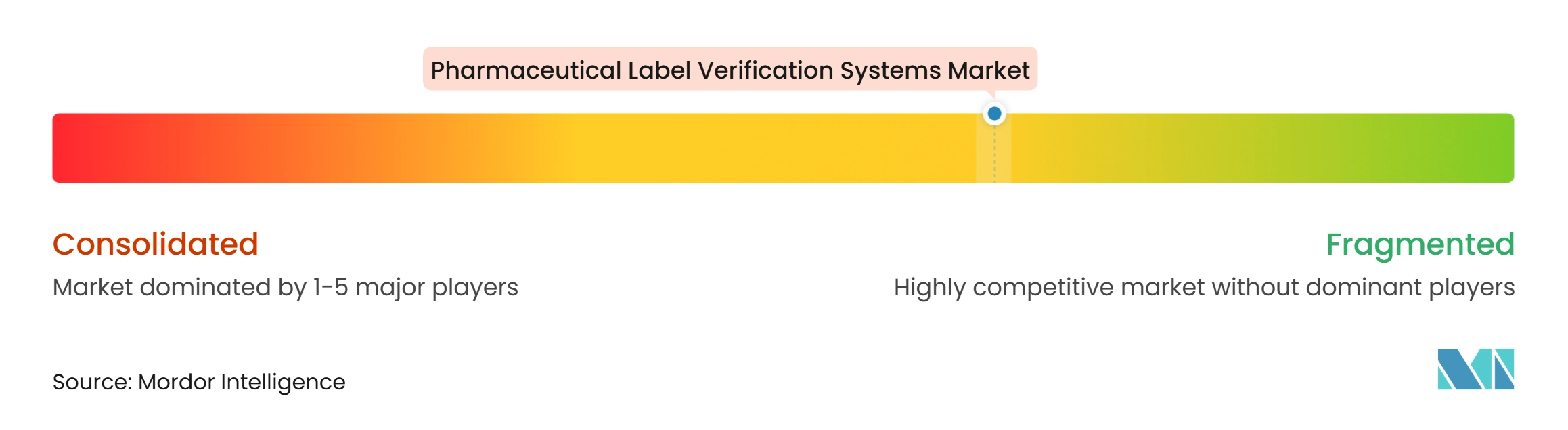
The pharmaceutical label verification systems market is moderately fragmented. Dedicated pharmaceutical inspection specialists compete with broader industrial vision suppliers and print-and-verify companies. Antares Vision Group, OPTEL GROUP, SEA Vision S.r.l., ACG Inspection, and Jekson Vision have pharmaceutical-specific algorithms and validated system templates. Their lifecycle service capabilities can reduce the qualification burden for pharmaceutical manufacturers. Cognex Corporation and Keyence Corporation compete through global service networks, AI hardware performance, and cross-industry data resources. Domino Printing Sciences, Videojet Technologies, Markem-Imaje, and Zebra Technologies Corporation focus on printer-integrated applications. This supplier mix keeps the pharmaceutical label verification systems market open to both specialized and broad-based competitors.
Crane NXT completed its acquisition of Antares Vision S.p.A. on April 1, 2026. The transaction integrated Antares Vision into Crane NXT’s Detection and Traceability Technologies segment.[4] It also provided access to life sciences and food and beverage inspection markets with an addressable value of USD 3 billion. Antares Vision’s specialist portfolio now operates within a larger detection and traceability business. Cognex launched the In-Sight 3900 in May 2026 and the In-Sight 6900 Vision Controller in April 2026. These launches show continued vendor investment in embedded AI hardware and centralized model development.
Körber introduced the ALVA adaptive inspection machine in May 2026 for high-mix, low-volume pharmaceutical operations. The system supports syringes, vials, and cartridges, with automated changeovers that address CDMO and clinical manufacturing needs. Domino Printing Sciences introduced its Ux360i UV laser coder in May 2026 for high-speed 2D code production with integrated vision inspection. ISO 16791:2026 gives buyers a common standard for machine-readable medicinal-product coding across the supply chain. Suppliers with validated solutions and global support can use this alignment in customer procurement processes. The pharmaceutical label verification systems industry also includes potential opportunities in artwork change-control support, cold-chain traceability checks, and software platforms that reduce upfront deployment costs. These conditions support product and service competition across the pharmaceutical label verification systems market.
Pharmaceutical Label Verification Systems Industry Leaders
-
Antares Vision Group
-
Cognex Corporation
-
Keyence Corporation
-
SICK AG
-
OMRON Corporation
- *Disclaimer: Major Players sorted in no particular order
Pharmaceutical Label Verification Systems Market Companies Covered in this Report
- Antares Vision Group
- Cognex Corporation
- Keyence Corporation
- OMRON Corporation
- SICK AG
- Mettler-Toledo International Inc.
- Datalogic S.p.A.
- WIPOTEC-OCS GmbH
- Systech International
- SEA Vision S.r.l.
- Syntegon Technology GmbH
- Körber AG
- Domino Printing Sciences plc
- Videojet Technologies Inc.
- Markem-Imaje SAS
- Zebra Technologies Corporation
- ACG Inspection
- Jekson Vision
Recent Industry Developments in Pharmaceutical Label Verification Systems Market
- May 2026: Cognex Corporation launched the In-Sight 3900 Vision System on May 5, 2026. The embedded AI vision platform is powered by Qualcomm Dragonwing technology and delivers inspections up to 4× faster than the prior generation at up to 25-megapixel resolution without an external PC. It supports cloud-to-edge AI inspection management through OneVision across multiple production sites and formats.
- May 2026: Domino Printing Sciences launched the Ux360i UV laser coder at interpack 2026 on May 7, 2026. The system delivers GS1-compliant 2D codes up to 80% faster than the prior-generation UV solution on sensitive and recyclable materials. It includes integrated R-Series vision inspection, EU GMP Annex 11 and FDA 21 CFR Part 11 compliance support, and ERP and MES integration.
- May 2026: Mettler-Toledo Product Inspection presented the V32 CV/OCR label verification vision system and ProdX data management software at interpack 2026 and INTERPHEX 2026. The solutions provide remote inspection-data monitoring and regulatory documentation. They combine precision weighing and vision inspection to help pharmaceutical manufacturers reduce labeling-related recalls and support GMP data integrity requirements.
- April 2026: Crane NXT completed the acquisition of Antares Vision S.p.A. on April 1, 2026. The company delisted Antares Vision from Euronext Milan and integrated it into the Detection and Traceability Technologies segment. Antares Vision’s results have been consolidated into Crane NXT’s financial statements from Q1 2026.
Global Pharmaceutical Label Verification Systems Market Report Scope
The pharmaceutical label verification systems market comprises solutions that inspect and validate pharmaceutical product labels to ensure accuracy, readability, regulatory compliance, and proper placement. These systems use technologies such as barcode verification, optical character recognition (OCR), vision inspection, and serialization to identify labeling errors, prevent product recalls, and support patient safety.
The Pharmaceutical Label Verification Systems Market Report is Segmented by Technology (2D and 3D Machine Vision, OCR and OCV Technology, Barcode Verification Technology, AI-Based Vision Inspection, and Multimodal and Combination Inspection), Verification Function (Barcode and QR Code Verification, OCR and OCV Verification, Label Presence, Position, and Orientation Verification, Print Quality and Variable-Data Verification, and Tamper-Evident and Component-Presence Verification), Packaging Format (Vials and Ampoules, Bottles, Blister Packs, Prefilled Syringes and Cartridges, Cartons, Pouches and Sachets, and Other Packaging Formats), End-User (Pharmaceutical Manufacturers, Contract Manufacturing and Packaging Organizations (CMOs and CPOs), Biopharmaceutical Manufacturers, and Other End-Users), Deployment (Inline Systems, Offline and Standalone Systems, and Printer-Integrated Systems), and Geography (North America, South America, Europe, Asia-Pacific, Middle East, and Africa). The Market Forecasts are Provided in Terms of Value (USD).
Segmentation Overview
| 2D/3D Machine Vision |
| OCR/OCV Technology |
| Barcode Verification Technology |
| AI-Based Vision Inspection |
| Multimodal/Combination Inspection |
| Barcode and QR Code Verification |
| OCR and OCV Verification |
| Label Presence, Position, and Orientation Verification |
| Print Quality and Variable-Data Verification |
| Tamper-Evident and Component-Presence Verification |
| Vials and Ampoules |
| Bottles |
| Blister Packs |
| Prefilled Syringes and Cartridges |
| Cartons |
| Pouches / Sachets |
| Other Packaging Formats |
| Pharmaceutical Manufacturers |
| Contract Manufacturing and Packaging Organizations (CMOs/CPOs) |
| Biopharmaceutical Manufacturers |
| Other End-Users |
| Inline Systems |
| Offline / Standalone Systems |
| Printer-Integrated Systems |
| North America | United States |
| Canada | |
| Mexico | |
| South America | Brazil |
| Argentina | |
| Chile | |
| Rest of South America | |
| Europe | Germany |
| United Kingdom | |
| France | |
| Italy | |
| Spain | |
| Rest of Europe | |
| Asia-Pacific | China |
| Japan | |
| India | |
| South Korea | |
| Australia | |
| Rest of Asia-Pacific | |
| Middle East | United Arab Emirates |
| Saudi Arabia | |
| Turkey | |
| Rest of Middle East | |
| Africa | South Africa |
| Egypt | |
| Nigeria | |
| Rest of Africa |
| By Technology | 2D/3D Machine Vision | |
| OCR/OCV Technology | ||
| Barcode Verification Technology | ||
| AI-Based Vision Inspection | ||
| Multimodal/Combination Inspection | ||
| By Verification Function | Barcode and QR Code Verification | |
| OCR and OCV Verification | ||
| Label Presence, Position, and Orientation Verification | ||
| Print Quality and Variable-Data Verification | ||
| Tamper-Evident and Component-Presence Verification | ||
| By Packaging Format | Vials and Ampoules | |
| Bottles | ||
| Blister Packs | ||
| Prefilled Syringes and Cartridges | ||
| Cartons | ||
| Pouches / Sachets | ||
| Other Packaging Formats | ||
| By End-User | Pharmaceutical Manufacturers | |
| Contract Manufacturing and Packaging Organizations (CMOs/CPOs) | ||
| Biopharmaceutical Manufacturers | ||
| Other End-Users | ||
| By Deployment | Inline Systems | |
| Offline / Standalone Systems | ||
| Printer-Integrated Systems | ||
| By Geography | North America | United States |
| Canada | ||
| Mexico | ||
| South America | Brazil | |
| Argentina | ||
| Chile | ||
| Rest of South America | ||
| Europe | Germany | |
| United Kingdom | ||
| France | ||
| Italy | ||
| Spain | ||
| Rest of Europe | ||
| Asia-Pacific | China | |
| Japan | ||
| India | ||
| South Korea | ||
| Australia | ||
| Rest of Asia-Pacific | ||
| Middle East | United Arab Emirates | |
| Saudi Arabia | ||
| Turkey | ||
| Rest of Middle East | ||
| Africa | South Africa | |
| Egypt | ||
| Nigeria | ||
| Rest of Africa | ||
Key Questions Answered in the Report
What is the size of the pharmaceutical label verification systems market?
The 2026 value is USD 216.18 million and is projected to reach USD 319.34 million by 2031, at a 8.12% CAGR.
What is driving demand for pharmaceutical label verification systems?
Serialization requirements, AI-enabled inspection, complex injectable packaging, and high-mix contract manufacturing are supporting demand.
Which technology holds the largest share in pharmaceutical label verification systems?
2D/3D Machine Vision held 39.91% share in 2025, supported by established validation practices and packaging-line compatibility.
Which packaging format is growing fastest?
Prefilled Syringes and Cartridges are projected to grow at a 9.39% CAGR through 2031, supported by self-administered biologics and ready-to-use therapies.
Which region is expected to grow fastest?
Asia-Pacific is projected to grow at a 9.43% CAGR through 2031, supported by traceability requirements in China, India, Japan, South Korea, and Indonesia.
Why are printer-integrated verification systems gaining adoption?
Printer-Integrated Systems are projected to grow at an 8.91% CAGR because they verify label quality at the point of print and application.