
PFAS Adsorbent Regeneration Chemicals Market Size and Share
Market Overview
| Study Period | 2021 - 2031 |
|---|---|
| Market Size (2026) | USD 188.71 Million |
| Market Size (2031) | USD 266.29 Million |
| Growth Rate (2026 - 2031) | 7.13 % |
| Fastest Growing Market | Asia-Pacific |
| Largest Market | Asia-Pacific |
| Market Concentration | Medium |
Major Players *Disclaimer: Major Players sorted in no particular order Image © Mordor Intelligence. Reuse requires attribution under CC BY 4.0. | |
PFAS Adsorbent Regeneration Chemicals Market Analysis by Mordor Intelligence
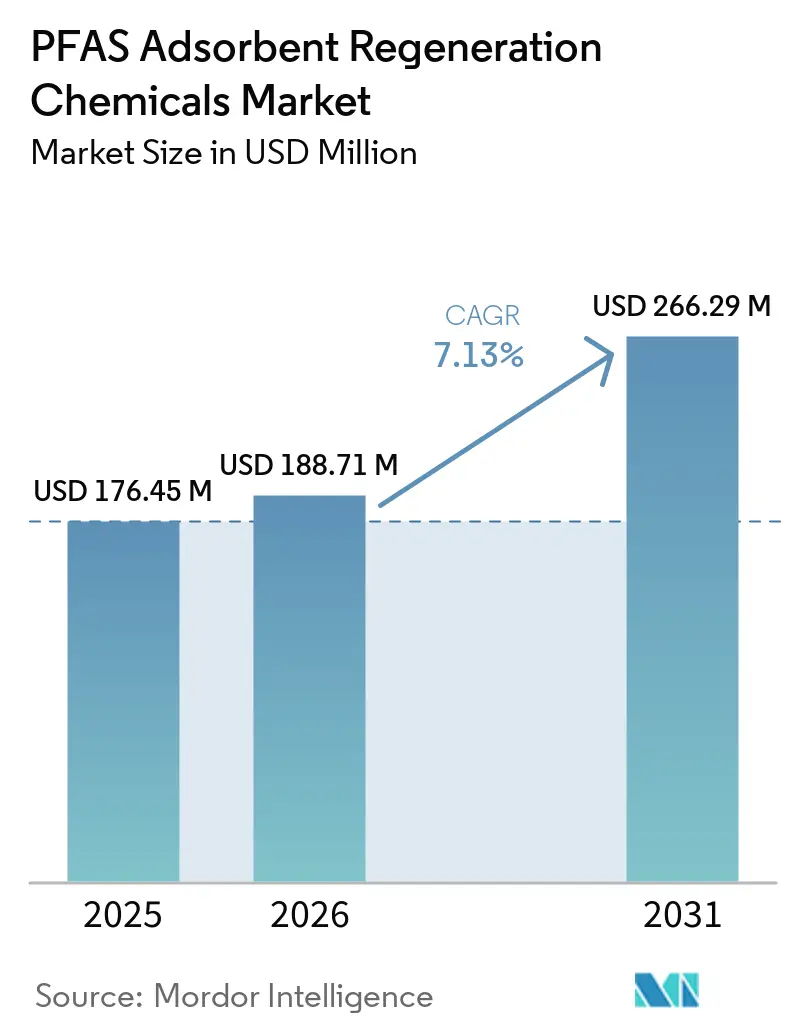
The PFAS Adsorbent Regeneration Chemicals Market was valued at USD 176.45 million in 2025 and is estimated to grow from USD 188.71 million in 2026 to reach USD 266.29 million by 2031, at a CAGR of 7.13% during the forecast period (2026–2031). The per- and polyfluoroalkyl substances (PFAS) adsorbent regeneration chemicals market is being shaped by enforceable drinking water rules, disposal constraints, and the need to reuse treatment media. The United States Environmental Protection Agency finalized national drinking water standards in 2024, with systems required to complete initial monitoring by 2027 and implement solutions by 2029 under the rule then in effect. Japan is applying mandatory perfluorooctane sulfonic acid (PFOS) and perfluorooctanoic acid (PFOA) water-quality standards from April 2026, which moves treatment requirements from voluntary targets to operating obligations. The PFAS adsorbent regeneration chemicals market benefits when utilities choose regeneration over replacing spent media, because this approach can reduce waste volumes and recurring disposal costs. Semiconductor facilities create a separate source of demand because their wastewater can contain complex mixtures of short-chain compounds that need specialized capture and regeneration approaches.
Key Report Takeaways
- By chemical type, sodium hydroxide held 41.86% of the PFAS adsorbent regeneration chemicals market share in 2025, while proprietary chemical blends are projected to grow at an 8.57% CAGR through 2031.
- By adsorbent type, granular activated carbon accounted for 46.74% of the PFAS adsorbent regeneration chemicals market share in 2025, while ion exchange resins are forecast to expand at a 7.79% CAGR through 2031.
- By end-use industry, municipal water treatment retained 47.28% of the PFAS adsorbent regeneration chemicals market share in 2025, while semiconductor manufacturing is forecast to advance at an 8.97% CAGR through 2031.
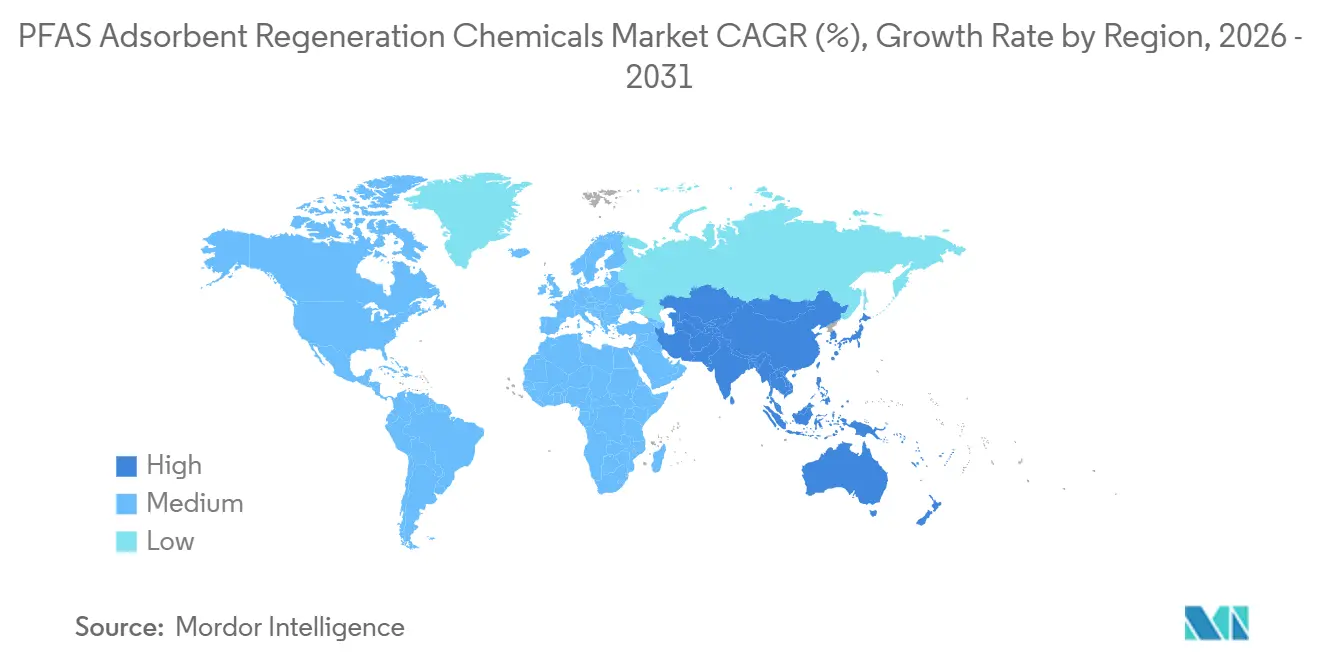
- By geography, Asia-Pacific held 39.91% of the PFAS adsorbent regeneration chemicals market share in 2025 and is expected to advance at an 8.53% CAGR through 2031.
Note: Market size and forecast figures in this report are generated using Mordor Intelligence’s proprietary estimation framework, updated with the latest available data and insights as of January 2026.
Market Trends and Insights
Drivers Impact Analysis of PFAS Adsorbent Regeneration Chemicals Market*
| Driver | (~) % Impact on CAGR Forecast | Geographic Relevance | Impact Timeline |
|---|---|---|---|
| Regulatory-Driven Adoption of Capture-and-Destroy Treatment | +2.3% | Global, concentrated in North America and EU | Short term (≤ 2 years) |
| Rising Demand for Short-Chain PFAS Treatment | +1.2% | Global; APAC core, spill-over to North America | Medium term (2-4 years) |
| Expansion of Centralized Regeneration Services | +1.1% | North America and Europe | Medium term (2-4 years) |
| Increasing Cost of Spent Adsorbent Disposal | +0.8% | North America, Europe, Australia | Short term (≤ 2 years) |
| Regenerant Recycling and Closed-Loop Solvent Recovery | +0.6% | North America and EU | Medium term (2-4 years) |
| Modular Regeneration Systems for Distributed Treatment Sites | +0.5% | Global, with early gains in North America | Medium term (2-4 years) |
| Source: Mordor Intelligence | |||
Regulatory-Driven Adoption of Capture-and-Destroy Treatment
The United States Environmental Protection Agency finalized the National Primary Drinking Water Regulation in April 2024 and set maximum contaminant levels of 4 parts per trillion for perfluorooctanoic acid and perfluorooctane sulfonic acid[1]. The rule also set limits of 10 parts per trillion for perfluorohexane sulfonic acid, perfluorononanoic acid, and hexafluoropropylene oxide dimer acid, commonly called GenX chemicals. These obligations have encouraged utilities to assess regeneration and destruction pathways rather than treat spent granular activated carbon as a disposal-only material. This supports the PFAS adsorbent regeneration chemicals market by tying chemical use to documented treatment and waste-management requirements. Japan’s mandatory standards for PFOS and PFOA at 50 nanograms per liter became effective in April 2026 and require water suppliers to test, inspect, and disclose results. European planning is also affected by the proposed universal restriction under the Registration, Evaluation, Authorisation and Restriction of Chemicals framework, whose scientific evaluation is expected to conclude by the end of 2026.
Rising Demand for Short-Chain PFAS Treatment
Standard granular activated carbon filtration relies heavily on hydrophobic interactions, which are less effective for perfluoroalkyl acids with chain lengths below 6 carbons. Ion exchange resins add electrostatic interactions to hydrophobic binding and can therefore improve the removal of both long-chain and short-chain compounds. The resulting regeneration process often uses methanol-brine or ethanol-brine mixtures, which creates demand for tailored chemical inputs and handling of the concentrated stream. Research published in 2025 found that more than 90% of methanol in regenerant solutions could be recovered by rotary evaporation within 4 hours at 50 °C, without detectable PFAS carryover into the recovered solvent. The PFAS adsorbent regeneration chemicals market gains from this transition because resin applications require material-specific regeneration protocols rather than a standard caustic cycle.
Expansion of Centralized Regeneration Services
Centralized regeneration moves chemical use from many small and irregular treatment sites into larger facilities with planned processing cycles. Onterris stated that its central Regen-as-a-Service model reduced lifecycle treatment costs for a 5 million-gallon-per-day system to USD 8.8 million, compared with USD 14.6 million for single-use ion exchange media. The company also reported that its model reduced waste volume relative to conventional disposal, which supports the operational case for regenerated media. In September 2025, Kurita America and Cyclopure announced plans for a Michigan facility that combines DEXSORB beta-cyclodextrin adsorbent with Kurita’s system engineering. In April 2026, Kurita Water Industries invested in Cyclopure and secured exclusive U.S. industrial and certain municipal rights for DEXSORB. The PFAS adsorbent regeneration chemicals market can gain more predictable procurement volumes through these hubs, although large operators may also increase their bargaining power over commodity chemical suppliers.
Increasing Cost of Spent Adsorbent Disposal
Rising disposal costs make regeneration more attractive even where compliance rules do not require a particular treatment process. The Environmental Research and Education Foundation reported that United States municipal solid-waste landfill tipping fees increased by 10% in 2024 across its surveyed facilities. Spent media containing PFAS may require specialized handling, and this adds cost and uncertainty for utilities that use a single-use approach. The United States Environmental Protection Agency stated in its 2026 interim guidance that new research indicated landfilling could lead to greater PFAS releases than earlier assessments suggested. This guidance has strengthened the case for processing spent adsorbents through controlled regeneration and destruction systems. The combination of higher disposal exposure, landfill acceptance risk, and the need for documented waste management consequently supports the PFAS adsorbent regeneration chemicals market.
Restraints Impact Analysis of PFAS Adsorbent Regeneration Chemicals Market*
| Restraint | (~) % Impact on CAGR Forecast | Geographic Relevance | Impact Timeline |
|---|---|---|---|
| Hazardous Handling Requirements for PFAS-Loaded Regenerants | -1.1% | Global | Short term (≤ 2 years) |
| Limited Availability of Specialized Reactivation Capacity | -0.8% | APAC, South America, MEA | Medium term (2-4 years) |
| Uncertainty Regarding PFAS Destruction Byproducts | -0.7% | Global | Medium term (2-4 years) |
| High Chemical Recovery and Wastewater Treatment Requirements | -0.5% | Global | Medium term (2-4 years) |
| Source: Mordor Intelligence | |||
Hazardous Handling Requirements for PFAS-Loaded Regenerants
Spent regenerants are concentrated PFAS-bearing liquids produced during solvent-based ion exchange regeneration or alkaline granular activated carbon desorption. Their management requires traceable handling and transfer to facilities permitted to process the waste, which increases the operating burden on treatment providers. Solvent-based waste streams also require appropriate storage and safety controls, raising the capital requirement for on-site regeneration systems. Small and medium utilities may lack staff with hazardous waste expertise or the processing volumes needed to support dedicated handling equipment. These limitations can keep distributed sites reliant on single-use media even when regeneration has lower lifecycle costs. The PFAS adsorbent regeneration chemicals market, therefore, remains more accessible to large operators that can use centralized infrastructure and documented waste logistics.
Uncertainty Regarding PFAS Destruction Byproducts
Thermal treatment of PFAS-containing media remains subject to questions about products of incomplete combustion when operating conditions are not sufficient for destruction. The United States Environmental Protection Agency stated in its April 2026 guidance that uncertainties remained regarding thermal treatment effectiveness and environmental releases under suboptimal conditions. A 2026 study identified challenges in achieving fluorine mass-balance closure during incineration of PFAS-laden solids and noted that current methods may not fully detect polar intermediate compounds. These questions can delay multi-year procurement decisions for thermal reactivation contracts. The PFAS adsorbent regeneration chemicals market still faces the need for consistent testing methods, demonstrated operating conditions, and clear emissions documentation.
*Our forecasts treat driver/restraint impacts as directional, not additive. The impact forecasts reflect baseline growth, mix effects, and variable interactions.
PFAS Adsorbent Regeneration Chemicals Market Segment Analysis
By Chemical Type:
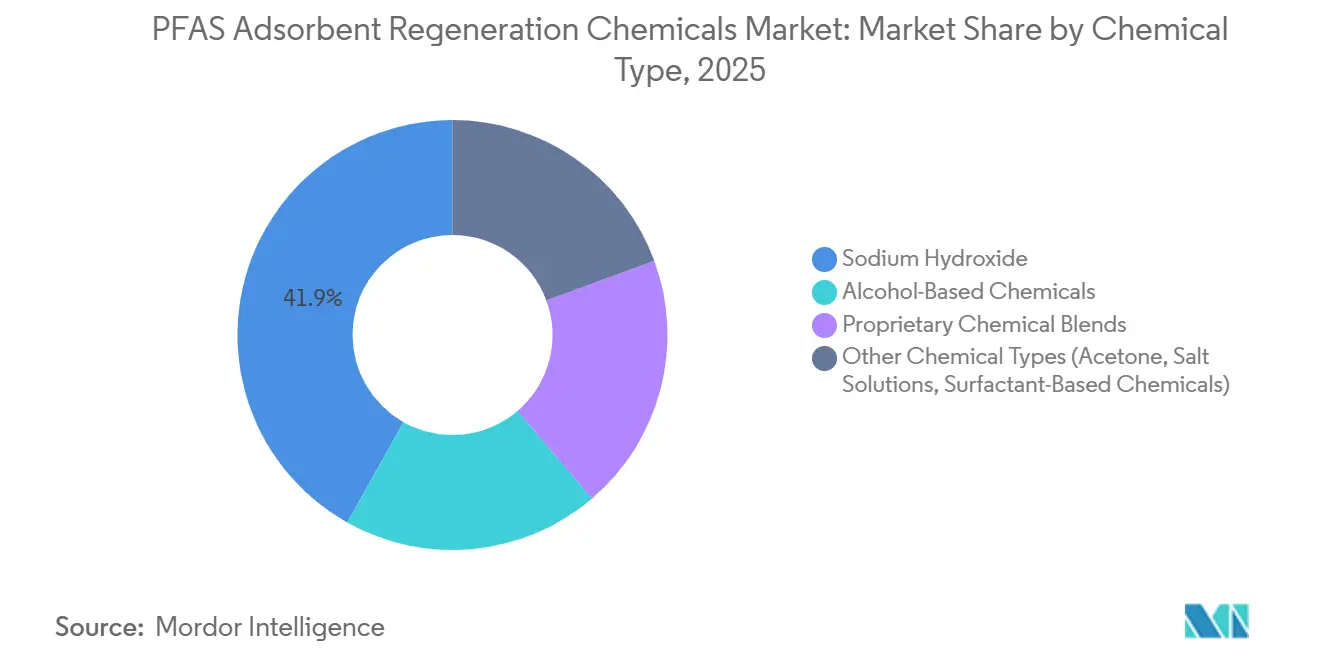
Sodium Hydroxide Leads Revenue While Proprietary Chemical Blends AccelerateSodium hydroxide held 41.86% of the market revenue in 2025. It is used in high-pH granular activated carbon reactivation protocols and during cleaning cycles for ion exchange resins. Alkaline conditions can weaken PFAS binding on charged adsorbent surfaces and support desorption. Alcohol-based chemicals, mainly methanol and ethanol, are used in solvent-based ion exchange regeneration. Their use is tied to installed resin capacity and the need to recover or manage the solvent after treatment.
Proprietary chemical blends are forecast to grow at an 8.57% CAGR through 2031. Their adoption is linked to newer PFAS-selective materials, including cyclodextrin polymers, fluoropolymer sorbents, and molecularly imprinted materials. These materials need regeneration protocols designed for their specific adsorption behavior. A 2024 Nature Communications study found that a fluoropolymer sorbent retained more than 90% PFAS sorption efficiency after 5 regeneration cycles when the appropriate desorption chemistry was used. The PFAS adsorbent regeneration chemicals market is likely to use more engineered blends as these materials progress from pilot projects to full-scale systems.

By Adsorbent Type:
Granular Activated Carbon Commands Scale, Ion Exchange Resins Gain MomentumGranular activated carbon held 46.74% of the market revenue in 2025. Its installed base in municipal treatment supports repeat demand for reactivation chemicals, rinsing agents, and related services within the PFAS adsorbent regeneration chemicals market. Powdered activated carbon remains useful for polishing applications and industrial streams that do not suit granular activated carbon columns. Modified clays, bio-based materials, and hybrid composites remain smaller options for applications that require specialized selectivity or disposal characteristics.
Ion exchange resins are projected to advance at a 7.79% CAGR through 2031. They deliver stronger short-chain PFAS removal because electrostatic interactions supplement hydrophobic adsorption. The PFAS adsorbent regeneration chemicals market size for resin-based treatment is supported using alcohol-brine regeneration systems and recovery steps. A 2025 study from Wageningen University & Research reported electroregeneration results that concentrated short-chain PFAS, including GenX, by a factor of 130 in laboratory-scale testing. This pathway remained pre-commercial, but it could reduce chemical use per cycle if it is deployed at full scale.
By End-Use Industry:
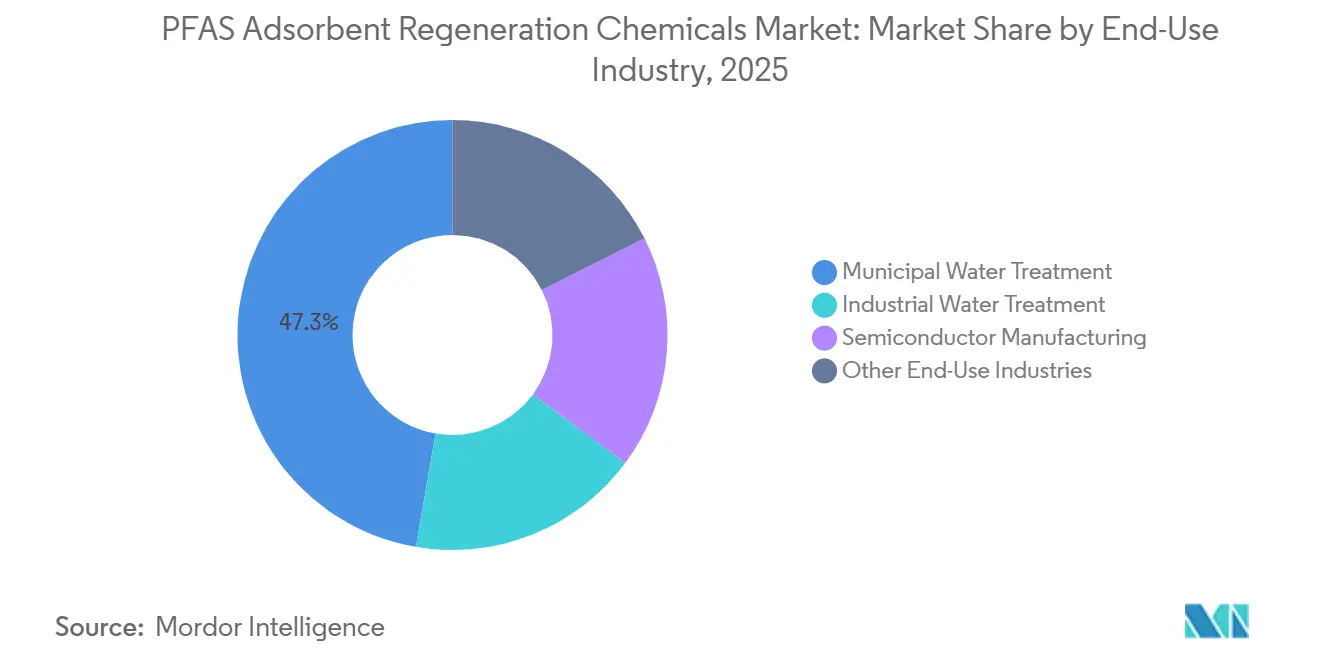
Municipal Water Treatment Anchor Demand, Semiconductor Manufacturing Gains MomentumMunicipal water treatment retained 47.28% of the market revenue in 2025. The segment is supported by public water-system obligations in the United States and emerging regulatory programs in Japan, South Korea, and Australia. Large granular activated carbon beds can enter scheduled reactivation cycles, providing recurring demand for sodium hydroxide and rinse chemicals in the PFAS adsorbent regeneration chemicals market. Industrial water treatment includes landfill leachate management, defense-site remediation, and mining drainage treatment. These projects can involve high PFAS loading and variable chain-length profiles, which complicate the regeneration process.
Semiconductor manufacturing is expected to advance at an 8.97% CAGR through 2031. A February 2026 review reported that individual semiconductor facilities can generate wastewater flows of up to 35,000 cubic meters per day and may contain PFAS across gas, liquid, and solid phases. The Semiconductor Industry Association’s PFAS Consortium has published technical material and analytical guidance that supports more consistent treatment adoption. The PFAS adsorbent regeneration chemicals market benefits from the sector’s need to treat ultrashort-chain compounds that standard granular activated carbon cannot always address efficiently. Defense, aerospace, mining, and metals applications add further demand where contamination profiles and disposal rules require specialized treatment.
Geography Analysis
APAC PFAS Adsorbent Regeneration Chemicals Market
Asia-Pacific held 39.91% of the market revenue in 2025 and is forecast to expand at an 8.53% CAGR through 2031. Japan’s mandatory PFOS and PFOA standards at 50 nanograms per liter became effective in April 2026 and apply to water supply operators through testing, inspection, and disclosure requirements. This supports investment in granular activated carbon reactivation and ion exchange regeneration programs. South Korea extended restrictions on PFOS, PFOA, and perfluorohexane sulfonic acid by mid-2025, while Taiwan faces PFAS wastewater concerns associated with semiconductor operations, and ASEAN countries, including Singapore and Thailand, are at earlier regulatory stages that provide a future pipeline for the PFAS adsorbent regeneration chemicals market.
North America PFAS Adsorbent Regeneration Chemicals Market
The North America region is anchored by the U.S. regulatory response to the 2024 drinking water rule and by investment in treatment infrastructure. In February 2026, Calgon Carbon Corporation, a subsidiary of KURARAY CO., LTD., announced a nearly USD 100 million investment in its Columbus, Ohio, plant to add 27 million pounds per year of reactivation capacity, with operations expected to begin in the first quarter of 2028. The expansion is intended to position domestic capacity before the 2031 compliance deadline, while semiconductor fabrication growth in Arizona, New York, and Ohio adds site-specific demand for short-chain PFAS regeneration chemistry in the PFAS adsorbent regeneration chemicals market.
EMEA and South America PFAS Adsorbent Regeneration Chemicals Market
In Europe, the European Union restriction is affecting treatment planning across municipal and industrial sites. The European Union restriction on PFAS-containing firefighting foams was published in October 2025, and the restriction on perfluorohexanoic acid-related substances takes effect in October 2026[2]. DESOTEC expanded its U.S. position through the 2023 acquisition of Evoqua’s carbon reactivation business and a 2025 partnership with Sentinel Water Solutions. South America, and Middle-East and Africa remain earlier-stage areas where mining contamination management and municipal investment create selective opportunities for the PFAS adsorbent regeneration chemicals market.
Competitive Landscape
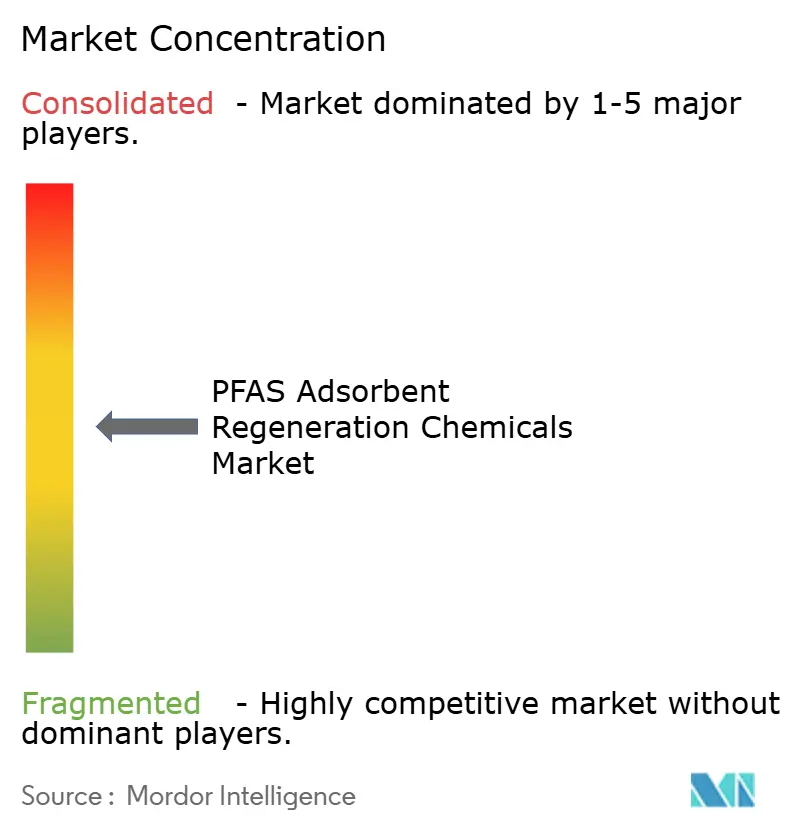
The PFAS adsorbent regeneration chemicals market is moderately concentrated, with the top five players including KURARAY CO., LTD., Norit, DESOTEC, Xylem, and Ecolab Inc. Service providers such as Onterris, Puragen, and Envirogen Group combine media supply, regeneration logistics, and destruction coordination. Ecolab and Kurita Water Industries offer PFAS programs within wider water management contracts, giving utilities a choice between chemical purchases and end-to-end managed services.
Calgon Carbon Corporation has strengthened its position through reactivation technology, peer-reviewed validation, and patents for PFAS removal. In September 2025, the company received U.S. Patent No. 12,478,948 for reactivated carbon sorbent materials and methods used to remove PFAS from liquid and gas streams. LANXESS has differentiated its Lewatit resin range through short-chain PFAS selectivity and field performance at Chemours Netherlands. De Nora launched the SORB FX Pak in September 2025 to serve small and rural systems with granular activated carbon and ion exchange media options. The PFAS adsorbent regeneration chemicals market is moving toward bundled offerings that link media, chemical protocols, logistics, and destruction documentation.
Small and rural treatment systems remain underserved because they may not have access to centralized reactivation capacity or onsite hazardous-waste capabilities. De Nora’s compact system is intended to reduce this operational gap through field-serviceable equipment and external servicing. Puraffinity’s PFAS-selective adsorbent and Aquagga’s hydrothermal alkaline treatment approach could reduce dependence on conventional sodium hydroxide and alcohol-based programs over time, but neither approach had reached the scale required to displace established formulations during the forecast period. National Sanitation Foundation and American National Standards Institute Standard 61 certification for potable water contact materials remains a material entry barrier in municipal applications. Established suppliers with approved media and validated processes therefore retain a procurement advantage in the PFAS adsorbent regeneration chemicals market.
PFAS Adsorbent Regeneration Chemicals Industry Leaders
-
KURARAY CO., LTD.
-
Norit
-
DESOTEC
-
Xylem
-
Ecolab Inc.
- *Disclaimer: Major Players sorted in no particular order
PFAS Adsorbent Regeneration Chemicals Market Companies Covered in this Report
- DESOTEC
- DuPont
- Ecolab Inc.
- Envirogen Group
- JACOBI CARBONS GROUP
- KURARAY CO., LTD.
- Kurita Water Industries Ltd.
- LANXESS
- Norit
- Onterris, Inc.
- Puraffinity
- Puragen
- ResinTech, Inc.
- Xylem
Recent Industry Developments in PFAS Adsorbent Regeneration Chemicals Market
- April 2026: Kurita Water Industries Ltd. and Cyclopure expanded their partnership to build a PFAS regeneration facility in Michigan. The project pairs Cyclopure's DEXSORB adsorbent media with Kurita America's water-treatment system design and fabrication to provide sustainable, closed-loop "forever chemical" removal for municipal and industrial clients.
- February 2026: Calgon Carbon Corporation, a wholly owned subsidiary of KURARAY CO., LTD., announced a nearly USD 100 million investment to expand drinking water carbon reactivation capacity at its Columbus, Ohio, plant. The expansion added 27 million pounds per year of National Sanitation Foundation and American National Standards Institute Standard 61-certified reactivation capacity, with operations targeted for the first quarter of 2028.
Global PFAS Adsorbent Regeneration Chemicals Market Report Scope
PFAS adsorbent regeneration chemicals are specialized chemical formulations used to restore the adsorption capacity of materials that capture per- and polyfluoroalkyl substances (PFAS) from contaminated water. These chemicals enable the reuse of adsorbents, reduce operating costs, minimize waste generation, and support sustainable PFAS treatment in water purification systems.
The PFAS Adsorbent Regeneration Chemicals Market is segmented by chemical type, adsorbent type, end-use industry, and geography. By chemical type, the market is segmented into sodium hydroxide, alcohol-based chemicals, proprietary chemical blends, and other chemical types (including acetone, salt solutions, and surfactant-based chemicals). By adsorbent type, the market is segmented into granular activated carbon, ion exchange resins, powdered activated carbon, and other adsorbent types (including modified clay, bio-based, and hybrid adsorbents). By end-use industry, the market is segmented into municipal water treatment, industrial water treatment, semiconductor manufacturing, and other end-use industries (including landfill leachate treatment, defense and aerospace, mining and metals, and chemicals and petrochemicals). The report also covers the market size and forecasts for PFAS adsorbent regeneration chemicals in 15 countries across major regions. For each segment, the market sizing and forecasts have been done on the basis of value (USD).
Segmentation Overview
| Sodium Hydroxide |
| Alcohol-Based Chemicals |
| Proprietary Chemical Blends |
| Other Chemical Types (Acetone, Salt Solutions, Surfactant-Based Chemicals) |
| Granular Activated Carbon |
| Ion Exchange Resins |
| Powdered Activated Carbon |
| Other Adsorbent Types (Modified Clay, Bio-Based and Hybrid Adsorbents) |
| Municipal Water Treatment |
| Industrial Water Treatment |
| Semiconductor Manufacturing |
| Other End-Use Industries (Landfill Leachate Treatment, Defense and Aerospace, Mining and Metals, Chemicals and Petrochemicals) |
| Asia-Pacific | China |
| India | |
| Japan | |
| South Korea | |
| ASEAN Countries | |
| Rest of Asia-Pacific | |
| North America | United States |
| Canada | |
| Mexico | |
| Europe | Germany |
| United Kingdom | |
| France | |
| Italy | |
| NORDIC Countries | |
| Rest of Europe | |
| South America | Brazil |
| Argentina | |
| Rest of South America | |
| Middle-East and Africa | Saudi Arabia |
| South Africa | |
| Rest of Middle-East and Africa |
| By Chemical Type | Sodium Hydroxide | |
| Alcohol-Based Chemicals | ||
| Proprietary Chemical Blends | ||
| Other Chemical Types (Acetone, Salt Solutions, Surfactant-Based Chemicals) | ||
| By Adsorbent Type | Granular Activated Carbon | |
| Ion Exchange Resins | ||
| Powdered Activated Carbon | ||
| Other Adsorbent Types (Modified Clay, Bio-Based and Hybrid Adsorbents) | ||
| By End-Use Industry | Municipal Water Treatment | |
| Industrial Water Treatment | ||
| Semiconductor Manufacturing | ||
| Other End-Use Industries (Landfill Leachate Treatment, Defense and Aerospace, Mining and Metals, Chemicals and Petrochemicals) | ||
| By Geography | Asia-Pacific | China |
| India | ||
| Japan | ||
| South Korea | ||
| ASEAN Countries | ||
| Rest of Asia-Pacific | ||
| North America | United States | |
| Canada | ||
| Mexico | ||
| Europe | Germany | |
| United Kingdom | ||
| France | ||
| Italy | ||
| NORDIC Countries | ||
| Rest of Europe | ||
| South America | Brazil | |
| Argentina | ||
| Rest of South America | ||
| Middle-East and Africa | Saudi Arabia | |
| South Africa | ||
| Rest of Middle-East and Africa | ||
Key Questions Answered in the Report
What is the size of the PFAS adsorbent regeneration chemicals market?
The PFAS adsorbent regeneration chemicals market stands at USD 188.71 million in 2026 and is projected to reach USD 266.29 million by 2031.
Which chemical type led the market demand in 2025?
Sodium hydroxide led the chemical type with 41.86% revenue share in 2025.
Which adsorbent type is expected to grow fastest through 2031?
Ion exchange resins are forecast to grow at a 7.79% CAGR through 2031 because of their short-chain PFAS removal capability.
Why are semiconductor facilities important to treatment demand?
Semiconductor manufacturing is projected to grow at an 8.97% CAGR through 2031 because facilities handle complex wastewater streams that can include ultrashort-chain PFAS.