
Peru Fixed Wireless Access Market Size and Share
Market Overview
| Study Period | 2020 - 2031 |
|---|---|
| Forecast Data Period | 2026 - 2031 |
| Base Year Market Size (2025) | USD 99.60 Million |
| Market Size (2026) | USD 112.51 Million |
| Market Size (2031) | USD 204.08 Million |
| Growth Rate (2026 - 2031) | 12.65 % |
| Market Concentration | Medium |
Major Players *Disclaimer: Major Players sorted in no particular order Image © Mordor Intelligence. Reuse requires attribution under CC BY 4.0. | |
Peru Fixed Wireless Access Market Analysis by Mordor Intelligence
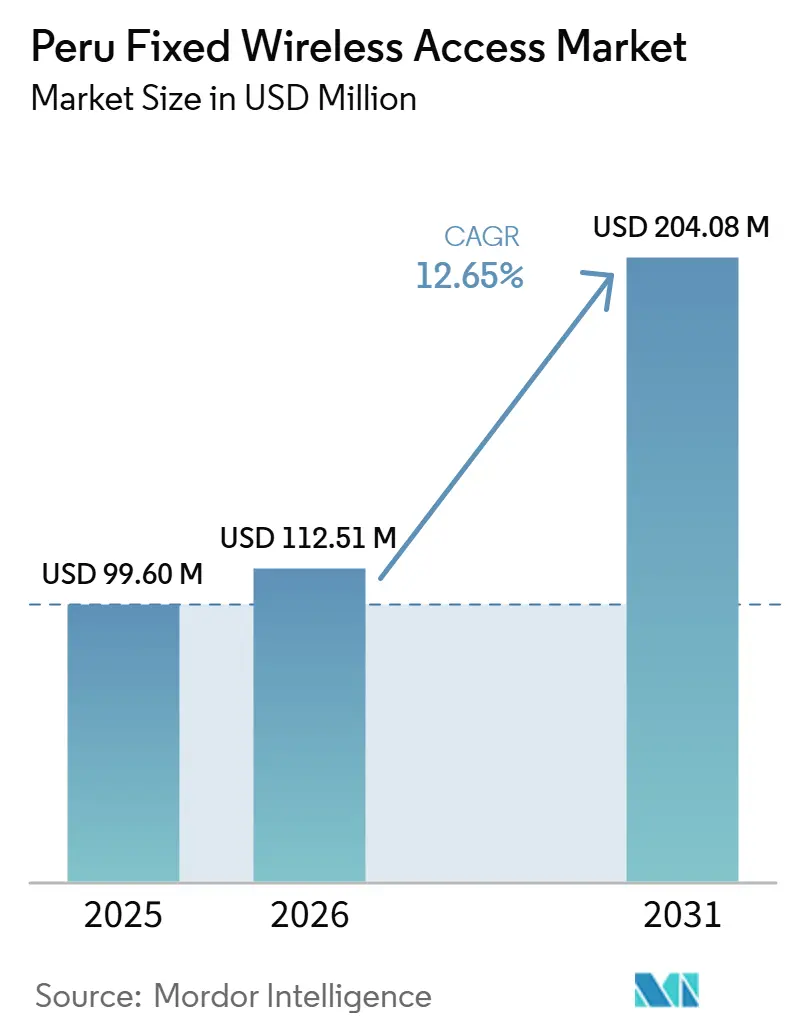
The Peru Fixed Wireless Access Market size is expected to grow from USD 99.60 million in 2025 to USD 112.51 million in 2026 and is forecast to reach USD 204.08 million by 2031 at 12.65% CAGR over 2026-2031. Rising household data use and the slower extension of fiber networks outside Lima support demand for fixed wireless access. The 2025 allocation of 3.5 GHz spectrum created a clearer path for 5G deployment by Bitel, Claro, Entel, and Integratel. Operators are using this capacity to serve secondary cities and peri-urban communities where fiber connections remain limited. Public connectivity commitments can create early anchor demand and improve the economics of extending coverage to nearby homes. Competition from fiber providers and satellite broadband is likely to limit pricing power, while also confirming demand for reliable wireless broadband.
Key Report Takeaways
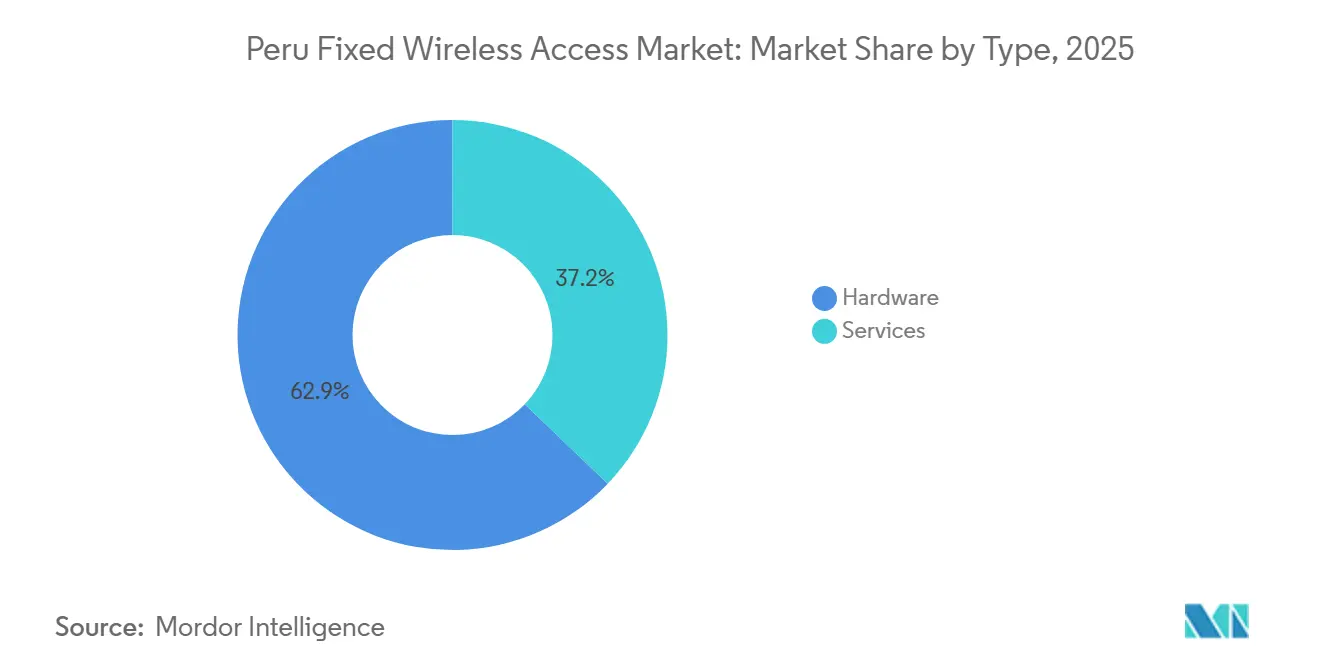
- By type, hardware held 62.85% of revenue share in the Peru fixed wireless access market in 2025, while services are projected to expand at a 13.72% CAGR through 2031.
- By application, residential services accounted for 73.40% of revenue share in the Peru fixed wireless access market in 2025, while government and public safety are expected to expand at a 14.18% CAGR through 2031.
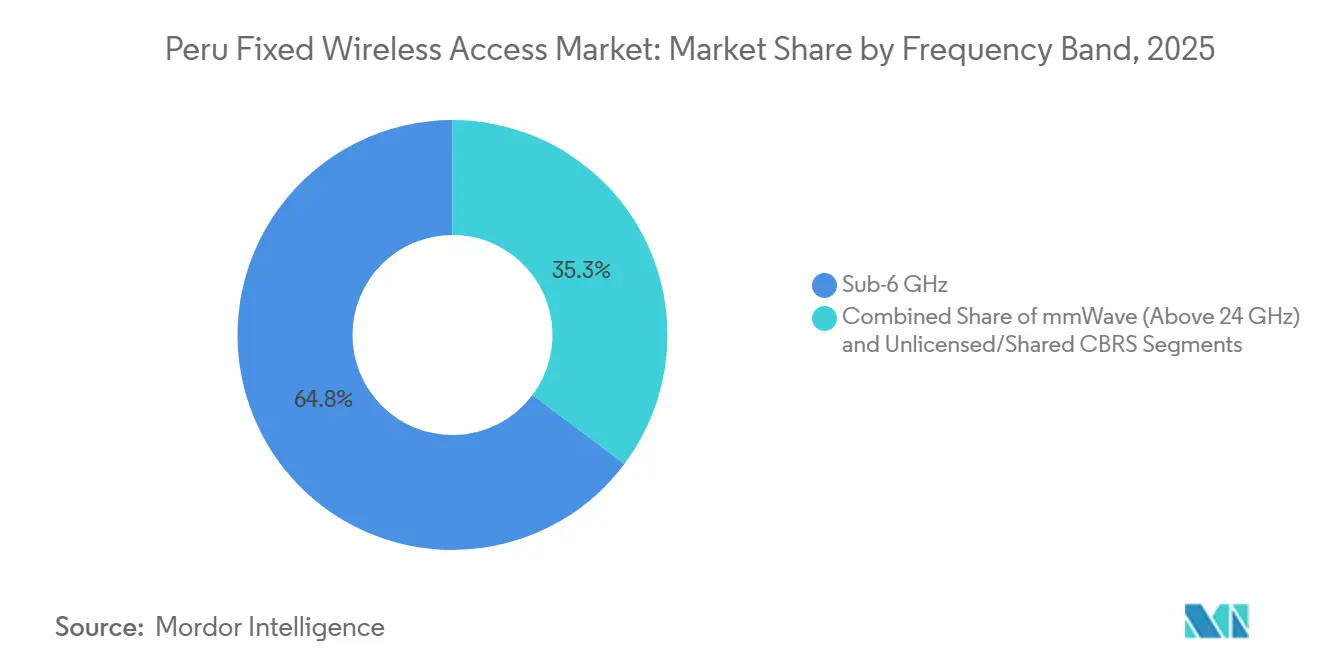
- By frequency band, sub-6 GHz represented 64.75% of revenue share in the Peru fixed wireless access market in 2025, while mmWave (above 24 GHz) is projected to grow at a 14.05% CAGR through 2031.
- By deployment mode, indoor CPE accounted for 69.22% of revenue share in the Peru fixed wireless access market in 2025, while self-install window-mount CPE is expected to advance at a 14.22% CAGR through 2031.
Note: Market size and forecast figures in this report are generated using Mordor Intelligence’s proprietary estimation framework, updated with the latest available data and insights as of January 2026.
Peru Fixed Wireless Access Market Trends and Insights
Drivers Impact Analysis*
| Driver | (~) % Impact on CAGR Forecast | Geographic Relevance | Impact Timeline |
|---|---|---|---|
| 5G Expansion Improving FWA Speeds and Coverage Economics | +4.5% | Lima metropolitan area and major coastal cities, with spillover to Andean and Amazonian regions | Short term (≤ 2 years) |
| Fiber Gaps in Secondary Cities and Rural Corridors | +3.0% | National, strongest in Loreto, Puno, Madre de Dios, and Áncash | Medium term (2-4 years) |
| Affordability Pressure on First-Mile Broadband Adoption | +2.2% | National, most pronounced in rural and peri-urban areas | Short term (≤ 2 years) |
| Enterprise Demand for Rapid-Deploy Backup Connectivity | +1.8% | Lima metropolitan area, Arequipa, and mining and industrial corridors | Short term (≤ 2 years) |
| Spectrum Refarming and Mid-Band Allocation Supporting Capacity Growth | +1.5% | National, with early gains in Lima and coastal urban centers | Medium term (2-4 years) |
| Low-Touch CPE Installations Reducing Customer Acquisition Costs | +1.2% | National, with highest uptake in the Lima metropolitan area | Short term (≤ 2 years) |
| Source: Mordor Intelligence | |||
5G Expansion Improves FWA Speeds and Coverage Economics
The Peru fixed wireless access market benefits from 5G deployment because it increases capacity without requiring a new connection to each home. Claro had extended its 5G network to 110 districts by April 2026, following commercial activation in December 2025. Entel also increased its available 3.5 GHz spectrum capacity in key locations after signing its concession agreement. Higher capacity can improve peak download performance and make wireless broadband more suitable for mid-tier home internet plans. Bitel also prepared its 4G network for 5G readiness through a modernization agreement with ZTE. The Ministry of Transport and Communications established a framework for direct 5G spectrum assignment in 2025, reducing procedural delays for concession awards.
Fiber Gaps Support Access in Secondary Cities and Rural Corridors
The Peru fixed wireless access market has room to grow, where fiber backbones have not been extended to local homes and businesses. Rural fixed internet access reached 23.6% of households in the second quarter of 2025, compared with 80.5% in the Lima metropolitan area. The gap is especially relevant in Loreto, Madre de Dios, Puno, and other interior regions. A well-located 5G base station can connect many customer premises equipment units after the network reaches a community. Public broadband projects can provide the backbone or access nodes needed for this model. Government service obligations for schools, medical centers, and public offices can also create dependable initial demand. These commitments may help operators extend service into adjacent areas with weaker residential economies.
Affordability Pressure Expands First-Mile Broadband Adoption
Affordability remains central to the Peru fixed wireless access market, as many households rely on mobile internet rather than a fixed connection. OSIPTEL reported that 96% of Peruvian households had fixed or mobile internet access by the end of 2025. Mobile-only access reached 83.4% of rural households, leaving room for home broadband services that offer more consistent capacity. Providers that can offer plans below PEN 60 per month, equivalent to USD 17, may be better placed to convert these households. Subscriber contracts that recover CPE costs over 24-36 months can reduce the upfront burden for customers. This approach shifts more revenue toward recurring service fees instead of one-time equipment sales.
Enterprise Need for Rapid Backup Connectivity Supports Adoption
Enterprise customers use wireless links for backup access where a fiber outage could disrupt operations. Claro operates private 5G networks at the Chinalco copper mine and the Chancay port, underscoring the importance of wireless connectivity in constrained industrial environments. Mining, energy, and logistics sites need resilient communications because earthquakes, landslides, and cable theft can disrupt terrestrial networks. Companies may use fixed wireless access as a secondary link while retaining fiber as the primary connection. Perudata markets corporate Starlink services for businesses that need connectivity at sites beyond conventional network coverage.[1]Perudata, “Servicio Starlink Corporativo de Perudata para Empresas,” Perudata, perudata.net This use case can generate more revenue per connection than residential service. It also supports deployment in remote industrial and transport corridors.
Restraints Impact Analysis*
| Restraint | (~) % Impact on CAGR Forecast | Geographic Relevance | Impact Timeline |
|---|---|---|---|
| Interference and Line-of-Sight Constraints in Dense Urban Districts | -0.9% | Lima metropolitan area, Callao, and dense urban areas of Arequipa | Short term (≤ 2 years) |
| Limited Rural Backhaul Quality Restricting Service Reliability | -0.8% | Loreto, Ucayali, Puno, and remote Andean regions | Long term (≥ 4 years) |
| Intensifying Fixed Broadband Competition From Fiber and HFC Networks | -0.6% | Lima metropolitan area and secondary coastal cities | Medium term (2-4 years) |
| Imported CPE Cost Sensitivity and Currency Volatility | -0.5% | National | Short term (≤ 2 years) |
| Source: Mordor Intelligence | |||
Urban Interference and Line-of-Sight Limits Constrain Service Quality
Dense urban construction can reduce the consistency of fixed wireless links in central Lima, Callao, and other densely populated areas of Arequipa. Concrete, glass, and multi-story buildings obstruct or scatter mid-band radio signals. Operators may need more cell sites to maintain performance, thereby increasing capital spending per subscriber. Ericsson notes that network design and CPE placement are important factors in FWA performance.[2]Ericsson, “Fixed Wireless Access, Your Ultimate Guide,” Ericsson, ericsson.com Sub-6 GHz networks face particular indoor coverage challenges in densely populated areas. Window-mounted CPE can improve placement at the glass surface, but some multi-dwelling buildings still require professional installation.
Rural Backhaul Limits Reliability and Subscriber Experience
The Peru fixed wireless access market faces a service-quality constraint in areas where base stations depend on microwave or satellite backhaul. Customers can receive a strong radio signal but still experience congestion, latency, or interruptions during busy periods. The national fiber backbone reaches many provincial capitals, yet local connections between backbone nodes and base stations remain incomplete. This issue is material in Loreto, Ucayali, and high-altitude Andean communities. Internet Para Todos used secure satellite connectivity at remote locations to extend rural network coverage.[3]Internet Para Todos, “Internet Para Todos,” Internet Para Todos, internetparatodos.pe Wider local fiber connections are needed to support stronger service reliability and improved revenue per user. Until then, network operators may face slower subscriber adoption and higher churn in remote locations.
*Our forecasts treat driver/restraint impacts as directional, not additive. The impact forecasts reflect baseline growth, mix effects, and variable interactions.
Segment Analysis
By Type: Services Gain Ground on an Installed Hardware Base
Hardware accounted for 62.85% of type revenue in 2025, reflecting the upfront costs of CPE and radio access units needed to establish service. Peru's fixed wireless access market share for hardware was driven by residential demand for indoor gateways and outdoor equipment. CPE drives most volume, while access units expand more slowly because early deployments favor wide-area macro coverage over dense small-cell layers. Lower equipment prices can reduce CPE subsidies and improve customer-acquisition economics, though imported equipment also exposes operators to currency and supply-chain risks.
Services are projected to grow at a 13.72% CAGR through 2031, the fastest rate within this segmentation. Managed Wi-Fi, remote monitoring, and installment plans are moving providers toward recurring revenue arrangements. Under 24-36 month contracts, operators can recover CPE costs through subscription fees rather than a point-of-sale payment. This produces a more predictable revenue profile than hardware sales alone. ZTE introduced 5G-A CPE products with AI, Wi-Fi 8, and self-install capabilities at MWC Barcelona 2026, which can reduce support needs and improve Peru fixed wireless access industry economics.


By Application: Public Safety Contracts Outpace Residential Growth
Residential service accounted for 73.40% of application revenue in 2025, supported by peri-urban household demand, where fiber coverage remains incomplete. The Peru fixed wireless access market for residential services is driven more by first-time fixed broadband adoption than by switching from fiber. Households that rely on mobile data remain an important potential customer group, while fiber-connected homes in Lima have less reason to change services. Commercial users, including small and medium-sized businesses in secondary cities, also use FWA as a primary link or a lower-cost backup connection.
Government and public safety services are projected to grow at a 14.18% CAGR through 2031. Bitel committed 5G connectivity to 1,056 educational institutions, 49 universities, and 51 medical centers under its spectrum agreement. These coverage requirements create initial demand in low-commercial-density areas and can shorten operator payback periods. The Ministry of Transport and Communications awarded the 911 Emergency Center technology platform to a Motorola Solutions consortium, which integrates surveillance, radio communications, and audio and video recording. Government contracts can therefore help make nearby residential deployment commercially viable.
By Frequency Band: Sub-6 GHz Remains the Core Coverage Layer
Sub-6 GHz frequencies accounted for 64.75% of frequency band revenue in 2025, making them the main coverage layer for the Peru fixed wireless access market. Peru's fixed wireless access market share in sub-6 GHz reflects its ability to reach homes across hills, vegetation, and building clusters. Frequencies below 3.5 GHz provide better Non-Line-of-Sight performance than mmWave across coastal plains, Andean highlands, and jungle corridors. Peru assigned 100 MHz in the 3.5 GHz band to each 5G concession operator, creating a substantial capacity layer for household and business connectivity.
mmWave is expected to register a 14.05% CAGR through 2031, making it the fastest-growing frequency category. The 2025 spectrum process also assigned 200 MHz in the 26 GHz band to each winning operator. This higher-frequency capacity can support dense urban locations where sub-6 GHz networks face congestion and interference. ZTE presented a combined 5G-A sub-6 GHz and mmWave CPE at MWC Barcelona in March 2026, which may enable operators to use multiple radio layers through a single device. Unlicensed and shared CBRS spectrum may also support smaller regional providers and industrial private networks.

By Deployment Mode: Self-Install CPE Changes Acquisition Economics
Indoor CPE accounted for 69.22% of deployment-mode revenue in 2025, reflecting residential demand for plug-and-play gateway devices. The Peru fixed wireless access market for indoor CPE is supported by apartment settings, where exterior installations require approval and specialized labor. Outdoor CPE remains important for enterprise and semi-rural sites where antennas must sit above local obstructions to achieve an acceptable link. The simpler deployment of indoor equipment can accelerate subscriber activation in urban housing developments and simplify service activation for operators and customers.
Self-install window-mount CPE is projected to grow at a 14.22% CAGR through 2031. Vantiva introduced the Hawk 5G near-window CPE for 5G Standalone networks in March 2026, and the device is designed for a windowsill rather than external mounting hardware. The product also supports Wi-Fi 8 compatibility. Self-install designs reduce technician visits and can lower customer acquisition costs. This is particularly relevant in lower-income peri-urban communities, where installation costs can be a continuing barrier to household adoption nationwide.
Geography Analysis
The Lima metropolitan area represents the largest revenue location for the Peruvian fixed wireless access market, supported by population concentration and established fixed internet demand. Fixed internet access reached 80.5% of households in the Lima metropolitan area in the second quarter of 2025. In central districts, FWA is most relevant for enterprise backup services and later mmWave small-cell deployment. In rapidly urbanizing peri-urban districts, it can be a primary connection when fiber deployment lags behind housing growth. Claro’s network reached 110 districts in April 2026, providing radio infrastructure for broader commercial availability.
Secondary coastal and highland cities are expected to add demand as operators extend 5G coverage beyond Lima. Arequipa, Trujillo, Chiclayo, Cusco, Piura, Ica, and Lambayeque combine expanding households, active small business communities, and uneven fiber availability. Entel’s 5G footprint includes Áncash, Arequipa, Ica, La Libertad, Lambayeque, Lima, Piura, Moquegua, and Tacna. These cities often have a small number of fixed broadband providers, so that wireless competition can affect pricing and service selection. Private 5G networks at mining and port sites also demonstrate enterprise demand outside the capital.
Rural, Andean, and Amazonian communities have the largest long-term coverage gap, though backhaul constraints limit immediate deployment. Rural fixed internet access stood at 23.6% of households in the second quarter of 2025. Overall, rural internet access reached 85.8% by the end of 2025, indicating a large group of mobile-connected households that may seek stronger home connectivity. Government backbone projects can create access nodes for last-mile wireless coverage, but additional local fiber will be needed before these areas become major revenue contributors to the Peruvian fixed wireless access market.
Competitive Landscape
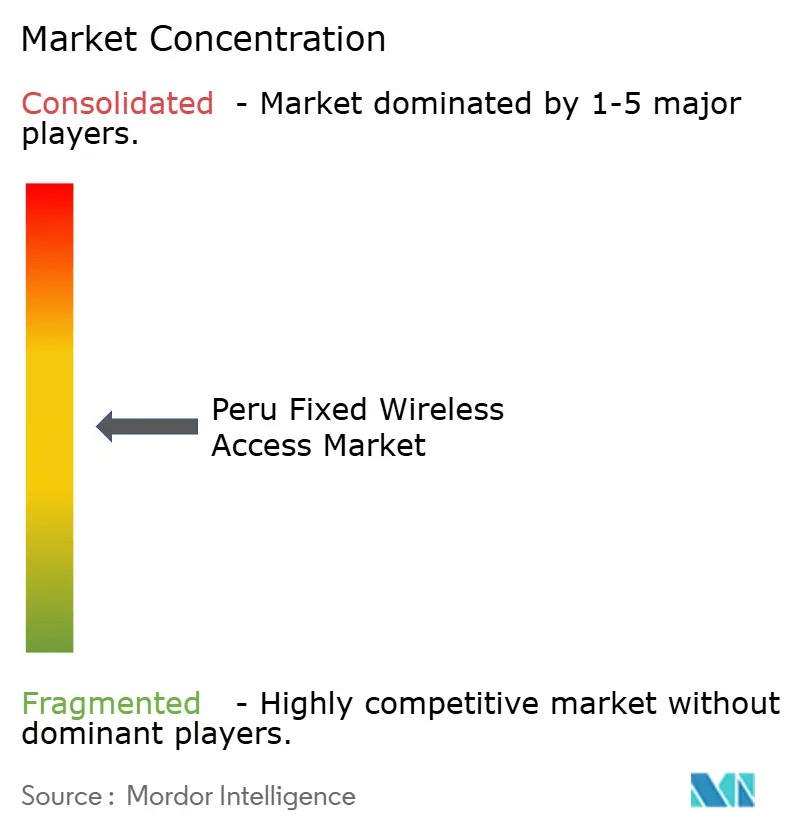
The Peru fixed wireless access market has a moderately concentrated operator layer led by Claro, Entel, Vittel, and others. These operators control much of the radio access infrastructure used to deliver FWA services. Equipment supply is more fragmented, with global vendors including ZTE, Huawei, Nokia, and Samsung. Mobile operators can bundle FWA with broader connectivity offers, while fiber specialists can extend service beyond their fiber footprint. Satellite broadband adds pressure because it serves remote and high-altitude sites without terrestrial access infrastructure.
Claro expanded its 5G network to 110 districts by April 2026 after activating the service in December 2025. Entel expanded its 5G spectrum capacity and pursued hybrid connectivity through its Starlink relationship. Bitel modernized its network with ZTE to prepare for 5G deployment. These moves place radio capacity, network reach, enterprise connectivity, and CPE financing at the center of competition. Wider capacity beyond the highest-density districts can support further adoption in the Peru fixed wireless access market, especially where fiber builds take longer and require more capital.
ZTE introduced the G6 Ultra and G6 Max CPE range at MWC Barcelona 2026, including a device that combines sub-6 GHz and mmWave capabilities. Vantiva launched its Hawk 5G near-window gateway for 5G Standalone networks in March 2026. Nokia offers fixed wireless gateways and mmWave equipment for operator deployment. Competition among suppliers centers on radio performance, ease of installation, and compatibility with evolving 5G networks.
Peru Fixed Wireless Access Industry Leaders
Claro Perú S.A.C.
Entel Perú S.A.
Sercomm Corporation
Hughes Network Systems, LLC
Bitel (Viettel Perú S.A.C.)
- *Disclaimer: Major Players sorted in no particular order

Recent Industry Developments
- April 2026: Entel Perú and Starlink expanded their direct-to-cell satellite connectivity alliance to include data applications, enabling Entel customers to remain connected when outside terrestrial mobile signal coverage. The expanded service, built on a December 2025 SMS-phase launch, positioned Entel to offer hybrid terrestrial-satellite connectivity for enterprise and rural FWA-adjacent use cases. The offering also addressed locations where terrestrial coverage remains intermittent or unavailable.
- April 2026: Claro Perú announced that its 5G network reached 110 districts across Peru, including Lima, Callao, Arequipa, Trujillo, Chiclayo, Cusco, Ica, Piura, Puno, Huaraz, Sullana, Paita, Talara, Pisco, and Abancay. The rapid expansion followed commercial activation in December 2025 and broadened the coverage infrastructure needed for residential and enterprise FWA deployments. In the Peru fixed wireless access market, broader district coverage can also improve the case for service bundles in areas where household fiber is limited.
- April 2026: OSIPTEL published its 2026-2027 regulatory agenda. The agenda included plans for a regulatory sandbox with flexible compliance requirements to encourage pilot projects and innovation in Peru’s telecommunications sector. It could provide a setting for operators to test spectrum-sharing models and new CPE deployment approaches before wider commercial use.


Peru Fixed Wireless Access Market Report Scope
The Peru fixed wireless access (FWA) market's revenue is generated through the sale of FWA hardware, including customer premises equipment (CPE) and access units, as well as recurring subscription fees, installation and activation services, managed connectivity services, maintenance, and network support provided by fixed wireless service providers operating across Sub-6 GHz, mmWave, and CBRS frequency bands. The Peru fixed wireless access market report is segmented by type (hardware (consumer premise equipment (CPE), access units (femto and picocells), and services), application (residential, commercial, industrial, and government and public safety), frequency band (sub-6 GHz, mmwave (above 24 GHz), and unlicensed/shared CBRS), and deployment mode (indoor CPE, outdoor CPE, and self-install window-mount CPE). The market forecasts are provided in value (USD).
| Hardware | Consumer Premise Equipment (CPE) |
| Access Units (Femto and Picocells) | |
| Services |
| Residential |
| Commercial |
| Industrial |
| Government and Public Safety |
| Sub-6 GHz |
| mmWave (Above 24 GHz) |
| Unlicensed/Shared CBRS |
| Indoor CPE |
| Outdoor CPE |
| Self-Install Window-Mount CPE |
| By Type | Hardware | Consumer Premise Equipment (CPE) |
| Access Units (Femto and Picocells) | ||
| Services | ||
| By Application | Residential | |
| Commercial | ||
| Industrial | ||
| Government and Public Safety | ||
| By Frequency Band | Sub-6 GHz | |
| mmWave (Above 24 GHz) | ||
| Unlicensed/Shared CBRS | ||
| By Deployment Mode | Indoor CPE | |
| Outdoor CPE | ||
| Self-Install Window-Mount CPE |


Key Questions Answered in the Report
What is the Peru fixed wireless access market size?
The Peru fixed wireless access market size is estimated at USD 112.2 million in 2026 and is forecast to reach USD 204.08 million by 2031, at a CAGR of 12.65%.
What is driving fixed wireless access adoption in Peru?
Household demand, uneven fiber coverage outside Lima, 5G expansion, public connectivity commitments, enterprise backup needs, and the need for lower-cost home broadband options support adoption across the country.
Which type leads fixed wireless access revenue in Peru?
Hardware held 62.85% of type revenue in 2025, while services are projected to grow faster at a 13.72% CAGR through 2031.
Which application is growing fastest in Peru?
Government and public safety is projected to record the highest application CAGR of 14.18% through 2031, supported by public connectivity commitments for education, medical, and emergency service locations.
Why is sub-6 GHz important for wireless broadband in Peru?
Sub-6 GHz held 64.75% of frequency band revenue in 2025 because it provides stronger coverage across varied terrain, obstructed locations, and many peri-urban residential settings.
How does self-install CPE affect service deployment?
Self-install window-mount CPE is expected to grow at a 14.22% CAGR through 2031 because it can reduce installation time, technician visits, and customer acquisition costs.
Page last updated on:





