
Personalization Engine Software Market Size and Share
Market Overview
| Study Period | 2020 - 2031 |
|---|---|
| Market Size (2026) | USD 4.41 Billion |
| Market Size (2031) | USD 11.93 Billion |
| Growth Rate (2026 - 2031) | 22.02 % |
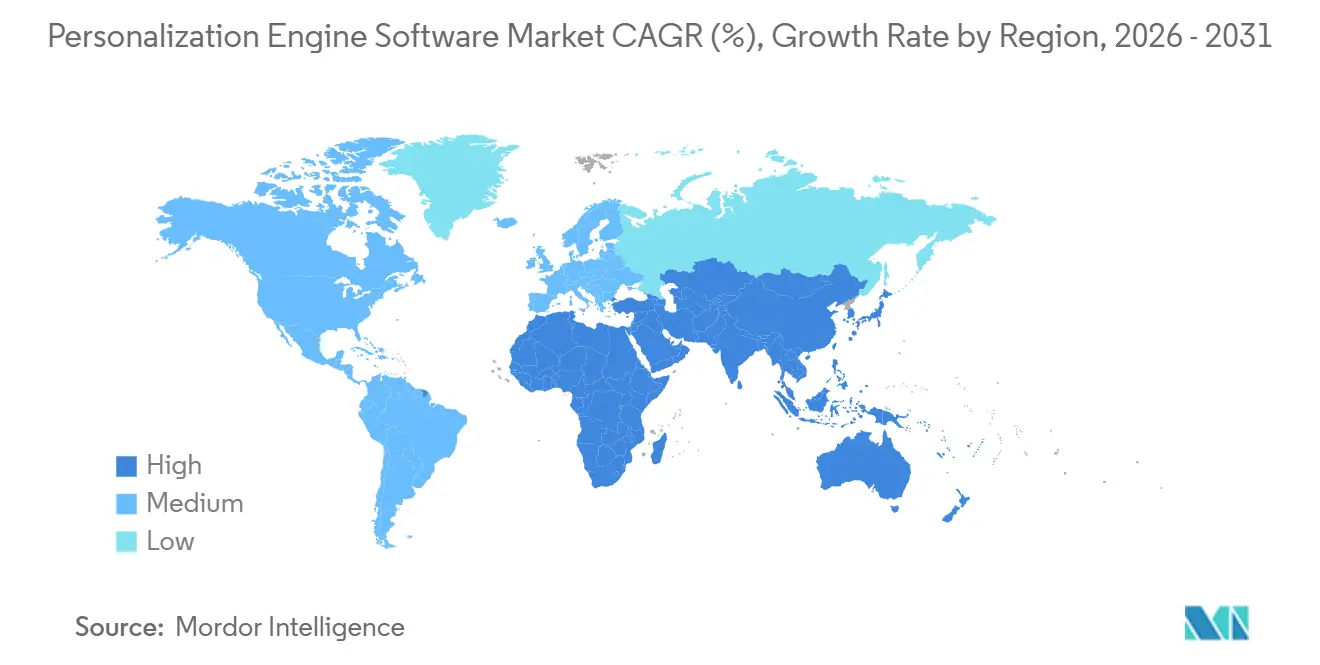
| Fastest Growing Market | Asia-Pacific |
| Largest Market | North America |
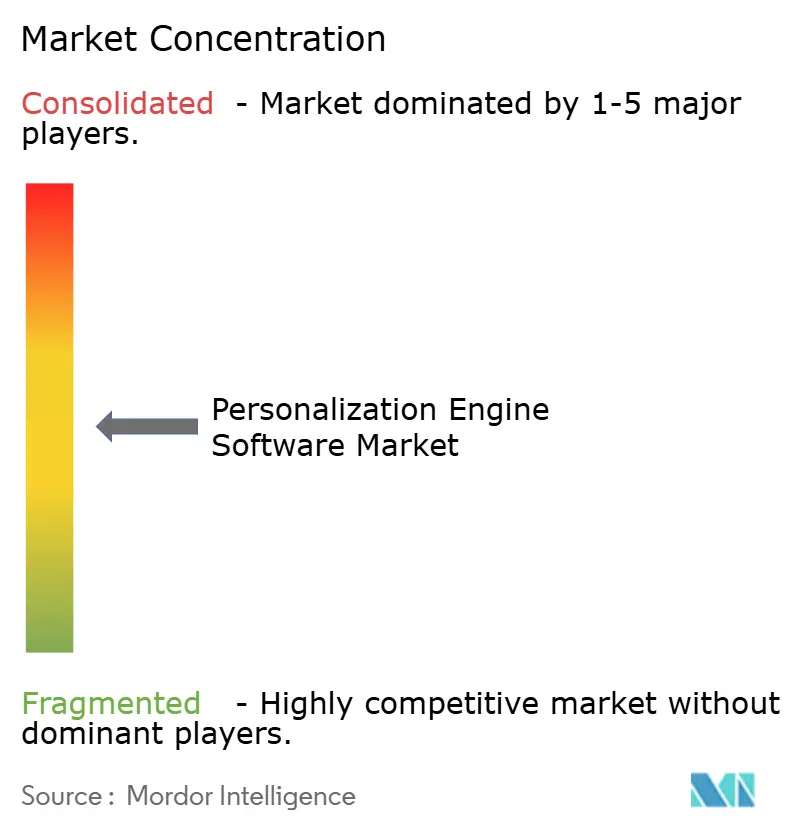
| Market Concentration | Medium |
Major Players *Disclaimer: Major Players sorted in no particular order Image © Mordor Intelligence. Reuse requires attribution under CC BY 4.0. | |
Personalization Engine Software Market Analysis by Mordor Intelligence
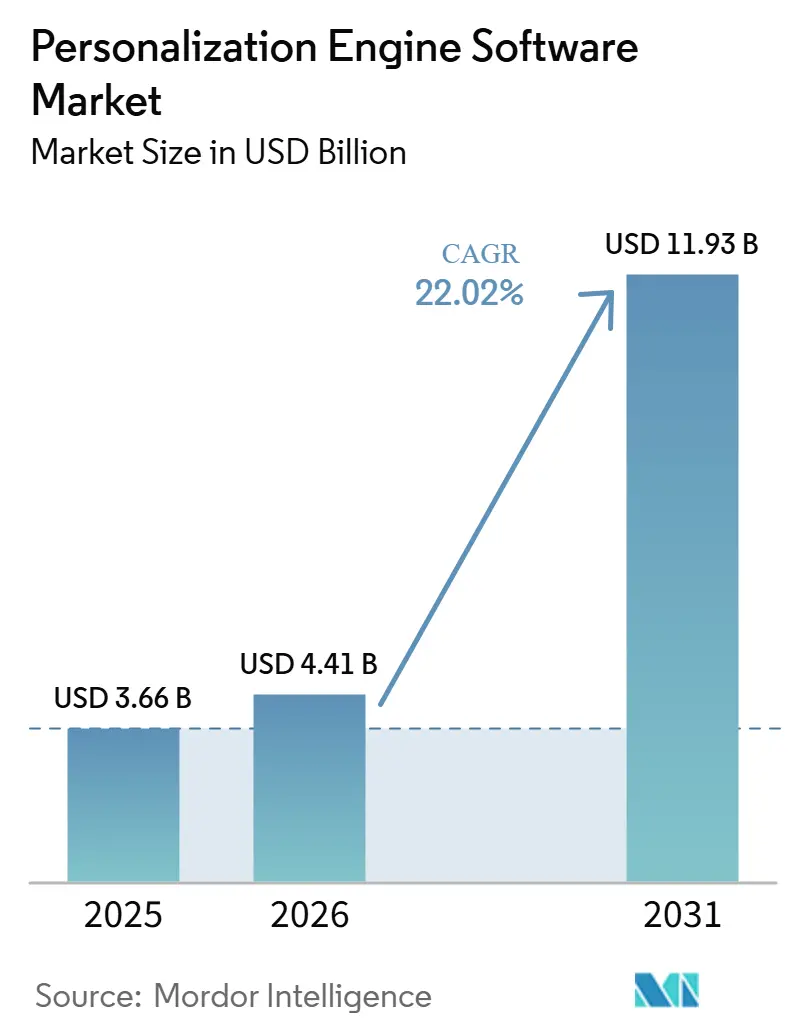
The Personalization Engine Software Market size was valued at USD 3.66 billion in 2025 and estimated to grow from USD 4.41 billion in 2026 to reach USD 11.93 billion by 2031, at a CAGR of 22.02% during the forecast period from 2026 to 2031. The market is expanding as enterprises make real-time customer engagement a standard part of their digital operations. Organizations are replacing disconnected tools with platforms that can process live behavioral signals and determine the next appropriate action across customer interactions. Demand is also shifting toward architectures that link web, mobile, email, and physical interactions through a shared customer profile. Data residency requirements are increasing interest in hybrid configurations, especially among regulated organizations that must keep sensitive data within controlled environments. The Personalization Engine Software Market also faces a practical constraint because incomplete and disconnected customer data can weaken model accuracy and limit the value of advanced decisioning capabilities.
Key Report Takeaways
- By component, platform software held 72.41% of the Personalization Engine Software Market share in 2025, while services are projected to expand at a CAGR of 25.83% through 2031.
- By deployment mode, cloud deployment accounted for 68.19% of the Personalization Engine Software Market in 2025, while hybrid deployment is expected to grow at a CAGR of 24.43% from 2026 to 2031.
- By enterprise size, large enterprises held 61.34% of the market in 2025, while small and medium enterprises are projected to advance at a CAGR of 26.16% through 2031.
- By application, website personalization accounted for 34.82% of the Personalization Engine Software Market in 2025, while omnichannel customer journey orchestration is projected to expand at a CAGR of 27.43% through 2031.
- By end user, retail and e-commerce held 26.71% of the market in 2025, while healthcare and life sciences are expected to grow at a CAGR of 24.39% through 2031.
- By geography, North America held 36.42% of the Personalization Engine Software Market in 2025, while Asia-Pacific is projected to grow at a CAGR of 25.18% through 2031.
Note: Market size and forecast figures in this report are generated using Mordor Intelligence’s proprietary estimation framework, updated with the latest available data and insights as of January 2026.
Market Trends and Insights
Drivers Impact Analysis of Personalization Engine Software Market*
| Driver | (~) % Impact on CAGR Forecast | Geographic Relevance | Impact Timeline |
|---|---|---|---|
| Rapid Adoption of AI-Powered Recommendation Engines | +4.5% | Global, strongest in North America and Asia-Pacific | Short term (≤ 2 years) |
| Rising Demand for Real-Time Personalized Customer Experiences | +4.2% | Global, strongest in North America and Europe | Short term (≤ 2 years) |
| Expansion of First-Party Data Activation | +3.8% | Global, with strong concentration in North America and Europe | Medium term (2-4 years) |
| Omnichannel Commerce and Cross-Device Identity Resolution | +3.2% | Global, strongest in Asia-Pacific and North America | Medium term (2-4 years) |
| Migration From Rule-Based Segmentation to Autonomous Decisioning | +2.5% | North America and Europe, with spillover to Asia-Pacific | Medium term (2-4 years) |
| Privacy-Safe Personalization Architectures | +2.1% | European Union core, with spillover to North America and Asia-Pacific | Long term (≥ 4 years) |
| Source: Mordor Intelligence | |||
Rising Demand for Real-Time Personalized Customer Experiences
Real-time decisioning has become an important requirement for organizations that need to respond to current customer behavior rather than past activity. The Personalization Engine Software Market benefits when platforms can combine live data, artificial intelligence, and human-led business rules during a customer interaction. Streaming systems can support different response windows, ranging from sub-100 millisecond decisions for bidding to longer response times for push notifications and campaign triggers.[1]Confluent, “Real-Time Hyper-Personalization in 2026 Architecture Guide,” Confluent Batch-based processes can produce irrelevant recommendations when a customer’s circumstances have changed since the prior data refresh. This issue is particularly material in commerce settings where browsing, purchasing, and service interactions occur frequently. Providers that support live event processing can therefore address a clear operational need for organizations seeking more responsive customer engagement.
Rapid Adoption of AI-Powered Recommendation Engines
AI-powered recommendation tools are moving beyond product suggestions and are increasingly being used to support decisions on content, timing, channel, and customer treatment. The Personalization Engine Software Market is therefore moving toward systems that can support lifecycle engagement, churn prevention, cross-selling, and next-best-action processes. This development increases the importance of implementation, model governance, integration, and customization services. Services are projected to expand at a CAGR of 25.83% from 2026 to 2031, as many organizations require ongoing support after initial platform deployment. Autonomous decisioning can reduce dependence on fixed journey templates when organizations have sufficient data quality, approved content, and governance controls. The resulting value depends on whether the organization can continuously evaluate outcomes and apply those learnings to subsequent interactions.
Expansion of First-Party Data Activation
First-party data activation has become central to personalization as organizations connect data from their owned digital and physical touchpoints. Customer profiles can become more useful when online behavior, purchase history, service records, and consent preferences are connected through identity resolution. This need supports the Personalization Engine Software Market, as activation requires tools that can create audiences, apply consent controls, and deliver relevant experiences across multiple channels.[2]Experian, “Why Activation Is Where First-Party Data Earns Its Value,” Experian Larger organizations retain an advantage when they have more behavioral events, broader customer histories, and dedicated data management teams. Smaller companies are increasingly able to participate through cloud-based platforms that reduce the infrastructure and implementation burden.
Omnichannel Commerce and Cross-Device Identity Resolution
Omnichannel customer journey orchestration is projected to grow at a 27.43% CAGR from 2026 to 2031 as organizations coordinate customer interactions across multiple channels. A customer who browses products on a mobile device may receive an irrelevant message if the organization cannot connect that activity to an email, website, or store interaction. Cross-device identity resolution enables a persistent customer profile, improving the relevance of communications and offers. Microsoft’s 2026 release plan for Dynamics 365 Customer Insights describes agentic orchestration as a way to manage multistep journeys that adapt to customer behavior in real time.[3]Microsoft, “Overview of Dynamics 365 Customer Insights Journeys 2026 Release Wave 1,” Microsoft Learn Rokt mParticle introduced its Performance Engine in June 2026 to combine behavioral signal capture, audience creation, and cross-platform activation. The quality of identity resolution is becoming important because model performance cannot overcome incomplete or incorrectly connected customer records.
Restraints Impact Analysis of Personalization Engine Software Market*
| Restraint | (~) % Impact on CAGR Forecast | Geographic Relevance | Impact Timeline |
|---|---|---|---|
| Data Fragmentation Across Customer Touchpoints | -2.8% | Global | Short term (≤ 2 years) |
| Regulatory Constraints on Profiling and Consent | -2.2% | European Union core, Asia-Pacific, North America | Medium term (2-4 years) |
| Integration Complexity with Legacy MarTech and CDP Stacks | -1.8% | Global, strongest in North America and Europe | Short term (≤ 2 years) |
| Model Drift and Limited Explainability in High-Stakes Use Cases | -1.4% | Global | Long term (≥ 4 years) |
| Source: Mordor Intelligence | |||
Data Fragmentation Across Customer Touchpoints
Data fragmentation limits the effectiveness of personalization because the model receives an incomplete view of the customer. Disconnected data sources can create duplicate profiles, inconsistent consent records, and conflicting customer interactions across channels. The Personalization Engine Software Market must address this constraint through better connectivity with data warehouses, customer data platforms, customer relationship management systems, and commerce applications. Databricks introduced CustomerLake in June 2026 as an agentic customer data platform embedded within the Databricks Lakehouse, combining customer data, identity resolution, segmentation, and personalization without requiring data movement. Insider One also introduced Zero Copy Segmentation for Snowflake in June 2026, enabling brands to build and activate audiences directly from governed Snowflake data environments. These approaches reflect demand for architectures that use governed data directly instead of generating additional copies across disconnected platforms.
Regulatory Constraints on Profiling and Consent
Privacy, consent, and automated-profiling rules can increase the time and cost required to deploy personalization systems. The European Data Protection Board published Guidelines 02/2026 on Anonymization in July 2026, providing organizations with a framework for assessing when data is anonymized and falls outside the scope of the General Data Protection Regulation.[4]European Data Protection Board, “Guidelines 02/2026 on Anonymisation,” European Data Protection Board The EU AI Act also affects the governance requirements for certain automated profiling and scoring use cases. Organizations may need clearer documentation, risk assessment processes, oversight mechanisms, and evidence of how automated decisions are controlled. Cisco reported that 77% of organizations considered accountability for AI data use to be a critical privacy and compliance concern in 2026. The Personalization Engine Software Market is responding through capabilities for consent orchestration, audit trails, explainability, and access controls.
*Our forecasts treat driver/restraint impacts as directional, not additive. The impact forecasts reflect baseline growth, mix effects, and variable interactions.
Personalization Engine Software Market Segment Analysis
By Component:
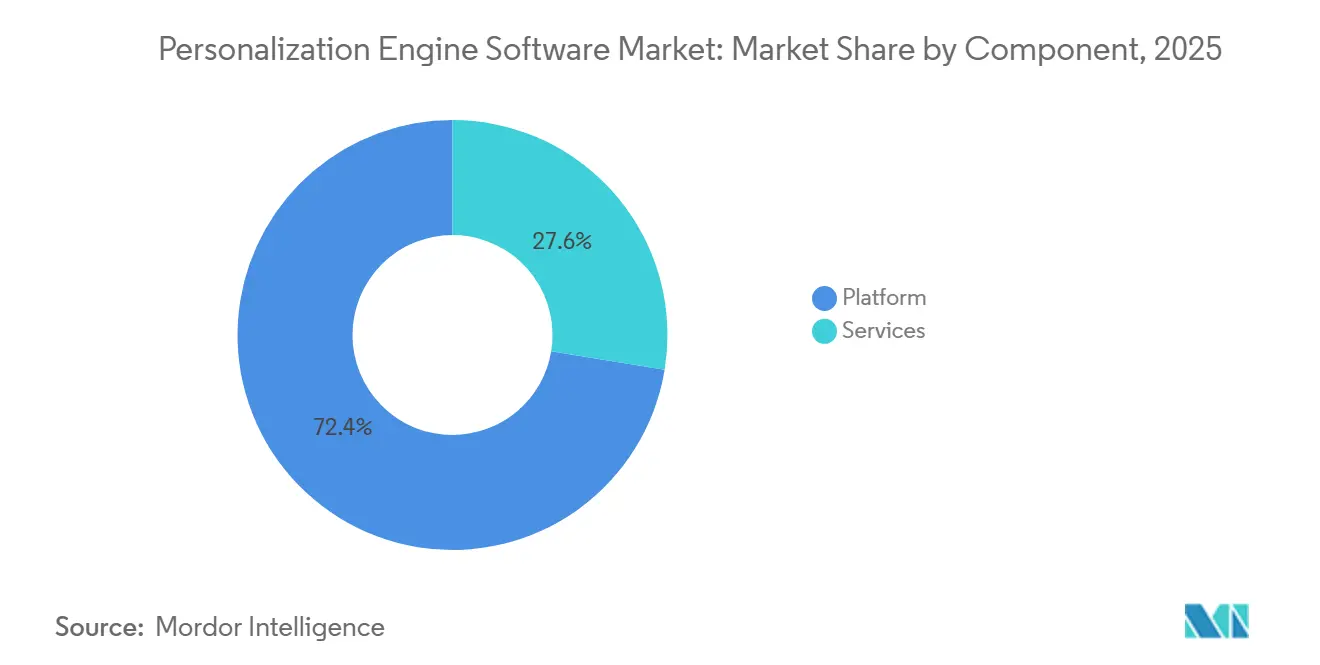
Platform Software Leads While Services Gain ImportancePlatform software held 72.41% of the Personalization Engine Software Market share in 2025, reflecting enterprise demand for integrated environments that combine data ingestion, audience creation, experimentation, decisioning, and content delivery. A unified platform can reduce the synchronization delays that arise when multiple disconnected point products are used for customer engagement. Enterprises are increasingly seeking a common orchestration layer because inconsistent data movement can weaken real-time decisions. Platform adoption also reflects the need to manage a growing number of customer channels from a coordinated set of workflows. The concentration of platform demand does not remove the need for specialized implementation support. It instead makes implementation quality more important because deployment requires connections across internal systems, data sources, and business processes.
Services are projected to grow at a CAGR of 25.83% from 2026 to 2031 as organizations seek support for implementation, data integration, workflow design, model governance, and ongoing optimization. The Personalization Engine Software Market size for services is supported by the practical complexity of aligning technology with customer data practices and approved engagement policies. Professional services teams and certified partner networks can help providers maintain longer customer relationships after the original software sale. These relationships may also raise switching costs when the provider becomes embedded in the customer’s data and engagement operations. Governance requirements are adding another consideration, as organizations increasingly expect documentation for AI system management. Providers with strong implementation capabilities can therefore compete on operational support as well as software functionality.


By Deployment Mode:
Cloud Leads While Hybrid Addresses Data ControlsCloud deployment held 68.19% of the market in 2025 because it provides scalable computing resources for model training, live inference, event processing, and content delivery. Real-time personalization can require organizations to process high volumes of customer activity while maintaining rapid response times. Cloud environments support this workload without requiring every customer to build and operate large internal infrastructure estates. The model also helps organizations introduce new features through software updates and managed services. Cloud delivery is particularly relevant for companies that operate in several channels and need consistent access to shared customer data. These benefits have made cloud deployment the dominant deployment mode in the Personalization Engine Software Market.
Hybrid deployment is projected to grow at a CAGR of 24.43% from 2026 to 2031 as organizations balance cloud scalability with data residency and security obligations. AWS launched its European Sovereign Cloud in January 2026 to support customers with sovereignty and compliance needs in Europe. Financial services, healthcare, government, and other regulated users may retain sensitive identity data within private or controlled environments. They can then use cloud resources for less sensitive processing, aggregated data, model training, or content delivery. This split architecture supports organizations that cannot move all customer data to a public cloud environment. Hybrid systems may become a meaningful differentiator for vendors that can support identity resolution, consent controls, and event processing across separate environments.
By Enterprise Size:
Large Organizations Lead While SMEs Expand FasterLarge enterprises accounted for 61.34% of the market in 2025 because they have extensive customer data, larger technology teams, and greater capacity to manage complex deployments. Their broader transaction volumes can provide more data for recommendation models and outcome measurement. Large organizations can also invest in systems that connect customer relationship management, commerce, loyalty, service, analytics, and content platforms. These capabilities enable broader use of personalization across many customer interactions. Their spending position helps them pursue agentic orchestration and advanced data governance programs. The Personalization Engine Software Market, therefore, retains a strong large-enterprise base despite the spread of more accessible cloud tools.
Small and medium enterprises are projected to grow at a CAGR of 26.16% from 2026 to 2031, as cloud-native, API-first platforms reduce deployment costs and time. Subscription pricing and modular implementations can make personalization tools accessible to organizations with smaller IT teams. These businesses can begin with focused use cases, such as website content, product recommendations, email triggers, or mobile engagement. Insider One reported in 2026 that more than 150 enterprise brands had moved to its platform from competitors during the preceding 12 months. The reported experience of faster implementation supports the broader demand for platforms that require fewer internal resources. Growth among smaller organizations will depend on whether providers can simplify data connection, content management, experimentation, and governance requirements.
By Application:
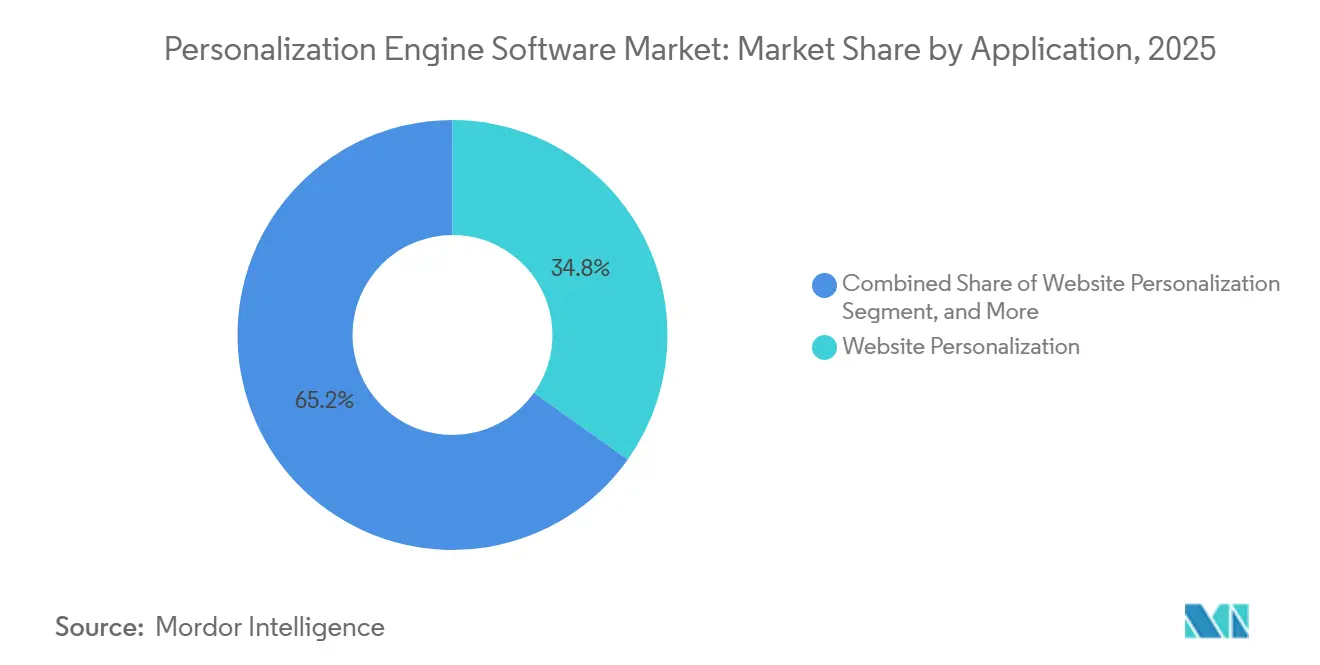
Website Personalization Remains Largest While Omnichannel Leads GrowthWebsite personalization held 34.82% of the market in 2025 because websites remain central customer touchpoints for product discovery, browsing, conversion, and account service. Organizations use website tools to adjust product recommendations, page content, search results, promotions, and navigation according to customer behavior. The Personalization Engine Software Market share held by website applications reflects the direct link between website experiences and digital commerce outcomes. Website deployments are often the initial personalization use case because they can be measured through customer engagement, conversion, and average order value. Mobile applications and email campaigns remain established channels for ongoing customer engagement. Together, these channels provide organizations with several places to apply behavioral insights and trigger tailored communications.
Omnichannel customer journey orchestration is projected to advance at a CAGR of 27.43% from 2026 to 2031 as organizations seek more coordinated decisioning across web, mobile, email, messaging, and store interactions. Braze announced RCS Rich Cards and WhatsApp Commerce capabilities at its Forge 2025 conference, expanding options for personalized customer communication across channels. Bloomreach expanded its Loomi Connect capability in February 2026 to bring ecommerce search intelligence into artificial intelligence environments through Model Context Protocol. Adobe introduced CX Enterprise in April 2026, including Engagement Intelligence for customer lifetime value decisions across cross-channel journeys. SAP also introduced an Advanced Success Plan for Customer Experience in June 2026 to connect SAP Commerce Cloud and SAP Engagement Cloud around shared commerce and engagement data.

By End User:
Retail Leads While Healthcare and Life Sciences Grow FastestRetail and e-commerce accounted for 26.71% of the market in 2025, driven by investments in recommendation systems, behavioral segmentation, A/B testing, search optimization, and digital commerce tools. Retailers use personalization to manage large product catalogs, tailor promotions, and guide customers toward relevant products. These organizations also generate substantial behavioral information through browsing, transactions, loyalty programs, and service interactions. Continued model retraining can improve recommendations as retailers accumulate more customer and product data. IT and telecommunications, BFSI, and media and entertainment are also established users of personalization for retention, next-best-offer programs, and content engagement. Education, research institutions, government, and administration remain early-stage users with applications focused on learner support and citizen service delivery.
The healthcare and life sciences industry is projected to expand at a CAGR of 24.39% from 2026 to 2031 as organizations use personalization to support patient engagement, adherence, and closure of care gaps. The Personalization Engine Software Market size in healthcare is shaped by priorities different from those in retail, as the focus is on clinical pathways, patient motivation, and population-level engagement. Lirio uses behavioral science and agentic AI to identify individual motivations and barriers, then deliver tailored interventions through existing care channels. Healthcare applications require stronger attention to data protection, regulatory obligations, and the appropriate use of automated recommendations. HIPAA requirements and emerging guidance on software as a medical device can create barriers for general-purpose marketing platforms. Specialized providers can compete by combining engagement functionality with healthcare-specific controls and workflow knowledge.
Geography Analysis
North America Personalization Engine Software Market
North America held 36.42% of the Personalization Engine Software Market share in 2025 because the region has a substantial base of cloud providers, enterprise technology buyers, digital commerce operators, and customer-data infrastructure. The United States remains the central demand market because many large organizations have mature customer relationship management, analytics, marketing automation, and commerce systems. High cloud infrastructure density supports frequent model training and the real-time processing of customer events. Companies in the region are also actively introducing agentic artificial intelligence tools for customer engagement. Adobe, Salesforce, Optimizely, Braze, and other providers continue to develop AI-supported orchestration capabilities for enterprise customers. Canada is supporting demand for consent-first approaches, while Mexico is seeing adoption among large retail and financial services organizations using cloud-native platforms.
Europe and South America Personalization Engine Software Market
Europe is a major region for the Personalization Engine Software Market because consumer digital engagement is high, and organizations increasingly need tools that meet strict privacy and governance requirements. The European Data Protection Board’s Guidelines 02/2026 on Anonymization affects how organizations evaluate behavioral event data and anonymization practices. Germany, the United Kingdom, and France remain major national markets with mature digital commerce activity and well-resourced enterprise technology teams. The EU AI Act is influencing how vendors prepare for use cases involving automated customer profiling and decisioning. Providers are responding by developing explainability features, audit records, consent processes, and oversight options. South America is expanding from a smaller base, with Brazil’s e-commerce ecosystem supporting demand across retail, financial services, and digital media. Argentina and other South American countries are also adopting cloud-based systems that reduce the need for extensive local technology infrastructure.
APAC and MEA Personalization Engine Software Market
Asia-Pacific is projected to grow at a CAGR of 25.18% from 2026 to 2031, making it the fastest-growing regional segment. India’s e-commerce and fintech sectors are deploying personalization platforms across customer acquisition, product discovery, customer support, and engagement programs. India Stack provides a digital identity infrastructure that supports consent-based data sharing across relevant commercial and financial touchpoints. South Korea and Japan have advanced connected commerce and device ecosystems that increase the need for persistent cross-device identity resolution. Southeast Asia requires localization-aware models because languages, cultures, and purchasing behaviors vary widely across the region. Chinese platform operators are embedding recommendation intelligence into super-app ecosystems that serve large daily user bases. The Middle East and Africa remain at an earlier stage of adoption, with Saudi Arabia and the United Arab Emirates supporting demand through national digital transformation priorities, while South Africa and Nigeria are primarily using personalization in mobile commerce and financial inclusion applications.

Competitive Landscape
The Personalization Engine Software Market combines major marketing cloud providers, focused independent specialists, and newer AI-native platforms. Adobe, Salesforce, SAP, Oracle, and Microsoft compete for large-enterprise contracts with suites that combine customer engagement, customer relationship management, analytics, content management, data tools, and personalization. Independent vendors such as Bloomreach, Braze, Optimizely, and Insider One compete through focused capabilities for specific industries, channels, or customer-engagement requirements. The competitive structure is more concentrated at the premium enterprise tier than in the wider market, where numerous specialized providers address narrower use cases. The market remains fragmented outside the largest enterprise accounts because customers differ in their data architecture, channels, sector requirements, and implementation capacity. Vendors are increasingly competing on how well they connect governed customer data to real-time decisioning.
Adobe launched CX Enterprise in April 2026 with a multiagent system that includes CX Enterprise Coworker, Adobe Brand Intelligence, and Adobe Engagement Intelligence. The platform builds on AEP Agent Orchestrator and includes partnerships with AWS, Anthropic, Google Cloud, IBM, Microsoft, NVIDIA, and OpenAI. Insider One acquired Bluecore in May 2026, expanding its retail technology capabilities and North American enterprise footprint. Bloomreach reported annual recurring revenue of USD 260 million in 2025, driven by the adoption of its Loomi AI platform. These developments show that both large vendors and independent platforms are expanding their capabilities through product development, partnerships, and acquisitions.
A key area of competition is the ability to operate directly on governed data without unnecessary replication across marketing and customer-data systems. Databricks introduced CustomerLake in June 2026 as an embedded agentic customer data platform that combines Customer 360, identity resolution, segmentation, and personalization within its Lakehouse environment. Insider One’s Zero Copy Segmentation for Snowflake also reflects the demand for warehouse-native activation approaches. Optimizely announced limitless 1:1 personalization in Optimizely Opal during June 2026, using audience intelligence and modular content to refresh customer-specific pages as customer and product data changes. Patent activity and platform investment are also focusing on streaming identity resolution, next-best-action systems, and privacy-preserving personalization. These capabilities are becoming more important as organizations seek a balance between personalization performance, data controls, and operational simplicity.
Personalization Engine Software Industry Leaders
Adobe Inc.
Salesforce, Inc.
Oracle Corporation
SAP SE
Dynamic Yield Ltd.
- *Disclaimer: Major Players sorted in no particular order
Personalization Engine Software Market Companies Covered in this Report
- Adobe Inc.
- Salesforce, Inc.
- SAP SE
- Oracle Corporation
- Microsoft Corporation
- IBM Corporation
- Optimizely, Inc.
- Bloomreach, Inc.
- Dynamic Yield Ltd.
- Insider Technology, Inc.
- Braze, Inc.
- Twilio Inc.
- Sitecore Corporation A/S
- Evergage, Inc.
- Coveo Solutions Inc.
- Nosto Solutions Ltd.
- SAP Emarsys
- Unbxd Inc.
- RichRelevance, Inc.
- Insider
- Barilliance Ltd.
- VWO Software Pvt. Ltd.
- Qubit Digital Ltd.
- Kibo Commerce, Inc.
- Yotpo Ltd.
- Algolia, Inc.

Recent Industry Developments in Personalization Engine Software Market
- June 2026: Insider One launched Zero Copy Segmentation for Snowflake at Snowflake Summit 26, enabling brands to build and activate audiences directly from Snowflake without copying or moving raw customer data. The integration enabled real-time behavioral targeting, AI-driven segmentation, and compliance-sensitive activation for data that remained within governed environments.
- June 2026: Optimizely announced limitless 1:1 personalization within Optimizely Opal, a capability that uses audience intelligence from CRM history, product data, and segment feeds to generate modular, continuously refreshed audience-specific pages without manual re-authoring. The launch extended Optimizely’s AI orchestration layer across its unified CMS, CMP, ODP, and experimentation stack.
- June 2026: SAP unveiled the Advanced Success Plan for SAP Customer Experience, consolidating hyper-personalization capabilities by natively integrating SAP Commerce Cloud and SAP Engagement Cloud. The unified architecture aimed to drive coordinated improvements in conversion rate, purchase frequency, and average order value by leveraging shared commerce and engagement data.
- May 2026: Insider One acquired Bluecore, a retail martech platform serving more than 400 U.S. enterprise brands including Sephora, Ralph Lauren, The North Face, and J.Crew, in a deal structured as a mix of cash and equity. The acquisition materially extended Insider One’s North American enterprise footprint ahead of a planned IPO.


Global Personalization Engine Software Market Report Scope
The personalization engine software market refers to the ecosystem of advanced software platforms and associated services that leverage artificial intelligence, machine learning, and real-time data analytics to deliver highly customized and relevant experiences to individual users. These engines analyze behavioral data, historical interactions, and contextual signals to dynamically adapt content, product recommendations, search results, and marketing messages across various digital touchpoints. The market includes platforms deployed via cloud, on-premise, or hybrid models, along with implementation and consulting services, catering to organizations of all sizes across industries such as retail, BFSI, media, and healthcare. By enabling applications like website and mobile app personalization, targeted email campaigns, and omnichannel journey orchestration, personalization engine software empowers businesses to move beyond traditional one-size-fits-all marketing, significantly enhancing customer engagement, increasing conversion rates, and fostering long-term brand loyalty.
The Personalization Engine Software Market Report is Segmented by Component (Platform and Services), Deployment Mode (Cloud, On-Premise, and Hybrid), Enterprise Size (Large Enterprises, and Small and Medium Enterprises), Application (Website Personalization, Mobile App Personalization, Email and Campaign Personalization, Personalized Search and Recommendations, and Omnichannel Customer Journey Orchestration), End User (IT and Telecommunication, BFSI, Healthcare and Life Sciences, Retail and E-Commerce, Education and Research Institutions, Media and Entertainment, Government and Administration, and Other End-User Industries), and Geography (North America, South America, Europe, Asia-Pacific, and Middle East and Africa). The Market Forecasts are Provided in Terms of Value (USD).
| Platform |
| Services |
| Cloud |
| On-Premise |
| Hybrid |
| Large Enterprises |
| Small and Medium Enterprises |
| Website Personalization |
| Mobile App Personalization |
| Email and Campaign Personalization |
| Personalized Search and Recommendations |
| Omnichannel Customer Journey Orchestration |
| IT and Telecommunication |
| BFSI |
| Healthcare and Life Sciences |
| Retail and E-Commerce |
| Education and Research Institutions |
| Media and Entertainment |
| Government and Administration |
| Other End-User Industries |
| North America | United States | |
| Canada | ||
| Mexico | ||
| South America | Brazil | |
| Argentina | ||
| Rest of South America | ||
| Europe | Germany | |
| United Kingdom | ||
| France | ||
| Russia | ||
| Spain | ||
| Rest of Europe | ||
| Asia-Pacific | China | |
| Japan | ||
| India | ||
| South Korea | ||
| Southeast Asia | ||
| Rest of Asia-Pacific | ||
| Middle East and Africa | Middle East | Saudi Arabia |
| United Arab Emirates | ||
| Rest of Middle East | ||
| Africa | South Africa | |
| Nigeria | ||
| Rest of Africa | ||
| By Component | Platform | ||
| Services | |||
| By Deployment Mode | Cloud | ||
| On-Premise | |||
| Hybrid | |||
| By Enterprise Size | Large Enterprises | ||
| Small and Medium Enterprises | |||
| By Application | Website Personalization | ||
| Mobile App Personalization | |||
| Email and Campaign Personalization | |||
| Personalized Search and Recommendations | |||
| Omnichannel Customer Journey Orchestration | |||
| By End-User | IT and Telecommunication | ||
| BFSI | |||
| Healthcare and Life Sciences | |||
| Retail and E-Commerce | |||
| Education and Research Institutions | |||
| Media and Entertainment | |||
| Government and Administration | |||
| Other End-User Industries | |||
| By Geography | North America | United States | |
| Canada | |||
| Mexico | |||
| South America | Brazil | ||
| Argentina | |||
| Rest of South America | |||
| Europe | Germany | ||
| United Kingdom | |||
| France | |||
| Russia | |||
| Spain | |||
| Rest of Europe | |||
| Asia-Pacific | China | ||
| Japan | |||
| India | |||
| South Korea | |||
| Southeast Asia | |||
| Rest of Asia-Pacific | |||
| Middle East and Africa | Middle East | Saudi Arabia | |
| United Arab Emirates | |||
| Rest of Middle East | |||
| Africa | South Africa | ||
| Nigeria | |||
| Rest of Africa | |||


Key Questions Answered in the Report
What is the size of the Personalization Engine Software Market?
The Personalization Engine Software Market was valued at USD 3.66 billion in 2025, is estimated at USD 4.41 billion in 2026, and is projected to reach USD 11.93 billion by 2031.
What is driving demand for personalization engine software?
Demand is being supported by real-time decisioning, first-party data activation, AI-powered recommendations, and omnichannel customer journey orchestration.
Which deployment model has the largest share?
Cloud deployment led with 68.19% share in 2025 because it provides scalable infrastructure for live data processing, model training, and customer engagement delivery.
Which application is expected to grow the fastest?
Omnichannel customer journey orchestration is projected to grow at a CAGR of 27.43% from 2026 to 2031 as organizations connect web, mobile, email, messaging, and store interactions.
Which end-user sector is projected to grow the fastest?
Healthcare and life sciences is projected to expand at a CAGR of 24.39% through 2031, supported by patient engagement, adherence, and care-gap closure use cases.
Which region is growing the fastest?
Asia-Pacific is projected to grow at a CAGR of 25.18% from 2026 to 2031, supported by digital commerce growth across India, Southeast Asia, South Korea, Japan, and China.
Page last updated on:


 Your data is secure and never sold or shared.


