
Peppermint Oil Market Size and Share
Market Overview
| Study Period | 2022 - 2032 |
|---|---|
| Market Size (2027) | USD 301.20 Million |
| Market Size (2032) | USD 427.60 Million |
| Growth Rate (2027 - 2032) | 7.26 % |
| Fastest Growing Market | Asia-Pacific |
| Largest Market | North America |
| Market Concentration | Low |
Major Players *Disclaimer: Major Players sorted in no particular order Image © Mordor Intelligence. Reuse requires attribution under CC BY 4.0. | |
Peppermint Oil Market Analysis by Mordor Intelligence
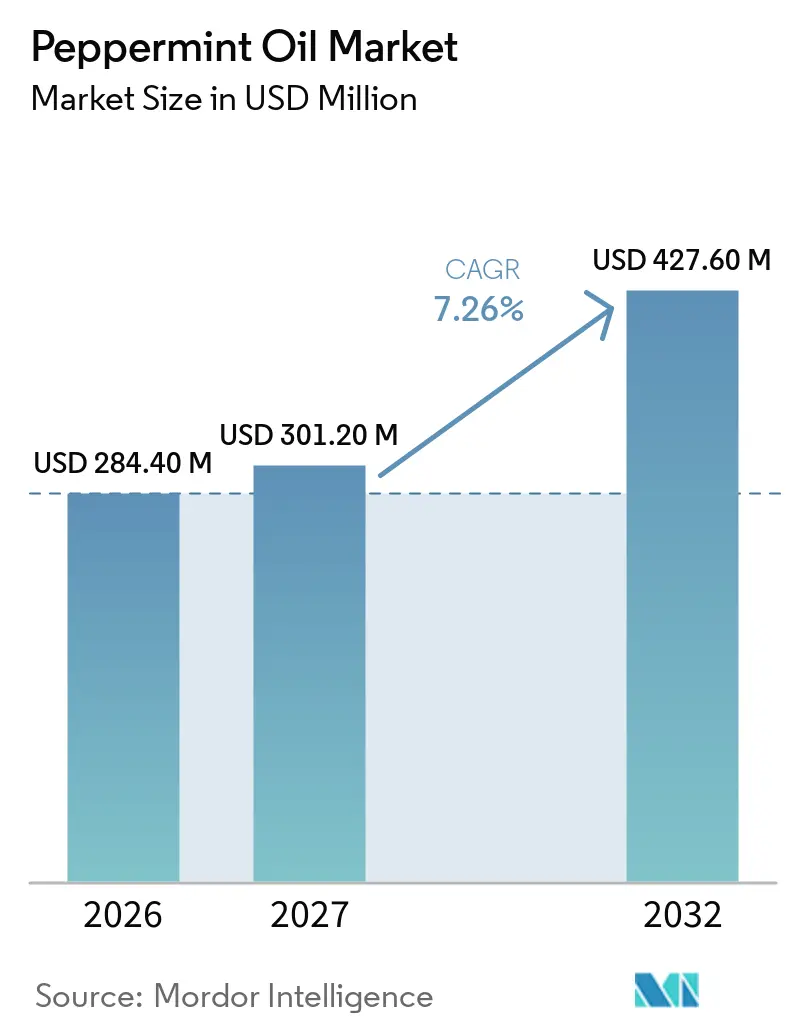
The peppermint oil market size is expected to grow from USD 284.40 million in 2026 to USD 301.20 million in 2027 and is forecast to reach USD 427.60 million by 2032 at a 7.26% CAGR over 2027-2032. The market is supported by growing demand for natural, plant-derived ingredients across food manufacturing, personal care, pharmaceuticals, and wellness products. Increasing consumer interest in clean-label formulations, natural flavoring agents, and plant-based wellness solutions continues to strengthen its commercial relevance. Peppermint oil's distinctive aroma, cooling properties, and functional applications contribute to its widespread use across consumer and industrial products. The market is also witnessing greater interest in product purity, traceability, and organically sourced ingredients. Overall, evolving consumer preferences and expanding applications are shaping the market's growth and product development landscape.
Key Report Takeaways
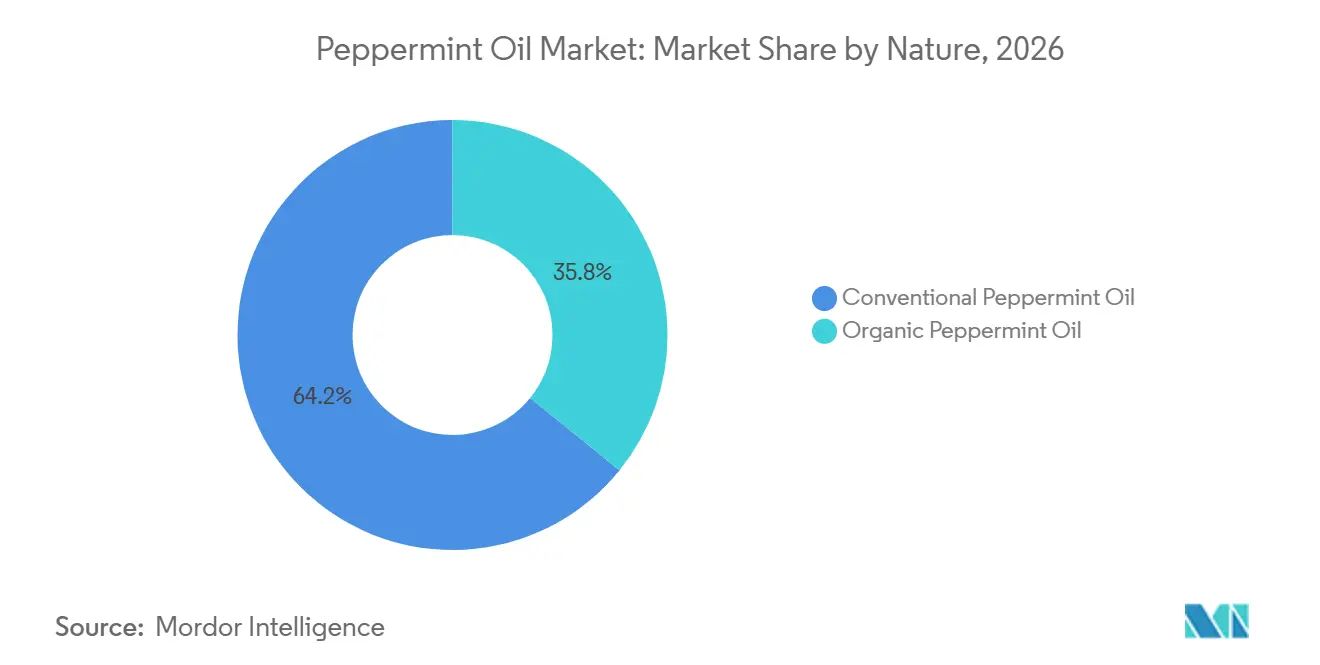
- By nature, conventional peppermint oil held 64.17% of the peppermint oil market share in 2026, while organic peppermint oil is forecast to grow at an 8.63% CAGR through 2032.
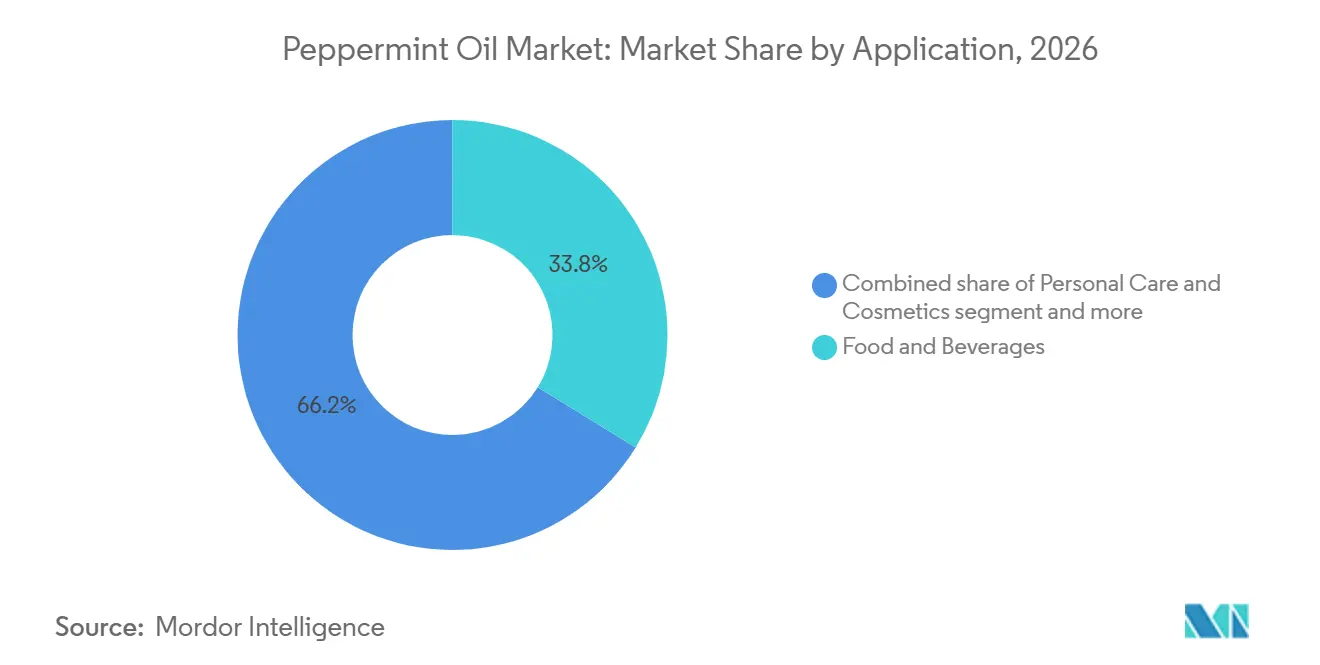
- By application, food and beverages accounted for 33.76% of the peppermint oil market size in 2026, while aromatherapy and wellness is forecast to expand at an 8.71% CAGR through 2032.
- By geography, North America held 32.37% of the peppermint oil market share in 2026, while Asia-Pacific is forecast to grow at an 8.05% CAGR through 2032.
Note: Market numbers in this report are based on Mordor Intelligence's proprietary estimation framework, which combines nine months of actuals with Q4 projections for base year 2026.
Global Peppermint Oil Market Trends and Insights
Drivers Impact Analysis*
| Driver | (~) % Impact on CAGR Forecast | Geographic Relevance | Impact Timeline |
|---|---|---|---|
| Demand for mint-flavoured food and beverage products | +1.8% | Global, concentrated in North America, Europe, and Asia-Pacific food manufacturing hubs | Medium term (2–4 years) |
| Expansion of oral care and breath-freshening products | +1.2% | Global; strong gains in North America, Europe, South Asia, and Southeast Asia | Short term (≤ 2 years) |
| Growth of pharmaceutical applications in digestive health | +0.9% | North America, Europe; emerging traction in India and China | Medium term (2–4 years) |
| Growth of aromatherapy and essential-oil applications | +1.1% | Global; fastest acceleration in Asia-Pacific and North America | Medium to long term (2–4+ years) |
| Increasing demand for organic, traceable and high-purity peppermint oil grades | +0.8% | North America and Europe as primary premium markets; Asia-Pacific growing | Medium term (2–4 years) |
| Advances in encapsulation and controlled-release formulation technologies | +0.6% | Global, with leading application development in North America, Japan, and Germany | Long term (≥ 4 years) |
| Source: Mordor Intelligence | |||
Demand for Mint-Flavoured Food and Beverage Products
Growing demand for mint-flavoured food and beverage products supports the use of peppermint oil as a flavouring ingredient across chewing gum, confectionery, candies, and refreshing beverages. Its characteristic cooling sensation and distinctive taste make it a popular choice for products designed to deliver freshness and enhance flavour. The continued presence of mint flavours in familiar consumer products sustains demand from food manufacturers seeking to meet established taste preferences. Peppermint oil's versatility in flavour formulations further supports its use across a range of food and beverage applications. It can also be incorporated into combination flavours, complementing ingredients such as chocolate, fruit, and other botanical extracts. Continued product innovation and the introduction of new flavour profiles provide additional opportunities for peppermint oil in food and beverage formulations.
Expansion of Oral Care and Breath-Freshening Products
Expansion of oral care and breath-freshening products supports demand for peppermint oil, which is used to impart a refreshing flavour in toothpaste, mouthwash, breath sprays, and other oral hygiene formulations. A 2025 study indexed by the National Library of Medicine (NLM) surveyed 265 adults in Chennai, India, and found that 41.9% used mouthwash, while 72% of mouthwash users cited breath freshening as a reason for use[1]. These findings highlight the relevance of breath-freshening benefits in oral care product usage. Peppermint oil's characteristic cooling sensation and refreshing taste make it suitable for formulations designed to improve the sensory experience of oral hygiene products. Continued development of oral care products that combine hygiene benefits with freshness may further support its use in these applications.
Growth of Pharmaceutical Applications in Digestive Health
Growing pharmaceutical applications in digestive health support demand for peppermint oil in formulations targeting irritable bowel syndrome (IBS), abdominal discomfort, and related gastrointestinal symptoms. A 2024 study indexed by the National Library of Medicine (NLM), involving 69 Japanese patients with IBS, reported an improvement rate of 85.1% after four weeks of peppermint oil treatment, based on patients' global assessments[2]. These findings provide clinical evidence of interest in peppermint oil as an ingredient in digestive health formulations. Its potential to alleviate gastrointestinal symptoms supports its inclusion in targeted pharmaceutical products, particularly enteric-coated capsules designed for intestinal delivery. Continued clinical research into plant-derived approaches to digestive symptom management may further support the development of peppermint oil-based treatments.
Growth of Aromatherapy and Essential-Oil Applications
Growing interest in aromatherapy and essential-oil applications supports demand for peppermint oil across wellness, personal care, and home-fragrance products. Its refreshing aroma makes it suitable for diffusers, massage blends, bath products, and other formulations designed to create invigorating sensory experiences. Peppermint oil is also used in aromatherapy practices involving inhalation and topical application, broadening its potential uses beyond flavouring and fragrance. Its distinctive scent and cooling characteristics support its incorporation into products intended to enhance everyday wellness routines. Continued development of essential-oil-based formulations provides additional opportunities for peppermint oil across consumer wellness and personal care applications.
Restraints Impact Analysis*
| Restraint | (~) % Impact on CAGR Forecast | Geographic Relevance | Impact Timeline |
|---|---|---|---|
| Crop yield fluctuations and variability in essential-oil composition | −1.8% | India (80% of natural supply), United States Pacific Northwest, China | Short to medium term (ongoing) |
| Competition from synthetic menthol and alternative flavouring ingredients | −1.5% | Global; most acute in price-sensitive applications in Asia and Latin America | Medium term (2–4 years) |
| High cultivation, labor and distillation costs | −0.8% | India, primarily Uttar Pradesh and Punjab; spill-over to Southeast Asia | Short term (≤ 2 years) |
| Oxidation and quality degradation during storage and transportation | −0.6% | Global, with higher incidence in tropical export corridors | Medium term (2–4 years) |
| Source: Mordor Intelligence | |||
Crop Yield Fluctuations and Variability in Essential-Oil Composition
Fluctuations in peppermint crop production can create uncertainty in the availability and consistency of natural peppermint oil supplies. According to the United States Department of Agriculture (USDA), U.S. peppermint oil production declined by approximately 9.3%, from 2.60 million pounds in 2023 to 2.36 million pounds in 2024, before recovering to 2.47 million pounds in 2025. Harvested area also decreased from 28,700 acres in 2023 to 22,900 acres in 2024 and remained at that level in 2025[3]. These variations can complicate raw-material planning and procurement for essential-oil processors and downstream manufacturers. Differences in growing conditions and harvest maturity can also influence the chemical composition and aroma profile of peppermint oil, making consistent quality an important consideration for manufacturers.
Competition from Synthetic Menthol and Alternative Flavouring Ingredients
Competition from synthetic menthol and alternative flavouring ingredients can constrain demand for natural peppermint oil across food, pharmaceutical, personal care, and fragrance applications. Synthetic menthol offers manufacturers an alternative for achieving a cooling sensation and mint flavour without relying exclusively on plant-derived raw materials. Its consistent specifications and suitability for large-scale production can make it attractive for cost-conscious manufacturers. Other natural and artificial flavouring ingredients may also be used to achieve similar sensory effects, depending on product requirements. These alternatives can limit the adoption of natural peppermint oil in price-sensitive applications and increase competition among ingredient suppliers.
*Our forecasts treat driver/restraint impacts as directional, not additive. The impact forecasts reflect baseline growth, mix effects, and variable interactions.
Segment Analysis
By Nature: Organic Grades Challenging Conventional Dominance
Conventional peppermint oil accounts for the largest share of the nature-based segmentation, at 64.17% in 2026, supported by its established use across food manufacturing, oral care, pharmaceuticals, and personal care applications. Its widespread adoption reflects established production processes, broad availability, and suitability for large-scale manufacturing. Familiarity with conventional grades and their compatibility with existing formulations further supports their continued use across industrial applications. Established procurement networks and consistent availability also make conventional peppermint oil a practical choice for manufacturers seeking reliable ingredient supplies. Its versatility across different product formulations reinforces its position as the leading category.
Organic peppermint oil is the fastest-growing sub-segment, with a forecast CAGR of 8.63% during 2027–2032, driven by increasing interest in naturally derived ingredients and certified sourcing practices. Growing emphasis on ingredient transparency, traceability, and organic certification is encouraging manufacturers to consider organic alternatives in their formulations. These preferences create opportunities for suppliers that can demonstrate compliance with organic production standards and maintain consistent product quality. Demand for products aligned with clean-label positioning further supports interest in organically sourced ingredients. Continued attention to sourcing practices and ingredient documentation may strengthen the adoption of organic peppermint oil across relevant applications.
By Application: Aromatherapy Disrupts Food's Revenue Leadership
Food and beverages accounts for the largest application share at 33.76% in 2026, supported by peppermint oil's established use in confectionery, chewing gum, herbal teas, and flavoured beverages. Its distinctive cooling sensation and refreshing taste make it suitable for a wide range of food and beverage formulations. Growing interest in new flavour combinations and differentiated beverage offerings further supports its application across established and emerging product categories. Its compatibility with various flavour profiles also reinforces its continued relevance to food manufacturers.
Aromatherapy and wellness is the fastest-growing application, with a forecast CAGR of 8.71% during 2027–2032, driven by growing interest in essential-oil-based wellness products and aromatic experiences. Peppermint oil's refreshing aroma supports its use in diffusers, massage blends, and other aromatherapy formulations. Increasing consumer interest in wellness routines and plant-derived ingredients provides further opportunities for application growth. The development of new essential-oil products and formulations may also broaden its use across personal wellness and home-fragrance applications.

Geography Analysis
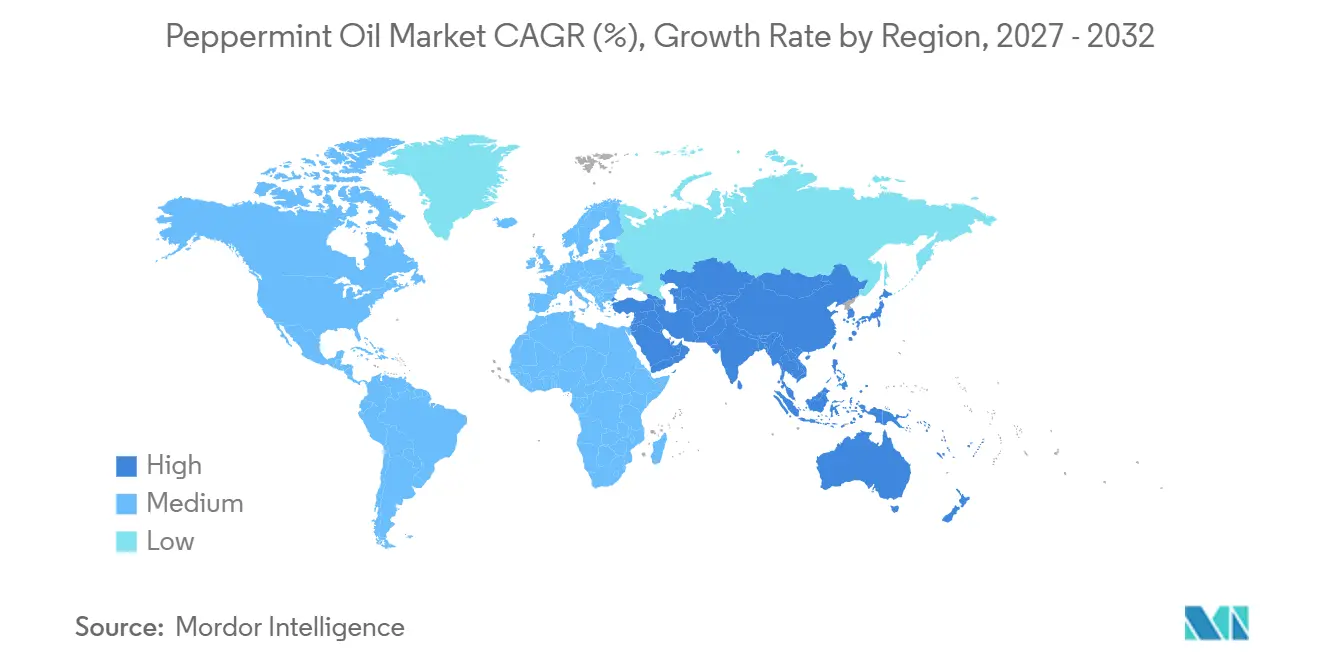
North America holds the largest regional share of the peppermint oil market, accounting for 32.37% in 2026, supported by established demand across food and beverage manufacturing, oral care, pharmaceuticals, and personal care. Domestic production in the United States contributes to regional supply, while established processing capabilities support the availability of peppermint oil for industrial and specialized applications. Demand from manufacturers seeking consistent ingredient quality and reliable sourcing further reinforces the region's position. However, competition from synthetic alternatives and changes in domestic cultivation can influence natural peppermint oil supply and procurement patterns.
Asia-Pacific is the fastest-growing regional market, with a forecast CAGR of 8.05% during 2027–2032, driven by expanding applications of peppermint oil across food products, personal care, pharmaceuticals, and wellness formulations. Growing consumer interest in essential-oil-based products and the wider availability of wellness products through online and offline distribution channels support regional demand. Established mint cultivation and processing capabilities in countries such as India and China also contribute to the region's role in the peppermint oil supply chain. Continued development of domestic processing and product formulation capabilities may further support market expansion.
Europe, South America, and the Middle East and Africa represent additional markets with distinct demand and supply characteristics. European demand is supported by established food, fragrance, pharmaceutical, and personal care industries, alongside attention to ingredient quality, traceability, and organic certification. South America has opportunities linked to agricultural production and the processing of mint-derived ingredients, while demand across the Middle East and Africa is supported by the use of peppermint oil in personal care, oral hygiene, and pharmaceutical products. Differences in local production capabilities, import dependence, and distribution infrastructure will continue to influence market development across these regions.
Competitive Landscape
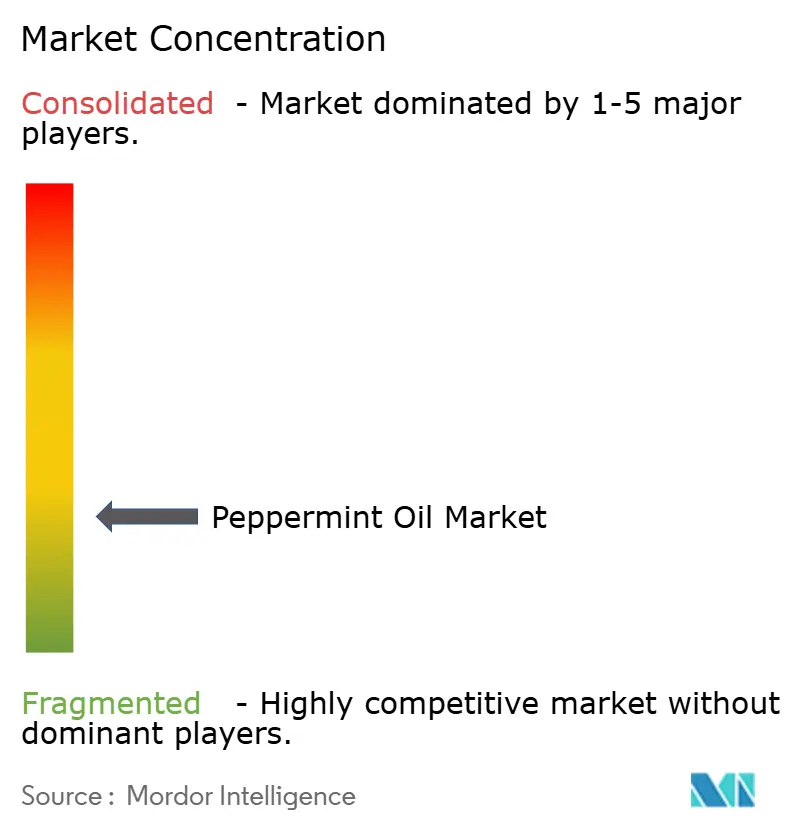
The peppermint oil market is fragmented, with competition among ingredient manufacturers, essential oil processors, and specialised suppliers. Major players identified in the market include Jindal Drugs, dsm-firmenich AG, Givaudan, Lebermuth, Inc., and Ultra International Limited. These companies participate in different parts of the value chain, including raw-material sourcing, oil processing, ingredient formulation, and distribution. Competitive positioning depends on factors such as sourcing capabilities, product quality, application expertise, and customer relationships.
Leading players focus on strengthening their ingredient portfolios, sourcing practices, and formulation capabilities to address demand across food and beverages, personal care, pharmaceuticals, and fragrance applications. Givaudan's 2030 strategy identifies natural solutions, transparency, and clean-label positioning as strategic priorities, reflecting the growing importance of natural ingredients within its business. Companies such as dsm-firmenich AG also draw on their flavour and fragrance expertise to serve manufacturers requiring specialised ingredient solutions. These activities highlight how product development, technical capabilities, and sourcing standards differentiate established suppliers.
Emerging and specialised suppliers compete through cost efficiency, access to raw materials, product quality assurance, and traceability. Indian processors such as Jindal Drugs serve the competitive landscape through their presence in the essential oils and ingredient supply chain. Increasing attention to peppermint oil authenticity and consistency also creates opportunities for suppliers that can demonstrate reliable quality and sourcing practices. Specialised formulation technologies and direct-to-consumer essential oil brands further contribute to differentiation in specific market channels, although their business models differ from those of bulk ingredient suppliers.
Peppermint Oil Industry Leaders
-
Jindal Drugs
-
dsm-firmenich AG
-
Givaudan
-
Lebermuth, Inc.
-
Ultra International Limited
- *Disclaimer: Major Players sorted in no particular order
Recent Industry Developments
- August 2025: Gem Aromatics Limited listed its shares on the National Stock Exchange of India and the Bombay Stock Exchange following its initial public offering. The listing marked a corporate milestone for the specialty ingredients manufacturer, whose portfolio includes peppermint oil, other mint oils and mint derivatives. The development expanded public-market access to a company operating in the mint ingredients sector.
- April 2025: doTERRA officially launched its Kazakhstan market through a grand-opening event in Almaty, extending its international distribution network for essential oils and wellness products. The expansion provides access to a new national market for the company's portfolio, which includes peppermint essential oil. The launch supports the company's geographic expansion and broadens the availability of its essential oil products in Central Asia.
Global Peppermint Oil Market Report Scope
The peppermint oil market covers the production, processing, and supply of oil extracted from peppermint leaves for use as a flavouring, fragrance, and functional ingredient across various industries. The peppermint oil market is segmented by nature into conventional peppermint oil and organic peppermint oil; by application into food and beverages, personal care and cosmetics, aromatherapy and wellness, and other applications; and by geography into North America, Europe, Asia-Pacific, South America, and the Middle East and Africa. The market forecasts are provided in terms of value in USD and volume in metric tons.
| Conventional Peppermint Oil |
| Organic Peppermint Oil |
| Food and Beverages |
| Personal Care and Cosmetics |
| Aromatherapy and Wellness |
| Other Applications |
| North America | United States |
| Canada | |
| Mexico | |
| Rest of North America | |
| Europe | Germany |
| United Kingdom | |
| Italy | |
| France | |
| Spain | |
| Rest of Europe | |
| Asia-Pacific | China |
| India | |
| Japan | |
| Australia | |
| Rest of Asia-Pacific | |
| South America | Brazil |
| Argentina | |
| Rest of South America | |
| Middle East and Africa | South Africa |
| Saudi Arabia | |
| Rest of Middle East and Africa |
| By Nature | Conventional Peppermint Oil | |
| Organic Peppermint Oil | ||
| By Application | Food and Beverages | |
| Personal Care and Cosmetics | ||
| Aromatherapy and Wellness | ||
| Other Applications | ||
| By Geography | North America | United States |
| Canada | ||
| Mexico | ||
| Rest of North America | ||
| Europe | Germany | |
| United Kingdom | ||
| Italy | ||
| France | ||
| Spain | ||
| Rest of Europe | ||
| Asia-Pacific | China | |
| India | ||
| Japan | ||
| Australia | ||
| Rest of Asia-Pacific | ||
| South America | Brazil | |
| Argentina | ||
| Rest of South America | ||
| Middle East and Africa | South Africa | |
| Saudi Arabia | ||
| Rest of Middle East and Africa | ||
Key Questions Answered in the Report
What is the projected value of the peppermint oil market by 2032?
The peppermint oil market is projected to reach USD 427.6 million by 2032, from USD 284.4 million in 2026, at a 7.26% CAGR for 2027-2032.
Which application currently has the largest peppermint oil market revenue share?
Food and beverages leads applications with a 33.76% share in 2026, supported by confectionery, chewing gum, teas, and functional beverages.
Which peppermint oil market application is growing the fastest?
Aromatherapy and wellness is forecast to grow at an 8.71% CAGR through 2032, supported by retail wellness demand and clinical interest in nausea management.
Which region leads global demand in the peppermint oil market?
North America leads with a 32.37% share in 2026.