
Patchouli Oil Market Size and Share
Market Overview
| Study Period | 2022 - 2032 |
|---|---|
| Market Size (2027) | USD 61.08 Million |
| Market Size (2032) | USD 74.45 Million |
| Growth Rate (2027 - 2032) | 4.04 % |
| Fastest Growing Market | Asia-Pacific |
| Largest Market | North America |
| Market Concentration | Medium |
Major Players *Disclaimer: Major Players sorted in no particular order Image © Mordor Intelligence. Reuse requires attribution under CC BY 4.0. | |
Patchouli Oil Market Analysis by Mordor Intelligence
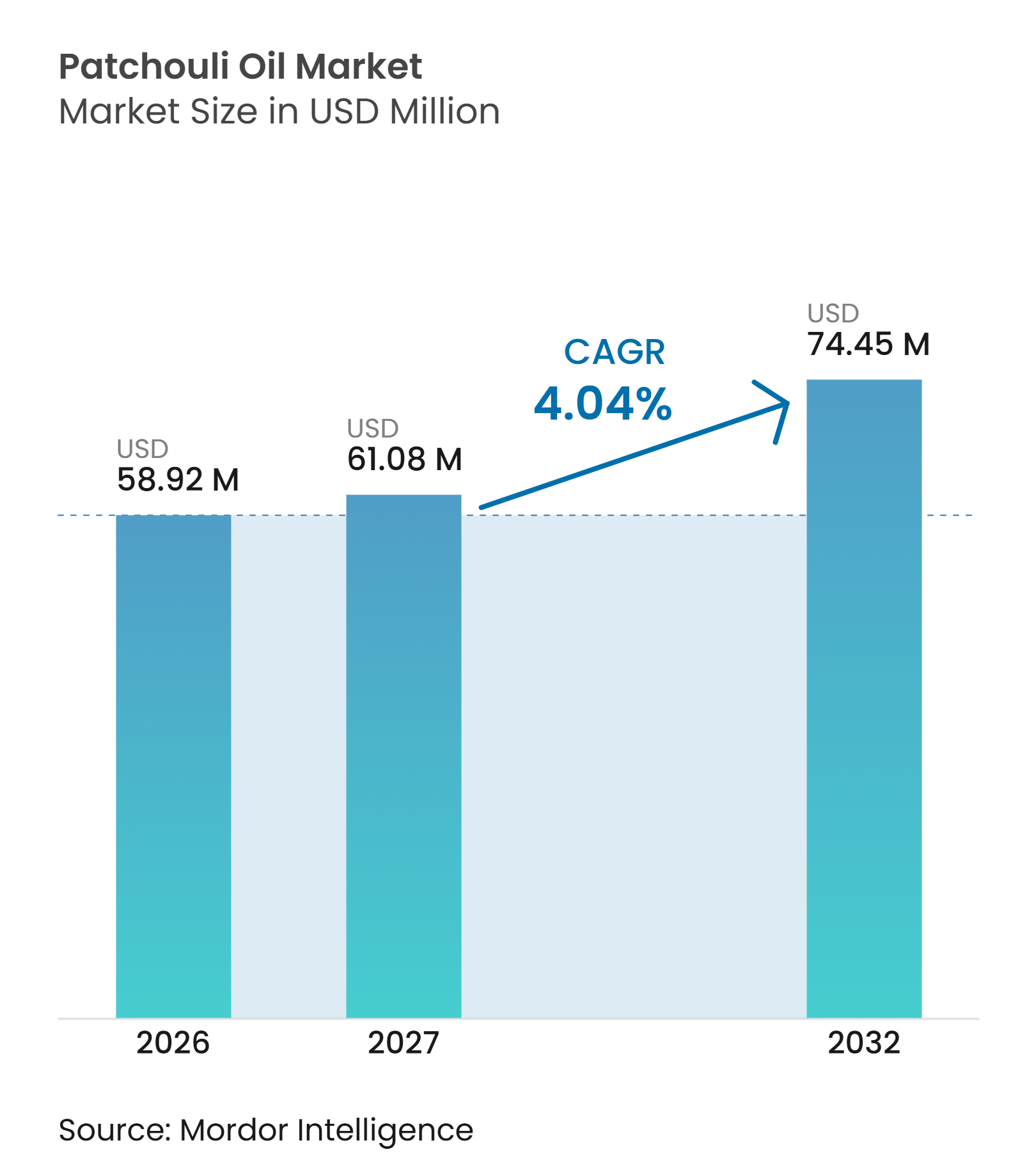
The patchouli oil market size was valued at USD 58.92 million in 2026 and is estimated to grow from USD 61.08 million in 2027 to reach USD 74.45 million by 2032, at a CAGR of 4.04% during the forecast period (2027-2032). Demand from fragrance, cosmetics, and wellness buyers for botanical ingredients that deliver reliable performance in finished formulations drives growth. Patchouli remains valuable because its sesquiterpene profile provides a fixative effect, helping preserve volatile top notes in fragrance compositions. The patchouli oil market also benefits from brands’ increasing demand for documented natural ingredients, as regulatory and customer requirements place greater emphasis on ingredient origin and formulation records. Indonesia remains central to global supply, creating opportunities for processors that can provide traceable, consistently specified grades. However, this concentration also exposes buyers to weather-related disruptions, farm economics, and quality variations.
Key Report Takeaways
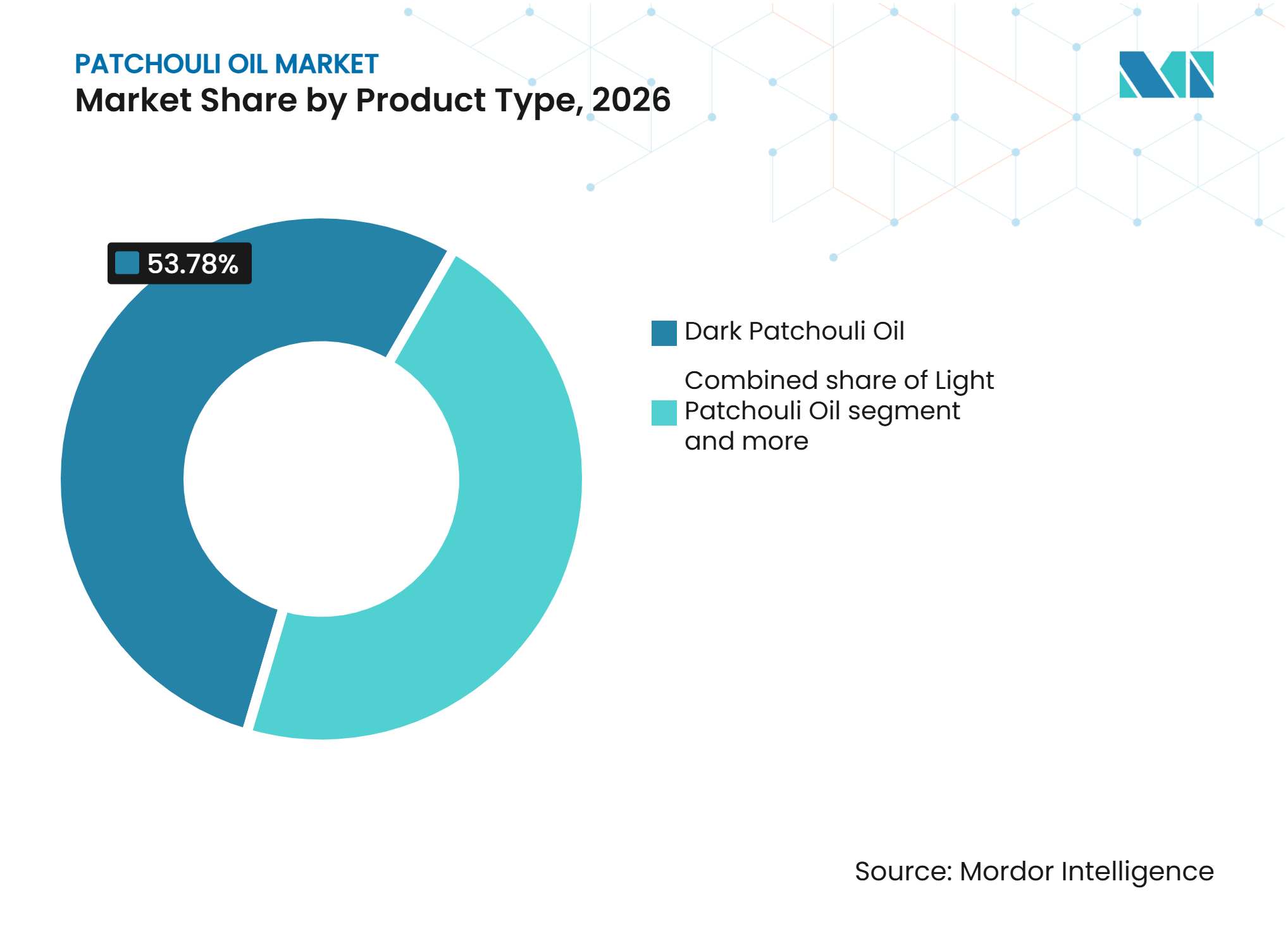
- By product type, dark patchouli oil dominated the patchouli oil market with a share of 53.78% in 2026, while light patchouli oil is anticipated to register the fastest CAGR of 5.21% during 2027-2032.
- By nature, conventional patchouli oil dominated the market with a share of 83.63% in 2026, while organic patchouli oil is anticipated to register the fastest CAGR of 5.97% during 2027-2032.
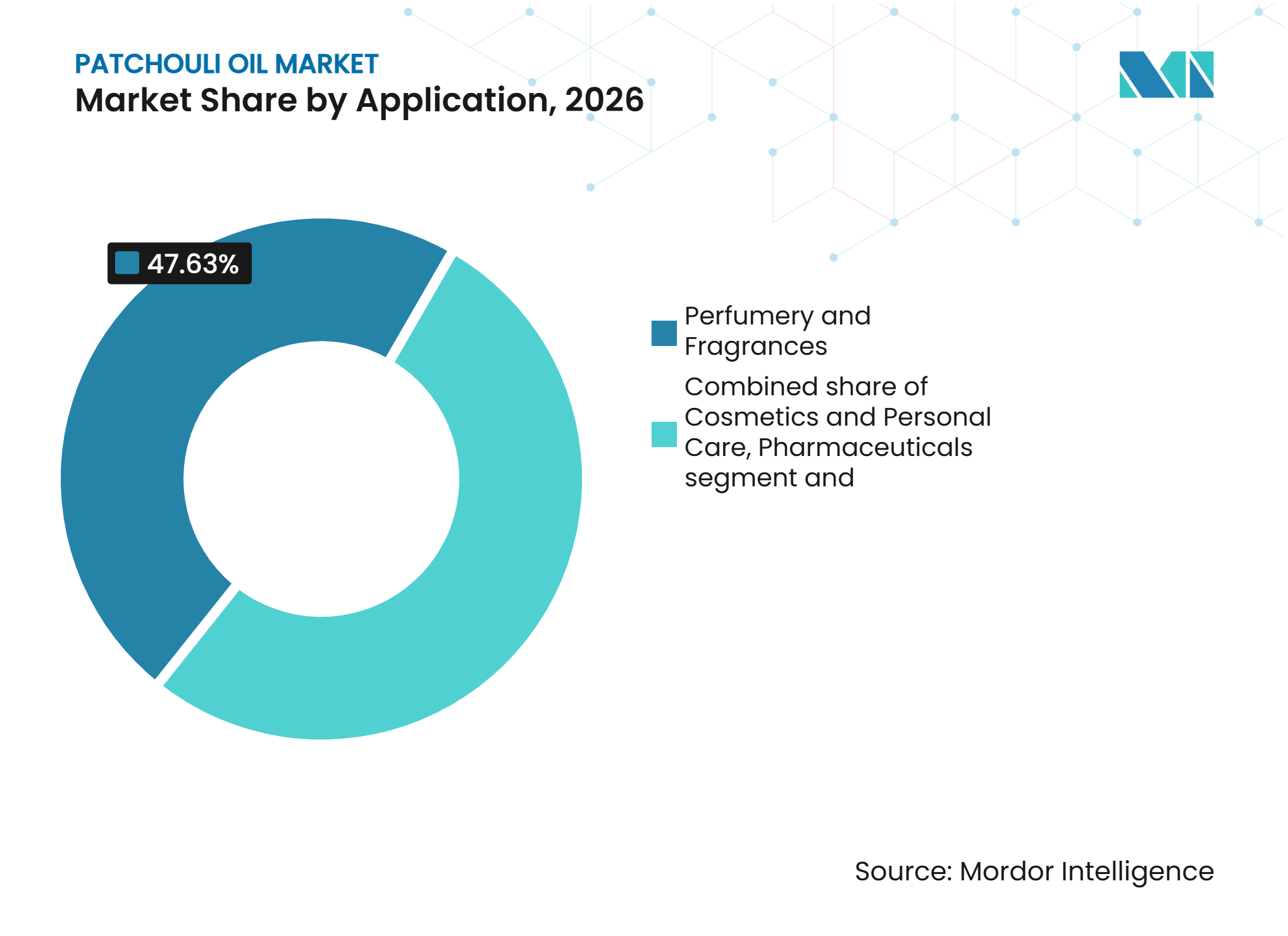
- By application, perfumery and fragrances dominated the market with a share of 47.63% in 2026, while aromatherapy and wellness is anticipated to register the fastest CAGR of 5.31% during 2027-2032.
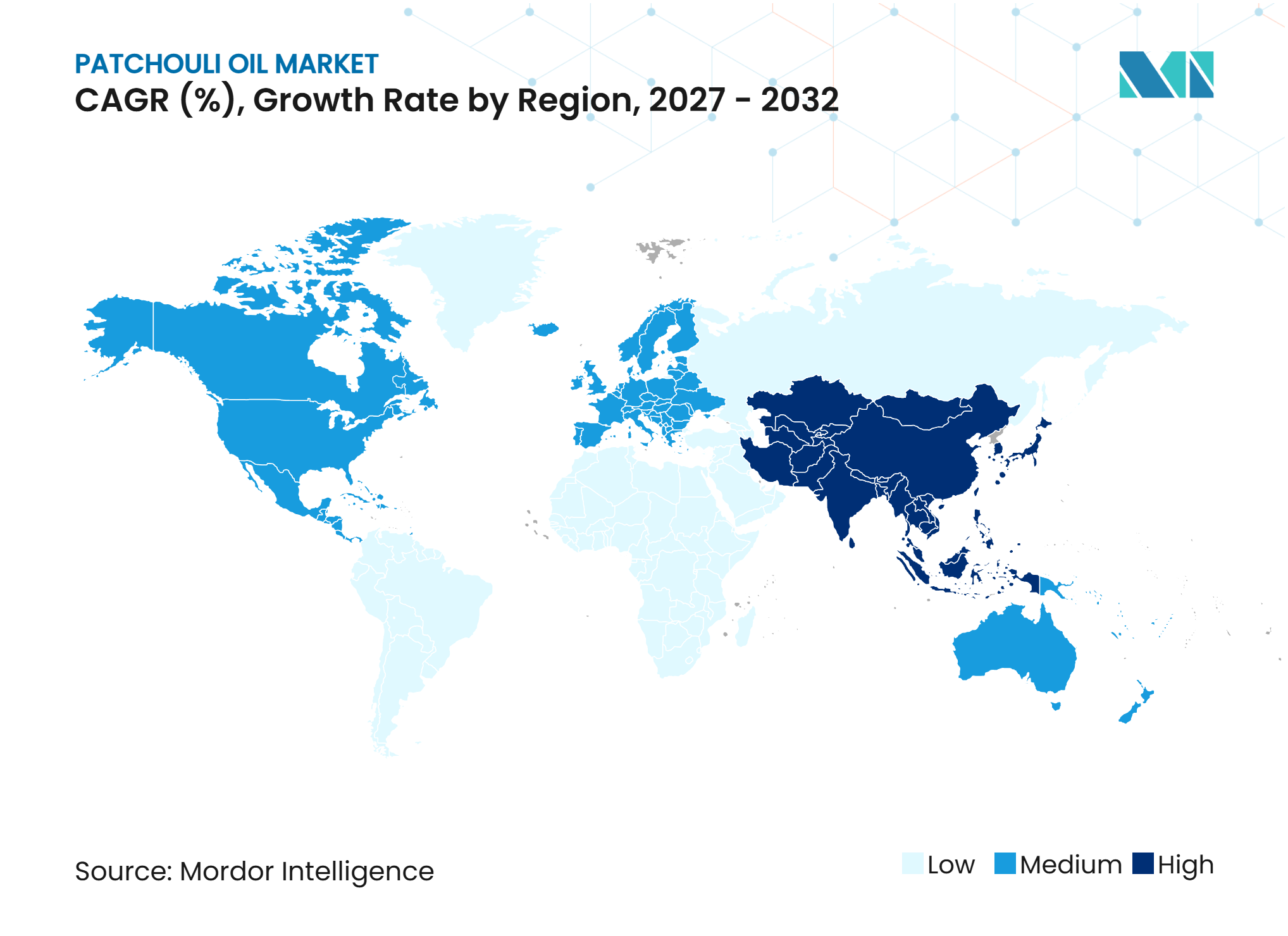
- By geography, North America dominated the patchouli oil market with a share of 39.12% in 2026, while Asia-Pacific is anticipated to register the fastest CAGR of 5.82% during 2027-2032.
Note: Market numbers in this report are based on Mordor Intelligence's proprietary estimation framework, which combines nine months of actuals with Q4 projections for base year 2026.
Market Trends and Insights
Drivers Impact Analysis of Patchouli Oil Market*
| Driver | (~) % Impact on CAGR Forecast | Geographic Relevance | Impact Timeline |
|---|---|---|---|
| Rising demand for natural ingredients in the fragrance | +1.8% | Global, with intensity in North America and Western Europe | Long term (≥ 4 years) |
| Rising popularity of aromatherapy and wellness products | +0.9% | North America, Europe, Asia-Pacific core | Medium term (2-4 years) |
| Expanding applications in household and home fragrance products | +0.6% | North America, Europe, emerging Asia-Pacific | Medium term (2-4 years) |
| Demand for pale, iron-free, and fractionated patchouli ingredients | +0.5% | North America and European Union, spill-over to Asia-Pacific | Short term (≤ 2 years) |
| Growing demand for personalized and innovative fragrance formulations | +0.4% | North America, Western Europe | Long term (≥ 4 years) |
| Technological advancements in essential oil formulation | +0.3% | Global, led by European Research and Development centers | Long term (≥ 4 years) |
| Source: Mordor Intelligence | |||
Rising Demand for Natural Ingredients in the Fragrance Industry
The growing preference for naturally derived fragrance ingredients is supporting demand for patchouli oil in fine fragrances, perfumes, deodorants, and other scented products. Patchouli oil is valued for its distinctive earthy, woody aroma and fixative properties, which add depth and extend the longevity of fragrance compositions. Fragrance manufacturers are incorporating botanical extracts and essential oils into product formulations to address consumer demand for natural-origin ingredients, ingredient transparency, and sustainability. This shift is also reflected in the industry’s ingredient portfolio. In July 2025, the International Fragrance Association (IFRA) published its updated Transparency List, identifying 1,021 Natural Complex Substances (NCSs) among the 3,691 fragrance and functional ingredients documented for fragrance creation worldwide[1]. This development highlights the established role of naturally derived materials in fragrance formulations and supports opportunities for essential oils such as patchouli oil.
Rising Popularity of Aromatherapy and Wellness Products
Aromatherapy demand is increasingly expanding beyond specialist treatment settings into home and personal wellness routines. The patchouli oil market benefits as wellness brands and institutional buyers seek grades with defined chemical profiles rather than standard fragrance-grade supplies. Spa operators, wellness hospitality providers, and professional aromatherapy users often have requirements that differ from those of mass fragrance manufacturers. This distinction creates demand in the patchouli oil market for premium oils supported by stronger documentation, traceability, and analytical testing. The expansion of essential oil-based massage blends, diffuser products, and wellness formulations further broadens the commercial applications of patchouli oil across professional and consumer wellness channels.
Expanding Applications in Household and Home Fragrance Products
The expanding use of fragrance ingredients in household and home fragrance products is creating additional demand opportunities for patchouli oil beyond traditional perfumery applications. Manufacturers of scented candles, incense sticks, room sprays, reed diffusers, and air fresheners are incorporating distinctive aromatic ingredients to develop differentiated fragrance profiles and enhance indoor environments. The growing commercialization of incense products and other home fragrance formats is also broadening the application base for essential oils. In December 2025, India’s Ministry of Consumer Affairs reported that the domestic agarbatti industry is valued at approximately INR 8,000 crore annually, with exports of around INR 1,200 crore to more than 150 countries[2]. The ministry also highlighted the widespread use of incense sticks in households, places of worship, and wellness spaces, demonstrating the commercial significance of fragrance-based household products. This established demand for incense and aromatic products creates additional application opportunities for patchouli oil suppliers.
Demand for Pale, Iron-Free, and Fractionated Patchouli Ingredients
Stainless-steel distillation enables producers to supply formulations that cannot use dark oil produced with conventional iron equipment. Dark oil may exhibit a brown to near-black color due to iron-sesquiterpene complexes, limiting its use in white soaps, pale emulsions, and light-colored cosmetics. Light Patchouli Oil with an iron content below 1 ppm can meet supply-chain requirements for COSMOS, Halal, Kosher documentation. This capability creates opportunities for specialized producers to supply premium-grade ingredients to cosmetic formulators and personal care manufacturers that require tighter control over color, purity, and chemical composition. Furthermore, the availability of pale and fractionated variants enables manufacturers to incorporate patchouli-derived fragrance ingredients into a broader range of visually sensitive formulations.
Restraints Impact Analysis of Patchouli Oil Market*
| Restraint | (~) % Impact on CAGR Forecast | Geographic Relevance | Impact Timeline |
|---|---|---|---|
| Climate sensitivity and unpredictable cultivation | -0.8% | Asia-Pacific supply base, Indonesia core, spill-over global | Long term (≥ 4 years) |
| Inconsistent quality and chemical composition | -0.5% | Indonesia supply base, impact on European Union and North America buyers | Medium term (2-4 years) |
| Price volatility and raw material procurement uncertainty | -0.7% | Global, most acute for small and mid-tier ingredient buyers | Short term (≤ 2 years) |
| Quality documentation and regulatory compliance requirements | -0.3% | European Union and North America buyers | Medium term (2-4 years) |
| Source: Mordor Intelligence | |||
Climate Sensitivity and Unpredictable Cultivation
Patchouli cultivation depends heavily on suitable climatic conditions, particularly consistent rainfall, adequate soil moisture, and well-drained land. Irregular rainfall, prolonged droughts, and excessive precipitation can disrupt plant growth, reduce leaf biomass, and limit the availability of raw materials for essential oil extraction. In October 2025, Indonesia’s Ministry of Agriculture published its Climate, Plant Pest, and Climate Change Impact Statistics for 2023–2025, which incorporates rainfall, temperature, flooding, and drought data, partly sourced from the country’s Meteorology, Climatology, and Geophysics Agency (BMKG)[3]. These documented agricultural climate risks are relevant to patchouli-producing regions, where fluctuations in rainfall and water availability can adversely affect cultivation conditions. Consequently, climate-related production uncertainty can disrupt raw material supply and create procurement challenges for patchouli oil processors.
Price Volatility and Raw Material Procurement Uncertainty
Fluctuations in patchouli oil prices create procurement challenges for essential oil processors, fragrance manufacturers and downstream buyers that depend on a consistent supply of raw materials. Patchouli oil prices are influenced by variations in agricultural production, seasonal availability, cultivation costs, oil quality and patchoulol concentration. Changes in supply conditions and purchasing requirements can create price uncertainty for farmers, collectors and processors, making it difficult for manufacturers to establish stable procurement budgets and long-term supply agreements. Additionally, dependence on geographically concentrated cultivation regions exposes buyers to local production disruptions and fluctuations in raw material availability. These uncertainties can increase sourcing costs, affect profit margins and complicate production planning for manufacturers that require consistent patchouli oil supplies.
*Our forecasts treat driver/restraint impacts as directional, not additive. The impact forecasts reflect baseline growth, mix effects, and variable interactions.
Patchouli Oil Market Segment Analysis
By Product Type:
Light Grade Expands Through Quality RequirementsDark Patchouli Oil accounted for 53.78% of the patchouli oil market in 2026. Its leading position reflects its established use in oriental, leather, and chypre fragrance compositions, where its natural color does not pose a constraint. The grade remains a cost-effective option for high-volume consumer fragrance production. Its earthy, camphoraceous profile provides the depth required in many traditional fragrance families. Large compounders can continue using dark patchouli oil where formulation appearance and iron-content specifications permit. Other product types include supercritical CO₂ extracts and molecularly distilled variants. These products serve prestige perfumery and pharmaceutical-adjacent applications, where buyers pay a premium for higher purity, more defined odor profiles, or specialized processing.
Light Patchouli Oil is forecast to grow at a CAGR of 5.21% through 2032. This growth is driven by demand from clean-label personal care products, pale cosmetic formulations, and original equipment manufacturer (OEM) requirements for iron content below 1 ppm. The light-grade segment benefits when cosmetic formulations require a botanical ingredient that does not discolor finished products. The shift toward light grades increases the importance of analytical control, validated production equipment, and certification readiness. It also incentivizes origin processors to improve the consistency of their distillation and fractionation operations in the patchouli oil market.



By Nature:
Organic Supply Grows Alongside Conventional VolumeConventional patchouli oil is projected to account for 83.63% of the market in 2026. This substantial share reflects the cost and volume requirements of established Indonesian distillation infrastructure. Major fragrance compounding houses procure conventional grades to meet a significant portion of their blending requirements. Their procurement systems are familiar with conventional supply specifications and typical patchoulol ranges. Established gas chromatography-mass spectrometry protocols enable these buyers to verify quality before incorporating the oil into finished formulations. Switching costs also make a rapid transition to certified organic supply unlikely for high-volume applications. The patchouli oil market will continue to rely on reliable conventional material, even as demand for specialty products expands.
Organic patchouli oil is forecast to grow at a CAGR of 5.97% through 2032. Prestige fragrance houses, clean beauty brands, and institutional aromatherapy buyers are increasingly including Organic certifications in their sourcing requirements. This consumer preference influences ingredient specifications and supports demand for certified material. Organic producers serving the patchouli oil market must combine certification with consistent composition, credible chain-of-custody records, and reliable logistics. Although these requirements may constrain supply in the near term, they also foster stronger supplier relationships. The patchouli oil industry gains value when growers, distillers, and buyers maintain organic status throughout the supply chain.
By Application:
Perfumery Provides Scale While Wellness Builds DemandPerfumery and Fragrances accounted for 47.63% of the segment size in 2026. Patchouli oil serves as a base-note fixative in fine fragrances, extending the longevity of fragrance compositions. It commonly blends with bergamot, rose, sandalwood, and vetiver across oriental, chypre, and gourmand fragrance families. Cosmetics and Personal Care represent another major application area, including lotions, shampoos, soaps, and body care products. Household and Home Fragrance Products also use patchouli oil in candles and reed diffusers due to its slow evaporation rate. Pharmaceutical research remains comparatively small in commercial terms but has expanded interest in controlled-delivery formats.
Aromatherapy and Wellness is forecast to grow at a CAGR of 5.31% through 2032. In November 2025, the International Labour Organization reported that Indonesia’s Aceh patchouli value chain had developed 32 locally derived products, including therapeutic formulations. The wellness application segment benefits from product formats that extend beyond occasional spa use into regular home-use routines. Buyers in this segment generally prefer oils with high patchoulol content and grades supported by technical evidence. Consequently, this segment has distinct quality and documentation requirements compared with standard perfumery applications. Suppliers that support formulation development, provide analytical records, and maintain certifications can meet these higher-value requirements. This application also reinforces the case for localized product innovation in the patchouli oil market near the Indonesian supply base.

Geography Analysis
North America: Clean-Label Requirements Support Documented Supply
North America holds a 39.12% market share in 2026. The Modernization of Cosmetics Regulation Act (MoCRA) places greater emphasis on ingredient documentation, facility records and cosmetic safety requirements. In North America, consumer demand and formal procurement standards that favour traceable, quality-controlled supplies drive the patchouli oil market. Established fragrance houses, cosmetic manufacturers and speciality ingredient distributors further support demand for consistently high-quality patchouli oil across commercial applications. Additionally, the region's established personal care and fine fragrance industries provide a broad customer base for suppliers offering standardised patchouli oil grades with reliable quality specifications and regulatory documentation.
Asia-Pacific: Indonesian Processing Changes the Supply Role
Asia-Pacific is forecast to grow at a CAGR of 5.82% through 2032. China and India drive demand through cosmetics, aromatics, incense and wellness product manufacturing. Indonesian producers can retain a greater share of value locally by offering higher-value finished ingredients and standardised products. The region’s established agricultural base, essential oil processing capabilities and expanding domestic manufacturing networks provide additional opportunities for local producers to strengthen their positions in international supply chains. Furthermore, the availability of locally sourced patchouli leaves and established distillation networks provides regional manufacturers with opportunities to improve raw material accessibility, expand processing capacity and serve international fragrance and personal care buyers more efficiently.
Europe, South America, and the Middle East and Africa: Established Imports Meet New Demand
Europe represents the second-largest regional demand base, with France, Germany, the United Kingdom, and the Netherlands hosting established fragrance-compounding networks. Brazil supports demand in South America through its cosmetics manufacturing industry, while Saudi Arabia, the United Arab Emirates, and South Africa generate demand for base-note-heavy fragrances. These diverse geographies create additional opportunities for premium patchouli oil grades supported by robust documentation and flexible delivery capabilities. European fragrance manufacturers prioritize consistent aroma profiles, chemical specifications, and responsible sourcing, which further supports the procurement of specialized patchouli oil varieties. Furthermore, the expanding cosmetics, personal care, and premium fragrance industries across emerging markets enable suppliers to diversify their customer base beyond traditional European buyers.
Competitive Landscape
Market Concentration
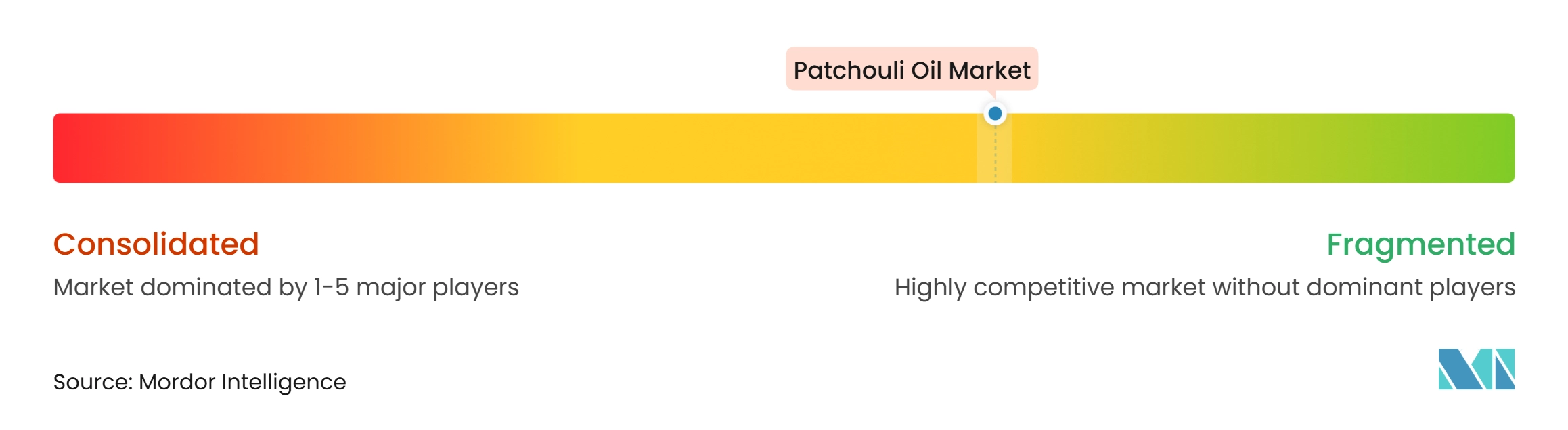
The patchouli oil market is moderately fragmented, with competition among Indonesian-origin processors, specialty essential oil producers, distributors, and international fragrance manufacturers. Companies such as Van Aroma, PT Indesso Aroma, and PT Djasula Wangi compete based on raw material sourcing, distillation capabilities, product quality, and certifications. European suppliers and fragrance houses, including Robertet Group and MANE, focus on specialized grades, traceability, quality documentation, and customized fragrance ingredients to meet the requirements of premium fragrance and personal care manufacturers.
Product innovation and alternative ingredient development are shaping competitive strategies as manufacturers address batch inconsistencies, climate-related supply disruptions, and variations in natural oil composition. In 2025, dsm-firmenich introduced Clearwood® Prisma, a natural patchouli-character ingredient developed through biotechnology, alongside its Patchouli Heart SFE offering. Similarly, Givaudan uses enzymatic transformation of natural patchouli to produce Akigalawood, a distinctive woody fragrance ingredient. These developments demonstrate the industry's focus on differentiated patchouli-derived materials.
Competition is shifting beyond conventional essential oil production toward specialized processing, ingredient innovation, and supply chain reliability. Manufacturers are strengthening capabilities in chemical profiling, GC-MS testing, traceability, and certification to meet the procurement requirements of international fragrance and cosmetics companies. Indonesian processors retain an advantage due to their proximity to major cultivation regions, while international fragrance companies differentiate themselves through formulation expertise, proprietary technologies, and premium ingredient portfolios.
Patchouli Oil Industry Leaders
-
Van Aroma
-
Givaudan S.A.
-
Plant Therapy Essential Oils
-
Symrise AG
-
Takasago International Corporation
- *Disclaimer: Major Players sorted in no particular order
Patchouli Oil Market Companies Covered in this Report
- Van Aroma
- Givaudan S.A.
- Plant Therapy Essential Oils
- PT Indesso Aroma
- Symrise AG
- International Flavors & Fragrances, Inc.
- DSM-Firmenich AG
- Robertet Group
- Takasago International Corporation
- Mane SA
- Ultra International B.V.
- PT Djasula Wangi
- Mountain Rose Herbs
- Berjé Inc.
- Albert Vieille
- Ernesto Ventós SA
- Aromaaz International
- Young Living Essential Oils
- doTERRA International LLC
- NOW Health Group, Inc.
Recent Industry Developments in Patchouli Oil Market
- September 2026: Baisifu added premium patchouli oil to its global business-to-business supply portfolio. The product serves fragrance, flavor, and cosmetic applications and meets specifications for patchoulol, alpha-bulnesene, and alpha-guaiene.
- July 2026: Agri-Essence launched Patchouli Oil PA50. The new ingredient offers more transparent, pure earthy, and musky fragrance notes, providing fragrance developers with an alternative patchouli ingredient for specialized formulations.
- October 2025: Cosmo introduced a molecularly distilled Indonesian patchouli ingredient with deep woody, earthy, and amber fragrance notes. This development demonstrates the use of advanced processing technologies to refine natural patchouli materials for specialty fragrance formulations.
Global Patchouli Oil Market Report Scope
Patchouli oil is a natural essential oil extracted from the dried leaves of the patchouli plant, primarily through steam distillation.
The patchouli oil market is segmented by product type, nature, application, and geography. By product type, the market is segmented into light patchouli oil, dark patchouli oil, and other product types. By nature, the market is segmented into organic and conventional. By application, the market is segmented into perfumery and fragrances, cosmetics and personal care, aromatherapy and wellness, household and home fragrance products, pharmaceuticals, and other applications. Based on geography, the market is classified into North America, Europe, South America, Asia-Pacific, and the Middle East and Africa. The market forecasts are provided in terms of value (USD).
Segmentation Overview
| Light Patchouli Oil |
| Dark Patchouli Oil |
| Other Product Types |
| Organic |
| Conventional |
| Perfumery and Fragrances |
| Cosmetics and Personal Care |
| Aromatherapy and Wellness |
| Household and Home Fragrance Products |
| Pharmaceuticals |
| Other Applications |
| North America | United States |
| Canada | |
| Mexico | |
| Rest of North America | |
| Europe | Germany |
| United Kingdom | |
| Italy | |
| France | |
| Spain | |
| Poland | |
| Belgium | |
| Netherlands | |
| Rest of Europe | |
| Asia-Pacific | China |
| India | |
| Japan | |
| Australia | |
| Indonesia | |
| Thailand | |
| Singapore | |
| Rest of Asia-Pacific | |
| South America | Brazil |
| Argentina | |
| Peru | |
| Colombia | |
| Rest of South America | |
| Middle East and Africa | South Africa |
| Saudi Arabia | |
| United Arab Emirates | |
| Egypt | |
| Turkey | |
| Rest of Middle East and Africa |
| By Product Type | Light Patchouli Oil | |
| Dark Patchouli Oil | ||
| Other Product Types | ||
| By Nature | Organic | |
| Conventional | ||
| By Application | Perfumery and Fragrances | |
| Cosmetics and Personal Care | ||
| Aromatherapy and Wellness | ||
| Household and Home Fragrance Products | ||
| Pharmaceuticals | ||
| Other Applications | ||
| By Geography | North America | United States |
| Canada | ||
| Mexico | ||
| Rest of North America | ||
| Europe | Germany | |
| United Kingdom | ||
| Italy | ||
| France | ||
| Spain | ||
| Poland | ||
| Belgium | ||
| Netherlands | ||
| Rest of Europe | ||
| Asia-Pacific | China | |
| India | ||
| Japan | ||
| Australia | ||
| Indonesia | ||
| Thailand | ||
| Singapore | ||
| Rest of Asia-Pacific | ||
| South America | Brazil | |
| Argentina | ||
| Peru | ||
| Colombia | ||
| Rest of South America | ||
| Middle East and Africa | South Africa | |
| Saudi Arabia | ||
| United Arab Emirates | ||
| Egypt | ||
| Turkey | ||
| Rest of Middle East and Africa | ||
Key Questions Answered in the Report
What is the current and projected size of the patchouli oil market?
The patchouli oil market was valued at USD 58.92 million in 2026 and is projected to reach USD 74.45 million by 2032, growing at a CAGR of 4.04% during 2027-2032.
Which product type held the largest share in the patchouli oil market in 2026?
Dark patchouli oil was the leading product type, accounting for 53.78% of the market share in 2026.
Which nature segment dominated the patchouli oil market in 2026?
The conventional segment dominated the market with a 83.63% share in 2026.
What was the largest application segment in the patchouli oil market in 2026?
Perfumery and fragrances were the largest application segment, holding 47.63% of the market in 2026.
Which region accounted for the largest share of the patchouli oil market in 2026?
North America led the market, capturing 39.12% of total revenue in 2026.