
Paste PVC Resin Market Size and Share
Market Overview
| Study Period | 2021 - 2031 |
|---|---|
| Market Size (2026) | USD 4.14 Billion |
| Market Size (2031) | USD 5.32 Billion |
| Growth Rate (2026 - 2031) | 5.14 % |
| Fastest Growing Market | Asia-Pacific |
| Largest Market | Asia-Pacific |
| Market Concentration | Low |
Major Players *Disclaimer: Major Players sorted in no particular order Image © Mordor Intelligence. Reuse requires attribution under CC BY 4.0. | |
Paste PVC Resin Market Analysis by Mordor Intelligence
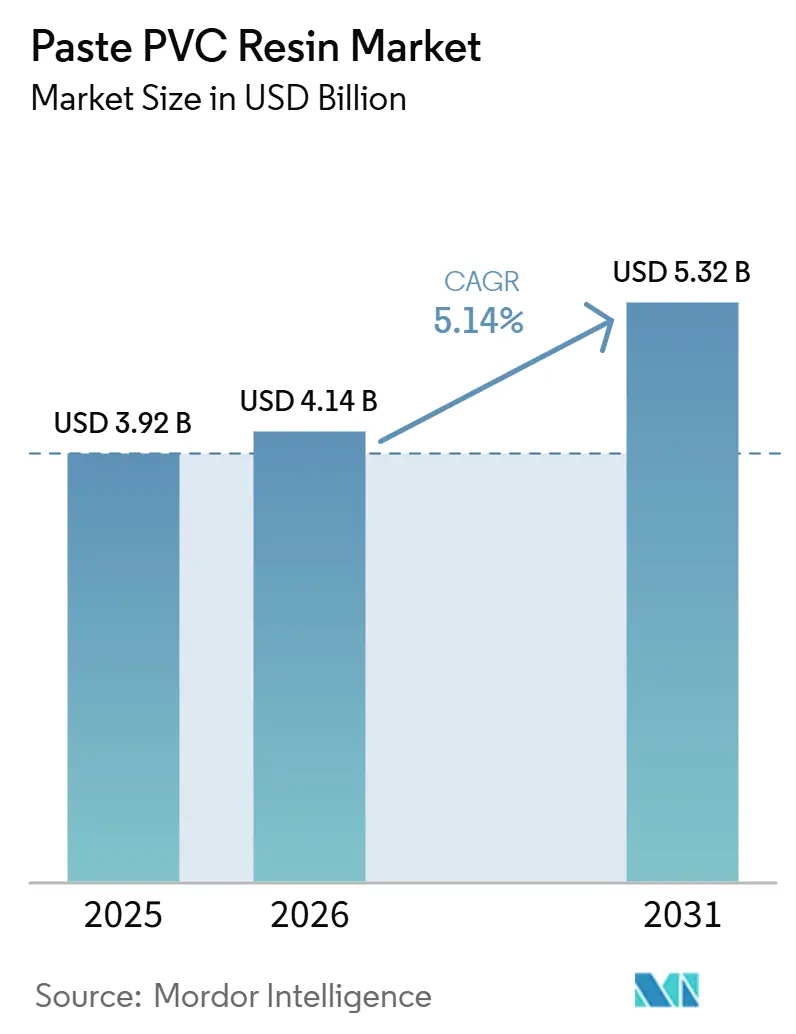
The Paste PVC Resin Market was valued at USD 3.92 billion in 2025 and is estimated to grow from USD 4.14 billion in 2026 to reach USD 5.32 billion by 2031, at a CAGR of 5.14% during the forecast period (2026–2031). Demand is supported by broader use of plastisol systems in construction, automotive, and healthcare applications that require controlled particle morphology, stable viscosity, predictable fusion behavior, and reliable finished-product appearance across large production runs. Asia-Pacific remained the center of demand in 2025, and its manufacturing base continues to shape supply, procurement, product qualification, local service expectations, and competitive pricing in the paste PVC resin market. Producers are responding with capacity programs, specialized grades, documented compliance support, and closer technical support for converters that need repeatable performance in demanding applications. Cost pressure, plasticizer restrictions, and excess standard-grade capacity in China are likely to keep the paste PVC resin market divided between high-volume supply and higher-specification applications.
Key Report Takeaways
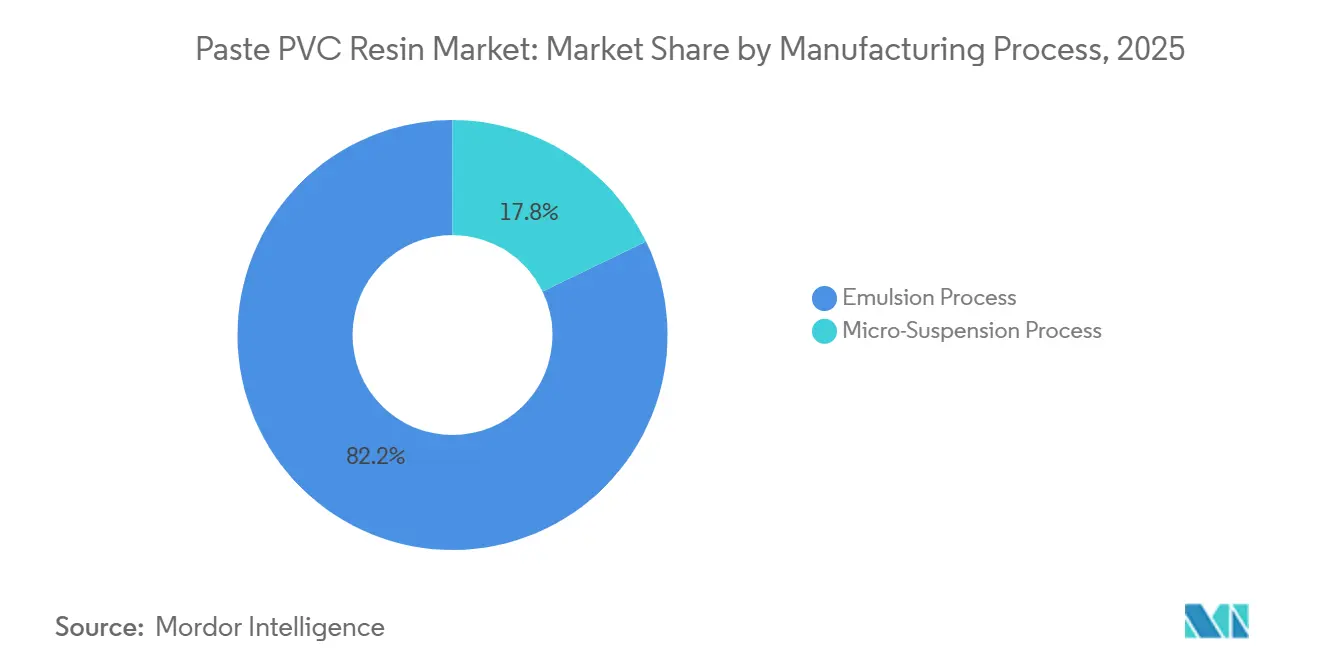
- By manufacturing process, the emulsion process held 82.16% of the paste PVC resin market share in 2025, while the micro-suspension process is forecast to grow at a 6.17% CAGR through 2031.
- By grade, medium K-value grade accounted for 36.84% of the paste PVC resin market share in 2025, while vinyl acetate copolymer grade is projected to expand at a 6.54% CAGR through 2031.
- By application, synthetic leather captured 34.22% of the paste PVC resin market share in 2025, while gloves (industrial and medical) are expected to advance at a 6.83% CAGR through 2031.
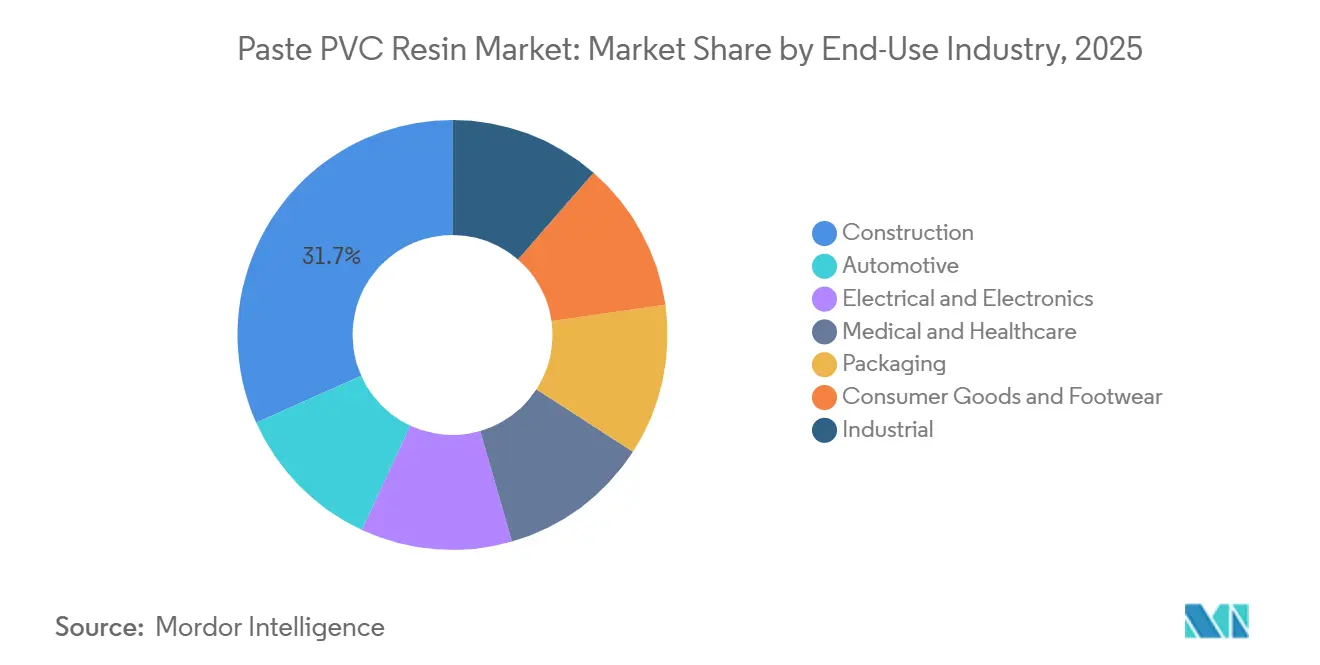
- By end-use industry, construction held 31.68% of the paste PVC resin market share in 2025, while medical and healthcare is projected to grow at a 6.97% CAGR through 2031.
- By geography, Asia-Pacific held 58.92% of the paste PVC resin market share in 2025 and is projected to grow at a 5.93% CAGR through 2031.
Note: Market size and forecast figures in this report are generated using Mordor Intelligence’s proprietary estimation framework, updated with the latest available data and insights as of January 2026.
Market Trends and Insights
Drivers Impact Analysis of Paste PVC Resin Market*
| Driver | (~) % Impact on CAGR Forecast | Geographic Relevance | Impact Timeline |
|---|---|---|---|
| Growing Demand from the Construction Industry for Resilient Flooring and Wall Covering Applications | +1.2% | Global; concentrated in Asia-Pacific and North America | Medium term (2-4 years) |
| Increasing Use of Paste PVC Resin in Automotive Interior Components, Sealants, and Coatings | +0.8% | Global; strong pull from China, Germany, and South Korea | Long term (≥4 years) |
| Expanding Demand for Synthetic Leather, Gloves, and Specialty Coating Applications | +1.1% | Asia-Pacific core; spill-over to South and Southeast Asia | Medium term (2-4 years) |
| Rising Adoption of Low-Viscosity Paste PVC Grades for High-Speed Plastisol Processing | +0.6% | Global; most concentrated in Southeast Asia and Europe | Medium term (2-4 years) |
| Growing Development of Bio-Circular and Recycled-Content PVC Resin Solutions | +0.4% | Europe and North America primarily | Long term (≥4 years) |
| Source: Mordor Intelligence | |||
Growing Demand from the Construction Industry for Resilient Flooring and Wall Covering Applications
Construction remains the largest end-use area for the paste PVC resin market because resilient flooring and wall-covering systems use plastisols in functional layers. Luxury vinyl tile and stone plastic composite products rely on carefully formulated foam and backing layers. Paste resin, therefore, serves as a material input with application-specific requirements rather than a simple interchangeable commodity. Vinyl wall coverings used in commercial and healthcare facilities provide a second source of demand for fine-particle emulsion grades. Long qualification cycles between resin suppliers and formulators can reinforce established sourcing relationships in the paste PVC resin market.
Expanding Demand for Synthetic Leather, Gloves, and Specialty Coating Applications
Synthetic leather is an important outlet for paste resin in automotive, footwear, furniture, and related coated-fabric applications. Industrial and medical gloves add another demand base for the paste PVC resin market, especially in Asian production centers. LG Chem’s HRTP4000 has a polymerization degree above 4,000, compared with 1,000 for conventional PVC, and supports 125 °C thermal resistance and recyclability without material separation.
Increasing Use of Paste PVC Resin in Automotive Interior Components, Sealants, and Coatings
Automotive underbody coatings and seam sealants are technically demanding uses for paste PVC resin. Electric vehicle platforms extend this need because battery housings require protective undercarriage coatings and flexible sealant compounds that tolerate thermal cycling. These places paste resin within vehicle architectures beyond conventional interior uses. SCG Chemicals’ PR701 is produced under OxyChem’s HYBRID technology and complies with RoHS II Directive 2011/65/EU and the Green Building Council of Australia guidelines[1]SCG Chemicals, “Technical Data Sheet SCGC PVC PR701,” SCG Chemicals, scgchemicals.com. These requirements show why automotive grades need both documented compliance and stable processing performance. Dedicated plastisol lines for seating leather and underbody coatings can create supplier commitments that extend across several vehicle generations.
Rising Adoption of Low-Viscosity Paste PVC Grades for High-Speed Plastisol Processing
Low-viscosity grades allow processors to raise line throughput while maintaining surface finish. These grades can reduce time and energy use per unit of output when the processing window is stable. Vinyl acetate copolymer grades generally fuse at temperatures 20-30 °C below comparable homopolymer grades, lowering oven energy use for converters. Orbia launched VESTOLIT M 124 and VESTOLIT XC 866 in December 2025, with the former positioned as a K-64 low-viscosity grade with foaming properties and the latter designed to reduce viscosity while retaining mechanical properties. The KaneVinyl portfolio also includes micro-suspension and emulsion grades for flooring, leather, and wall-covering uses. Grade differentiation can therefore matter more than price for mid- and high-specification converters in Southeast Asia, while bio-circular and recycled-content solutions remain a longer-term development area in Europe and North America.
Restraints Impact Analysis of Paste PVC Resin Market*
| Restraint | (~) % Impact on CAGR Forecast | Geographic Relevance | Impact Timeline |
|---|---|---|---|
| Stringent Environmental Regulations on PVC and Plasticizer Usage | -0.7% | Europe and North America; increasingly affecting Asia-Pacific exporters to EU | Medium term (2-4 years) |
| Volatility in Ethylene, Chlorine, and Energy Prices | -0.9% | Global; most acute for ethylene-route producers in Europe and Northeast Asia | Short term (≤2 years) |
| Stringent Product Quality, Particle Morphology, and Process Qualification Requirements | -0.5% | Global | Long term (≥4 years) |
| Source: Mordor Intelligence | |||
Stringent Environmental Regulations on PVC and Plasticizer Usage
REACH-related phthalate restrictions raise compliance demands for paste PVC formulators serving the European Union. The European Commission added diisobutyl phthalate (DIBP), di-n-pentyl phthalate (DPENP), and di-2-hexyl phthalate (DHEXP) to REACH Annex XVII at a 0.1% concentration threshold in May 2026[2]European Chemicals Agency, “REACH Annex XVII Restriction on Phthalates,” European Chemicals Agency, echa.europa.eu. The restriction applies to PVC flooring, wall panels, automotive sealing compounds, and packaging coatings placed on the EU market. Producers exporting from Asia must document the formulation supply chain, including information from plasticizer suppliers. The diisononyl cyclohexane-1,2-dicarboxylate (DINCH) and dioctyl terephthalate (DOTP) alternatives carry 15-25% premiums over restricted grades, raising formulated plastisol costs. Kem One’s ELYSE membrane electrolysis unit at Fos-sur-Mer became operational in March 2025 and reduces annual CO₂ emissions by 50,000 metric tons, supporting the lower-footprint credentials sought by compliance-sensitive buyers.
Volatility in Ethylene, Chlorine, and Energy Prices
Paste PVC resin production depends on ethylene and chlorine, making costs sensitive to feedstock and energy movements. Crude oil increases linked to Middle-East supply disruptions affected ethylene-route producers in Europe and Northeast Asia in the first half of 2026. Hanwha Solutions reduced vinyl chloride monomer (VCM) operating rates at its Yeosu units from April 2025 under low-margin conditions. Calcium carbide-route producers in China operate on a different cost base that is connected to coal and electricity prices. This difference can improve the cost position of Chinese material when oil-linked feedstocks become more expensive. Product quality, particle morphology, and lengthy customer qualification requirements add another constraint because medical, food-contact, and automotive applications cannot switch grades quickly.
*Our forecasts treat driver/restraint impacts as directional, not additive. The impact forecasts reflect baseline growth, mix effects, and variable interactions.
Paste PVC Resin Market Segment Analysis
By Manufacturing Process:
Emulsion Process Dominance Anchored in Particle-Size RequirementsThe emulsion process held 82.16% of the paste PVC resin market share in 2025. Its position rests on the ability to make particles in the 0.1-2 μm range with narrow size distributions. These characteristics support smooth fusion in synthetic leather topcoats and luxury vinyl tile foam layers. Customers commonly qualify specific grades through testing cycles that last 6-18 months. This combination of specialized assets and qualification work raises switching costs for both suppliers and converters.
The micro-suspension process is forecast to grow at a 6.17% CAGR through 2031. Its quasi-Newtonian flow behavior suits continuous-immersion glove-dipping lines and rotational molding uses where viscosity stability is important. Hanwha’s KH-31G grade is designed for thin-wall PVC gloves and offers low viscosity at low shear rates with limited viscosity aging. This technical profile distinguishes it from commodity emulsion blends. The manufacturing route, therefore, affects both processing performance and the supplier’s ability to serve higher-value applications.


By Grade:
Medium K-Value Grade Drives Revenue, Vinyl Acetate Copolymer Grade Gains MomentumMedium K-value grade accounted for 36.84% of the paste PVC resin market size in 2025. It is widely used in synthetic leather because balanced molecular weight supports mechanical strength, elongation, and heat-aging performance. Automotive and furniture compounders rely on these properties for their finished products. Low K-value grades are used in coatings and printing inks where lower fusion temperature and surface finish are priorities. High K-value grades address heavy-duty uses such as conveyor belt backings and tarpaulins.
Vinyl acetate copolymer grade is projected to grow at a 6.54% CAGR through 2031. Its lower fusion temperature can reduce converter energy costs compared with homopolymer alternatives. The same grades can also operate at lower plasticizer loadings, which is useful as restrictions on orthophthalate plasticizers expand in Europe. LG Chem’s HRTP4000 demonstrates a high-performance category with a polymerization degree above 4,000 and 125 °C heat resistance. It can be recycled without separation, according to the company.
By Application:
Synthetic Leather Leads Revenue While Gloves AccelerateSynthetic leather captured 34.22% of the paste PVC resin market size in 2025. Asian footwear and furniture manufacturing provides a large production base for this application. Larger interior surface areas in electric vehicles also support demand for automotive synthetic leather. The application has a durable revenue base, although premium automotive uses may substitute polyurethane leather in some cases. These factors keep product performance and cost control important for suppliers.
Gloves (industrial and medical) are expected to register a 6.83% CAGR through 2031. PVC glove orders in Asian markets extended into June 2026, indicating recovery after post-pandemic inventory reduction. Adhesives and sealants, printing inks, paints and coatings, packaging and can coatings, and electrical components further broaden the application base.
By End-Use Industry:
Construction Leads, Medical and Healthcare AcceleratesConstruction held 31.68% of the paste PVC resin market share in 2025. Luxury vinyl tile, vinyl wall coverings, roof membranes, and waterproofing compounds all use paste-grade plastisols. Building activity in Asia-Pacific and the North American residential recovery after rate easing in 2025 supports demand through 2031. This broad set of uses reduces dependence on a single finished product. It also makes specification consistency important for converters that produce several building-material formats.
Medical and healthcare is projected to grow at a 6.97% CAGR through 2031. Hospital infrastructure is expanding across Southeast Asia, India, and the Gulf Cooperation Council markets. Examination gloves and intravenous (IV) tubing need ultra-low residual VCM and may require ISO 8317 and FDA 21 Code of Federal Regulations (CFR) compliance. These requirements favor producers with Good Manufacturing Practice (GMP)-aligned process lines. Automotive demand includes seats, door panels, underbody coatings, seam sealants, and dashboard laminates.

Geography Analysis
APAC Paste PVC Resin Market
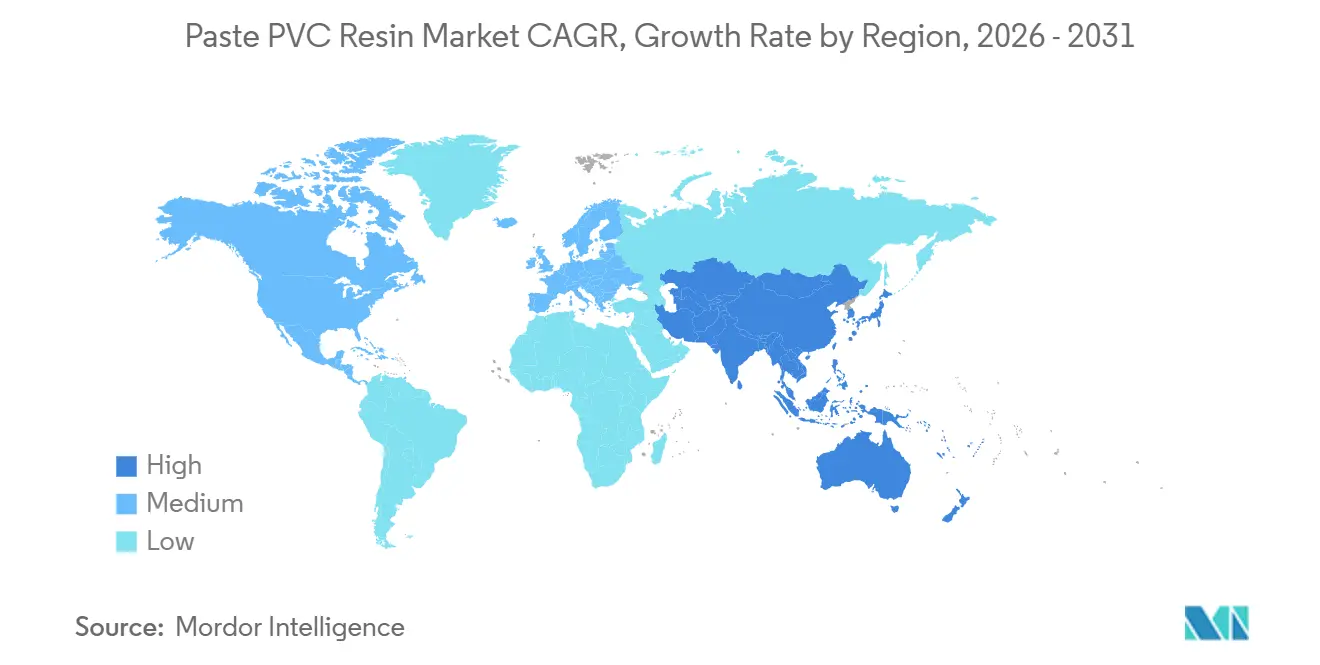
Asia-Pacific held 58.92% of the paste PVC resin market share in 2025 and is forecast to grow at a 5.93% CAGR through 2031. China reported that a 120,000 metric tons per year Tianjin paste PVC plant was commissioned in the first quarter of 2026. These conditions support import substitution for standard emulsion grades. India’s footwear, apparel, healthcare, and construction activity supports the region’s expanding demand base. Japan and South Korea serve high-specification electronics and medical applications. South Korean producers faced both oversupply and higher VCM costs in 2025, and Hanwha Solutions reduced operating rates at Yeosu from April 2025.
North America and Europe Paste PVC Resin Market
North America and Europe anchor the premium-specification tier of the paste PVC resin market. Shintech’s Plaquemine expansion is planned to add 625,000 metric tons per year of ethylene, 500,000 metric tons per year of VCM, and 310,000 metric tons per year of caustic soda, with the first phase expected in 2030.
EMEA and South America Paste PVC Resin Market
Europe’s quality and traceability requirements can favor locally produced and documented grades, although higher energy costs and Chinese imports remain important constraints. Westlake completed its acquisition of the Wilhelmshaven PVC and VCM site in June 2026, adding a facility with 380,000 metric tons per year of PVC capacity. Kem One also secured a EUR 100 million recapitalization in June 2026. South America, and the Middle-East and Africa remain underserved and depend largely on Asian and European imports.

Competitive Landscape
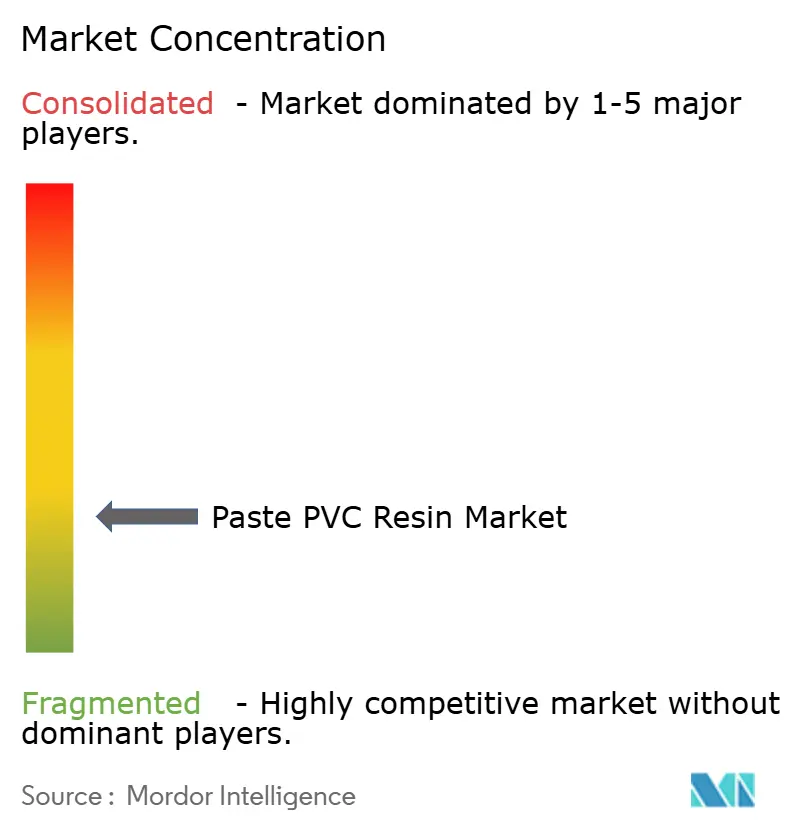
The paste PVC resin market is highly fragmented, with the top five players including Westlake Corporation, The Sanmar Group, Orbia (Vestolit), Kem One, and LG Chem. Regional producers in China, Southeast Asia, and India compete through location, grade specialization, and customer service. Western suppliers focus more on specialty-grade development, documentation, and application support. This balance leaves space for regional producers while preserving a strong role for large global suppliers.
INEOS Inovyn markets BIOVYN as an ISCC PLUS-certified bio-based PVC with a stated carbon footprint reduction of more than 90% compared with conventional grades. Orbia launched VESTOLIT M 124, B 7042, B 7242, and XC 866 in December 2025 for automotive, flooring, and other high-specification converters. The portfolio update shows how suppliers use tailored rheology and application performance to compete beyond volume. Kem One’s lower-emission Fos-sur-Mer project provides a further example of producers linking manufacturing improvements with customer compliance needs.
Opportunities are concentrated in GMP-grade resins for medical and pharmaceutical supply chains, bio-circular grades for audited buyers, and ultra-high-polymerization materials for electric vehicle cable insulation and heat-resistant synthetic leather. LG Chem’s HRTP4000 offers 125 °C heat resistance and recyclability without separation. Tosoh announced a price increase of at least JPY 45 per kilogram across paste PVC grades effective April 21, 2026, reflecting persistent raw-material and energy cost pressure. Patent activity and grade qualification pipelines are likely to matter more than raw capacity additions in higher-margin applications.
Paste PVC Resin Industry Leaders
Westlake Corporation
The Sanmar Group
Orbia (Vestolit)
Kem One
LG Chem
- *Disclaimer: Major Players sorted in no particular order
Paste PVC Resin Market Companies Covered in this Report
- Anhui Tianchen Chemical Co., Ltd.
- Formosa Plastics Corporation
- Hanwha Solutions Corporation
- INEOS
- Kaneka Corporation
- Kem One
- LG Chem
- Orbia (Vestolit)
- Reliance Industries Limited
- SCG Chemicals Public Company Limited
- Shandong Xinfa Chemical Group
- Shin-Etsu Chemical Co., Ltd.
- The Sanmar Group
- Tosoh Corporation
- Westlake Corporation

Recent Industry Developments in Paste PVC Resin Market
- June 2026: Westlake Corporation's German subsidiary, Westlake Vinnolit GmbH & Co. KG, completed the acquisition of a PVC and vinyl chloride monomer production site in Wilhelmshaven, Germany, from insolvency administration. The plant has an annual PVC capacity of 380,000 metric tons and includes deep-water dock infrastructure for raw material supply, expanding Westlake Corporation's chlorovinyl presence in Europe.
- March 2026: Shintech Louisiana, a wholly owned subsidiary of Shin-Etsu Chemical Co., Ltd., announced a USD 3.4 billion phased expansion at its Plaquemine, Iberville Parish, Louisiana facility. The project increased annual capacity by 500,000 metric tons of VCM, strengthening the supply chain for the paste PVC resin market.


Global Paste PVC Resin Market Report Scope
Paste PVC resin is a fine-particle polyvinyl chloride resin produced primarily through emulsion or micro-suspension polymerization processes. It is formulated into plastisols and organosols for applications requiring excellent surface finish, flexibility, coating performance, and molding characteristics across construction, automotive, medical, and consumer industries.
The Paste PVC Resin Market is segmented by manufacturing process, grade, application, end-use industry, and geography. By manufacturing process, the market is segmented into emulsion process and micro-suspension process. By grade, the market is segmented into K grade, low K-value grade, medium K-value grade, high K-value grade, vinyl acetate copolymer grade, and blend resin grade. By application, the market is segmented into synthetic leather, PVC flooring, gloves (industrial and medical), adhesives and sealants, printing inks, paints and coatings, electrical and electronic components, packaging and can coatings, consumer goods, and other applications. By end-use industry, the market is segmented into construction, automotive, electrical and electronics, medical and healthcare, packaging, consumer goods and footwear, and industrial. The report also covers the market size and forecasts for paste PVC resin in 16 countries across major regions. For each segment, the market sizing and forecasts have been done on the basis of value (USD).
| Emulsion Process |
| Micro-Suspension Process |
| K Grade |
| Low K-Value Grade |
| Medium K-Value Grade |
| High K-Value Grade |
| Vinyl Acetate Copolymer Grade |
| Blend Resin Grade |
| Synthetic Leather |
| PVC Flooring |
| Gloves (Industrial and Medical) |
| Adhesives and Sealants |
| Printing Inks |
| Paints and Coatings |
| Electrical and Electronic Components |
| Packaging and Can Coatings |
| Consumer Goods |
| Other Applications |
| Construction |
| Automotive |
| Electrical and Electronics |
| Medical and Healthcare |
| Packaging |
| Consumer Goods and Footwear |
| Industrial |
| Asia-Pacific | China |
| India | |
| Japan | |
| South Korea | |
| Rest of Asia-Pacific | |
| North America | United States |
| Canada | |
| Mexico | |
| Europe | Germany |
| United Kingdom | |
| France | |
| Italy | |
| Russia | |
| Rest of Europe | |
| South America | Brazil |
| Argentina | |
| Rest of South America | |
| Middle-East and Africa | Saudi Arabia |
| South Africa | |
| Rest of Middle-East and Africa |
| By Manufacturing Process | Emulsion Process | |
| Micro-Suspension Process | ||
| By Grade | K Grade | |
| Low K-Value Grade | ||
| Medium K-Value Grade | ||
| High K-Value Grade | ||
| Vinyl Acetate Copolymer Grade | ||
| Blend Resin Grade | ||
| By Application | Synthetic Leather | |
| PVC Flooring | ||
| Gloves (Industrial and Medical) | ||
| Adhesives and Sealants | ||
| Printing Inks | ||
| Paints and Coatings | ||
| Electrical and Electronic Components | ||
| Packaging and Can Coatings | ||
| Consumer Goods | ||
| Other Applications | ||
| By End-Use Industry | Construction | |
| Automotive | ||
| Electrical and Electronics | ||
| Medical and Healthcare | ||
| Packaging | ||
| Consumer Goods and Footwear | ||
| Industrial | ||
| By Geography | Asia-Pacific | China |
| India | ||
| Japan | ||
| South Korea | ||
| Rest of Asia-Pacific | ||
| North America | United States | |
| Canada | ||
| Mexico | ||
| Europe | Germany | |
| United Kingdom | ||
| France | ||
| Italy | ||
| Russia | ||
| Rest of Europe | ||
| South America | Brazil | |
| Argentina | ||
| Rest of South America | ||
| Middle-East and Africa | Saudi Arabia | |
| South Africa | ||
| Rest of Middle-East and Africa | ||


Key Questions Answered in the Report
What is the size of the paste PVC resin market?
The paste PVC resin market stands at USD 4.14 billion in 2026 and is projected to reach USD 5.32 billion by 2031.
Which manufacturing process led the paste PVC resin market in 2025?
The emulsion process led with 82.16% share in 2025 because it supports fine particles and smooth fusion for major plastisol uses in the paste PVC resin market.
Which application is expected to grow fastest through 2031?
Gloves (industrial and medical) are projected to grow at a 6.83% CAGR through 2031, supported by industrial and medical demand.
Why is the Asia-Pacific important in the paste PVC resin market?
Asia-Pacific held a 58.92% share in 2025 and is projected to grow at a 5.93% CAGR through 2031, supported by manufacturing scale and expanding demand in China and India.
Page last updated on:





