
Passive Fire Protection Market Size and Share
Market Overview
| Study Period | 2021 - 2031 |
|---|---|
| Market Size (2026) | USD 5.02 Billion |
| Market Size (2031) | USD 6.44 Billion |
| Growth Rate (2026 - 2031) | 5.11 % |
| Fastest Growing Market | Asia-Pacific |
| Largest Market | North America |
| Market Concentration | Medium |
Major Players *Disclaimer: Major Players sorted in no particular order Image © Mordor Intelligence. Reuse requires attribution under CC BY 4.0. | |
Passive Fire Protection Market Analysis by Mordor Intelligence
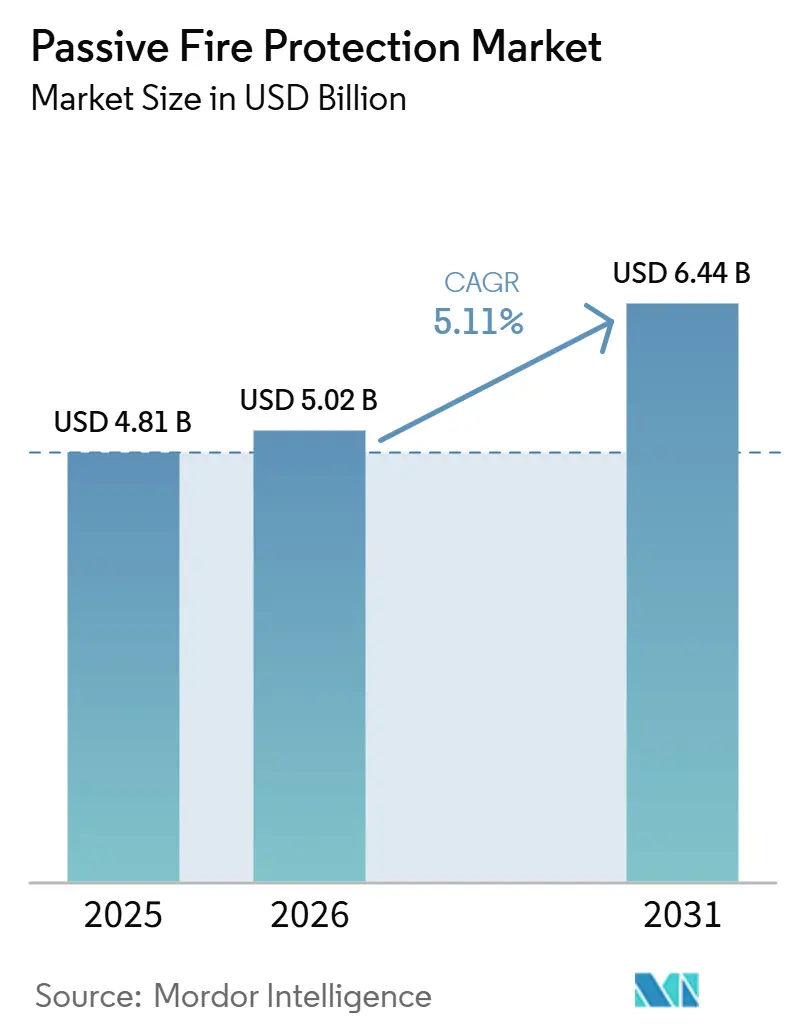
The Passive Fire Protection Market was valued at USD 4.81 billion in 2025 and is estimated to grow from USD 5.02 billion in 2026 to reach USD 6.44 billion by 2031, at a CAGR of 5.11% during the forecast period (2026–2031). The passive fire protection market is being supported by construction activity in high-rise, mixed-use, and industrial projects, where fire resistance is a required part of the building specification and must be coordinated with structural, architectural, and services work from early design through installation, inspection, and final documentation for the completed asset. Demand also extends to renovations because existing structures need to maintain fire protection when building layouts, services, or materials change, and these projects often need the original fire barriers to be restored after the work is complete. Product choice is moving beyond a basic compliance decision because project teams must balance tested performance, installation needs, environmental requirements, lifecycle upkeep, the available space around structural members, and the evidence required for approval. The passive fire protection market also benefits from code-driven replacement cycles, which can defer spending during a slowdown but do not remove the underlying obligation to protect structural elements, limit fire spread, and preserve the integrity of barriers and seals. Suppliers with broad system approvals, rather than isolated products, are better placed when customers need a documented route to compliance that can address coatings, boards, penetrations, openings, and the links between these parts of a building fire strategy, while also giving contractors, owners, and inspection teams a consistent record of the materials and installation conditions used on site.
Key Report Takeaways
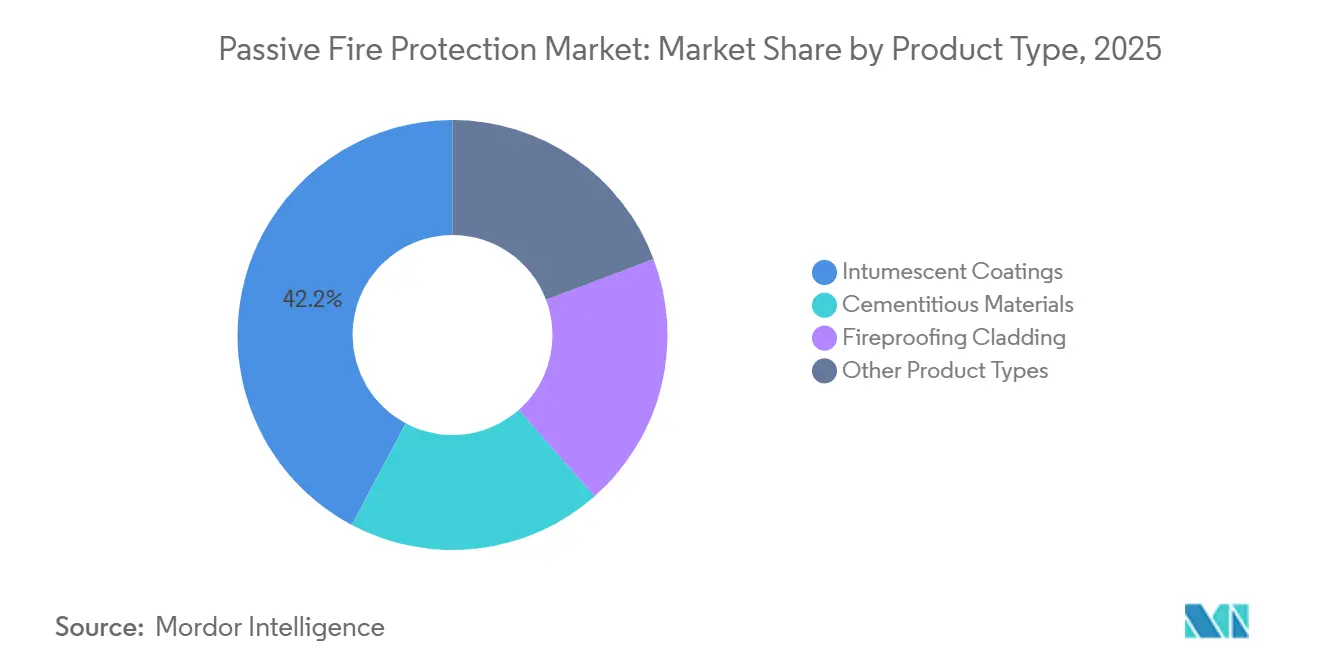
- By product type, intumescent coatings held 42.24% of the passive fire protection market share in 2025 and is forecast to grow at a 5.94% CAGR through 2031.
- By application, structural steel protection held 34.49% of the passive fire protection market share in 2025, while penetration seals and firestopping are forecast to grow at a 5.88% CAGR through 2031.
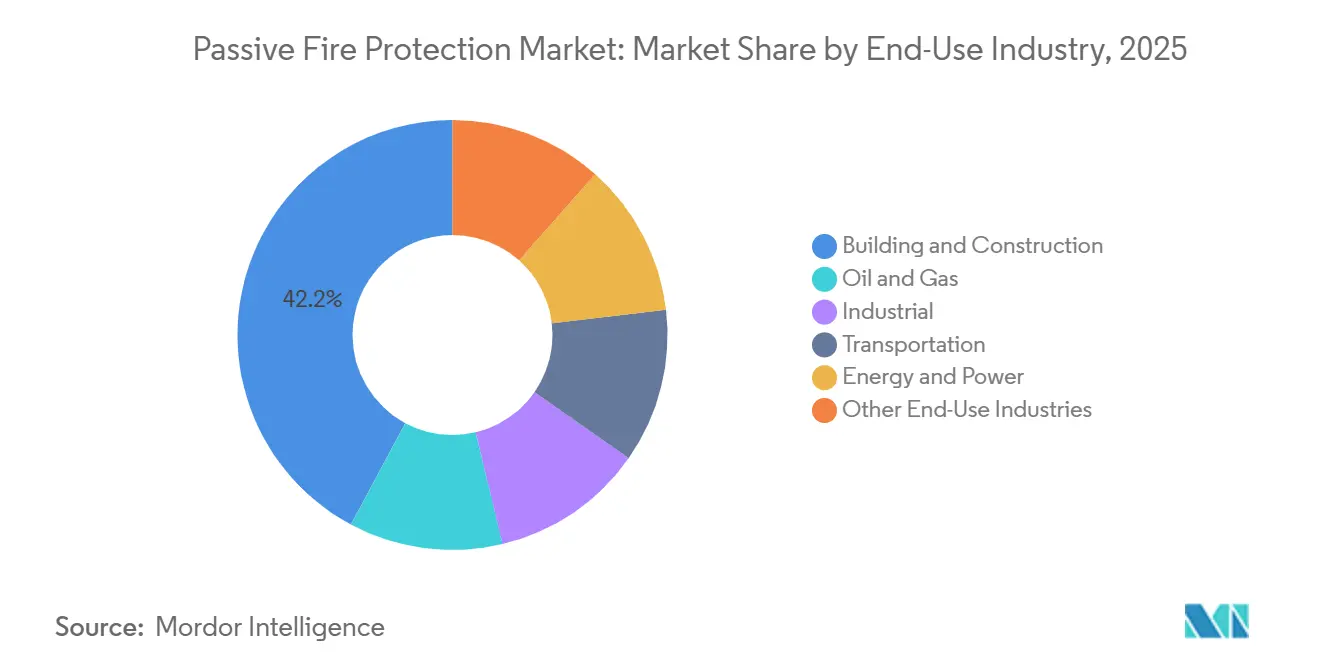
- By end-use industry, building and construction held 42.17% of the passive fire protection market share in 2025, while energy and power is forecast to grow at a 6.07% CAGR through 2031.
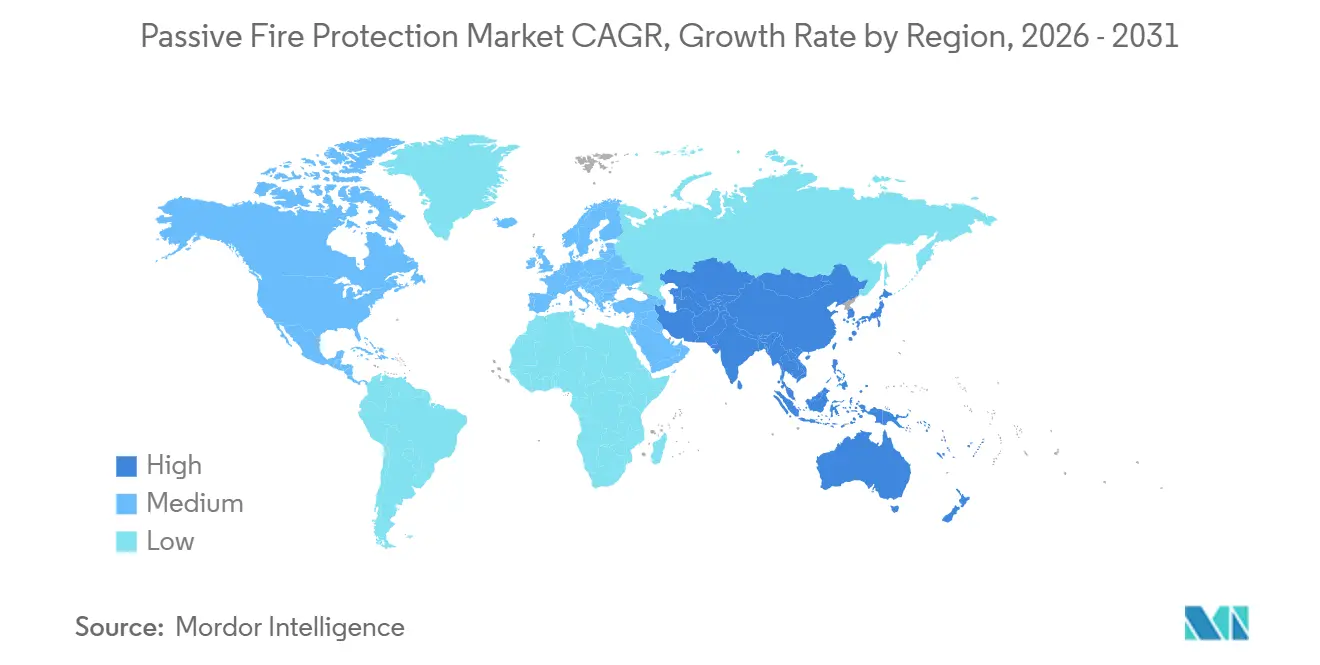
- By geography, North America held 39.82% of the passive fire protection market share in 2025, while Asia-Pacific is forecast to grow at a 6.13% CAGR through 2031.
Note: Market size and forecast figures in this report are generated using Mordor Intelligence’s proprietary estimation framework, updated with the latest available data and insights as of January 2026.
Market Trends and Insights
Drivers Impact Analysis of Passive Fire Protection Market*
| Driver | (~) % Impact on CAGR Forecast | Geographic Relevance | Impact Timeline |
|---|---|---|---|
| Stringent Fire Safety Regulations and Increasing Building Code Compliance Requirements | +1.3% | Global, with concentrated early gains in EU, North America, India, and China | Short term (≤ 2 years) |
| Growing Construction of High-Rise Buildings and Mass Timber Structures | +1.1% | North America, Europe, Asia-Pacific core | Medium term (2–4 years) |
| Expansion of High-Risk Industrial Facilities Across Oil and Gas, Energy, and Manufacturing Sectors | +0.9% | Middle-East and Africa, Asia-Pacific, North America | Medium term (2–4 years) |
| Increasing Adoption of Low-VOC and Environmentally Compliant Passive Fire Protection Systems | +0.6% | North America & EU, with spill-over to APAC | Long term (≥ 4 years) |
| Rising Integration of Digital Fire Engineering and Building Information Modeling (BIM) in Building Design | +0.4% | North America, Europe, emerging in APAC | Long term (≥ 4 years) |
| Source: Mordor Intelligence | |||
Stringent Fire Safety Regulations and Increasing Building Code Compliance Requirements
Fire code revisions are expanding the need for certified products in the passive fire protection market. The European Commission published Delegated Regulation (EU) 2026/557 in March 2026, which set new fire-resistance performance classification tables for construction products under Regulation (EU) 2024/3110[1]European Commission, “Commission Delegated Regulation (EU) 2026/557 of 16 March 2026 Supplementing Regulation (EU) 2024/3110,” EUR-Lex, eur-lex.europa.eu.. Manufacturers must review the classification of protective coatings, boards, renderings, and cladding systems against the revised criteria, then provide the supporting evidence used by specifiers and approval bodies. The work is particularly important when a product is supplied as part of a complete assembly, since the coating, board, seal, substrate, and installation details all affect the tested outcome. This process can create short approval delays, but it also increases the value of systems with established test evidence and clear installation guidance. The passive fire protection market gains when specifiers select tested packages that reduce uncertainty across assemblies, penetrations, structural elements, and the handover records required for the project. ISO 834, UL 263, ASTM E119, UL 1709 Edition 5, NORSOK M-501 Revision 7, and API RP 2218 remain important standards for assessing performance in building and energy applications, because different projects use different fire curves, exposure conditions, and acceptance criteria.
Growing Construction of High-Rise Buildings and Mass Timber Structures
Mass timber is changing how fire protection is specified in taller buildings. The 2024 International Building Code recognized Types IV-A, IV-B, and IV-C construction, allowing mass timber buildings of up to 18 stories with required noncombustible protection layers and varying fire-resistance ratings. Type IV-A requires a 3-hour rating, while Type IV-C requires a 2-hour rating. The required layers change the design discussion because the protection must work with timber members, connections, service openings, and the planned exposed surfaces. These projects often require boards, encapsulation, and penetration seals together rather than a single product, creating a more detailed specification and a greater need for compatible, tested systems. Guidance from Arup states that mass timber structures above 35 meters require larger passive protection margins, which favors suppliers that can offer certified board-and-coating combinations and explain the limits of each assembly. The passive fire protection market, therefore, has an opportunity to capture greater value per project as mass timber specifications become more detailed, particularly where projects cannot rely on the inherent char behavior of timber alone.
Expansion of High-Risk Industrial Facilities Across Oil and Gas, Energy, and Manufacturing Sectors
Liquefied natural gas (LNG) infrastructure, hydrogen facilities, refineries, and industrial assets require protection that performs in more demanding fire conditions. A 2025 study found that intumescent coatings could extend the fire resistance of structural steel in hydrocarbon fire conditions by up to 40 minutes. The same study reported that formulations using graphene additives reduced CO2 emissions by 35%, linking fire performance with environmental goals. This demand differs from standard architectural work because energy projects can require certification for hydrocarbon and cryogenic scenarios, as well as protection for steel, equipment supports, cable trays, and process areas. Product selection must also reflect the conditions at the asset, since a system used in an industrial facility may face different heat exposure, inspection needs, and installation limits than one used in an office building. The passive fire protection market is consequently seeing greater interest in products that meet several hazard requirements without increasing installation complexity or adding unnecessary layers to the work. Retrofit work at aging refinery and industrial sites creates recurring demand because equipment and structural members need assessment, maintenance, and protection over long operating lives.
Increasing Adoption of Low-VOC and Environmentally Compliant Passive Fire Protection Systems
Environmental requirements are becoming a procurement condition for many institutional and public-sector projects. ISOLATEK's CAFCO SprayFilm WB 5 and ISOLATEK Type WB 5 are certified zero-VOC intumescent coatings, showing that a lower-emission formulation can be paired with fireproofing performance. This shifts competition away from fire rating alone and toward the environmental documentation available for each tested system, including evidence that supports the product’s use in the intended assembly. Low-VOC products can be relevant where projects seek Leadership in Energy and Environmental Design (LEED)-compatible material choices or similar environmental credentials, especially when the project team is comparing technically similar systems. The passive fire protection market may see a longer qualification process as suppliers reformulate, complete testing, and update their specification support for new products. Suppliers without accepted environmental credentials could face fewer opportunities in North American and European institutional specifications after 2027, even when their existing systems meet the core fire-resistance requirement.
Restraints Impact Analysis of Passive Fire Protection Market*
| Restraint | (~) % Impact on CAGR Forecast | Geographic Relevance | Impact Timeline |
|---|---|---|---|
| High Installation and Lifecycle Maintenance Costs of Passive Fire Protection Systems | −1.6% | Global, most acute in retrofit-heavy Europe and cost-sensitive APAC emerging markets | Medium term (2–4 years) |
| Lengthy Project Approval and Regulatory Compliance Processes | −1.0% | Global, particularly North America & EU | Short term (≤ 2 years) |
| Design and Installation Challenges in Space-Constrained Retrofit and Renovation Projects | −0.8% | North America, Europe, spill-over to mature APAC markets | Long term (≥ 4 years) |
| Source: Mordor Intelligence | |||
High Installation and Lifecycle Maintenance Costs of Passive Fire Protection Systems
Installation cost is a significant restraint for the passive fire protection market, especially in renovation projects. New construction allows fire protection costs to be planned during design and included in the base-build budget, before services, finishes, and access restrictions complicate the work. Existing buildings can require complex surface preparation, restricted access, and tailored coating profiles around older structural geometry, which can make otherwise standard materials more expensive to apply. Project teams must also plan for the effect of occupied areas, working hours, and the need to protect surrounding finishes while the work is completed. Epoxy intumescent coatings may require inspection and, in some cases, recoating during a 15 to 20-year service period. Hempel notes that structural steel in multistory EU buildings often requires at least a 60-minute rating, while many Middle-East applications require 120-minute protection. These thresholds can raise material and specialist labor needs compared with cementitious alternatives, which can slow upgrades in cost-sensitive retrofit work.
Lengthy Project Approval and Regulatory Compliance Processes
Regulatory change can delay procurement when product approvals and project requirements move at different speeds. The EU transition from the 2011 Construction Products Regulation to Regulation (EU) 2024/3110 requires new performance classifications for relevant construction products. Manufacturers may need to retest and reclassify systems, update technical records, and explain the revised classification to project teams, which can extend the route to market for reformulated products. The passive fire protection market is affected most when a system must demonstrate compliance with several standards, such as UL 263, ASTM E119, and UL 1709, because each approval path can involve separate evidence and review. Smaller manufacturers can face a heavier burden because certification costs must be spread across fewer products and markets. Larger suppliers with multiple certified systems can therefore gain specification influence while approvals are being updated and customers seek a lower-risk route to compliance.
*Our forecasts treat driver/restraint impacts as directional, not additive. The impact forecasts reflect baseline growth, mix effects, and variable interactions.
Passive Fire Protection Market Segment Analysis
By Product Type:
Intumescent Coatings Lead Across Structural SubstratesIntumescent coatings held 42.24% of the passive fire protection market share in 2025 and is projected to grow at a 5.94% CAGR through 2031. Their position reflects their use of structural steel and their relevance in mass timber assemblies. The coatings offer a thinner applied profile than many cementitious options, which helps on exposed structural members where appearance and available space matter. Their compatibility with LEED-related material requirements also supports their use in commercial interiors. Cementitious materials remain relevant in heavy industrial and offshore projects where high thermal mass and established application practices are valued. The passive fire protection market size for intumescent coatings is also supported by suppliers’ ability to document performance across several substrates and project conditions.
Cementitious products retain a cost advantage in many heavy industrial applications, including situations where hydrocarbon fire protection is needed. Board-based cladding and encapsulation systems are gaining attention in mass timber construction because building requirements call for noncombustible protection layers over structural wood members. ASTM revised E2924 in 2025, updating the standard practice for intumescent coatings applied to structural steel. The revision raises the importance of performance documentation and supports established suppliers with proven testing records. Fire collars, intumescent strips, and hybrid products remain more specialized, serving uses such as acoustic and curtain-wall penetrations. The passive fire protection market continues to differentiate these products through documented fire performance and lower-VOC formulation choices.



By Application:
Penetration Seals and Firestopping Gains Ground in MEP-Dense BuildingsStructural steel protection held 34.49% share of the passive fire protection market by application in 2025. Its leading position is tied to commercial construction practices and mandatory fire-resistance ratings for load-bearing frames in multistory buildings. Fire compartmentation is another important application because barriers, fire-rated partitions, and horizontal assemblies limit fire spread. Opening protection, including doors, dampers, and glazing systems, also benefits from code requirements in high-occupancy buildings. These applications remain part of routine construction specifications in North America and Europe.
Penetration seals and firestopping are projected to grow at a 5.88% CAGR from 2026 to 2031. Their faster growth follows the increasing density of mechanical, electrical, and plumbing services in modern buildings. Each wall or floor penetration can require individual sealing, and data centers, hospitals, and transport infrastructure have especially high service density. Tightening use of through-penetration standards, including UL 1479 and ASTM E814, reinforces this requirement. The application benefits from wider electrification, including electric vehicle (EV) charging, battery storage, and expanded heating, ventilation, and air conditioning (HVAC) systems, because these additions increase penetration counts.
By End-Use Industry:
Energy and Power Transition Broadens DemandBuilding and construction held 42.17% of the passive fire protection market share in 2025. High-rise residential projects, commercial complexes, and data centers supported this leading position across major regions. The sector requires protection for structural elements, compartments, openings, and service penetrations. Demand is also linked to renovation because changes to a building’s layout or services can require fire barriers to be restored or upgraded. Commercial construction remains important because visible structural steel often needs protection that meets both performance and design requirements. These conditions make building and construction a stable source of demand for the passive fire protection market.
Energy and power is forecast to grow at a 6.07% CAGR through 2031, making it the fastest-growing end-use industry segment. LNG terminals, regasification facilities, hydrogen plants, and related infrastructure require systems designed for hydrocarbon and cryogenic fire scenarios. New assets can require premium epoxy intumescent systems, while existing power stations and substations support demand for cementitious and board-based retrofit work. Oil and gas demand remains tied to capital cycles, but offshore projects require protection for structural members, cable trays, and process equipment. Industrial facilities, including manufacturing, chemical processing, and logistics sites, also need ongoing safety inspections and maintenance. The passive fire protection market can benefit when these asset owners choose systems with performance records suited to high-risk operating environments.
Geography Analysis
North America Passive Fire Protection Market
North America held a 39.82% share of the passive fire protection market in 2025. The United States supported demand through commercial construction, industrial maintenance, and code-driven replacement work. Mass timber projects are adding a specialized need for tested protection systems that combine boards, encapsulation, and seals. Canada’s encapsulated mass timber guidance requires a minimum 2-hour fire-resistance rating in the relevant construction approach[2]Canadian Wood Council, “Guide to Encapsulated Mass Timber Construction in the Ontario Building Code,” Canadian Wood Council, cwc.ca.. This gives suppliers an additional route to supply certified systems for wood-based mid-rise and taller structures.
Europe Passive Fire Protection Market
Europe remains an important revenue area, led by Germany, the United Kingdom, and France. Germany’s industrial base and renovation needs support for the continued use of intumescent coatings and firestopping products. Regulation (EU) 2026/557 is now requiring a fresh review of fire-resistance classifications for relevant construction products. This increases specification activity across the construction materials supply chain as manufacturers and project teams assess their systems. The passive fire protection market in Europe is also supported by renovation activity linked to building energy performance obligations.
APAC, South America and MEA Passive Fire Protection Market
Asia-Pacific is forecast to grow at a 6.13% CAGR from 2026 to 2031, the highest regional rate. The region combines urbanization, industrial growth, and expanding attention to building safety requirements. Japan has required intumescent coatings on buildings taller than 31 m since April 2025. South Korea’s Green Building Certification system has offered bonus points for 3-hour passive protection since January 2026, which supports the use of higher-performing systems. China’s urban renewal and infrastructure work support high demand volumes, while Vietnam, Indonesia, and the Philippines offer further potential as industrialization and safety enforcement strengthen. South America and Middle-East and Africa are smaller, but industrial modernization, energy projects, mining, and commercial construction make them relevant demand areas for the passive fire protection market.

Competitive Landscape
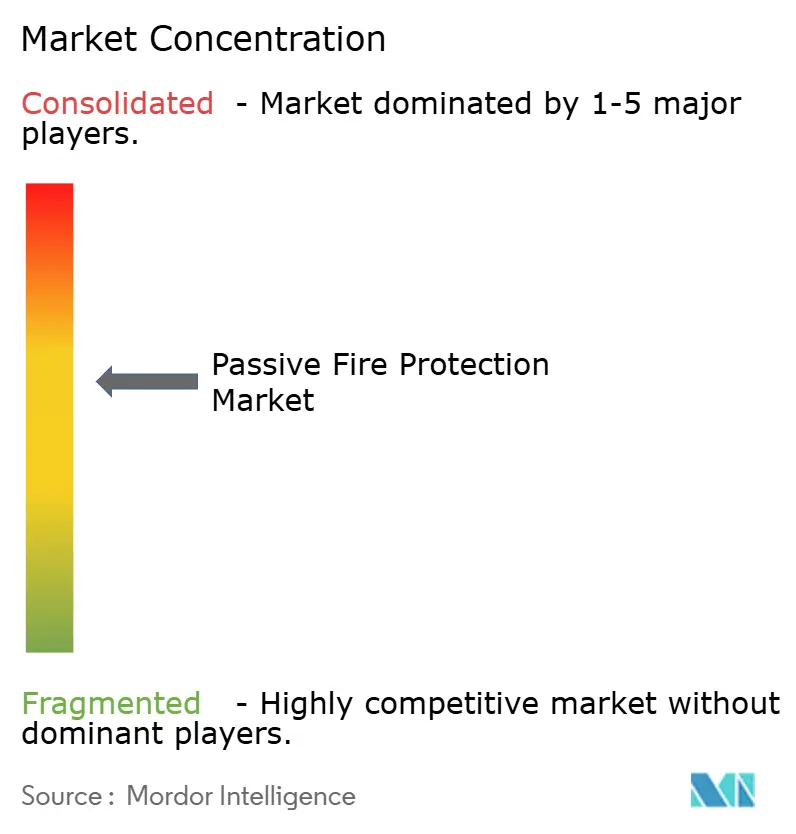
The passive fire protection market is moderately concentrated. AkzoNobel, PPG Industries, Sika AG, ROCKWOOL A/S, and Sherwin-Williams have important positions across coatings and building product categories. Hilti Corporation has a defensible position in firestopping, while Rudolf Hensel GmbH is established in intumescent coatings. These companies compete through product formulations, certification coverage, applicator relationships, and distribution reach. A supplier that can provide a tested system for several standards can be more attractive than a supplier selling a single product. This encourages the passive fire protection market to favor companies with a broad portfolio of approved solutions.
Environmental performance is becoming part of the competitive approach. Water-borne and zero-VOC intumescent chemistry is receiving greater attention as customer specifications include environmental documentation. Isolatek’s zero-VOC intumescent offerings show that this direction is commercially relevant. Product development also focuses on reducing installation time and improving the evidence available for demanding applications. Hempel’s 2025 guide highlights the need to align passive protection specifications with ISO 834, European Assessment Document (EAD) 350402-00-1106, and regional building codes. This favors suppliers that can support specifiers with clear technical and compliance material.
Acquisition activity also reflects interest in code-mandated fire protection categories. Catchment Capital completed its acquisition of Isolatek International from SK Capital Partners in June 2026, with plans for investment across commercial, institutional, data center, and advanced manufacturing applications. Sika announced its planned acquisition of Akkim in 2026 to expand its adhesives and sealants footprint and production capacity. ROCKWOOL signed an agreement in May 2026 to acquire a Hungarian stone wool factory with an annual capacity of 40,000 metric tons, subject to the expected Q4 2026 closing. These actions support broader manufacturing, distribution, and product capabilities in the passive fire protection market.
Passive Fire Protection Industry Leaders
3M
The Sherwin-Williams Company
PPG Industries, Inc.
Hilti Corporation
Sika AG
- *Disclaimer: Major Players sorted in no particular order
Passive Fire Protection Market Companies Covered in this Report
- 3M
- Akzo Nobel N.V.
- Carboline Company
- Etex Group
- Hempel A/S
- Hilti Corporation
- Isolatek International
- Jotun
- Lloyd Insulations (India) Limited
- Nullifire (Tremco CPG)
- PPG Industries, Inc.
- ROCKWOOL A/S
- Rudolf Hensel GmbH
- Sika AG
- The Sherwin-Williams Company

Recent Industry Developments in Passive Fire Protection Market
- June 2026: Catchment Capital completed its acquisition of Isolatek International from SK Capital Partners. The deal aimed to expand Isolatek’s passive fire protection capabilities across the commercial, data center, and manufacturing markets.
- December 2025: Cardo entered into an agreement to acquire the assets of Gunfire, a UK-based passive fire protection specialist. The transaction strengthened Cardo’s fire protection and compliance capabilities, broadened its service offering across a wider geographic footprint, and supported continued growth in building safety services for residential, commercial, and public sector clients.


Global Passive Fire Protection Market Report Scope
Passive fire protection includes built-in, static building components that contain fires or slow their spread without manual activation or power. It continuously safeguards escape routes and the building’s structural framework, giving occupants time to evacuate and firefighters time to respond.
The Passive Fire Protection Market is segmented by product type, application, end-use industry, and geography. By product type, the market is segmented into intumescent coatings, cementitious materials, fireproofing cladding, and other product types. By application, the market is segmented into structural steel protection, fire compartmentation, opening protection, and penetration seals and firestopping. By end-use industry, the market is segmented into building and construction, oil and gas, industrial, transportation, energy and power, and other end-use industries. The report also covers the market size and forecasts for passive fire protection in 16 countries across major regions. For each segment, the market sizing and forecasts have been done on the basis of value (USD).
| Intumescent Coatings |
| Cementitious Materials |
| Fireproofing Cladding |
| Other Product Types |
| Structural Steel Protection |
| Fire Compartmentation |
| Opening Protection |
| Penetration Seals and Firestopping |
| Building and Construction |
| Oil and Gas |
| Industrial |
| Transportation |
| Energy and Power |
| Other End-Use Industries |
| Asia-Pacific | China |
| India | |
| Japan | |
| South Korea | |
| Rest of Asia-Pacific | |
| North America | United States |
| Canada | |
| Mexico | |
| Europe | Germany |
| United Kingdom | |
| France | |
| Italy | |
| Russia | |
| Rest of Europe | |
| South America | Brazil |
| Argentina | |
| Rest of South America | |
| Middle-East and Africa | Saudi Arabia |
| South Africa | |
| Rest of Middle-East and Africa |
| By Product Type | Intumescent Coatings | |
| Cementitious Materials | ||
| Fireproofing Cladding | ||
| Other Product Types | ||
| By Application | Structural Steel Protection | |
| Fire Compartmentation | ||
| Opening Protection | ||
| Penetration Seals and Firestopping | ||
| By End-Use Industry | Building and Construction | |
| Oil and Gas | ||
| Industrial | ||
| Transportation | ||
| Energy and Power | ||
| Other End-Use Industries | ||
| By Geography | Asia-Pacific | China |
| India | ||
| Japan | ||
| South Korea | ||
| Rest of Asia-Pacific | ||
| North America | United States | |
| Canada | ||
| Mexico | ||
| Europe | Germany | |
| United Kingdom | ||
| France | ||
| Italy | ||
| Russia | ||
| Rest of Europe | ||
| South America | Brazil | |
| Argentina | ||
| Rest of South America | ||
| Middle-East and Africa | Saudi Arabia | |
| South Africa | ||
| Rest of Middle-East and Africa | ||


Key Questions Answered in the Report
What is the size of the passive fire protection market?
The passive fire protection market stands at USD 5.02 billion in 2026 and is projected to reach USD 6.44 billion by 2031.
What is driving demand for passive fire protection systems?
Code compliance, high-rise construction, mass timber projects, industrial facilities, and renovation work support demand.
Which product type held the largest revenue share in 2025?
Intumescent coatings led product type demand with a 42.24% share in 2025.
Which application is expected to grow fastest through 2031?
Penetration seals and firestopping are forecast to grow at a 5.88% CAGR through 2031.
Page last updated on:





