
Palm Methyl Ester Derivatives Market Size and Share
Market Overview
| Study Period | 2022 - 2032 |
|---|---|
| Market Size (2027) | USD 2.38 Billion |
| Market Size (2032) | USD 3.15 Billion |
| Growth Rate (2027 - 2032) | 5.83 % |
| Fastest Growing Market | Asia-Pacific |
| Largest Market | Asia-Pacific |
| Market Concentration | Medium |
Major Players *Disclaimer: Major Players sorted in no particular order Image © Mordor Intelligence. Reuse requires attribution under CC BY 4.0. | |
Palm Methyl Ester Derivatives Market Analysis by Mordor Intelligence
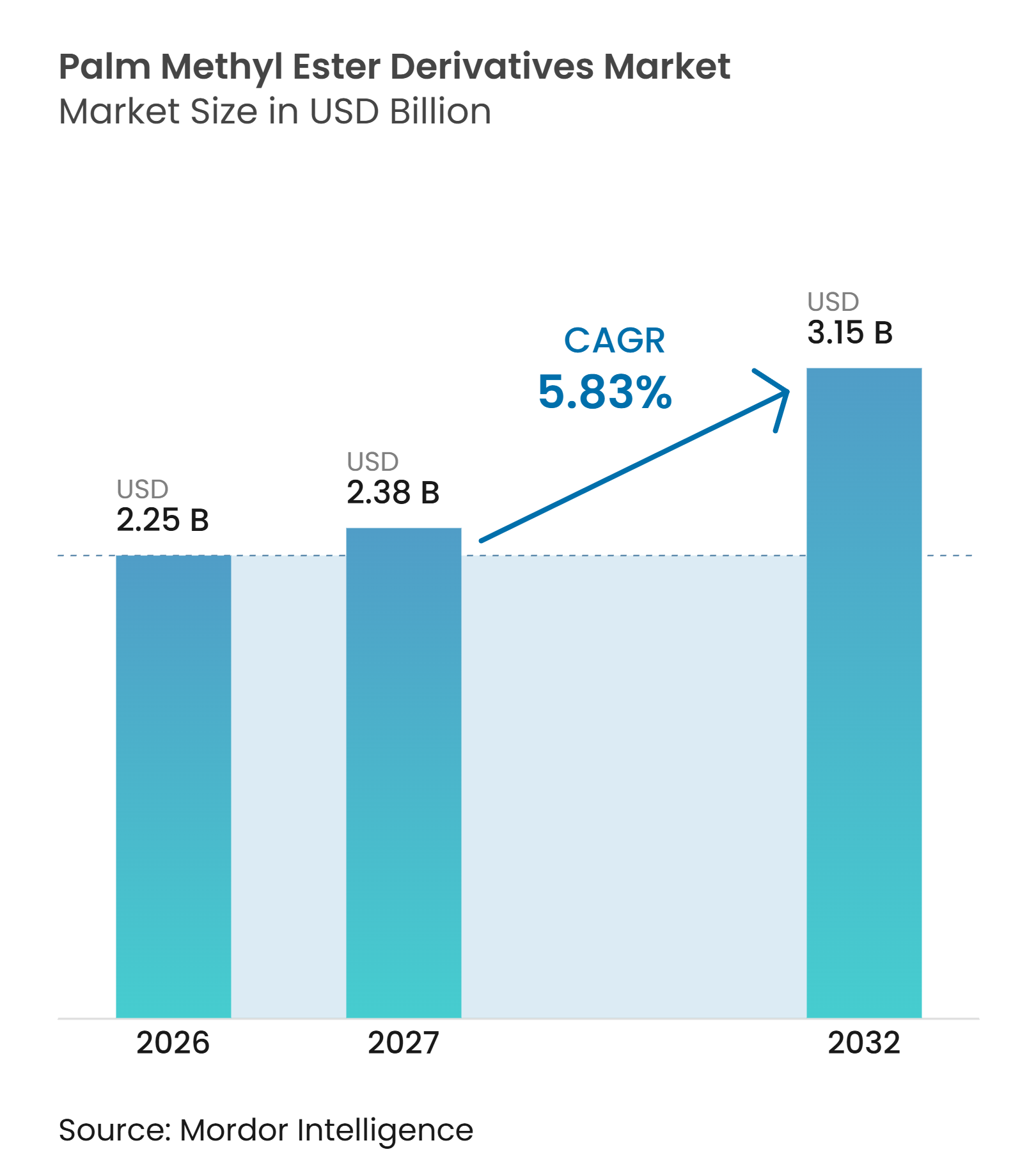
The Palm Methyl Ester Derivatives Market size was valued at USD 2.25 billion in 2026 and is estimated to grow from USD 2.38 billion in 2027 to reach USD 3.15 billion by 2032, at a CAGR of 5.83% during the forecast period (2027-2032). The palm methyl ester derivatives market is supported by detergent, personal care, industrial lubricant, and solvent formulations that use palm-based ester inputs. Buyers are placing more weight on documented sourcing and biodegradable ingredients, which favors suppliers that can link feedstock, refining, and derivatives operations. Indonesia and Malaysia retain an important cost position because cultivation, refining, and downstream processing are located close together. Indonesia's export levy framework also favors further processing within the country, which encourages investment in derivatives rather than crude palm oil exports. The palm methyl ester derivatives market also faces higher feedstock costs, traceability demands, and technical limits in cold-weather uses.
Key Report Takeaways
- By product, palm methyl oleate held 30.67% of the palm methyl ester derivatives market share in 2026, while palm methyl laurate is forecast to advance at a 7.06% CAGR through 2032.
- By source, crude palm oil held 75.02% of the palm methyl ester derivatives market share in 2026, while palm kernel oil is forecast to advance at a 6.71% CAGR through 2032.
- By end-use, soaps and detergents held 32.34% of the palm methyl ester derivatives market share in 2026, while personal care and cosmetic products are forecast to advance at a 7.13% CAGR through 2032.
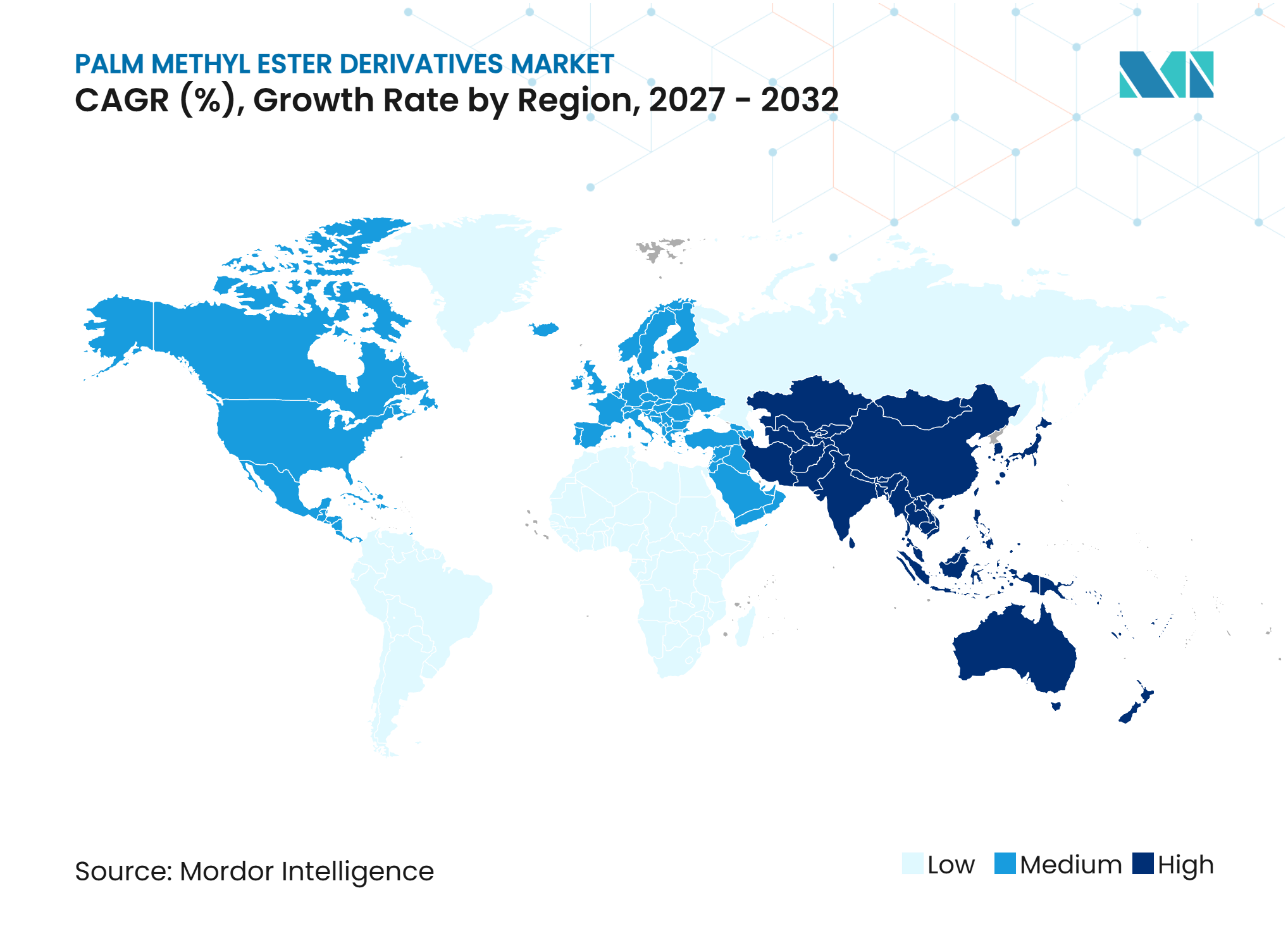
- By geography, Asia-Pacific held 35.56% of the palm methyl ester derivatives market share in 2026 and is forecast to advance at a 6.94% CAGR through 2032.
Note: Market numbers in this report are based on Mordor Intelligence's proprietary estimation framework, which combines nine months of actuals with Q4 projections for base year 2026.
Market Trends and Insights
Drivers Impact Analysis of Palm Methyl Ester Derivatives Market*
| Driver | (~) % Impact on CAGR Forecast | Geographic Relevance | Impact Timeline |
|---|---|---|---|
| Rising Demand for Bio-Based Surfactants and Solvents | +1.8% | Global, strongest pull in EU and North America | Short term (≤ 2 years) |
| Expansion of Personal Care and Cosmetic Formulations | +1.5% | Asia-Pacific, Western Europe, North America | Medium term (2-4 years) |
| Growth in Palm-Based Biodiesel and Renewable Fuel Blending | +1.2% | ASEAN (Indonesia, Malaysia), EU (FAME mandates) | Short term (≤ 2 years) |
| Increasing Demand for Sustainable Lubricants and Emollients | +0.8% | APAC core, spillover to North America and Europe | Medium term (2-4 years) |
| Procurement Preference for Traceable and Certified Oleochemicals | +0.6% | EU, North America, with supply-side response from ASEAN | Long term (≥ 4 years) |
| Source: Mordor Intelligence | |||
Rising Demand for Bio-Based Surfactants and Solvents
The palm methyl ester derivatives market benefits as detergent formulators seek renewable inputs that can replace petroleum-based intermediates. Palm-derived methyl ester sulfonates can serve in compact powder detergent applications and offer biodegradability benefits in selected uses. Palm methyl ester solvents are also used in agrochemical carriers, coatings, and cleaning applications. These uses can reduce disposal requirements when they meet relevant biodegradability standards. Demand for these products is strongest where buyers must document the origin and environmental profile of chemical inputs. At the same time, renewable fuel blending competes for C16 to C18 methyl ester feedstock, which can tighten supply for surfactant production during periods of higher blending demand.
Expansion of Personal Care and Cosmetic Formulations
Palm methyl laurate and palm methyl caprylate support light-feel emollient formulations in personal care products. These medium-chain derivatives can meet natural-origin definitions under International Organization for Standardization (ISO) 16128 when the formulation meets the standard's requirements. A 2025 Malaysian Palm Oil Board research publication reported a palm methyl ester-based water insecticide formulation with field performance comparable to a naphtha-based commercial formulation, showing use beyond cosmetics[1]. This product flexibility helps manufacturers serve personal care, household, and crop-protection customers from related feedstock streams. KLK OLEO marketed its PALMESTER emollient range to beauty and personal care customers during 2025. The palm methyl ester derivatives market, therefore, gains from more specialized demand for certified, medium-chain ester cuts.
Growth in Palm-Based Biodiesel and Renewable Fuel Blending
Biodiesel programs affect the palm methyl ester derivatives market because they draw on the same palm methyl ester supply base. Indonesia's move to B40 blending increased palm biodiesel production by 12% to 13.6 million metric tons in 2025. Malaysia's national program used 934,823.31 metric tons of palm methyl ester in 2025 for transport and industrial blending. Higher renewable fuel demand can raise pressure on ester feedstock availability for soaps, detergents, and solvents. PTT Global Chemical Public Company Limited began Sustainable Aviation Fuel production from used cooking oil in Thailand in January 2025. The shift toward used cooking oil also shows how renewable fuel producers are pursuing feedstocks that do not rely on palm-based inputs.
Procurement Preference for Traceable and Certified Oleochemicals
Traceability requirements are becoming more important in chemical procurement, especially for European and North American customers. The Malaysian Sustainable Palm Oil 2.0 framework includes traceability, greenhouse gas management, and High Conservation Value protection requirements. The Roundtable on Sustainable Palm Oil mass-balance model is also used by buyers seeking documented palm supply chains. The European Union Deforestation Regulation places due diligence requirements on relevant supply chains and increases the need for records that establish product origin. These requirements can raise costs for smaller suppliers that lack robust tracking systems. They can also strengthen the position of integrated suppliers with established certification and traceability processes. The palm methyl ester derivatives market is therefore moving toward procurement standards that reward verified supply chains.
Restraints Impact Analysis of Palm Methyl Ester Derivatives Market*
| Restraint | (~) % Impact on CAGR Forecast | Geographic Relevance | Impact Timeline |
|---|---|---|---|
| Palm Oil Price Volatility | -1.2% | Global, most acute for non-integrated derivative producers | Short term (≤ 2 years) |
| Deforestation, Biodiversity and Land-Use Concerns | -0.9% | EU import market, North America, global brand procurement | Long term (≥ 4 years) |
| Cold-Flow and Oxidation-Stability Limitations in Selected Applications | -0.5% | Temperate markets in EU, North America, Northeast Asia | Medium term (2-4 years) |
| Source: Mordor Intelligence | |||
Palm Oil Price Volatility
Crude palm oil price changes can quickly reduce margins for derivative producers that do not own plantations or operate near refineries. Indonesia raised its crude palm oil export levy to 10%, effective May 17, 2025. This change increased the importance of downstream processing in Indonesia and changed input-cost conditions for overseas buyers. Smaller producers can find it difficult to pass higher feedstock costs through to detergent, cosmetic, or lubricant customers. Long-term supply commitments become harder to price when feedstock costs change quickly. The palm methyl ester derivatives market remains more exposed where producers lack backward integration.
Deforestation, Biodiversity and Land-Use Concerns
Deforestation and land-use concerns continue to affect procurement decisions for palm-derived materials. The European Union Deforestation Regulation requires due diligence for covered commodities and products, which makes reliable origin records more important for suppliers serving European buyers. The regulation may lead buyers to favor suppliers with documentation from plantation to downstream product. Apical reported trial shipments that met European Union Deforestation Regulation requirements and published traceability information across operations in Indonesia, China, and Spain in 2025. Compliance can help suppliers retain access to premium customer accounts. However, the cost of meeting documentation, audit, and segregation requirements can be significant. The palm methyl ester derivatives market is constrained where producers cannot demonstrate responsible sourcing clearly.
*Our forecasts treat driver/restraint impacts as directional, not additive. The impact forecasts reflect baseline growth, mix effects, and variable interactions.
Palm Methyl Ester Derivatives Market Segment Analysis
By Product:
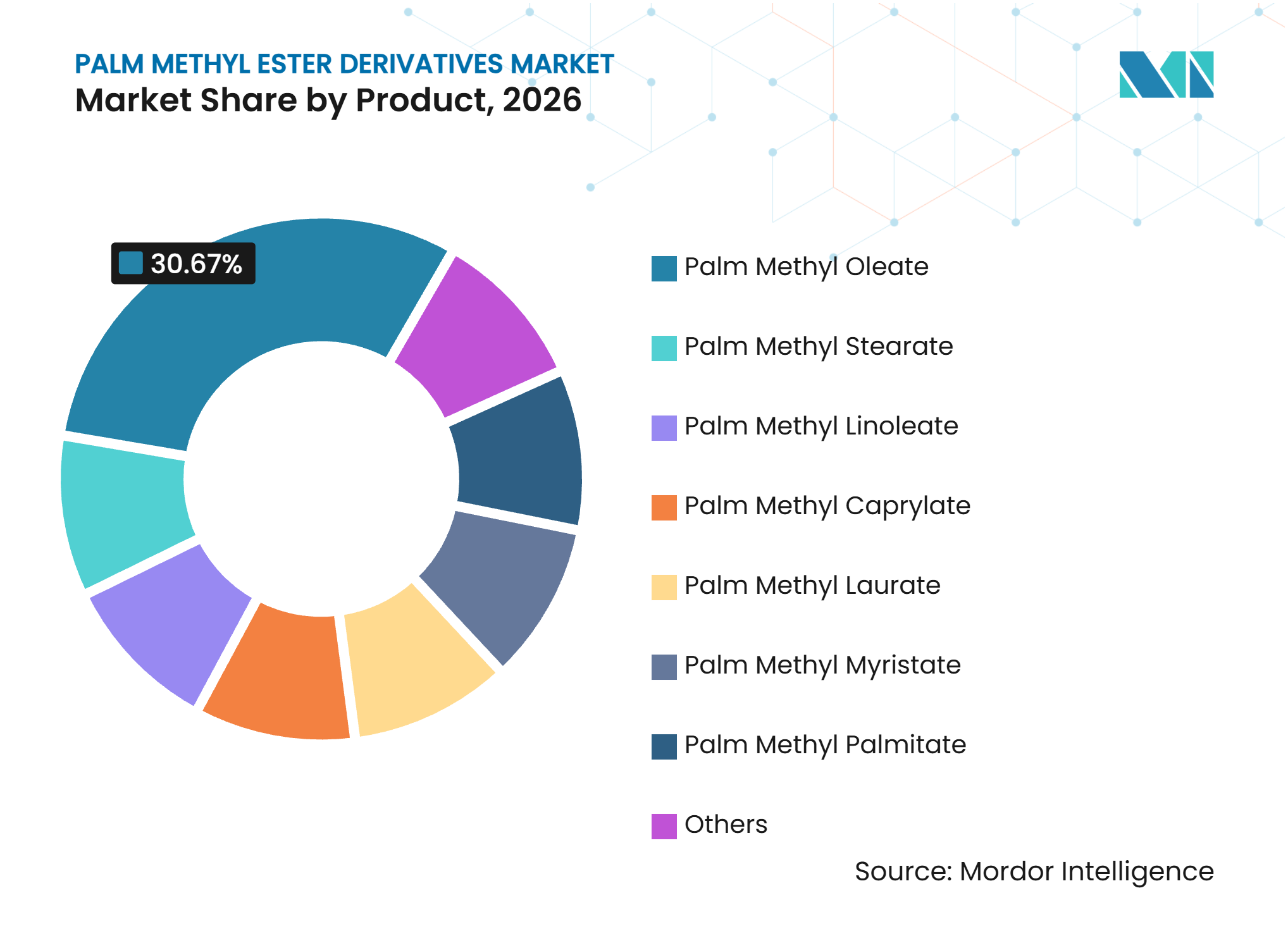
Palm Methyl Oleate Leads While Palm Methyl Laurate Supports Faster GrowthPalm methyl oleate held 30.67% of the palm methyl ester derivatives market share in 2026. Its C18:1 profile supports biodiesel blending, surfactant production, and certain industrial applications where energy density, emulsification, and cold-flow behavior must be balanced. The product also has use as a precursor for lightweight personal care emollients. Palm methyl laurate is projected to advance at a 7.06% CAGR through 2032. Its C12 chain makes it relevant to mild surfactant systems, personal care concentrates, and selected pharmaceutical excipient applications. A 2025 study recorded transesterification yields of up to 94.99% for palm olein-derived fatty acid methyl ester fractions using potassium hydroxide catalysis. The result supports a scalable route to high-purity oleic fractions. Product demand therefore depends on both performance requirements and the availability of distinct chain-length cuts.
Palm methyl caprylate has a specialized role in cosmetic emollients and medium-chain triglyceride precursor applications. Its C8 chain supports rapid absorption and can improve bioavailability in nutritional and pharmaceutical formulations. Palm methyl palmitate and palm methyl stearate are used as precursor materials for food-grade emulsifiers and industrial lubricant base stocks. Palm methyl myristate can be used as a cosmetic emulsifier modifier. Palm Methyl Linoleate has a polyunsaturated C18:2 profile, which limits some industrial uses because of oxidation sensitivity. KLK OLEO presented its PALMERE Methyl Esters range at K 2025 for plastics processing applications, including release agents and lubricity additives. These applications create additional outlets for palmitate and stearate products. The palm methyl ester derivatives market is thus supported by a mix of high-volume and specialized ester grades.



By Source:
Crude Palm Oil Maintains Scale While Palm Kernel Oil Gains Specialty DemandCrude palm oil held 75.02% of the palm methyl ester derivatives market in 2026. This position reflects large-scale refinery infrastructure in Indonesia and Malaysia and its suitability for commodity methyl ester production. Crude palm oil-derived oleate, palmitate, and stearate are used in biodiesel, detergent feedstocks, and bulk solvent applications. Malaysia produced 20.28 million metric tons of crude palm oil in 2025, supporting the region's established processing base. Price per metric ton remains an important factor in these applications. Feedstock scale also allows producers to serve customers that require consistent supply. The crude palm oil segment remains central to the palm methyl ester derivatives market because many end uses do not require highly specific chain lengths.
Palm kernel oil is projected to advance at a 6.71% CAGR through 2032. It provides C8 to C14 cuts that are important for personal care, pharmaceutical, and specialty lubricant products. Malaysian palm kernel oil export value increased 35.7% in 2025 despite a 5.9% decline in volume, indicating stronger unit values for derivatives serving more specialized customers. The 93.7% trimethylolpropane triester yield from palm kernel oil methyl esters also supports its use in bio-lubricant formulations. Palm kernel oil suppliers can therefore target higher-value applications where performance and traceability affect buying decisions.
By End-Use:
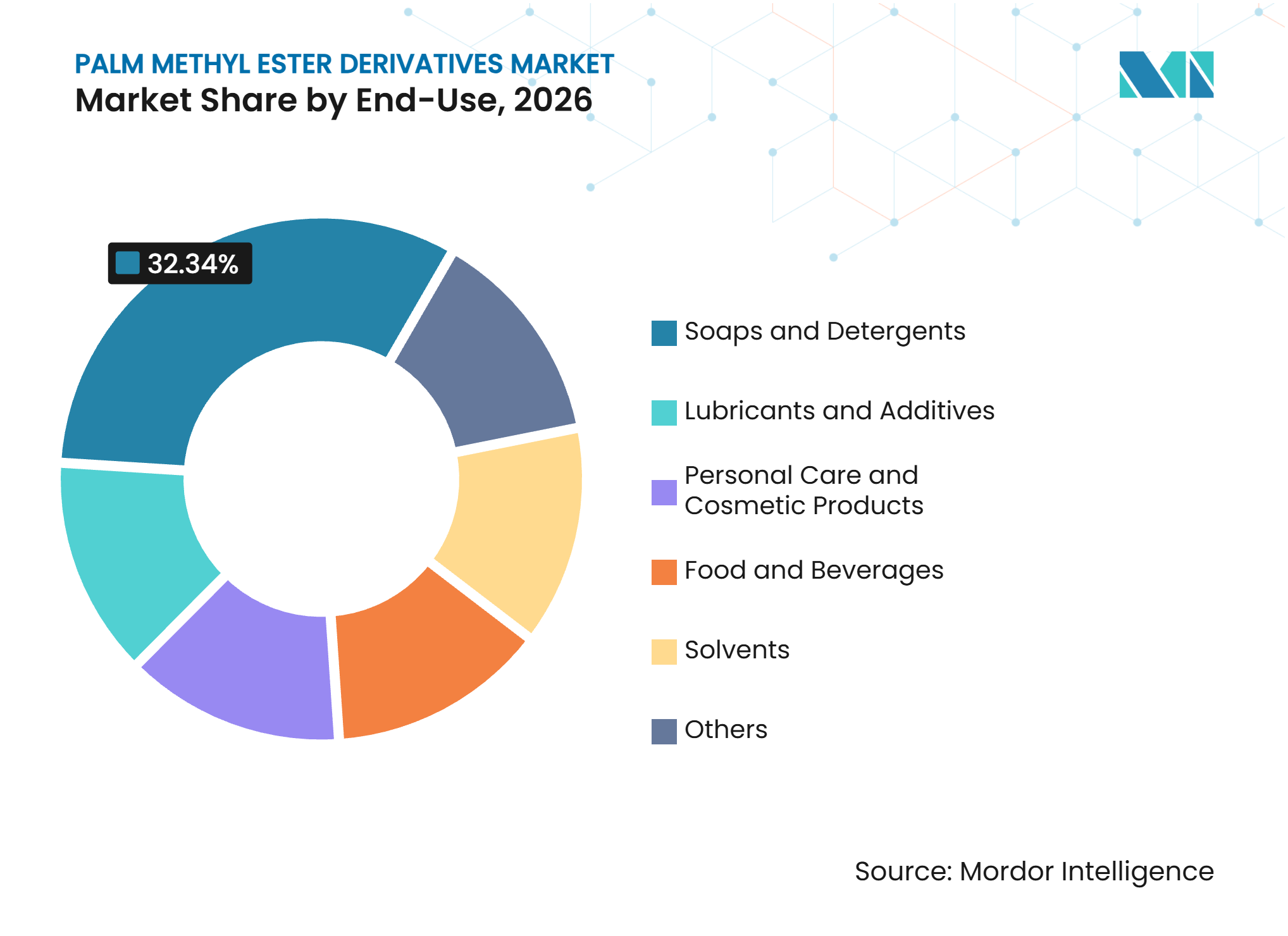
Soaps and Detergents Provide Revenue While Personal Care and Cosmetic Products ExpandSoaps and detergents held 32.34% of the palm methyl ester derivatives market in 2026. Palm-derived methyl ester sulfonates are used in compact powder detergents, especially in Asia and Africa. Their biodegradability and cold-water washing properties make them relevant to household cleaning formulations. India has continued to build downstream capacity for oleochemical intermediates. Godrej Industries Limited committed INR 600 crore (approximately USD 72 million) to expand capacity at Valia, Gujarat. VVF Limited Liability Company also operates fatty alcohol, fatty acid, and glycerin capacity at Taloja. These investments support a broader base of surfactant and detergent intermediates.
Personal care and cosmetic products are projected to advance at a 7.13% CAGR through 2032. Palm methyl laurate and palm methyl caprylate are used in anti-aging serums and sun-care emulsions because they provide a light skin feel. Demand is supported by clean-beauty reformulation and greater use of certified emollient ingredients in Asia-Pacific. Palm methyl ester-derived solvents also have growing use in agrochemical carriers, industrial coatings, and cleaning products. Food and beverages provide demand for food-grade emulsifiers and release agents, although purity and traceability requirements can slow qualification. Lubricants and additives are another important outlet for products with targeted viscosity and oxidation properties. The palm methyl ester derivatives market serves these end uses through different quality standards and price points. This range of applications reduces reliance on a single downstream sector.

Geography Analysis
Asia-Pacific
Asia-Pacific held 35.56% of palm methyl ester derivatives market share in 2026 and is projected to advance at a 6.94% CAGR through 2032. Indonesia, Malaysia, Thailand, and India link feedstock supply, refining, and downstream formulations, which support regional processing. Indonesia's integrated producers continue to support supply. KLK OLEO opened a representative office in Mumbai in February 2025 to support access to Indian customers.
North America
North American demand is focused on certified, auditable ingredients for detergent, personal care, lubricant, and specialty solvent applications. The United States Department of Agriculture BioPreferred Program supports federal purchasing preferences for designated bio-based products, which support renewable inputs in institutional cleaning and industrial uses[2]. Canadian formulators use high-purity C8 to C12 palm kernel oil methyl esters in pharmaceutical excipient and nutraceutical applications. The Malaysian Palm Oil Council has identified opportunities for Malaysian oleochemicals in the United States, while Mexican consumer goods manufacturing supports regional demand, and customer audits make documented sourcing essential.
Europe, South America, and Middle East and Africa
Europe is technically advanced but has lower demand than Asia-Pacific for the palm methyl ester derivatives market. Germany and the United Kingdom consume personal care emollients and industrial lubricant formulations, while European Union Deforestation Regulation compliance increasingly shapes product qualification. Brazil relies heavily on soybean methyl ester derivatives, but palm methyl oleate-based bio-lubricants have potential in agricultural equipment maintenance. Argentina and other South American countries remain earlier-stage, import-served markets. Saudi Arabia's specialty chemicals investment, South Africa's personal care production, and sub-Saharan Africa's value-tier soap demand create distinct channels for Asian and Indian suppliers.
Competitive Landscape
Market Concentration
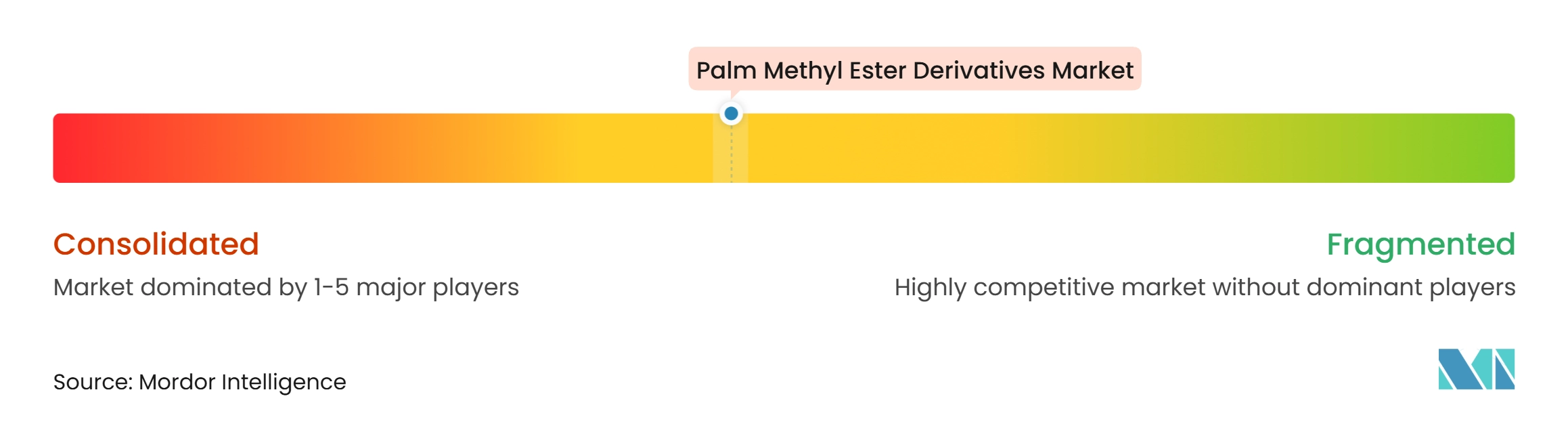
The palm methyl ester derivatives market is moderately concentrated, with the top five players including Wilmar International Ltd, KLK OLEO, Musim Mas Group, Procter & Gamble, and Emery Oleochemicals. Wilmar International Ltd, Apical, Asian Agri, Carotino Sdn Bhd, KLK OLEO, Musim Mas Group, PT Ecogreen Oleochemicals, PT Sinar Mas Agro Resources and Technology Tbk, and PTT Global Chemical Public Company Limited are producers with positions across the supply chain. Cargill, Incorporated participates in palm processing and specialty chemical value chains, while Pacific Oleochemicals Sdn Bhd produces in Malaysia, and Godrej Industries Limited and VVF Limited Liability Company expand the Indian downstream base. Procter & Gamble is a downstream purchaser of palm-derived ingredients rather than a core producer of palm methyl ester derivatives. Integrated supply supports feedstock access, cost control, traceability, and the ability to supply high-volume and specialized customers.
Capacity and downstream expansion remain key competitive strategies in the palm methyl ester derivatives market. Indonesia's export levy framework strengthens incentives for downstream processing in the country. Musim Mas Group agreed in May 2025 to acquire a Stepan surfactant manufacturing facility in the Philippines, broadening its portfolio for personal care, home care, and industrial uses. KLK OLEO established a Life Sciences division in October 2026 to provide glycerin, polysorbates, macrogols, esters, and fatty acids to pharmaceutical, biopharma, nutraceutical, diagnostic, and dermocosmetic customers. These moves target applications with stricter quality specifications and traceability requirements.
Specialty-grade production is an important part of competitive positioning because pharmaceutical-grade ester applications require consistent purity, batch documentation, and dedicated manufacturing controls. Emery Oleochemicals has focused on sustainable ester base stocks and additives for industrial markets. PTT Global Chemical Public Company Limited advanced biochemicals and biopolymers production from used cooking oil in 2025. Roundtable on Sustainable Palm Oil certification and ISO 16128 alignment affect access to premium customers, so competition depends on product capability, traceability, and end-use coverage.
Palm Methyl Ester Derivatives Industry Leaders
-
Wilmar International Ltd
-
KLK OLEO
-
Musim Mas Group
-
Procter & Gamble
-
Emery Oleochemicals
- *Disclaimer: Major Players sorted in no particular order
Palm Methyl Ester Derivatives Market Companies Covered in this Report
- Apical
- Asian Agri
- Cargill, Incorporated
- Carotino Sdn Bhd
- Emery Oleochemicals
- Godrej Industries Limited
- KLK OLEO
- Musim Mas Group
- Pacific Oleochemicals Sdn Bhd
- Procter & Gamble
- PT Ecogreen Oleochemicals
- PT Sinar Mas Agro Resources and Technology Tbk
- PTT Global Chemical Public Company Limited
- VVF Limited Liability Company
- Wilmar International Ltd
Recent Industry Developments in Palm Methyl Ester Derivatives Market
- September 2025: KLK OLEO showcased its PALMERE methyl ester portfolio, including methyl palmitate and methyl stearate, at the K 2025 plastics trade fair in Germany. The products were presented alongside plant-based oleochemical ingredients for plastics manufacturing, supporting the palm methyl ester derivatives market through wider applications of palm-derived esters in specialty chemicals and industrial formulations.
- June 2025: Verbio announced plans to develop a renewable methyl 9-decenoate production facility at its Bitterfeld chemical site in Germany, with a planned annual capacity of 32,000 metric tons. The facility is designed to use rapeseed oil methyl ester as feedstock, supporting the palm methyl ester derivatives market by highlighting the development of alternative renewable methyl ester feedstocks and specialty oleochemical intermediates.
Global Palm Methyl Ester Derivatives Market Report Scope
Palm methyl ester derivatives are fatty acid methyl esters obtained by processing palm-based oils through esterification or transesterification. They serve as oleochemical intermediates and functional ingredients in formulations used across industrial and consumer applications.
The Palm Methyl Ester Derivatives Market is segmented by product, source, end-use, and geography. By product, the market is segmented into palm methyl oleate, palm methyl caprylate, palm methyl laurate, palm methyl myristate, palm methyl palmitate, palm methyl stearate, palm methyl linoleate, and others. By source, the market is segmented into crude palm oil and palm kernel oil. By end-use, the market is segmented into soaps and detergents, personal care and cosmetic products, food and beverages, lubricants and additives, solvents, and others. The report also covers the market size and forecasts for palm methyl ester derivatives across 15 countries. For each segment, the market sizing and forecasts have been done on the basis of value (USD).
Segmentation Overview
| Palm Methyl Oleate |
| Palm Methyl Caprylate |
| Palm Methyl Laurate |
| Palm Methyl Myristate |
| Palm Methyl Palmitate |
| Palm Methyl Stearate |
| Palm Methyl Linoleate |
| Others |
| Crude Palm Oil |
| Palm Kernel Oil |
| Soaps and Detergents |
| Personal Care and Cosmetic Products |
| Food and Beverages |
| Lubricants and Additives |
| Solvents |
| Others |
| Asia-Pacific | China |
| India | |
| Japan | |
| South Korea | |
| ASEAN Countries | |
| Rest of Asia-Pacific | |
| North America | United States |
| Canada | |
| Mexico | |
| Europe | Germany |
| United Kingdom | |
| France | |
| Italy | |
| NORDIC Countries | |
| Rest of Europe | |
| South America | Brazil |
| Argentina | |
| Rest of South America | |
| Middle East and Africa | Saudi Arabia |
| South Africa | |
| Rest of Middle East and Africa |
| By Product | Palm Methyl Oleate | |
| Palm Methyl Caprylate | ||
| Palm Methyl Laurate | ||
| Palm Methyl Myristate | ||
| Palm Methyl Palmitate | ||
| Palm Methyl Stearate | ||
| Palm Methyl Linoleate | ||
| Others | ||
| By Source | Crude Palm Oil | |
| Palm Kernel Oil | ||
| By End-Use | Soaps and Detergents | |
| Personal Care and Cosmetic Products | ||
| Food and Beverages | ||
| Lubricants and Additives | ||
| Solvents | ||
| Others | ||
| By Geography | Asia-Pacific | China |
| India | ||
| Japan | ||
| South Korea | ||
| ASEAN Countries | ||
| Rest of Asia-Pacific | ||
| North America | United States | |
| Canada | ||
| Mexico | ||
| Europe | Germany | |
| United Kingdom | ||
| France | ||
| Italy | ||
| NORDIC Countries | ||
| Rest of Europe | ||
| South America | Brazil | |
| Argentina | ||
| Rest of South America | ||
| Middle East and Africa | Saudi Arabia | |
| South Africa | ||
| Rest of Middle East and Africa | ||
Key Questions Answered in the Report
What is the size of the palm methyl ester derivatives market?
The palm methyl ester derivatives market size was valued at USD 2.25 billion in 2026 and is estimated to grow from USD 2.38 billion in 2027 to reach USD 3.15 billion by 2032, at a CAGR of 5.83% during the forecast period (2027-2032).
Which product held the largest share in 2026?
Palm methyl oleate led with a 30.67% share in 2026, supported by biodiesel, surfactant, industrial, and personal care uses.
Which product is projected to advance fastest through 2032?
Palm methyl laurate is projected to advance at a 7.06% CAGR through 2032, supported by personal care and pharmaceutical-related applications.
What is driving demand for palm methyl ester derivatives?
Demand is supported by bio-based surfactants, renewable fuel blending, personal care formulations, sustainable lubricants, and traceable sourcing requirements.