
Packaged Sunflower Seeds Market Size and Share
Market Overview
| Study Period | 2021 - 2031 |
|---|---|
| Market Size (2026) | USD 2.63 Billion |
| Market Size (2031) | USD 3.73 Billion |
| Growth Rate (2026 - 2031) | 7.25 % |
| Fastest Growing Market | Asia-Pacific |
| Largest Market | Europe |
| Market Concentration | Medium |
Major Players *Disclaimer: Major Players sorted in no particular order Image © Mordor Intelligence. Reuse requires attribution under CC BY 4.0. | |
Packaged Sunflower Seeds Market Analysis by Mordor Intelligence
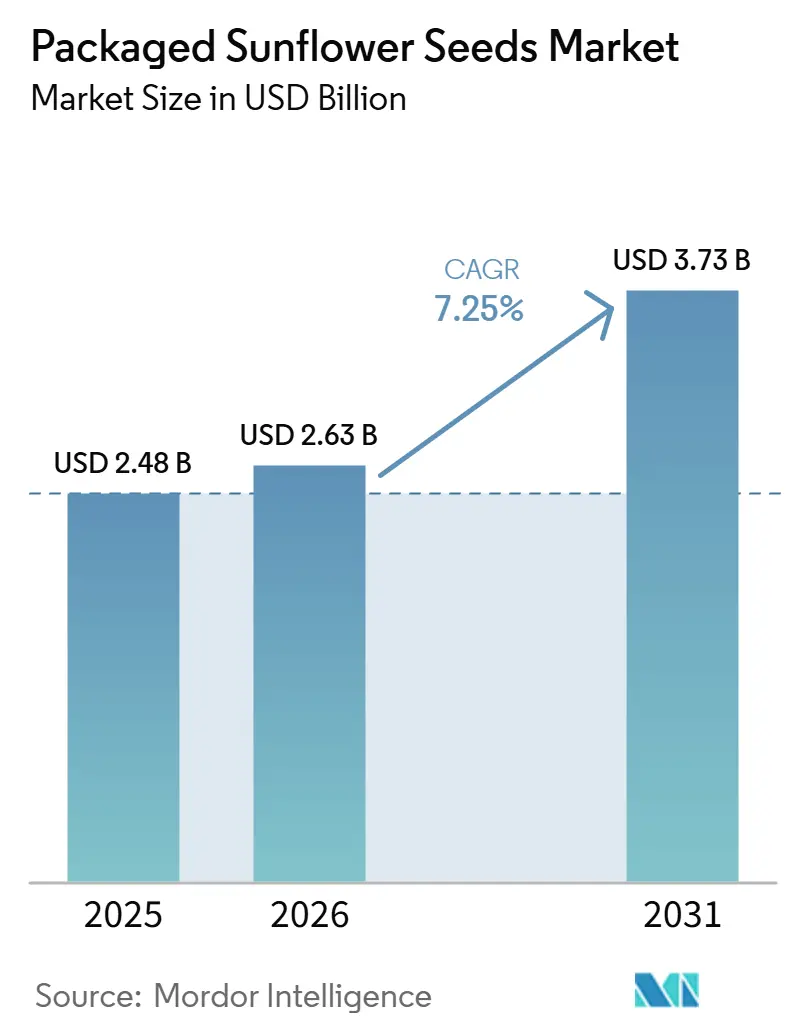
The packaged sunflower seeds market size was valued at USD 2.48 billion in 2025 and is estimated to grow from USD 2.63 billion in 2026 to reach USD 3.73 billion by 2031, at a CAGR of 7.25% during the forecast period (2026-2031). Demand is supported by portable, shelf-stable snacks that offer protein and natural fats in familiar formats. The category also benefits as consumers move toward plant-based, minimally processed foods and away from additive-heavy snacks. U.S. sunflower production reached 2.2 billion pounds in 2025, up 103% from 2024 as planted acreage increased, supporting raw material availability for packagers in the near term. This supply position helps brands plan production and promotions with greater confidence than during an immediate material shortage. Brands are using flavor launches, branded partnerships, and broader online availability to drive trial, while cleaner ingredients and traceable sourcing support premium positioning.
Key Report Takeaways
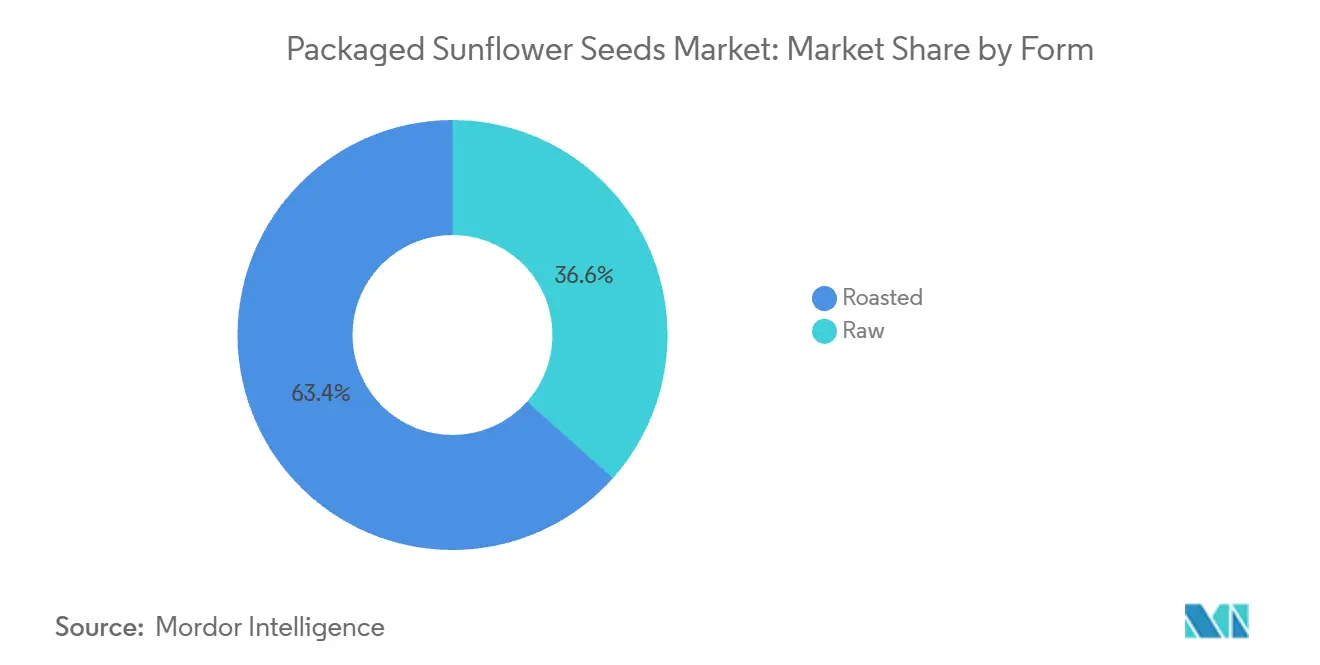
- By form, roasted sunflower seeds held 63.4% of the packaged sunflower seeds market share in 2025, while raw sunflower seeds are forecast to grow at a 9.2% CAGR through 2031.
- By flavor, flavored products accounted for 55.6% of the packaged sunflower seeds market size in 2025, while unflavored products are projected to expand at an 8.5% CAGR through 2031.
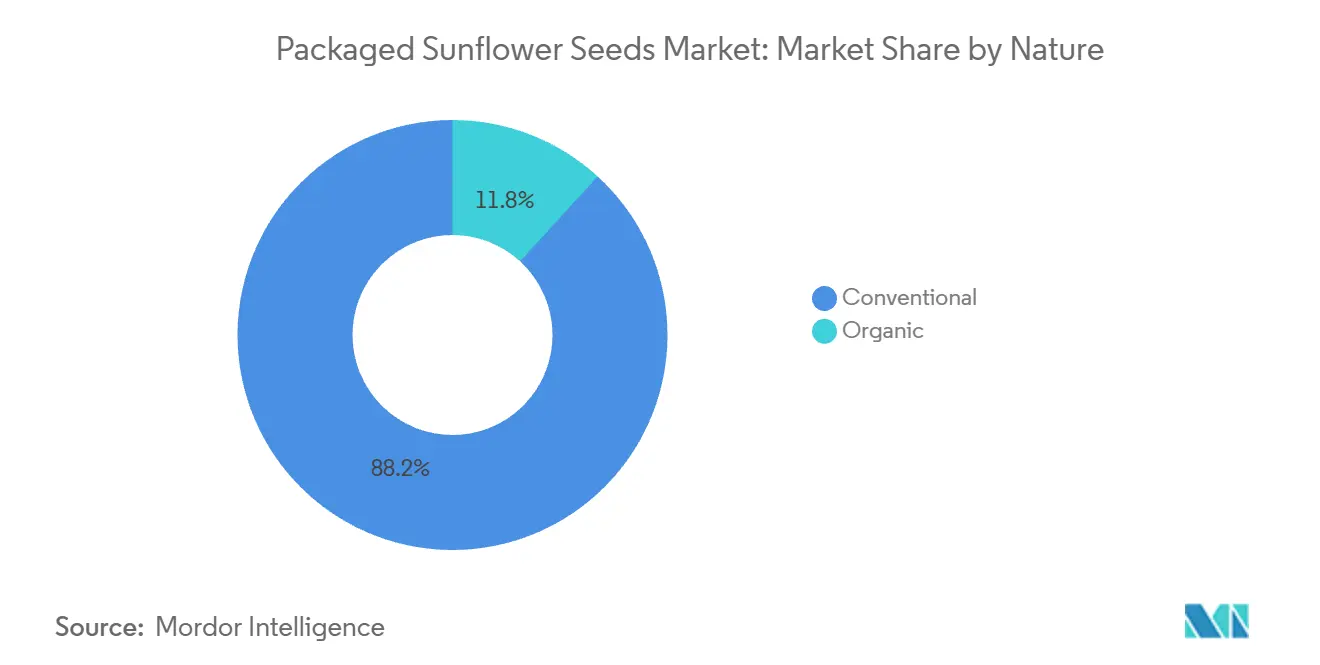
- By nature, conventional seeds held 88.2% of packaged sunflower seeds market share in 2025, while organic seeds are forecast to grow at a 10.3% CAGR through 2031.
- By distribution channel, supermarkets and hypermarkets accounted for 51.5% of the packaged sunflower seeds market size in 2025, while online retail is projected to grow at an 8.8% CAGR through 2031.
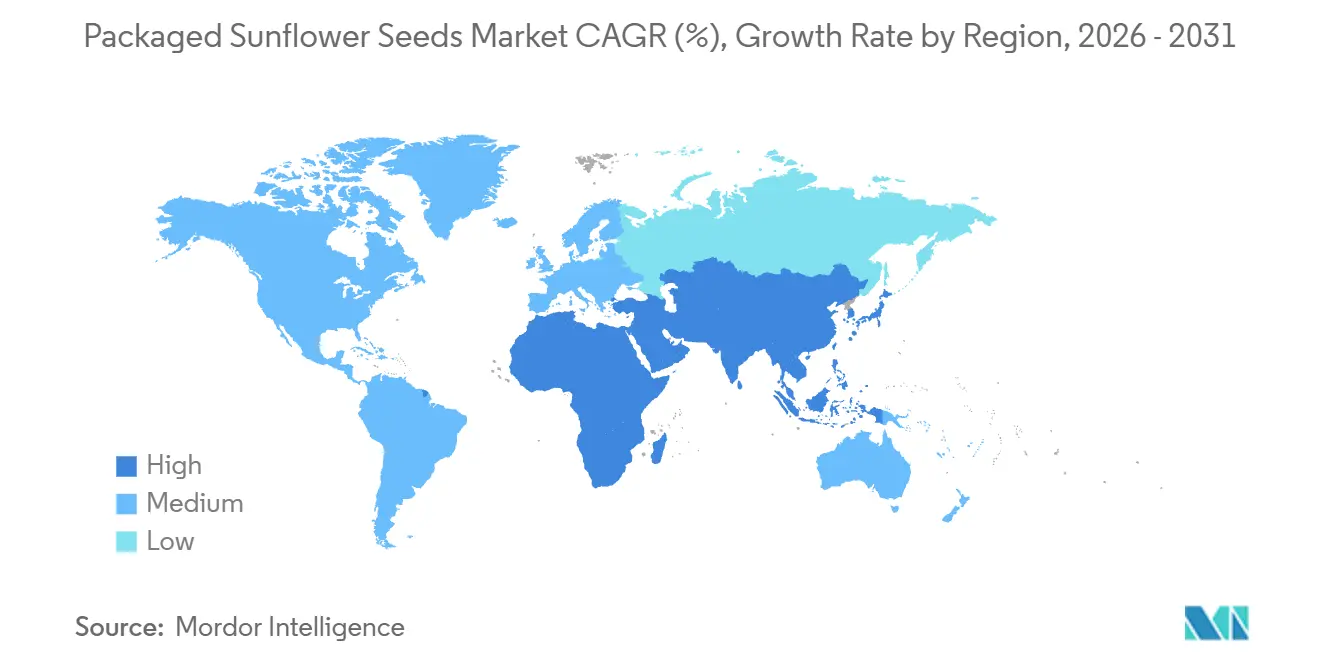
- By geography, Europe held 28.3% revenue share in 2025, while Asia-Pacific is forecast to grow at an 8.3% CAGR through 2031.
Note: Market size and forecast figures in this report are generated using Mordor Intelligence’s proprietary estimation framework, updated with the latest available data and insights as of January 2026.
Market Trends and Insights
Drivers Impact Analysis of Packaged Sunflower Seeds Market*
| Drivers | (~) % Impact on CAGR Forecast | Geographic Relevance | Impact Timeline |
|---|---|---|---|
| Rising demand for convenient snacks | +1.9% | Global, with peak intensity in North America and Western Europe | Short term (≤ 2 years) |
| Clean-label and simple-ingredient preference | +1.3% | North America & EU core, spill-over to APAC urban centres | Medium term (2–4 years) |
| Expansion of flavor innovation | +0.9% | North America & EU; early gains in APAC and MEA | Short term (≤ 2 years) |
| Growth of retail availability | +0.8% | Global, with strongest momentum in APAC e-commerce | Medium term (2–4 years) |
| Popularity of snacking between meals | +1.0% | Global | Short term (≤ 2 years) |
| Long shelf life and storage convenience | +0.6% | Global, amplified in South America and MEA with infrastructure constraints | Long term (≥ 4 years) |
| Source: Mordor Intelligence | |||
Popularity of Snacking Between Meals
Packaged sunflower seeds fit the need for food that can be carried, stored, and eaten without preparation. Conagra stated that the average American recorded 1,200 snacking occasions in 2025, showing the role of snacks in everyday eating routines. Seeds can combine portability with protein and fat content, without refrigeration or the longer ingredient lists found in many bars. This gives single-serve packs a practical role in travel, work, school, sports venues, and other away-from-home occasions. The packaged sunflower seeds market can benefit when shoppers choose a compact food that can remain in a bag, desk, vehicle, or pantry. Brands that offer portion-controlled products at convenience-channel price points can address these occasions more directly than bulk formats.
Clean-label and Simple-ingredient Preference
Sunflower seeds have a short ingredient list, which supports demand for simple snack products. Chaucer Foods reported that 71% of shoppers in 2026 actively chose snacks without artificial additives and preservatives. This preference supports unflavored, lightly processed, and certified products, especially where consumers review ingredient labels before buying. It also gives packaged sunflower seeds a clearer point of comparison with complex snack products that contain several additives or processing aids. In November 2025, Kensing received exclusive European Food Safety Authority authorization for Sunvasterol, an allergen-free sunflower-derived plant sterol with a cholesterol-reduction claim. The product shows how documented sunflower-based ingredients can support health-oriented positioning, while long shelf life also remains valuable where storage and distribution are less reliable.
Expansion of Flavor Innovation
Flavor remains an important way for brands to differentiate a product based on a widely available agricultural input. Conagra expanded its seed offerings from April 2025 through the 2026 Sweets & Snacks Expo with Cinnamon Churro DAVID Seeds, Taco Bell Fire Sauce BiGS, Aaron Judge Sweet & Spicy DAVID Seeds, and BiGS Triple Blast varieties. These products connect sunflower seeds to sweet, spicy, restaurant-inspired, and sports-related snack occasions. The packaged sunflower seeds market therefore uses flavor both to retain established buyers and to attract consumers who normally choose chips, popcorn, or other seasoned snacks. Licensed flavors can reduce the effort needed to explain a new product to shoppers because consumers already recognize the flavor association. The approach can support faster trial but also shortens product cycles and increases the need for regular launches, favoring brands with established retail relationships and recognizable partnerships.
Growth of Retail Availability
Broader retail availability is improving product discovery in the packaged sunflower seeds market. The 2025 USDA GAIN report projected that India’s e-commerce food segment will grow 45% from 2025 to 2030, while Tier II and Tier III cities account for 60% of online consumer activity[1]Source: U.S. Department of Agriculture Foreign Agricultural Service, “India’s E-commerce and Quick Commerce Market”, apps.fas.usda.gov. This gives seed brands a route to consumers outside the areas best served by physical distribution. Online selling also helps smaller and premium brands reach shoppers without the same trade-spending requirements as large suppliers. The channel gives the packaged sunflower seeds market a way to test new flavors, pack sizes, and premium claims before a broad retail rollout. Easier online entry can strengthen private-label competition and weaken shelf-placement advantages that national brands hold in supermarkets, making product information, search terms, and cross-selling placements more important in digital channels.
Restraints Impact Analysis of Packaged Sunflower Seeds Market*
| Restraint | (~) % Impact on CAGR Forecast | Geographic Relevance | Impact Timeline |
|---|---|---|---|
| Raw material price volatility | -0.9% | Global, most acute for Black Sea-dependent EU processors | Short term (≤ 2 years) |
| Competition from alternative healthy snacks | -0.7% | North America & EU, spreading to APAC | Medium term (2–4 years) |
| Allergen and cross-contamination concerns | -0.4% | North America & EU, governed by FDA and EFSA frameworks | Medium term (2–4 years) |
| Dependence on agricultural growing conditions | -0.6% | Black Sea region, EU, Argentina | Long term (≥ 4 years) |
| Source: Mordor Intelligence | |||
Raw Material Price Volatility
Raw material costs remain the most immediate pressure on packaged sunflower seed producers in 2026. Global ending stocks were forecast to fall 15% to 2.28 million metric tons by September 2026, while U.S. confectionery sunflower prices were projected at USD 37.1 per cwt, 15% above the USD 32.3 per cwt spring price in 2025[2]Source: University of Nebraska–Lincoln Department of Agricultural Economics, “Rebounding Acres: The 2025 Sunflower Surge and What Comes Next”, agecon.unl.edu. France’s 2026 sunflower yield forecast was revised to 1.94 t/ha after sustained heat stress, and the country’s 2025 harvest was estimated at 1.6 million metric tons. This raises planning uncertainty for the packaged sunflower seeds market, particularly when weather affects supply regions at the same time. These conditions can raise costs for organic and confectionery-grade kernels, which are used in higher-margin product lines. Producers with limited supply agreements or no direct sourcing presence face greater exposure when retail prices cannot rise at the same pace as input costs.
Competition From Alternative Healthy Snacks
Packaged sunflower seeds compete with pumpkin seeds, trail mixes, protein bars, lentil snacks, seaweed snacks, and premium nuts for the same eating occasions. The range of choices makes it harder for products that rely only on familiarity or value pricing to protect margins. Chaucer Foods noted that naturally sweetened products represented 38% of healthy snack launches in 2026, indicating continued innovation across competing snack formats. Rival products can use functional claims and distinct lifestyle positioning to give consumers a clearer reason to accept higher prices. The packaged sunflower seeds market must therefore connect its nutritional qualities with a clear taste, format, or ingredient proposition. Food safety also remains relevant because allergen management and cross-contamination controls can influence trust, particularly for consumers seeking allergen-free snacks.
*Our forecasts treat driver/restraint impacts as directional, not additive. The impact forecasts reflect baseline growth, mix effects, and variable interactions.
Packaged Sunflower Seeds Market Segment Analysis
By Form:
Roasted Products Lead Sales While Raw Seeds Gain Health-Focused DemandRoasted seeds accounted for 63.4% of sales in 2025. Their ready-to-eat format fits well with established snacking occasions, including sports venues in North America and at-home consumption in Europe. Roasting improves aroma and shelf appeal while retaining the storage advantages of a product that does not need refrigeration. It also provides the base for many branded seasoning and flavor programs. Conagra’s recent DAVID Seeds and BiGS launches were concentrated in roasted products, linking the format to cinnamon, sauce, pickle, and spicy flavor profiles.
Raw sunflower seeds are forecast to grow at a 9.2% CAGR from 2026 to 2031, the fastest rate within the form segment. Buyers use raw seeds for home roasting, baking, trail mixes, and nutrition products, where control over freshness and sodium is important. A 2025 USDA GAIN report described growing institutional demand in Brazil for unprocessed seeds used in baked goods, protein enrichment, trail mixes, and bars. Larger pack sizes can suit online buyers purchasing seeds for household preparation or ingredient use. The format is therefore moving beyond its role as an input and gaining relevance as a premium snack option.


By Flavor:
Flavored Products Lead Revenue While Unflavored Products Meet Simpler-Label DemandFlavored products held 55.6% of sales in 2025. Seasoning gives brands a clear way to stand apart on shelves shared with nuts, chips, pretzels, and popcorn. It also allows sunflower seed products to match familiar taste profiles from other snack categories. Restaurant partnerships and sports-linked launches have particular relevance in North America, where they can introduce seeds to younger consumers. Because seasoning uses a relatively small amount of material per unit, flavor variety can support product differentiation without fundamentally changing the product’s storage and portability benefits.
Unflavored sunflower seeds are projected to grow at an 8.5% CAGR through 2031. This growth reflects demand from consumers who want fewer ingredients and greater control over sodium intake. The 71% of shoppers who chose snacks without artificial additives or preservatives in 2026 provides a supportive base for plain and lightly processed formats. Unflavored products can fit whole-food eating patterns and use cases such as baking or home roasting. Their progress alongside flavored products shows that the category serves both novelty-driven snackers and shoppers seeking ingredient transparency.
By Nature:
Conventional Seeds Retain Scale While Organic Products Grow FasterConventional seeds held 88.2% of sales in 2025. Their position reflects lower prices and broad availability across mainstream stores, discount outlets, and private-label ranges. The segment serves consumers seeking a familiar and affordable snack rather than a certified premium product. Its large volumes support purchasing scale for ingredients and manufacturing, which helps preserve its leading role. Food safety compliance is a basic requirement in this segment, including the relevant U.S. and European rules for food production and labeling.
Organic seeds are forecast to grow at a 10.3% CAGR from 2026 to 2031, the highest rate across the packaged sunflower seeds market. Growth is supported by consumers who are willing to pay more for certified production practices and traceable ingredients. Health food retailers and online platforms can support the higher prices of organic products more readily than mass retail channels. The format also benefits from the interest in simple labels and plant-based protein sources. Organic suppliers must continue to demonstrate compliance with certification requirements if they are to maintain the price premium that supports this segment.
By Distribution Channel:
Supermarkets Lead While Online Retail Grows FastestSupermarkets and hypermarkets accounted for 51.5% of the packaged sunflower seeds market size in 2025. These stores remain the principal place for snack discovery because seeds are displayed near nuts, dried fruit, and other salty snacks. This placement encourages trial and repeat purchases across related product categories. Large stores can also carry private-label, mainstream branded, and premium options together. Convenience stores form an important secondary physical channel for single-serve products sold at transport locations, fuel stations, and quick-service areas.
Online retail is forecast to grow at an 8.8% CAGR through 2031. Digital channels reduce the cost of reaching consumers for emerging brands that lack the retail budgets of major suppliers. They also support larger pack purchases by consumers who roast seeds or use them in home cooking. India’s online food segment is projected to grow at a positive rate by 2031, and smaller cities already represent 60% of online consumer activity. The channel can widen access to new areas, although it also makes competitive comparison and private-label entry easier.
Geography Analysis
Europe and North America Packaged Sunflower Seeds Market
Europe held 28.3% regional share in 2025. Consumer familiarity with seeds, organized retail networks, and proximity to major Black Sea supply areas support the region’s position. Germany remains an important Western European market because grocery retailers offer broad seed assortments across branded and private-label products, while the United Kingdom is growing through plant-based diets and online health food retail. France’s 2025 harvest was estimated at 1.6 million metric tons, up 7% year on year but 11% below its five-year average because of heat stress and water shortages. Nutrition-label discussions are encouraging dry-roasted and lightly salted variants, while North America follows Europe in scale through long-standing baseball-related snacking in the United States.
APAC Packaged Sunflower Seeds Market
Asia-Pacific is forecast to grow at an 8.3% CAGR from 2026 to 2031, the highest regional rate in the packaged sunflower seeds market. Urban growth, rising incomes, and a shift from loose seeds to branded packs are supporting demand in China, India, and Southeast Asia. Digital platforms give brands access to secondary cities without building the same physical distribution network needed for traditional retail. This is particularly relevant in India, where online food sales are expected to expand 45% from 2025 to 2030. The region gives premium brands room to grow, but they must adjust price points, pack sizes, and flavors to local buying behavior.
South America and MEA Packaged Sunflower Seeds Market
South America combines major sunflower production with an emerging market for packaged seeds. Brazil and Argentina can serve both as supply sources and as developing domestic consumer markets. The USDA identified opportunities and challenges in Brazil’s growing sunflower sector, including demand for raw seeds in food manufacturing. The Middle East and Africa remain smaller but relevant, especially in Turkey, Saudi Arabia, and the UAE, where seed snacking is familiar and modern retail is expanding. Nigeria, Egypt, and Morocco offer future potential, although infrastructure limits and price sensitivity currently constrain premium branded sales.

Competitive Landscape
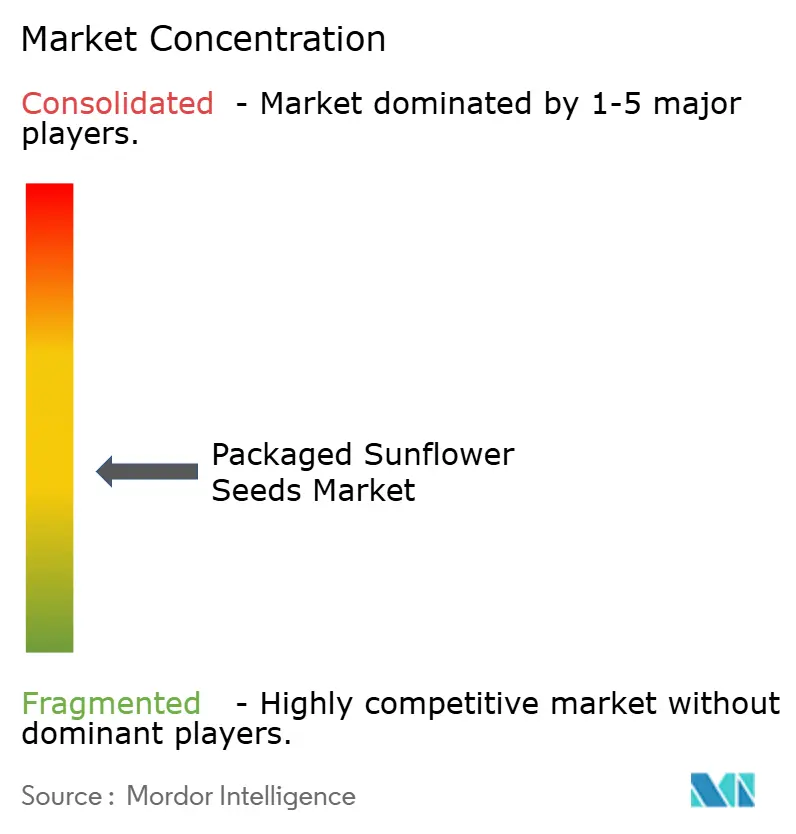
The packaged sunflower seeds market is moderately fragmented. No single company controls pricing or retail placement across all regions. Conagra leads in North America through its DAVID Seeds and BiGS brands, while Tong Garden has a strong presence in Southeast Asia. Yoga Bar, Farmley, and True Elements compete in India’s health-focused snacking segment. Large food companies and regional specialists compete on retail reach, price, flavor, ingredient standards, and product positioning.
Conagra uses flavors and cultural partnerships to keep its portfolio visible. In 2026, the company announced BiGS Triple Blast sunflower seeds in Pickle Ranch and Spicy Sweet Chili, with a fall launch planned. In June 2026, it released limited-edition DAVID Seeds Sweet & Spicy packs featuring Aaron Judge, with part of the proceeds supporting the Aaron Judge All Rise Foundation. Chinook Seedery announced an equity partnership with Blake Snell in January 2025 and planned a custom Zilla flavor for the first quarter of 2026. These moves show how brands use athletes, familiar flavors, and product launches to reach consumers during sports-related snacking occasions.
Ingredient and food safety claims also influence competition in the packaged sunflower seeds market. Kensing’s November 2025 EFSA authorization for Sunvasterol created an exclusive European position for a sunflower-derived plant sterol used in heart-health applications. Smaller brands compete through allergen control, simple ingredients, and premium production standards. E-commerce gives brands a lower-cost route to shoppers, but it also makes the category easier for new brands and private labels to enter. Limited consolidation compared to some adjacent snack categories creates room for acquisitions by companies seeking a stronger position in seeds and related snacks.
Packaged Sunflower Seeds Industry Leaders
Conagra Brands, Inc.
PepsiCo, Inc.
The Kraft Heinz Company
GIANT Snacks Inc.
Chinook Seedery
- *Disclaimer: Major Players sorted in no particular order
Packaged Sunflower Seeds Market Companies Covered in this Report
- Conagra Brands, Inc.
- PepsiCo, Inc.
- The Kraft Heinz Company
- Waymouth Farms, Inc.
- Chinook Seedery
- GIANT Snacks Inc.
- Dakota Style Foods
- Sincerely Nuts
- REALFOODSOURCE LTD
- Flaper S.A.
- Good Sense Foods
- Pramoda Exim Corporation
- Taj Pharmaceuticals Limited
- SunOpta Inc.
- True Elements
- Yoga Bar (Sproutlife Foods Pvt. Ltd.)
- Farmley
- Tong Garden Co., Ltd.
- Sahale Snacks
- Wonderful Pistachios and Almonds LLC

Recent Industry Developments in Packaged Sunflower Seeds Market
- June 2026: Conagra Brands announces BiGS Triple Blast Sunflower Seeds launch. Available in Pickle Ranch and Spicy Sweet Chili, these triple-seasoned, jumbo roasted sunflower seeds are set to debut in fall 2026, expanding Conagra's flavored seeds portfolio. The launch deepens BiGS's position in flavored sunflower seeds within Conagra's USD 3.3 billion snacks portfolio.
- June 2026: Conagra Brands releases limited-edition DAVID Seeds Aaron Judge packs. The Sweet & Spicy packs, featuring MLB player Aaron Judge, are intended to strengthen the DAVID Seeds link with sports culture and reach younger consumers. A portion of proceeds supports the Aaron Judge All Rise Foundation.
- June 2026: Green Fox has launched Sota Seedz, a new brand of Minnesota-grown, 100% organic sunflower seeds, expanding its value-added snack portfolio. The brand is positioned around the concept of "Seedz with Standards," emphasizing quality, transparency, and farm-to-bag traceability.


Global Packaged Sunflower Seeds Market Report Scope
| Raw |
| Roasted |
| Unflavored |
| Flavored |
| Conventional |
| Organic |
| Supermarkets & Hypermarkets |
| Convenience Stores |
| Online Retail |
| Other Distribution Channels |
| North America | United States |
| Canada | |
| Mexico | |
| Rest of North America | |
| Europe | Germany |
| United Kingdom | |
| Italy | |
| France | |
| Spain | |
| Netherlands | |
| Poland | |
| Belgium | |
| Sweden | |
| Rest of Europe | |
| Asia-Pacific | China |
| India | |
| Japan | |
| Australia | |
| Indonesia | |
| South Korea | |
| Thailand | |
| Singapore | |
| Rest of Asia-Pacific | |
| South America | Brazil |
| Argentina | |
| Colombia | |
| Chile | |
| Peru | |
| Rest of South America | |
| Middle East and Africa | South Africa |
| Saudi Arabia | |
| United Arab Emirates | |
| Nigeria | |
| Egypt | |
| Morocco | |
| Turkey | |
| Rest of Middle East and Africa |
| By Form | Raw | |
| Roasted | ||
| By Flavor | Unflavored | |
| Flavored | ||
| By Nature | Conventional | |
| Organic | ||
| By Distribution Channel | Supermarkets & Hypermarkets | |
| Convenience Stores | ||
| Online Retail | ||
| Other Distribution Channels | ||
| By Geography | North America | United States |
| Canada | ||
| Mexico | ||
| Rest of North America | ||
| Europe | Germany | |
| United Kingdom | ||
| Italy | ||
| France | ||
| Spain | ||
| Netherlands | ||
| Poland | ||
| Belgium | ||
| Sweden | ||
| Rest of Europe | ||
| Asia-Pacific | China | |
| India | ||
| Japan | ||
| Australia | ||
| Indonesia | ||
| South Korea | ||
| Thailand | ||
| Singapore | ||
| Rest of Asia-Pacific | ||
| South America | Brazil | |
| Argentina | ||
| Colombia | ||
| Chile | ||
| Peru | ||
| Rest of South America | ||
| Middle East and Africa | South Africa | |
| Saudi Arabia | ||
| United Arab Emirates | ||
| Nigeria | ||
| Egypt | ||
| Morocco | ||
| Turkey | ||
| Rest of Middle East and Africa | ||


Key Questions Answered in the Report
What is the forecast for packaged sunflower seeds through 2031?
The packaged sunflower seeds market is projected to reach USD 3.73 billion by 2031, growing at a 7.25% CAGR from 2026.
Which packaged sunflower seed format has the largest sales share?
Roasted products led with 63.4% share in 2025 because they are ready to eat and support a wide range of flavors.
Why are organic sunflower seeds growing faster than conventional products?
Organic seeds are forecast to grow at a 10.3% CAGR through 2031 as consumers pay more for certified production and traceable ingredients.
Which sales channel is growing fastest for sunflower seed brands?
Online retail is forecast to expand at an 8.8% CAGR through 2031, helped by broader access to consumers outside major retail centers.
Page last updated on:





