
Packaged Natural Mineral Water Market Size and Share
Market Overview
| Study Period | 2022 - 2032 |
|---|---|
| Market Size (2027) | USD 143.35 Billion |
| Market Size (2032) | USD 202.94 Billion |
| Growth Rate (2027 - 2032) | 7.20 % |
| Fastest Growing Market | Asia-Pacific |
| Largest Market | Europe |
| Market Concentration | Low |
Major Players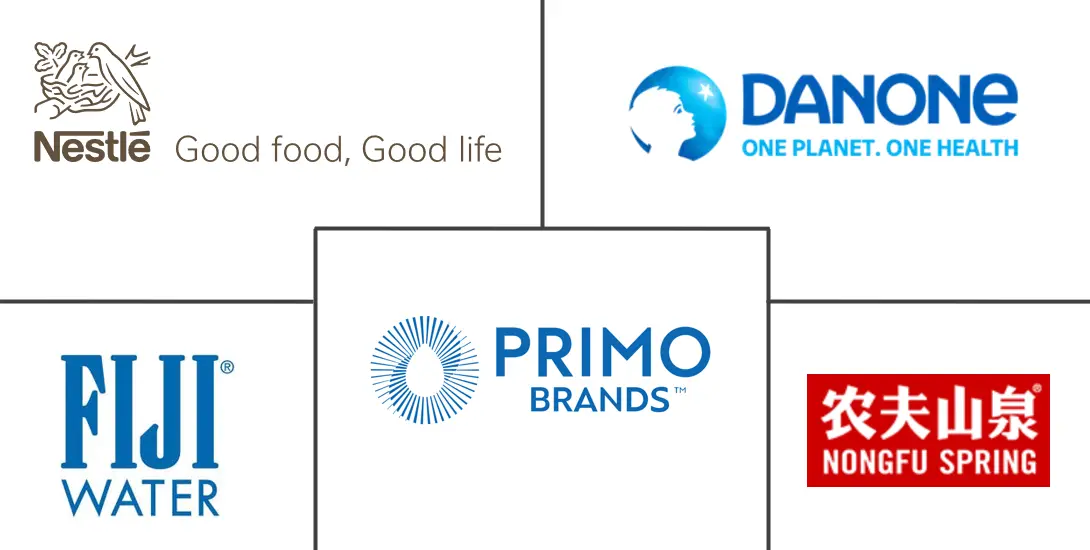 *Disclaimer: Major Players sorted in no particular order Image © Mordor Intelligence. Reuse requires attribution under CC BY 4.0. | |
Packaged Natural Mineral Water Market Analysis by Mordor Intelligence
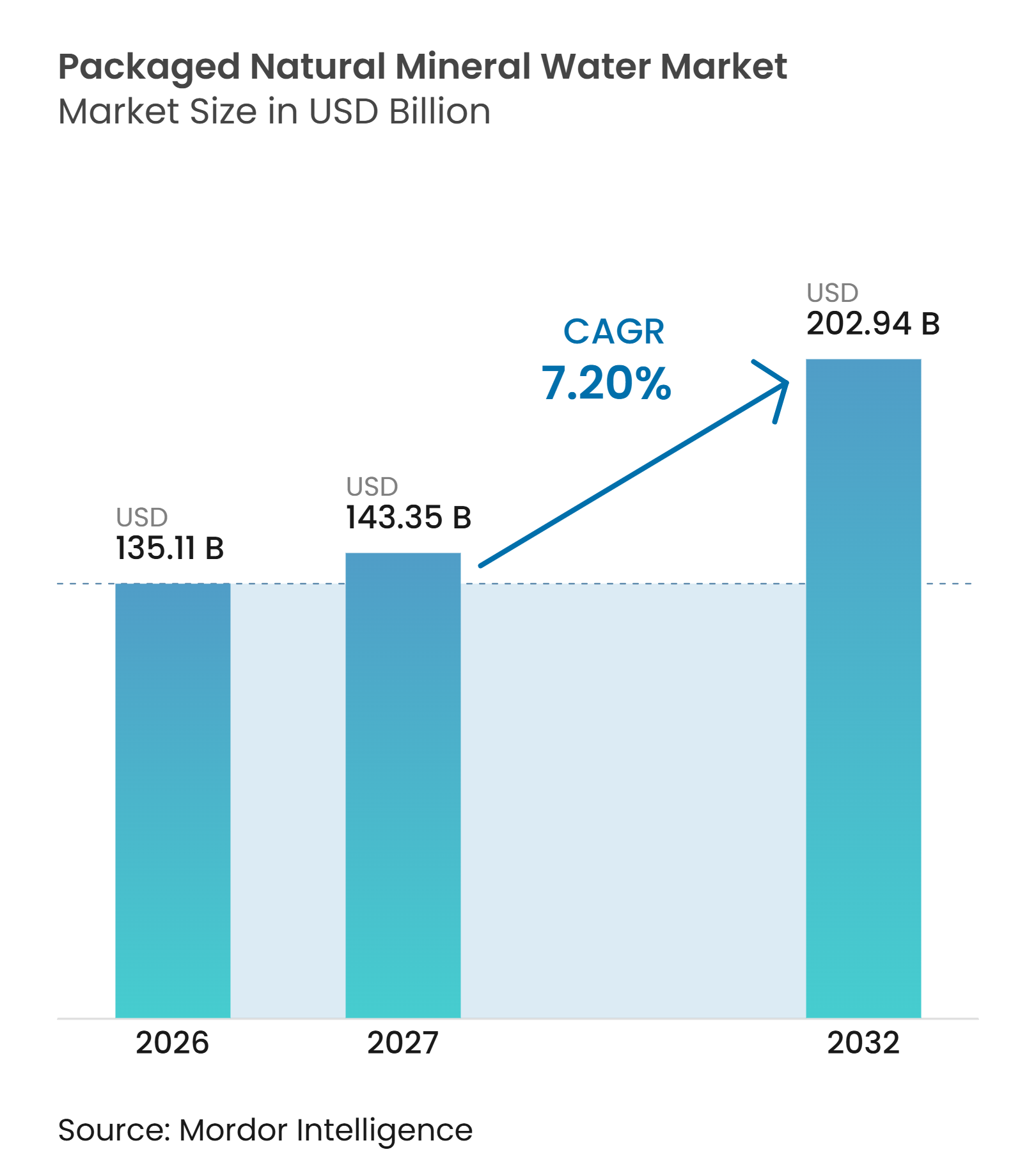
The packaged natural mineral water market size is projected to be USD 135.11 billion in 2026, USD 143.35 billion in 2027, and reach USD 202.94 billion by 2032, growing at a CAGR of 7.20% from 2027 to 2032. Protected underground origins, stable mineral composition, and limits on chemical treatment separate natural mineral water from purified water. These features restrict the availability of qualifying sources and make source control central to brand positioning. Consumer interest in health, provenance, and premium formats supports demand beyond routine hydration. Producers are responding through packaging changes, premium formats, and targeted expansion in hotel, restaurant, retail, and online channels. Compliance failures can weaken trust in a source-led brand and can affect commercial performance as well as operating permissions.
Key Report Takeaways
-
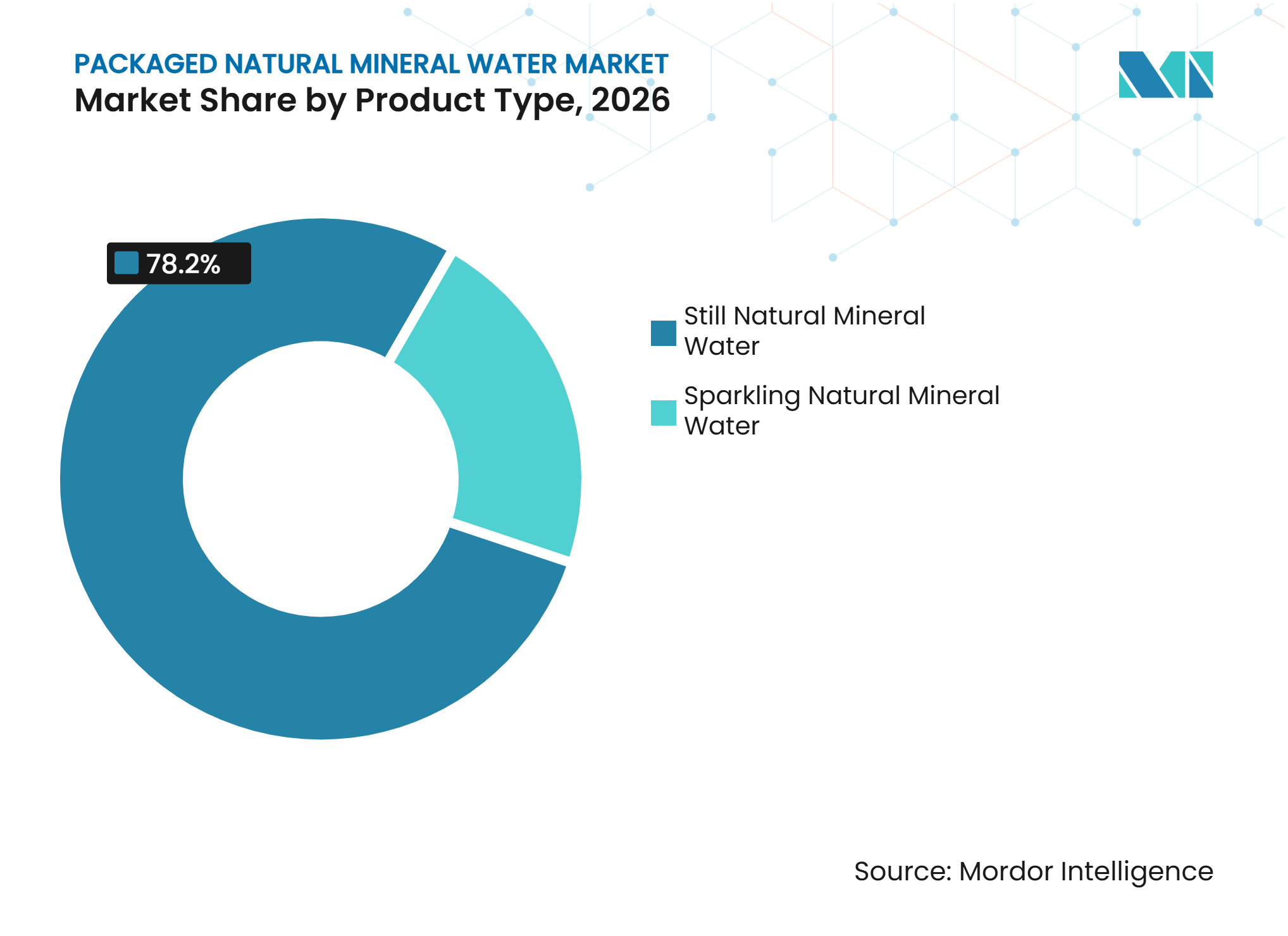
By product type, still natural mineral water held 78.2% of the packaged natural mineral water market share in 2026, while sparkling natural mineral water is projected to grow at an 8.3% CAGR through 2032.
-
By price, the mass segment held 74.6% in 2026, while the premium segment is projected to grow at a 9.1% CAGR through 2032.
-
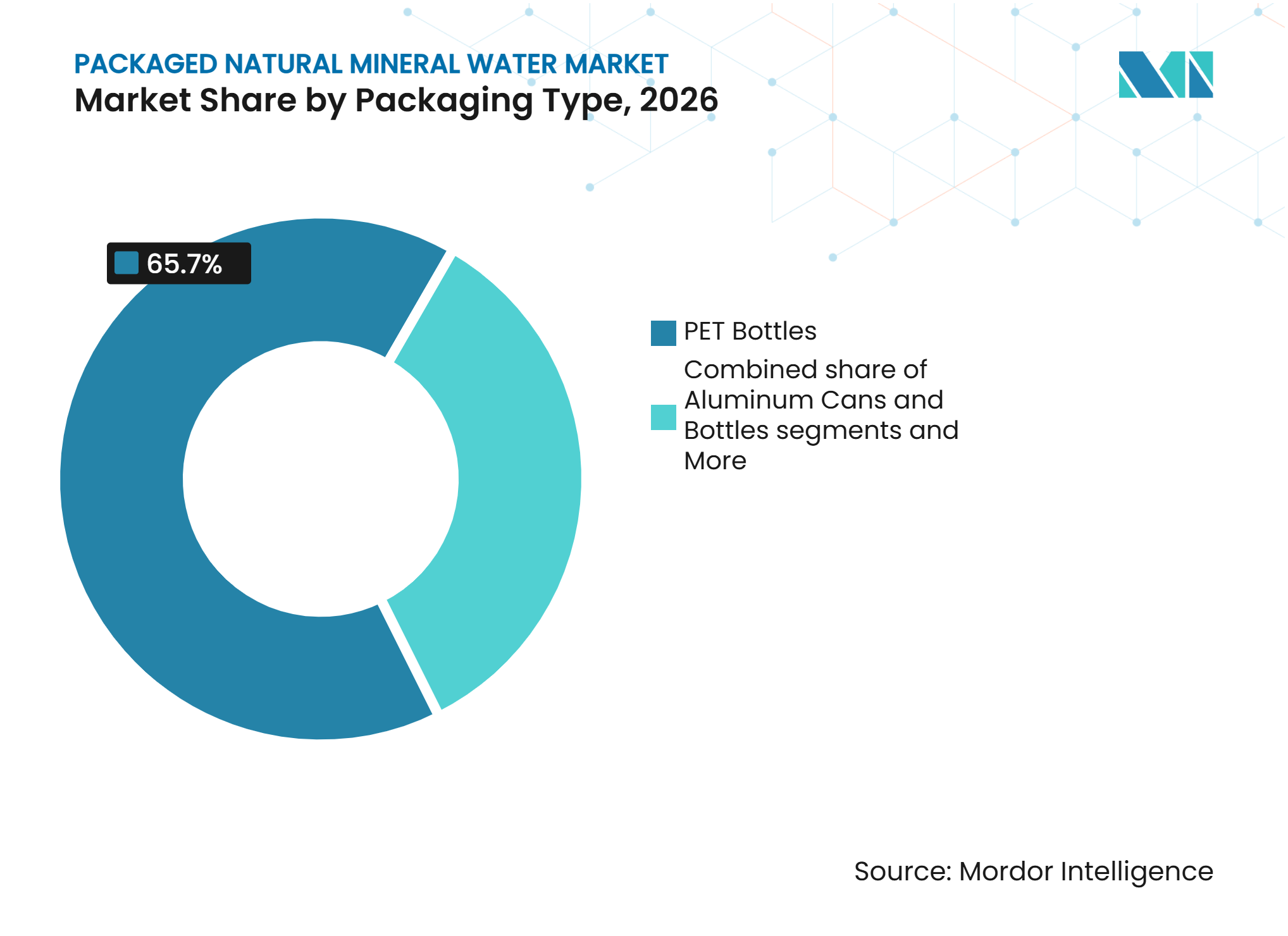
By packaging type, PET bottles held 65.7% in 2026, while aluminum cans and bottles are projected to grow at a 9.3% CAGR through 2032.
-
By distribution channel, off-trade held 76.2% in 2026, while on-trade distribution is projected to grow at an 8.7% CAGR through 2032.
-
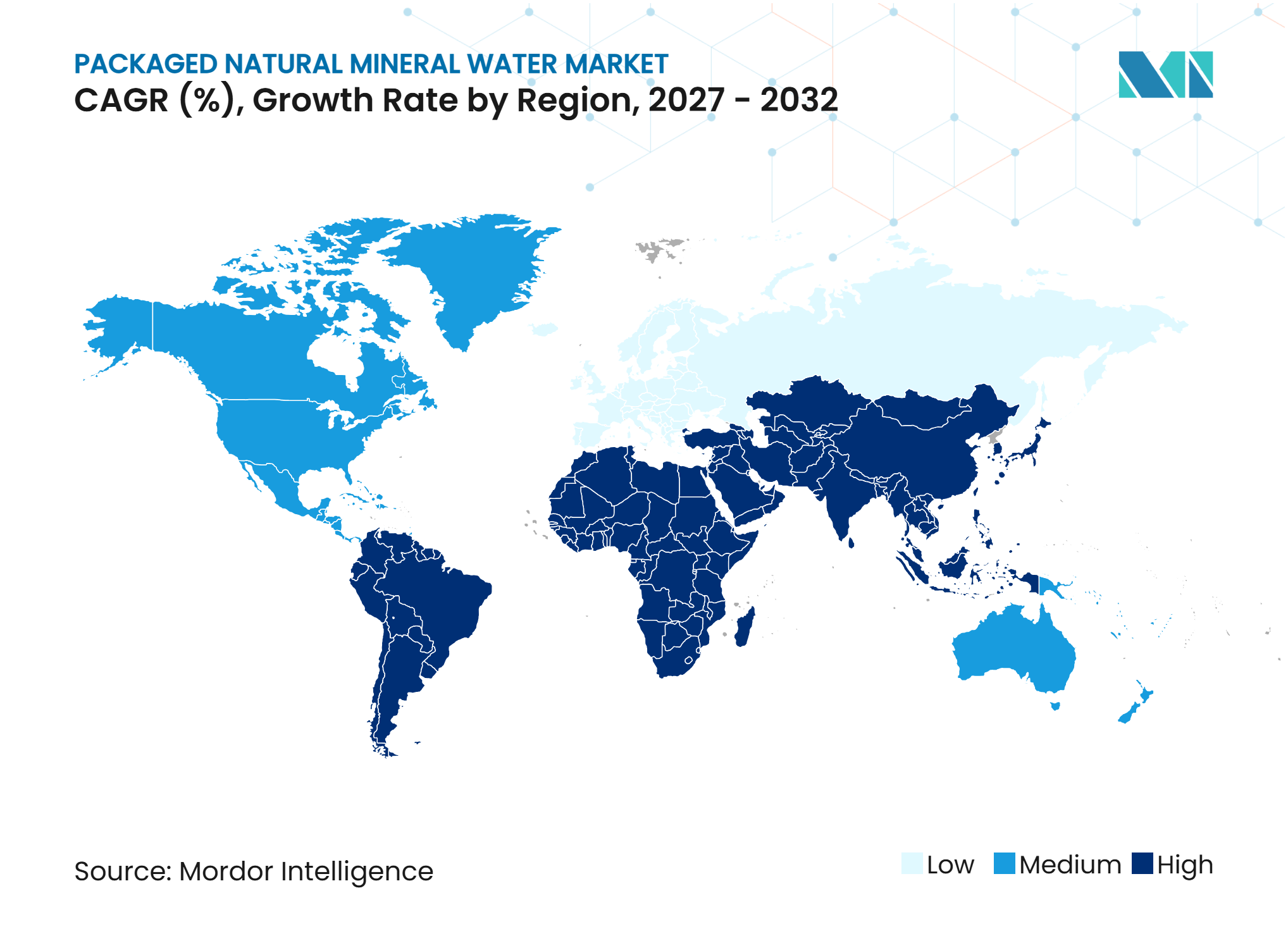
By geography, Europe held 38.5% in 2026, while Asia-Pacific is projected to grow at an 8.5% CAGR through 2032.
Note: Market numbers in this report are based on Mordor Intelligence's proprietary estimation framework, which combines nine months of actuals with Q4 projections for base year 2026.
Market Trends and Insights
Drivers Impact Analysis of Packaged Natural Mineral Water Market*
| Driver | (~) % Impact on CAGR Forecast | Geographic Relevance | Impact Timeline |
|---|---|---|---|
| Preference for Clean-Label and Minimally Processed Products | +1.1% | Global, with higher intensity in North America and Western Europe | Medium term (2-4 years) |
| Concerns Over Tap Water Quality and Safety | +1.3% | North America, Asia-Pacific, South America | Short term (≤ 2 years) |
| Growth of Functional and Fortified Water | +0.9% | North America, Asia-Pacific, Western Europe | Medium term (2-4 years) |
| Premiumization and Provenance-Based Branding | +0.8% | Western Europe, North America, Middle East | Long term (≥ 4 years) |
| Convenience and On-The-Go Consumption | +0.7% | Global, led by Asia-Pacific and North America | Short term (≤ 2 years) |
| Sustainable and Eco-Friendly Packaging Innovation | +0.6% | Europe, North America | Medium term (2-4 years) |
| Source: Mordor Intelligence | |||
Concerns Over Tap Water Quality and Safety
PFAS contamination in municipal systems is strengthening the appeal of packaged natural mineral water for consumers who question tap-water quality. According to the 2025 report by Environmental Protection Agency, it is known that more than 73 million Americans were exposed to PFAS levels above maximum contaminant limits. This concern can shift demand toward products whose source and treatment restrictions are easier for consumers to understand. Italy’s Legislative Decree 102/2025 updates Decree 18/2023 to implement the EU Drinking Water Directive 2020/2184. The change shows that contaminant rules remain an active compliance issue for municipal water systems. In the packaged natural mineral water market, this creates a near-term demand opportunity where confidence in local water quality is under pressure.
Premiumization and Provenance-Based Branding
Premiumization and provenance-based branding are driving demand in the Packaged Natural Mineral Water Market, as consumers increasingly associate natural water sources, distinctive mineral compositions, and geographical origin with product quality and authenticity. Brands are leveraging the geological characteristics and purity of specific water sources to differentiate their offerings from conventional packaged drinking water. For instance, Evian highlights its natural filtration through the French Alps and its 15-year journey through glacial rocks, reinforcing its origin-based premium positioning. Similarly, Fiji Water emphasizes its artesian source in the Fiji Islands and naturally occurring minerals, supporting its premium brand identity. These strategies enable manufacturers to command higher price points and strengthen consumer preference for source-specific natural mineral water products.
Growth of Functional and Fortified Water
Functional hydration is widening the set of occasions in which consumers consider bottled water. It also noted that consumers increasingly associate bottled water with health and seek skin-health or digestive benefits from hydration products. Natural mineral water producers can address this demand by explaining the existing mineral profile of their source. That approach requires careful language because natural mineral water claims remain subject to rules on composition and labeling. In the packaged natural mineral water market, transparent mineral information can help brands participate in health-oriented demand without changing the product’s defining source characteristics.
Sustainable and Eco-Friendly Packaging Innovation
Packaging is becoming a direct part of competitive positioning in the packaged natural mineral water market. Regulation (EU) 2025/40 takes effect on August 12, 2026, and establishes recycled-content and collection requirements for beverage packaging. The regulation requires single-use plastic beverage bottles to contain 30% post-consumer recycled content from 2030. It also requires deposit-return systems to collect 90% of plastic bottles and metal containers by 2029. A 2025 University of Salerno assessment found that PET had lower global warming potential per 1,000 liters than aluminum and glass in the evaluated packaging systems. This means packaging decisions need to balance recyclability, recovery systems, product protection, and full life-cycle effects rather than relying on material perceptions alone[1].
Restraints Impact Analysis of Packaged Natural Mineral Water Market*
| Restraint | (~) % Impact on CAGR Forecast | Geographic Relevance | Impact Timeline |
|---|---|---|---|
| Complex and Fragmented Regulatory Compliance | -0.6% | Global, particularly Europe and Asia-Pacific | Medium term (2-4 years) |
| Limited Availability of Authentic Natural Mineral Sources | -0.7% | Western Europe, South Asia | Long term (≥ 4 years) |
| Tightening Packaging and Recycling Regulations | -0.5% | Europe, expanding to North America and Asia | Medium term (2-4 years) |
| Competition From Home Filtration and Refill Systems | -0.8% | East Asia, North America, Western Europe | Medium term (2-4 years) |
| Source: Mordor Intelligence | |||
Tightening Packaging and Recycling Regulations
The phased implementation of EU packaging rules creates costs and operating complexity for bottlers active across Europe. Regulation (EU) 2025/40 requires packaging changes that affect recycled content, collection, and producer responsibility arrangements[2]. European Union Austria’s deposit-return system, introduced on January 1, 2025, as an early indicator of adjustment pressure. It stated that mineral water volumes fell 12.7% in the first 9 months and that Vöslauer expected a 2- to 3-year return to earlier volumes. Country-specific registration and fee arrangements add work for producers managing several national markets. Smaller regional bottlers may face a greater burden because they have fewer resources to spread compliance costs across a broad portfolio.
Competition From Home Filtration and Refill Systems
Point-of-use filtration and refill systems are a credible substitute for single-serve packaged water in selected markets. Coway received the Diamond Prize at the Korea International Sommelier Association competition in October 2025. The recognition showed that filtered water can gain quality credentials in a premium setting. BE WTR acquired Porla in Singapore and Hong Kong in May 2026 and entered Thailand through a licensing partnership. The company targeted premium hospitality accounts, including channels where mineral water brands seek visibility. This competition places greater importance on the provenance, sensory character, and service value that natural mineral water can offer.
*Our forecasts treat driver/restraint impacts as directional, not additive. The impact forecasts reflect baseline growth, mix effects, and variable interactions.
Packaged Natural Mineral Water Market Segment Analysis
By Product Type:
Still Water Anchors Volume, Sparkling AcceleratesStill natural mineral water held 78.2% of the packaged natural mineral water market in 2026. Its position reflects routine hydration demand and broad availability across retail and food-service outlets. The segment benefits from consumer familiarity and from its role as an alternative to sweetened beverages. Germany’s mineral water association reported that domestic still mineral water sales rose 6.1% in 2025. Total mineral water sales in the country increased 2.4% to 10.2 billion liters in the same year. The difference supports the view that some consumers are moving from carbonated formats to still water. Still products also suit large multi-packs and everyday household buying. These factors keep the format important for producers seeking volume stability.
Sparkling natural mineral water is projected to grow at an 8.3% CAGR through 2032. It is positioned as a no-calorie alternative for consumers reducing carbonated soft-drink consumption. Spanish association reported that Spain’s sparkling water volume rose 14.3% in 2025 to 202.7 million liters. It also linked this result to changing habits that favor naturally carbonated mineral water. Spanish association data showed that natural mineral water remained the country’s most consumed beverage at 139 liters per person in 2025. The category’s range of source characteristics and carbonation profiles supports differentiation across restaurants and retail. Brands can use these attributes to create a clear alternative to conventional soda. The packaged natural mineral water market therefore has room for sparkling formats to outpace the larger still segment.



By Price:
Mass Sustains Volume, Premium Commands Value GrowthThe mass price segment held 74.6% in 2026. It is supported by frequent household purchasing through supermarkets and other modern retail outlets. Large-format and lower-priced stock-keeping units generate high transaction volume in this part of the category. It is known that France’s natural mineral water sector as generating EUR 3 billion in annual producer revenue. It also stated that category volume and value both grew 7% in 2025 after a contraction in 2023. Private-label development can maintain volume in off-trade channels. At the same time, it can compress margins for branded suppliers. Brands in the mass tier must preserve quality and availability while controlling packaging and distribution costs.
The premium price segment is forecast to grow at a 9.1% CAGR through 2032. Packaging, and hospitality placement are central to price realization in this segment. It reported a U.S. premium price of USD 2.65 per liter, compared with USD 0.99 per liter in France. FIJI Water introduced a 700mL format in July 2025 for car cupholders and backpacks. The format shows how a premium supplier can add more frequent consumption occasions without moving away from origin-led positioning. Premium suppliers must sustain product consistency because the commercial case depends on trust in the source. The packaged natural mineral water industry uses premium formats to raise value while retaining the distinction between natural mineral water and treated water.
By Packaging Type:
PET Leads Volume, Aluminum Drives InnovationPET bottles held 65.7% of the packaged natural mineral water market in 2026. The material remains widely used because it is light, cost-efficient, and compatible with multi-packs and large formats. A 2025 assessment at the University of Salerno reported a global warming potential of 198 kg CO₂-equivalent per 1,000 liters for PET. The study reported 513 kg CO₂-equivalent for aluminum and 933 kg CO₂-equivalent for glass under its assessed conditions. These results show why material decisions should consider the complete package system. EU requirements will require producers to secure compliant recycled material and maintain food-contact standards. PET producers must also make recycling instructions and collection performance visible to consumers and retailers. The format remains central even as brands invest in alternatives.
Aluminum cans and bottles are projected to grow at a 9.3% CAGR through 2032. This format fits premium and portable use occasions. It also has a visible connection to recycling narratives in retail and hospitality. Formosa Springs relaunched under new ownership in 2025 with an aluminum-focused production strategy. The company planned capacity of up to 100 million cans annually. Aluminum does not replace PET across all use cases because format, cost, and recovery infrastructure differ. It gives suppliers another way to position portable products within the packaged natural mineral water market.

By Distribution Channel:
Off-Trade Dominates, On-Trade Gains ShareOff-trade distribution held 76.2% in 2026. Supermarkets and hypermarkets are the primary volume channels for large formats, multi-packs, and routine household purchases. Online retail adds subscription and bulk-buy options that can strengthen repeat purchasing. Convenience and grocery stores serve a different need by supplying single-serve formats in urban, travel, and fuel-station settings. Spanish Association of Mineral Waters (ANEABE) stated that household off-trade consumption in Spain was broadly flat in 2025. This indicates that mature retail demand may be stable rather than rapidly expanding. Reliable shelf availability and pack architecture therefore remain important for suppliers in this channel. The packaged natural mineral water market relies on off-trade outlets to maintain the volume base that supports broad distribution.
On-trade distribution is projected to grow at an 8.7% CAGR through 2032. Restaurants and hotels use still and sparkling natural mineral water as part of table service and premium beverage selection. Tourism recovery and restaurant activity are supporting the channel’s expansion. Spanish Association of Mineral Waters (ANEABE) described Spain’s on-trade volumes as growing at a double-digit rate in 2025. Spain’s association also reported 6.8 billion liters of mineral-water production during 2025. Hospitality gives brands a setting to communicate source, mineral profile, and packaging quality. It can also make sparkling formats more visible at meals. This channel offers higher-value placements, but suppliers need dependable service and a suitable portfolio for food-service customers.
Geography Analysis
Europe: Largest Market, Value Reorientation Under Way
Europe held 38.5% of the packaged natural mineral water market in 2026. The region has long-established consumption cultures in Italy, Germany, France, and Spain. Association of German Mineral Water Producers (VDM) stated that Italy consumed 17 billion liters in 2024, Germany consumed 13 billion liters, and Spain consumed 9.1 billion liters. Germany’s domestic mineral water sales rose 2.4% to 10.2 billion liters in 2025. Still mineral water grew 6.1% in Germany, faster than total category sales. Spain produced 6.8 billion liters of mineral water in 2025. Compliance with the EU packaging regulation will shape recycled content, collection, and packaging choices across the region. Producers are balancing everyday formats with higher-value hospitality and premium placements. This supports value reorientation while preserving Europe’s large consumption base.
Asia-Pacific: Fastest Growing on Consumption Ladder Migration
Asia-Pacific is projected to grow at an 8.5% CAGR through 2032. China, India, and Southeast Asian markets are moving from commoditized purified water toward products with clear origin and mineral credentials. China’s per capita natural mineral water consumption at 42 liters in 2025. It compared this with 68 liters in Japan and 55 liters in Western Europe. These differences indicate room for category development where consumers begin to distinguish natural mineral water from treated packaged water. Premium brands, including Himalayan from Tata Consumer Products, are building awareness of mineral-profile distinctions in India. Urban, higher-income consumers are an important audience for artisan entrants. The region also has growing demand for portable and functional hydration occasions. Suppliers that explain source quality clearly can improve relevance without overstating product benefits.
Divergent Trajectories Across Remaining Regions
North America is shaped by consumer concern over tap-water quality and a premiumizing bottled-water segment. South America has a mixed profile, with Brazil leading regional consumption at 12 billion liters in 2024. The Middle East is oriented toward premium hotel and restaurant service, while Africa remains earlier in its category development outside South Africa. Agthia acquired Riviere Mineral Water in the United Arab Emirates in March 2025. The acquisition tripled Agthia’s household customer base and added 3 bottling facilities and more than 160 delivery trucks. Nigeria, Egypt, and Morocco are priority markets as organized retail develops. Across these regions, retail access, service channels, and consumer confidence in source claims determine the pace of category development.
Competitive Landscape
Market Concentration
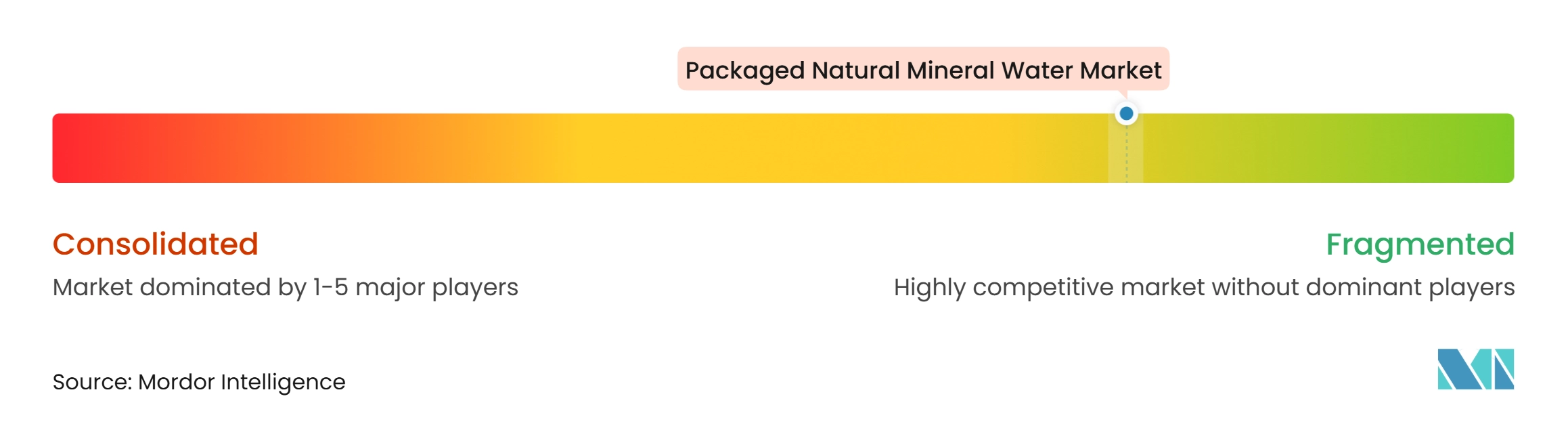
The packaged natural mineral water market has a concentration score of 3 out of 10 and is moderately fragmented. Protected spring locations give producers an advantage that competitors cannot replicate through marketing or distribution alone. Global multinationals compete alongside regional producers with access to recognized local sources, which limits consolidation since the source is central to the product. The research identified opportunities in developing markets in Africa and Southeast Asia, along with functional extensions based on transparent mineral profiles, subject to EU Council Directive 2009/54/EC. Source compliance has grown in importance following the treatment controversy that affected Perrier and Vittel volumes between 2020 and 2025, making strong documentation and quality controls essential for source-led brands.
Recent strategic moves reflect a focus on portfolio refinement, premium channels, and capacity development. Elior Group acquired Société d'Exploitation de l'Eau Minérale 808 in France in March 2026, planning to modernize its 3,000 m² bottling facility and double its workforce, with a 2-year target of 15 million to 20 million bottles for luxury hotels, restaurants, and export channels. Agthia's acquisition of Riviere strengthened its UAE position through added facilities and delivery capacity. FIJI Water introduced a 700 mL bottle targeting mobile use occasions. These moves show that format, channel access, and service reach matter alongside source ownership.
Packaging and channel execution remain key competitive areas. Nongfu Spring's June 2025 collaboration with Sam's Club produced a laser-engraved, label-free PET bottle from recyclable food-grade material, while AQUA Carpatica invested in capacity at Vatra Dornei and expanded into Poland. Smaller premium producers can build recognition through visible source information and third-party tasting events. BE WTR's expansion into Southeast Asia shows that sustainable filtered-water providers are competing for premium hospitality accounts, pressuring bottled-water brands reliant on restaurant and hotel visibility. Competitive performance will depend on how effectively suppliers align compliance, packaging, and source authenticity across channels.
Packaged Natural Mineral Water Industry Leaders
-
Danone S.A.
-
Nestlé S.A.
-
Nongfu Spring Co., Ltd.
-
Primo Brands Corporation
-
FIJI Water Company LLC
- *Disclaimer: Major Players sorted in no particular order
Packaged Natural Mineral Water Market Companies Covered in this Report
- Nestlé S.A (Nestlé Waters and Premium Beverages)
- Danone S.A.
- Nongfu Spring Co., Ltd.
- Primo Brands Corporation
- FIJI Water Company LLC
- Gerolsteiner Brunnen GmbH and Co. KG
- The Coca-Cola Company
- PepsiCo, Inc.
- Tata Consumer Products Limited
- Bisleri International Pvt. Ltd.
- Suntory Beverage and Food Limited
- Asahi Group Holdings, Ltd.
- Voss of Norway AS
- CG Roxane LLC
- Vichy Catalan Corporation
- Ferrarelle S.p.A.
- Spadel Group
- Highland Spring Group Limited
- Nongshim Co., Ltd.
- Tingyi (Cayman Islands) Holding Corp.
Recent Industry Developments in Packaged Natural Mineral Water Market
- May 2026: Swiss-founded sustainable premium filtered water brand BE WTR acquired Singapore and Hong Kong distributor Porla, gaining 300+ premium hospitality clients including Raffles Hotel Singapore, while simultaneously entering Thailand through a licensing partnership, marking a deliberate push into Southeast Asia's luxury F&B on-trade channel.
- April 2026: FIJI Water launched a new multi-platform campaign accompanied by city takeover activations, extending its "Origins" source-story narrative to urban consumer touchpoints in key North American and international markets.
- March 2026: Elior Group acquired Société d'Exploitation de l'Eau Minérale 808, sourced at Meyreuil, southern France, with plans to modernize the 3,000 m² bottling facility and double its workforce. The 2-year target is annual production of 15 to 20 million still and sparkling bottles distributed through luxury hotels, renowned restaurants, and international export channels.
- July 2025: FIJI Water launched a 700mL bottle designed to fit standard car cupholders and backpacks, rolling out through 7-Eleven and nationwide retail and online channels in the US. The simultaneous "Origins" multimedia campaign anchored the brand's source narrative in the Viti Levu artesian aquifer.
Global Packaged Natural Mineral Water Market Report Scope
The Packaged Natural Mineral Water Market refers to the market for water obtained from naturally occurring underground sources, such as protected springs or boreholes, containing characteristic mineral compositions and packaged at source for commercial distribution and consumption. By product type, the market is segmented into still natural mineral water and sparkling natural mineral water. By price, the market is divided into mass and premium categories. By packaging type, the market is segmented into PET bottles, glass bottles, aluminum cans and bottles, cartons and Tetra Paks, and other packaging types. By distribution channel, the market is divided into on-trade and off-trade channels, with off-trade further segmented into supermarkets and hypermarkets, convenience and grocery stores, online retail stores, and other off-trade distribution channels. Geographically, the market covers North America, Europe, Asia-Pacific, South America, and the Middle East and Africa, with country-level coverage across major markets, including the United States, Canada, Mexico, Germany, the United Kingdom, Italy, France, Spain, the Netherlands, Poland, Belgium, Sweden, China, India, Japan, Australia, Indonesia, South Korea, Thailand, Singapore, Brazil, Argentina, Colombia, Chile, Peru, South Africa, Saudi Arabia, the United Arab Emirates, Nigeria, Egypt, Morocco, and Turkey, along with the respective regional rest-of-country categories. Market size and growth forecasts are presented in terms of value (USD).
Segmentation Overview
| Still Natural Mineral Water |
| Sparkling Natural Mineral Water |
| Mass |
| Premium |
| PET Bottles |
| Glass Bottles |
| Aluminum Cans and Bottles |
| Cartons and Tetra Paks |
| Others |
| On-Trade | |
| Off-Trade | Supermarkets and Hypermarkets |
| Convenience and Grocery Stores | |
| Online Retail Stores | |
| Other Off-Trade Distribution Channels |
| North America | United States |
| Canada | |
| Mexico | |
| Rest of North America | |
| Europe | Germany |
| United Kingdom | |
| Italy | |
| France | |
| Spain | |
| Netherlands | |
| Poland | |
| Belgium | |
| Sweden | |
| Rest of Europe | |
| Asia-Pacific | China |
| India | |
| Japan | |
| Australia | |
| Indonesia | |
| South Korea | |
| Thailand | |
| Singapore | |
| Rest of Asia-Pacific | |
| South America | Brazil |
| Argentina | |
| Colombia | |
| Chile | |
| Peru | |
| Rest of South America | |
| Middle East and Africa | South Africa |
| Saudi Arabia | |
| United Arab Emirates | |
| Nigeria | |
| Egypt | |
| Morocco | |
| Turkey | |
| Rest of Middle East and Africa |
| By Product Type | Still Natural Mineral Water | |
| Sparkling Natural Mineral Water | ||
| By Price | Mass | |
| Premium | ||
| By Packaging Type | PET Bottles | |
| Glass Bottles | ||
| Aluminum Cans and Bottles | ||
| Cartons and Tetra Paks | ||
| Others | ||
| By Distribution Channel | On-Trade | |
| Off-Trade | Supermarkets and Hypermarkets | |
| Convenience and Grocery Stores | ||
| Online Retail Stores | ||
| Other Off-Trade Distribution Channels | ||
| By Geography | North America | United States |
| Canada | ||
| Mexico | ||
| Rest of North America | ||
| Europe | Germany | |
| United Kingdom | ||
| Italy | ||
| France | ||
| Spain | ||
| Netherlands | ||
| Poland | ||
| Belgium | ||
| Sweden | ||
| Rest of Europe | ||
| Asia-Pacific | China | |
| India | ||
| Japan | ||
| Australia | ||
| Indonesia | ||
| South Korea | ||
| Thailand | ||
| Singapore | ||
| Rest of Asia-Pacific | ||
| South America | Brazil | |
| Argentina | ||
| Colombia | ||
| Chile | ||
| Peru | ||
| Rest of South America | ||
| Middle East and Africa | South Africa | |
| Saudi Arabia | ||
| United Arab Emirates | ||
| Nigeria | ||
| Egypt | ||
| Morocco | ||
| Turkey | ||
| Rest of Middle East and Africa | ||
Key Questions Answered in the Report
What is driving packaged natural mineral water demand?
Demand is supported by concern over water quality, preference for products with documented origin, premium positioning, and packaging innovation.
How large is the packaged natural mineral water market?
The market is projected to expand from USD 135.11 billion in 2026 to USD 202.94 billion by 2032, at a 7.2% CAGR from 2027 to 2032.
Which product type is growing fastest?
Sparkling natural mineral water is projected to grow at an 8.3% CAGR through 2032, while still water remains the largest product type.
Why is Europe important for natural mineral water producers?
Europe held 38.5% in 2026 and combines deep consumption habits with regulatory requirements that shape packaging and source compliance.
What packaging format is gaining momentum?
Aluminum cans and bottles are projected to grow at a 9.3% CAGR through 2032, while PET remains the largest format at 65.7% in 2026.