
Packaged Milkshakes Market Size and Share
Market Overview
| Study Period | 2021 - 2031 |
|---|---|
| Market Size (2026) | USD 4.11 Billion |
| Market Size (2031) | USD 5.71 Billion |
| Growth Rate (2026 - 2031) | 6.79 % |
| Fastest Growing Market | Middle East and Africa |
| Largest Market | Asia-Pacific |
| Market Concentration | Medium |
Major Players *Disclaimer: Major Players sorted in no particular order Image © Mordor Intelligence. Reuse requires attribution under CC BY 4.0. | |
Packaged Milkshakes Market Analysis by Mordor Intelligence
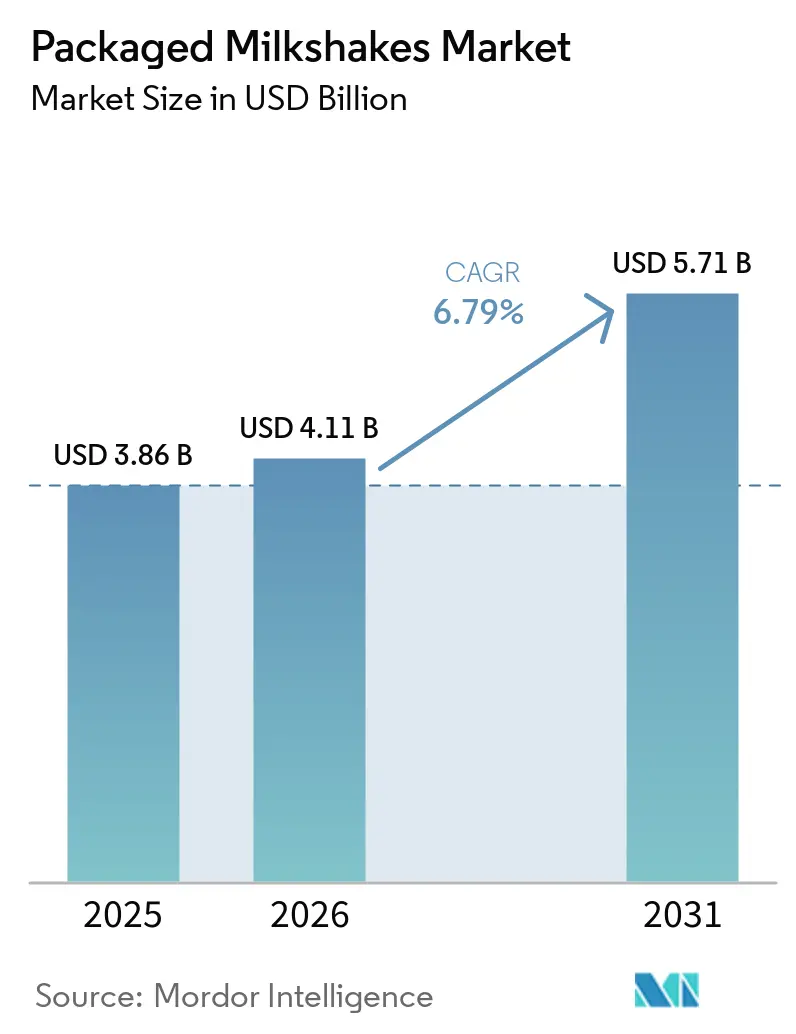
The packaged milkshakes market size is expected to grow from USD 3.86 billion in 2025 to USD 4.11 billion in 2026 and is forecast to reach USD 5.71 billion by 2031 at a 6.79% CAGR over 2026-2031. The market is evolving as manufacturers respond to changing consumer preferences for convenient, ready-to-drink beverages that offer both indulgence and nutritional value. Demand is increasingly driven by high-protein, functional, and better-for-you formulations, alongside innovation in flavors, packaging, and product positioning aimed at a broader consumer base. While traditional dairy-based milkshakes continue to dominate the category, plant-based alternatives are gaining traction as health, dietary, and sustainability considerations influence purchasing decisions. Growth is further supported by the expansion of modern retail and foodservice channels, although manufacturers continue to navigate challenges related to sugar reduction initiatives, clean-label expectations, raw material cost volatility, and evolving food regulations across major markets.
Key Report Takeaways
- By product type, dairy-based milkshakes held 82.37% of the category value share in 2025, while plant-based milkshakes are forecast to grow at 8.96% CAGR from 2026 to 2031, with Asia-Pacific providing the main volume base for dairy products and North America and Europe supporting plant-based demand.
- By flavor, chocolate held 36.84% of the category value share in 2025, while coffee is forecast to grow at 8.12% CAGR from 2026 to 2031, with coffee demand linked to adult consumption occasions in North America, Europe, and urban Asia-Pacific.
- By packaging format, bottles held 46.68% of the category value share in 2025, while cans are forecast to grow at 8.41% CAGR from 2026 to 2031, supported by convenient retail formats across North America, Europe, and Asia-Pacific.
- By distribution channel, retail held 83.58% of the category value share in 2025, while foodservice/institutional channels are forecast to grow at 8.27% CAGR from 2026 to 2031, with school and foodservice opportunities emerging in South America, Asia-Pacific, and the Middle East and Africa.
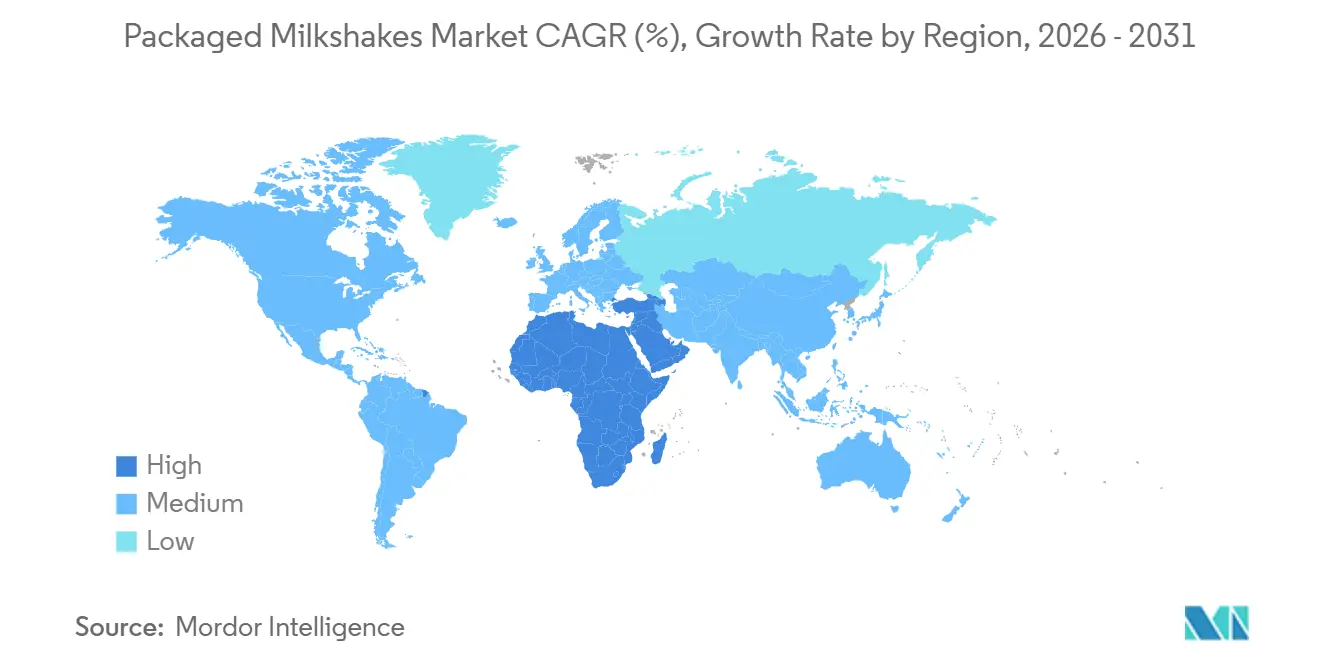
- By geography, Asia-Pacific held 35.74% of global value in 2025, while the Middle East and Africa is forecast to grow at 7.91% CAGR from 2026 to 2031.
Note: Market size and forecast figures in this report are generated using Mordor Intelligence’s proprietary estimation framework, updated with the latest available data and insights as of January 2026.
Market Trends and Insights
Drivers Impact Analysis of Packaged Milkshakes Market*
| Driver | (~) % Impact on CAGR Forecast | Geographic Relevance | Impact Timeline |
|---|---|---|---|
| Growth of on-the-go and convenient nutrition consumption | +1.8% | Global; concentrated in Asia-Pacific urban centres, North America, Western Europe | Short term (≤ 2 years) |
| Expansion of high-protein and functional milkshake variants | +1.5% | North America and Western Europe core; spill-over to Asia-Pacific premium tier | Medium term (2–4 years) |
| Growing demand for better-for-you dairy beverages | +1.2% | Global; early gains in North America and India | Medium term (2–4 years) |
| Premium flavor and format innovation | +0.9% | North America, Europe, Asia-Pacific premium urban centres | Short term (≤ 2 years) |
| Expansion of modern retail and foodservice availability | +0.7% | Middle East and Africa, South America, South and Southeast Asia | Long term (≥ 4 years) |
| Growing demand for lactose-free and plant-based milkshake alternatives | +0.6% | North America, Europe, high lactose-intolerance markets in Asia-Pacific | Medium term (2–4 years) |
| Source: Mordor Intelligence | |||
Growth of on-the-go and convenient nutrition consumption
Increasingly busy lifestyles and changing eating habits are driving demand for packaged milkshakes as convenient, ready-to-drink options that can be consumed during commuting, work, travel, or between meals. Their portability, minimal preparation requirements, and ability to provide energy and satiety in a single serving have made them an attractive choice for consumers seeking convenient meal or snack alternatives. Manufacturers are responding by expanding single-serve formats, resealable packaging, and nutrient-fortified products that cater to on-the-go consumption occasions. According to the 2025 International Food Information Council (IFIC) Food & Health Survey, 29% of consumers reported that convenience of consumption has a significant impact on their food and beverage purchasing decisions[1]. The survey also found that 32% of consumers consider convenience in cooking or preparation to have a significant impact on their purchasing decisions[2]. Additionally, 28% of consumers stated that convenience in purchasing has a significant impact on their food and beverage buying decisions, reinforcing the importance of readily accessible and portable beverage options such as packaged milkshakes[3].
Expansion of high-protein and functional milkshake variants
Growing consumer interest in protein intake, active lifestyles, and general wellness is encouraging manufacturers to expand packaged milkshake portfolios with high-protein and functional formulations. These products are increasingly fortified with ingredients such as protein, vitamins, minerals, fiber, and probiotics to provide nutritional benefits beyond basic refreshment. This is driving innovation across both dairy-based and plant-based milkshakes, with manufacturers introducing products targeted at fitness-conscious consumers, busy professionals, and individuals seeking nutritious snack or meal options. As consumers place greater emphasis on health and functionality, high-protein and fortified milkshakes are becoming an important area of product development and differentiation within the packaged dairy beverage market.
Growing demand for better-for-you dairy beverages
Growing consumer focus on health and wellness is driving demand for packaged milkshakes with improved nutritional profiles that also maintain taste and convenience. Manufacturers are responding by introducing products with reduced sugar, lower fat content, clean-label ingredients, and fewer artificial additives to align with evolving consumer preferences and dietary guidelines. The market is also seeing greater adoption of lactose-free formulations and products made with natural ingredients to appeal to health-conscious consumers and those with specific dietary requirements. As expectations for healthier beverage options continue to evolve, better-for-you dairy milkshakes are becoming an important area of product innovation and portfolio expansion across the packaged dairy beverage industry.
Premium flavor and format innovation
Manufacturers are increasingly investing in premium flavor development and innovative packaging formats to differentiate packaged milkshakes in a competitive beverage market. Indulgent dessert-inspired flavors, coffee-based varieties, seasonal offerings, and region-specific taste profiles are helping brands attract a wider consumer base and encourage repeat purchases. Innovations such as resealable bottles, premium packaging designs, and single-serve formats are enhancing product appeal while improving portability and ease of consumption. These developments are supporting product premiumization and enabling manufacturers to cater to evolving consumer preferences for indulgence and convenience.
Restraints Impact Analysis of Packaged Milkshakes Market*
| Restraint | (~) % Impact on CAGR Forecast | Geographic Relevance | Impact Timeline |
|---|---|---|---|
| Added-sugar, calorie, and ultra-processed food scrutiny | -0.9% | United States, United Kingdom, Europe; spill-over to Asia-Pacific policy markets | Medium term (2–4 years) |
| Volatility in dairy raw material and packaging costs | -0.7% | Global; acute in markets with aluminum tariff exposure and limited hedging | Short term (≤ 2 years) |
| Short shelf life and refrigerated distribution requirements | -0.5% | Sub-Saharan Africa, South/Southeast Asia, Latin America interior | Long term (≥ 4 years) |
| Texture and taste trade-offs in reduced-sugar and plant-based reformulation | -0.3% | North America, Europe; early-stage in Asia-Pacific premium tier | Medium term (2–4 years) |
| Source: Mordor Intelligence | |||
Added-sugar, calorie, and ultra-processed food scrutiny
Growing consumer awareness of the health risks associated with excessive sugar intake, high-calorie foods, and ultra-processed products is challenging the packaged milkshakes market. Many conventional milkshakes contain added sugars, flavorings, and stabilizers that are facing increasing scrutiny from health-conscious consumers and public health authorities. In response, manufacturers are investing in sugar reduction, clean-label reformulation, and natural ingredients to align with evolving dietary preferences and regulatory expectations. However, reducing sugar and simplifying ingredient lists while maintaining the taste, texture, and shelf stability that consumers expect remains a significant product development challenge, limiting the pace of innovation and increasing reformulation costs.
Volatility in dairy raw material and packaging costs
Fluctuations in the prices of dairy ingredients and packaging materials continue to create cost pressures for packaged milkshake manufacturers. Changes in the cost of milk, cream, cocoa, sweeteners, and other key inputs, along with volatility in the prices of plastic, paperboard, aluminum, and energy, can significantly affect production expenses and profit margins. These cost increases are driven by factors such as supply chain disruptions, inflation, changing agricultural conditions, and fluctuations in global commodity markets. As a result, manufacturers face ongoing challenges in maintaining competitive pricing while investing in product innovation, packaging improvements, and operational efficiency.
*Our forecasts treat driver/restraint impacts as directional, not additive. The impact forecasts reflect baseline growth, mix effects, and variable interactions.
Packaged Milkshakes Market Segment Analysis
By Product Type:
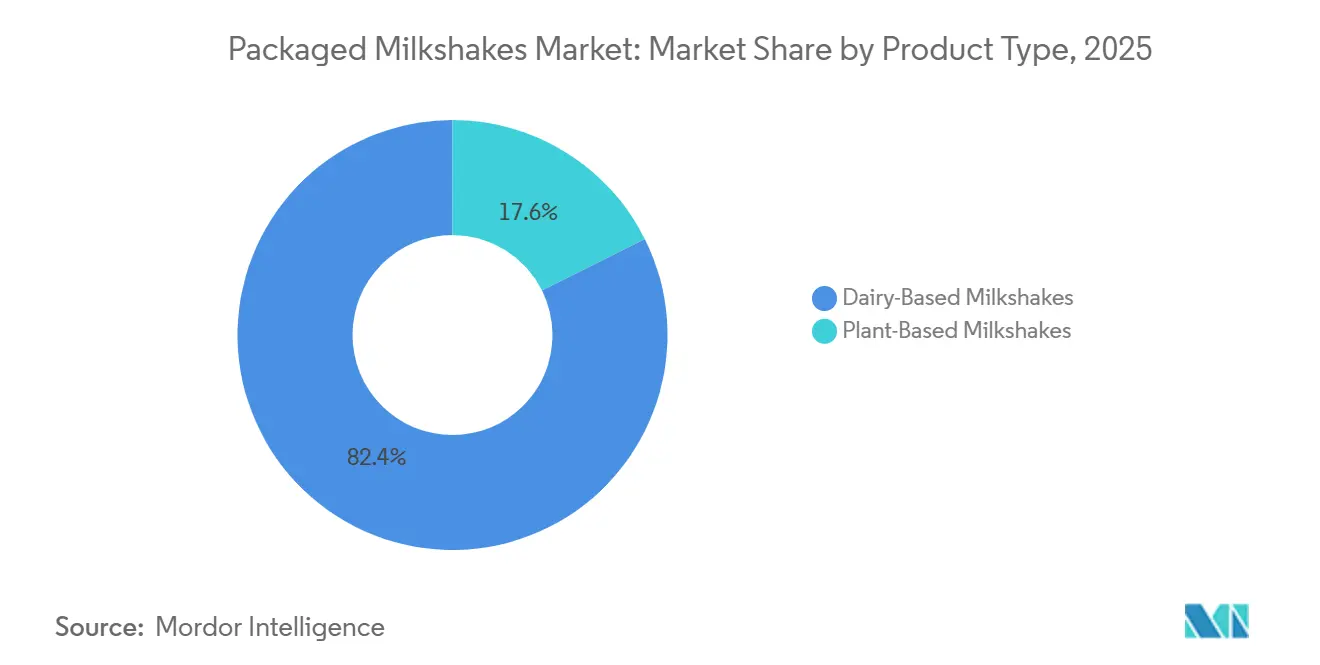
Dairy Foundation Holds, Plant Protein Reshapes the Growth CurveDairy-based milkshakes accounted for the largest share of the packaged milkshakes market, representing 82.37% of total market value in 2025. The segment continues to dominate due to strong consumer preference for traditional dairy formulations, extensive product availability, and well-established manufacturing and distribution infrastructure across both developed and emerging markets. Ongoing product innovation in flavors, formulations, and packaging is further supporting the segment's adoption across retail and foodservice channels.
Plant-based milkshakes are projected to register the fastest growth during the forecast period, expanding at a CAGR of 8.96% from 2026 to 2031. Growth is driven by increasing consumer interest in dairy alternatives, lactose-free products, and beverages that align with evolving dietary preferences and lifestyle choices. Manufacturers are expanding plant-based portfolios with soy-, oat-, almond-, coconut-, and other plant-based formulations while improving taste, texture, and nutritional profiles to appeal to a broader consumer base.
By Flavor:
Chocolate's Structural Anchor, Coffee's Premiumization SignalChocolate accounted for the largest share of the packaged milkshakes market by flavor, representing 36.84% of total market value in 2025. The segment continues to lead due to its widespread consumer acceptance across all age groups, strong presence in both retail and foodservice channels, and compatibility with a wide range of dairy-based and plant-based formulations. Its broad appeal and consistent demand make chocolate the dominant flavor across global packaged milkshake portfolios.
Coffee is projected to be the fastest-growing flavor segment, registering a CAGR of 8.12% from 2026 to 2031. Growth is driven by increasing consumer preference for premium café-inspired beverages and the rising popularity of ready-to-drink coffee-based dairy drinks. Manufacturers are expanding coffee-flavored milkshake offerings with premium formulations and convenient packaging to appeal to adult consumers seeking both refreshment and indulgence.
By Packaging Format:
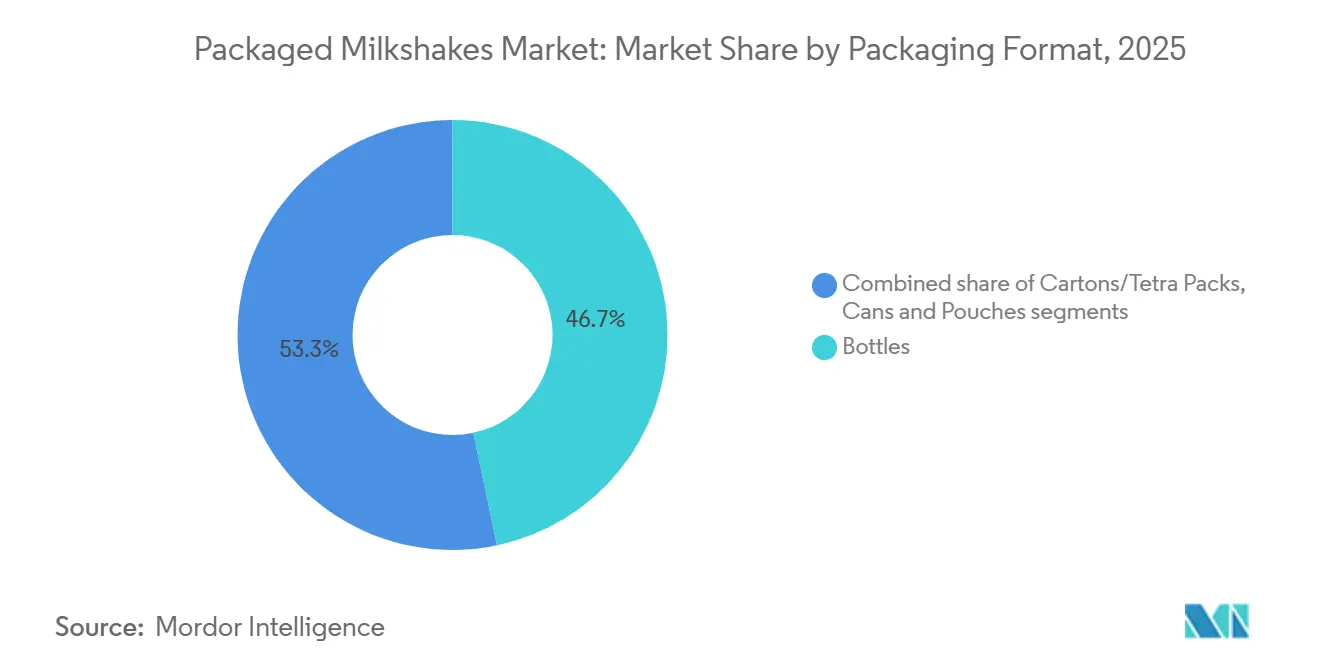
Bottles Command Share, Cans Carry the Sustainability NarrativeBottles accounted for the largest share of the packaged milkshakes market by packaging format, representing 46.68% of total market value in 2025. Their widespread adoption is supported by ease of handling, portability, product visibility, and compatibility with both refrigerated and shelf-stable milkshake formulations. Bottles are extensively used across retail and foodservice channels and remain the preferred packaging format for single-serve and on-the-go consumption.
Cans are projected to register the fastest growth during the forecast period, expanding at a CAGR of 8.41% from 2026 to 2031. This growth is driven by increasing consumer preference for convenient, lightweight, and recyclable packaging, along with the growing popularity of premium ready-to-drink beverages. Manufacturers are expanding canned milkshake offerings to improve product differentiation, enhance shelf appeal, and align with evolving sustainability and convenience preferences.

By Distribution Channel:
Retail Saturation Meets Foodservice MomentumRetail accounted for the largest share of the packaged milkshakes market by distribution channel, representing 83.58% of total market value in 2025. The segment's dominance is driven by the extensive presence of supermarkets, hypermarkets, convenience stores, specialty retailers, and online platforms, which ensure broad product availability and easy consumer access. The ongoing expansion of organized retail networks and improvements in chilled product distribution continue to support retail sales across both developed and emerging markets.
Foodservice and institutional channels are projected to register the fastest growth during the forecast period, expanding at a CAGR of 8.27% from 2026 to 2031. This growth is supported by increasing demand from cafés, restaurants, quick-service restaurants, educational institutions, and other foodservice establishments offering ready-to-drink dairy beverages. Manufacturers are strengthening partnerships with foodservice operators and expanding product portfolios tailored to out-of-home consumption, supporting the channel's continued growth.
Geography Analysis
APAC Packaged Milkshakes Market
Asia-Pacific accounted for the largest share of the global packaged milkshakes market, representing 35.74% of total market value in 2025. The region's position is supported by its large consumer base, expanding dairy processing industry, and growing demand for convenient ready-to-drink beverages across major economies such as China, India, and Southeast Asia. Rising urbanization, increasing disposable incomes, and the continued expansion of modern retail and foodservice networks are further supporting market growth across the region.
MEA Packaged Milkshakes Market
The Middle East and Africa is projected to be the fastest-growing regional market, registering a CAGR of 7.91% from 2026 to 2031. Growth is driven by improving retail infrastructure, expanding foodservice networks, and increasing demand for packaged dairy beverages among a growing urban population. Investments in dairy processing capacity, wider product availability, and the gradual development of cold-chain logistics are expected to further support market expansion across the region during the forecast period.
Europe and the Americas Packaged Milkshakes Market
North America and Europe represent mature markets characterized by established consumer demand and ongoing product innovation focused on premium, functional, and better-for-you packaged milkshakes. South America continues to experience steady growth supported by the expansion of organized retail, increasing availability of ready-to-drink dairy beverages, and rising consumer preference for convenient packaged nutrition. Across these regions, manufacturers continue to invest in new product development, packaging innovation, and healthier formulations to address evolving consumer preferences and regulatory requirements.
Competitive Landscape
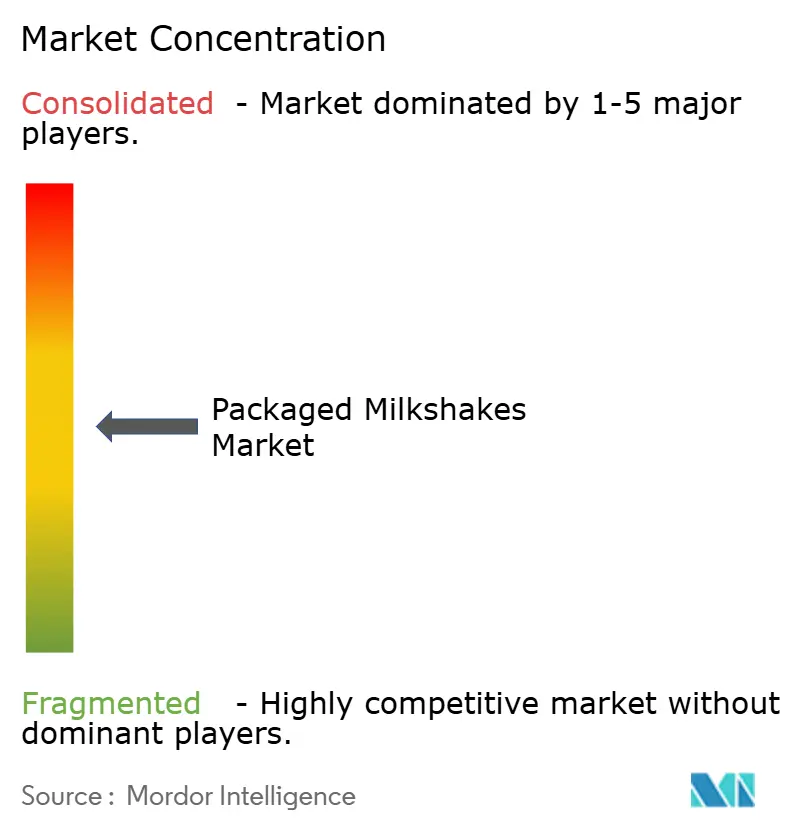
The packaged milkshakes market is moderately fragmented, with competition among multinational food and beverage companies, global dairy processors, regional dairy manufacturers, and cooperative-backed producers. Companies compete on product quality, flavor innovation, nutritional positioning, pricing, packaging formats, and distribution capabilities across retail and foodservice channels.
Major players such as Nestlé S.A., Danone S.A., PepsiCo, Inc., Arla Foods amba, and Royal FrieslandCampina N.V. are strengthening their market positions through investments in product innovation, premium formulations, high-protein offerings, and expanded distribution networks. Manufacturers are also introducing new flavors, clean-label formulations, convenient packaging formats, and plant-based alternatives to address evolving consumer preferences and improve portfolio competitiveness.
Regional dairy companies and emerging brands continue to expand their presence by focusing on localized product offerings, value-added dairy beverages, and strategic partnerships with retail and foodservice operators. Continued investment in premium products, functional nutrition, and broader geographic expansion is expected to intensify competition, while opportunities remain in shelf-stable, plant-based, and protein-enriched packaged milkshake products.
Packaged Milkshakes Industry Leaders
-
Nestlé S.A.
-
Danone S.A.
-
PepsiCo, Inc.
-
Arla Foods amba
-
Royal FrieslandCampina N.V.
- *Disclaimer: Major Players sorted in no particular order
Packaged Milkshakes Market Companies Covered in this Report
- Nestlé S.A.
- Danone S.A.
- PepsiCo, Inc.
- The Coca-Cola Company
- Arla Foods amba
- Royal FrieslandCampina N.V.
- Unternehmensgruppe Theo Müller
- The Hershey Company
- Lactalis
- Saputo Inc.
- Inner Mongolia Yili Industrial Group Co., Ltd.
- China Mengniu Dairy Company Limited
- Gujarat Cooperative Milk Marketing Federation Ltd.
- Mother Dairy Fruit & Vegetable Pvt. Ltd.
- CavinKare Group
- Britannia Industries
- Dairy Farmers of America, Inc.
- Fonterra Co-operative Group Limited
- Yazoo
- Shaken Udder Limited
Recent Industry Developments in Packaged Milkshakes Market
- July 2026: Nestlé Portugal expanded its Nesquik Milk-Mix portfolio with the launch of Vanilla. The new flavor is designed to transform dairy and plant-based milk into creamy milkshakes while also being suitable for recipes such as frappes, desserts, and ice cream. The launch builds on the brand's portfolio diversification strategy, following earlier Strawberry and Banana variants, and reflects continued investment in flavor innovation to expand consumption occasions within the packaged milkshake market.
- June 2026: Hindustan Unilever Limited launched Horlicks Milkshake in India, expanding the Horlicks brand into the ready-to-drink milkshake category. Available in Classic Malt, Chocolate, and Kesar Badam flavors, the product is formulated with 40% less total sugars and fortified with 10 essential nutrients. The launch reflects growing industry focus on convenient, better-for-you packaged milkshakes that combine indulgent taste with enhanced nutritional value for on-the-go consumption.
- September 2024: Shaken Udder expanded its protein milkshake portfolio with the launch of a new White Chocolate flavor. The shelf-stable protein milkshake contains 20 g of protein and is made with Belgian chocolate, expanding the company's growing protein milkshake range. The launch reflects increasing product innovation in high-protein packaged milkshakes, enabling manufacturers to cater to consumers seeking both indulgent taste and enhanced nutritional value.
Global Packaged Milkshakes Market Report Scope
The global packaged milkshakes market covers ready-to-drink dairy-based and plant-based beverages formulated for convenient nutrition and indulgent consumption across retail and foodservice channels. The market is segmented by product type into dairy-based milkshakes and plant-based milkshakes, by flavor into chocolate, vanilla, and others, by packaging into bottles, cans, and others, by distribution channel into retail and foodservice/institutional, and by geography into North America, Europe, Asia-Pacific, South America, and Middle East and Africa. The market forecasts are provided in terms of value (USD) and volume (liters).
Segmentation Overview
| Dairy-Based Milkshakes | |
| Plant-Based Milkshakes | Soy-Based Milkshakes |
| Oat-Based Milkshakes | |
| Almond-Based Milkshakes | |
| Coconut-Based Milkshakes | |
| Other Plant-Protein-Based Milkshakes |
| Chocolate |
| Vanilla |
| Coffee |
| Fruit-Based |
| Other flavors |
| Bottles |
| Cartons/Tetra Packs |
| Cans |
| Pouches |
| Retail | Supermarkets/Hypermarkets |
| Convenience Stores | |
| Online Retail Stores | |
| Specialty Stores | |
| Others | |
| Foodservice/Institutional Channels |
| North America | United States |
| Canada | |
| Mexico | |
| Rest of North America | |
| Europe | Germany |
| United Kingdom | |
| Italy | |
| France | |
| Spain | |
| Netherlands | |
| Poland | |
| Belgium | |
| Sweden | |
| Rest of Europe | |
| Asia-Pacific | China |
| India | |
| Japan | |
| Australia | |
| Indonesia | |
| South Korea | |
| Thailand | |
| Singapore | |
| Rest of Asia-Pacific | |
| South America | Brazil |
| Argentina | |
| Colombia | |
| Chile | |
| Peru | |
| Rest of South America | |
| Middle East and Africa | South Africa |
| Saudi Arabia | |
| United Arab Emirates | |
| Nigeria | |
| Egypt | |
| Morocco | |
| Turkey | |
| Rest of Middle East and Africa |
| By Product Type | Dairy-Based Milkshakes | |
| Plant-Based Milkshakes | Soy-Based Milkshakes | |
| Oat-Based Milkshakes | ||
| Almond-Based Milkshakes | ||
| Coconut-Based Milkshakes | ||
| Other Plant-Protein-Based Milkshakes | ||
| By Flavor | Chocolate | |
| Vanilla | ||
| Coffee | ||
| Fruit-Based | ||
| Other flavors | ||
| By Packaging Format | Bottles | |
| Cartons/Tetra Packs | ||
| Cans | ||
| Pouches | ||
| By Distribution Channel | Retail | Supermarkets/Hypermarkets |
| Convenience Stores | ||
| Online Retail Stores | ||
| Specialty Stores | ||
| Others | ||
| Foodservice/Institutional Channels | ||
| By Geography | North America | United States |
| Canada | ||
| Mexico | ||
| Rest of North America | ||
| Europe | Germany | |
| United Kingdom | ||
| Italy | ||
| France | ||
| Spain | ||
| Netherlands | ||
| Poland | ||
| Belgium | ||
| Sweden | ||
| Rest of Europe | ||
| Asia-Pacific | China | |
| India | ||
| Japan | ||
| Australia | ||
| Indonesia | ||
| South Korea | ||
| Thailand | ||
| Singapore | ||
| Rest of Asia-Pacific | ||
| South America | Brazil | |
| Argentina | ||
| Colombia | ||
| Chile | ||
| Peru | ||
| Rest of South America | ||
| Middle East and Africa | South Africa | |
| Saudi Arabia | ||
| United Arab Emirates | ||
| Nigeria | ||
| Egypt | ||
| Morocco | ||
| Turkey | ||
| Rest of Middle East and Africa | ||
Key Questions Answered in the Report
What is the forecast growth rate for the packaged milkshakes market through 2031?
The category is forecast to grow at a 6.79% CAGR from 2026 to 2031 and reach USD 5.71 billion by 2031. Growth reflects demand for convenient products, functional nutrition, lower-sugar options, and wider access through retail and foodservice channels.
Which product type holds the largest share in the packaged milkshakes market?
Dairy-based products held 82.37% share in 2025. Established milk supply networks, refrigerated distribution, familiar taste profiles, and accessible pricing supported this position across major volume markets.
Which product type is growing fastest in the packaged milkshakes market?
Plant-based products are forecast to grow at 8.96% CAGR from 2026 to 2031. Functional positioning, dietary preferences, and premium retail and foodservice occasions are expected to support their faster expansion.
Which regional area is expected to grow fastest in the packaged milkshakes market?
The Middle East and Africa is forecast to grow at 7.91% CAGR through 2031. Packaged dairy demand, developing cold-chain infrastructure, localized flavors, and ambient formats can support expansion across varied retail conditions.