
Outdoor Toys Market Size and Share
Market Overview
| Study Period | 2027 - 2032 |
|---|---|
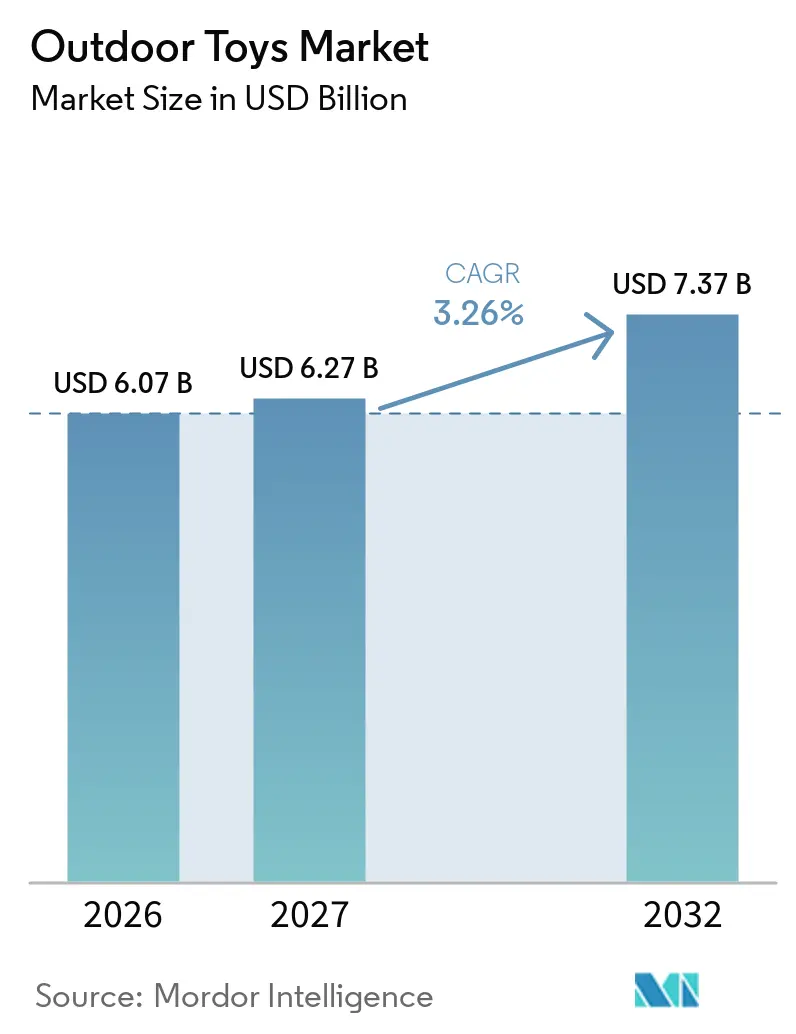
| Market Size (2027) | USD 6.27 Billion |
| Market Size (2032) | USD 7.37 Billion |
| Growth Rate (2027 - 2032) | 3.26 % |
| Fastest Growing Market | Asia-Pacific |
| Largest Market | Asia-Pacific |
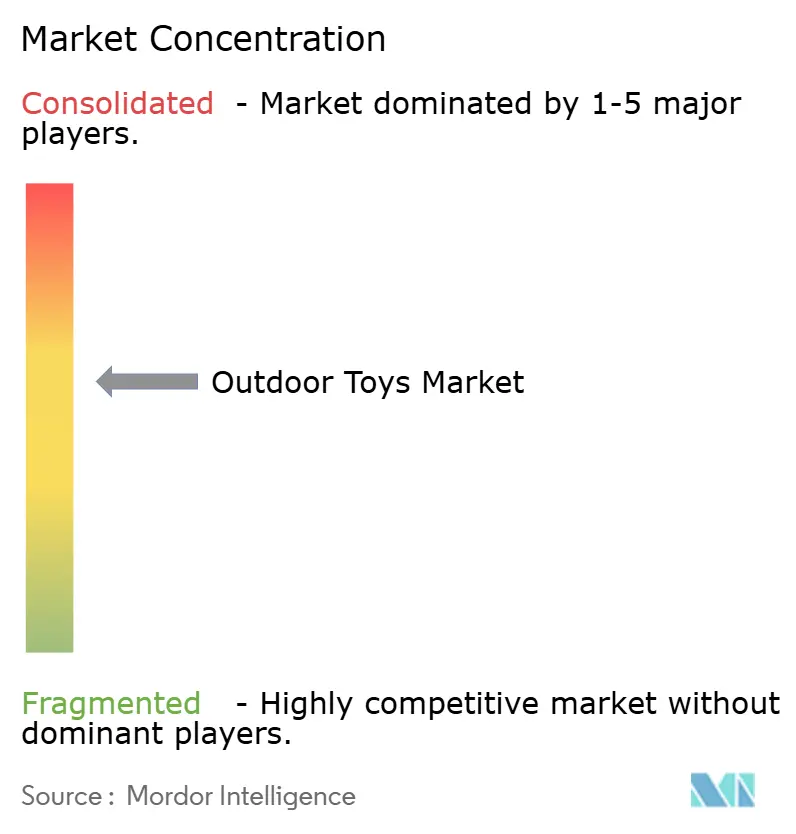
| Market Concentration | Medium |
Major Players *Disclaimer: Major Players sorted in no particular order Image © Mordor Intelligence. Reuse requires attribution under CC BY 4.0. | |
Outdoor Toys Market Analysis by Mordor Intelligence
The outdoor toys market size is estimated at USD 6.07 billion in 2026, rising to USD 6.27 billion in 2027 and projected to reach USD 7.37 billion by 2032, growing at an estimated CAGR of 3.26% from 2027 to 2032. The market is supported by increasing awareness of the importance of outdoor play and physical activity in children's development. Sports-based toys, including balls, frisbees, rackets, and other recreational play products, benefit from parental interest in encouraging active lifestyles and reducing sedentary screen time. Demand for backyard play equipment, water toys, and exploration-based products also reflects consumers' interest in engaging outdoor experiences that combine entertainment, physical activity, and learning. Product innovation is creating opportunities for interactive outdoor toys, adventure play products, and nature-based exploration kits. Parents increasingly seek toys that support coordination, creativity, sensory development, and problem-solving alongside recreation.
Key Report Takeaways
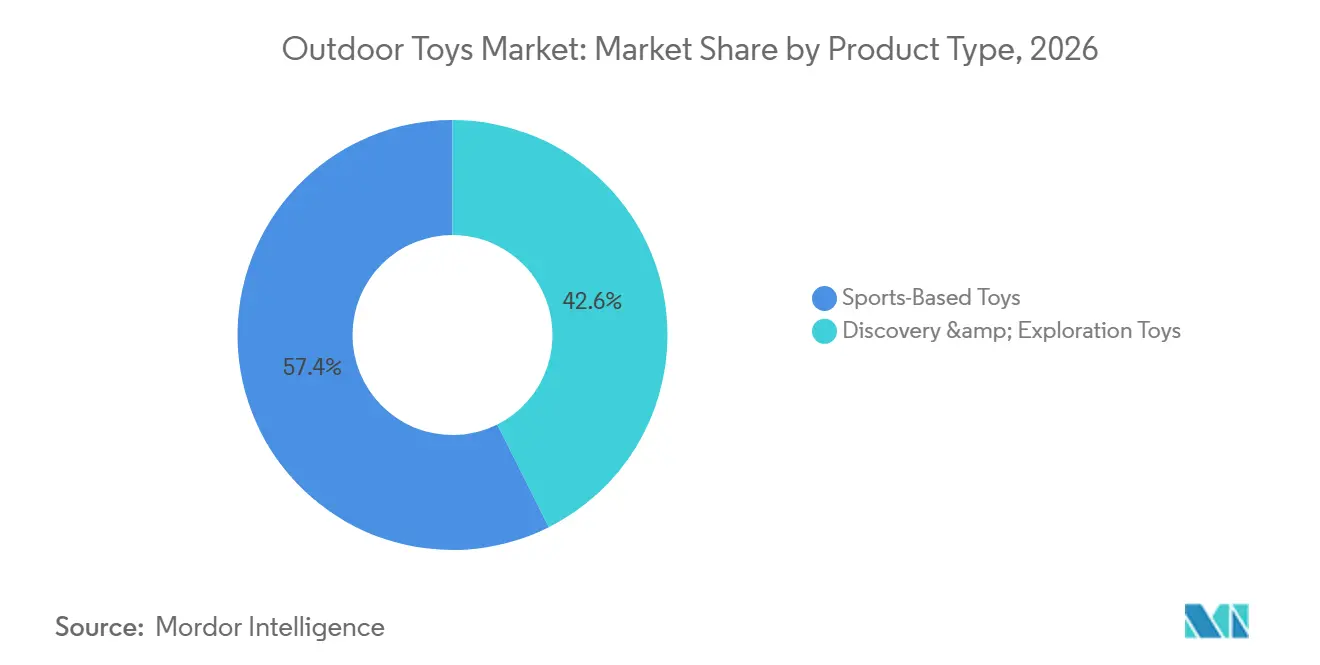
- By product type, Sports-based Toys led the Outdoor Toys Market with an estimated 57.40% share in 2026 and are projected to grow at a CAGR of 5.50% from 2027 to 2032.
- By material, Plastic accounted for an estimated 45.70% of the Outdoor Toys Market in 2026, while Wood is forecast to be the fastest-growing material segment, with a CAGR of 4.50% through 2032.
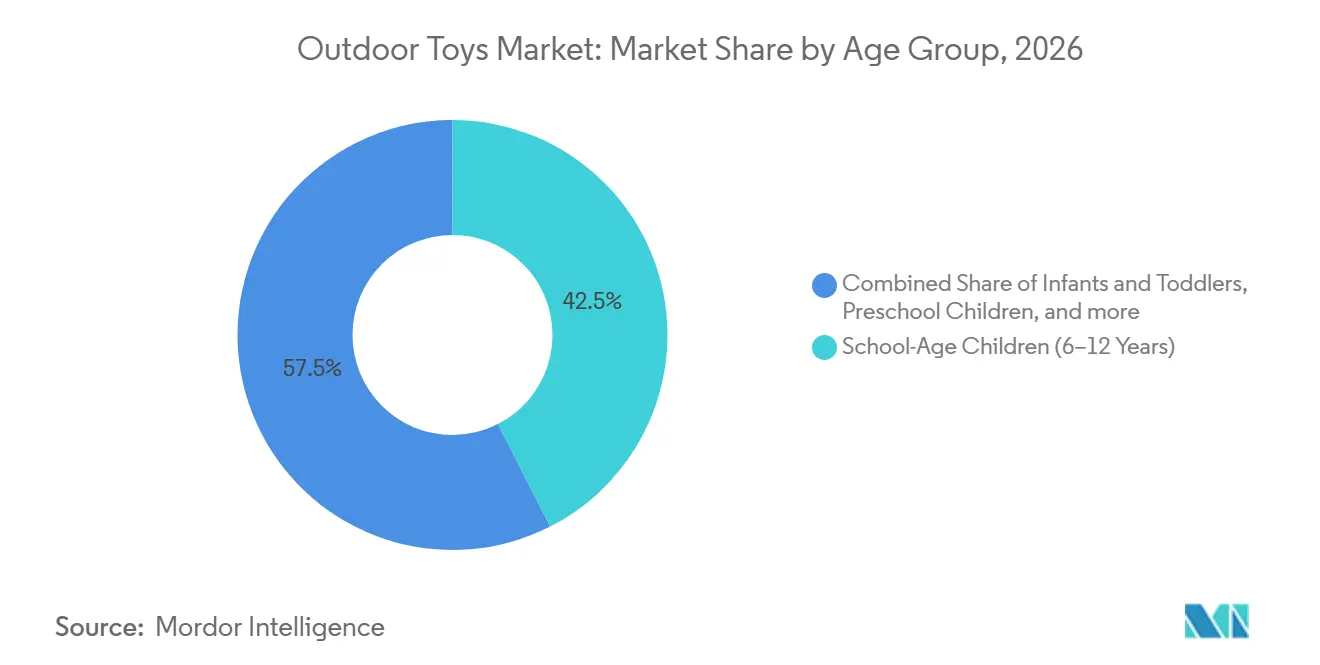
- By age group, School-Age Children (6–12 Years) represented an estimated 42.50% of the Outdoor Toys Market in 2026, while Infants and Toddlers (Below 3 Years) are expected to record the fastest growth, at a CAGR of 6.20% through 2032.
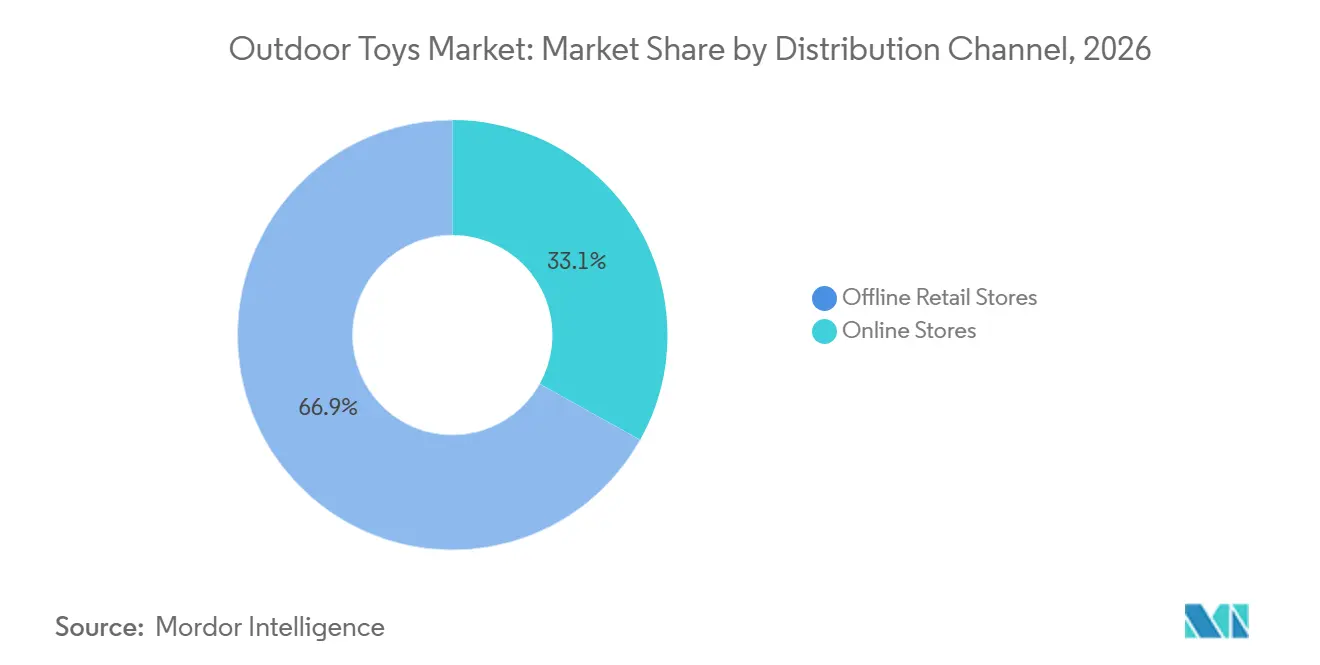
- By distribution channel, Offline Retail Stores accounted for an estimated 66.90% of the Outdoor Toys Market in 2026, whereas Online Stores are projected to grow at a CAGR of 5.20% from 2027 to 2032.
- By geography, Asia-Pacific accounted for an estimated 36.80% of the Outdoor Toys Market in 2026 and is projected to remain the fastest-growing region, with a CAGR of 5.80% from 2027 to 2032.
Note: Market numbers in this report are based on Mordor Intelligence's proprietary estimation framework, which combines nine months of actuals with Q4 projections for base year 2026.
Market Trends and Insights
Drivers Impact Analysis of Outdoor Toys Market*
| DRIVER | (~) % IMPACT ON CAGR FORECAST | GEOGRAPHIC RELEVANCE | IMPACT TIMELINE |
|---|---|---|---|
| Rising Demand for Outdoor Play and Physical Activities Among Children | +0.7% | Global, particularly North America, Europe, and Asia-Pacific | Medium term (2–4 years) |
| Growing Popularity of Outdoor Sports Toys and Recreational Equipment | +0.6% | Global, led by North America and Europe | Medium term (2–4 years) |
| Increasing Demand for Backyard Play Equipment and Active Play Products | +0.5% | North America and Europe, with growing relevance in Asia-Pacific | More than 4 years |
| Innovation in Interactive, Water-Based, and Adventure Outdoor Toys | +0.4% | Global, with demand influenced by seasonal conditions and consumer preferences | Less than 2 years |
| Rising Parental Awareness of Outdoor Play for Child Development | +0.4% | Global, particularly North America, Europe, and urban Asia-Pacific | More than 4 years |
| Source: Mordor Intelligence | |||
Rising Demand for Outdoor Play and Physical Activities Among Children
Growing recognition of the health benefits of physical activity supports demand opportunities in the Outdoor Toys Market. Outdoor products such as balls, skipping ropes, ride-on toys, and active-play equipment can encourage children to participate in recreational movement and games. The World Health Organization states that physical activity supports healthy growth, bone health, and motor and cognitive development in children and adolescents; it recommends an average of at least 60 minutes per day of moderate-to-vigorous physical activity for children and adolescents aged 5–17 years [1]. These recommendations reinforce the relevance of products that make active play accessible at home, in schools, and in community settings. For manufacturers, this creates opportunities to develop age-appropriate products that combine recreation with movement, coordination, and skill development.
Growing Popularity of Outdoor Sports Toys and Recreational Equipment
Interest in outdoor recreation provides a potential demand base for sports-based products within the Outdoor Toys Market. Balls, frisbees, junior rackets, and other recreational toys can introduce children to accessible activities that are suitable for individual or group play. The Outdoor Foundation and Outdoor Industry Association reported that outdoor recreation participation in the United States reached 175.8 million people aged six and older in 2023, equivalent to 57.3% of that population [2]. Although this figure covers outdoor recreation broadly rather than toy purchases specifically, it indicates an established participation base for outdoor activities. Manufacturers can respond by offering products for different ages, skill levels, and play settings, including portable toys for parks and gardens and beginner-friendly sports equipment.
Increasing Demand for Backyard Play Equipment and Active Play Products
Home-based outdoor recreation creates opportunities for the Outdoor Toys Market, particularly for products that enable children to play in gardens, yards, and other residential outdoor spaces. Slides, swings, climbing structures, ride-on toys, and water-play products can provide convenient options for active recreation without requiring families to visit dedicated recreational facilities. The U.S. Consumer Product Safety Commission (CPSC) provides specific guidance for outdoor home playground equipment, including recommendations for safer equipment selection and use [3]. This guidance highlights the importance of appropriate design, installation, and use when selecting products for residential play. Manufacturers can address household needs through space-efficient designs, age-appropriate equipment, durable construction, and clear assembly and safety instructions.
Innovation in Interactive, Water-Based, and Adventure Outdoor Toys
Product innovation creates opportunities for differentiation in the Outdoor Toys Market by expanding the range of activities and play experiences available to children. Water-play toys, exploration kits, outdoor obstacle products, and interactive sports toys can appeal to families seeking variety in recreational activities. However, product development needs to reflect the intended age group, the environment in which the toy will be used, and relevant safety considerations. The CPSC identifies applicable toy-safety requirements for children’s toys, including third-party testing and certification where required, while outdoor playground equipment may fall under different requirements depending on its design and intended use [4].
Restraints Impact Analysis of Outdoor Toys Market*
| RESTRAINT | (~) % IMPACT ON CAGR FORECAST | GEOGRAPHIC RELEVANCE | IMPACT TIMELINE |
|---|---|---|---|
| Competition from Indoor Toys, Video Games, and Screen-Based Entertainment | -0.9% | Global, particularly markets with widespread access to digital entertainment | Less than 2 years |
| Safety Concerns and Stringent Product Standards | -0.6% | Global, with compliance requirements varying by market | Medium term (2–4 years) |
| High Shipping, Storage, and Installation Costs for Bulky Outdoor Toys | -0.5% | Global, particularly markets with long-distance distribution and limited delivery infrastructure | Medium term (2–4 years) |
| Price Sensitivity and Discretionary Consumer Spending | -0.4% | Global, particularly price-sensitive and emerging markets | More than 4 years |
| Source: Mordor Intelligence | |||
Competition from Indoor Toys, Video Games, and Screen-Based Entertainment
Indoor toys, video games, and screen-based entertainment create competition for the Outdoor Toys Market by offering children alternative leisure activities that can be accessed at home. Digital games and interactive content provide continuous entertainment, while indoor toys remain convenient options regardless of weather, outdoor space, or seasonal conditions. These alternatives may reduce the frequency of outdoor play and influence household spending across competing play categories. Outdoor toy manufacturers can respond through products that encourage physical activity, imaginative play, and group interaction, although demand may remain affected by children’s entertainment preferences, parental screen-time decisions, and access to suitable outdoor spaces.
Safety Concerns and Stringent Product Standards
Safety requirements can increase product development, testing, certification, and compliance obligations in the Outdoor Toys Market. Products such as ride-on toys, water-play toys, sports toys, and outdoor play equipment may present different risks depending on their design, materials, intended age group, and usage environment. In the United States, the Consumer Product Safety Commission requires applicable toys intended primarily for children aged 12 and under to undergo third-party testing and certification against relevant children’s product safety requirements. These obligations can add to manufacturers’ compliance costs and complicate product launches across markets with differing regulations. Companies must therefore account for safety considerations during product design, material selection, quality control, labelling, and distribution.
*Our forecasts treat driver/restraint impacts as directional, not additive. The impact forecasts reflect baseline growth, mix effects, and variable interactions.
Outdoor Toys Market Segment Analysis
By Product Type:
Sports-Based Toys Lead the Active-Play MarketSports-based toys accounted for an estimated 57.40% share of the Outdoor Toys Market in 2026, making them the largest product-type segment. Their leading position reflects the broad range of active-play products available to children, including balls, skipping ropes, frisbees, junior sports equipment, and other recreational toys. These products support individual and group activities across gardens, parks, schools, and community spaces, offering families accessible options for encouraging physical movement and outdoor recreation. The segment is projected to grow at a CAGR of 5.50% from 2027 to 2032, supported by opportunities to develop age-appropriate sports products, beginner-friendly equipment, and toys that combine recreation with skill development.
Discovery and exploration toys represent another important category within the Outdoor Toys Market. Products such as outdoor exploration kits, nature discovery sets, gardening toys, and child-oriented observation tools encourage children to engage with their surroundings through hands-on activities. These toys can appeal to families seeking alternatives to conventional sports products by combining outdoor recreation with curiosity, imaginative play, and nature-based exploration. Product differentiation in this category can focus on age suitability, portability, ease of use, and activities that encourage children to explore outdoor environments.

By Material:
Plastic Leads While Wood Records Faster GrowthPlastic accounted for an estimated 45.70% share of the Outdoor Toys Market in 2026, making it the largest material segment. Its use across balls, slides, ride-on toys, water-play products, and other outdoor play equipment reflects its versatility in product design, moulding, colour selection, and manufacturing at different price points. Plastic can also support lightweight construction and weather-resistant designs when appropriate materials and formulations are used. However, product performance varies by polymer type, construction quality, exposure conditions, and maintenance requirements.
Wood is projected to be the fastest-growing material segment, with a CAGR of 4.50% from 2027 to 2032. Wooden swings, climbing frames, playhouses, sandboxes, and outdoor activity structures provide opportunities for manufacturers targeting natural-material aesthetics and backyard play applications. Growth opportunities may also arise from demand for durable, visually distinctive equipment designed for residential outdoor spaces. Manufacturers must account for weather exposure, surface treatment, structural integrity, and maintenance requirements when developing wooden products for outdoor use.
By Age Group:
School-Age Children Lead, Toddlers Grow FasterSchool-Age Children (6–12 Years) accounted for an estimated 42.50% share of the Outdoor Toys Market in 2026, making this the largest age-group segment. Children in this age range can engage with a wide variety of outdoor products, including sports toys, bicycles and ride-on products where included in the market scope, water-play toys, and exploration equipment. Their ability to participate in more structured games and activities supports demand for products that encourage coordination, skill development, competition, and group interaction. Manufacturers can target this segment through products with different difficulty levels and designs suitable for individual, family, or group play.
Infants and Toddlers (Below 3 Years) are projected to be the fastest-growing age-group segment, with a CAGR of 6.20% from 2027 to 2032. Outdoor toys designed for this group may include age-appropriate push-and-pull toys, sensory play products, small slides, and supervised water-play items. Product development requires particular attention to age grading, small-parts risks, stability, material safety, and clear supervision instructions. Opportunities in this segment depend on offering products suited to early developmental stages while meeting applicable safety requirements.
By Distribution Channel:
Offline Stores Lead While Online Stores ExpandOffline Stores accounted for an estimated 66.90% share of the Outdoor Toys Market in 2026, making them the largest distribution channel. Supermarkets and hypermarkets, specialty toy stores, and other physical retailers allow consumers to inspect product size, materials, construction, and packaging before purchase. This can be particularly relevant for outdoor toys, where dimensions, assembly requirements, durability, and suitability for available play spaces may influence purchasing decisions. Physical retail also supports product discovery through seasonal displays and in-store promotions.
Online Stores are projected to be the fastest-growing distribution channel, with a CAGR of 5.20% from 2027 to 2032. E-commerce platforms allow consumers to compare product specifications, prices, customer reviews, and delivery options across a wider assortment of outdoor toys. Online channels may be particularly useful for larger or specialised products that are not consistently stocked by local retailers. However, bulky products can create delivery and return challenges, while customers may need detailed product dimensions, assembly instructions, and safety information before purchasing. Retailers can strengthen online conversion through accurate product descriptions, clear imagery, transparent delivery terms, and accessible customer support.
Geography Analysis
APAC Outdoor Toys Market
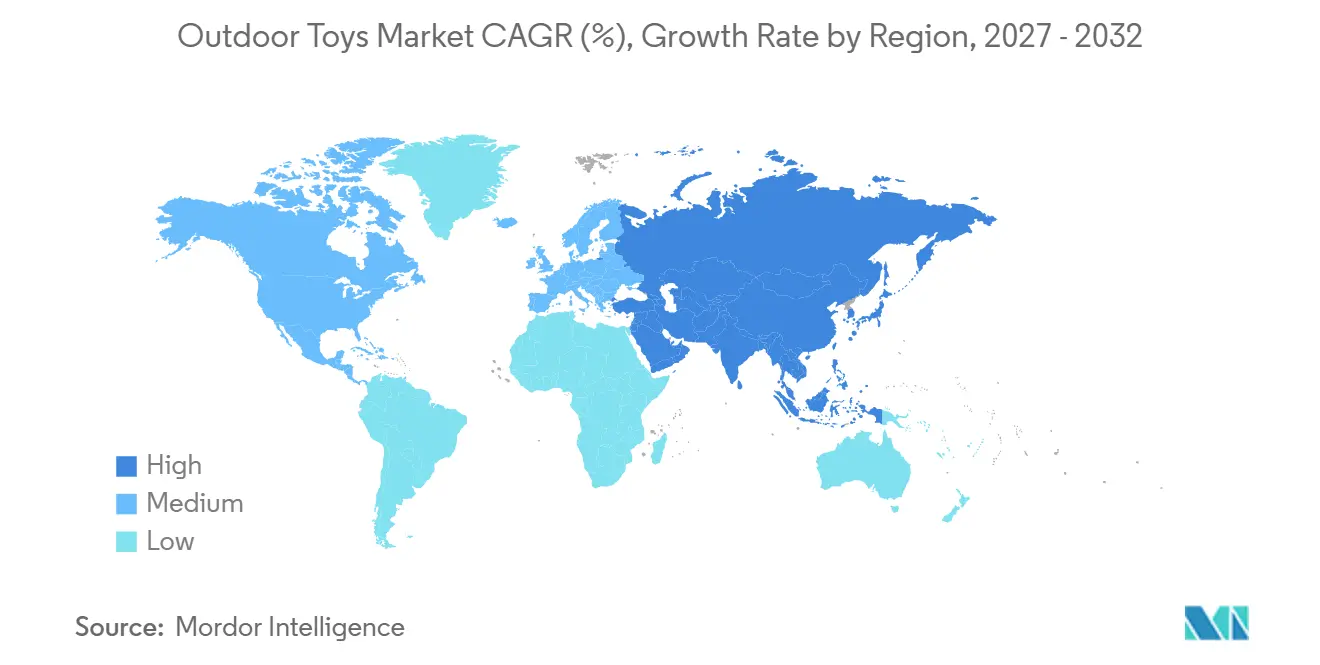
Asia-Pacific accounted for an estimated 36.80% share of the Outdoor Toys Market in 2026 and is projected to grow at the fastest CAGR of 5.80% from 2027 to 2032. Growth opportunities are supported by demand for sports-based toys, recreational products, and outdoor play equipment across diverse markets, including China, India, Japan, and Southeast Asia. Differences in household purchasing power, urban living conditions, climate, and access to outdoor spaces shape regional demand, creating opportunities for manufacturers offering affordable, age-appropriate products through both physical retail and e-commerce channels.
North America Outdoor Toys Market
North America represents an important market for outdoor sports toys, backyard play equipment, and recreational products. Demand spans balls, junior sports equipment, ride-on toys, slides, swings, and water-play products, with seasonal conditions and household access to outdoor spaces influencing purchasing patterns. Established retail networks and e-commerce platforms support product availability, while opportunities exist for manufacturers offering durable designs, convenient assembly, and products suited to different age groups and budgets. Competition from digital entertainment, discretionary spending pressures, and product-safety requirements remain important considerations for market participants.
Europe Outdoor Toys Market
The European Outdoor Toys Market offers opportunities across sports-based toys, outdoor exploration products, and residential play equipment. Demand varies across countries according to climate, housing conditions, household spending, and recreational preferences. Manufacturers can differentiate their products through durable construction, age-appropriate designs, clear safety information, and materials suited to outdoor use. Product compliance and distribution strategies adapted to national market conditions remain important for companies serving the region.
Competitive Landscape
The Outdoor Toys Market features a mix of multinational toy manufacturers, specialist outdoor-play brands, and companies focused on recreational and backyard equipment. Key participants include Mattel Inc., Hasbro Inc., Spin Master Corp., MGA Entertainment Inc., TOMY Company, Ltd., Simba Dickie Group, ZURU Ltd., Moose Toys, JAKKS Pacific Inc., and Jazwares LLC, alongside specialist manufacturers such as Little Tikes, Radio Flyer Inc., Step2 Company LLC, Kettler International Inc., Intex Recreation Corp., Bestway Group, Plum Products Ltd., TP Toys, BIG-Spielwarenfabrik, and Decathlon SE. These companies differ in their product portfolios, with some offering broad toy ranges while others focus more specifically on outdoor playsets, ride-on products, sports toys, or recreational equipment. Competition is shaped by brand recognition, pricing, distribution reach, product safety, and the ability to address different age groups and outdoor-play needs.
The market spans multiple product categories, from portable sports toys and discovery products to larger outdoor play equipment, including slides, swings, playhouses, ride-on toys, and water-play products. These categories require different capabilities in product design, materials, manufacturing, packaging, and distribution. Bulky equipment can involve additional storage, delivery, and assembly considerations, while smaller outdoor toys compete on affordability, portability, and ease of use. This creates opportunities for specialist manufacturers to differentiate through category expertise, age-specific designs, and products suited to residential gardens, parks, and other recreational settings.
Companies compete through product innovation, brand development, retail partnerships, and expansion across online and offline channels. Established toy companies can leverage broad distribution networks and recognised brands, while specialist outdoor-play businesses can focus on durability, product functionality, and backyard recreation. Product safety and age-appropriate design are important competitive considerations, particularly for ride-on toys, climbing equipment, and water-play products. Differentiation through convenient assembly, varied price points, durable materials, and engaging outdoor-play experiences can help companies respond to changing consumer preferences in the Outdoor Toys Market.
Outdoor Toys Industry Leaders
-
Mattel Inc.
-
Hasbro Inc.
-
Spin Master Corp.
-
MGA Entertainment Inc.
-
TOMY Company, Ltd.
- *Disclaimer: Major Players sorted in no particular order
Outdoor Toys Market Companies Covered in this Report
- Mattel Inc.
- Hasbro Inc.
- Spin Master Corp.
- MGA Entertainment Inc.
- TOMY Company, Ltd.
- Simba Dickie Group
- ZURU Ltd.
- Moose Toys
- Jakks Pacific Inc.
- Jazwares LLC
- Little Tikes (MGA Entertainment)
- Radio Flyer Inc.
- Step2 Company LLC
- Kettler International Inc.
- Intex Recreation Corp.
- Bestway Group
- Plum Products Ltd.
- TP Toys
- BIG-Spielwarenfabrik (Simba Dickie Group)
- Decathlon SE
Recent Industry Developments in Outdoor Toys Market
- October 2026: Sakar International expanded its focus on outdoor, sporting, and wheeled products ahead of its 50th anniversary. Its portfolio includes scooters, skateboards, ride-on products, protective gear, and licensed sporting goods, strengthening its presence across multiple active-play categories.
- September 2026: Little Tikes launched its Cloud Collection, refreshing established products in neutral colour palettes. The collection includes the adjustable Easy Score Basketball Set, wagons, garden chairs, and play tables, extending the brand’s outdoor-play offering through updated designs and contemporary aesthetics.
- June 2026: Australian outdoor-play brand Wahu entered an exclusive, multi-year distribution agreement with Kroeger Marketing for Canada, beginning in spring 2027. Kroeger will manage distribution across retail and e-commerce channels, expanding Wahu’s planned North American reach for pool toys, inflatables, backyard games, and other outdoor recreation products.
- January 2025: Hedstrom acquired What Kids Want, adding licensed indoor, outdoor, impulse, and novelty toys to its portfolio. The acquisition broadens Hedstrom’s product range and combines the companies’ capabilities and distribution networks, supporting its position in outdoor and active-play categories.
Global Outdoor Toys Market Report Scope
The Outdoor Toys Market comprises toys and recreational products designed and marketed for outdoor play, physical activity, sports, discovery, and exploration among children. The market is classified by product type, material, age group, distribution channel, and geography. Based on product type, the market is classified into sports-based toys and discovery and exploration toys. Based on material, the market is classified into plastic, wood, metal, and other materials. Based on age group, the market is classified into infants and toddlers (below 3 years), preschool children (3–5 years), and more. Based on distribution channel, the market is classified into offline stores, including supermarkets and hypermarkets, specialty toy stores, and other offline stores, and online stores. Based on geography, the market is classified into North America, Europe, Asia-Pacific, South America, and more. The market forecasts are provided in terms of value (USD).
Segmentation Overview
| Sports-based Toys |
| Discovery & Exploration Toys |
| Plastic |
| Wood |
| Metal |
| Other Materials |
| Infants and Toddlers (Below 3 Years) |
| Preschool Children (3-5 Years) |
| School-Age Children (6-12 Years) |
| Teenagers (13-17 Years) |
| Offline Stores | Supermarkets and Hypermarkets |
| Specialty Toy Stores | |
| Other Offline Stores | |
| Online Stores |
| North America | United States |
| Canada | |
| Mexico | |
| Rest of North America | |
| Europe | United Kingdom |
| Germany | |
| France | |
| Italy | |
| Spain | |
| Sweden | |
| Belgium | |
| Poland | |
| Netherlands | |
| Europe | |
| Asia-Pacific | China |
| Japan | |
| India | |
| Thailand | |
| Singapore | |
| Indonesia | |
| Korea | |
| Australia | |
| Rest of Asia-Pacific | |
| South America | Brazil |
| Argentina | |
| Colombia | |
| Peru | |
| Chile | |
| Rest of South America | |
| Middle East and Africa | South Africa |
| Saudi Arabia | |
| United Arab Emirates | |
| Nigeria | |
| Egypt | |
| Morocco | |
| Turkey | |
| Rest of Middle East and Africa |
| By Product Type | Sports-based Toys | |
| Discovery & Exploration Toys | ||
| By Material | Plastic | |
| Wood | ||
| Metal | ||
| Other Materials | ||
| By Age Group | Infants and Toddlers (Below 3 Years) | |
| Preschool Children (3-5 Years) | ||
| School-Age Children (6-12 Years) | ||
| Teenagers (13-17 Years) | ||
| By Distribution Channel | Offline Stores | Supermarkets and Hypermarkets |
| Specialty Toy Stores | ||
| Other Offline Stores | ||
| Online Stores | ||
| By Geography | North America | United States |
| Canada | ||
| Mexico | ||
| Rest of North America | ||
| Europe | United Kingdom | |
| Germany | ||
| France | ||
| Italy | ||
| Spain | ||
| Sweden | ||
| Belgium | ||
| Poland | ||
| Netherlands | ||
| Europe | ||
| Asia-Pacific | China | |
| Japan | ||
| India | ||
| Thailand | ||
| Singapore | ||
| Indonesia | ||
| Korea | ||
| Australia | ||
| Rest of Asia-Pacific | ||
| South America | Brazil | |
| Argentina | ||
| Colombia | ||
| Peru | ||
| Chile | ||
| Rest of South America | ||
| Middle East and Africa | South Africa | |
| Saudi Arabia | ||
| United Arab Emirates | ||
| Nigeria | ||
| Egypt | ||
| Morocco | ||
| Turkey | ||
| Rest of Middle East and Africa | ||
Key Questions Answered in the Report
What is the size of the Outdoor Toys Market?
The Outdoor Toys Market is estimated at USD 6.27 billion in 2027 and is projected to reach USD 7.37 billion by 2032.
What is the expected growth rate of the Outdoor Toys Market?
The Outdoor Toys Market is projected to register a CAGR of 3.26% from 2027 to 2032.
Which product type holds the largest share of the Outdoor Toys Market?
Sports-based toys are the largest product-type segment, accounting for an estimated 57.40% share in 2026.
Which region is expected to grow fastest in the Outdoor Toys Market?
Asia-Pacific is projected to be the fastest-growing region, with a CAGR of 5.80% from 2027 to 2032.