
Outdoor Gym Equipment Market Size and Share
Market Overview
| Study Period | 2022 - 2032 |
|---|---|
| Market Size (2027) | USD 2.62 Billion |
| Market Size (2032) | USD 3.35 Billion |
| Growth Rate (2027 - 2032) | 5.04 % |
| Fastest Growing Market | Asia-Pacific |
| Largest Market | North America |
| Market Concentration | Low |
Major Players *Disclaimer: Major Players sorted in no particular order Image © Mordor Intelligence. Reuse requires attribution under CC BY 4.0. | |
Outdoor Gym Equipment Market Analysis by Mordor Intelligence
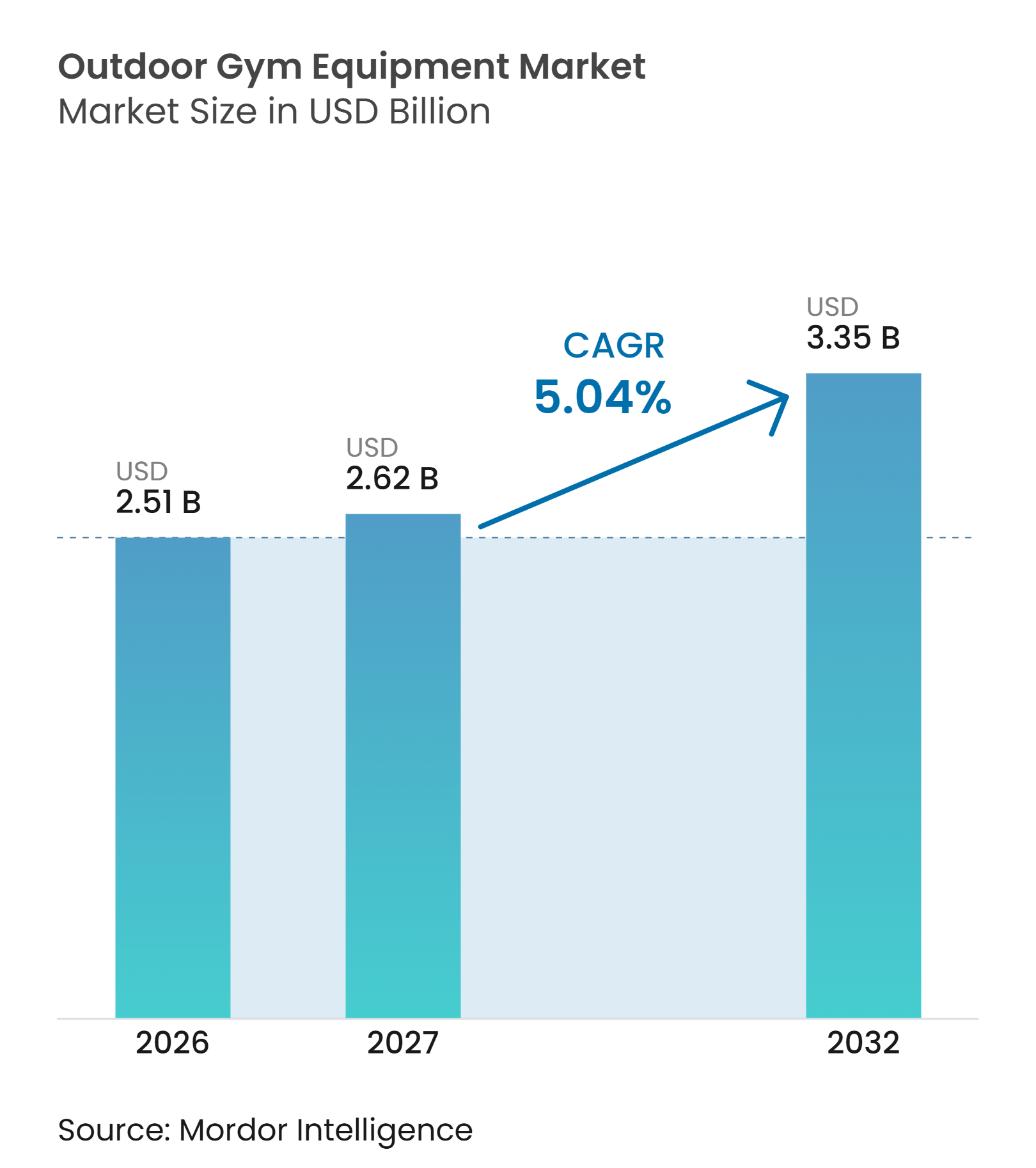
The outdoor gym equipment market size is projected to expand from USD 2.51 billion in 2026 to USD 2.62 billion, and to USD 3.35 billion by 2032, registering a CAGR of 5.04% between 2027 and 2032. Public investment in preventive health, accessible recreation, and park renewal supports demand for permanent fitness installations. Municipal buyers increasingly treat outdoor exercise areas as part of public-health infrastructure rather than a discretionary recreation purchase. This approach creates opportunities for suppliers that can meet accessibility, durability, and maintenance requirements within public procurement. Digital features and adjustable resistance are also raising expectations for equipment used in parks, schools, and community facilities. The outdoor gym equipment market remains fragmented, so contract awards depend on product quality, local relationships, and the ability to support installations after delivery.
Key Report Takeaways
-
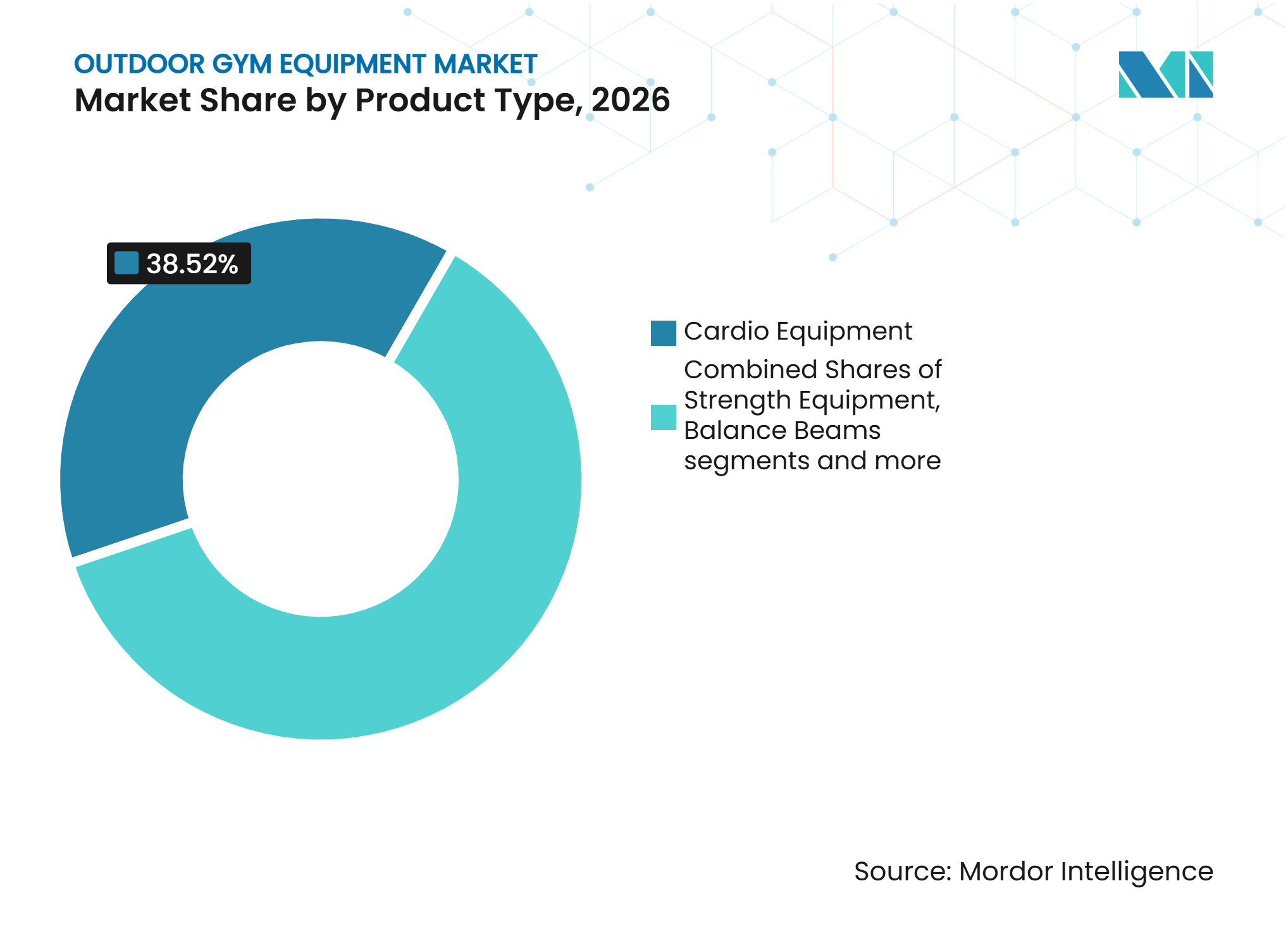
By product type, Cardio Equipment held 38.52% of the market share in 2026, while Strength Equipment is forecast to grow at a 6.55% CAGR through 2032.
-
By machine type, Single-User Stations held 56.47% of the market share in 2026, while Multi-User Stations are forecast to grow at a 6.34% CAGR through 2032.
-
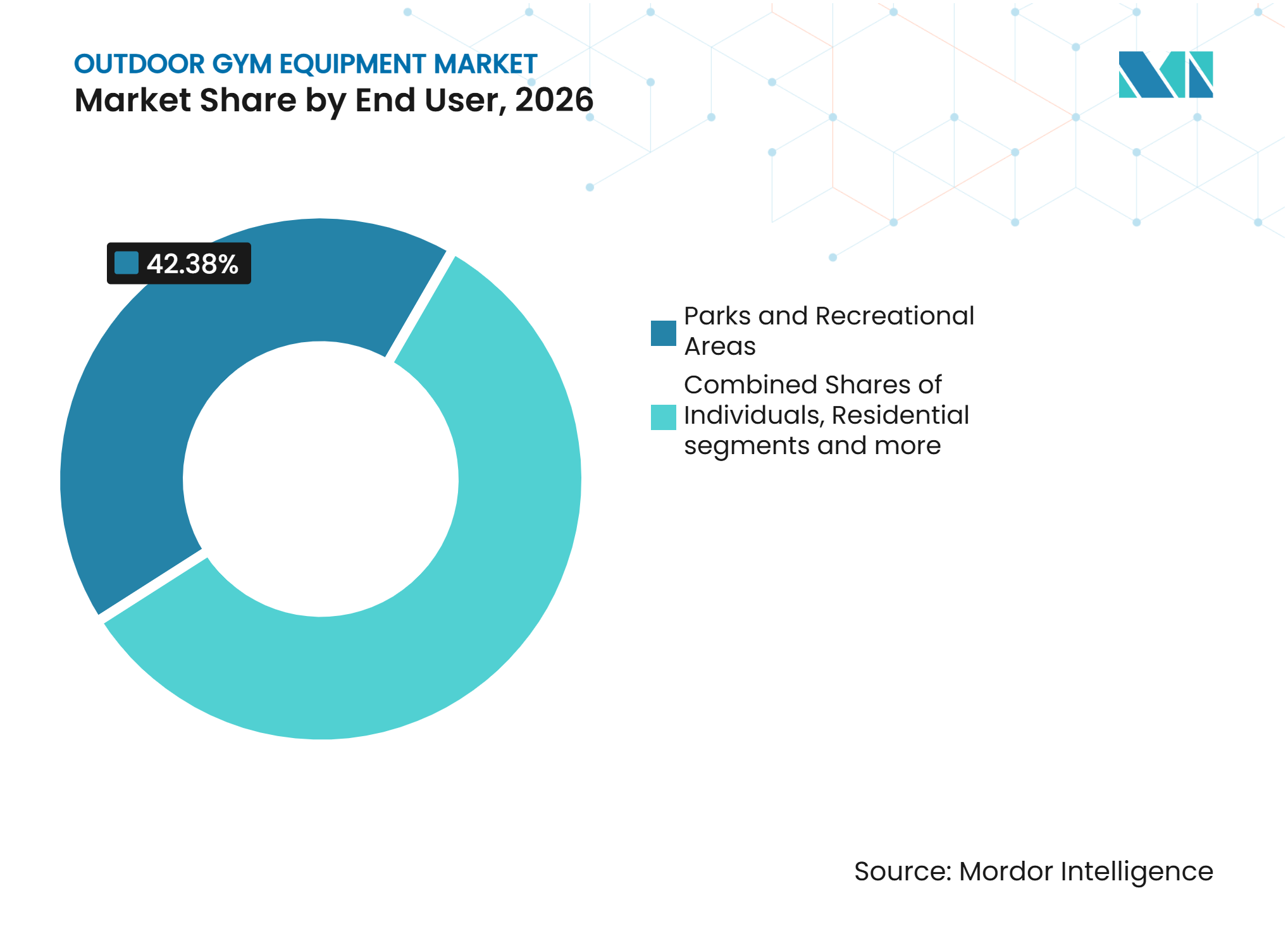
By end user, Parks and Recreational Areas held 42.38% of the market share in 2026, while Educational Institutes are forecast to grow at a 6.51% CAGR through 2032.
-
By distribution channel, Offline Channels held 67.53% of the market share in 2026, while Online Channels are forecast to grow at a 7.08% CAGR through 2032.
-
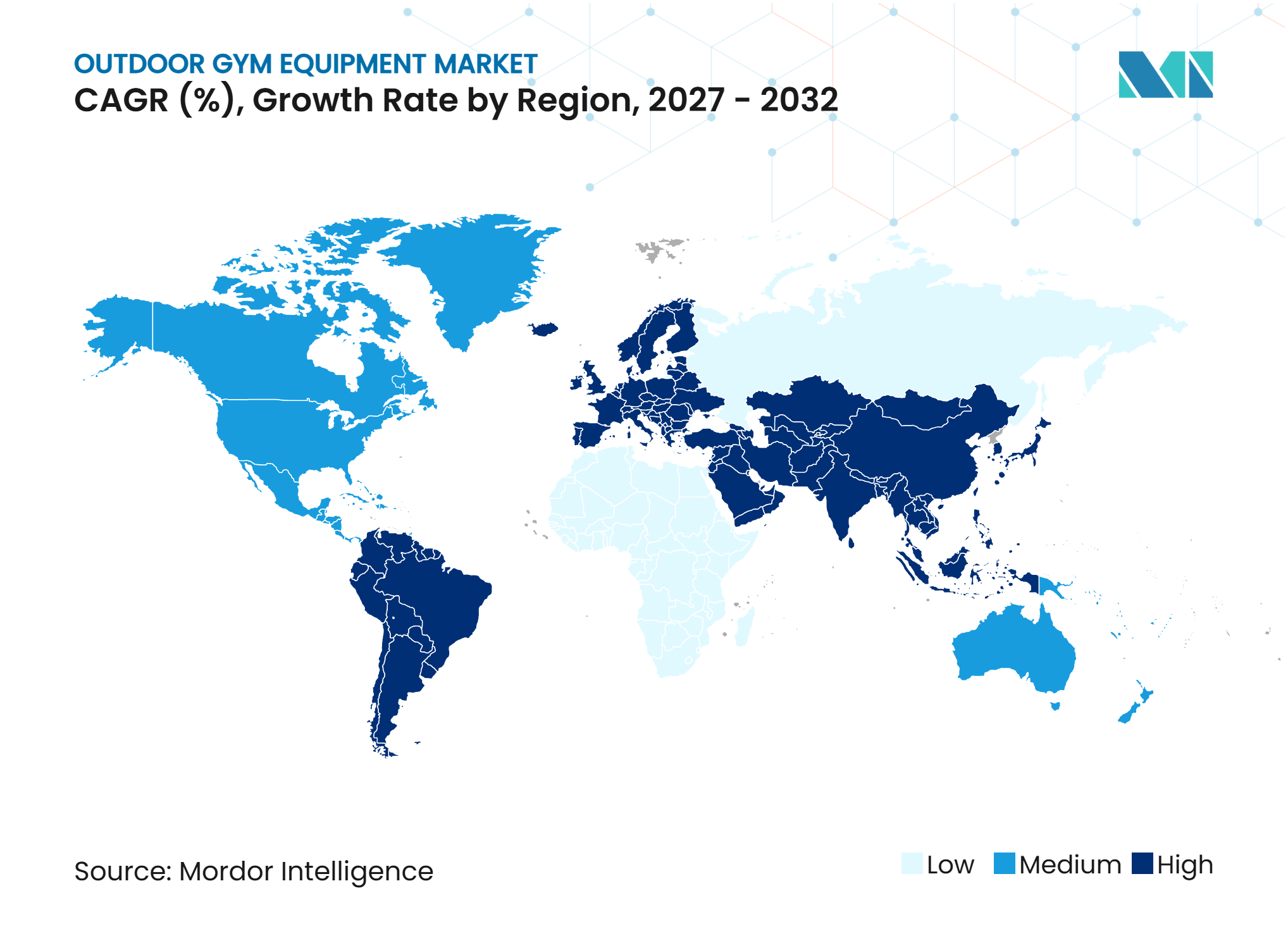
By geography, North America held 39.26% of the market share in 2026, while Asia-Pacific is forecast to grow at a 6.62% CAGR through 2032.
Note: Market numbers in this report are based on Mordor Intelligence's proprietary estimation framework, which combines nine months of actuals with Q4 projections for base year 2026.
Market Trends and Insights
Drivers Impact Analysis of Outdoor Gym Equipment Market*
| Driver | (~) % Impact on CAGR Forecast | Geographic Relevance | Impact Timeline |
|---|---|---|---|
| Rising public investment in preventive health and active public spaces | +1.2% | Global, with North America and Western Europe leading funded programs | Short term (≤ 2 years) |
| Growth of fitness parks, trails, and community wellness infrastructure | +0.9% | Global; Asia-Pacific expanding fastest through smart city and sports sector programs | Medium term (2–4 years) |
| Demand for free and convenient exercise access | +0.7% | Global, with high relevance in lower-income urban communities across North America, South Asia, and Africa | Short term (≤ 2 years) |
| Aging populations and low-impact fitness requirements | +0.6% | Europe, North America, East Asia (Japan, South Korea); emerging demand in China and India | Long term (≥ 4 years) |
| Technological advancements in outdoor fitness equipment | +0.5% | Asia-Pacific core, spill-over to North America and Western Europe | Medium term (2–4 years) |
| Expansion of school and institutional fitness facilities | +0.6% | North America, South Asia, Oceania | Medium term (2–4 years) |
| Source: Mordor Intelligence | |||
Rising Public Investment Drives Installation Pipelines Across Continents
Governments are treating outdoor exercise infrastructure as preventive health spending, which gives these projects access to wider funding sources. According to Indy Parks and Recreation, Indianapolis opened the USD 13 million Riverside Adventure Park in May 2025, funded through the Circle City Forward Initiative and the Lilly Endowment Grant, with a fitness loop and outdoor equipment. The Kujawsko-Pomorskie region allocated more than PLN 2 million for small sports infrastructure in 2025, including outdoor gyms in underserved towns. The outdoor gym equipment market benefits when federal grants, municipal capital budgets, health insurers, and community organizations share project funding. This structure reduces the burden on one buyer and can shorten approval processes for new sites.
Growth of Fitness Parks, Trails, and Community Wellness Infrastructure
Municipal authorities and park management organizations are increasingly incorporating outdoor fitness equipment into public parks, walking trails, recreational spaces, and community wellness projects. These facilities provide accessible exercise opportunities without requiring gym memberships, encouraging physical activity among different age groups. According to the 2026 State of the Industry Report by Recreation Management reported that the share of parks and recreation facilities offering outdoor fitness equipment or fitness trails increased from 28.2% in 2015 to 44.1% in 2026[1]. This expansion of public recreational infrastructure is creating procurement opportunities for manufacturers of outdoor cardio machines, strength-training stations, balance equipment, and multifunctional fitness units.
Technological Advancements in Outdoor Fitness Equipment
IoT connectivity, QR-enabled coaching applications, and adjustable resistance are moving outdoor equipment beyond simple mechanical stations. China identified 100 flagship smart sports projects in March 2025, including outdoor fitness zones with monitoring and performance functions. An AI-enabled facility in Wuxi used sensor-based tracks and smart stations that connected exercise data with mobile devices. A 2025 study from Frontiers in Nutrition found that the M-AGEW system could support outdoor jogging and calisthenics with real-time feedback and virtual coaching[2]. These features are shifting procurement across the outdoor gym equipment market toward lifecycle considerations, including engagement, service, and future upgrades. The outdoor gym equipment market therefore gives an advantage to suppliers that can pair durable hardware with useful digital services.
Ageing Populations and Low-Impact Fitness Requirements
Older adults require outdoor exercise settings that are low impact, safe, and easy to use. A 2025 systematic review from the Journal of Physical Activity and Health, 17 studies found that most outdoor gym programs were designed mainly for older adults. A 2025 study from Leisure Studies, 372 adults aged 65 to 93 found that older-adult-specific equipment ranked second among the design features considered important for outdoor fitness areas. A randomized controlled trial published in Scientific Reports in 2025 reported improved sagittal spinal alignment and pelvic tilt after an 8-week outdoor resistance-training program among middle-aged and older adults. The outdoor gym equipment market must respond with adjustable resistance, ergonomic seating, clear instructions, and access for wheelchair users. These requirements raise the standard for public installations and favor suppliers with inclusive product designs.
Restraints Impact Analysis of Outdoor Gym Equipment Market*
| Restraint | (~) % Impact on CAGR Forecast | Geographic Relevance | Impact Timeline |
|---|---|---|---|
| Vandalism and equipment damage | -0.4% | Global, most acute in urban areas of Europe, North America, and parts of Asia-Pacific | Short term (≤ 2 years) |
| Weather-related equipment deterioration | -0.3% | Asia-Pacific and Middle East and Africa, with extreme heat and humidity, plus Northern Europe with freeze-thaw cycles | Long term (≥ 4 years) |
| High maintenance and repair expenses | -0.3% | Global, with greater pressure in emerging markets without specialist supply chains | Medium term (2-4 years) |
| Competition from indoor fitness facilities | -0.3% | North America and Europe, where indoor gym penetration is high | Medium term (2-4 years) |
| Source: Mordor Intelligence | |||
Vandalism and Equipment Damage
Vandalism can reduce equipment availability and discourage repeat use at publicly accessible sites. Waikato District Council reported vandalism repair costs of more than NZD 120,000 from January through November 2025 across public assets, excluding staff time and callout expenses. The outdoor gym equipment market faces higher specification demands when operators want tamper-resistant fasteners, enclosed mechanisms, and highly visible equipment placement. European projects also consider EN 16630, which covers safety and structural requirements for permanently installed outdoor fitness equipment. These measures can improve durability, but they raise unit costs for buyers with limited capital budgets. Suppliers that make maintenance needs clear at the tender stage can reduce the risk of underfunded installations.
High Maintenance and Repair Expenses
Maintenance costs in the outdoor gym equipment market are often not fully recognized when a project is first approved. Bearings, corrosion protection, fasteners, surfacing, and moving components require scheduled checks or specialist servicing. The challenge is greater at rural and community-run facilities where technical staff and spare parts are less available. Connected equipment can add service needs because sensors and electronic components require different skills from mechanical equipment. The outdoor gym equipment market rewards manufacturers that include preventive maintenance, remote diagnostics, and spare-parts support in their commercial offers. Such services are increasingly important where public buyers assess total ownership cost instead of purchase price alone.
*Our forecasts treat driver/restraint impacts as directional, not additive. The impact forecasts reflect baseline growth, mix effects, and variable interactions.
Outdoor Gym Equipment Market Segment Analysis
By Product Type:
Cardio Equipment Leads While Strength Equipment Gains MomentumCardio Equipment held 38.52% of the outdoor gym equipment market share in 2026. Exercise bikes, air walkers, elliptical machines, and rowing machines suit users with different fitness levels. Public buyers use these products in parks and trails because the equipment is familiar and does not require intensive supervision. They also suit older users, beginners, and people seeking lower-impact activity. Cardio stations support broad participation at open-access public sites. Their position is reinforced by the need for equipment that can be used quickly during a park visit. This demand supports repeat procurement for municipal renovation projects. It also gives cardio stations an important role in balanced equipment packages.
Strength Equipment is forecast to grow at a 6.55% CAGR through 2032. The category benefits from demand for outdoor exercise that more closely resembles an indoor gym experience. Adjustable resistance supports progressive training and allows several user groups to use the same station. KOMPAN introduced its Essentials Strength range in 2026 with 12 adjustable-resistance products for permanent outdoor settings. The products included chest press, horizontal row, squat, and leg-extension stations. This direction narrows the functional gap between indoor weights areas and outdoor facilities.



By Machine Type:
Single-User Stations Lead While Multi-User Stations Build Social UseSingle-User Stations held 56.47% of the market share in 2026. Their layout supports independent exercise and works well in parks with limited available space. Many public specifications use a sequence of individual stations so visitors can use equipment at the same time without coordination. These units also have straightforward maintenance profiles. Their design supports flexible placement along trails, plazas, and neighborhood park paths. The format is familiar to procurement teams and to park users. It can be expanded gradually when funding becomes available. These qualities support continued demand across established public recreation systems.
Multi-User Stations are forecast to grow at a 6.34% CAGR through 2032. Municipal planners increasingly value equipment that supports physical activity and social interaction. Social design is particularly relevant for older adults, whose regular participation can improve when sites make group exercise easier. Compact multi-user units can increase simultaneous capacity within a limited footprint. Greenfields Outdoor Fitness holds United States patents for wheelchair-accessible multi-user units that enable users in wheelchairs to exercise alongside other users. Accessibility requirements are becoming more prominent in grants and local specifications.
By End User:
Single-User Stations Lead, Multi-User Stations Gain GroundParks and Recreational Areas held 42.38% of the market share in 2026. Public parks are the main setting for government-funded outdoor fitness infrastructure. The Land and Water Conservation Fund, state programs, and local capital budgets can support fitness features within wider park renewal work. According to the United States House of Representatives, Glendale received a USD 5.95 million award in September 2025 for development that included an outdoor fitness plaza. Residential communities and individual buyers form another meaningful demand pool. Developers use fitness installations as amenities for urban and suburban housing projects. This mix keeps parks at the center of the outdoor gym equipment market.
Educational Institutes are forecast to grow at a 6.51% CAGR through 2032. District bond programs, insurer co-funding, and interest in student well-being support equipment purchases. Humble ISD opened its sixth fitness and obstacle course at Kingwood Middle School in 2025, with more campus work planned through 2027. The example shows the value of planned, district-wide procurement rather than stand-alone site purchases. The Others category includes hospitality properties, military bases, and healthcare campuses. Fort Cavazos opened a family fitness park in 2025 for service members and their families.

By Distribution Channel:
Offline Procurement Leads While Online Channels ExpandOffline Channels held 67.53% of the market share in 2026. Government tenders, supplier frameworks, and direct relationships remain central to large municipal projects. Parks departments often need site planning, installation, compliance documentation, and service support in addition to equipment. These requirements favor direct supplier engagement and formal procurement routes. Sourcewell contracts allow public entities in the United States to use pre-negotiated supplier arrangements. Such mechanisms can simplify acquisition while retaining formal purchasing oversight. They also strengthen the role of established vendor relationships for high-value orders. Offline procurement therefore remains important to the outdoor gym equipment market where installations are complex and publicly funded.
Online Channels are forecast to grow at a 7.08% CAGR through 2032. Digital procurement tools make it easier for smaller municipalities, schools, and housing organizations to compare standard products. These buyers may not have the resources to conduct a full tender for every purchase. Online configurators can help them assess space, equipment mix, and delivery needs before speaking with a supplier. Digital channels can also widen access to smaller and mid-sized markets.
Geography Analysis
North America
North America held 39.26% of the outdoor gym equipment market share in 2026. Federal, state, and municipal programs create a broad funding base for park fitness investments. The United States draws demand from land conservation grants, community development funding, and state open-space programs. In Canada, Winnipeg’s CAD 859,000 John Forsyth Park project used several government and community funding sources. ASTM F2666 influences safety and accessibility expectations for public outdoor equipment.
Asia-Pacific
Asia-Pacific is forecast to grow at a 6.62% CAGR through 2032, the fastest regional rate in the outdoor gym equipment market. China’s smart sports program supports AI-monitored fitness zones, connected parks, and digital coaching systems. In India, Andhra Pradesh directed officials in February 2025 to install gym equipment in all public parks and municipal schools. Suppliers that offer durable, digitally enabled equipment can benefit from the region’s smart-city focus.
Europe, South America, and Middle East and Africa
Europe continued to support municipal outdoor fitness projects in 2025, while South America and the Middle East and Africa remained earlier-stage expansion areas. Fuengirola approved a EUR 348,183 outdoor gym project funded by Málaga Provincial Council in 2025[3]. EN 16630 remains an important compliance factor for permanent outdoor equipment, while Technogym’s Riyadh subsidiary demonstrates demand from Saudi real estate, hospitality, sports, and medical projects. The outdoor gym equipment market requires suppliers to adapt to varied public funding practices, climate conditions, and compliance requirements across these areas.
Competitive Landscape
Market Concentration
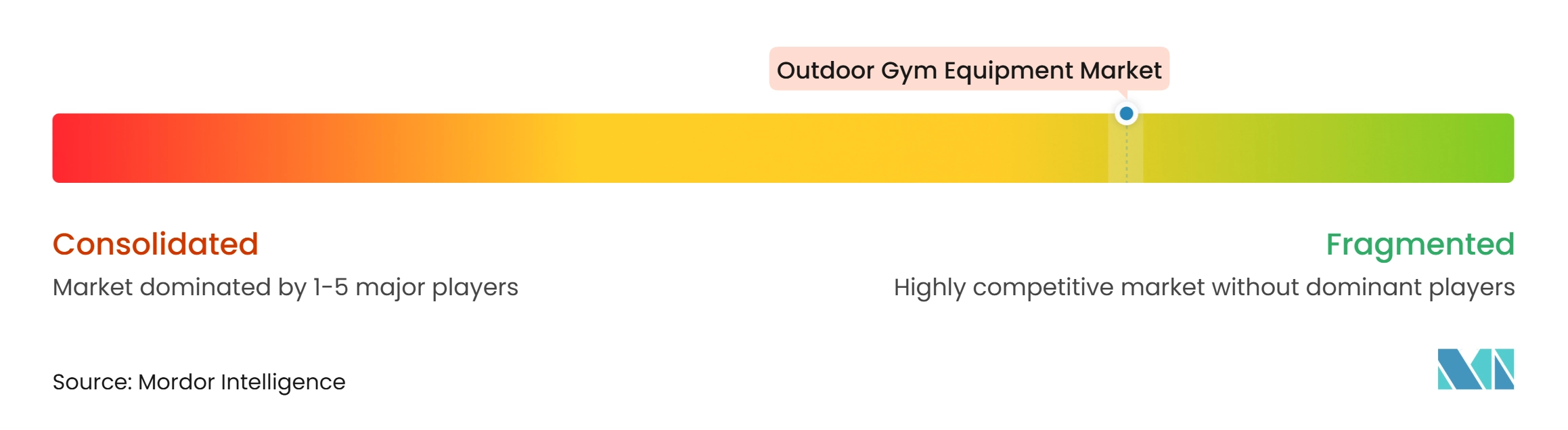
The outdoor gym equipment market has a fragmented structure, with many manufacturers competing across geographies, product categories, and end-user segments. KOMPAN, Lappset Group, HAGS Aneby AB, Proludic SAS, and Norwell A/S compete across Europe through product development and municipal relationships. Greenfields Outdoor Fitness, TriActive USA, PlayCore through Playworld Systems, and Landscape Structures are active in North America.
KOMPAN partnered with BeaverFit in August 2026 to combine its outdoor equipment with weatherproof storage solutions. Lappset launched Spark in September 2026, adding motion sensors, sounds, and light responses to outdoor play and fitness equipment. KOMPAN also piloted FitBLOCK in Lincoln, Nebraska, during 2025 as an outdoor gym with a digitally supported user experience. These moves show that digital interaction and integrated site solutions are becoming practical points of differentiation. Smaller suppliers can find opportunities in specialized calisthenics, senior-friendly, and accessibility-focused equipment.
Maintenance and replacement support also shape competition in the outdoor gym equipment market. Buyers want equipment that can withstand heavy public use, weather exposure, and attempted vandalism. Suppliers that provide spare parts, preventive service, and lifecycle planning can improve their position in municipal tenders. The fragmented structure continues to allow differentiated suppliers to win defined customer groups.
Outdoor Gym Equipment Industry Leaders
-
Greenfields Outdoor Fitness, Inc.
-
Husson International SAS
-
Kenguru Professional
-
Norwell A/S
-
Lappset Group Ltd.
- *Disclaimer: Major Players sorted in no particular order
Outdoor Gym Equipment Market Companies Covered in this Report
- ActionFit
- Greenfields Outdoor Fitness, Inc.
- HAGS Aneby AB
- Husson International SAS
- Kenguru Professional
- KOMPAN A/S
- Landscape Structures Inc.
- Lappset Group Ltd.
- Legnolandia srl
- KPS Capital Partners (Life Fitness LLC)
- Metalco Active Srl
- Norwell A/S
- Omnigym Oy
- Outdoor Fitness, Inc.
- PlayCore Inc. (Playworld Systems, Inc.)
- Proludic SAS
- SportsPlay Equipment, Inc.
- Street Barbell
- TGH s.r.l. (Technogym S.p.A.)
- The Great Outdoor Gym Company Ltd.
- TriActive USA
- Wicksteed Leisure Ltd.
- Xccent, Inc.
- Peloton Interactive, Inc. (Precor Incorporated)
Recent Industry Developments in Outdoor Gym Equipment Market
- January 2026: Fresh Air Fitness introduced its Resistance Range, a new outdoor gym equipment series featuring adjustable weight stacks and user-friendly controls. The range includes resistance chest press, shoulder press, seated row, lat pulldown, resistance bike, and accessible arm bike stations.
- January 2026: MoveStrong announced the launch of its Outdoor Pillar Total Strength Station, a compact modular fitness structure designed for outdoor functional training. The station accommodates four to six users simultaneously and integrates adjustable dip bars, pull-up bars, push-up bars, battle ropes, and other bodyweight training components.
- August 2025: WillPlay highlighted its WillFit outdoor fitness range, organized into cardio, strength, and core-training equipment categories. The cardio range includes exercise bikes and cross trainers featuring magnetic resistance technology for smooth and quiet operation.
- May 2025: Fortitude Equip introduced Urban Experience, a self-contained outdoor gym unit available in 10-foot, 20-foot, and twin 20-foot configurations. Manufactured using corrosion-resistant steel, the structure can be supplied as a basic unit or equipped with functional fitness equipment.
Global Outdoor Gym Equipment Market Report Scope
The outdoor gym equipment market comprises the manufacturing, distribution, and sale of fitness equipment designed for installation and use in outdoor environments, including public parks, recreational areas, residential communities, educational institutions, and other open spaces.
The report analyzes the outdoor gym equipment market by product type, machine type, end user, distribution channel, and geography. By product type, the market is segmented into cardio equipment, strength equipment, agility and functional equipment, balance beams, and other equipment. Cardio equipment includes elliptical machines, exercise bikes, air walkers, rowing machines, and other products. Strength equipment comprises pull-up bars, chest press and shoulder press stations, leg press machines, and other strength-training equipment. Agility and functional equipment includes monkey bars, ladders, boxing and combat fitness stations, and related products. Based on machine type, the market is categorized into single-user stations and multi-user stations. By end user, it covers individuals, educational institutes, residential areas, parks and recreational areas, and other users. Distribution channels include offline stores and online stores. Geographically, the report covers North America, Europe, Asia-Pacific, South America, and the Middle East and Africa. The market sizing has been done in value terms in USD for all the abovementioned segments.
Segmentation Overview
| Cardio Equipment | Elliptical Machines |
| Exercise Bikes | |
| Air Walkers | |
| Rowing Machines | |
| Others | |
| Strength Equipment | Pull-Up Bars |
| Chest Press and Shoulder Press | |
| Leg Press | |
| Others | |
| Agility and Functional Equipment | Monkey Bars |
| Ladders | |
| Boxing and Combat Fitness Stations | |
| Others | |
| Balance Beams | |
| Other Equipment |
| Single-User Stations |
| Multi-User Stations |
| Individuals |
| Educational Institutes |
| Residential Areas |
| Parks and Recreational Areas |
| Others |
| Offline Channels |
| Online Channels |
| North America | United States |
| Canada | |
| Mexico | |
| Rest of North America | |
| Europe | Germany |
| United Kingdom | |
| France | |
| Italy | |
| Spain | |
| Netherlands | |
| Sweden | |
| Poland | |
| Belgium | |
| Rest of Europe | |
| Asia-Pacific | China |
| India | |
| Japan | |
| Australia | |
| South Korea | |
| Vietnam | |
| Indonesia | |
| Rest of Asia-Pacific | |
| South America | Brazil |
| Argentina | |
| Chile | |
| Peru | |
| Colombia | |
| Rest of South America | |
| Middle East and Africa | United Arab Emirates |
| Saudi Arabia | |
| South Africa | |
| Nigeria | |
| Rest of Middle East and Africa |
| Product Type | Cardio Equipment | Elliptical Machines |
| Exercise Bikes | ||
| Air Walkers | ||
| Rowing Machines | ||
| Others | ||
| Strength Equipment | Pull-Up Bars | |
| Chest Press and Shoulder Press | ||
| Leg Press | ||
| Others | ||
| Agility and Functional Equipment | Monkey Bars | |
| Ladders | ||
| Boxing and Combat Fitness Stations | ||
| Others | ||
| Balance Beams | ||
| Other Equipment | ||
| Machine Type | Single-User Stations | |
| Multi-User Stations | ||
| End-User | Individuals | |
| Educational Institutes | ||
| Residential Areas | ||
| Parks and Recreational Areas | ||
| Others | ||
| Distribution Channels | Offline Channels | |
| Online Channels | ||
| By Geography | North America | United States |
| Canada | ||
| Mexico | ||
| Rest of North America | ||
| Europe | Germany | |
| United Kingdom | ||
| France | ||
| Italy | ||
| Spain | ||
| Netherlands | ||
| Sweden | ||
| Poland | ||
| Belgium | ||
| Rest of Europe | ||
| Asia-Pacific | China | |
| India | ||
| Japan | ||
| Australia | ||
| South Korea | ||
| Vietnam | ||
| Indonesia | ||
| Rest of Asia-Pacific | ||
| South America | Brazil | |
| Argentina | ||
| Chile | ||
| Peru | ||
| Colombia | ||
| Rest of South America | ||
| Middle East and Africa | United Arab Emirates | |
| Saudi Arabia | ||
| South Africa | ||
| Nigeria | ||
| Rest of Middle East and Africa | ||
Key Questions Answered in the Report
What is the projected value of the outdoor gym equipment market by 2032?
The market is projected to reach USD 3.35 billion by 2032, from USD 2.51 billion in 2026, at a 5.04% CAGR from 2027 to 2032.
Which product category leads outdoor gym equipment demand?
Cardio Equipment leads with 38.52% share in 2026, supported by broad use in parks and accessible public exercise settings.
Which end user is expected to grow fastest through 2032?
Educational Institutes are forecast to grow at a 6.51% CAGR through 2032 as schools use capital programs and co-funding to add fitness spaces.
Why do public parks remain important for outdoor fitness equipment suppliers?
Parks and Recreational Areas held 42.38% share in 2026 because public funding programs make them the main location for open-access equipment.