
OTT Subtitling Market Size and Share
Market Overview
| Study Period | 2020 - 2031 |
|---|---|
| Market Size (2026) | USD 361.08 Million |
| Market Size (2031) | USD 580.09 Million |
| Growth Rate (2026 - 2031) | 9.95 % |
| Fastest Growing Market | Asia-Pacific |
| Largest Market | North America |
| Market Concentration | Medium |
Major Players *Disclaimer: Major Players sorted in no particular order Image © Mordor Intelligence. Reuse requires attribution under CC BY 4.0. | |
OTT Subtitling Market Analysis by Mordor Intelligence
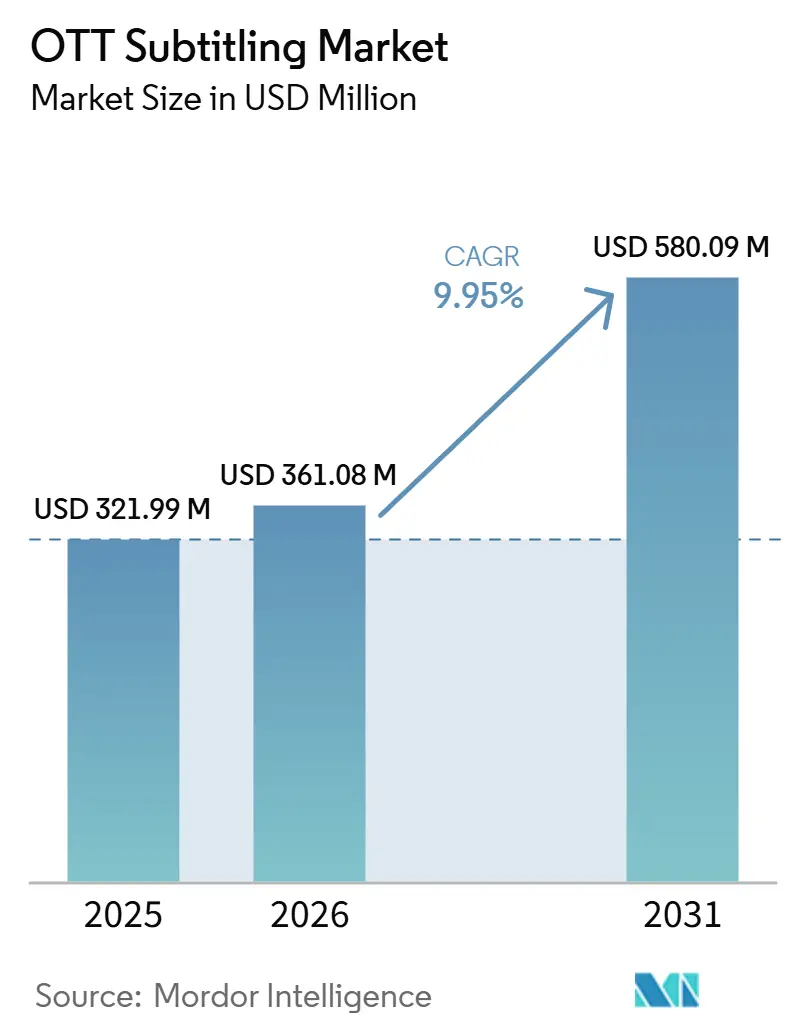
The OTT Subtitling Market size was valued at USD 321.99 million in 2025 and is estimated to grow from USD 361.08 million in 2026 to reach USD 580.09 million by 2031, at a CAGR of 9.95% during the forecast period (2026-2031). Rising streaming libraries, wider international distribution, and accessibility obligations are increasing the volume of subtitle work required for each release. Platforms are bringing localization earlier into production because delayed language delivery can weaken the experience for viewers in newly served territories. AI-assisted production is reducing turnaround time for routine work, while human review remains necessary for accuracy, context, and compliance. This combination supports suppliers that can manage large, multilingual programs, maintain delivery quality, and adapt established workflows to different release schedules without reducing quality controls. The OTT subtitling market also faces more complex requirements where national rules, language expectations, and content formats differ across markets.
Key Report Takeaways
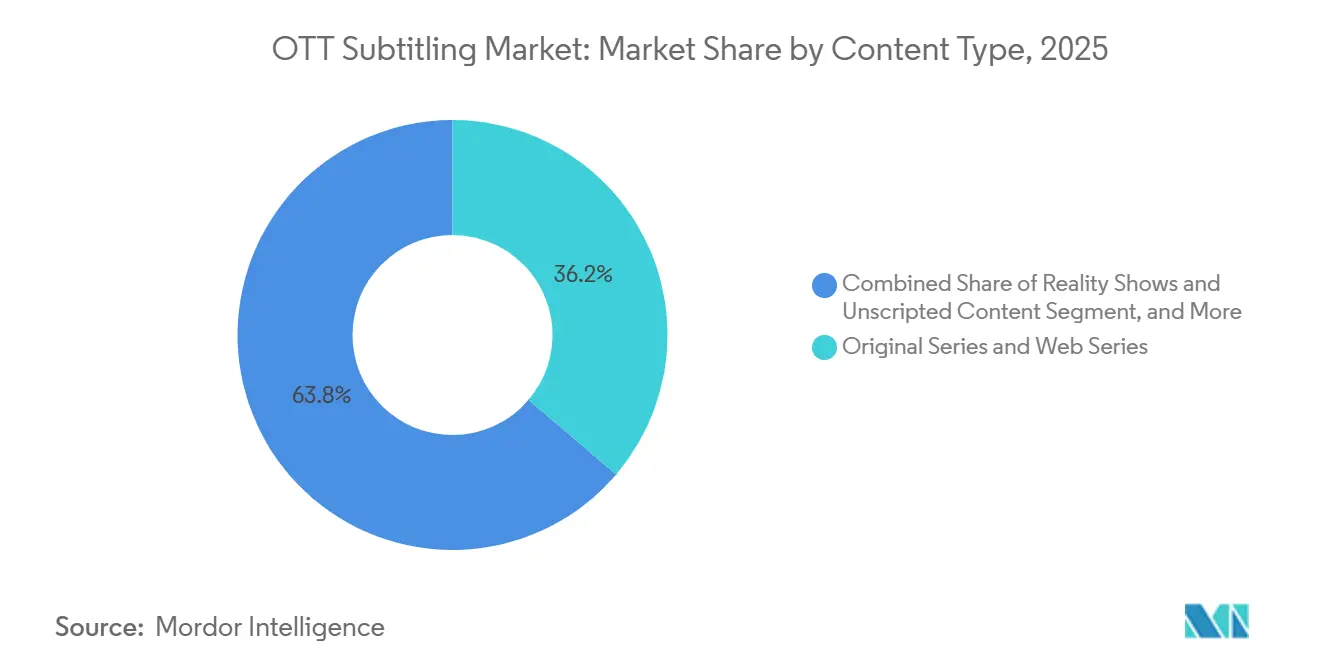
- By content type, original series and web series accounted for 36.23% of the OTT subtitling market share in 2025, while documentary and non-fiction content is projected to expand at a 10.71% CAGR through 2031.
- By subtitle type, closed captions accounted for a 38.81% share in 2025, while SDH and accessibility captions are projected to grow at a 10.63% CAGR through 2031.
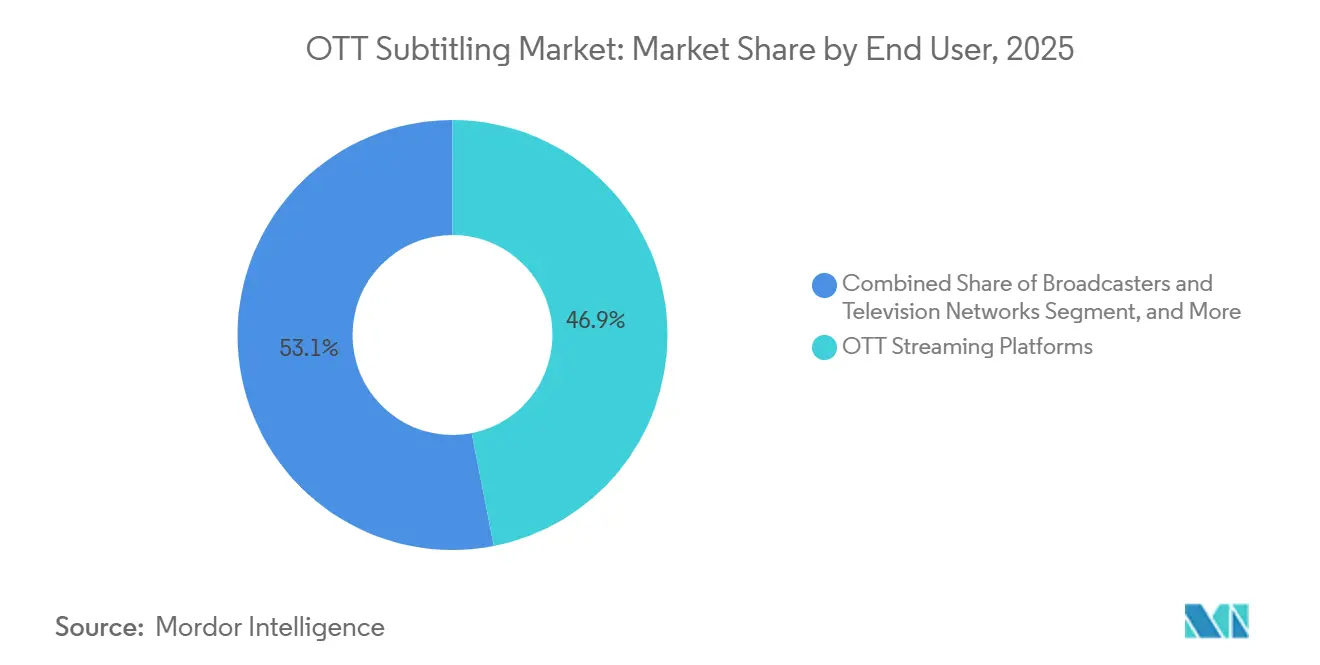
- By end user, OTT streaming platforms held 46.92% of the OTT subtitling market share in 2025, while independent creators are expected to record the highest projected CAGR of 11.54% through 2031.
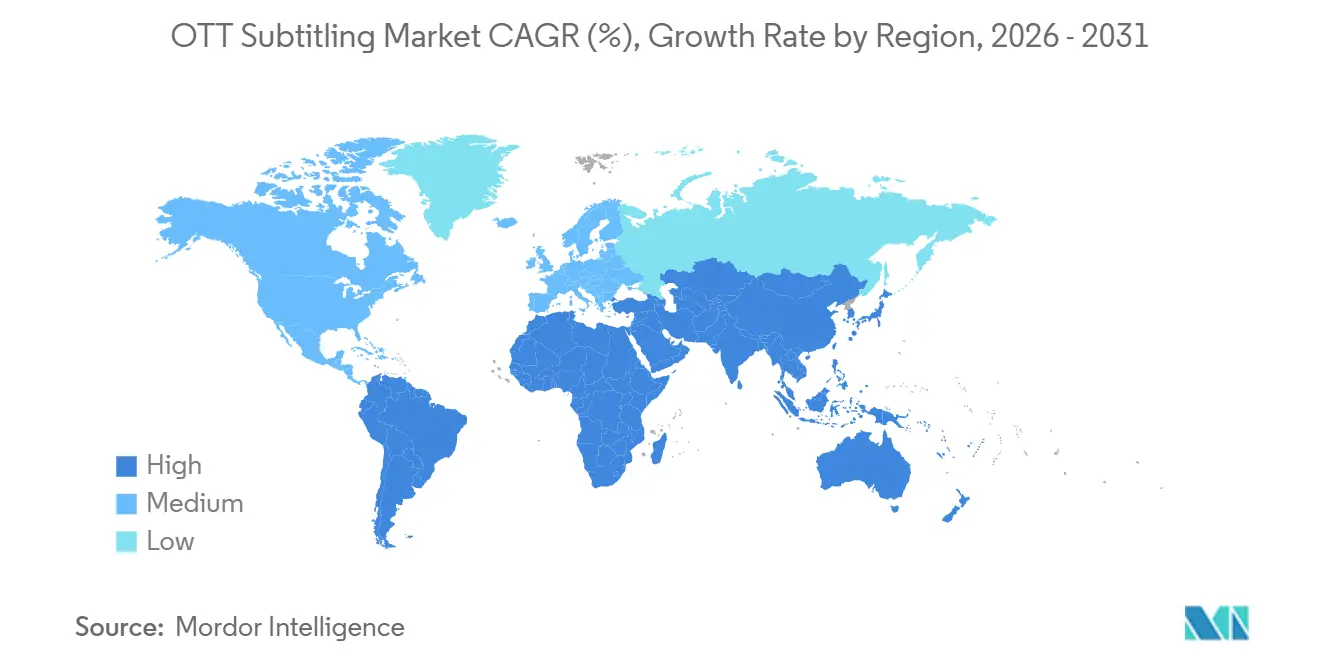
- By geography, North America accounted for 42.72% of the OTT subtitling market share in 2025, while Asia-Pacific is projected to grow at a 10.48% CAGR through 2031.
Note: Market size and forecast figures in this report are generated using Mordor Intelligence’s proprietary estimation framework, updated with the latest available data and insights as of January 2026.
Global OTT Subtitling Market Trends and Insights
Drivers Impact Analysis*
| Driver | (~) % Impact on CAGR Forecast | Geographic Relevance | Impact Timeline |
|---|---|---|---|
| Rising OTT Localization Spend for Multilingual Audience Expansion | +3.5% | Global | Long term (≥ 4 years) |
| Accessibility Compliance Requirements Across Streaming Catalogs | +2.0% | North America and EU | Short term (≤ 2 years) |
| AI-Assisted Subtitle Workflows Reducing Turnaround Time | +1.5% | Global | Medium term (2-4 years) |
| Growth of Live and Near-Live OTT Content Formats | +0.9% | North America, Europe, Asia-Pacific | Medium term (2-4 years) |
| Rising Demand for Low-Latency Cloud Production Pipelines | +0.7% | North America and Asia-Pacific | Medium term (2-4 years) |
| Expansion of Short-Form and Creator-Led Streaming Libraries | +0.6% | Asia-Pacific and North America | Long term (≥ 4 years) |
| Source: Mordor Intelligence | |||
Rising OTT Localization Spend for Multilingual Audience Expansion
The OTT subtitling market grows steadily as platforms add territories and need language assets for every title they distribute. Localization has become part of subscriber acquisition because viewers expect releases in relevant languages at launch. Non-English original programming now needs the same broad language coverage once reserved for English-language productions. Korean content illustrates this demand, as Netflix committed USD 2.5 billion to Korean content from 2024 through 2028. K-dramas accounted for 4.136 billion viewing hours in Netflix's global top-10 rankings in 2025, underscoring the need for multilingual subtitle packages. The number of subtitle versions required per title can therefore rise even when automation lowers the cost of each production minute. The effect is strongest when a platform launches the same series across many territories on the same date. Each language pair requires linguistic adaptation, timing checks, and delivery to the platform’s required technical format.
Accessibility Compliance Requirements Across Streaming Catalogs
Accessibility rules are moving subtitle work from a voluntary service into a formal operating requirement for many streaming providers. The European Accessibility Act became enforceable across the 27 EU member states on June 28, 2025. Its requirements cover captions, SDH tracks, audio descriptions, and accessible video player controls for relevant digital services. The European framework refers to EN 301 549 and WCAG 2.1 AA requirements, which raise the need for structured accessibility production. In the United States, the FCC set August 17, 2026, as the compliance date for closed-caption display settings requirements on covered equipment. These requirements add compliance work alongside existing expectations for accuracy, synchronization, completeness, and placement. The obligation is not met by providing only English caption tracks for a service operating across Europe. Platforms must provide relevant accessibility services in the language of each market they serve. This increases production requirements for German, French, Spanish, Italian, and other local-language catalogs.
AI-Assisted Subtitle Workflows Reducing Turnaround Time
AI-assisted workflows are reducing the time required to prepare first subtitle drafts and translations. Their primary value lies in speeding dialogue analysis, timing, translation support, and quality review preparation. ZOO Digital reported that a major studio customer approved machine translation for subtitling after completing trials. The company expects AI-enabled volume to shorten delivery times and improve gross margins while working with its established human talent network. This supports a hybrid model where automation handles repeatable steps and experienced reviewers make final editorial decisions. The OTT subtitling market retains a role for human specialists because content context and language nuance remain important. Encompass deployed its Altitude Intelligence platform with Narrative Entertainment in May 2026. The platform automates dialogue analysis, context assessment, timing, and language nuance detection before skilled subtitlers review the output. These systems can improve throughput without requiring providers to remove human validation from sensitive work.
Growth of Live and Near-Live OTT Content Formats
Live sports, news, awards coverage, and creator events require subtitle processes that differ from scheduled on-demand workflows. These formats need rapid speech recognition, caption generation, language support, and delivery during the event. ZOO Digital introduced its Fast Track service during FY25 and reported growing demand through FY26.[1]ZOO Digital Group plc, “Annual Report 2025,” ZOO Digital Group plc, zoodigital.com The service reduced localization turnaround from weeks to hours and completed 24-hour dubbing assignments for 8 weekly episodes in multiple languages. This shows why customers are seeking production models designed for shorter release windows. The OTT subtitling market benefits from live programming, as subtitle delivery becomes an immediate operational need. Eurovision Sport and CAMB.AI partnered in March 2026 to provide live and on-demand subtitling for the Milano Cortina 2026 Paralympic Winter Games. The work covered all 6 Paralympic Winter Games sports through contextual speech-to-text captioning for live streams and on-demand replays CAMB.AI. Such deployments show that automated live support can be used at major international events.
Restraints Impact Analysis*
| Restraint | (~) % Impact on CAGR Forecast | Geographic Relevance | Impact Timeline |
|---|---|---|---|
| High Human Review Burden for Accuracy and Brand Safety | -1.5% | Global | Long term (≥ 4 years) |
| Fragmented Language Quality Standards Across Markets | -1.2% | EU and Asia-Pacific | Medium term (2-4 years) |
| Rights Holder Approval Delays in Multi-Territory Releases | -0.8% | North America and Europe | Short term (≤ 2 years) |
| Subtitle Workflow Integration Costs for Smaller OTT Publishers | -0.6% | Global | Medium term (2-4 years) |
| Source: Mordor Intelligence | |||
High Human Review Burden for Accuracy and Brand Safety
Fully automated subtitle generation performs best when the audio is clear and the vocabulary is familiar. It is less dependable when speakers overlap, use regional accents, or discuss specialized topics. Sports, legal, and medical programming often contain these conditions, which require closer review. The European accessibility framework has raised expectations for accurate live captions and limited delay. AVIXA notes that live captions should meet at least 98.5% accuracy under its interpretation of applicable EAA requirements. Human review remains necessary when errors could create legal, reputational, or accessibility concerns. This review requirement creates a cost floor that automation alone cannot remove. It also limits providers' ability to treat all content as a standard production task. Larger libraries can increase the number of corrections that internal teams must manage. Specialist vendors can respond by maintaining trained reviewer networks and content-specific quality controls.
Fragmented Language Quality Standards Across Markets
Subtitle requirements vary across jurisdictions and do not follow one fully harmonized international standard. The European Accessibility Act refers to EN 301 549 and WCAG 2.1 AA for EU services. The FCC applies its own requirements to covered United States content and equipment. National broadcaster requirements in Asian markets also vary by country and technical format. A subtitle file accepted in one market can require changes before it can be used in another. The OTT subtitling market must therefore manage local rules alongside shared global workflows. This fragmentation adds quality assurance work during international launches. Local-language capacity may not be available at the same pace as a platform’s content-acquisition plans. The result can include catalog delays, additional revisions, and higher workloads for buyers. Vendors that maintain territory-specific quality teams can reduce these risks for platforms. Centralized production models can face repeated remediation costs when they enter new markets without local support. The operational challenge is particularly significant for services that publish content across several European countries simultaneously.
*Our forecasts treat driver/restraint impacts as directional, not additive. The impact forecasts reflect baseline growth, mix effects, and variable interactions.
Segment Analysis
By Content Type: Scripted Originals Lead While Factual Programming Accelerates
Original series and web series held 36.23% of the OTT subtitling market share in 2025, reflecting the central role of scripted premium programming in subscriber acquisition, international catalog differentiation, and viewer retention across multiple territories. Day-and-date releases require subtitle packages for many language pairs at the same time, creating reliable volume for suppliers that coordinate translation, timing, editorial review, and platform delivery around fixed release schedules. Controlled audio and available scripts can support automated production steps, while premium series still require review for cultural fit, dialogue context, and natural reading speed. Each new season can create recurring work across existing language combinations, while expansion into new territories can add further versions. The segment retains an important position in the OTT subtitling market because platform commissioning remains strongly focused on original series that must travel effectively across languages.
Documentary and non-fiction content is projected to record a 10.71% CAGR during 2026-2031, making it the fastest-growing content category as subscription and advertising-supported services expand educational, investigative, and specialist programming. Interviews, archival recordings, technical vocabulary, regional accents, spontaneous conversations, and inconsistent audio can increase review needs compared with scripted drama, which can sustain higher service requirements despite wider automation use. Movies and feature films remain a material volume source as theatrical windows shorten and legacy libraries return to streaming services with updated subtitle and accessibility requirements. Reality shows need careful treatment because multiple participants may speak over one another, while animation and children’s programming generate ongoing SDH demand because accessibility is important for younger viewers with hearing impairments.



By Subtitle Type: Closed Captions Lead While SDH Demand Expands
Closed captions accounted for 38.81% of the OTT subtitling market size in 2025, supported by long-standing adoption across United States platforms, established production procedures, and broad compatibility with common playback systems. They are a familiar accessibility format, but they also help viewers in noisy environments or those who choose to view content without sound. Their installed base gives them a continuing role as platforms update existing libraries, add new programs, and reformat imported content. Closed captions are used for both domestic and international titles, which supports steady demand beyond a narrow compliance use case. The OTT subtitling market continues to rely on this format as a basic element of accessible streaming delivery and routine viewing convenience.
SDH and accessibility captions are projected to expand at a 10.63% CAGR during 2026-2031 because they include speaker identification, non-speech sound descriptions, and detailed timing beyond basic spoken-dialogue transcription. The European Accessibility Act has increased demand for these more complete access services, which usually require greater authoring precision and more extensive quality checks. Platforms can favor suppliers able to deliver both closed captions and SDH through a coordinated program, simplifying review, reporting, catalog consistency, and compliance management across territories. Open subtitles remain important where text is embedded in video streams and local playback environments do not support closed-caption decoding. Live captions, spoken subtitles, and sign-language-overlaid tracks broaden the service range and increase the need for technical delivery expertise alongside language and editorial skills.
By End User: Streaming Platforms Lead While Independent Creators Expand Demand
OTT streaming platforms accounted for 46.92% of demand in 2025, representing the largest end-user position in the OTT subtitling market, as they control large commissioning budgets, broad content libraries, and multinational release calendars. Their contracts can cover original releases, imported programs, catalog updates, accessibility remediation, and recurring technical conversions of assets across different platform environments. This scale supports long-term supply arrangements with preferred vendors that can provide several languages, formats, quality controls, and dependable delivery. It also underscores the operational importance of subtitle production, as delays can disrupt coordinated releases across several countries. The OTT subtitling market depends strongly on platforms that need consistent delivery at a library scale and can use framework agreements to manage that requirement.
Independent creators are projected to grow at an 11.54% CAGR during 2026-2031 as creator-led content expands demand beyond traditional studio and broadcaster procurement channels. Short-form video is often viewed without sound, so readable subtitles can help creators retain attention and make their material usable in more viewing settings. Creator tools can help channels identify content for localization and choose languages, while 3Play Media introduced AI Dubbing for YouTube creators in 2025 with channel-level analytics to inform those decisions.[2]3Play Media, “3Play Media Launches AI-Enabled Solutions to Prepare for ADA Title II Requirements,” 3Play Media, 3playmedia.com Production studios, broadcasters, television networks, corporate media teams, and higher education institutions also need subtitle conversion, digital reformatting, catalog audits, remediation planning, and ongoing accessible video support. 3Play Media’s 2025 Pulse launch, which centralizes accessibility auditing and remediation across video libraries, illustrates how suppliers can serve these additional buyers alongside entertainment customers.
Geography Analysis
North America held 42.72% of the OTT subtitling market share in 2025. The region combines a large base of streaming platforms, major content producers, and active accessibility requirements. The United States creates substantial demand because domestic originals are often released internationally with many language versions. Imported titles also need high-quality English subtitle formatting for platform delivery. Canada adds volume through English-French content needs, while Mexico supports English-Spanish localization as streaming adoption grows. ZOO Digital received preferred-vendor designations from Netflix in October 2024 and Amazon Prime Video in February 2025. These designations illustrate why platform density can favor vendors with proven technical and operational capabilities.
Europe is the second-largest regional market for OTT subtitling. The June 2025 enforcement of the European Accessibility Act created immediate demand for accessible subtitle capacity across EU member states. The United Kingdom, Germany, France, Italy, and Spain are important markets for deployment because each has a large streaming audience and local-language needs. National implementation and enforcement processes can add complexity beyond the shared EU framework. Spain’s Law 11/2023 provides for fines of up to EUR 600,000 (USD 654,000) per violation. This raises the importance of documented accessibility procedures and locally appropriate subtitle delivery. South America also adds demand as platforms expand Portuguese and Spanish localization for regional originals and licensed programming.
Asia-Pacific is projected to grow at a 10.48% CAGR during 2026-2031, the highest regional rate in the OTT subtitling market. India, South Korea, Japan, and Southeast Asia support this growth through rising streaming use and expanding original content catalogs. South Korean programming is particularly subtitle intensive because it is distributed to international audiences in many languages. Platforms need English, Spanish, Arabic, French, Portuguese, and other versions for simultaneous availability. The Middle East and Africa have a smaller current contribution but are receiving more platform investment. Arabic-language programming and pan-African services create demand for local language subtitle support.

Competitive Landscape
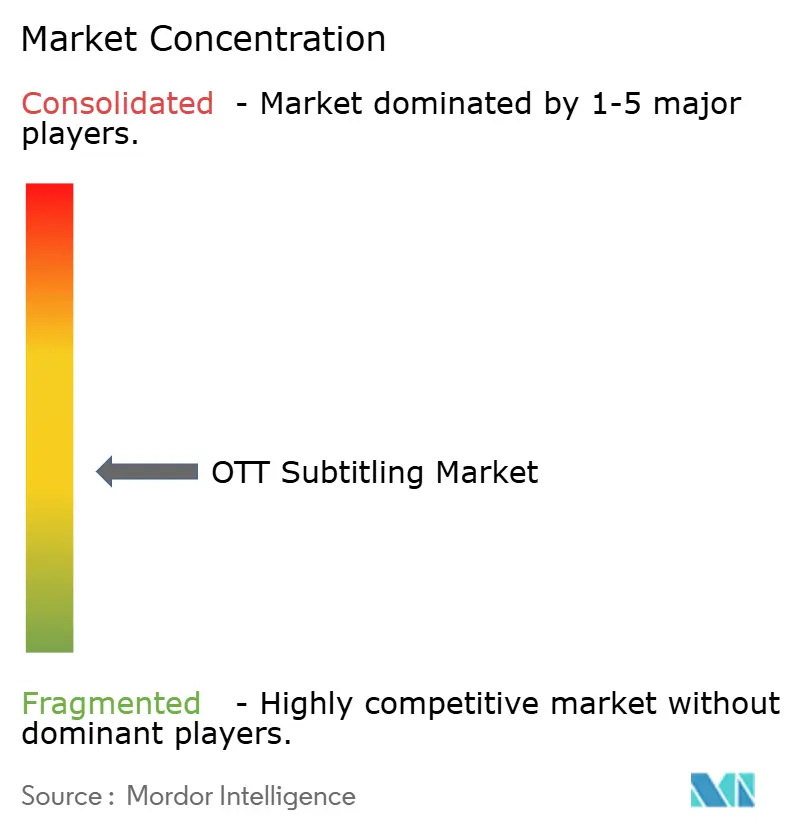
The OTT subtitling market has a tiered competitive structure. Amara Subtitling, Inc., Verbit, Inc., and ZOO Digital operate as global, technology-enabled localization specialists with access to large studio and platform accounts. A more fragmented group of mid-tier suppliers serves regional OTT operators, broadcasters, and independent production companies. Large customers seek multi-territory arrangements that can support consistent quality, several languages, and demanding delivery schedules. Smaller providers compete where customers need local expertise or lower-cost support. This combination means that the competitive environment is concentrated at the top but remains fragmented across the wider supplier base.
The OTT subtitling market, therefore, offers room for both global programs and specialized local delivery. ZOO Digital completed machine-translation trials for a major customer and received approval to deploy the capability at scale. It also held preferred-vendor status with Netflix and Amazon Prime Video, indicating the value of verified technology and dependable delivery performance. AI-Media introduced the LEXI Text Encoder UHD592 and LEXI Voice Encoder AIX-1 at NAB 2026 for real-time captioning and voice translation.[3]AI-Media Technologies Limited, “LEXI Text Encoder UHD592 and LEXI Voice Encoder AIX-1,” AI-Media Technologies Limited, ai-media.tv These moves show that suppliers are investing in automation, live delivery, and connected production systems rather than relying only on traditional language services.
Regulatory readiness is becoming a meaningful competitive factor for the OTT subtitling market. Vendors that can provide EAA-compliant SDH production, FCC-aligned accuracy processes, and documented accessibility workflows can be more attractive to risk-conscious buyers. Opportunities remain in live captioning for mid-tier broadcasters, EU accessibility work, and creator-focused tools. 3Play Media’s 2025 Pulse launch addressed video accessibility governance through centralized audit and remediation capabilities. Platform-native AI remains a competitive consideration because large buyers may internalize routine subtitle creation. External providers are likely to remain relevant for complex content, regulated accessibility work, and high-quality multilingual releases, particularly when platforms need accountable human review, local cultural knowledge, and reliable delivery across several language pairs at once.
OTT Subtitling Industry Leaders
Rev Inc.
3Play Media, Inc.
Amara Subtitling, Inc.
Verbit, Inc.
ZOO Digital Group plc
- *Disclaimer: Major Players sorted in no particular order

Recent Industry Developments
- May 2026: Narrative Entertainment partnered with Encompass to deploy the Altitude Intelligence AI-assisted subtitling platform across its Great! network content catalog. The hybrid AI-plus-human workflow automates dialogue analysis, context assessment, timing, and language nuance detection before skilled subtitlers review and refine the output, delivering improvements in subtitle quality, speed, and scale simultaneously.
- April 2026: AI-Media Technologies launched the LEXI Text Encoder UHD592 and LEXI Voice Encoder AIX-1 at NAB 2026. Both encoders deliver real-time captioning and voice translation with upgraded AMD EPYC and GPU-accelerated processing respectively, supporting 4K 12G-SDI UHD formats with improved security and a hardware-as-a-subscription commercial model for broadcaster and OTT platform deployments.
- March 2026: Eurovision Sport and CAMB.AI entered a formal partnership to deliver live and on-demand AI subtitling for the Milano Cortina 2026 Paralympic Winter Games, covering all 6 Paralympic Winter Games sports with real-time contextual speech-to-text captioning across both live streams and on-demand replays without altering broadcast editorial integrity.
- March 2026: ZOO Digital expanded its US invoice financing facility from USD 3 million to USD 5 million to support working capital as its Fast Track live-localization service volumes grew. The company reported FY26 revenue of USD 42.3 million and adjusted EBITDA of at least USD 3.8 million, reflecting continued margin improvement from cost-base restructuring.


Global OTT Subtitling Market Report Scope
The OTT subtitling market includes the services, software, and technologies used to create, translate, localize, synchronize, and deliver subtitles for over-the-top video content across streaming platforms, video-on-demand services, and other internet-based media distribution channels. The scope of the report covers market trends, growth drivers, restraints, opportunities, key segments, and the competitive landscape across major regions.
The OTT Subtitling Market Report is Segmented by Content Type (Movies and Feature Films, Original Series and Web Series, Documentary and Non-Fiction, Reality Shows and Unscripted Content, Animation and Kids Content, and Other Content Types), Subtitle Type (Closed Captions, Open Subtitles, SDH and Accessibility Captions, Live Captions, and Other Subtitle Types), End User (OTT Streaming Platforms, Production Studios, Broadcasters and Television Networks, Independent Creators, and Other End Users), and Geography (North America, South America, Europe, Asia-Pacific, Middle East, and Africa). The Market Forecasts are Provided in Terms of Value (USD).
| Movies and Feature Films |
| Original Series and Web Series |
| Documentary and Non-Fiction |
| Reality Shows and Unscripted Content |
| Animation and Kids Content |
| Other Content Types |
| Closed Captions |
| Open Subtitles |
| SDH and Accessibility Captions |
| Live Captions |
| Other Subtitle Types |
| OTT Streaming Platforms |
| Production Studios |
| Broadcasters and Television Networks |
| Independent Creators |
| Other End Users |
| North America | United States |
| Canada | |
| Mexico | |
| South America | Brazil |
| Argentina | |
| Chile | |
| Rest of South America | |
| Europe | Germany |
| United Kingdom | |
| France | |
| Italy | |
| Spain | |
| Rest of Europe | |
| Asia-Pacific | China |
| Japan | |
| India | |
| South Korea | |
| Australia | |
| Rest of Asia-Pacific | |
| Middle East | Saudi Arabia |
| United Arab Emirates | |
| Qatar | |
| Rest of Middle East | |
| Africa | South Africa |
| Egypt | |
| Nigeria | |
| Rest of Africa |
| By Content Type | Movies and Feature Films | |
| Original Series and Web Series | ||
| Documentary and Non-Fiction | ||
| Reality Shows and Unscripted Content | ||
| Animation and Kids Content | ||
| Other Content Types | ||
| By Subtitle Type | Closed Captions | |
| Open Subtitles | ||
| SDH and Accessibility Captions | ||
| Live Captions | ||
| Other Subtitle Types | ||
| By End User | OTT Streaming Platforms | |
| Production Studios | ||
| Broadcasters and Television Networks | ||
| Independent Creators | ||
| Other End Users | ||
| By Geography | North America | United States |
| Canada | ||
| Mexico | ||
| South America | Brazil | |
| Argentina | ||
| Chile | ||
| Rest of South America | ||
| Europe | Germany | |
| United Kingdom | ||
| France | ||
| Italy | ||
| Spain | ||
| Rest of Europe | ||
| Asia-Pacific | China | |
| Japan | ||
| India | ||
| South Korea | ||
| Australia | ||
| Rest of Asia-Pacific | ||
| Middle East | Saudi Arabia | |
| United Arab Emirates | ||
| Qatar | ||
| Rest of Middle East | ||
| Africa | South Africa | |
| Egypt | ||
| Nigeria | ||
| Rest of Africa | ||


Key Questions Answered in the Report
What is the OTT subtitling market size?
The OTT Subtitling Market size was valued at USD 321.99 million in 2025 and is estimated to grow from USD 361.08 million in 2026 to reach USD 580.09 million by 2031, at a CAGR of 9.95% during the forecast period (2026-2031).
What is driving demand for OTT subtitling services?
International content releases, accessibility obligations, larger streaming libraries, and live programming are increasing subtitle production needs.
Which content type holds the largest share of OTT subtitling demand?
Original series and web series held 36.23% of demand in 2025 because platforms release scripted programming across many territories.
Which subtitle format is growing fastest?
SDH and accessibility captions are projected to grow at a 10.63% CAGR through 2031, supported by stronger accessibility requirements.
Which region is growing fastest for OTT subtitling?
Asia-Pacific is projected to grow at a 10.48% CAGR through 2031, supported by streaming growth across India, South Korea, Japan, and Southeast Asia.
How is AI changing subtitle production?
AI can speed dialogue analysis, timing, and first-draft production, while human reviewers remain important for accuracy, context, and compliance.
Page last updated on:





