
OTT Security Market Size and Share
Market Overview
| Study Period | 2020 - 2031 |
|---|---|
| Market Size (2026) | USD 6.26 Billion |
| Market Size (2031) | USD 12.28 Billion |
| Growth Rate (2026 - 2031) | 14.42 % |
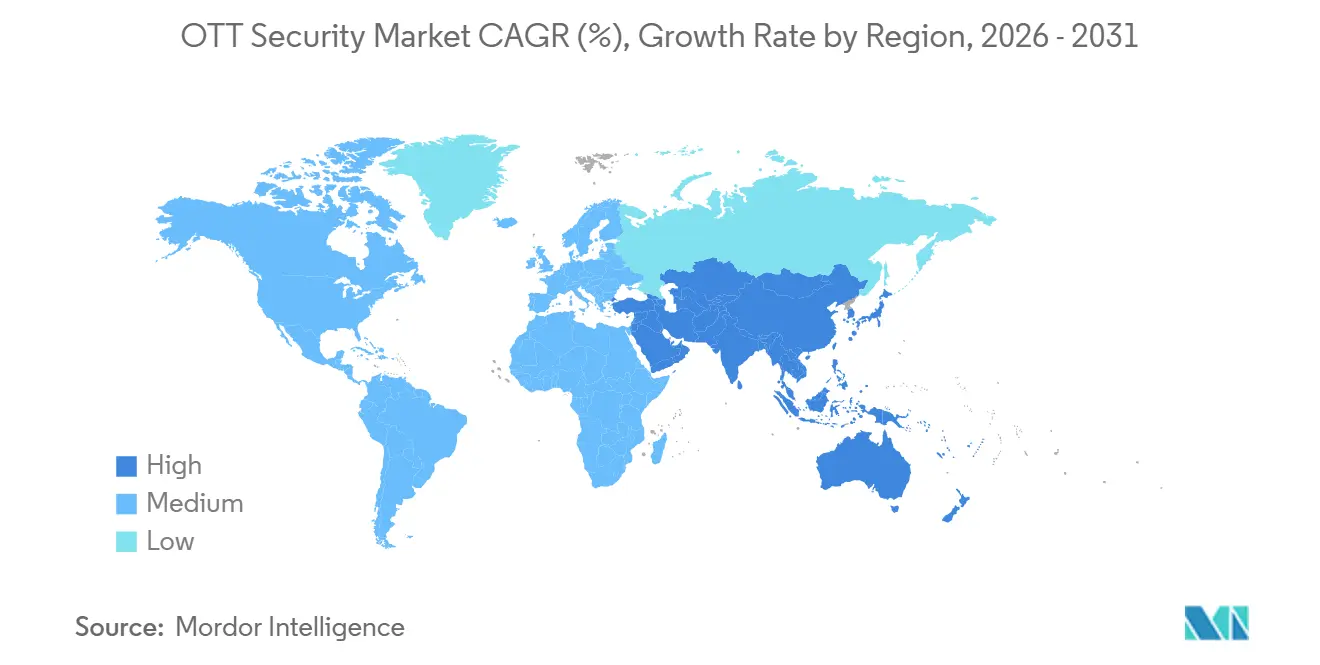
| Fastest Growing Market | Asia-Pacific |
| Largest Market | North America |
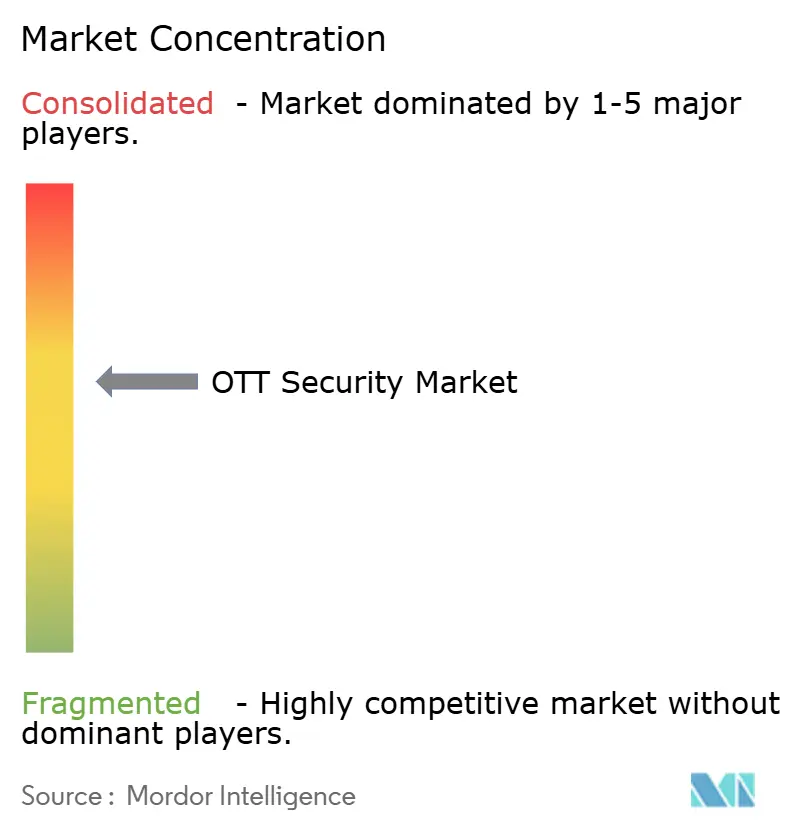
| Market Concentration | Medium |
Major Players *Disclaimer: Major Players sorted in no particular order Image © Mordor Intelligence. Reuse requires attribution under CC BY 4.0. | |
OTT Security Market Analysis by Mordor Intelligence
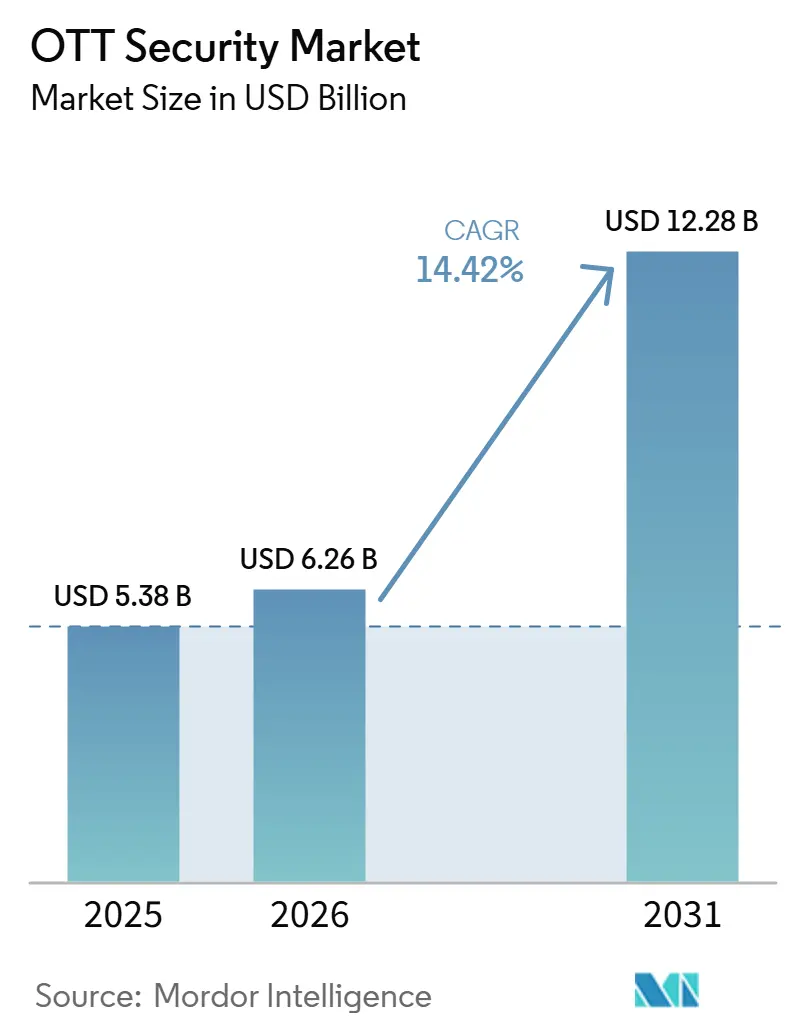
The OTT security market size is expected to increase from USD 5.38 billion in 2025 to USD 6.26 billion in 2026 and reach USD 12.28 billion by 2031, growing at a CAGR of 14.42% over 2026-2031. Security spending is moving closer to content delivery and subscriber access because piracy, credential theft, and application attacks can directly reduce revenue. Streaming services are also expanding live programming and multi-device viewing, which requires security controls that can act quickly across cloud delivery, player applications, and license systems. Studio requirements for DRM, hardware-backed playback, and forensic watermarking make many content protection purchases difficult to defer. Providers are extending their offers through partnerships that combine DRM, watermarking, monitoring, and cloud workflows. The outlook remains constrained by device compatibility issues, integration work, and the risk that strict controls may make legal services harder to use.
Key Report Takeaways
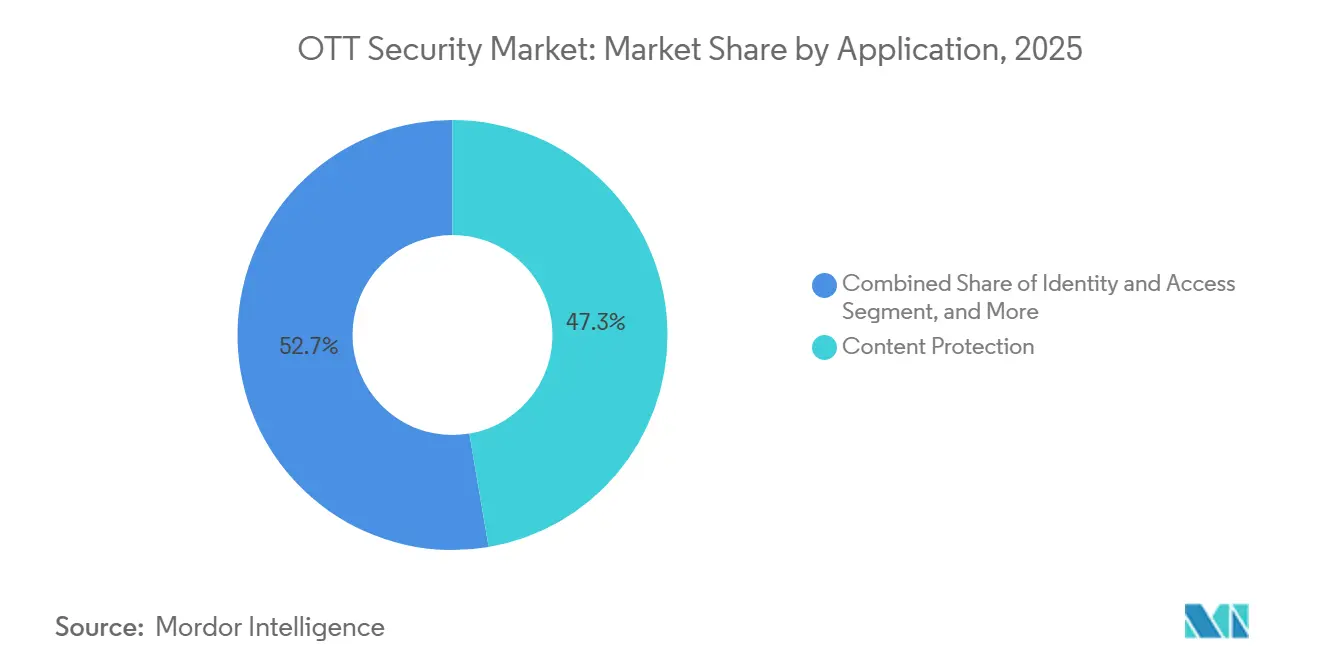
- By application, content protection held 47.31% of the OTT security market share in 2025, while application security is projected to expand at a 14.78% CAGR through 2031.
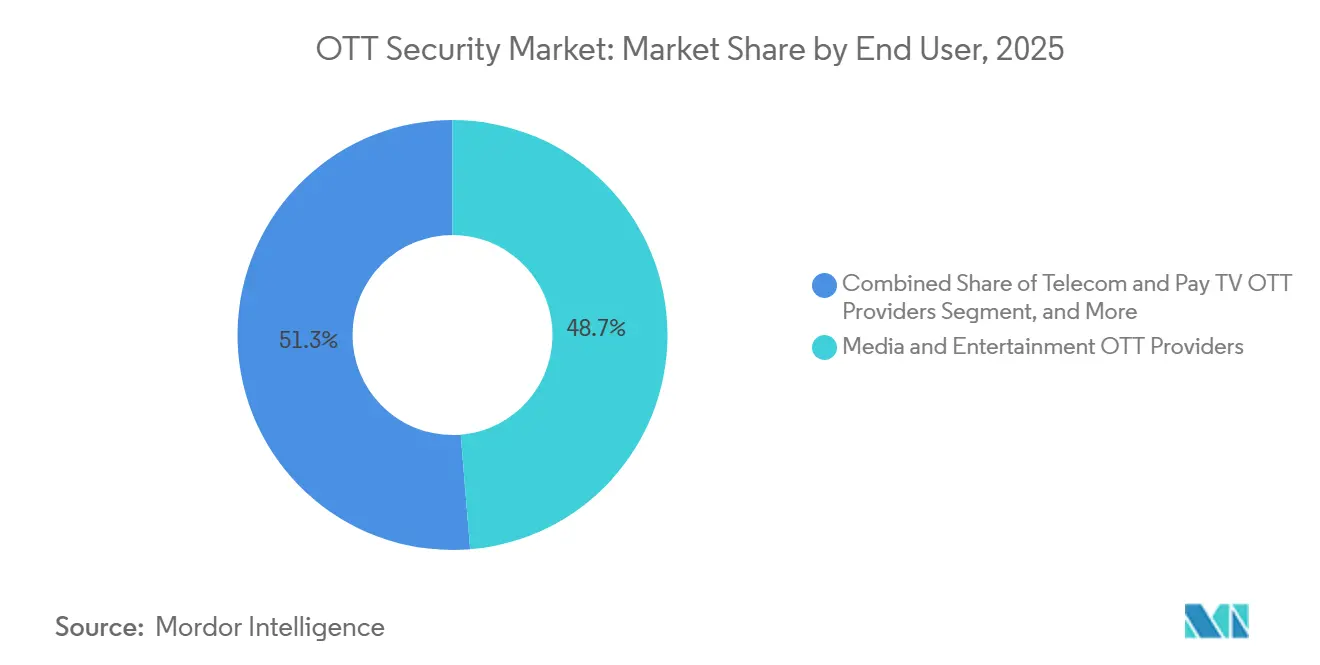
- By end user, media and entertainment OTT providers held 48.69% of end-user revenue in 2025, while educational OTT providers are projected to expand at a 15.21% CAGR through 2031.
- By geography, North America accounted for 43.28% share of the over-the-top (OTT) security market revenue in 2025, while Asia-Pacific is projected to expand at a 14.92% CAGR through 2031.
Note: Market size and forecast figures in this report are generated using Mordor Intelligence’s proprietary estimation framework, updated with the latest available data and insights as of January 2026.
Market Trends and Insights
Drivers Impact Analysis of OTT Security Market*
| Driver | (~) % Impact on CAGR Forecast | Geographic Relevance | Impact Timeline |
|---|---|---|---|
| Escalating OTT Piracy and DRM Circumvention | +3.2% | Global, with greater exposure in Asia-Pacific and Western Europe | Short term (≤ 2 years) |
| Cloud-Native Security Demand From Live and Multi-Device Streaming | +2.8% | Global, concentrated in North America and Asia-Pacific | Medium term (2-4 years) |
| Regulatory Pressure on Content Protection and Access Control | +2.4% | North America, Europe, India, and Southeast Asia | Medium term (2-4 years) |
| Revenue Leakage From Account Sharing, Credential Stuffing, and Subscription Fraud | +2.1% | Global, strongest in North America and Asia-Pacific core markets | Short term (≤ 2 years) |
| License-Layer Attack Surface Expansion Beyond Traditional DRM | +1.6% | Global, particularly where live sports rights have high value | Medium term (2-4 years) |
| Ad-Tech and Payment Workflow Integrity Requirements in Monetized OTT | +1.2% | North America and Europe, with spillover to Asia-Pacific | Long term (≥ 4 years) |
| Source: Mordor Intelligence | |||
Escalating OTT Piracy and DRM Circumvention
The OTT security market is being supported by organized efforts to bypass DRM through license-key extraction, altered player software, and license-server spoofing. Piracy networks can distribute premium programming worldwide soon after release and can move operations when individual domains are removed, increasing the operating risk for the OTT security market. Japan-origin digital content piracy losses reached JPY 5.7 trillion (USD 38 billion) in 2025, compared with JPY 2 trillion (USD 13.56 billion) in 2022.[1]Ministry of Economy, Trade and Industry, “Results of the Survey on Losses From Online Piracy of Japan-Origin Content,” Ministry of Economy, Trade and Industry, meti.go.jp The ITU identifies compromised software and counterfeit receivers as key channels for the misappropriation of OTT content. It also calls for fast takedown rules and layered technical protections, so legal action and technical controls need to work together. This pressure makes monitoring, forensic watermarking, and license-layer protection more important parts of the OTT security market than encryption alone.
Cloud-Native Security Demand From Live and Multi-Device Streaming
Live sports and other time-sensitive programming are in increasing demand in the OTT security market because delayed responses have limited commercial value after an event ends. Services need to identify the source of an unauthorized live stream and act while the event is still underway, which raises response requirements across the OTT security market. NAGRAVISION and Harmonic launched an event-based watermarking-as-a-service offer in April 2026 that combines NAGRA NexGuard with Harmonic VOS 360 Media SaaS. The service uses an A/B watermarking design and an event-based model that lowers the cost and engineering work for protection that is not required at all times. Asia-Pacific online video revenue totaled USD 70 billion in 2025, and live sports remained an important driver of subscriber acquisition across the region. Multi-device use adds further requirements for device identification, session controls, token management, and trusted execution environment checks.
Regulatory Pressure on Content Protection and Access Control
Privacy and copyright requirements are bringing access controls and data protection closer together within the OTT security market. India’s Digital Personal Data Protection Act and its 2025 Rules require stronger consent management, data minimization, breach response, and controls around data transfers. These requirements affect identity and access systems because viewing data, account information, and personalization workflows must be managed securely across the over-the-top (OTT) security market. GDPR and the California Consumer Privacy Act create similar pressure for streaming providers that handle viewing and subscriber information. The ITU recommends that national administrations establish legislation that allows fast action against unauthorized multimedia content. As regulations become more specific, operators need security designs that protect content and personal data without separating these responsibilities.
Revenue Leakage From Account Sharing, Credential Stuffing, and Subscription Fraud
Account sharing and stolen credentials undermine OTT security by bypassing DRM and exploiting subscriber identities instead. Credential stuffing uses automated tools to test stolen passwords and then resells accounts that still work. The resulting loss includes missed subscriptions, higher concurrent-stream costs, and less reliable viewing data for advertising and recommendations in the OTT security market. Providers are responding with device fingerprinting, IP reputation checks, session monitoring, and anomaly detection. These controls are commonly combined with bot management to help platforms distinguish legitimate shared household use from organized abuse. The pattern broadens demand beyond video encryption and makes identity protection central to protecting subscription revenue.
Restraints Impact Analysis of OTT Security Market*
| Restraint | (~) % Impact on CAGR Forecast | Geographic Relevance | Impact Timeline |
|---|---|---|---|
| Rising Viewer Friction From Aggressive DRM and Device Restrictions | -1.5% | Global, especially where device fleets are diverse or aging | Short term (≤ 2 years) |
| Fragmented Device, Codec, and Playback Environments | -1.3% | Global, particularly severe in Asia-Pacific and South America | Medium term (2-4 years) |
| High Integration Complexity Across CDN, Billing, Ad Tech, and Identity Stacks | -1.0% | Global, especially for mid-market and regional operators | Medium term (2-4 years) |
| Rapidly Evolving Piracy Toolchains and Low-Quality Enforcement Economics | -0.8% | Global, particularly where legal enforcement infrastructure is limited | Long term (≥ 4 years) |
| Source: Mordor Intelligence | |||
Rising Viewer Friction From Aggressive DRM and Device Restrictions
The OTT security market faces a constraint when stronger protection limits playback on devices used by legitimate subscribers. HbbTV guidance requires hardware-backed protection, including Microsoft PlayReady SL3000 and HDCP 2.2, for certain UHD and early-release content. These requirements can prevent 4K playback on software-only or uncertified devices and can reduce service quality for some OTT security market subscribers. A 2026 Friend MTS survey found that nearly 80% of respondents considered DRM and watermarking the preventive foundation of content security, while subscriber experience remained a concern. AVIA reported that 73% of piracy users across 8 Asia-Pacific markets said they would pay for legal content if piracy services were unavailable. Operators, therefore, need to meet studio requirements while avoiding controls that make unauthorized options appear easier to use.
Fragmented Device, Codec, and Playback Environments
The OTT security market must support Android-based televisions, iOS and iPadOS devices, web browsers, set-top boxes, game consoles, and connected television platforms. These environments have different DRM interfaces, security capabilities, and software update cycles. Consumer services commonly need Widevine, PlayReady, and FairPlay, which require separate packaging, license-server settings, and device-specific policies. HbbTV states that CMAF with CBCS encryption can cut dual-packaging storage and CDN cache pressure by 66%, but older Android Widevine devices may not support the required compatibility. The SVTA identifies multi-DRM interoperability testing as a high-priority operational task because production weaknesses often arise between systems rather than from encryption itself.[2]Streaming Video Technology Alliance, “SVTA5056-1: OTT Streaming Security Checklist, Revision 1.0,” Streaming Video Technology Alliance, svta.org Mid-market providers can face higher costs when they lack teams capable of maintaining these parallel OTT security market environments.
*Our forecasts treat driver/restraint impacts as directional, not additive. The impact forecasts reflect baseline growth, mix effects, and variable interactions.
OTT Security Market Segment Analysis
By Application:
Content Protection Remains the Core Security LayerContent protection accounted for 47.31% of application-segment revenue in 2025 and remained the largest application category. DRM is a basic requirement for premium programming because studio licensing agreements set the protection levels that providers must use for distribution. Hardware-level trusted execution environments are required for some UHD and early-release content, while software DRM can support standard-definition and lower-resolution viewing. Forensic watermarking increasingly accompanies DRM because it can identify the account, device, or delivery path connected to an unauthorized copy. NAGRAVISION and MediaTek announced a September 2025 partnership for renewable on-device DRM credentials that can be updated after compromise.
Identity and access functions determine which subscribers can view particular content, through which approved device, and during which valid session. Authentication, authorization, continuous checks, and behavioral analysis are increasingly linked as providers identify account misuse and automated access attempts. Application security is projected to grow at a 14.78% CAGR through 2031, the fastest rate among the application categories. This part of the OTT security market covers streaming APIs, license-key endpoints, client-side code, application interfaces, and in-app payment workflows. Friend MTS reported that 43.6% of industry professionals viewed AI-driven attack automation as the leading emerging threat in 2026.



By End User:
Media Platforms Set Requirements While Education ExpandsMedia and entertainment OTT providers held 48.69% of end-user revenue in 2025, making them the largest end-user group. Their studio relationships and premium-programming portfolios create demanding requirements for DRM, watermarking, monitoring, and concurrent-stream controls. These providers frequently establish over-the-top (OTT) security market expectations that technology suppliers later apply to other streaming customers and delivery models. Telecom and pay TV providers form the next large group as they move linear audiences toward IP-delivered and hybrid services. NAGRAVISION, OSN, and Samsung introduced TVkey Cloud in February 2026 to deliver OSN’s linear satellite service to connected Samsung TVs in more than 20 Middle East and North Africa countries.
Enterprise OTT providers use video for internal communications, compliance training, and customer education, so they commonly prioritize federated identity and access controls. Educational OTT providers are projected to grow at a 15.21% CAGR through 2031, the fastest rate among end users. Paid course material is exposed to piracy through messaging channels, resale networks, browser-extension screen capture, and unauthorized distribution services. This creates demand for multi-DRM and viewer-specific dynamic watermarking that can protect content without broadcast-scale infrastructure costs. Government broadcasting, healthcare video, and B2B distribution also need controlled access when confidentiality matters more than entertainment piracy.
Geography Analysis
North America OTT Security Market
North America accounted for 43.28% of the OTT security market in 2025 and remained the largest regional contributor. The region combines large streaming platforms, major studios, specialized security vendors, and strict licensing expectations for premium programming. US providers operate under privacy requirements, including the Video Privacy Protection Act, the Children’s Online Privacy Protection Act, and the California Consumer Privacy Act. These rules increase the importance of secure handling for subscriber records, viewing history, account credentials, and consent-related data. Canada adds privacy obligations under PIPEDA and provincial rules, while Mexico extends regional platform operations into a growing subscription video base.
Europe OTT Security Market
Europe was the 2nd-largest region and has a highly prescriptive approach to protecting user data. GDPR compliance has made access controls, identity management, retention practices, and incident-response processes important parts of platform architecture. The region also includes countries moving from legacy conditional-access systems toward IP-delivered video services within the OTT security market. France, the UK, Russia, Germany, and other European markets need security approaches that can manage different devices, licensing conditions, and delivery methods.
APAC, MEA and South America OTT Security Market
Asia-Pacific is projected to record a 14.92% CAGR through 2031, the highest regional growth rate in the over-the-top (OTT) security market. The region generated USD 70 billion in online video revenue in 2025, with China, Japan, Australia, South Korea, and India accounting for 88% of that total.[3]Asia Video Industry Association, “Asia-Pacific Video Industry Report 2026,” Asia Video Industry Association, December 2025, avia.org India’s premium video revenue is projected to nearly double between 2025 and 2031. South Korea’s content export ecosystem supports investment in watermarking and rapid takedown tools, while the Middle East, Africa, and South America favor cloud-managed protection. Saudi Arabia, the UAE, South Africa, Nigeria, Egypt, and Brazil are key demand centers, where fraud, account sharing, and uneven enforcement shape local priorities.

Competitive Landscape
The OTT security market is moderately concentrated because specialist vendors hold valuable DRM, watermarking, and studio-certification capabilities. Verimatrix, Irdeto, and NAGRAVISION compete through specialized content protection expertise and established relationships with service providers. Google Widevine, Microsoft PlayReady, and Apple FairPlay supply foundational DRM technologies that many specialist offerings must support. This creates a market structure in which large platform owners can also be technology partners for security specialists. Specialist providers differentiate within the OTT security market by combining multi-DRM, watermarking, anti-piracy monitoring, and access tools into usable operator workflows.
Partnerships and product extensions have been more visible than acquisitions among focused security providers. NAGRAVISION and Harmonic launched their event-based watermarking service in April 2026, providing live operators with a way to apply forensic protection on an event-by-event basis.[4]NAGRAVISION, “NAGRAVISION and Harmonic Extend Partnership With Launch of Scalable Watermarking-as-a-Service for Live Events,” NAGRAVISION, April 2026, nagra.vision NAGRAVISION also partnered with MediaTek in September 2025 to bring renewable DRM credentials to consumer devices. Verimatrix expanded its work with AgileTV in March 2025 through VCAS, Multi-DRM, Counterspy watermarking, and DVB ReAccess for a cloud television-as-a-service platform. These moves show that suppliers are combining protection functions instead of offering isolated tools.
Smaller providers compete by serving platform types and budgets that large enterprise suppliers may not prioritize. CastLabs and EZDRM focus on cloud-based multi-DRM services that can be integrated through application programming interfaces, while Brightcove and Vobile combine video operations with rights management. Friend MTS and Vobile Group focus on monitoring and enforcement after content redistribution, while MovieLabs compliance and MPEG-DASH interoperability increasingly affect procurement. Opportunity areas include post-quantum encryption readiness, player-level behavioral analysis, and privacy-preserving analytics.
OTT Security Industry Leaders
Verimatrix, Inc.
Irdeto B.V.
Nagravision S.A.
Synamedia Limited
Viaccess S.A.
- *Disclaimer: Major Players sorted in no particular order
OTT Security Market Companies Covered in this Report
- Verimatrix, Inc.
- Irdeto B.V.
- Nagravision S.A.
- Synamedia Limited
- Viaccess S.A.
- BuyDRM, Inc.
- EZDRM, Inc.
- Intertrust Technologies Corporation
- Kudelski SA
- CastLabs GmbH
- Adobe Inc.
- Microsoft Corporation
- Google LLC
- Apple Inc.
- Akamai Technologies, Inc.
- Amazon Web Services, Inc.
- Cisco Systems, Inc.
- Axinom GmbH
- Brightcove Inc.
- Vobile Group Limited
- Friend MTS Limited

Recent Industry Developments in OTT Security Market
- July 2026: Akamai Technologies completed its acquisition of LayerX, a secure enterprise browser and AI usage control provider, for USD 205 million. The deal integrates browser-level security and AI-session governance into Akamai's Zero Trust platform, extending content and access protection for OTT operators managing partner and enterprise access workflows through Akamai's global network.
- June 2026: NAGRAVISION launched NAGRA Venturi, an intelligence-led streaming security solution built for AI-driven threat environments. The product extends NAGRAVISION's security stack with adaptive threat intelligence capabilities designed to counter evolving piracy toolchains targeting both live and on-demand content pipelines.
- April 2026: NAGRAVISION and Harmonic extended their long-standing partnership to launch a scalable watermarking-as-a-service solution for live events, integrating NAGRA NexGuard forensic watermarking with Harmonic VOS 360 Media SaaS. The event-based pricing model reduces per-event forensic watermarking cost and engineering overhead, making real-time content source attribution economically accessible for mid-market live event operators.
- March 2026: Synamedia secured Mileto Tecnologia, one of Brazil's largest pay-TV operators, as a customer for its Synamedia Go OTT platform. The deployment also includes VideoGuard, Synamedia's conditional access system, to secure Mileto's DTH service. The win followed Mileto's acquisition of OiTV and supports a strategic expansion across South America's OTT transition pipeline.


Global OTT Security Market Report Scope
The OTT Security Market refers to the industry focused on technologies and solutions that protect over-the-top (OTT) video platforms, applications, and digital content from unauthorized access, piracy, cyber threats, and data breaches. OTT security solutions enable secure content delivery, digital rights management (DRM), user authentication, encryption, application protection, and access control, ensuring a safe streaming experience while safeguarding intellectual property and subscriber information. The market is driven by the rapid growth of OTT services, increasing digital content consumption, rising cybersecurity threats, and the need to comply with data privacy and content protection regulations.
The OTT Security Market Report is Segmented by Application (Content Protection, Identity and Access, and Application Security), End User (Media and Entertainment OTT Providers, Telecom and Pay TV OTT Providers, Enterprise OTT Providers, Educational OTT Providers, and Other End Users), and Geography (North America, Europe, Asia-Pacific, Middle East, Africa, and South America). The Market Forecasts are Provided in Terms of Value (USD).
| Content Protection |
| Identity and Access |
| Application Security |
| Media and Entertainment OTT Providers |
| Telecom and Pay TV OTT Providers |
| Enterprise OTT Providers |
| Educational OTT Providers |
| Other End Users |
| North America | United States |
| Canada | |
| Mexico | |
| Europe | Germany |
| United Kingdom | |
| France | |
| Russia | |
| Rest of Europe | |
| Asia-Pacific | China |
| Japan | |
| India | |
| South Korea | |
| Australia | |
| Rest of Asia-Pacific | |
| Middle East | Saudi Arabia |
| United Arab Emirates | |
| Turkey | |
| Rest of Middle East | |
| Africa | South Africa |
| Egypt | |
| Nigeria | |
| Rest of Africa | |
| South America | Brazil |
| Argentina | |
| Rest of South America |
| By Application | Content Protection | |
| Identity and Access | ||
| Application Security | ||
| By End User | Media and Entertainment OTT Providers | |
| Telecom and Pay TV OTT Providers | ||
| Enterprise OTT Providers | ||
| Educational OTT Providers | ||
| Other End Users | ||
| By Geography | North America | United States |
| Canada | ||
| Mexico | ||
| Europe | Germany | |
| United Kingdom | ||
| France | ||
| Russia | ||
| Rest of Europe | ||
| Asia-Pacific | China | |
| Japan | ||
| India | ||
| South Korea | ||
| Australia | ||
| Rest of Asia-Pacific | ||
| Middle East | Saudi Arabia | |
| United Arab Emirates | ||
| Turkey | ||
| Rest of Middle East | ||
| Africa | South Africa | |
| Egypt | ||
| Nigeria | ||
| Rest of Africa | ||
| South America | Brazil | |
| Argentina | ||
| Rest of South America | ||


Key Questions Answered in the Report
What is the projected size of the OTT security market?
The OTT security market is expected to grow from USD 6.26 billion in 2026 to USD 12.28 billion by 2031, at a 14.42% CAGR.
What is driving spending on OTT security?
Piracy, credential abuse, live-event protection, multi-device use, and privacy obligations are increasing spending on content, identity, and application controls.
Which application category leads OTT security spending?
Content protection led with 47.31% share in 2025 because DRM and forensic watermarking are common requirements for premium programming.
Which end-user group is growing fastest?
Educational OTT providers are projected to expand at a 15.21% CAGR through 2031 as paid course content faces broader redistribution risks.
Which region is growing fastest for OTT security?
Asia-Pacific is projected to grow at a 14.92% CAGR through 2031, supported by expanding video services and persistent piracy exposure.
How do streaming platforms protect live events?
Platforms use forensic watermarking, real-time monitoring, automated takedowns, session controls, and DRM to identify and disrupt unauthorized live streams.
Page last updated on:





