
OTT Recommendation Engine Market Size and Share
Market Overview
| Study Period | 2020 - 2031 |
|---|---|
| Market Size (2026) | USD 1.17 Billion |
| Market Size (2031) | USD 2.48 Billion |
| Growth Rate (2026 - 2031) | 16.21 % |
| Fastest Growing Market | Asia-Pacific |
| Largest Market | North America |
| Market Concentration | Medium |
Major Players *Disclaimer: Major Players sorted in no particular order Image © Mordor Intelligence. Reuse requires attribution under CC BY 4.0. | |
OTT Recommendation Engine Market Analysis by Mordor Intelligence
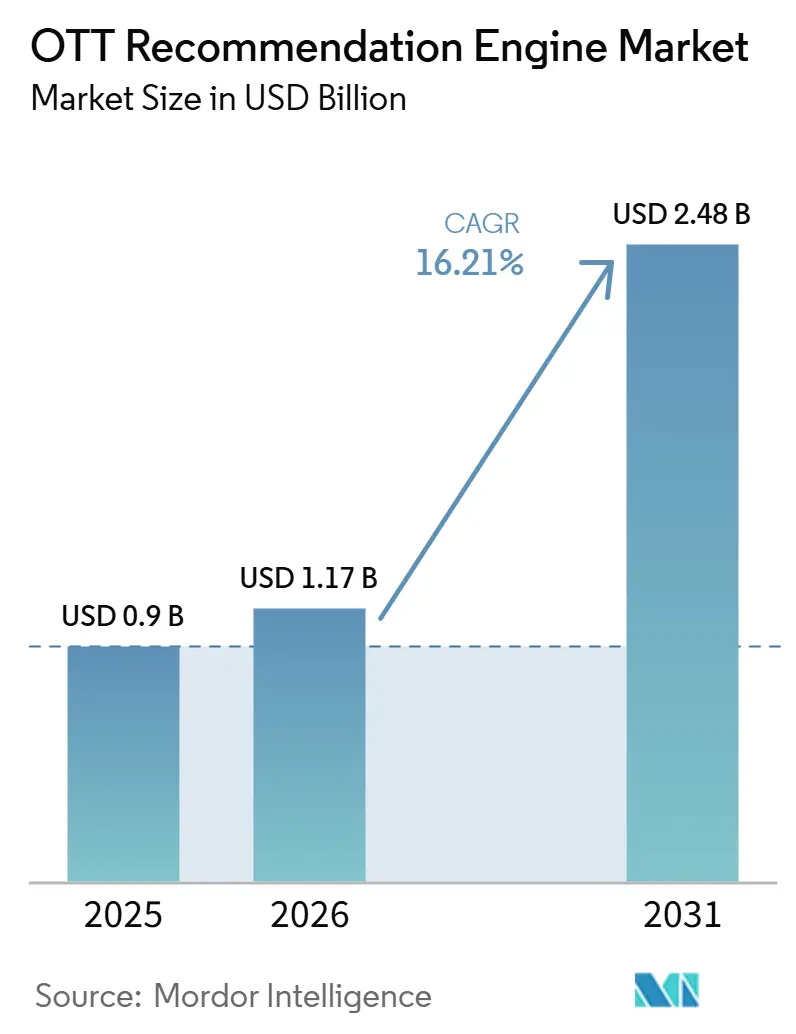
The OTT recommendation engine market size is projected to expand from USD 0.90 billion in 2025 and USD 1.17 billion in 2026 to USD 2.48 billion by 2031, registering a CAGR of 16.21% between 2026 to 2031. The OTT recommendation engine market is benefiting as broadcasters shift revenue and viewer engagement from linear programming to streaming services. Personalization now affects viewing time, retention, and advertising value, which has made recommendation infrastructure a core operating priority. Purpose-built systems are gaining ground with mid-tier broadcasters and connected-TV manufacturers because large retrieval and ranking systems are costly to develop and maintain internally. SVOD, AVOD, and FAST services require different recommendation settings because each model relies on a different balance of subscriber retention, advertising relevance, and content discovery. This creates opportunities in the OTT recommendation engine market for providers that combine ranking, metadata, interface design, and real-time delivery in a single service.
Key Report Takeaways
- By deployment mode, cloud-based systems held 65.70% of the OTT recommendation engine market share in 2025 and are projected to expand at a 16.71% CAGR through 2031.
- By end user, broadcasters and pay-TV operators held 40.45% of revenue in 2025, while connected-TV and device ecosystems are projected to record the highest CAGR of 16.94% through 2031.
- By business model, SVOD held 45.50% of revenue in 2025, while AVOD and FAST are projected to expand at a 17.01% CAGR through 2031in the OTT recommendation engine market.
- By application, content recommendation accounted for 55.60% of revenue in 2025, while advertising and promotional recommendation is projected to grow at a 16.55% CAGR through 2031.
- By geography, North America held 40.45% of global revenue in 2025, while Asia-Pacific is projected to grow at a 16.78% CAGR through 2031 in the OTT recommendation engine market.
Note: Market size and forecast figures in this report are generated using Mordor Intelligence’s proprietary estimation framework, updated with the latest available data and insights as of January 2026.
Global OTT Recommendation Engine Market Trends and Insights
Drivers Impact Analysis*
| Driver | (~) % Impact on CAGR Forecast | Geographic Relevance | Impact Timeline |
|---|---|---|---|
| Shift Toward Non-Intrusive Advertising Formats | +2.8% | Global, with the strongest concentration in North America and Europe | Short term (≤ 2 years) |
| Video-First Content Consumption Across Publisher and Social Environments | +2.3% | North America and Asia-Pacific, with spillover to Europe and the Middle East | Short term (≤ 2 years) |
| First-Party and Contextual Targeting Demand in a Cookieless Media Mix | +1.9% | North America and Europe, with expansion to Asia-Pacific | Medium term (2–4 years) |
| Creator Economy Scaling Into Always-On Brand Programs | +1.5% | North America and Asia-Pacific, with early adoption in Europe and South America | Medium term (2–4 years) |
| Retail Media and Commerce Content Convergence | +1.3% | North America, with growth in Asia-Pacific and Europe | Medium term (2–4 years) |
| AI-Led Creative Adaptation and Performance Measurement | +1.0% | Global, with fastest adoption in North America and Asia-Pacific | Long term (≥ 4 years) |
| Source: Mordor Intelligence | |||
Demand for Hyper-Personalized Viewer Experiences
Recommendation quality has become a central operating measure because it affects churn, viewing time, and advertising yield at the same time. Netflix research presented in 2026 found that its recommendation system affects both title choice and whether viewers watch at all, linking personalization to revenue per user rather than only interface quality.[1]Netflix Technology Blog, “Measuring the Impact of Personalized Recommendations,” Netflix Technology Blog, netflixtechblog.medium.com The OTT recommendation engine market is therefore moving toward systems that coordinate home-page layout, artwork selection, and editorial presentation together. Netflix reported that its GenPage system improved core engagement measures and reduced end-to-end serving latency by 20% compared with its earlier multi-stage recommender. JioHotstar reported that more than 60% of users selected voice when text and voice discovery were both offered, showing that discovery interfaces can shape the value delivered by the underlying model.
Rising Streaming Content Volumes
The OTT recommendation engine market is supported by catalog growth that makes manual discovery increasingly difficult. Amagi tracked more than 6,500 FAST channel deliveries on its THUNDERSTORM platform by mid-2026, increasing the need for accurate program metadata and search results.[2]Amagi, “Amagi Releases June 2026 AIRTIME Report: FAST Viewing Hours Grow 55% YoY as Metadata Friction Escalates,” Amagi, amagi.com A 2026 Hub Entertainment Research report found that incomplete genre, rating, or episode data can reduce a program's visibility in search and weaken contextual advertising matches. Metadata enrichment is becoming as important as ranking quality because poor metadata can leave useful catalog titles unseen. ThinkAnalytics introduced ThinkMetadataAI at IBC2025 to automate content tagging across dozens of languages and connect that information to its discovery tools. Providers that combine enriched metadata with ranking systems are better placed to serve platforms seeking stronger discovery across large and varied libraries.
First-Party Data Strategies in a Cookieless Advertising Environment
The loss of third-party cookies has increased the importance of authenticated first-party behavior in OTT advertising. Connected-TV services with login-based profiles can use viewer data for both content recommendations and audience targeting without third-party identifiers.[3]Broadpeak, “CTV Advertising in a Cookieless World: How Targeting Works,” Broadpeak, broadpeak.io The OTT recommendation engine market is consequently extending beyond content discovery into systems that also help build advertising audiences. In June 2026, Xumo integrated Gracenote and IRIS.TV signals across its FAST inventory and said that advertisements placed in relevant content settings produced 5.2 times higher brand purchase intent. These uses require separate handling of consent-based personalization and advertising inference, particularly in regulated markets. Vendors with modular data practices can give platforms more control over how behavioral signals are used across content and advertising workflows.
Real-Time and Edge-AI Inference for Contextual Recommendations
Fast response times are becoming important for services that personalize connected-TV and mobile screens as they load. The OTT recommendation engine market is seeing greater interest in edge delivery because it can support device-aware recommendations, regional content rows, and pre-cached personalized results. Smaller models deployed close to the user can reduce reliance on central servers while maintaining local relevance. Kuaishou reported that its OneRec generative recommendation system, deployed to more than 400 million daily users, raised single-machine queries per second by 31.8% and reduced computational graph latency by 55.45%. The result indicates that generative recommendation approaches can operate within large-scale response-time requirements. Live sports, events, and FAST channel guides may especially value systems that reduce the delay between opening a service and finding relevant programming.
Restraints Impact Analysis*
| Restraint | (~) % Impact on CAGR Forecast | Geographic Relevance | Impact Timeline |
|---|---|---|---|
| Data Privacy and Consent Management Requirements | -1.5% | The European Union and United Kingdom, with immediate compliance pressure, and growing relevance in Asia-Pacific | Medium term (2–4 years) |
| Cold-Start and Sparse-Interaction Limitations | -1.2% | Global, most acute in Asia-Pacific and Africa where new-user ratios remain high | Long term (≥ 4 years) |
| Algorithmic Bias, Filter Bubbles, and Explainability Gaps | -0.8% | The European Union, due to regulatory exposure, and North America, due to reputational exposure | Medium term (2–4 years) |
| Escalating Compute, Feature Store, and Model Serving Costs | -0.7% | Global, most acute for mid-tier and independent streaming platforms | Long term (≥ 4 years) |
| Source: Mordor Intelligence | |||
Data Privacy and Consent Management Requirements
Privacy and transparency obligations are making cross-border personalization programs more difficult to operate. The European Commission states that Article 50 transparency rules under the EU AI Act will apply from August 2, 2026, with disclosure and documentation obligations for relevant systems that interact with people. The Digital Services Act also affects services that use algorithmic curation by requiring meaningful options beyond profiling-based recommendations. The OTT recommendation engine market must therefore support clearer consent controls, documentation, and user-facing explanations. Separate training environments for data subject to European privacy rules can increase infrastructure costs and slow model updates. Larger providers with established consent and governance systems may find it easier to meet these requirements than smaller specialist vendors.
Cold-Start and Sparse-Interaction Limitations
New users and newly added titles remain difficult to personalize because there is little interaction history to guide a model. This issue is especially relevant for rapidly growing streaming services and FAST aggregators that add viewers and libraries quickly. Tubi described an asymmetric graph method that gives newly added content standalone representations based on intrinsic features before behavioral data becomes available. Netflix reported production testing that improved relevant cold-item discovery measures by up to 104% through LLM-based re-ranking. Research on sparse-regularized multimodal tokenization also points to ways of improving cold-start recommendations, but production use at mid-tier streaming scale remains difficult. Until interaction data builds, platforms can face weaker discovery and monetization for newly acquired titles.
*Our forecasts treat driver/restraint impacts as directional, not additive. The impact forecasts reflect baseline growth, mix effects, and variable interactions.
Segment Analysis
By Deployment Mode: Cloud Leads While Hybrid Use Expands
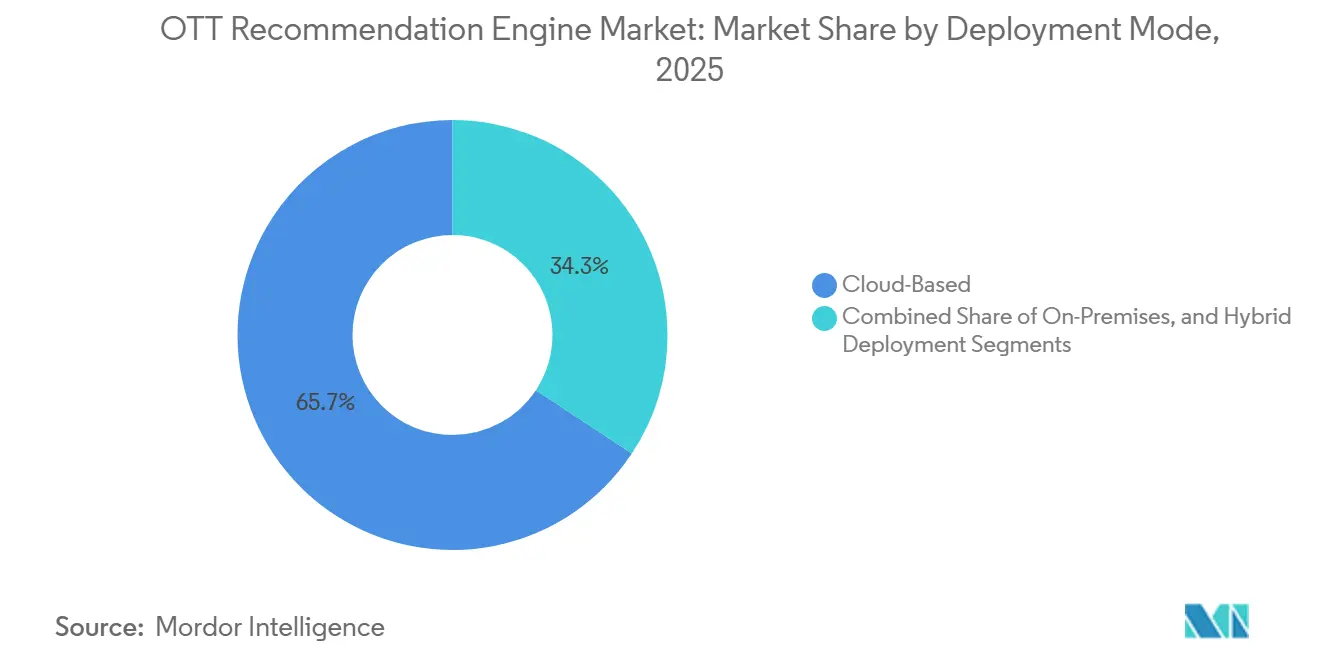
Cloud-based systems held 65.70% of the OTT recommendation engine market share in 2025 and are projected to grow at a 16.71% CAGR through 2031. Cloud delivery reduces the effort required to maintain feature stores, model retraining, and inference services for broadcaster-scale content libraries. It also allows teams to add capacity without building and operating the full underlying infrastructure. ByteDance's Volcengine offers a managed large-screen recommendation service for IPTV and OTT operators across home pages, channels, and content-detail pages. The service illustrates how the OTT recommendation engine market can offer packaged personalization to operators that do not maintain proprietary model teams.
On-premises systems remain relevant for state-owned broadcasters and operators subject to strict data-localization rules. These requirements are particularly important where cross-border transfer of viewer data is restricted. Hybrid arrangements are gaining attention among larger pay-TV operators that retain sensitive subscriber profiles within their own systems. Those operators can still use cloud capacity for less sensitive inference tasks and nonpersonal signals. This approach gives providers in the OTT recommendation engine market a way to preserve local control while providing flexible capacity without a fully isolated recommendation environment.



By End User: Broadcasters Lead as Device Ecosystems Gain Influence
Broadcasters and pay-TV operators held 40.45% of revenue in 2025 within the OTT recommendation engine market. Their large content catalogs require effective discovery tools to make premium programs easier to find. As traditional broadcasters adopt streaming-led distribution, recommendation systems are becoming a retention tool rather than an optional app feature. Digital media and publishing platforms also use recommendation systems to manage high content volumes across news, podcasts, and user-generated material. Their use cases add demand for re-engagement and timely content presentation.
Connected-TV and device ecosystems are projected to grow at a 16.94% CAGR through 2031. Smart-TV manufacturers are placing recommendation features in the operating-system layer, allowing discovery to begin before a viewer enters an individual streaming app. In February 2026, Samsung partnered with Gracenote on LLM-enabled conversational search and discovery for its global smart-TV platform. Such integrations move discovery upstream toward the device interface. Device manufacturers can then influence audience attention, household-level discovery, and the advertising inventory associated with the home screen, which increases the importance of interoperability across the OTT recommendation engine market.
By Business Model: SVOD Holds Revenue While AVOD and FAST Grow Faster
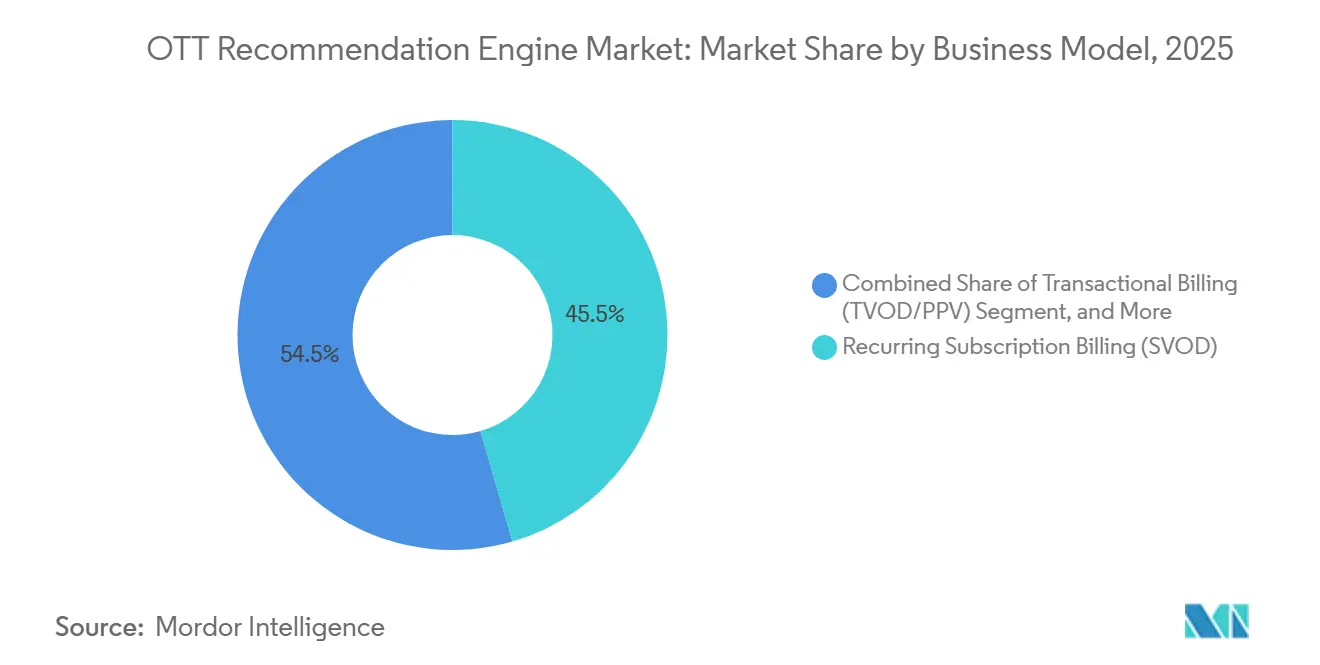
SVOD held 45.50% of 2025 revenue in the OTT recommendation engine market. Paying subscribers expect relevant discovery because poor content selection can contribute to cancellation decisions. This model gives providers an incentive to refine home-page recommendations, title prompts, and catalog navigation. It also supports continued demand for systems that can connect viewing behavior with retention programs. Subscription-oriented services generally need strong relevance across both popular and less visible titles.
AVOD and FAST are projected to grow at a 17.01% CAGR through 2031. Their economics depend on matching programming and advertising to the viewer's context during a session. Amagi reported in July 2026 that global FAST viewing hours grew 55% year over year, while advertising impressions rose 53%. Nielsen stated that FAST and AVOD attract different demographic groups, supporting the case for audience-aware recommendation and advertising tools. Transactional billing and hybrid models require systems that can present subscriptions, purchases, and ad-supported choices in the same session, making implementation needs more varied across the OTT recommendation engine market.
By Application: Content Discovery Remains Central as Advertising Use Grows
Content recommendation accounted for 55.60% of revenue in 2025. It supports the viewer journey from initial home-screen selection to next-title prompts after a program ends. This use case remains the foundation of the OTT recommendation engine market because every service needs to make a large catalog manageable. Ranking, content metadata, and interface placement must work together for content discovery to perform well. Strong discovery can help platforms bring more visibility to titles outside the most popular catalog groups.
Advertising and promotional recommendation is projected to grow at a 16.55% CAGR through 2031. AVOD expansion has made advertising relevance a distinct deployment need rather than a secondary result of content personalization. Platforms are developing audience modeling, contextual ad placement, and bidding-system compatibility alongside content recommendations. JioHotstar's AI-led commerce work links content discovery with shopping decisions and subscription conversion, creating additional signals that can support advertising and commercial activity. Research on LLM-powered agentic systems for connected-TV discovery describes parallel handling of content retrieval, viewer preferences, and context within 1 query, expanding the functional scope of the OTT recommendation engine market.
Geography Analysis
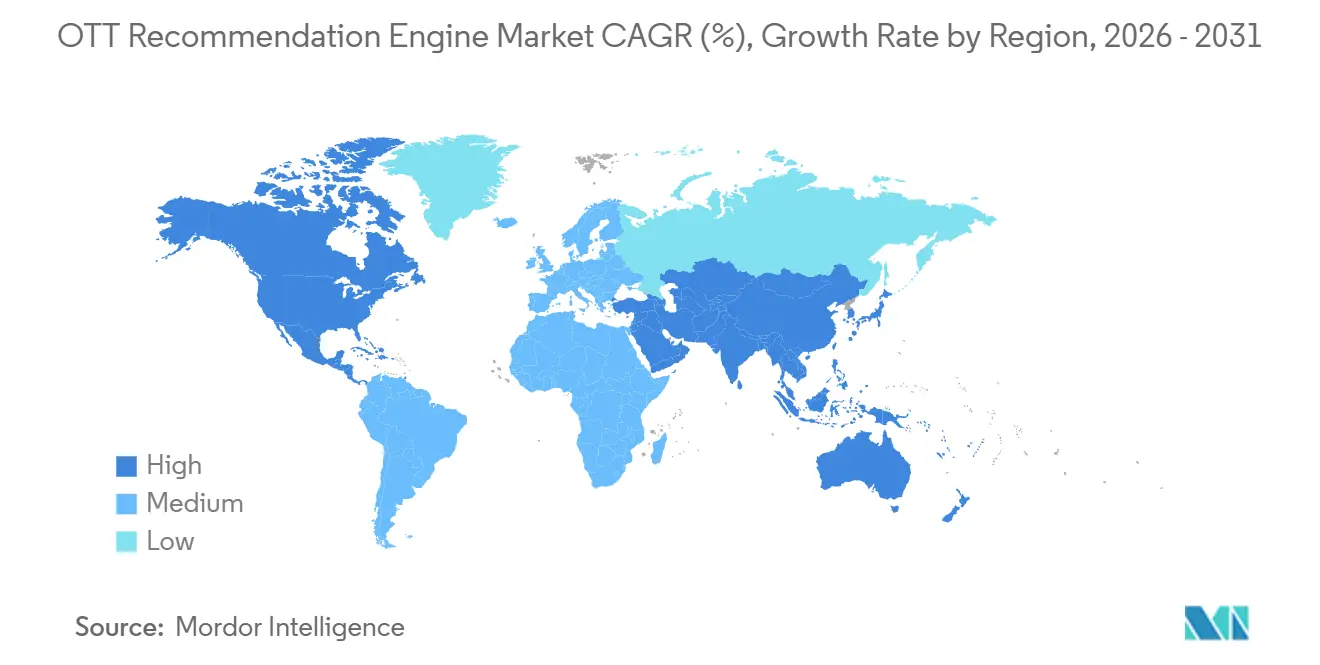
North America held 40.45% of global revenue in 2025, giving the region the largest global revenue position. The region has a dense base of subscription and ad-supported streaming platforms, established programmatic advertising tools, and significant connected-TV usage. Amazon's July 2026 AI-focused redesign work on Prime Video showed that recommendation investment has moved beyond product teams to senior leadership priorities. Amagi reported that the United States and Canada generated 54% of global FAST viewing hours and 74% of global FAST advertising impressions in mid-2026. Roku found that 64% of Roku households stream FAST content, supporting the importance of operating-system-level discovery. In South America, SKY+ and DGO deployed Mediagenix and Spideo's recommendation engine across a 10,000-title catalog in April 2025, covering 170 and 260 live channels, respectively.
Asia-Pacific is projected to record the highest regional CAGR of 16.78% through 2031. India, China, South Korea, Japan, and Southeast Asian markets combine mobile-first usage with expanding vernacular-language catalogs. JioHotstar serves more than 200 million users and reported that over 60% of users chose voice-based discovery when voice and text options were available. DMM TV has developed measurement methods that distinguish views driven by recommendation rows from views arriving through other platform paths. China applies the YD/T 4886-2024 standard for AI-based mobile video recommendation services, which took effect in October 2024 and defines technical and functional requirements for relevant services.
Europe faces higher deployment requirements because the EU AI Act, GDPR, and Digital Services Act increase the need for consent controls and explainable recommendation practices. Those requirements can raise engineering costs, but they also increase demand for providers with transparent personalization tools. In the Middle East, Sharjah Broadcasting Authority deployed Mediagenix and Spideo technology for the Maraya platform in May 2025, reporting engagement gains of 20% to 60% and a 35% improvement in conversion. Africa remains earlier in streaming adoption, though Mangomolo expanded its AI personalization and localization capabilities through 2025 and 2026 for clients that include the South African Broadcasting Corporation. The OTT recommendation engine market in these regions is shaped by the need to support local languages, regional content rights, and differing regulatory expectations.

Competitive Landscape
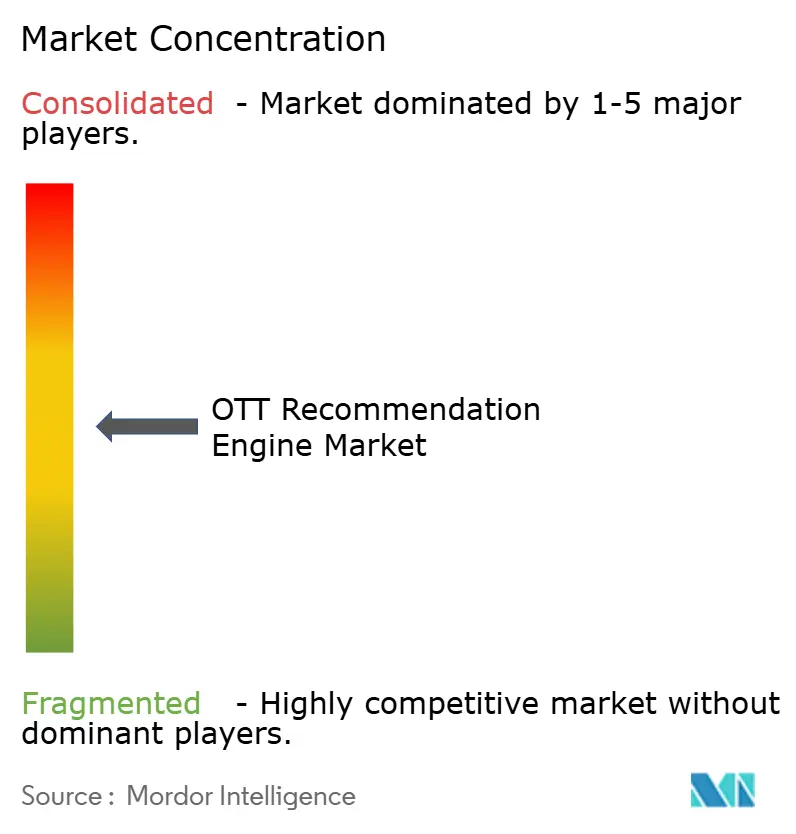
The OTT recommendation engine market has a moderately fragmented structure that includes cloud providers, specialist media vendors, and platform integrators. Amazon Web Services, Google, and Microsoft can bundle recommendation services with their storage, computing, and advertising products. Their existing infrastructure relationships can increase switching costs for streaming platforms that use several services from the same provider. Specialist providers including ThinkAnalytics, Gracenote, ContentWise, and 24i Media Group compete through media-specific metadata, editorial controls, and operator-focused delivery models. These providers can differentiate where platforms need tailored catalog handling or closer support for media workflows.
Gracenote renewed a multiyear strategic partnership with Google in February 2026 and later announced a separate agreement with Samsung for LLM-enabled conversational search and discovery. The 2 agreements show how metadata providers are seeking a role in both cloud-based and device-level discovery. The OTT recommendation engine market also has an opportunity among regional broadcasters that need production-grade tools without relying fully on a hyperscale provider. These operators may need multilingual metadata, consent management, content scheduling, and recommendation features from a single supplier. Mediagenix completed the integration of Spideo into its portfolio in September 2025, combining scheduling, metadata intelligence, and AI recommendation capabilities.
Emerging vendors are working on agentic systems that divide discovery across specialized AI components and multimodal tools that read scene-level video signals. These approaches aim to reduce reliance on manually created metadata and improve the handling of complex content libraries. ThinkAnalytics has also added automated metadata tagging tools that support many languages and live-TV content. Mediagenix reported engagement improvement of 20% to 60% for Maraya, which demonstrates the type of measurable operating outcome sought in platform procurement. The competitive position of vendors will depend on measurable engagement results, data practices that meet regulatory requirements, and the ability to serve varied deployment models. No combined market-share data for leading firms was provided, so a concentration assessment cannot be calculated from the available information.
OTT Recommendation Engine Industry Leaders
Amazon Web Services, Inc.
Google LLC
Microsoft Corporation
Netflix, Inc.
Adobe Inc.
- *Disclaimer: Major Players sorted in no particular order

Recent Industry Developments
- July 2026: Amazon's executive chairman Jeff Bezos directly intervened to reshape Prime Video's recommendation architecture through the internal "Lighthouse" project, mandating an AI-first home screen redesign that centers machine-generated recommendations and voice-based refinement over traditional grid navigation. Amazon has committed USD 200 billion in capital expenditures in 2026 primarily for AI infrastructure, indicating the scale of investment behind this personalization overhaul.
- July 2026: Researchers from multiple institutions published an LLM-powered agentic recommendation architecture specifically for connected-TV content discovery, demonstrating multi-agent orchestration patterns where specialized agents handle retrieval, preference modeling, and context injection in parallel, a directional shift from single-model recommendation toward agent-coordinated discovery pipelines.
- June 2026: Xumo, the streaming joint venture of Comcast and Charter, expanded integrations with Gracenote and IRIS.TV to bring contextual targeting signals from on-demand libraries to FAST inventory, citing research showing that relevant contextual ads drive 5.2 times higher brand purchase intent.
- June 2026: APOS 2026 featured JioHotstar's conversational discovery system, jointly developed with OpenAI, recording over 60% voice-preference adoption among users offered both text and voice-based content discovery. The platform serves over 200 million users and integrates commerce into the recommendation loop, combining content personalization with consumer-intent data for advertising and shopping use cases.


Global OTT Recommendation Engine Market Report Scope
The Global OTT Recommendation Engine Market refers to the ecosystem of software platforms, algorithms, and AI-driven solutions designed to analyze user behavior, viewing history, preferences, demographic attributes, contextual data, and content metadata to deliver personalized content recommendations across over-the-top (OTT) streaming services.
The OTT Recommendation Engine Market is Segmented by Deployment Mode (Cloud-Based, On-Premises, and Hybrid Deployment), End User (Broadcasters and Pay-TV Operators, Digital Media and Publishing Platforms, and Connected-TV and Device Ecosystems), Business Model (Recurring Subscription Billing (SVOD), Transactional Billing (TVOD/PPV), Advertising-Supported Billing (AVOD/FAST), and Hybrid Monetization Billing), Application (Content Recommendation, Advertising and Promotional Recommendation, Commerce and Subscription Recommendation, and Other Applications), and Geography (North America, South America, Europe, Asia-Pacific, Middle East, and Africa). The Market Forecasts are Provided in Terms of Value (USD).
| Cloud-Based |
| On-Premises |
| Hybrid Deployment |
| Broadcasters and Pay-TV Operators |
| Digital Media and Publishing Platforms |
| Connected-TV and Device Ecosystems |
| Recurring Subscription Billing (SVOD) |
| Transactional Billing (TVOD/PPV) |
| Advertising-Supported Billing (AVOD/FAST) |
| Hybrid Monetization Billing |
| Content Recommendation |
| Advertising and Promotional Recommendation |
| Commerce and Subscription Recommendation |
| Other Applications |
| North America | United States |
| Canada | |
| Mexico | |
| South America | Brazil |
| Argentina | |
| Rest of South America | |
| Europe | United Kingdom |
| Germany | |
| France | |
| Italy | |
| Spain | |
| Russia | |
| Rest of Europe | |
| Asia-Pacific | China |
| India | |
| Japan | |
| South Korea | |
| Singapore | |
| Australia | |
| Rest of Asia-Pacific | |
| Middle East | United Arab Emirates |
| Saudi Arabia | |
| Turkey | |
| Rest of Middle East | |
| Africa | South Africa |
| Nigeria | |
| Egypt | |
| Rest of Africa |
| By Deployment Mode | Cloud-Based | |
| On-Premises | ||
| Hybrid Deployment | ||
| By End User | Broadcasters and Pay-TV Operators | |
| Digital Media and Publishing Platforms | ||
| Connected-TV and Device Ecosystems | ||
| By Business Model | Recurring Subscription Billing (SVOD) | |
| Transactional Billing (TVOD/PPV) | ||
| Advertising-Supported Billing (AVOD/FAST) | ||
| Hybrid Monetization Billing | ||
| By Application | Content Recommendation | |
| Advertising and Promotional Recommendation | ||
| Commerce and Subscription Recommendation | ||
| Other Applications | ||
| By Geography | North America | United States |
| Canada | ||
| Mexico | ||
| South America | Brazil | |
| Argentina | ||
| Rest of South America | ||
| Europe | United Kingdom | |
| Germany | ||
| France | ||
| Italy | ||
| Spain | ||
| Russia | ||
| Rest of Europe | ||
| Asia-Pacific | China | |
| India | ||
| Japan | ||
| South Korea | ||
| Singapore | ||
| Australia | ||
| Rest of Asia-Pacific | ||
| Middle East | United Arab Emirates | |
| Saudi Arabia | ||
| Turkey | ||
| Rest of Middle East | ||
| Africa | South Africa | |
| Nigeria | ||
| Egypt | ||
| Rest of Africa | ||


Key Questions Answered in the Report
What is the size of the OTT recommendation engine market?
The OTT recommendation engine market is projected to reach USD 1.17 billion in 2026 and USD 2.48 billion by 2031, growing at a CAGR of 16.21% during the forecast period.
What is driving demand for OTT recommendation engines?
Key demand drivers include expanding streaming content catalogs, increasing focus on viewer retention, growing use of first-party advertising data, and the need for faster content discovery across connected-TV platforms.
Which deployment approach leads OTT recommendation engines?
Cloud-based deployment led the market with 65.70% revenue share in 2025 and is projected to grow at a 16.71% CAGR through 2031.
Which end users are expanding fastest?
Connected-TV and device ecosystems are projected to be the fastest-growing end-user segment, registering a 16.94% CAGR through 2031, driven by device manufacturers embedding discovery capabilities into operating-system layers.
Why are AVOD and FAST services important for recommendation providers?
AVOD (Advertising-Based Video on Demand) and FAST (Free Ad-Supported Streaming TV) services are projected to grow at a 17.01% CAGR through 2031, increasing the importance of linking content recommendations with advertising relevance and contextual targeting.
Which region is projected to grow fastest?
Asia-Pacific is expected to record the highest regional CAGR of 16.78% through 2031, supported by mobile-first viewing behaviors, growing broadband penetration, and expanding local-language content libraries.
Page last updated on:





