
OTT Middleware Market Size and Share
Market Overview
| Study Period | 2020 - 2031 |
|---|---|
| Market Size (2026) | USD 1.20 Billion |
| Market Size (2031) | USD 1.82 Billion |
| Growth Rate (2026 - 2031) | 8.70 % |
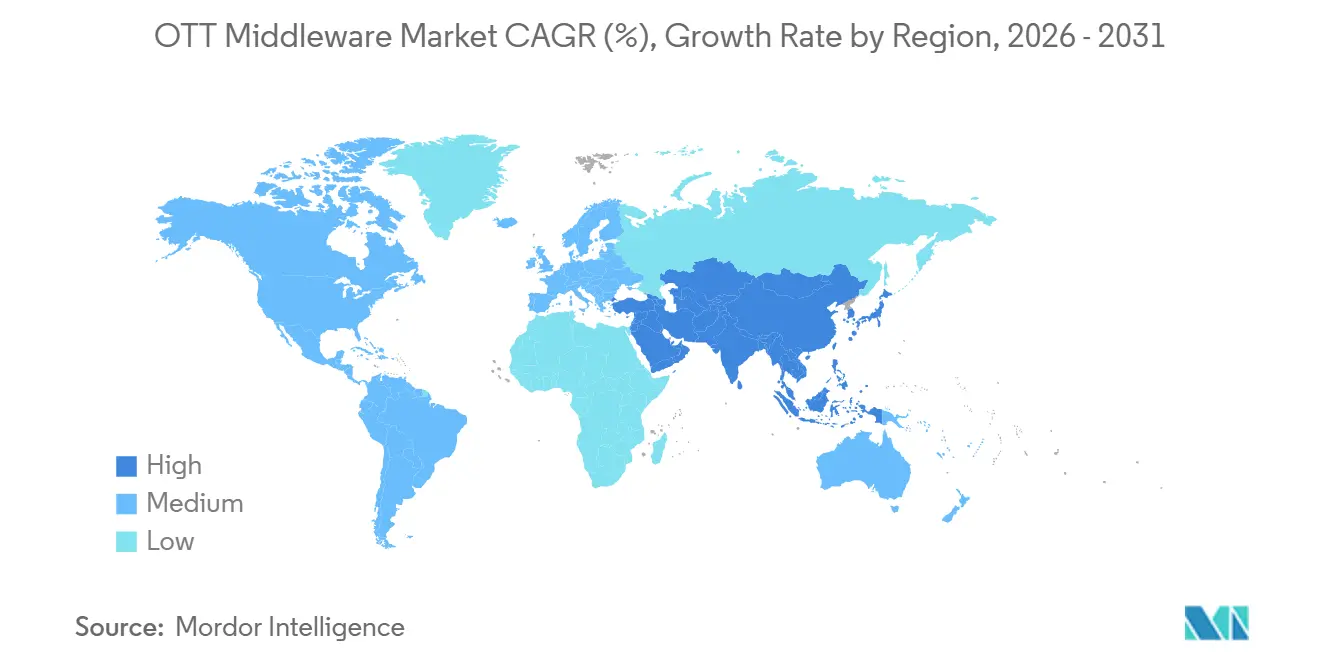
| Fastest Growing Market | Asia-Pacific |
| Largest Market | North America |
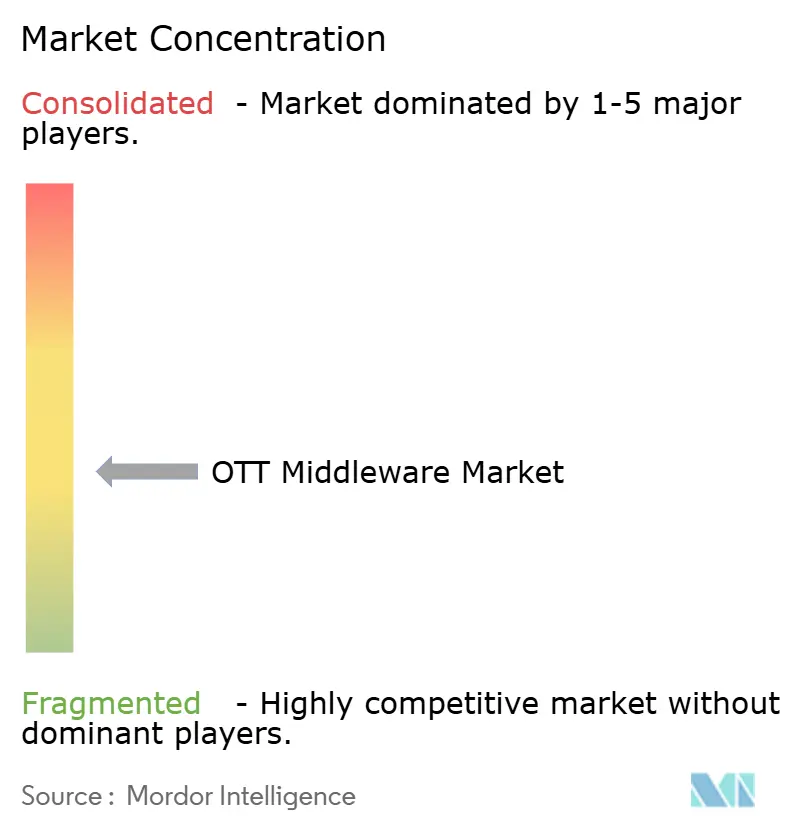
| Market Concentration | Medium |
Major Players *Disclaimer: Major Players sorted in no particular order Image © Mordor Intelligence. Reuse requires attribution under CC BY 4.0. | |
OTT Middleware Market Analysis by Mordor Intelligence
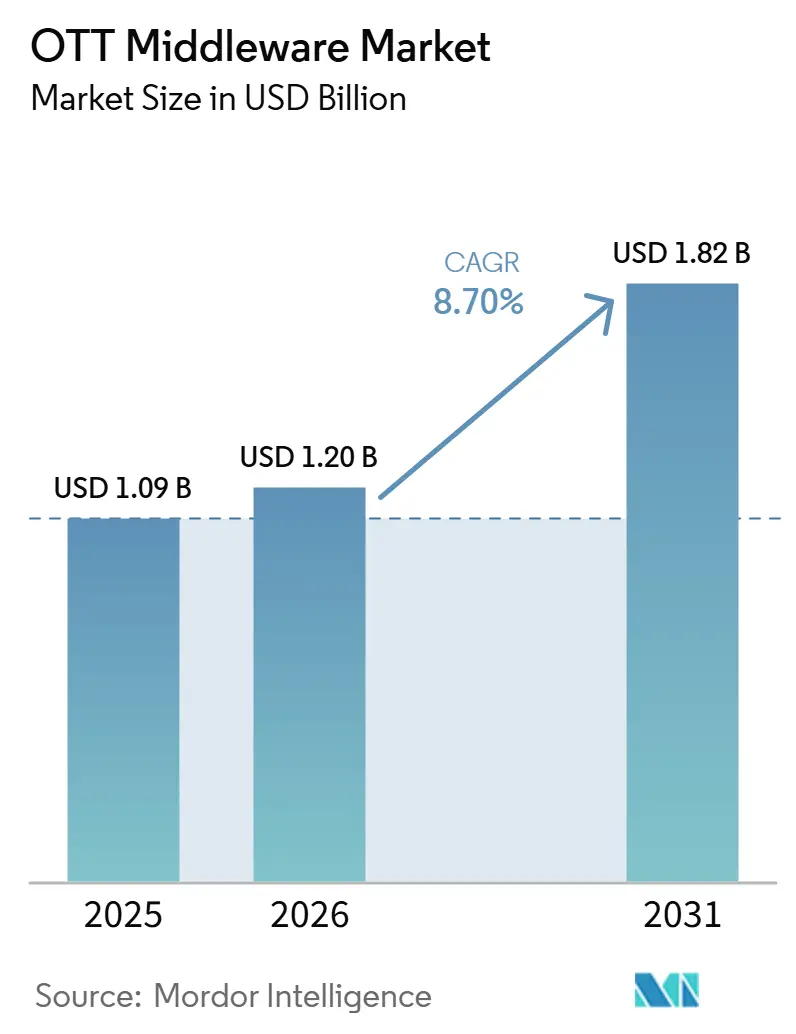
The OTT middleware market size is expected to grow from USD 1.09 billion in 2025 to USD 1.20 billion in 2026 and is forecast to reach USD 1.82 billion by 2031 at 8.70% CAGR over 2026-2031. The OTT middleware market is expanding as broadcasters, telecom operators, and direct-to-consumer services invest in platforms that connect content ingest, digital rights management, advertising systems, and subscriber entitlements. Demand depends on service complexity and audience growth, because every added viewing format, device, and payment option creates additional operating requirements. Hybrid services need a common layer that can coordinate subscriptions, advertising, and content rights without disrupting the viewer experience. The OTT middleware market also benefits from super-aggregation, in which operators bring linear television, video on demand, subscription services, and free ad-supported channels into a single interface. Legacy system migration and content piracy continue to raise costs and delay modernization for many operators.
Key Report Takeaways
- By streaming service type, on-demand video streaming led the OTT middleware market with a 41.39% revenue share in 2025, and is expected to have the fastest CAGR of 9.23% over the forecast period.
- By end user, pure-play OTT and direct-to-consumer providers accounted for 32.87% of revenue in 2025, while telecom operators and internet service providers are projected to expand at a 9.45% CAGR through 2031.
- By geography, North America accounted for 38.42% of the over-the-top (OTT) middleware market revenue in 2025, while Asia-Pacific is projected to expand at a 9.38% CAGR through 2031.
Note: Market size and forecast figures in this report are generated using Mordor Intelligence’s proprietary estimation framework, updated with the latest available data and insights as of January 2026.
Market Trends and Insights
Drivers Impact Analysis of OTT Middleware Market*
| Driver | (~) % Impact on CAGR Forecast | Geographic Relevance | Impact Timeline |
|---|---|---|---|
| Shift From Linear Television to Direct-to-Consumer Streaming | +2.0% | Global, led by North America and Europe | Short term (≤ 2 years) |
| Cloud-Native Scaling for Peak Concurrent Viewing | +1.5% | Global, concentrated in North America and Asia-Pacific | Medium term (2-4 years) |
| Expansion of Hybrid Subscription and Advertising Monetization | +1.2% | Global, with early gains in North America, Western Europe, and India | Medium term (2-4 years) |
| Multi-Device Streaming and 5G-Enabled Viewing | +0.8% | Asia-Pacific and Europe, spill-over to Middle East and Africa | Medium term (2-4 years) |
| Rights-Aware Dynamic Ad Insertion and Blackout Automation | +0.6% | North America and Europe, expanding to Asia-Pacific | Long term (≥ 4 years) |
| Super-Aggregation and Multi-Provider Content Orchestration | +0.5% | North America and Europe, spill-over to Asia-Pacific core | Long term (≥ 4 years) |
| Source: Mordor Intelligence | |||
Shift From Linear Television to Direct-to-Consumer Streaming
The move away from linear television is increasing demand for OTT middleware. Broadcasters, studios, and sports organizations are building direct-to-consumer services that need subscriber controls, content security, and delivery coordination. Netflix reported that its advertising plan represented more than 70% of its new member signups in the first quarter of 2026.[1]Netflix, “Q1 2026 Letter to Shareholders,” Netflix Investor Relations, ir.netflix.net This change shows why platforms are operating subscription and advertising workflows together instead of maintaining separate systems. The OTT middleware market supports those workflows by handling searches, playback requests, entitlement checks, and advertising calls as they occur. Sports organizations and studios also need rights management, conditional access, and advertising tools as their content becomes available outside traditional broadcast windows.
Cloud-Native Scaling for Peak Concurrent Viewing
Peak viewing periods are making scalable architecture a central requirement in the OTT middleware market. Large live events can cause sudden traffic spikes that affect authentication, entitlement, and playback simultaneously. Kaltura stated that its cloud-native microservices design allowed services to scale independently during record-scale streaming for the 2026 FIFA World Cup. Containerized services, orchestration tools, and multi-CDN delivery allow capacity to rise without planned downtime. Telefónica selected Ateme in November 2025 for a cloud-native media processing platform that supports dynamic resource scaling, 4K delivery, and AI-enhanced metadata workflows. A platform that cannot support a major event can lose both viewer confidence and advertising revenue during the period when the audience is largest.
Expansion of Hybrid Subscription and Advertising Monetization
The OTT middleware market is gaining from services that combine subscription video on demand, advertising video on demand, and free ad-supported streaming television. Each revenue option needs separate rules for access, billing, consent, advertising delivery, and content rights. Global free ad-supported streaming television viewing hours rose 55% year over year through the second quarter of 2026. The same reporting identified incomplete or inaccurate electronic program guide data as a barrier to advertising revenue growth. That issue underscores the importance of middleware that can maintain accurate metadata, schedule ad breaks, and share entitlement information across systems. Platforms that cannot connect advertising engines with subscription systems can create inconsistent access and leave revenue unrealized.
Multi-Device Streaming and 5G-Enabled Viewing
The spread of connected televisions, smartphones, and tablets is widening the technical role of the over-the-top (OTT) middleware market. Services need to maintain playback quality across devices with different operating systems, screen sizes, and network conditions. ETSI published Release 18 specifications for 5G Media Streaming in 2025, establishing a standard architecture for quality-aware streaming between content providers and mobile network operators. Nokia and Elisa demonstrated bandwidth prediction APIs that adjusted video bitrate during a live ice hockey event in Finland. Mobile-led viewing in Asia-Pacific requires efficient adaptive bitrate delivery for data-constrained networks. Vendors serving both Asia-Pacific and North America, therefore, need delivery capabilities suited to mobile viewing and connected television viewing.
Restraints Impact Analysis of OTT Middleware Market*
| Restraint | (~) % Impact on CAGR Forecast | Geographic Relevance | Impact Timeline |
|---|---|---|---|
| Interoperability Complexity | -1.2% | Global, concentrated in Europe and established Asia-Pacific markets | Short term (≤ 2 years) |
| Content Piracy, Data Privacy, and Cross-Border Regulatory Exposure | -0.9% | Global, with hotspots in South America, Southeast Asia, and Middle East | Medium term (2-4 years) |
| Peak-Event Ad Decisioning Failures and Monetization Leakage | -0.5% | North America and Europe | Short term (≤ 2 years) |
| Connected-TV Operating-System Certification and Application Fragmentation | -0.4% | Global, concentrated in North America and Europe | Medium term (2-4 years) |
| Source: Mordor Intelligence | |||
Legacy-System Integration and Interoperability Complexity
Legacy integration remains a major constraint for the OTT middleware market. Operators often need to connect cloud-native services with existing IPTV and broadcast systems that cannot be retired quickly. Older stacks can create incompatible APIs, proprietary conditional-access dependencies, and lengthy data migration programs. These operators must maintain existing platforms while also building new capabilities, which divides engineering resources. The lack of universal standards for moving subscriber entitlement data between middleware systems further complicates the transition. Ongoing work on format conversion, digital rights management updates, and conditional access interoperability can delay the return from modernization programs.
Content Piracy, Data Privacy, and Cross-Border Regulatory Exposure
Content piracy and data privacy obligations increase the operational burden for the OTT middleware market. The Motion Picture Association reported 218.8 billion visits to movie and television piracy websites in 2024.[2]Motion Picture Association, “Global Content Piracy Data 2024,” Motion Picture Association, motionpictures.org Rights holders need digital rights management, watermarking, automated rights checks, and geographic controls to protect premium content. GDPR requirements in Europe and India’s Digital Personal Data Protection Act 2023 add consent, data localization, and cross-border transfer requirements to subscriber workflows. Italy’s Piracy Shield requires the blocking of infringing streams within 30 minutes of a rights holder's request. This operating environment makes real-time enforcement capabilities even more important for providers serving multiple jurisdictions.
*Our forecasts treat driver/restraint impacts as directional, not additive. The impact forecasts reflect baseline growth, mix effects, and variable interactions.
OTT Middleware Market Segment Analysis
By Streaming Service Type:
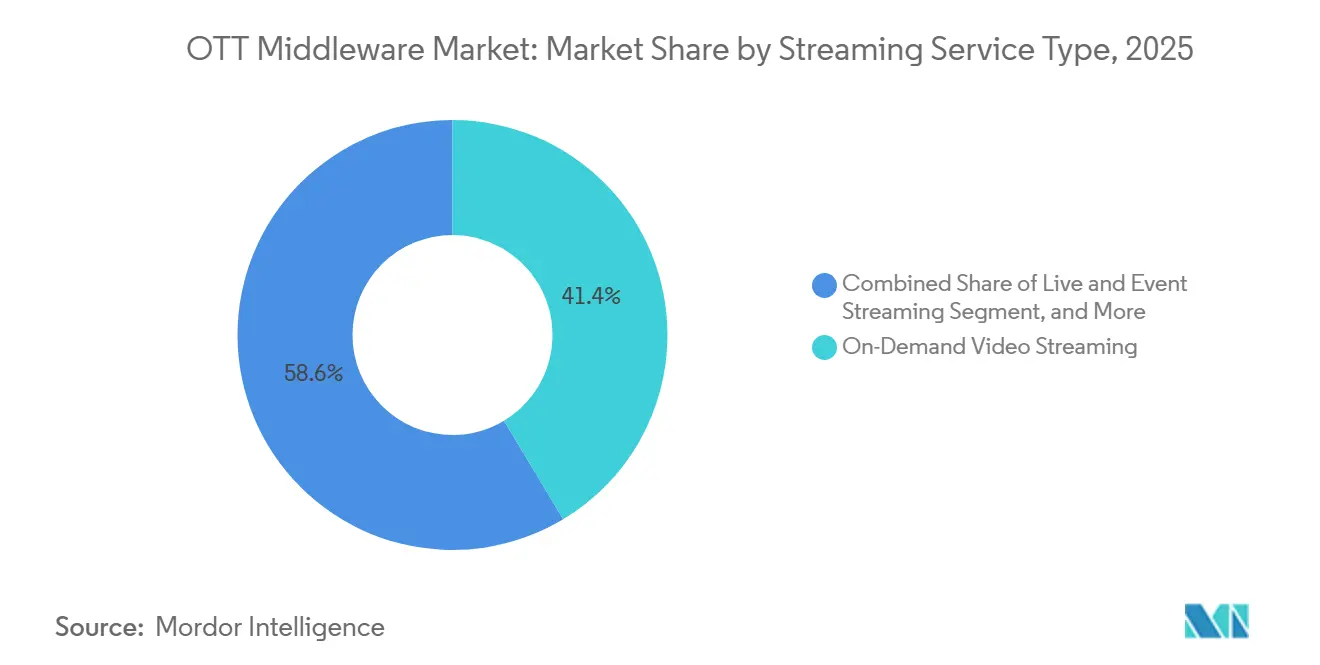
On-Demand Video Leads, While FAST Raises Operating DemandsOn-demand video streaming accounted for 41.39% of the OTT middleware market size in 2025, and the segment is expected to register the fastest growth a CAGR of 9.23% over the forecast period. This is supported by personalization, multi-DRM licensing, and server-side ad insertion. The format needs reliable content discovery, playback, and entitlement checks for services that offer both paid and advertising-supported plans. Free ad-supported streaming television viewing hours rose 55% year over year through the second quarter of 2026. This format adds electronic program guide management, advertising schedules, rights controls, and channel playout to the platform workload in the OTT middleware market. Brightcove introduced AI Contextual Ads in 2026 to provide scene-level signals for contextual advertising in server-side ad insertion processes.
The IAB Tech Lab certified FreeWheel for Open Measurement SDK support on LG and Samsung devices in February 2025. Live and event streaming require substantial middleware capacity because large audiences can arrive simultaneously, and access rights vary by territory. Linear OTT and free ad-supported streaming services create extensive API activity for program guide updates, advertising schedules, rights monitoring, and playout coordination. Hybrid services combine live events, on-demand libraries, and free ad-supported channels, creating the most complex platform configuration. This combination requires the OTT middleware market to coordinate on formats and revenue models across a single platform, strengthening demand for purpose-built hybrid systems.



By End User:
Telecom Operators Become the Fastest-Growing BuyersTelecom operators and internet service providers are projected to record a 9.45% CAGR from 2026 to 2031. These operators are moving from single-service IPTV offerings toward multi-service aggregation, using billing relationships and household devices as a foundation for unified discovery. NAGRAVISION launched OpenTV ENTera on AWS Marketplace in September 2025 with personalization, third-party bundling, and targeted advertising capabilities. NAGRAVISION later expanded ONE Hungary’s platform to provide access to more than 100 subscription services through Bango’s Digital Vending Machine. Setplex’s Zapflex platform, introduced in 2026, added unified search across internal and third-party catalogs.
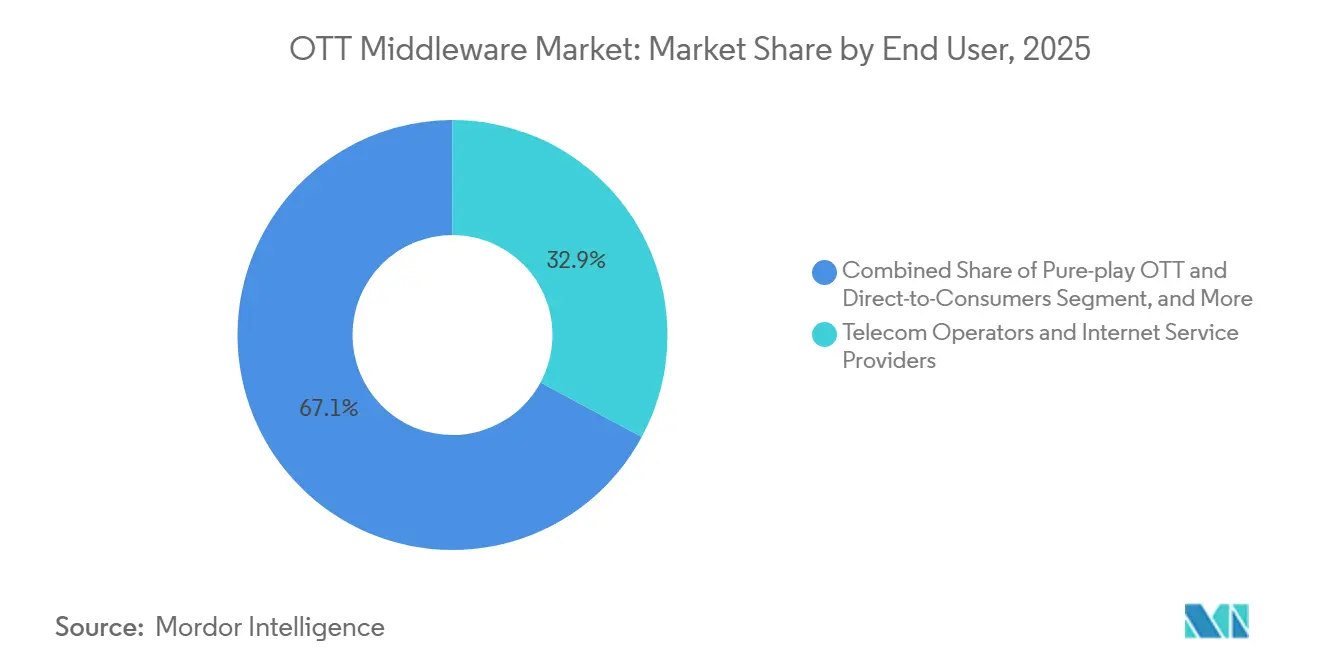
Pure-play OTT and direct-to-consumer providers accounted for 32.87% of revenue in 2025. They depend on middleware for subscriber management, content security, recommendations, and consistent delivery across devices. Broadcasters and pay-TV operators remain buyers as they add digital distribution and automate rights controls. Content owners, studios, and digital media companies are becoming direct buyers when they retain streaming rights and manage their own delivery. Sports leagues, rights holders, enterprises, and institutional organizations need specialized systems for live events, communications, training, and owned streaming services.
Geography Analysis
North America OTT Middleware Market
North America held 38.42% of the OTT middleware market share in 2025. The region has a high concentration of direct-to-consumer services, fragmented sports rights, and enterprise streaming operations. The United States and Canada represented 54% of global free ad-supported streaming television viewing hours and 74% of global advertising impressions in the second quarter of 2026. These services require program guide tools, ad scheduling, and rights enforcement. North American telecom operators are investing in interfaces that present live television, subscription video, and free ad-supported content together in the over-the-top (OTT) middleware market.
APAC OTT Middleware Market
Asia-Pacific is projected to expand at a 9.38% CAGR through 2031. India drives demand because platforms must manage sports rights restrictions, multilingual metadata, and delivery across mobile, connected television, and web devices. JioHotstar exceeded USD 1 billion in revenue in 2025.[3]Asia Video Industry Association, “Asia-Pacific Video and Broadband 2026, Streaming, Social Video, and CTV Drive Asia-Pacific Video Revenue Growth,” Asia Video Industry Association, avia.org Southeast Asia recorded a 19% year-over-year increase in paid streaming accounts in 2025, bringing the total to more than 61 million across Indonesia, Thailand, the Philippines, Malaysia, and Singapore. Japan and South Korea favor personalization of recommendations and advertising, while Australia focuses on multi-DRM compliance upgrades for connected television services.
MEA and South America OTT Middleware Market
South America reported the strongest regional free ad-supported streaming television viewing growth in the first half of 2026, with viewing hours up 190% and advertising impressions up 124%. Mileto Tecnologia selected Synamedia Go in March 2026 for a streaming service with AI-driven recommendations and multi-brand ISP capabilities. The Middle East needs Arabic localization, regional DRM compliance, and broadcast scheduling functions. Africa remains at an earlier stage, although Kenya’s 2026 copyright proposal indicates growing expectations for rights enforcement. These needs extend the opportunity for security-capable middleware vendors into emerging streaming regions.

Competitive Landscape
The OTT middleware market is moderately fragmented. Synamedia and NAGRAVISION have a broad subscriber reach, while Brightcove and Kaltura compete through analytics and monetization tools. Setplex, Accedo, Leyra, and Evergent target operators that want cloud-native platforms and modular services. This structure gives buyers in the OTT middleware market a choice between larger end-to-end providers and specialized vendors. Lumine Group acquired Synamedia’s Video Network business, including the Quortex multiview platform, in June 2026.[4]Lumine Group, “Lumine Group to Acquire Synamedia Video Network Business,” SaaS Rise, saasrise.com
The acquisition transferred a live sports multiview capability to a portfolio company that can cross-sell to broadcasters and streaming providers. 18 major platform enhancements followed Brightcove’s acquisition by Bending Spoons in the second half of 2025. Accedo and Magine Pro agreed in December 2025 to combine their SaaS businesses into Leyra. The combined operation brings together an OTT platform and marketplace with subscriber lifecycle capabilities. Evergent introduced its Agentic Revenue Orchestration Platform in April 2026 for retention, product configuration, and customer support.
Real-time rights-aware advertising for live sports remains an important area for vendor development. Platforms must make fast blackout decisions across different territories and active viewer sessions. Evergent stated that its platform draws on behavioral data from more than 1 billion users across 180 countries and supports more than USD 8 billion in annual subscription transactions. Patent activity around 5G content steering points toward closer links between video platforms and mobile networks, supporting vendors that combine network awareness, rights controls, and subscriber operations.
OTT Middleware Industry Leaders
Synamedia Limited
NAGRAVISION SA
Brightcove Inc.
Kaltura Inc.
Accedo Group AB
- *Disclaimer: Major Players sorted in no particular order
OTT Middleware Market Companies Covered in this Report
- Brightcove Inc.
- Kaltura Inc.
- Synamedia Limited
- NAGRAVISION SA
- Accedo Group AB
- Minerva Networks, Inc.
- Amino Technologies plc
- Netgem S.A.
- Setplex LLC
- Muvi Technology Pvt. Ltd.
- JW Player
- Wowza Media Systems, LLC
- Dacast, Inc.
- Evergent Technologies, Inc.
- Zype, Inc.
- Uscreen, Inc.
- Vimeo, Inc.
- Harmonic Inc.
- Quortex SAS
- Bitmovin GmbH

Recent Industry Developments in OTT Middleware Market
- July 2026: Kaltura delivered record-scale live streaming for the 2026 FIFA World Cup following a multi-year migration to a cloud-native microservices architecture. The company also previewed agentic avatar experiences for live sports, with AI agents monitoring 6 production environments in real time and completing operational tasks in minutes that previously required hours of manual analysis, a material advance in live event middleware automation.
- June 2026: Lumine Group announced the acquisition of Synamedia's Video Network business, including the Quortex multiview platform, for an undisclosed consideration. The transaction restructures the competitive landscape by transferring a key live-sports multiview middleware capability to Lumine's portfolio, which is positioning the combined entity for cross-selling to large broadcasters and OTT platforms through Quortex's existing SaaS billing and API framework.
- May 2026: Brightcove launched Prism, a redesigned platform interface developed with input from over 100 customers. The update, the company's most significant user experience overhaul in several years, incorporated Live 4K streaming, SSAI with DRM, vertical video support, and animated thumbnails, building on 18 major platform enhancements delivered in H2 2025 following Brightcove's acquisition by Bending Spoons.
- April 2026: Evergent introduced the Agentic Revenue Orchestration Platform, a suite of purpose-built AI agents for subscriber retention, product configuration, and customer support, drawing on behavioral data from over 1 billion users across 180 countries and supporting over USD 8 billion in annual subscription transactions. The platform targets streaming operators seeking to automate subscriber lifecycle management beyond conventional billing systems.


Global OTT Middleware Market Report Scope
The OTT Middleware Market comprises software platforms, middleware frameworks, and associated services that enable the integration, orchestration, management, and delivery of over-the-top (OTT) streaming services across multiple devices, operating systems, applications, and backend systems. OTT middleware acts as the intermediary software layer between content delivery infrastructure, application interfaces, subscriber management systems, and end-user devices, enabling seamless content access, service interoperability, user authentication, personalization, monetization, and device management for internet-based streaming services.
The OTT Middleware Market Report is Segmented by Streaming Service Type (On-demand Video Streaming, Live and Event Streaming, Linear OTT and FAST Streaming, and Hybrid Multi-format Streaming), End User (Broadcasters and Pay-TV Operators, Telecom Operators and Internet Service Providers, Pure-play OTT and Direct-to-Consumer Providers, Content Owners, Studios, and Digital Media Companies, Sports Leagues, Federations, and Rights Holders, and Enterprises and Institutional Organizations), and Geography (North America, South America, Europe, Asia-Pacific, Middle East, and Africa). The Market Forecasts are Provided in Terms of Value (USD).
| On-demand Video Streaming |
| Live and Event Streaming |
| Linear OTT and FAST Streaming |
| Hybrid Multi-format Streaming |
| Broadcasters and Pay-TV Operators |
| Telecom Operators and Internet Service Providers |
| Pure-play OTT and Direct-to-Consumers |
| Content Owners, Studios, and Digital Media Companies |
| Sports Leagues, Federations, and Rights Holders |
| Enterprises and Institutional Organizations |
| North America | United States |
| Canada | |
| Mexico | |
| South America | Brazil |
| Argentina | |
| Chile | |
| Rest of South America | |
| Europe | United Kingdom |
| Germany | |
| France | |
| Italy | |
| Spain | |
| Russia | |
| Rest of Europe | |
| Asia-Pacific | China |
| Japan | |
| India | |
| South Korea | |
| Australia | |
| Southeast Asia | |
| Rest of Asia-Pacific | |
| Middle East | Saudi Arabia |
| United Arab Emirates | |
| Turkey | |
| Israel | |
| Rest of Middle East | |
| Africa | South Africa |
| Nigeria | |
| Egypt | |
| Rest of Africa |
| By Streaming Service Type | On-demand Video Streaming | |
| Live and Event Streaming | ||
| Linear OTT and FAST Streaming | ||
| Hybrid Multi-format Streaming | ||
| By End User | Broadcasters and Pay-TV Operators | |
| Telecom Operators and Internet Service Providers | ||
| Pure-play OTT and Direct-to-Consumers | ||
| Content Owners, Studios, and Digital Media Companies | ||
| Sports Leagues, Federations, and Rights Holders | ||
| Enterprises and Institutional Organizations | ||
| By Geography | North America | United States |
| Canada | ||
| Mexico | ||
| South America | Brazil | |
| Argentina | ||
| Chile | ||
| Rest of South America | ||
| Europe | United Kingdom | |
| Germany | ||
| France | ||
| Italy | ||
| Spain | ||
| Russia | ||
| Rest of Europe | ||
| Asia-Pacific | China | |
| Japan | ||
| India | ||
| South Korea | ||
| Australia | ||
| Southeast Asia | ||
| Rest of Asia-Pacific | ||
| Middle East | Saudi Arabia | |
| United Arab Emirates | ||
| Turkey | ||
| Israel | ||
| Rest of Middle East | ||
| Africa | South Africa | |
| Nigeria | ||
| Egypt | ||
| Rest of Africa | ||


Key Questions Answered in the Report
What is the OTT middleware market size?
The OTT middleware market size is expected to increase from USD 1.20 billion in 2026 to USD 1.82 billion by 2031, at a CAGR of 8.70%.
What is driving demand for OTT middleware?
Direct-to-consumer services, hybrid subscription and advertising models, cloud scaling, and multi-device viewing are increasing demand for middleware capabilities.
Which streaming service type leads OTT middleware demand?
On-demand video streaming led with 41.39% share in 2025, supported by personalization, content protection, and server-side advertising needs.
Which end user is growing fastest in OTT middleware?
Telecom operators and internet service providers are projected to grow at a 9.45% CAGR through 2031 as they build multi-service content platforms.
Which region is expanding fastest for OTT middleware?
Asia-Pacific is projected to expand at a 9.38% CAGR through 2031, supported by complex mobile, multilingual, and sports streaming requirements.
What limits adoption of OTT middleware platforms?
Legacy system integration, content piracy, privacy compliance, advertising failures during peak events, and connected television application fragmentation can slow adoption.
Page last updated on:





