
OTT For Religious Organizations Market Size and Share
Market Overview
| Study Period | 2020 - 2031 |
|---|---|
| Market Size (2026) | USD 0.66 Billion |
| Market Size (2031) | USD 1.07 Billion |
| Growth Rate (2026 - 2030) | 10.06 % |
| Fastest Growing Market | Asia-Pacific |
| Largest Market | North America |
| Market Concentration | Medium |
Major Players *Disclaimer: Major Players sorted in no particular order Image © Mordor Intelligence. Reuse requires attribution under CC BY 4.0. | |
OTT For Religious Organizations Market Analysis by Mordor Intelligence
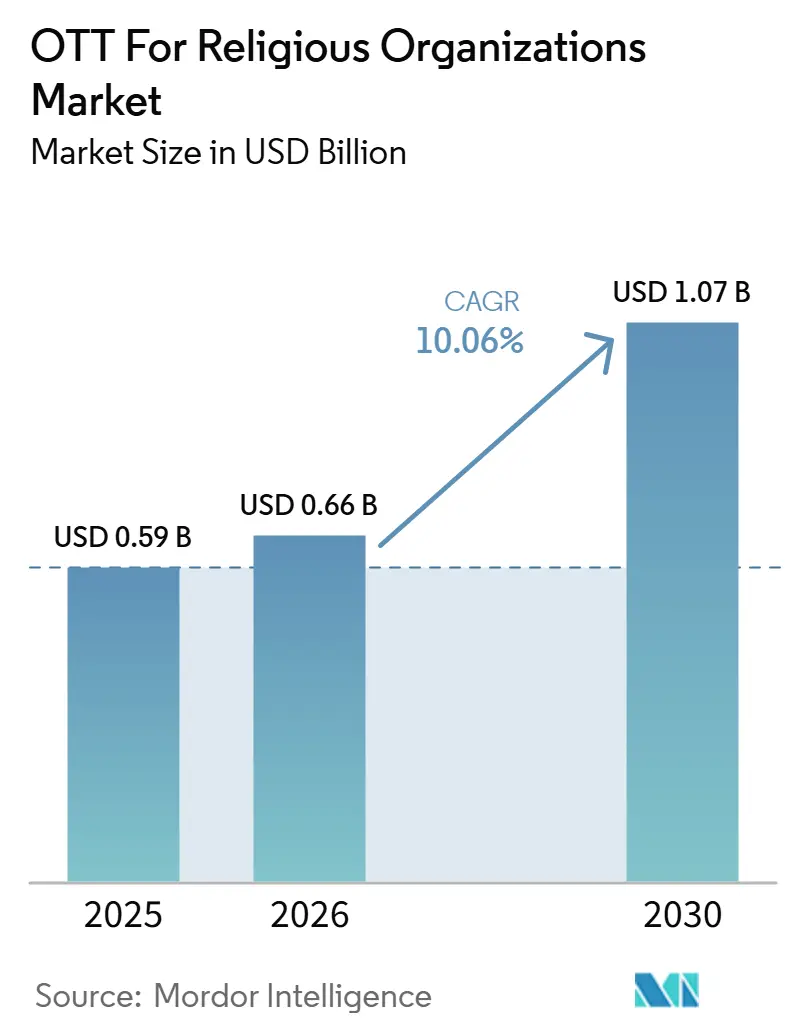
The OTT for religious organizations market size is expected to grow from USD 0.59 billion in 2025 to USD 0.66 billion in 2026 and is forecast to reach USD 1.07 billion by 2031, growing at a CAGR of 10.06% from 2026 to 2031. The OTT for religious organizations market is moving from supplementary broadcasting toward an operating requirement for congregations that serve both in-person and remote audiences, including homebound members, dispersed families, and people who participate through a secondary campus. Hybrid worship models, branded media channels, and digital giving tools are increasingly being selected as connected services rather than separate products because each function can support a different stage of participation. This shift favors providers that combine live video, on-demand libraries, engagement tools, and giving functions in a single environment, allowing staff to avoid separate workflows for content publishing, participant communication, and donation activity. The OTT for religious organizations market also creates opportunities for platforms that reduce the technical burden on volunteer teams while supporting native television and mobile viewing, since smaller organizations often cannot maintain specialist production staff. The OTT for religious organizations market remains shaped by an affordability divide, since larger ministries can fund platforms and technical support while smaller congregations often need simpler pricing, managed services, clear setup processes, and tools that work under varied network conditions.
Key Report Takeaways
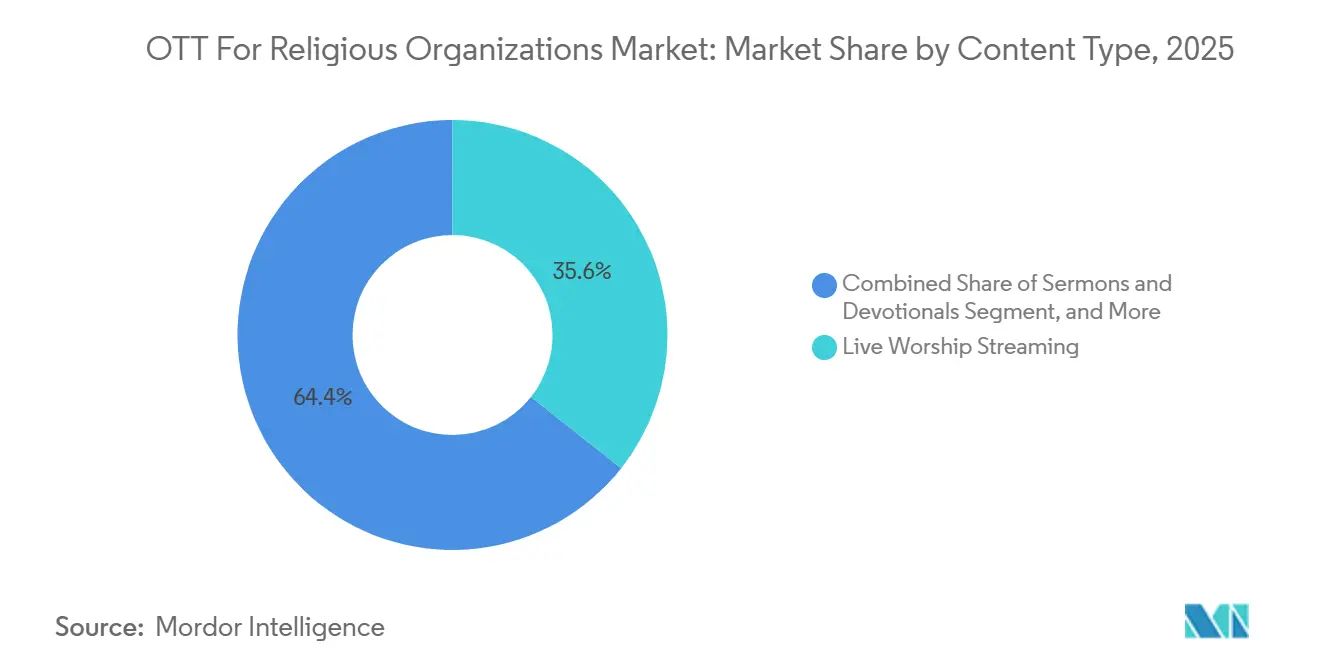
- By content type, live worship and services held 35.64% of the OTT for religious organizations market share in 2025, while education and discipleship is projected to expand at a 10.73% CAGR through 2031.
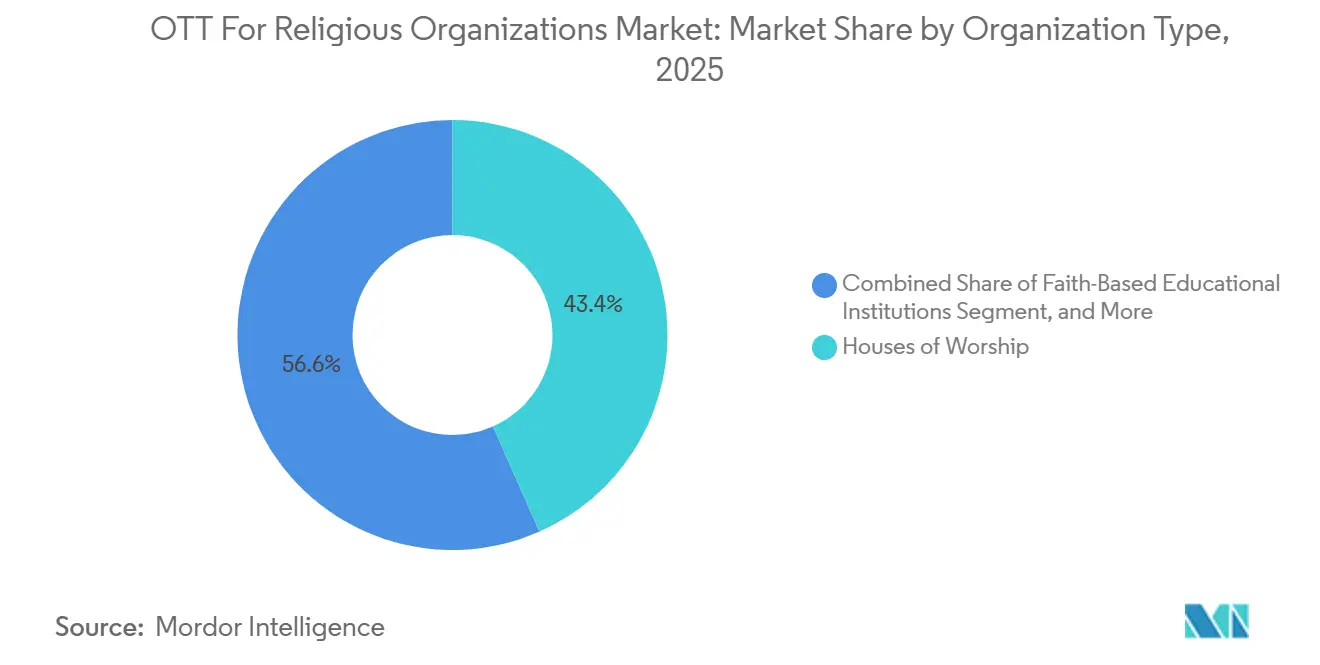
- By organization type, houses of worship and local congregations held 43.36% share in 2025, while multi-site religious organizations and ministries are projected to record the highest CAGR of 10.91% through 2031.
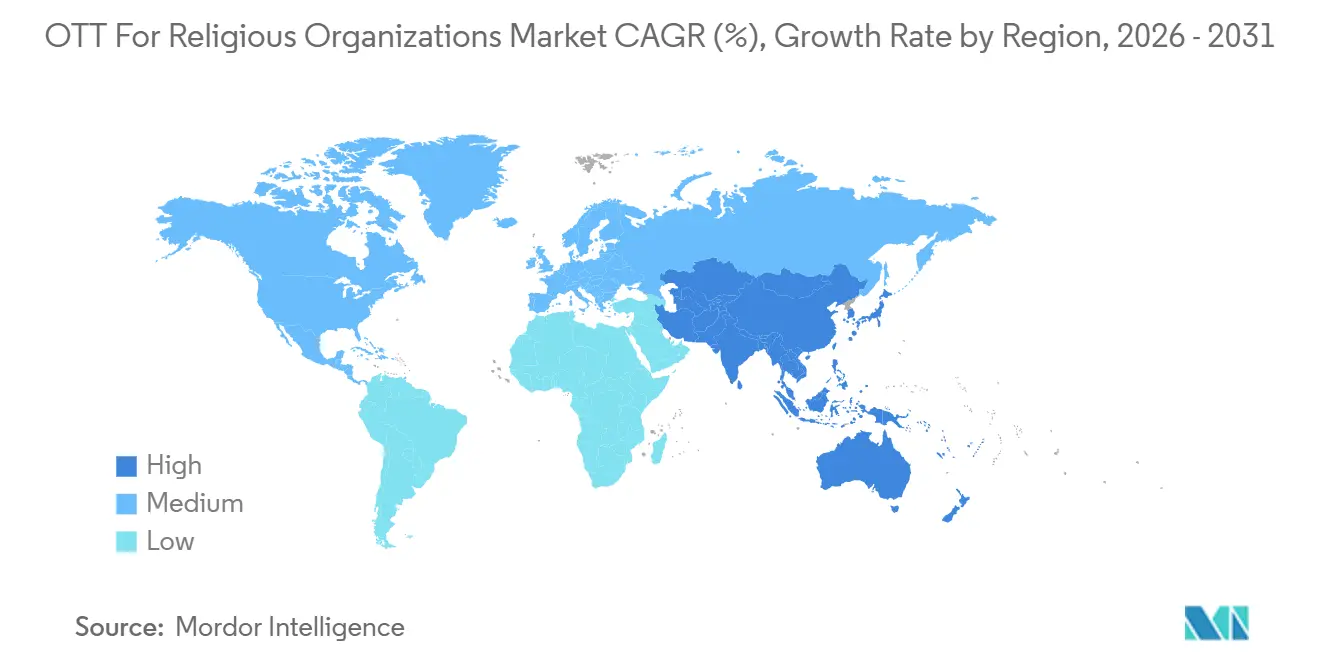
- By geography, North America accounted for 46.11% of the OTT for religious organizations market share in 2025, while Asia-Pacific is projected to grow at a 10.88% CAGR through 2031.
Note: Market size and forecast figures in this report are generated using Mordor Intelligence’s proprietary estimation framework, updated with the latest available data and insights as of January 2026.
Market Trends and Insights
Drivers Impact Analysis of OTT For Religious Organizations Market*
| Driver | (~) % Impact on CAGR Forecast | Geographic Relevance | Impact Timeline |
|---|---|---|---|
| Hybrid Worship and Digital Discipleship | +2.8% | Global | Short term (≤ 2 years) |
| Branded and Owned Faith Media Channels | +2.1% | North America and Europe | Medium term (2-4 years) |
| Mobile and Connected-TV Expansion | +1.9% | North America and Asia-Pacific | Short term (≤ 2 years) |
| Integrated Streaming and Digital Giving | +1.4% | North America and Europe | Medium term (2-4 years) |
| AI-Enabled Multilingual and Accessibility Features | +1% | Global, with early gains in Asia-Pacific and Africa | Medium term (2-4 years) |
| First-Party Congregation Engagement Intelligence | +0.7% | North America and Europe | Long term (≥ 4 years) |
| Source: Mordor Intelligence | |||
Continued Hybrid Worship and Digital Discipleship
Hybrid ministry remains a lasting operating model, dividing congregations into in-person and remote groups with distinct viewing habits, service expectations, and participation opportunities. According to Pushpay’s church technology report, most churches livestreamed services in 2024. The report also found that a notable share of American adults participated only in online religious services, while a larger share participated both online and in person.[1]Pushpay, “2024 State of Church Tech Report,” Pushpay, pushpay.com. The OTT for religious organizations market, therefore, extends beyond a single weekly service toward material that can support learning and engagement during the rest of the week, including content that participants can revisit at a suitable time. Churches that build devotional series, small-group libraries, and youth programming can give remote participants more regular ways to engage and can make a recorded service part of a broader program. Education and discipleship content needs on-demand delivery, organized libraries, and clear navigation, which encourages organizations to consider broader OTT platforms rather than live-streaming subscriptions alone.
Rising Demand for Branded and Owned Faith Media Channels
Religious organizations are seeking branded channels because algorithm changes, demonetization policies, and content rules can reduce the reach of material posted on social platforms, even when an organization has invested years in building an audience. Lightcast states that branded applications let ministries present their own identity and retain audience data rather than relying on a platform’s data practices. This model gives the organization more control over programming, viewing paths, donation prompts, and the order in which people encounter services, teaching, or other resources. It also limits the chance that unrelated material appears beside worship or teaching content, which can be especially important where the organization wants a consistent environment for families and regular participants. The OTT for religious organizations market benefits when organizations view audience retention and session duration as outcomes they can manage within their own applications instead of relying entirely on social reach. These priorities support investment in branded Roku, Apple TV, Fire TV, and mobile applications, rather than relying only on browser-based or social distribution.
Mobile and Connected-TV Expansion Across Congregations
The expansion of mobile devices and connected televisions is changing how faith content is designed and delivered, because the screen used by a viewer affects both the expected format and the length of a viewing session. Connected television encourages a planned viewing experience that can include curated series, scheduled channels, continuous programming, and simple navigation from a television remote. Native applications for Roku, Amazon Fire TV, and Apple TV can serve viewers who prefer larger screens, longer viewing sessions, and a less distracting setting than a browser or social feed. The OTT for religious organizations market must also support mobile-first audiences, where data usage, device storage, and network conditions can affect whether a participant can reliably watch a full service. This creates demand for adaptive delivery, efficient video formats, offline access, and content designs that remain useful under constrained connectivity. Providers that can support both television-led and mobile-led use cases are better placed to serve organizations that have audiences across several regions and very different infrastructure conditions.
Integrated Streaming and Digital Giving Workflows
Digital giving is becoming more closely connected with streaming and church management functions because organizations want to reduce the steps between viewing, responding, and participating. Tithe.ly presents its product range as a connected set of giving, church management, application, and engagement tools for churches. This approach reduces the need for participants to leave a viewing session to complete a donation, while helping administrators keep related activity within the same working environment. Pushpay acquired Nurture.io in April 2026 to add pastoral care and engagement capabilities that draw on more than 17 technology integrations. The OTT for religious organizations market is consequently rewarding providers that connect viewing, giving, and engagement information within one administrative system, rather than leaving staff to reconcile disconnected products. Standalone streaming suppliers face a weaker position where they cannot offer the related workflows, participant context, and administrative simplicity that larger organizations increasingly expect.
Restraints Impact Analysis of OTT For Religious Organizations Market*
| Restraint | (~) % Impact on CAGR Forecast | Geographic Relevance | Impact Timeline |
|---|---|---|---|
| Copyright and Worship-Music Licensing Complexity | -1.4% | Global | Short term (≤ 2 years) |
| Volunteer-Led Production and Technical Skills Gaps | -1.1% | Global, particularly South America and Africa | Short term (≤ 2 years) |
| Data Privacy, Cybersecurity, and Trust Requirements | -0.8% | North America and Europe | Medium term (2-4 years) |
| Digital Convenience and In-Person Community Tension | -0.6% | Global | Long term (≥ 4 years) |
| Source: Mordor Intelligence | |||
Copyright and Worship-Music Licensing Complexity
Music rights create a practical barrier because the license for worship performance does not automatically cover online distribution, and leaders must identify which rights apply to each part of a service. CCLI states that its Streaming and Streaming Plus licenses address online streaming rights for live worship music, with coverage that differs from its standard church copyright license.[2]CCLI, “Streaming and Streaming Plus Licenses [US],” CCLI, ccli.com. Congregations may also need separate permissions when services use master recordings or material from publishers outside the relevant catalog, so a single broadcast may involve more than one review. OneLicense maintains a separate streaming license approach for participating liturgical music publishers, adding another process for organizations that use this repertoire. These overlapping requirements can be difficult for smaller organizations that lack dedicated compliance staff, clear documentation practices, or funds for several licenses. The OTT for religious organizations market faces slower adoption in settings where leaders are uncertain about the licenses required for lawful online worship and decide to limit their online programming.
Volunteer-Led Production and Technical Skills Gaps
Professional streaming requires skills in encoder setup, audio mixing, stream monitoring, camera coordination, and distribution that many volunteer production teams do not have. High turnover among volunteers can make it difficult to maintain consistent production standards, particularly when the same few people manage sound, video, and platform administration. Repeated sound failures, latency, and unstable streams can weaken the remote viewer experience and reduce willingness to invest further, creating a cycle in which poor results limit the budget for improvement. BoxCast and Mixing Station introduced Mixing Station Anywhere in January 2026 to allow remote management of digital audio consoles, including for multi-campus worship settings.[3]BoxCast, “BoxCast and Mixing Station Announce Strategic Partnership to Power the Future of Live Audio Production,” BoxCast, boxcast.com. The OTT for religious organizations market is therefore creating space for managed services, remote support, and tools that simplify production work for teams with limited technical capacity. These tools can help smaller congregations improve quality without hiring a full broadcast team or maintaining specialist staff at every site.
*Our forecasts treat driver/restraint impacts as directional, not additive. The impact forecasts reflect baseline growth, mix effects, and variable interactions.
OTT For Religious Organizations Market Segment Analysis
By Content Type:
Live Worship Leads While Discipleship Supports GrowthLive worship and services held 35.64% share in 2025, reflecting the central role of synchronized services in the category and the continuing value placed on communal participation. Live broadcasts let homebound members, diaspora communities, and satellite audiences participate at the same time as the main congregation, while providing a consistent service for people unable to travel. This role makes live streaming the usual first investment for organizations entering the OTT for religious organizations market because it addresses an immediate congregational need. After establishing live capability, many organizations add on-demand libraries as their production routines, content storage, and volunteer confidence become more mature. Sermons and devotionals are also moving toward shorter episodes that can be browsed in applications, and larger ministries are adapting editorial plans for viewers who may choose 8-12 minute clips rather than a full-service archive.
Education and discipleship content is projected to grow at a CAGR of 10.73% from 2026 to 2031, the highest rate among content types. The OTT for religious organizations industry is using video libraries to support multi-site and diaspora-serving organizations, where in-person teaching does not scale easily or reach participants on a regular schedule. Subscription-video-on-demand-style libraries can create a more regular engagement point than one-time donation activity and can organize teaching material around courses, age groups, or small-group needs. Events, conferences, and fundraising programming have an episodic role but can support donation activity when viewers receive giving prompts during a live stream. Community and family programming provides additional touchpoints between weekly services and may help organizations maintain participation among members who are not attending every service in person.



By Organization Type:
Local Congregations Provide Scale While Multi-Site Organizations Require More CapabilityHouses of worship and local congregations held 43.36% of the OTT for religious organizations market size in 2025, making them the broadest potential customer group and the clearest test of whether products can work with limited resources. Many organizations in this group have constrained budgets, small administrative teams, and volunteer technical staff, which makes predictable costs and straightforward use important. Their operating conditions favor turnkey products that require limited setup and maintenance rather than modular enterprise platforms with separate contracts. Religious broadcasters and media networks have different needs, including continuous channel scheduling, rights-managed libraries, and advertising functions that house-of-worship products do not always provide. Faith-based educational institutions may need support for distance learning, chapel broadcasts, and lecture libraries, so the OTT for religious organizations industry serves customer groups with distinct technical and administrative requirements.
Multi-site religious organizations and ministries are projected to expand at a 10.91% CAGR from 2026 to 2031. These organizations need separate or location-specific feeds, synchronized broadcast times, centralized libraries, and consolidated analytics across locations, which makes video infrastructure a core operating requirement. In 2026, 78% of ministry leaders rated ease of use as extremely important when evaluating software, according to Pushpay and Barna. This preference supports integrated platforms that place streaming, giving, and church management in one administrative layer and reduce the effort required to coordinate vendors. Faith-based nonprofits and community organizations add further demand through social-service programming, interfaith dialogue, relief-mission documentation, and community fundraising, requiring providers to balance simple local workflows with deeper control for distributed ministries.
Geography Analysis
North America OTT for Religious Organizations Market
North America accounted for 46.11% of the OTT for religious organizations market size in 2025, supported by a high concentration of specialist providers and established digital giving practices. The region includes Pushpay, Subsplash, BoxCast, Ministry Brands, and Tithe.ly, whose products increasingly combine live video with administrative, financial, and engagement functions. Pushpay acquired Nurture.io in April 2026, adding engagement capabilities that draw upon data from church technology integrations. Ministry Brands partnered with AvidXchange in August 2025 to bring accounts payable automation to faith-based organizations. These moves show that competition in North America increasingly includes financial and engagement functions alongside video delivery, while Canada follows similar adoption patterns, and other North American markets are earlier in their use of dedicated services.
South America and Europe OTT for Religious Organizations Market
South America is led by Brazil, where local faith audiences support subscription and on-demand video models and provide a large Portuguese-language audience for denomination-specific services. CREDO launched in Brazil in July 2026 with a pay-per-rental offering of films and documentaries aligned with Catholic values. Argentina and Spanish-speaking South American markets are earlier in their adoption of dedicated church streaming services, so providers may require localized language and support models. Europe remains diverse because denominations, languages, and institutional practices vary materially by country. The United Kingdom and Germany have more developed digital ministry ecosystems, while France, Italy, and Spain can require liturgical streaming and multilingual captioning for their institutional settings.
APAC and MEA OTT for Religious Organizations Market
Asia-Pacific is projected to grow at a 10.88% CAGR from 2026 to 2031, the highest rate among regions. South Korea and Australia have mature streaming patterns that resemble those in North America, while the Middle East includes a wider faith-content opportunity involving mosque livestreams, Quran libraries, and Ramadan programming. Africa has a large potential audience for culturally relevant religious programming and a strong need for mobile-oriented delivery because connectivity and affordability conditions differ from established markets. House of Faith launched FaithStream in Lagos in February 2026 with free access, donor funding, AI personalization, offline viewing, and more than 1,700 hours of programming.

Competitive Landscape
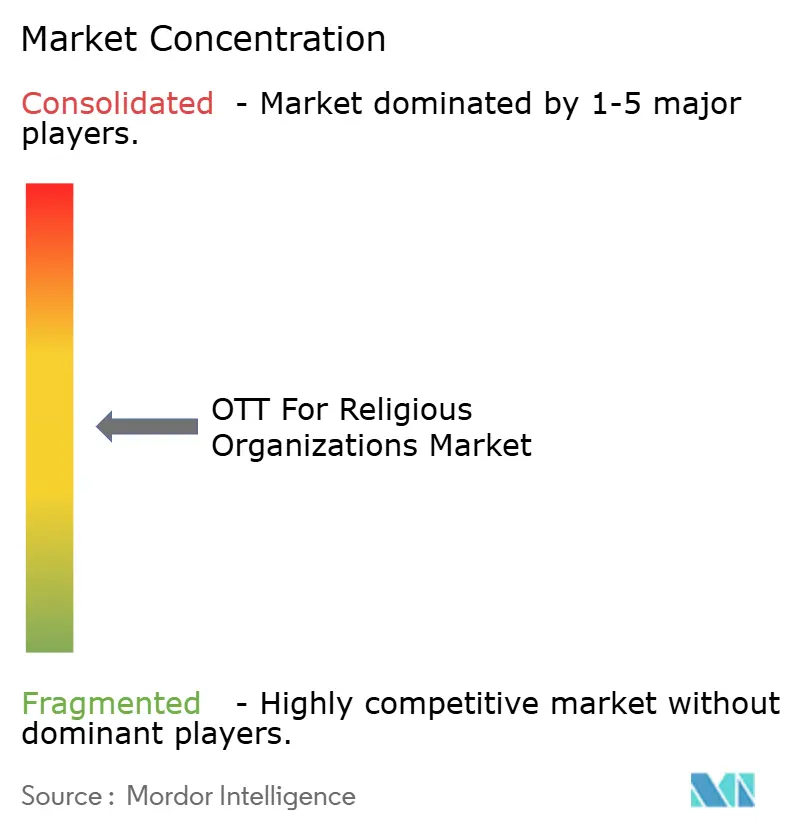
The OTT for religious organizations market is moderately fragmented, with specialist faith-technology platforms competing alongside general video infrastructure providers. Specialist platforms include Pushpay and its Resi streaming business, Subsplash, BoxCast, Ministry Brands, and Tithe.ly, while their main advantage is the ability to connect streaming with giving, church management, and engagement functions. This integration can raise switching costs because customers depend on a broader operating system rather than only a streaming service, and it can reduce the administrative burden of moving information between products. Pushpay launched Groups in June 2026 as the first major release in its Staq Transformation, with a rebuilt church management experience and a more unified entry point for its products. This approach positions streaming as one component of a more extensive technology relationship with a congregation.
Subsplash joined Roper Technologies in July 2025 in a USD 800 million transaction, increasing the resources available to a specialist platform provider. The transaction may pressure mid-sized independent providers to specialize, develop a narrow customer focus, or seek larger backing as product expectations rise. BoxCast uses a different position, centered on reliable streaming delivery and production support for demanding network conditions. Its January 2026 audio partnership added a remote mixing capability that can help organizations operate across several campuses. Ministry Brands has also broadened its position through financial workflow integration with AvidXchange.
Kaltura, Brightcove, Vimeo, and Dacast serve religious users while also addressing wider enterprise video markets. They compete through scalability, application programming interfaces, customization, and content protection, which can appeal to broadcasters managing rights-restricted libraries and educational institutions with more formal compliance needs. The OTT for religious organizations market has unmet needs in multilingual streaming for immigrant and diaspora congregations, FAST channel tools for religious broadcasters, and affordable products for congregations with fewer than 200 members. These gaps reflect a wider challenge for the OTT for religious organizations market, because a platform designed for a large multi-site ministry may not be practical for a small congregation with limited staff and a modest technical budget. Licensing requirements also affect product design, particularly where automated rights reporting and license-related features can reduce customer complexity.
OTT For Religious Organizations Industry Leaders
Pushpay Holdings Limited
Subsplash, Inc.
BoxCast, Inc.
Dacast, Inc.
Vimeo, Inc.
- *Disclaimer: Major Players sorted in no particular order
OTT For Religious Organizations Market Companies Covered in this Report
- Pushpay Holdings Limited
- Subsplash, Inc.
- BoxCast, Inc.
- Dacast, Inc.
- Vimeo, Inc.
- Uscreen, Inc.
- Ministry Brands, LLC
- Tithe.ly, Inc.
- Faithlife Corporation
- Streann Media, Inc.
- Endavo Media, Inc.
- TVStartup, Inc.
- Muvi Technology Private Limited
- Kaltura, Inc.
- Brightcove Inc.
- JW Player
- Wowza Media Systems, LLC
- Switcher Studio
- Lightcast
- Wirecast, Inc.

Recent Industry Developments in OTT For Religious Organizations Market
- June 2026: Pushpay launched Groups, the first major deliverable of its Staq Transformation initiative, providing a rebuilt church management experience with 20% fewer navigation steps. The company also introduced a streamlined integration between Pushpay and the newly acquired Nurture.io, creating a single-dashboard entry point for giving, church management, and pastoral engagement analytics.
- June 2026: Ministry Brands opened its new corporate headquarters in Milton, Georgia, consolidating its team following a period of product and partnership expansion in church financial-technology integration.
- April 2026: Pushpay acquired Nurture.io, a pastoral care and engagement platform that aggregates data from more than 17 church-technology integrations. Churches using Nurture reported a 145% increase in lapsed donors resuming giving and nearly 3 times more re-engaged lapsed volunteers.
- February 2026: Tithe.ly introduced Two-Way Push Notifications for its Church App, enabling congregants to reply directly, RSVP, ask questions, and initiate private chat threads within the app.


Global OTT For Religious Organizations Market Report Scope
OTT for Religious Organizations Market refers to streaming platforms and digital distribution solutions used by churches, temples, mosques, faith-based groups, and spiritual organizations to deliver live and on-demand religious content over the internet. It includes sermons, prayers, devotional music, rituals, community events, and faith education across mobile, web, smart TV, and connected devices.
The OTT for Religious Organizations Market Report is Segmented by Content Type (Live Worship and Services, Sermons and Devotionals, Education and Discipleship, Events, Conferences, and Fundraising, and Community and Family Programming), Organization Type (Houses of Worship and Local Congregations, Multi-Site Religious Organizations and Ministries, Religious Broadcasters and Media Networks, Faith-Based Educational Institutions, and Faith-Based Nonprofit and Community Organizations), and Geography (North America, South America, Europe, Asia-Pacific, Middle East, and Africa). The Market Forecasts are Provided in Terms of Value (USD).
| Live Worship and Services |
| Sermons and Devotionals |
| Education and Discipleship |
| Events, Conferences, and Fundraising |
| Community and Family Programming |
| Other Content Types |
| Houses of Worship and Local Congregations |
| Multi-Site Religious Organizations and Ministries |
| Religious Broadcasters and Media Networks |
| Faith-Based Educational Institutions |
| Faith-Based Nonprofit and Community Organizations |
| North America | United States |
| Canada | |
| South America | Brazil |
| Argentina | |
| Rest of South America | |
| Europe | United Kingdom |
| Germany | |
| France | |
| Italy | |
| Spain | |
| Russia | |
| Rest of Europe | |
| Asia-Pacific | China |
| India | |
| Japan | |
| South Korea | |
| Australia | |
| Rest of Asia-Pacific | |
| Middle East | Turkey |
| Saudi Arabia | |
| United Arab Emirates | |
| Rest of Middle East | |
| Africa | South Africa |
| Nigeria | |
| Egypt | |
| Rest of Africa |
| By Content Type | Live Worship and Services | |
| Sermons and Devotionals | ||
| Education and Discipleship | ||
| Events, Conferences, and Fundraising | ||
| Community and Family Programming | ||
| Other Content Types | ||
| By Organization Type | Houses of Worship and Local Congregations | |
| Multi-Site Religious Organizations and Ministries | ||
| Religious Broadcasters and Media Networks | ||
| Faith-Based Educational Institutions | ||
| Faith-Based Nonprofit and Community Organizations | ||
| By Geography | North America | United States |
| Canada | ||
| South America | Brazil | |
| Argentina | ||
| Rest of South America | ||
| Europe | United Kingdom | |
| Germany | ||
| France | ||
| Italy | ||
| Spain | ||
| Russia | ||
| Rest of Europe | ||
| Asia-Pacific | China | |
| India | ||
| Japan | ||
| South Korea | ||
| Australia | ||
| Rest of Asia-Pacific | ||
| Middle East | Turkey | |
| Saudi Arabia | ||
| United Arab Emirates | ||
| Rest of Middle East | ||
| Africa | South Africa | |
| Nigeria | ||
| Egypt | ||
| Rest of Africa | ||


Key Questions Answered in the Report
What is the size of the OTT for religious organizations market?
The OTT for religious organizations market was valued at USD 0.59 billion in 2025 expected to expand to USD 0.66 billion in 2026, and is projected to reach USD 1.07 billion by 2031, at a 10.06% CAGR from 2026 to 2031. The forecast reflects the wider adoption of connected streaming, engagement, and giving tools.
Which content type holds the largest share?
Live worship and services held the largest share at 35.64% in 2025. Synchronized worship remains the main way remote, homebound, and geographically dispersed participants can join a congregation in real time.
Which content type is growing fastest?
Education and discipleship content is projected to expand at a 10.73% CAGR through 2031. On-demand libraries help organizations offer structured teaching, devotional series, small-group resources, and youth content beyond weekly services.
Which organization type is expected to grow fastest?
Multi-site religious organizations and ministries are projected to grow at a 10.91% CAGR through 2031. Their requirements include location-specific feeds, synchronized broadcasts, centralized libraries, and combined analytics.
Which region is the largest and fastest growing?
North America held 46.11% of revenue in 2025, while Asia-Pacific is projected to record the highest regional CAGR of 10.88% through 2031. North America benefits from specialist providers, while Asia-Pacific includes diverse demand for mobile and devotional content.
What capabilities do religious organizations look for in OTT platforms?
Organizations increasingly seek live and on-demand video, branded applications, digital giving, church management links, engagement tools, rights support, and simplified production assistance. The mix reflects the need to serve audiences across television, web, and mobile devices.
Page last updated on:





