
OTT For Healthcare Market Size and Share
Market Overview
| Study Period | 2020 - 2031 |
|---|---|
| Market Size (2026) | USD 1.93 Billion |
| Market Size (2031) | USD 3.40 Billion |
| Growth Rate (2026 - 2031) | 11.96 % |
| Fastest Growing Market | Asia-Pacific |
| Largest Market | North America |
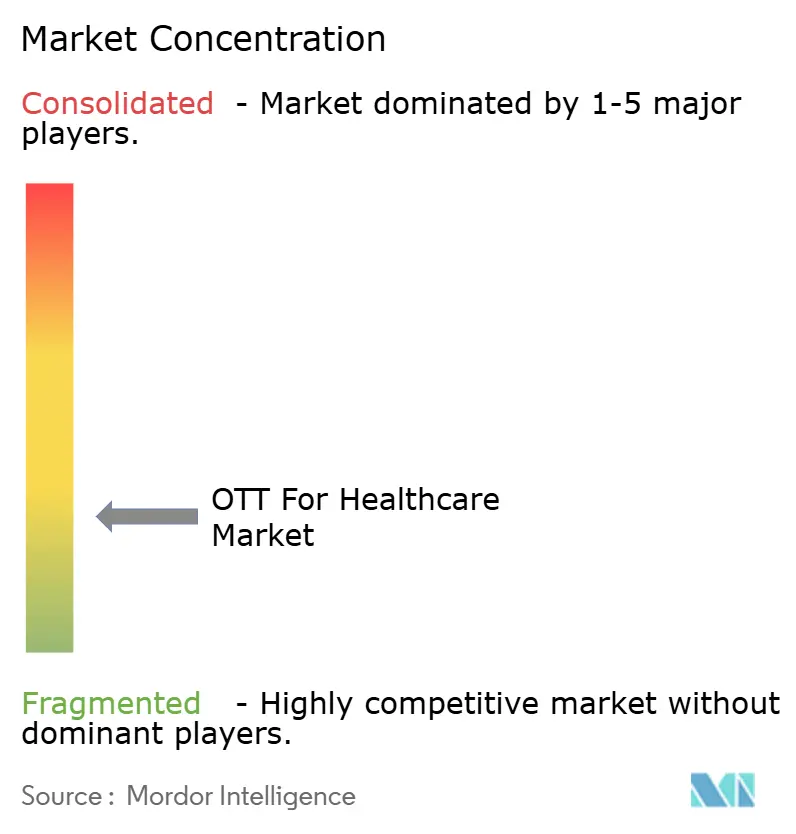
| Market Concentration | Low |
Major Players *Disclaimer: Major Players sorted in no particular order Image © Mordor Intelligence. Reuse requires attribution under CC BY 4.0. | |
OTT For Healthcare Market Analysis by Mordor Intelligence
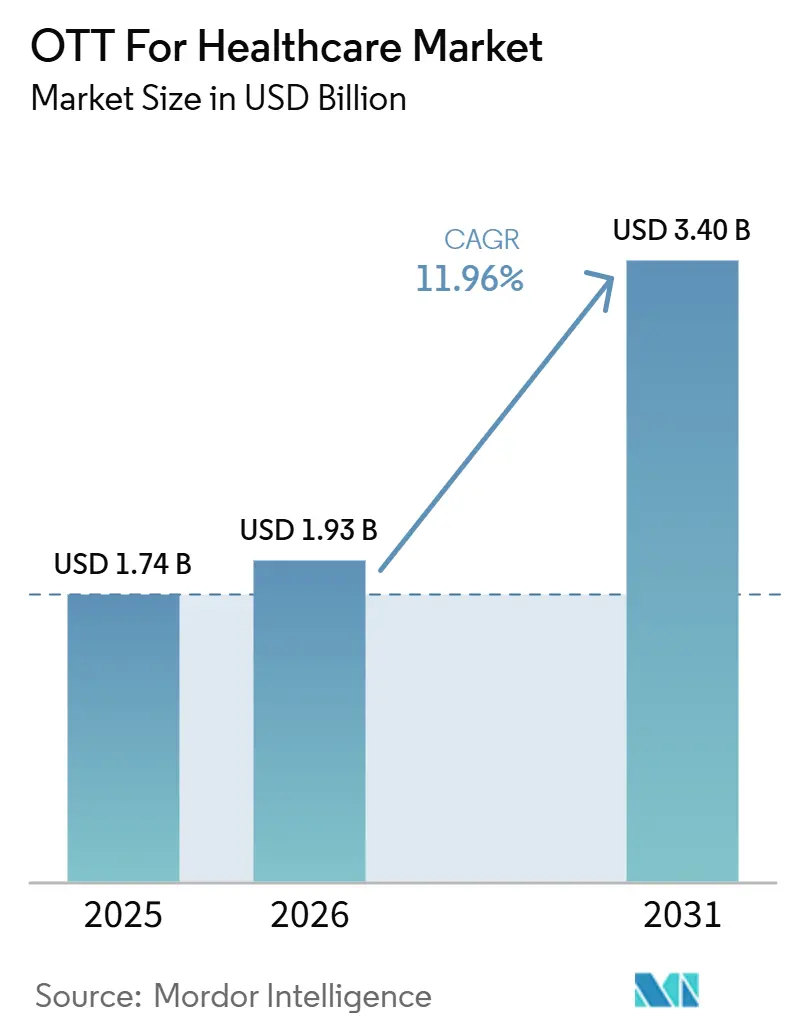
The OTT for healthcare market size was valued at USD 1.74 billion in 2025 and is projected to reach USD 3.40 billion by 2031, advancing at an 11.96% CAGR over 2026-2031. The healthcare OTT market moved beyond general video delivery in 2025 as providers, life sciences companies, and clinical training organizations treated compliant streaming as part of core care and education workflows. The OTT for healthcare market is also benefiting from the closer link between patient education, care coordination, and measurable clinical accountability, which has made video completion, content traceability, and workflow integration more important in platform selection. Enterprise buyers are now placing more weight on secure delivery, EHR connectivity, and content intelligence, which is pushing the OTT for healthcare market toward higher-value contracts and broader enterprise deployments. At the same time, the healthcare OTT market is seeing stronger competitive pressure as large video platforms add healthcare-specific capabilities while specialist vendors deepen clinical relevance through patient engagement, CME delivery, and governance tools. Regulatory compliance, internal buying complexity, and specialized content requirements still slow adoption in some accounts, but these same barriers also create room for vendors that can simplify deployment and prove operational value.
Key Report Takeaways
- By device type, smart TVs held 28.34% of revenue of the OTT for healthcare market in 2025, while smartphones and tablets are projected to expand at a 12.11% CAGR through 2031.
- By streaming type, on-demand streaming accounted for 65.77% of revenue of the OTT for healthcare market in 2025, while live streaming is projected to grow at a 12.44% CAGR through 2031.
- By end user, hospitals and health systems held 52.42% of revenue in 2025, while pharmaceutical and life sciences companies are projected to expand at a 12.36% CAGR through 2031.
- By geography, North America held 42.56% of the healthcare OTT market share in 2025, while Asia-Pacific is projected to advance at a 12.57% CAGR through 2031.
Note: Market size and forecast figures in this report are generated using Mordor Intelligence’s proprietary estimation framework, updated with the latest available data and insights as of January 2026.
Market Trends and Insights
Drivers Impact Analysis of OTT For Healthcare Market*
| Driver | (~) % Impact on CAGR Forecast | Geographic Relevance | Impact Timeline |
|---|---|---|---|
| Rising Demand for Secure Patient Education Video Portals | +3.2% | Global, concentrated in North America and Western Europe | Short term (≤ 2 years) |
| Expansion of Hybrid Care and Digital Front Door Programs | +2.8% | North America and Europe, early adoption in Asia-Pacific | Medium term (2-4 years) |
| Growth of Clinical Microlearning and Continuous Medical Education Video Libraries | +2.3% | Global, strongest adoption in Asia-Pacific and South America | Medium term (2-4 years) |
| Need for Auditable Content Governance, Access Control, and Archiving | +1.5% | North America and EU | Short term (≤ 2 years) |
| Integration of Video Engagement Data Into Care Journey Analytics | +1.2% | North America and Asia-Pacific core, spill-over to Middle East and Africa | Medium term (2-4 years) |
| Shift to Multi-Channel Hospital Communication and Branded Health Apps | +0.9% | Global, early gains in Middle East and Africa | Long term (≥ 4 years) |
| Source: Mordor Intelligence | |||
Rising Demand For Secure Patient Education Video Portals
The OTT for healthcare market is gaining from the way patient education has become more visible within formal care delivery and reimbursement-linked workflows. The CMS TEAM model took effect in August 2025 and tied episode outcomes across major surgical pathways to more structured care management, which raised the value of education delivery that can be assigned, tracked, and reviewed within hospital systems. Mytonomy reported in August 2025 that patients at a 1,100-bed academic medical center averaged 24 minutes of viewing per session, and a separate 400-patient cohort showed 77% care-plan adherence linked to video use, which gave hospital buyers a concrete operating case for compliant education platforms. This has made the OTT for healthcare market more workflow-driven because providers increasingly prefer platforms that can assign content through the EHR rather than depend on patients to search for material on their own. Health systems with Epic MyChart integration are therefore favoring vendors that can automate delivery at the point of order, document completion, and maintain a traceable record for quality and compliance needs. As a result, the OTT for healthcare market is moving closer to clinical infrastructure spending rather than optional digital engagement spending.
Expansion Of Hybrid Care And Digital Front Door Programs
The OTT for healthcare market is also expanding because hybrid care models have increased the number of video interactions tied to a single patient relationship. When telehealth, remote monitoring, intake, triage, scheduling, and education sit inside one branded access path, providers need both live and on-demand video within the same compliant environment. TytoCare announced in November 2025 that it integrated with Teladoc Health's 24/7 Care and Primary360 programs, extending clinical-grade virtual care further into the home and reinforcing the home as a more active entry point for care delivery.[1]TytoCare, “TytoCare Integrates With Teladoc Health to Augment Virtual Primary and Urgent Care,” TytoCare Press Release, tytocare.com This shift matters for the OTT for healthcare market because it increases demand for video systems that can work across bedside settings, home settings, and provider workflows without breaking security or continuity. It also changes the buying motion, since enterprise digital front door initiatives often pull streaming decisions away from isolated departments and into broader health system contracts. That pattern supports higher contract value and makes the healthcare OTT market more attractive to vendors that can cover multiple care pathways with one platform.
Growth Of Clinical Microlearning And Continuous Medical Education Video Libraries
The OTT for healthcare market is widening beyond patient communication because clinical education is shifting toward shorter and more frequent video formats. The AAPA launched Vital Rounds in September 2025 and validated microlearning video as a CME-ready format built for clinicians who need concise updates between patient encounters.[2]American Academy of Physician Associates, “AAPA Launches Vital Rounds Microlearning Platform to Address Pressing Clinical Topics, Boost Healthcare Workforce Readiness,” AAPA News Central, aapa.org AstraZeneca also partnered with Z-Waka in 2025 to deliver short on-demand medical education to clinicians across 6 Southeast Asian frontier markets, which showed that pharmaceutical sponsors are treating digital video as a measurable education channel rather than a supporting format. This matters for the OTT for healthcare market because it extends the addressable user base from patients to physicians, nurses, pharmacists, and other health professionals. It also increases the value of platforms that can manage accreditation logic, disclosure standards, mobile access, and engagement analytics inside a single learning environment. The healthcare OTT market is therefore gaining from a structural change in how medical education is produced, distributed, and evaluated.
Need For Auditable Content Governance, Access Control, And Archiving
The OTT for healthcare market is seeing stronger demand for governance tools because health systems now treat video libraries as sensitive operational content rather than passive media archives. As clinical video spreads across education, training, patient communication, and internal collaboration, buyers want immutable logs, role-based permissions, version control, and retention rules that align with healthcare compliance needs. Vbrick expanded its MCP server capabilities in March 2026 so enterprise video assets could connect with AI copilots and agentic workflows, which showed how governed retrieval is becoming part of the next phase of enterprise video use. That development matters for the OTT for healthcare market because buyers increasingly expect video content to remain searchable and usable inside workflows without exposing protected information or losing auditability. It also raises the standard for smaller vendors, since governance is no longer limited to storage and playback and now extends into AI access, content reuse, and enterprise policy control. The healthcare OTT market is therefore shifting toward platforms that can combine usability with defensible governance at scale.
Restraints Impact Analysis of OTT For Healthcare Market*
| Restraint | (~) % Impact on CAGR Forecast | Geographic Relevance | Impact Timeline |
|---|---|---|---|
| HIPAA, Consent, and Data Residency Compliance Complexity | -1.8% | North America and EU (GDPR) | Short term (≤ 2 years) |
| Fragmented Buyer Workflows Across IT, Clinical, and Communications Teams | -1.4% | Global, most acute in large health systems | Medium term (2-4 years) |
| High Content Production and Localization Costs for Specialized Medical Video | -0.8% | Asia-Pacific, South America, Africa | Long term (≥ 4 years) |
| Limited Reimbursement Linkage for Patient Engagement Content | -0.6% | North America | Medium term (2-4 years) |
| Source: Mordor Intelligence | |||
HIPAA, Consent, And Data Residency Compliance Complexity
The OTT for healthcare market still faces a meaningful constraint because compliant deployment requires more than a secure player or encrypted file delivery. Buyers expect Business Associate Agreement support, encryption in transit and at rest, audit-ready logging, access control, and infrastructure choices that fit local data handling requirements. That raises the cost floor for the OTT for the healthcare market, especially for mid-sized hospitals and physician groups that do not have large internal compliance teams or long procurement capacity. Multinational health systems also face added complexity when U.S. and European data frameworks shape platform architecture, hosting decisions, and cross-border workflows at the same time. Compliance credentials such as SOC 2 Type II and ISO 27001 further raise the barrier for new entrants and narrow the field of vendors that can pass enterprise review. This slows adoption in smaller accounts even though those organizations may benefit strongly from cost-efficient patient education and clinical communication tools.
Fragmented Buyer Workflows Across IT, Clinical, And Communications Teams
The OTT for healthcare market also slows when buying authority is split across functions that evaluate the same platform in very different ways. IT teams focus on security, integration, and infrastructure fit, while clinical leaders care more about content validity, workflow placement, and EHR interoperability. Communications and patient experience teams often prioritize usability, branding, and consumer-facing delivery quality, which creates a multi-track review process for the same platform decision. This fragmentation extends cycle time in the OTT for healthcare market because any shift in leadership, budget timing, or project ownership can restart evaluation. It also favors vendors with patient sales motions and modular entry points, even if those approaches reduce first-phase contract size and delay broader revenue recognition. The result is a market where winning the technical review is often not enough unless the vendor can align several internal stakeholders around a common operating case.
*Our forecasts treat driver/restraint impacts as directional, not additive. The impact forecasts reflect baseline growth, mix effects, and variable interactions.
OTT For Healthcare Market Segment Analysis
By Device Type:
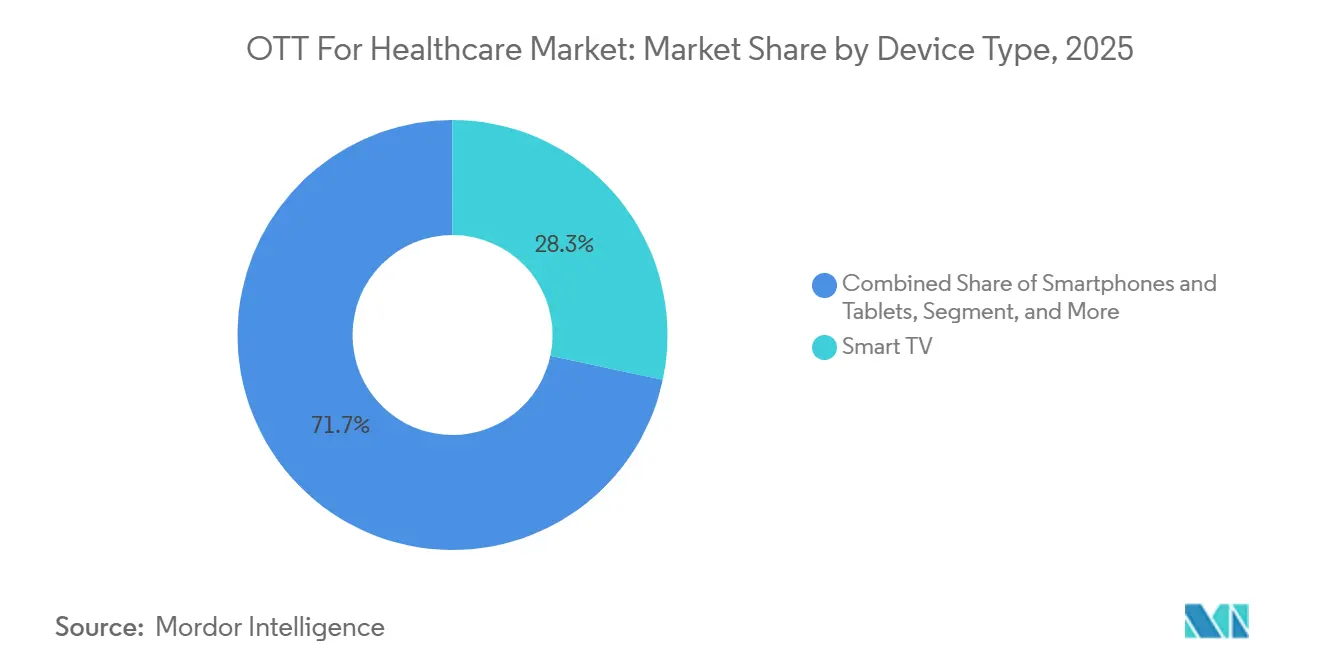
Smart Tvs Lead As Mobile Access Expands Beyond The BedsideSmart TVs held 28.34% of revenue in 2025, which placed them at the center of bedside education, patient communication, and entertainment delivery across hospital rooms. This portion of the OTT for healthcare market remained anchored in managed inpatient environments where the screen is institution-controlled and already linked to room workflows. Hospitals value that control because education can be pushed to the patient, logged more consistently, and aligned with discharge preparation or procedure-specific content. The role of the television also extends beyond passive viewing because modern deployments increasingly support secure casting and a more familiar content experience without weakening access controls. As a result, the healthcare OTT market has kept smart TVs in a leading role even while usage expands across personal devices.
Smartphones and tablets are projected to advance at a 12.11% CAGR through 2031, which makes them the fastest-growing device group in the OTT for healthcare market. Growth is tied to care journeys that start before admission and continue after discharge, since video engagement now follows the patient into the home rather than stopping at the bedside. Nonius Health, in partnership with Philips, deployed certified Apple AirPlay and Google Cast across professional healthcare TVs from major manufacturers, which shows how providers are trying to bridge personal-device habits with hospital-managed screens.[3]Nonius Health, “Nonius TV+ Certified Cast and AirPlay Across Leading Healthcare TVs,” Nonius Health, noniushealth.com Laptops and desktops still matter inside the healthcare OTT industry because staff training, CME access, and administrative video review often remain tied to managed workstation environments. Other device formats such as kiosks and set-top solutions will continue to serve niche settings, but the device mix now points to a OTT for healthcare market that must optimize both hospital-grade control and consumer-grade convenience.



By Streaming Type:
On-Demand Holds Scale While Live Video Broadens Clinical ReachOn-demand streaming accounted for 65.77% of revenue in 2025, which shows how strongly the OTT for healthcare market has been built around self-paced education and stored clinical content. That format fits perioperative preparation, discharge support, and institutional CME libraries because users can access material when schedules allow rather than wait for a fixed event. On-demand use also supports more consistent documentation, which is important when organizations want proof of delivery and completion across regulated care pathways. Because of those advantages, on-demand systems still form the base layer of many enterprise deployments in the OTT for healthcare market. The dominance of this format reflects operational maturity rather than limited innovation, since archived libraries remain essential even as live use rises.
Live streaming is projected to grow at a 12.44% CAGR through 2031, making it the fastest-moving format in this part of the healthcare OTT industry. Clinical grand rounds, surgical demonstrations, and pharmaceutical education events are increasingly distributed in real time to dispersed audiences that need immediate access without travel. Cisco reported that its OR-X deployment at a Swiss university hospital supported 144 research and development experiments and trained 2,195 medical professionals across 108 hands-on courses over 2 years, which illustrates the scale that live clinical streaming can reach when embedded in advanced training environments. The most important shift is that the OTT for healthcare market no longer treats live and on-demand as isolated formats, because buyers want live events to become searchable libraries immediately after the session ends. That convergence is pushing providers and life sciences organizations toward platforms that can handle event delivery, archiving, search, and governance without handing content across multiple systems.
By End User:
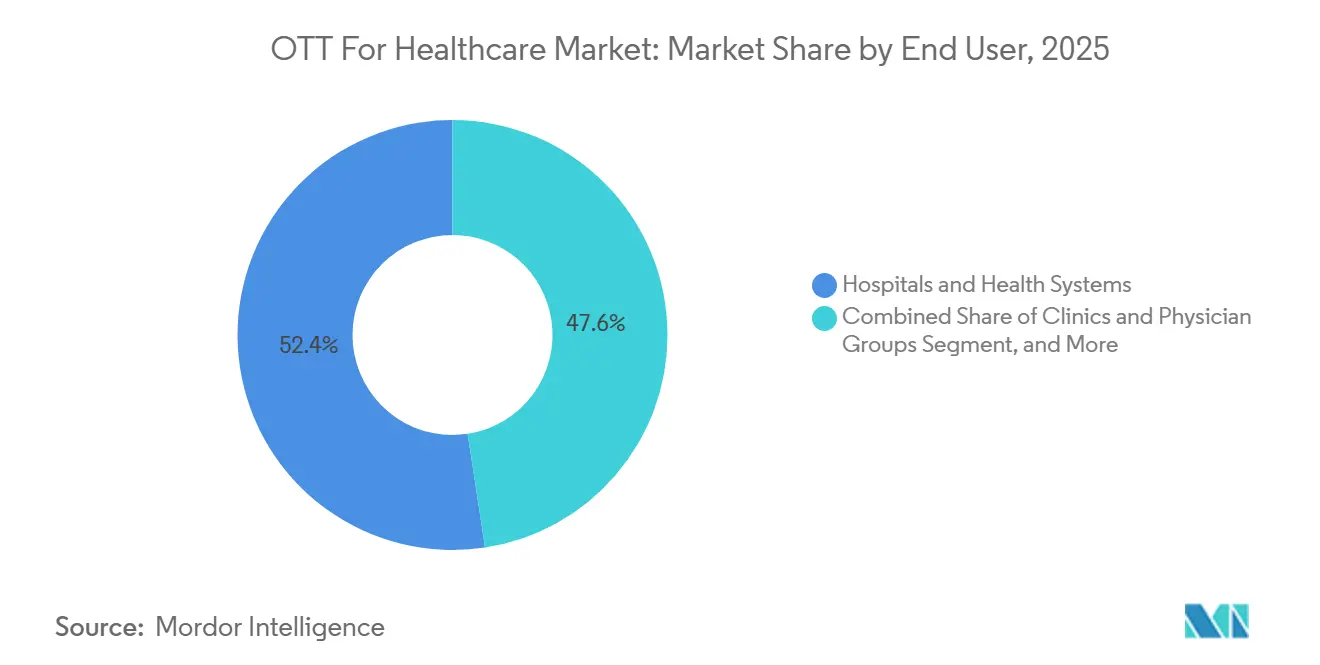
Hospitals Anchor Spending While Pharma Scales Digital EducationHospitals and health systems held 52.42% of revenue in 2025, representing the largest end-user pool in the OTT for healthcare market size. Their lead reflects concentrated demand for bedside education, staff training, internal communication, and institutional content management under one enterprise buyer. Hospital systems also have a stronger reason to integrate video into EHR workflows because they operate across perioperative care, inpatient settings, and discharge planning at the same time. This makes the OTT for healthcare market more enterprise-centric, since a hospital contract often covers many departments and many recurring use cases rather than a single media need. The buying case is strengthened when education content can be assigned, completed, and tracked inside the same operational framework used for broader digital patient engagement.
Pharmaceutical and life sciences companies are projected to expand at a 12.36% CAGR through 2031, which makes them the fastest-growing end-user segment in the OTT for healthcare market. Growth reflects the move away from representative-led education toward scalable video programs that can support CME, clinician outreach, and more measurable engagement. Elsevier completed the acquisition of Mytonomy in May 2026 and integrated a platform that served more than 70 hospitals and 200 clinics in the United States, showing how content publishers are moving deeper into delivery infrastructure and patient engagement workflows. Clinics and physician groups remain a mid-tier buyer group because their budgets are tighter, yet they are being pulled into larger contracts when affiliated systems standardize digital front door tools. Payers and public health agencies are still a smaller demand layer, but their role could widen as chronic disease management and community-scale education programs place more value on compliant video distribution.
Geography Analysis
North America OTT for Healthcare Market
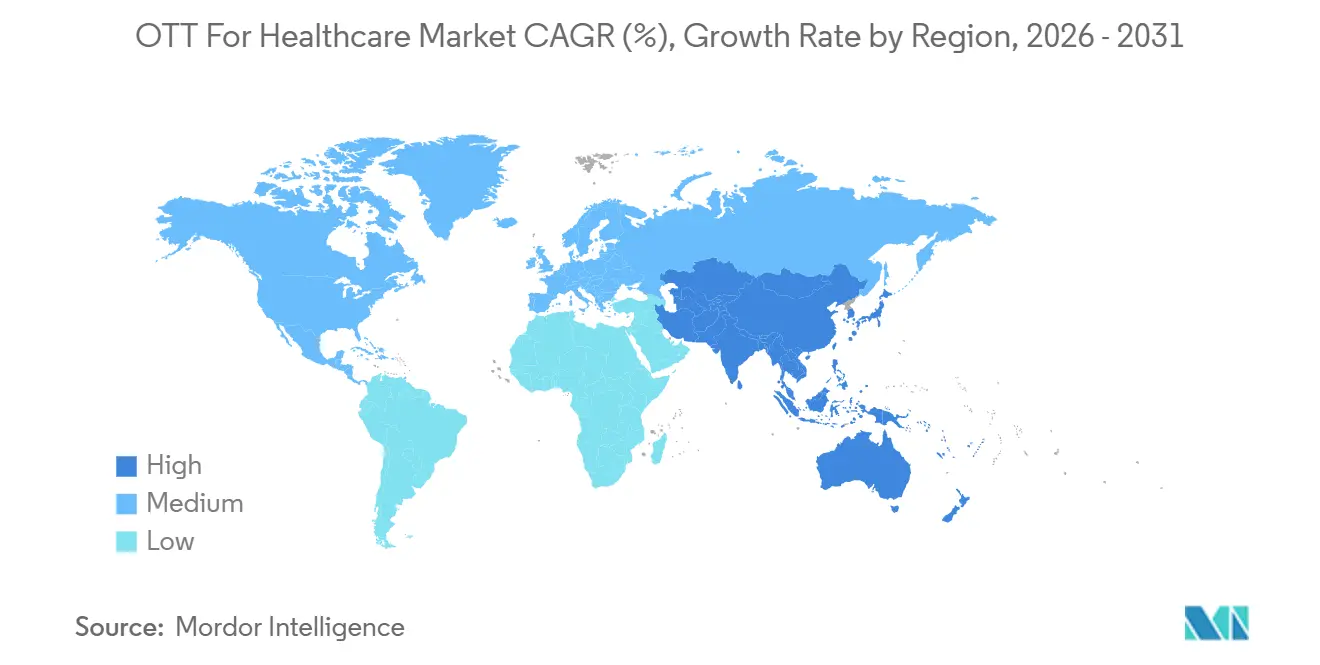
North America held 42.56% of revenue in 2025, giving it the largest regional position in the OTT for healthcare market share. The region benefits from strong EHR penetration, more mature hospital digital budgets, and reimbursement structures that make digital patient engagement easier to justify in procurement. The United States remains the largest national market because compliant video infrastructure is increasingly tied to value-based care, documented patient education, and institutional workflow integration. Canada and Mexico still represent smaller regional opportunities, but both contribute through telehealth access programs and service models that need dependable remote communication tools. This keeps the healthcare OTT market highly active in North America, especially where providers want secure platforms that serve both patient-facing and staff-facing use cases.
Europe OTT for Healthcare Market
Europe presents a more differentiated regional profile in the OTT for healthcare market because adoption strength varies by national health system, digital investment pace, and data governance requirements. The United Kingdom and Germany remain leading investment centers, while broader hospital digitization is also moving forward in France, Spain, and Italy through funding support and modernization programs. GDPR obligations add a formal data handling layer that influences platform architecture, vendor selection, and hosting choices for organizations operating across borders. The European Health Data Space workstream is also shaping expectations around how patient-related information, including video interaction records, may be processed and shared within the region. These conditions support demand, but they also favor vendors that can meet local hosting and governance expectations without increasing workflow friction for providers.
APAC, South America and MEA OTT for Healthcare Market
Asia-Pacific is projected to expand at a 12.57% CAGR through 2031, making it the fastest-growing regional block in the healthcare OTT market size. Growth is being supported by 5G expansion, high smartphone usage in several countries, and government-backed digital health programs that widen access to connected care pathways. India stands out because the Ayushman Bharat Digital Mission is building public digital health infrastructure at very large scale, which supports broader use of patient education and engagement tools across care networks. China, Japan, South Korea, and Australia are also important contributors as providers extend video use into telehealth, chronic disease management, and aged-care settings. South America, the Middle East, and Africa remain earlier-stage markets, but mobile-first models and national digital health strategies are gradually opening new channels for community health communication and pharmaceutical education.

Competitive Landscape
The OTT for healthcare market has a moderately fragmented structure with a visible top tier of enterprise video vendors and a second layer of healthcare-focused specialists. Kaltura, Brightcove, Vbrick Systems, and Cisco Systems compete with healthcare-oriented platforms and content businesses such as Mytonomy, WebMD Ignite, Wolters Kluwer, and Haivision Systems. Competition is increasingly centered on 3 areas: AI-supported content creation, deeper workflow integration, and compliance-ready infrastructure that can satisfy enterprise healthcare review. That mix means the healthcare OTT market is no longer being decided by streaming performance alone, because buyers want systems that also support governance, discoverability, and measurable user engagement. The result is a field where scale matters, but clinical relevance and workflow fit still shape win rates.
Kaltura strengthened its position in 2026 through acquisitions and new product launches that pushed AI-led video creation further into enterprise use. The company was recognized in June 2026 in the Aragon Research Globe for Enterprise Video after adding eSelf.ai and PathFactory and launching its Avatar Video Production Studio, which reduced production time by nearly 90% for regulated content workflows with human oversight still in place. Vbrick also expanded its position in March 2026 by extending AI capabilities and MCP server connectivity across Microsoft Copilot, Claude, OpenAI, and Salesforce Agentforce, showing how enterprise video is being connected to everyday work tools rather than left in isolated repositories. Elsevier's May 2026 acquisition of Mytonomy added another strategic signal because it brought a patient education platform and a clinical content library together under one healthcare information business. These moves show that the OTT for healthcare market is rewarding vendors that can combine software, content, and automation into one operating model.
White space remains concentrated in mid-tier regional hospitals that need compliant video capability but do not have the procurement depth to evaluate large enterprise suites easily. That gap creates room for specialists and modular sales approaches, even though smaller vendors often face pressure from audit requirements, EHR expectations, and multi-stakeholder buying cycles. Newer participants are also testing AI-generated medical video and more targeted education networks, which could widen reach without following traditional CME distribution paths. At the same time, patented casting tools and hardware-software integration in patient rooms show that defensible positions can still be created inside what might otherwise look like a standard streaming layer. The healthcare OTT market therefore remains open enough for innovation, but scale, trust, and compliance still give established vendors a meaningful edge in larger health system decisions.
OTT For Healthcare Industry Leaders
Kaltura, Inc.
Brightcove Inc.
Panopto, Inc.
Vbrick Systems, Inc.
Mytonomy, Inc.
- *Disclaimer: Major Players sorted in no particular order
OTT For Healthcare Market Companies Covered in this Report
- Brightcove Inc.
- Kaltura, Inc.
- Panopto, Inc.
- Vbrick Systems, Inc.
- Mytonomy, Inc.
- WebMD Ignite
- Elsevier B.V.
- Wolters Kluwer N.V.
- Healthcare Learning Innovations LLC
- Enghouse Systems Limited
- Haivision Systems Inc.
- Wowza Media Systems, LLC
- IPV Curator
- Muvi LLC
- V-Unite Limited
- Mediasite LLC
- Cisco Systems, Inc.
- Microsoft Corporation
- Vimeo, Inc.
- Dacast Inc.
- JW Player, Inc.

Recent Industry Developments in OTT For Healthcare Market
- July 2026: Boehringer Ingelheim and Aster DM Healthcare announced a strategic partnership introducing the Heart Failure Nurse Education Program as its first initiative, combining pharmaceutical clinical education content with a multi-country hospital network's nurse training infrastructure across the Middle East, illustrating pharma's expanding role as a healthcare OTT content originator.
- May 2026: Elsevier completed the acquisition of Mytonomy, a video-based patient education platform deployed across more than 70 hospitals and 200 clinics in the U.S., integrating Mytonomy's Cloud for Healthcare and its library of over 4,000 broadcast-quality clinical videos into Elsevier's Clinical Solutions portfolio alongside PatientPass.
- May 2026: Kaltura launched its Avatar Video Production Studio, enabling healthcare and enterprise organizations to produce avatar-led clinical training videos from text or slide inputs, with self-serve purchasing planned for Q3 2026. The studio reduces production time by approximately 90% while maintaining human oversight for regulated content accuracy.
- April 2026: Haivision unveiled the Makito ONE at NAB Show 2026, a single-blade video encoding and decoding platform supporting dual-channel 4K/HD/HDR streaming, SDI, and SMPTE ST 2110 connectivity, applicable to surgical livestreaming and remote clinical training environments.


Global OTT For Healthcare Market Report Scope
The OTT for Healthcare Market refers to the use of over-the-top streaming platforms to deliver healthcare-related video content, patient education, awareness campaigns, and provider communications over the internet. It includes connected TV, mobile, and web-based streaming environments used by hospitals, pharma brands, insurers, and digital health companies.
The OTT for Healthcare Market Report is Segmented by Device Type (Smartphones and Tablets, Smart TVs, and Laptops and Desktops), Streaming Type (Live Streaming, and On-demand Streaming), End User (Hospitals and Health Systems, Clinics and Physician Groups, and Pharmaceutical and Life Sciences Companies), and Geography (North America, Europe, Asia-Pacific, Middle East, Africa, and South America). The Market Forecasts are Provided in Terms of Value (USD).
| Smartphones and Tablets |
| Smart TVs |
| Laptops and Desktops |
| Other Device Types |
| Live Streaming |
| On-demand Streaming |
| Other Streaming Type |
| Hospitals And Health Systems |
| Clinics And Physician Groups |
| Pharmaceutical And Life Sciences Companies |
| Other End Users |
| North America | United States |
| Canada | |
| Mexico | |
| Europe | United Kingdom |
| Germany | |
| France | |
| Spain | |
| Italy | |
| Rest of Europe | |
| Asia-Pacific | China |
| Japan | |
| India | |
| South Korea | |
| Australia | |
| Rest of Asia-Pacific | |
| Middle East | Saudi Arabia |
| United Arab Emirates | |
| Rest of Middle East | |
| Africa | South Africa |
| Egypt | |
| Rest of Africa | |
| South America | Brazil |
| Argentina | |
| Rest of South America |
| By Device Type | Smartphones and Tablets | |
| Smart TVs | ||
| Laptops and Desktops | ||
| Other Device Types | ||
| By Streaming Type | Live Streaming | |
| On-demand Streaming | ||
| Other Streaming Type | ||
| By End User | Hospitals And Health Systems | |
| Clinics And Physician Groups | ||
| Pharmaceutical And Life Sciences Companies | ||
| Other End Users | ||
| By Geography | North America | United States |
| Canada | ||
| Mexico | ||
| Europe | United Kingdom | |
| Germany | ||
| France | ||
| Spain | ||
| Italy | ||
| Rest of Europe | ||
| Asia-Pacific | China | |
| Japan | ||
| India | ||
| South Korea | ||
| Australia | ||
| Rest of Asia-Pacific | ||
| Middle East | Saudi Arabia | |
| United Arab Emirates | ||
| Rest of Middle East | ||
| Africa | South Africa | |
| Egypt | ||
| Rest of Africa | ||
| South America | Brazil | |
| Argentina | ||
| Rest of South America | ||


Key Questions Answered in the Report
What is the current and future value of the healthcare OTT market?
The healthcare OTT market size was USD 1.74 billion in 2025 and is projected to reach USD 3.40 billion by 2031 at an 11.96% CAGR over 2026-2031.
Which region leads healthcare OTT adoption?
North America led with 42.56% of global revenue in 2025 because of strong EHR adoption, mature digital budgets, and tighter links between video workflows and care delivery.
Which region is growing fastest through 2031?
Asia-Pacific is expected to post the fastest growth at a 12.57% CAGR through 2031, supported by mobile access, 5G expansion, and public digital health programs.
Which device category is expanding the fastest?
Smartphones and tablets are projected to grow at a 12.11% CAGR as patient engagement extends further into home-based care before and after hospital visits.
Why does on-demand streaming still dominate healthcare video delivery?
On-demand streaming held 65.77% of revenue in 2025 because it fits self-paced patient education, discharge support, and institutional learning libraries that need flexible access and easier documentation.
Which end users are creating the strongest growth opportunity?
Hospitals and health systems remained the largest buyers at 52.42% of 2025 revenue, while pharmaceutical and life sciences companies are projected to grow fastest at a 12.36% CAGR through 2031.
Page last updated on:





