
OTT Dubbing Market Size and Share
Market Overview
| Study Period | 2020 - 2031 |
|---|---|
| Market Size (2026) | USD 0.81 Billion |
| Market Size (2031) | USD 1.25 Billion |
| Growth Rate (2026 - 2031) | 9.06 % |
| Fastest Growing Market | Asia-Pacific |
| Largest Market | North America |
| Market Concentration | Medium |
Major Players *Disclaimer: Major Players sorted in no particular order Image © Mordor Intelligence. Reuse requires attribution under CC BY 4.0. | |
OTT Dubbing Market Analysis by Mordor Intelligence
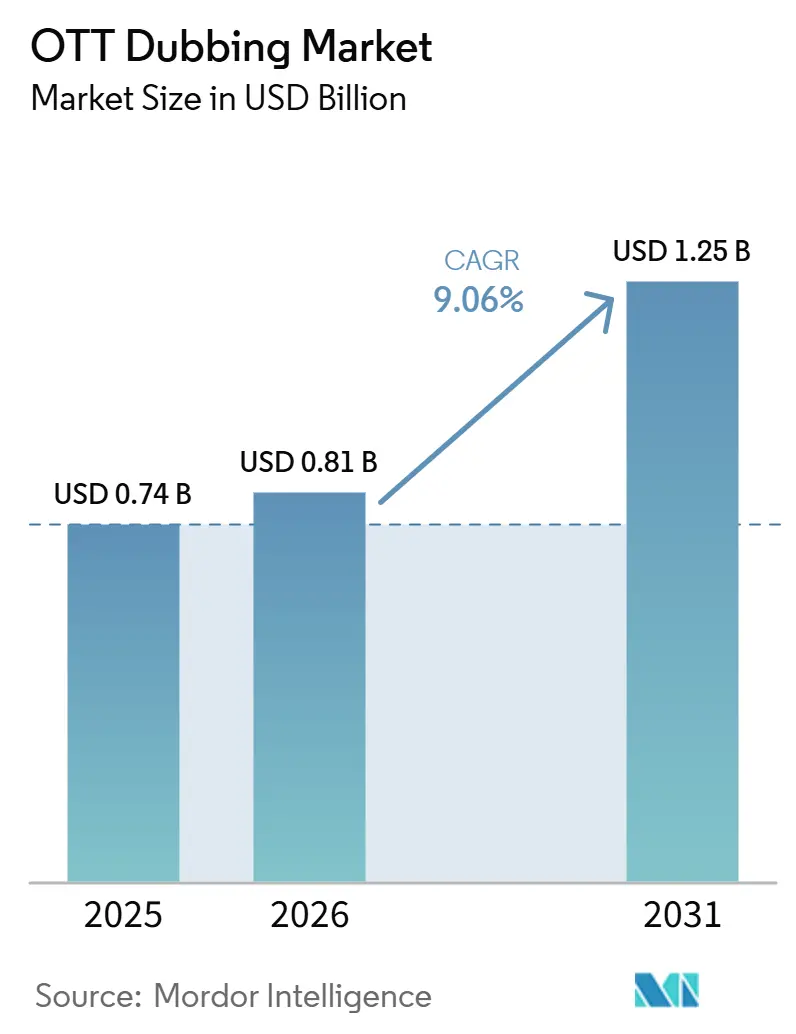
The OTT Dubbing Market size is expected to increase from USD 0.74 billion in 2025 to USD 0.81 billion in 2026 and reach USD 1.25 billion by 2031, growing at a CAGR of 9.06% over 2026-2031. The OTT dubbing market is being shaped by streaming platforms that now treat multilingual audio as part of content strategy rather than as a limited post-production task, especially as subscriber growth slows in core English-language markets. The OTT dubbing market is also expanding because cross-border demand for regional originals has become less predictable, meaning titles produced in one language are now drawing meaningful audiences across South America, Europe, and the Asia-Pacific, and extending localization budgets beyond initial expectations. Faster launch cycles are tightening delivery windows, so the OTT dubbing market is rewarding vendors that can combine distributed production models with AI-assisted workflows without lowering platform quality thresholds. Catalog monetization adds another layer of demand, as older licensed and library titles are increasingly considered for new language versions when viewership data supports the decision. Competitive positioning in the OTT dubbing market is therefore moving toward companies that can manage multi-directional language pairs, support large title volumes, and balance premium studio delivery with lower-cost AI-enabled workflows.
Key Report Takeaways
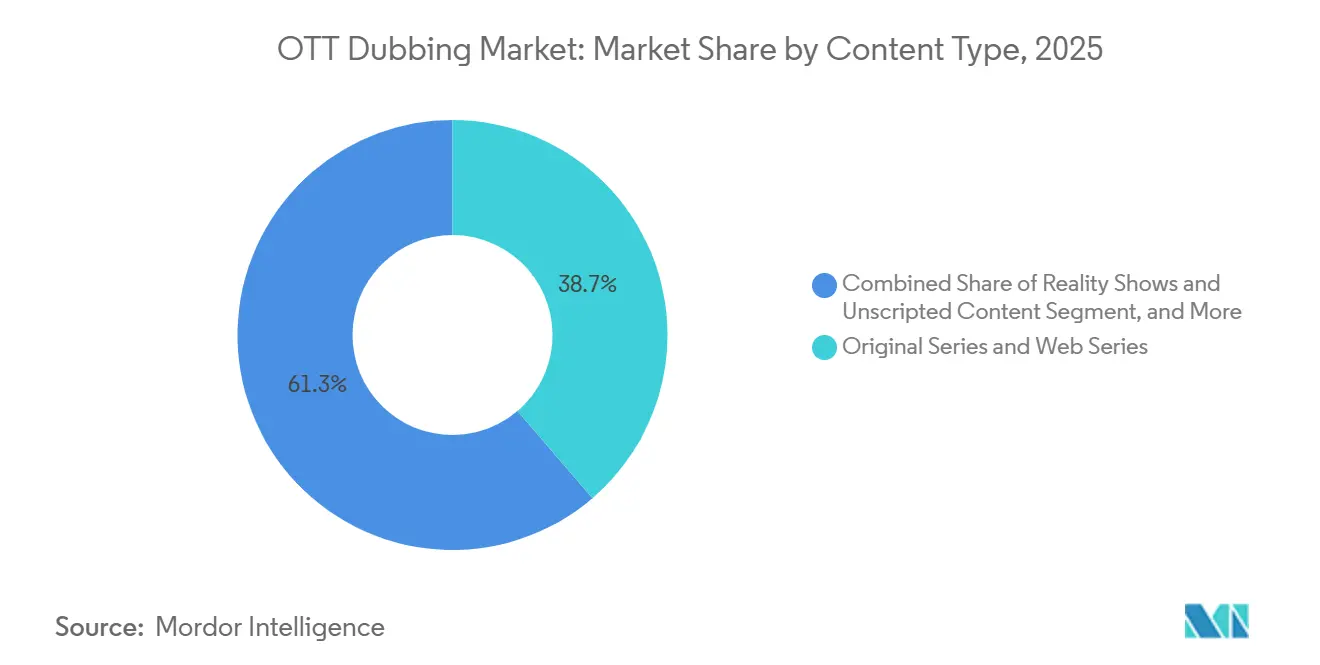
- By content type, original series and web series accounted for 38.72% of the OTT dubbing market share in 2025, while animation and kids content are projected to expand at a 10.81% CAGR through 2031.
- By dubbing type, lip-sync dubbing held 64.48% share in 2025, while voice cloning dubbing is projected to expand at 10.44% CAGR through 2031.
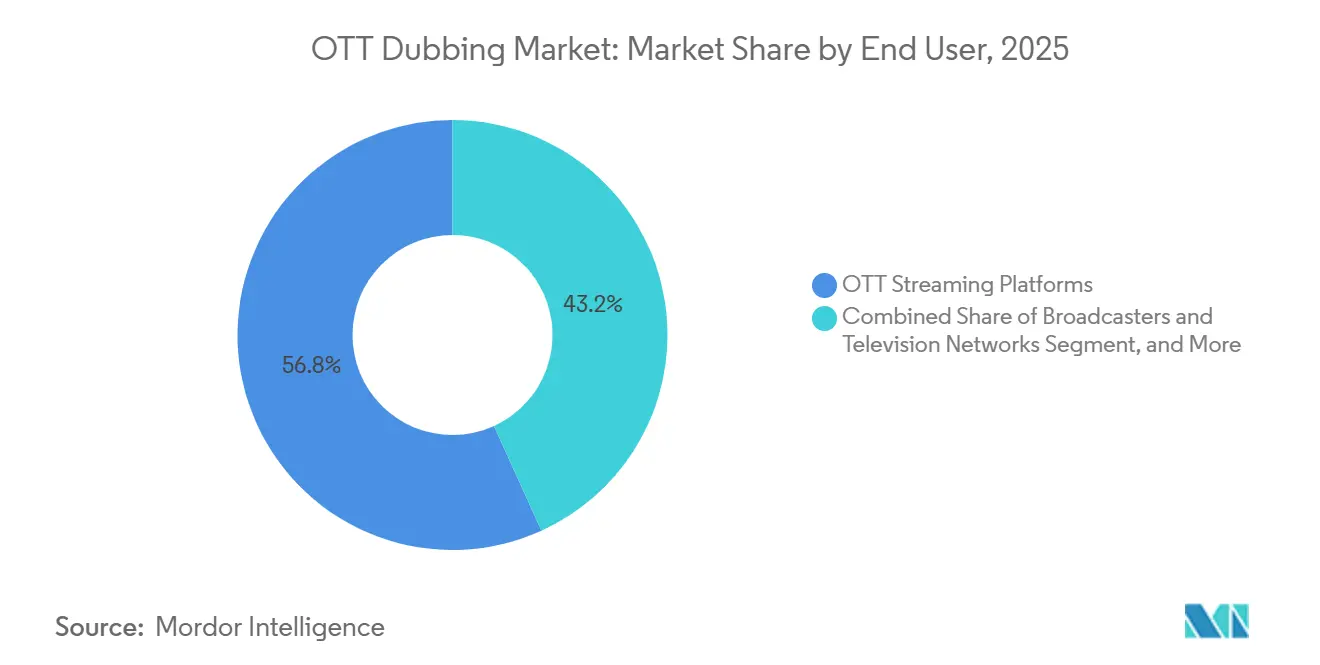
- By end user, OTT streaming platforms held 56.79% of the OTT dubbing market in 2025, while independent creators are projected to expand at a 9.73% CAGR through 2031.
- By geography, North America held 42.63% of the OTT dubbing market share in 2025, while Asia-Pacific is projected to expand at a 10.06% CAGR through 2031.
Note: Market size and forecast figures in this report are generated using Mordor Intelligence’s proprietary estimation framework, updated with the latest available data and insights as of January 2026.
Market Trends and Insights
Drivers Impact Analysis of OTT Dubbing Market*
| Driver | (~) % Impact on CAGR Forecast | Geographic Relevance | Impact Timeline |
|---|---|---|---|
| Rising OTT Content Volume Requiring Multi-Language Localization | +2.5% | Global | Short term (≤ 2 years) |
| Expansion of Regional Originals Across Streaming Platforms | +2.0% | Asia-Pacific, South America, Europe | Medium term (2-4 years) |
| Demand For Faster Time to Launch in New Language Markets | +1.5% | Global | Short term (≤ 2 years) |
| Improved AI-Assisted Workflows For Voice Casting and Mix Preparation | +1.2% | North America, Europe, Asia-Pacific | Medium term (2-4 years) |
| Growing Monetization of Catalog Titles Through Re-Dubbing | +0.8% | North America, Europe | Medium term (2-4 years) |
| Broader Adoption of Localized Audio for Accessibility and Retention | +0.6% | Global | Long term (≥ 4 years) |
| Source: Mordor Intelligence | |||
Rising OTT Content Volume Requiring Multi-Language Localization
The OTT dubbing market is benefiting from the fact that multilingual audio has become a default release expectation for both original and licensed streaming content. Major titles are now being launched with 25 to 40 language versions, which is a scale that earlier theatrical dubbing budgets could not support. Netflix content reaches viewers in nearly 190 countries, and platform decisions on language depth are increasingly tied to completion-rate behavior in each territory rather than to older assumptions about language proximity. This shift places pressure on vendors because language volumes are rising faster than scheduling flexibility, and rate structures are evolving. The OTT dubbing market is therefore favoring providers that can handle multiple language pairs simultaneously, maintain stable quality control, and leverage workflows that combine automation and human review.
Expansion of Regional Originals Across Streaming Platforms
The OTT dubbing market is also being pushed forward by the wider spread of regional original production across streaming services. Korean, Spanish, Turkish, and Hindi originals are no longer being localized through a simple English-first approach, as they are now moving directly into many destination languages, creating demand for language combinations that smaller studios often cannot support. South Korea's K-FAST Alliance had localized 1,200 K-content titles into English, Spanish, and Portuguese by late 2025, and the related AI-dubbed channels had reached 100 million cumulative viewers across 22 countries within 5 months.[1]Ministry of Science and ICT Coverage Team, “MSIT Expands AI Dubbing Support to Boost K-FAST After Reaching 100 Million Viewers in 22 Countries,” Digital Today, digitaltoday.co.kr Comparable programs in Southeast Asia and South America are widening dubbing demand beyond Western language pairs. The OTT dubbing market is therefore seeing stronger interest in voice models and production systems that can support many source and destination combinations without depending on English as the only bridge language.
Demand for Faster Time to Launch in New Language Markets
The OTT dubbing market is increasingly shaped by time-to-launch requirements that have moved from an advantage to a basic procurement condition. Streaming platforms are releasing episodic and event-based content on tighter schedules, which leaves less room for traditional studio booking and longer production cycles. ZOO Digital stated that its Fast Track service delivers subtitles within 3 hours and dubbing within 24 hours, compared with conventional workflows that usually take 1 to 2 weeks for subtitling and 2 to 3 weeks for dubbing. This model relies on AI support and a distributed freelancer network to keep production moving across time zones. The OTT dubbing market is therefore rewarding vendors that can prove sub-48-hour delivery for time-sensitive content categories without weakening output standards.
Improved AI-Assisted Workflows for Voice Casting and Mix Preparation
AI tools are changing the production stack across the OTT dubbing market, from voice matching to final mix preparation. The value of these tools is not limited to cost reduction, as buyers also use them to improve turnaround time and manage higher content volumes at the same quality threshold. Deepdub launched Phantom X 3.2 in March 2026, and the model supports zero-shot voice cloning from 1 second of reference audio, including noisy or degraded material, while also maintaining character name and pronunciation consistency across a full series. ElevenLabs launched Dubbing v2 in May 2026, with direct conditioning applied to the original waveform, intended to preserve pacing, emotional tone, and emphasis across more than 90 languages. The OTT dubbing market is responding to these changes because the quality gap between AI-supported workflows and fully human studio processes is narrowing most clearly at the emotional delivery layer, which used to resist automation.
Restraints Impact Analysis of OTT Dubbing Market*
| Restraint | (~) % Impact on CAGR Forecast | Geographic Relevance | Impact Timeline |
|---|---|---|---|
| High Talent and Studio Costs for Premium Multi-Territory Dubbing | -1.5% | North America, Europe | Short term (≤ 2 years) |
| Inconsistent Linguistic Quality Across Dialects and Local Viewing Preferences | -0.9% | Asia-Pacific, Middle East, Africa | Medium term (2-4 years) |
| Rights Clearance and Union Compliance Complexity | -0.6% | North America, Europe | Short term (≤ 2 years) |
| Limited ROI On Low-Viewership Language Versions for Niche Titles | -0.4% | Global | Long term (≥ 4 years) |
| Source: Mordor Intelligence | |||
High Talent and Studio Costs for Premium Multi-Territory Dubbing
The OTT dubbing market still faces a significant cost barrier to premium multilingual production. A single title localized across 30 to 40 languages needs coordinated casting, direction, recording, and post-production in major dubbing countries such as Germany, France, Italy, Spain, and Japan. Those markets have talent and studio cost floors that do not align with title tier or expected viewership, so the economics remain difficult for wide catalog coverage. This is creating a tiered structure in the OTT dubbing market, where proven global titles receive full dubbing support, while long-tail content is either left without dubbing or moved into AI-assisted pipelines with lower-quality ceilings. The result is that volume growth in titles does not automatically convert into equal growth in premium dubbing revenue.
Inconsistent Linguistic Quality Across Dialects and Local Viewing Preferences
Linguistic quality remains a restraint because the OTT dubbing market is expanding into regions where audience expectations vary sharply by dialect and local speech patterns. Viewers often clearly distinguish between Spanish in the Spanish market and South American Spanish, and between standard Mandarin and regional Chinese speech patterns, and those preferences require separate production work rather than simple language-level replication. AI systems trained on limited dialect data still struggle with regional intonation, idiom, and pacing in lower-resource variants, which reduces acceptance in markets with strong local dubbing traditions. The EU AI Act requires disclosure of AI-generated audio content from August 2026, and that adds compliance work for platforms and vendors operating across European libraries. The OTT dubbing market may therefore see slower AI adoption in some territories, where disclosure, audience expectations, and local production standards all favor more controlled workflows.
*Our forecasts treat driver/restraint impacts as directional, not additive. The impact forecasts reflect baseline growth, mix effects, and variable interactions.
OTT Dubbing Market Segment Analysis
By Content Type:
Original Series Lead, Animation Accelerates at Streaming FrontiersOriginal series and web series accounted for 38.72% of the OTT dubbing market share in 2025, underscoring the need for full localization planning from the start for platform-owned exclusives. These titles do not benefit from earlier theatrical dubbing assets, so buyers must make fresh language coverage decisions for each release. That setup creates recurring work for vendors already embedded in preferred supplier programs and capable of managing simultaneous multilingual delivery. The OTT dubbing market, therefore, remains closely tied to the release cadence of originals, as these projects carry the clearest commitment to a broad, structured language rollout.
Animation and kids content is the fastest-growing segment, and the OTT dubbing market size for this category is projected to expand at 10.81% CAGR through 2031. Children's programming travels well across borders, and animation is more compatible with AI-assisted dubbing because mouth movement precision is less restrictive than in live-action content. Netflix has offered dubbed audio in up to 33 languages for major anime titles, underscoring the scale of language ambition streaming platforms now expect for top animation releases. Within the OTT dubbing industry, reality shows and unscripted formats remain harder to localize because of rapid dialogue, informal language, and cultural references, which increase adaptation effort. Documentary and non-fiction content is growing at a more measured pace, supported by demand for factual programming in education-oriented Asia-Pacific markets and by institutional buyers looking for dubbed educational material.



By Dubbing Type:
Lip-Sync Standard Holds, Voice Cloning Expands the Addressable MarketLip-sync dubbing held a 64.48% share in 2025, keeping it the dominant production model in the OTT dubbing market. Major streaming platforms continue to require frame-level alignment between spoken dialogue and on-screen mouth movement for premium content, especially for originals and other high-visibility releases. That quality standard preserves demand for specialized directors, engineers, and post-production teams, and it keeps the cost floor higher than in lighter formats such as voice-over. Voice-over dubbing still serves documentary and educational use cases, while ADR remains relevant for same-language correction work, and real-time dubbing is beginning to open space in live event settings.
Voice cloning dubbing is the fastest-growing subtype, and the OTT dubbing market size for this category is projected to expand at 10.44% CAGR through 2031. Its value lies in the ability to add languages when viewership data supports expansion, rather than forcing full-up-front budget commitments across uncertain language pairs. Deepdub's Phantom X 3.2 supports zero-shot cloning from 1 second of reference audio, including degraded material, providing platforms with a practical route for retroactive dubbing of older library titles without clean studio stems. Within the OTT dubbing industry, this reduces some dependence on original cast access for later library expansion, even though rights clearance and union terms still shape how widely such workflows can be used.
By End User:
OTT Platforms Drive Volume, Independent Creators Expand the Structural BaseOTT streaming platforms captured 56.79% of the OTT dubbing market share in 2025, which reflected their role as the largest and most standardized buyers in the value chain. Their procurement programs concentrate volume among vendors that can meet strict technical, linguistic, and turnaround requirements across multiple territories simultaneously. Production studios remain a distinct buyer group because they often commission dubbing before platform licensing to improve the export value of their owned content. Broadcasters and television networks still participate in the OTT dubbing market, but their localization budgets and AI adoption patterns remain more conservative than those of major streaming platforms.
Independent creators are the fastest-growing end-user group, with the OTT dubbing market size for this segment projected to expand at 9.73% CAGR through 2031. AI-native platforms have lowered the entry barrier by turning multilingual dubbing into a self-serve product rather than a fully managed studio service. CAMB.AI opened its Tokyo office in July 2025 to support expansion across Japan, South Korea, and Indonesia, which showed how vendors are positioning around creator and regional content demand in Asia-Pacific.[2]CAMB.AI Staff, “CAMB AI Announces APAC Launch with Japan Office,” CAMB.AI, camb.ai The OTT dubbing market is unlikely to see premium project economics from this segment in the near term, but the steady use of multilingual audio by creators is broadening the demand base and making localization a normal part of release planning for smaller producers.
Geography Analysis
The Americas OTT Dubbing Market
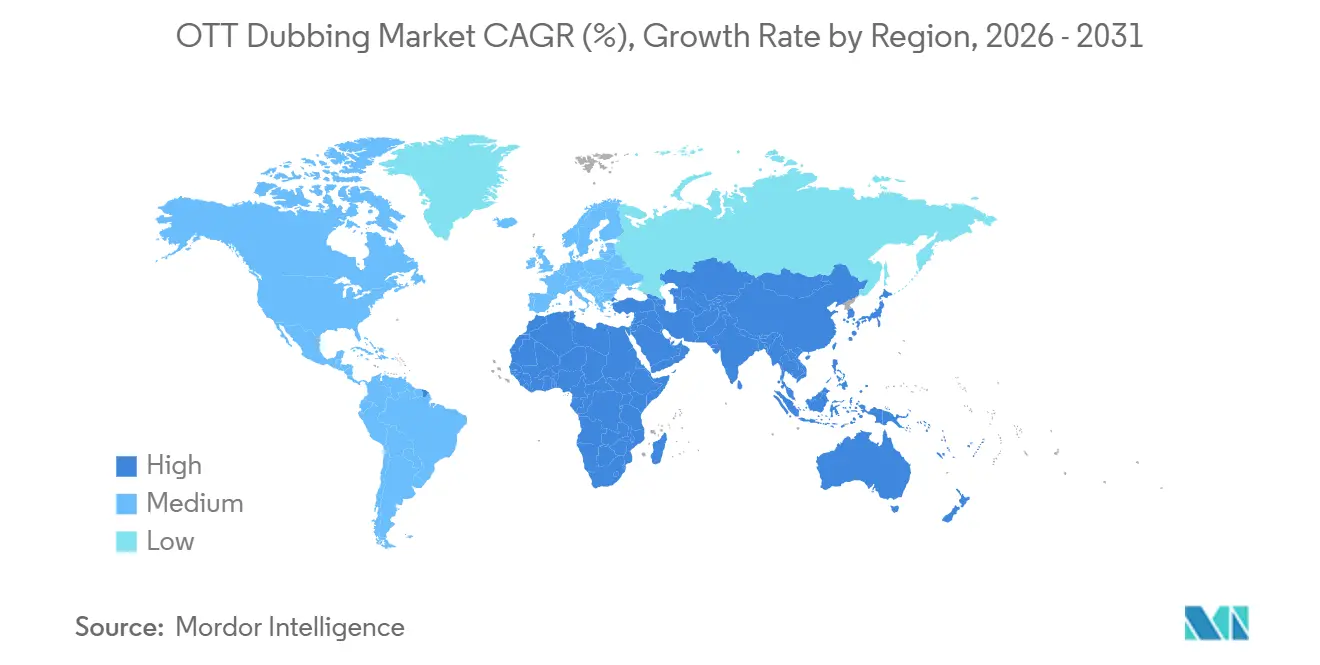
North America accounted for 42.63% of the global OTT dubbing market in 2025, reflecting the concentration of procurement and quality-setting functions around the headquarters of Netflix, Amazon Prime Video, Disney+, and Apple TV+. The United States anchors buyer influence, while Canada adds bilingual production capacity and Mexico supports regional output as a South American Spanish dubbing center. The OTT dubbing market in the region is under pressure from tighter content budgets on one side and unchanged premium-quality expectations on the other, creating margin pressure for vendors that still rely on fully human workflows. Amazon Prime Video launched an AI-aided dubbing pilot in March 2025 for 12 licensed titles in English and South American Spanish, using human oversight to support quality control. South America, led by Brazil and Argentina, remains important because audience preference for dubbed content is high and because Portuguese and South American Spanish both support stable regional demand.
Europe OTT Dubbing Market
Europe remains one of the most structured parts of the OTT dubbing market because Germany, France, Italy, and Spain each maintain established local dubbing ecosystems with distinct quality standards and professional frameworks. Compliance is becoming more important in the region because the EU AI Act requires synthetic audio disclosure from August 2026, which adds review and reporting demands for vendors operating across many language libraries. TransPerfect acquired Omnimago GmbH in February 2026 and Studio Emme SpA in April 2026, which reinforced its strategy of building in-country studio depth in markets where local presence matters for talent access and client trust.[3]TransPerfect Staff, “TransPerfect Acquires German Post-Production Studio Omnimago,” PR Newswire, prnewswire.com The rest of Europe is growing more gradually as regional originals move into wider international distribution and create multi-directional localization needs.
APAC and MEA OTT Dubbing Market
Asia-Pacific is the fastest-growing geography, and the OTT dubbing market size for the region is projected to expand at 10.06% CAGR through 2031. South Korean originals, Indian regional-language content, and Southeast Asian titles are all drawing stronger cross-border interest, which is increasing the value of vendors that can manage non-English source flows at scale. South Korea's K-FAST Alliance reached 100 million cumulative viewers across 22 countries within 5 months for AI-dubbed K-content channels, which showed how public support can accelerate localization outside standard platform procurement routes. India remains structurally under-served because the number of recognized and widely used languages exceeds the deep language coverage that most vendors can currently support. The Middle East is building demand through rising investment in Arabic-language content, while Africa remains the longest-term expansion zone as subscriber penetration and local-language production capacity continue to develop.

Competitive Landscape
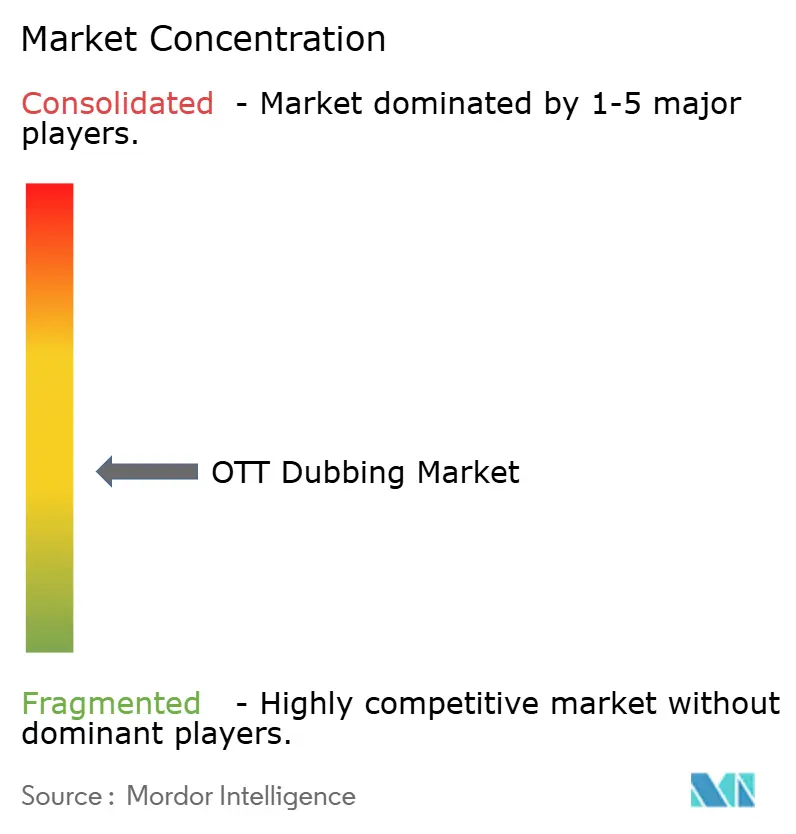
The OTT dubbing market is moderately fragmented across the broader mid-market and AI-native layers. Iyuno, TransPerfect, and ZOO Digital remain entrenched in the highest-value work because they combine preferred vendor relationships, multi-country studio capacity, and the ability to manage large volumes of simultaneous language delivery. That structure gives major streaming buyers a limited group of suppliers for complex originals, while newer vendors compete more actively for catalog work, creator demand, and lower-budget localization programs. The OTT dubbing market is therefore not concentrated in a single operating model, because premium studio delivery and AI-led workflows are growing in parallel rather than on a single replacement path. This split is widening the difference between vendors built for quality-heavy original programming and vendors built for scale, speed, and flexible language expansion.
TransPerfect has used acquisitions as a direct capacity strategy in the OTT dubbing market. It acquired SPEEECH in March 2025, Omnimago in February 2026, and Studio Emme in April 2026, expanding its footprint across Germany and Italy and strengthening its in-country production model. ZOO Digital has focused on turnaround speed, and its Fast Track service moved dubbing delivery to 24 hours for episodic content while keeping the same quality target used in longer workflows. ZOO Digital also stated in its FY26 update that it was onboarding new business groups after RFP wins, which suggested that procurement consolidation is still leaving room for vendor switching when execution improves. These moves show that scale in the OTT dubbing market is being built through both physical infrastructure and process acceleration.
AI-native providers are competing for the parts of the OTT dubbing market that sit between premium studio work and content that once had no dubbing path at all. Deepdub launched its Agentic Dubbing Co-Worker in April 2026, positioning AI not only as an automation layer but also as a workflow participant involved in casting, planning, and review tasks.[4]Deepdub Staff, “Deepdub Introduces the World’s First Agentic Dubbing Co-Worker,” PR Newswire, prnewswire.com CAMB.AI strengthened its regional presence through its Tokyo launch in 2025 and then expanded further in June 2026 through a partnership with Vodafone and Tomorrow Street around real-time multilingual deployment. The clearest opening in the OTT dubbing market remains origin-language-agnostic infrastructure that can move Korean, Hindi, Turkish, and other non-English source content into multiple destination languages without routing everything through English first.
OTT Dubbing Industry Leaders
Iyuno Inc.
Deluxe Media Inc.
ZOO Digital Group plc
Keywords Studios plc
TransPerfect Global, Inc.
- *Disclaimer: Major Players sorted in no particular order
OTT Dubbing Market Companies Covered in this Report
- Iyuno Inc.
- VSI Limited
- Deluxe Media Inc.
- ZOO Digital Group plc
- Keywords Studios plc
- TransPerfect Global, Inc.
- Digital Nirvana, Inc.
- BTI Studios AB
- Hiventy SAS
- Deepdub Ltd.
- Dubverse Technologies Private Limited
- Rask AI Inc.
- Camb.AI Inc.
- ElevenLabs Inc.
- Dubbing Brothers SAS
- Pixelogic Media Partners, LLC
- Sfera Studios Limited

Recent Industry Developments in OTT Dubbing Market
- July 2026: Disney+ expanded its audio language support from 41 to 58 languages, adding Arabic, Hindi, Tamil, Telugu, and 13 further languages, along with a right-to-left user interface for Arabic and Hebrew markets, the expansion directly increases per-title dubbing volume requirements for its vendor base across Asia-Pacific and the Middle East.
- June 2026: CAMB.AI entered a strategic partnership with Vodafone and Tomorrow Street innovation accelerator to deploy real-time multilingual dubbing across Vodafone's contact centers using the MARS8 voice model family and established its European headquarters at Tomorrow Street's Luxembourg premises as part of its broader European expansion strategy.
- May 2026: ElevenLabs launched Dubbing v2, an AI dubbing model supporting 90+ languages that conditions on the original audio waveform rather than a transcript, preserving the speaker's emotional register, pacing, and tone, the release also introduces automatic speech-timing alignment to source video cadence, eliminating a manual post-production step that historically added hours to localization workflows.
- April 2026: Deepdub launched the world's first Agentic Dubbing Co-Worker, an AI system embedded within production workflows at enterprise clients that performs the judgment functions of a senior dubbing professional, including voice casting, project planning, and quality review, operating alongside human teams rather than as a standalone automation layer.


Global OTT Dubbing Market Report Scope
The OTT dubbing market covers services and solutions that adapt original audio content into multiple languages for distribution on over-the-top streaming platforms. The scope of the report includes dubbing services for films, series, documentaries, animation, and other digital video content delivered through subscription, advertising, and transactional-based OTT platforms. It also examines market trends, growth drivers, challenges, and opportunities across key regions and end-user segments.
The OTT Dubbing Market Report is Segmented by Content Type (Movies and Feature Films, Original Series and Web Series, Documentary and Non-Fiction, Reality Shows and Unscripted Content, Animation and Kids Content, and Other Content Types), Dubbing Type (Lip-Sync Dubbing, Voice-Over Dubbing, ADR (Same-Language Replacement), Real-Time Dubbing, Voice Cloning Dubbing, and Other Dubbing Types), End User (OTT Streaming Platforms, Production Studios, Broadcasters and Television Networks, Independent Creators, and Other End Users), and Geography (North America, South America, Europe, Asia-Pacific, Middle East, and Africa). The Market Forecasts are Provided in Terms of Value (USD).
| Movies and Feature Films |
| Original Series and Web Series |
| Documentary and Non-Fiction |
| Reality Shows and Unscripted Content |
| Animation and Kids Content |
| Other Content Types |
| Lip‑Sync Dubbing |
| Voice‑Over Dubbing |
| ADR (Same‑Language Replacement) |
| Real‑Time Dubbing |
| Voice Cloning Dubbing |
| Other Dubbing Types |
| OTT Streaming Platforms |
| Production Studios |
| Broadcasters and Television Networks |
| Independent Creators |
| Other End Users |
| North America | United States |
| Canada | |
| Mexico | |
| South America | Brazil |
| Argentina | |
| Chile | |
| Rest of South America | |
| Europe | Germany |
| United Kingdom | |
| France | |
| Italy | |
| Spain | |
| Rest of Europe | |
| Asia-Pacific | China |
| Japan | |
| India | |
| South Korea | |
| Australia | |
| Rest of Asia-Pacific | |
| Middle East | Saudi Arabia |
| United Arab Emirates | |
| Qatar | |
| Rest of Middle East | |
| Africa | South Africa |
| Egypt | |
| Nigeria | |
| Rest of Africa |
| By Content Type | Movies and Feature Films | |
| Original Series and Web Series | ||
| Documentary and Non-Fiction | ||
| Reality Shows and Unscripted Content | ||
| Animation and Kids Content | ||
| Other Content Types | ||
| By Dubbing Type | Lip‑Sync Dubbing | |
| Voice‑Over Dubbing | ||
| ADR (Same‑Language Replacement) | ||
| Real‑Time Dubbing | ||
| Voice Cloning Dubbing | ||
| Other Dubbing Types | ||
| By End User | OTT Streaming Platforms | |
| Production Studios | ||
| Broadcasters and Television Networks | ||
| Independent Creators | ||
| Other End Users | ||
| By Geography | North America | United States |
| Canada | ||
| Mexico | ||
| South America | Brazil | |
| Argentina | ||
| Chile | ||
| Rest of South America | ||
| Europe | Germany | |
| United Kingdom | ||
| France | ||
| Italy | ||
| Spain | ||
| Rest of Europe | ||
| Asia-Pacific | China | |
| Japan | ||
| India | ||
| South Korea | ||
| Australia | ||
| Rest of Asia-Pacific | ||
| Middle East | Saudi Arabia | |
| United Arab Emirates | ||
| Qatar | ||
| Rest of Middle East | ||
| Africa | South Africa | |
| Egypt | ||
| Nigeria | ||
| Rest of Africa | ||


Key Questions Answered in the Report
What is the size outlook for the OTT dubbing market?
The OTT Dubbing Market size is expected to increase from USD 0.74 billion in 2025 to USD 0.81 billion in 2026 and reach USD 1.25 billion by 2031, growing at a CAGR of 9.06% over 2026-2031.
Which content type leads to OTT dubbing demand?
Original series and web series led with 38.72% share in 2025 because platform-owned exclusives usually require full localization planning from the start.
Which dubbing format is growing the fastest?
Voice cloning dubbing is projected to expand at a 10.44% CAGR through 2031, as it supports lower-cost language expansion for catalog and mid-tier content.
Which end users are driving the most revenue?
OTT streaming platforms accounted for 56.79% of end-user demand in 2025, making them the largest buyers across the value chain.
Which region is growing the fastest?
Asia-Pacific is projected to grow at 10.06% CAGR through 2031, supported by Korean originals, Indian regional content, and Southeast Asian cross-border releases.
What is changing competition in dubbing services for streaming platforms?
Competition is shifting toward vendors that can combine studio quality, AI-assisted speed, and multi-language scale, with TransPerfect, ZOO Digital, Deepdub, and CAMB.AI all using different expansion strategies.
Page last updated on:





