
Organic Personal Care Ingredients Market Size and Share
Market Overview
| Study Period | 2022 - 2032 |
|---|---|
| Market Size (2027) | USD 13.69 Billion |
| Market Size (2032) | USD 18.57 Billion |
| Growth Rate (2027 - 2032) | 6.29 % |
| Fastest Growing Market | Asia-Pacific |
| Largest Market | North America |
| Market Concentration | Medium |
Major Players *Disclaimer: Major Players sorted in no particular order Image © Mordor Intelligence. Reuse requires attribution under CC BY 4.0. | |
Organic Personal Care Ingredients Market Analysis by Mordor Intelligence
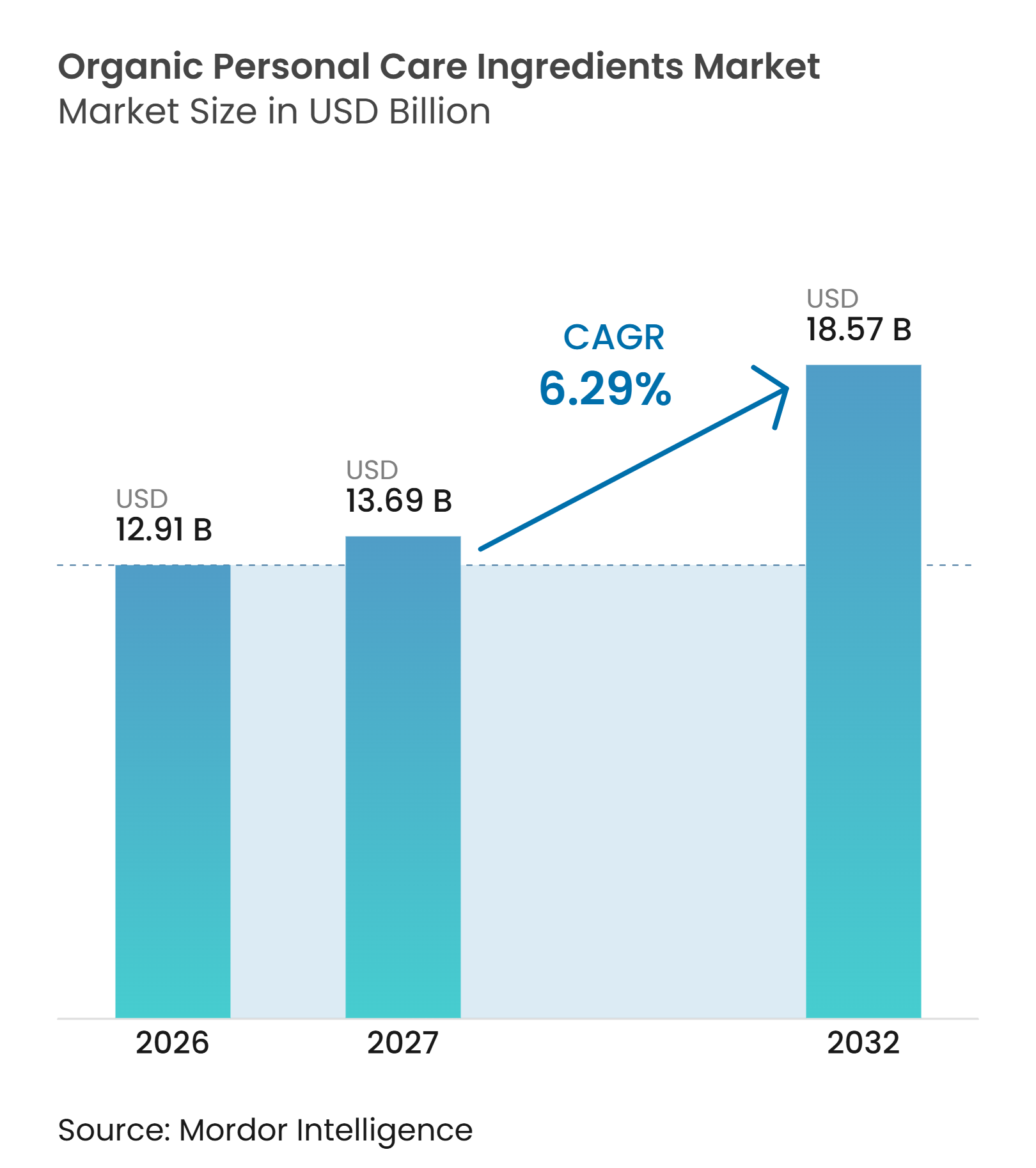
The organic personal care ingredients market size is projected to expand from USD 12.91 billion in 2026 to USD 18.57 billion by 2032, registering a CAGR of 6.29% between 2027 and 2032. Demand is moving toward formulations with documented sourcing, certified organic content, and clearer ingredient disclosure. In a 2025 survey, 74% of U.S. respondents considered organic ingredients important in personal care products, while 65% reviewed ingredient lists for potentially harmful substances. The organic personal care ingredients market is also shaped by higher safety and documentation expectations under U.S. and European regulatory frameworks. Suppliers that can combine organic certification, performance evidence, and reliable raw material access are better positioned to serve premium formulations. Supply risk remains material because botanical inputs can be sensitive to weather, trade conditions, and geographic concentration, as per The International Natural and Organic Cosmetics Association[1].
Key Report Takeaways
-
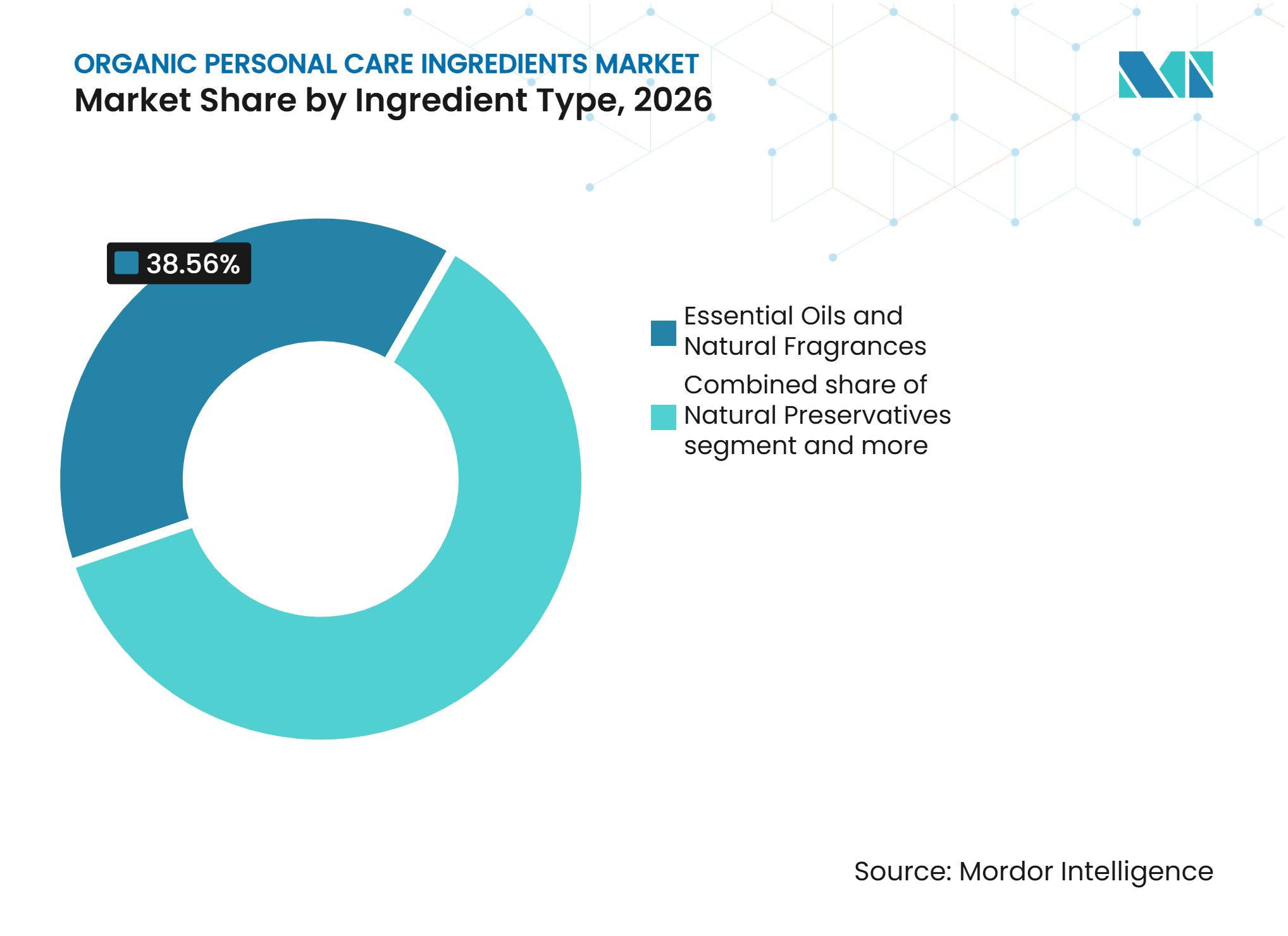
By ingredient type, Essential Oils and Natural Fragrances accounted for the largest share of the organic personal care ingredients market, at 38.56% in 2026, while Natural Preservatives and Antimicrobial Systems are projected to grow at the fastest CAGR of 8.65% during 2027-2032.
-
By source, Plant-Based ingredients accounted for the largest share of the organic personal care ingredients market, at 49.33% in 2026, while Microbial and Fermentation-Derived ingredients are projected to grow at the fastest CAGR of 7.43% during 2027-2032.
-
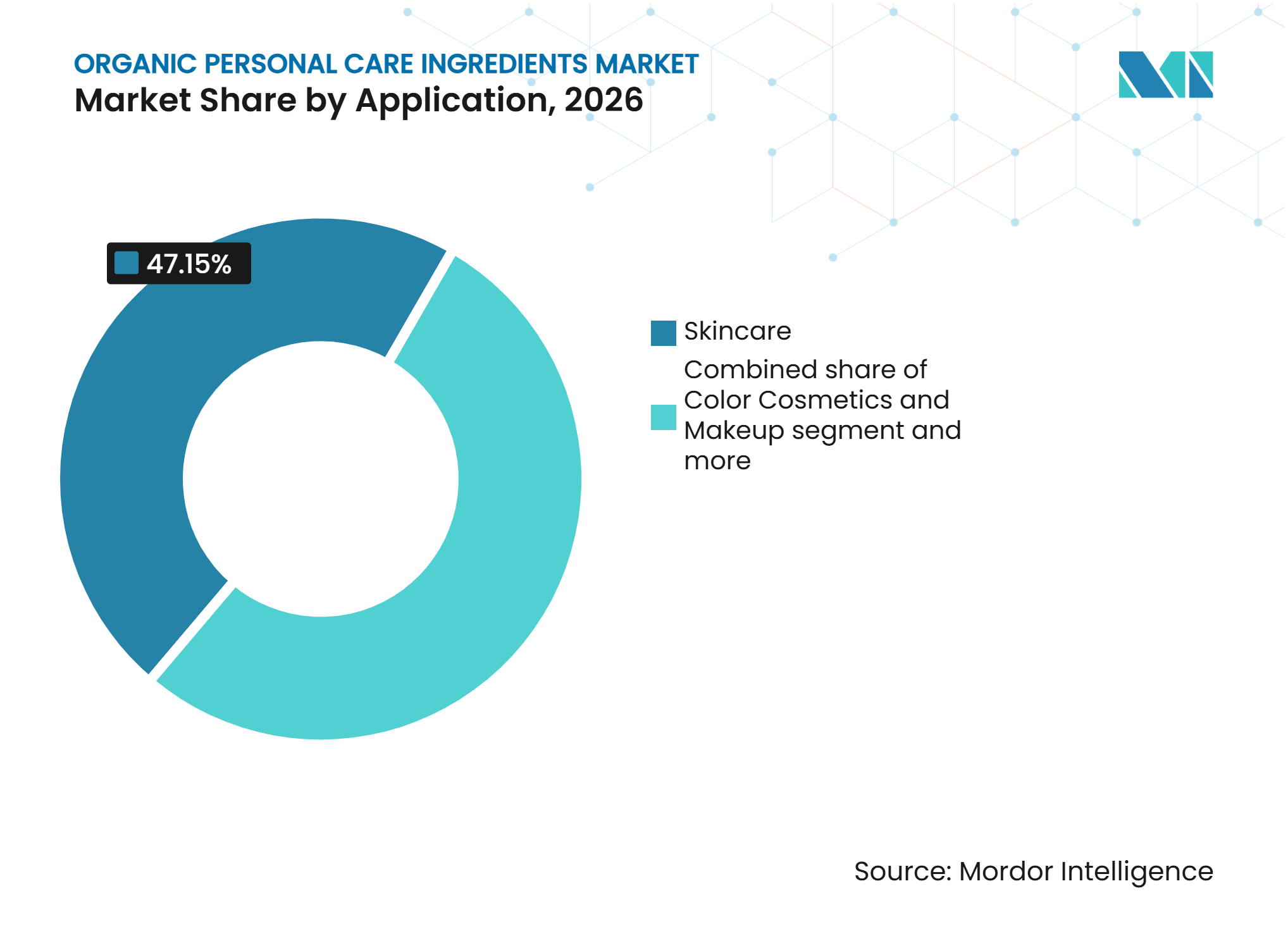
By application, Skincare accounted for the largest share of the organic personal care ingredients market, at 47.15% in 2026, while Color Cosmetics and Makeup are projected to grow at the fastest CAGR of 7.32% during 2027-2032.
-
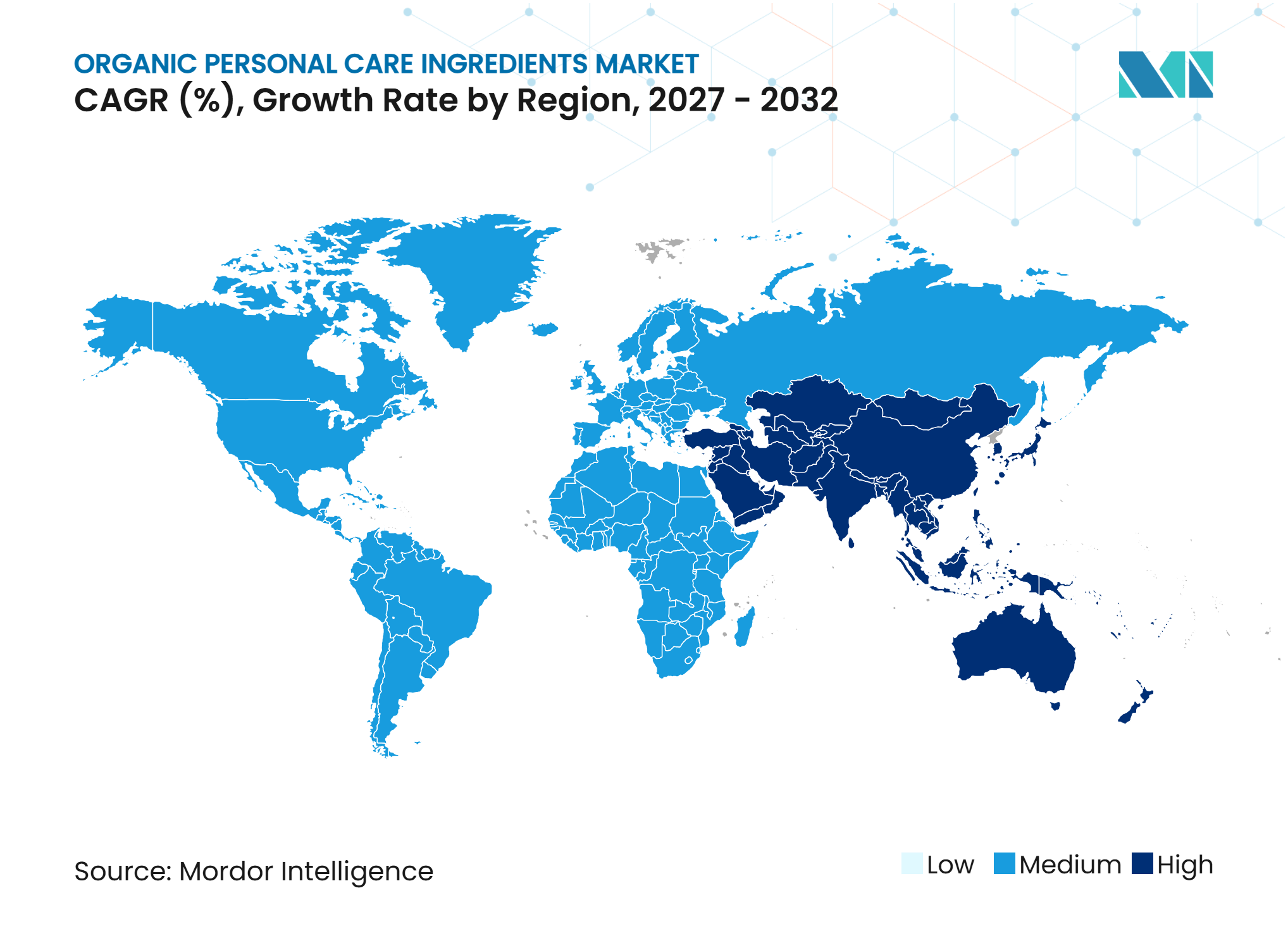
By geography, North America accounted for the largest share of the organic personal care ingredients market, at 35.14% in 2026, while Asia-Pacific is projected to grow at the fastest CAGR of 8.17% during 2027-2032.
Note: Market numbers in this report are based on Mordor Intelligence's proprietary estimation framework, which combines nine months of actuals with Q4 projections for base year 2026.
Market Trends and Insights
Drivers Impact Analysis of Organic Personal Care Ingredients Market*
| Driver | (~) % Impact on CAGR Forecast | Geographic Relevance | Impact Timeline |
|---|---|---|---|
| Clean-Label and Ingredient Transparency Demand | +2.0% | Global, with strongest relevance in North America and Western Europe | Short term (≤ 2 years) |
| Regulatory Substitution Away From Petrochemical Ingredients | +1.5% | Europe and the United Kingdom, with spillover to Asia-Pacific and North America | Medium term (2-4 years) |
| Premiumization of Clinically Substantiated Botanical Actives | +0.9% | North America, Europe, and South Korea | Medium term (2-4 years) |
| Natural Formulation Expansion in Skin Care and Hair Care | +1.2% | Global, with earlier-stage growth in Southeast Asia and India | Short term (≤ 2 years) |
| Precision Fermentation Reducing Botanical Crop Dependence | +0.7% | Global, led by European and North American research clusters | Long term (≥ 4 years) |
| Digital Traceability for Ingredient-Level Sustainability Claims | +0.5% | Asia-Pacific, with spillover to the Middle East, Africa, and South America | Medium term (2-4 years) |
| Source: Mordor Intelligence | |||
Clean-Label and Ingredient Transparency Demand
Consumer attention has moved beyond broad free-from claims toward sourcing records and third-party verification. In the 2025 NSF survey, only 9% of respondents fully trusted voluntary label claims, while 88% associated certified organic personal care products with physical benefits. The organic personal care ingredients market therefore favors suppliers that can provide audit-ready documents with their raw materials. COSMOS reported more than 34,000 certified finished products and 24,000 certified ingredients globally in 2025. Its Version 4.2 calculation method excludes water and minerals from the organic-content denominator, which makes the certified content of finished products more distinguishable. This raises the value of ingredients that are certified across multiple programs and supported by reliable provenance records.
Regulatory Substitution Away From Petrochemical Ingredients
European regulatory review is increasing attention to ingredient safety, environmental claims, and the compatibility of cosmetics rules with chemical regulation. The European Cosmetics Regulation review considers its connection with REACH, the Green Claims Directive, and biodiversity legislation, which adds scrutiny to formulation choices. NATRUE reported that the European Chemicals Agency Risk Assessment Committee recommended a stricter CMR 1B classification for tea tree oil[2]. The Scientific Committee on Consumer Safety issued a preliminary June 2025 opinion that supported defined concentration limits for tea tree oil, subject to ISO 4730:2017 conformity. These requirements may shift formulation work toward alternatives that meet safety, traceability, and labeling expectations. The organic personal care ingredients market can benefit when suppliers demonstrate that their botanical materials meet the applicable product and chemical requirements.
Premiumization of Clinically Substantiated Botanical Actives
Botanical ingredients with clinical support can command higher value than undifferentiated natural extracts. BASF introduced Ameriflor™ Calm in October 2025, using material from regenerative organic-certified farms in Oregon and production powered by 100% renewable electricity. BASF reported a 10% improvement in the appearance of skin redness versus placebo at 1% concentration in a 28-day clinical study. Symrise introduced SymRelief® green in March 2025, combining biotech-derived bisabolol and organic ginger extract with 100% natural-origin content under ISO 16128. These launches show how the organic personal care ingredients market is linking botanical origin with measurable product performance. The approach also narrows the group of suppliers able to meet both efficacy testing and certified-natural requirements.
Natural Formulation Expansion in Skin Care and Hair Care and Precision Fermentation
Skin care and hair care are replacing selected synthetic polymers, emulsifiers, and conditioning agents with bio-based alternatives. Ashland presented renewable, non-GMO, and non-microplastic alternatives to conventional film formers and emulsifiers at in-cosmetics Global 2025. Evonik presented RHEANCE® D50, a vegan biosurfactant made from European renewable feedstocks through fermentation and positioned for certified-natural cosmetics. Precision fermentation also offers a route to reduce dependence on crop harvests for selected high-value ingredients. A 2025 study published in Multidisciplinary Digital Publishing Institute reported hyaluronic acid yields above 7 g/L from engineered Bacillus subtilis and squalene yields of 20.80 g/L from engineered Pichia pastoris. The organic personal care ingredients market may increasingly value ingredients that reduce formulation complexity by providing more than one function in a certified-natural system.
Restraints Impact Analysis of Organic Personal Care Ingredients Market*
| Restraint | (~) % Impact on CAGR Forecast | Geographic Relevance | Impact Timeline |
|---|---|---|---|
| Agricultural Yield Volatility and Botanical Supply Disruptions | -0.9% | Global, with stronger exposure in Europe and Asia-Pacific | Short term (≤ 2 years) |
| Certification and Compliance Cost Across Fragmented Standards | -0.6% | Global, with a higher burden for small and medium-sized enterprises entering several markets | Medium term (2-4 years) |
| Narrow Preservation Windows in Organic Formulations | -0.4% | Global | Short term (≤ 2 years) |
| Traceability Exposure From Deforestation and Biodiversity Regulation | -0.5% | Europe directly, with spillover to North America and Asia-Pacific | Medium term (2-4 years) |
| Source: Mordor Intelligence | |||
Agricultural Yield Volatility and Botanical Supply Disruptions
The organic personal care ingredients market remains exposed to agricultural supply disruption because many inputs come from a limited group of growing regions. NATRUE identified sunflower oil supply concentration as a risk for natural cosmetics that use sunflower-derived materials. Droughts, floods, and trade volatility can also affect the availability and cost of olive oil and other botanical commodities. Certified formulations cannot always substitute a missing raw material quickly because the replacement must satisfy the same approved certification conditions. This can extend reformulation timelines and complicate production planning. Natural preservation systems add another constraint because they often require precise formulation conditions to maintain product protection.
Certification, Compliance, and Traceability Costs
Suppliers often need to meet separate requirements under COSMOS, NATRUE, NSF/ANSI 305, USDA Organic, and national market-entry systems. NSF/ANSI 305 requires at least 70% organic content by weight, while COSMOS ORGANIC requires at least 95% natural-origin ingredients and 20% organic content. A 2025 scientific review published in the National Library of Medicine described China’s separate notification pathway for new cosmetic ingredients outside the IECIC list. The European Union Deforestation Regulation also brings due diligence requirements for commodity-linked supply chains, including palm oil, cocoa, and soy derivatives[3]. These overlapping systems increase documentation, audit, and traceability costs. They can favor established suppliers but make market entry more difficult for smaller firms.
*Our forecasts treat driver/restraint impacts as directional, not additive. The impact forecasts reflect baseline growth, mix effects, and variable interactions.
Organic Personal Care Ingredients Market Segment Analysis
By Ingredient Type:
Essential Oils Lead While Natural Preservation Grows FastestEssential Oils and Natural Fragrances held 38.56% of the organic personal care ingredients market share in 2026. Their leading position reflects their ability to provide fragrance and bioactive characteristics within one input. The category is well established in premium skin care and hair care formulations, where sensory qualities remain important to product selection. Natural Oils and Butters are also central to the organic personal care ingredients industry because they provide emollient and occlusive functions previously supplied by petroleum-derived materials. Vitamins and Antioxidants, Proteins, Peptides, Polysaccharides, and Natural Colorants and Pigments serve the active and appearance-focused needs of formulations. Fermentation is increasingly supplementing conventional plant extraction for several of these materials. This broad functional role helps Essential Oils and Natural Fragrances retain their leading position.
Natural Preservatives and Antimicrobial Systems are projected to grow at a CAGR of 8.65% from 2027 to 2032. The segment benefits from efforts to replace conventional preservative systems in certified-natural products. Clariant launched Nipaguard™ SCE Vita in March 2025, combining 100% renewable Sorbitan Caprylate with naturally derived benzoic acid. The product was designed for natural-certified cosmetic formulations, which addresses a persistent formulation need. Botanical extracts such as eugenol, lavender hydrosol, and lichen metabolites can also provide antimicrobial and antioxidant functions. This supports their use as multifunctional options. The organic personal care ingredients market is rewarding preservation inputs that can support product safety without weakening natural certification claims.



By Source:
Plant-Based Ingredients Hold Scale While Fermentation Builds MomentumPlant-Based ingredients accounted for 49.33% of the organic personal care ingredients market size in 2026. Their scale rests on the wide availability of botanical raw materials and consumer familiarity with plant-derived INCI names. These materials form the foundation for many oils, butters, extracts, fragrances, and active ingredients used in personal care. Marine-Based ingredients remain a smaller segment, with differentiated algal polysaccharides and marine peptides. Sustainable harvesting limits and the need to standardize extracts can restrict their wider use. Animal-Derived inputs have a narrower role where vegan formulation policies or certification standards limit their compatibility. Plant-Based materials are likely to remain the principal source base because they fit both consumer expectations and existing formulation practices.
Microbial and Fermentation-Derived ingredients are forecast to expand at a CAGR of 7.43% from 2027 to 2032. Precision fermentation can provide high-value actives with less dependence on agricultural cycles. The 2025 Applied Sciences study published in Multidisciplinary Digital Publishing Institute estimated bioreactor production costs of USD 20-40/kg for fermentation-derived squalene, compared with USD 50-80/kg for olive-derived squalane. It also documented technical progress in hyaluronic acid and squalene production through engineered microorganisms. This cost and supply profile can make fermentation commercially useful for selected organic cosmetic actives. The technology does not remove the need for certification or ingredient safety review. It does, however, give suppliers another path to scale materials that are difficult to obtain consistently from crops.
By Application:
Skincare Holds the Largest Base While Color Cosmetics AccelerateSkincare captured 47.15% of organic personal care ingredients market share in 2026. The segment requires a broad set of oils, emollients, surfactants, botanical actives, antioxidants, and preservation systems. Brands are increasingly supporting botanical claims with in vivo and ex vivo evidence, which raises the specification requirements for ingredient suppliers. Hair care is the second-largest application, supported by bio-based surfactants and natural conditioning agents that can replace silicones and quaternary compounds. Oral care, baby care, and bath-and-shower products make up the remaining demand base. Baby care can require additional attention to safety and toxicological documentation. Skincare remains the largest application because it concentrates both high-value actives and a wide set of functional ingredients.
Color Cosmetics and Makeup are projected to expand at a CAGR of 7.32% from 2027 to 2032. Growth is supported by natural formulations that are improving finish, wear, and shade options. NATRUE reported that plant waxes, mineral pigments, and plant-based film formers are enabling natural mascaras with up to 12-hour wear. Tinted serums, skin tints, and hybrid SPF products bring together skincare and makeup functions. These products can require certified organic actives, natural colorants, and bio-derived film-forming agents in the same formulation. This can raise ingredient content per product. The organic personal care ingredients market is therefore gaining application demand from products that combine coverage, skin benefits, and natural positioning.

Geography Analysis
North America
North America held a 35.14% regional share in 2026. The United States supports regional demand through a developed clean beauty retail environment and greater attention to ingredient disclosure. The Modernization of Cosmetics Regulation Act framework has increased the commercial importance of safety substantiation and product documentation. BASF launched Ameriflor™ Calm in October 2025 from regenerative organic-certified farms in Oregon, showing investment in domestic botanical sourcing for selected actives. This can reduce import dependence for some inputs and strengthen supply resilience. Canada adds a separate compliance influence through Health Canada’s Cosmetic Ingredient Hotlist. Mexico provides access to agave- and hibiscus-derived materials, which gives formulators an additional regional sourcing option.
Asia-Pacific
Asia-Pacific is projected to grow at a CAGR of 8.17% from 2027 to 2032, the fastest rate in the organic personal care ingredients market. Rising disposable income, digital ingredient discovery, and familiarity with botanical wellness concepts support demand across the region. China is becoming increasingly important because its separate registration pathway is shaping the entry process for novel cosmetic ingredients. India offers a distinct pathway through the cultural standing of Ayurvedic and traditional botanical ingredients under AYUSH-related rules. In Southeast Asia, halal certification requirements, particularly in Indonesia and Malaysia, can sit alongside organic certification needs. Suppliers with documentation that addresses both requirements can create a clearer route to regional customers.
Europe, South America, and the Middle East and Africa
Europe remains influential because it sets many of the certification and compliance expectations used across the organic personal care ingredients market. The European Union Deforestation Regulation provides a compliance factor for ingredients connected to palm oil, cocoa, and soy supply chains. Germany, France, and the United Kingdom remain major demand centers for natural formulations. In 2026, Laboratoire Science et Nature and Nature et Stratégie combined to form Office Nature, bringing Centifolia Bio, Coslys, and Body Nature into one French group. South America is gaining attention as a source region for botanicals such as cupuaçu butter and tamanu oil. Brazil, Argentina, Colombia, and Peru offer biodiversity, while logistics can limit faster scaling. The Middle East and Africa remain earlier-stage markets where premium halal personal care demand provides a route for certified organic ingredients. South Africa and Nigeria are accessible entry points for distributors that can support product documentation and market education.
Competitive Landscape
Market Concentration

The organic personal care ingredients market reflects a moderate structure in which diversified specialty chemical groups and focused natural ingredient suppliers both compete without dominant control. BASF SE, Croda International Plc, Givaudan SA, Symrise AG, Evonik Industries AG, and dsm-firmenich AG form the enterprise group. These companies can combine manufacturing scale, regulatory resources, and investment in fermentation and green extraction. Evonik presented RHEANCE® D50 in 2025 as a fermentation-based biosurfactant from European renewable feedstocks. Symrise introduced SymRelief® green in 2025 as a natural-origin soothing complex that combines biotechnology and organic ginger extract. These moves show that performance evidence and sustainability provenance are becoming linked competitive requirements.
Specialists such as Provital Group, Indena S.p.A., Gattefossé SAS, Galaxy Surfactants Ltd., Stepan Company, Corbion N.V., Bio-Botanica Inc., Natura-Tec, Naolys, Ashland Inc., and Clariant AG compete in targeted ingredient categories. Their focus includes botanical actives, certified-organic surfactant systems, and fermentation-derived preservation solutions. Ashland’s 2025 natural platform technologies targeted renewable alternatives to conventional personal care ingredients. Clariant’s Nipaguard™ SCE Vita targeted preservation for natural-certified formulations. Suppliers that can meet COSMOS ORGANIC, NATRUE, NSF/ANSI 305, and halal requirements at the same time have a meaningful differentiation opportunity. Digital lot tracking and ingredient disclosure tools can also support faster compliance reviews before clinical testing.
Acquisition activity is consolidating specialist capabilities within the organic personal care ingredients market. Solabia Group acquired Mibelle Biochemistry in 2026, adding biotechnology-focused actives distributed across more than 50 countries. The transaction strengthens Solabia’s access to premium active ingredients and broader distribution. Roquette expanded its cosmetics activity in 2026 following its acquisition of IFF Pharma Solutions, integrating METHOCEL™, Avicel®, Aquacoat®, and alginate technologies into its plant-based offering. Sensient Beauty acquired BIOLIE in 2025 to add white biotechnology capabilities for natural active oils. Further consolidation is likely where large suppliers need specialized natural biotechnology or certification capabilities that would take longer to build internally.
Organic Personal Care Ingredients Industry Leaders
-
BASF SE
-
Croda International Plc
-
Givaudan SA
-
Symrise AG
-
Evonik Industries AG
- *Disclaimer: Major Players sorted in no particular order
Organic Personal Care Ingredients Market Companies Covered in this Report
- BASF SE
- Croda International Plc
- Givaudan SA
- Symrise AG
- Evonik Industries AG
- dsm-firmenich AG
- Ashland Inc.
- Clariant AG
- The Lubrizol Corporation
- Dow Inc.
- Solvay S.A.
- Kao Corporation
- Inolex Inc.
- Provital Group
- Indena S.p.A.
- Gattefoss� SAS
- Galaxy Surfactants Ltd.
- Stepan Company
- Corbion N.V.
- Bio-Botanica Inc.
- Natura-Tec
- Naolys
Recent Industry Developments in Organic Personal Care Ingredients Market
- October 2026: Solabia Group announced the acquisition of Mibelle Biochemistry from Persán, adding a Swiss portfolio of biotechnology-driven active ingredients distributed across more than 50 countries, strengthening Solabia's global distribution footprint in the premium cosmetic ingredient segment.
- April 2026: Symrise unveiled three natural innovations at in-cosmetics
- Global 2026: Cellexora® MD, Mindera® Euca, and SymConcentrole® Barrier Boost.
- March 2026: Roquette Beauté launched an enriched cosmetics portfolio following the 2025 acquisition of IFF Pharma Solutions, integrating METHOCEL™, Avicel®, Aquacoat®, and alginate technologies into its plant-based ingredient offering at in-cosmetics Global 2026 in Paris.
Global Organic Personal Care Ingredients Market Report Scope
Organic personal care ingredients are agricultural ingredients used in cosmetics or personal-care products that are produced, handled, processed, and labeled in accordance with recognized organic standards, typically without ingredients.
Segmentation Overview
| Essential Oils and Natural Fragrances |
| Natural Oils and Butters |
| Natural Surfactants and Emulsifiers |
| Natural Preservatives and Antimicrobial Systems |
| Botanical Extracts |
| Vitamins and Antioxidants |
| Proteins, Peptides, and Polysaccharides |
| Natural Colorants and Pigments |
| Plant-Based |
| Marine-Based |
| Microbial and Fermentation-Derived |
| Animal-Derived |
| Skin Care |
| Hair Care |
| Color Cosmetics and Makeup |
| Oral Care |
| Baby Care |
| Bath and Shower |
| North America | United States |
| Canada | |
| Mexico | |
| Rest of North America | |
| South America | Brazil |
| Argentina | |
| Colombia | |
| Chile | |
| Peru | |
| Rest of South America | |
| Europe | Germany |
| United Kingdom | |
| France | |
| Italy | |
| Spain | |
| Netherlands | |
| Poland | |
| Belgium | |
| Sweden | |
| Rest of Europe | |
| Asia-Pacific | China |
| India | |
| Japan | |
| Australia | |
| Indonesia | |
| Thailand | |
| Malaysia | |
| Singapore | |
| Rest of Asia-Pacific | |
| Middle East and Africa | South Africa |
| Egypt | |
| Nigeria | |
| Rest of Middle East and Africa |
| By Ingredient Type | Essential Oils and Natural Fragrances | |
| Natural Oils and Butters | ||
| Natural Surfactants and Emulsifiers | ||
| Natural Preservatives and Antimicrobial Systems | ||
| Botanical Extracts | ||
| Vitamins and Antioxidants | ||
| Proteins, Peptides, and Polysaccharides | ||
| Natural Colorants and Pigments | ||
| By Source | Plant-Based | |
| Marine-Based | ||
| Microbial and Fermentation-Derived | ||
| Animal-Derived | ||
| By Application | Skin Care | |
| Hair Care | ||
| Color Cosmetics and Makeup | ||
| Oral Care | ||
| Baby Care | ||
| Bath and Shower | ||
| By Geography | North America | United States |
| Canada | ||
| Mexico | ||
| Rest of North America | ||
| South America | Brazil | |
| Argentina | ||
| Colombia | ||
| Chile | ||
| Peru | ||
| Rest of South America | ||
| Europe | Germany | |
| United Kingdom | ||
| France | ||
| Italy | ||
| Spain | ||
| Netherlands | ||
| Poland | ||
| Belgium | ||
| Sweden | ||
| Rest of Europe | ||
| Asia-Pacific | China | |
| India | ||
| Japan | ||
| Australia | ||
| Indonesia | ||
| Thailand | ||
| Malaysia | ||
| Singapore | ||
| Rest of Asia-Pacific | ||
| Middle East and Africa | South Africa | |
| Egypt | ||
| Nigeria | ||
| Rest of Middle East and Africa | ||
Key Questions Answered in the Report
What is the projected growth rate for organic personal care ingredients?
The organic personal care ingredients market is projected to grow at a 6.29% CAGR from 2027 to 2032, reaching USD 18.57 billion by 2032. The expansion is tied to demand for documented sourcing, certified organic content, clearer ingredient disclosure, and the need to demonstrate safety and product performance.
Which ingredient type has the largest share in organic personal care formulations?
Essential Oils and Natural Fragrances lead with a 38.56% share in 2026. Their position reflects the ability to deliver scent and bioactive characteristics within one input, especially in premium skin care and hair care products where sensory performance affects product selection.
Which source segment is growing fastest for organic personal care ingredients?
Microbial and Fermentation-Derived ingredients are projected to record a 7.43% CAGR during 2027-2032. Fermentation offers a route to scale selected high-value actives with less dependence on crop harvest cycles and can improve supply consistency for materials that are difficult to source from agriculture alone.
Why are natural preservatives gaining adoption in cosmetic formulations?
Natural Preservatives and Antimicrobial Systems are forecast to grow at 8.65% CAGR as brands seek certified-natural product protection systems. Suppliers are developing multifunctional options that support preservation and antioxidant performance, helping formulators limit the number of separate inputs needed to meet product safety requirements.