
Organic Perfumes Market Size and Share
Market Overview
| Study Period | 2022 - 2032 |
|---|---|
| Market Size (2027) | USD 19.18 Billion |
| Market Size (2032) | USD 30.87 Billion |
| Growth Rate (2027 - 2032) | 9.98 % |
| Fastest Growing Market | Asia-Pacific |
| Largest Market | North America |
| Market Concentration | Low |
Major Players *Disclaimer: Major Players sorted in no particular order Image © Mordor Intelligence. Reuse requires attribution under CC BY 4.0. | |
Organic Perfumes Market Analysis by Mordor Intelligence
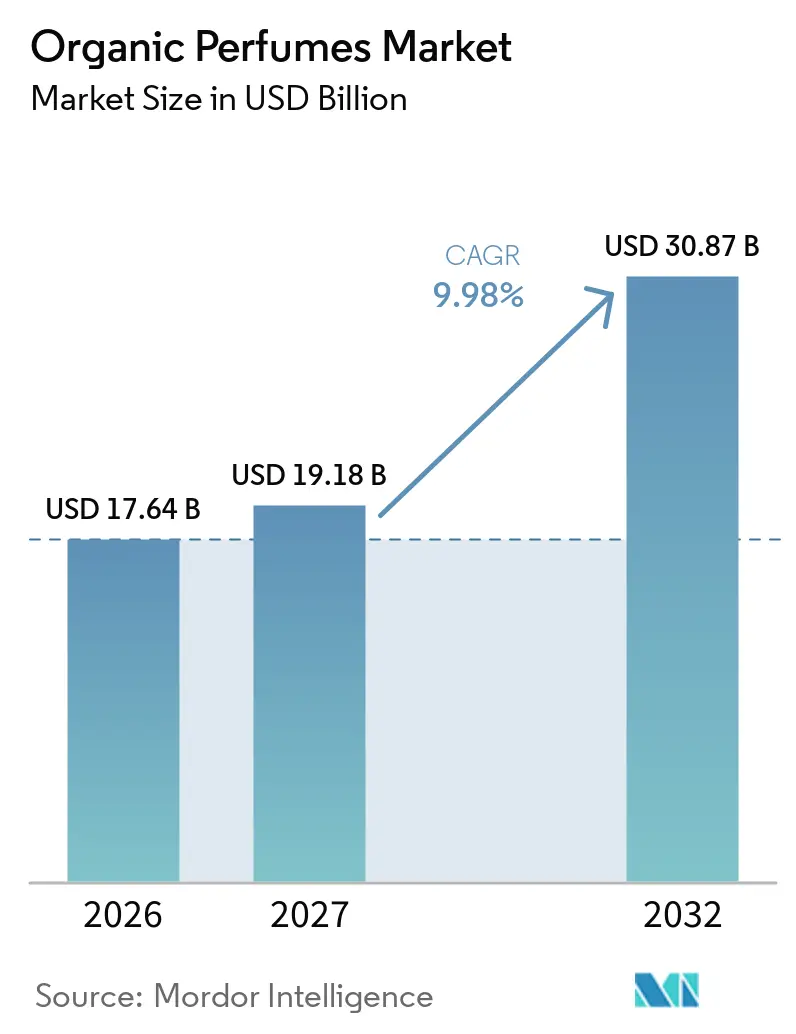
The organic perfumes market size is expected to grow from USD 17.64 billion in 2026 to USD 19.18 billion in 2027 and is forecast to reach USD 30.87 billion by 2032 at a 9.98% CAGR over 2027-2032. The market is experiencing steady growth, supported by increasing consumer preference for clean-label beauty products, naturally derived ingredients, and sustainable fragrance formulations. Rising awareness of ingredient transparency and product safety is encouraging manufacturers to incorporate organic and naturally sourced components into their fragrance offerings. The growing integration of fragrance into personal care and wellness routines is further supporting market demand, while evolving consumer preferences are driving interest in diverse fragrance profiles and formulations. Expanding digital retail channels and improved product accessibility are also strengthening market penetration by facilitating product discovery and purchase convenience. Additionally, continued innovation in natural ingredient sourcing, extraction technologies, and fragrance formulation is broadening product development opportunities and supporting the market's long-term expansion.
Key Report Takeaways
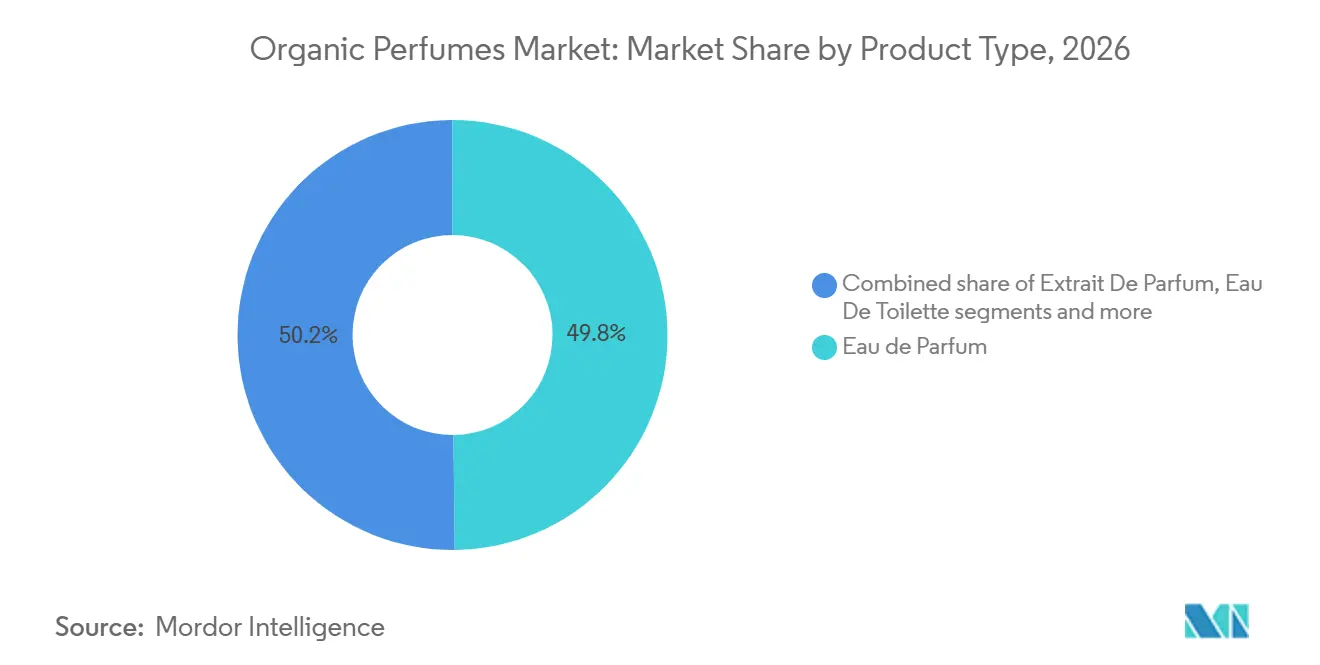
- By product type, Eau de Parfum held 49.83% of organic perfumes market share in 2026, while Extrait de Parfum is forecast to grow at an 11.62% CAGR from 2027 to 2032.
- By price tier, Premium held 63.31% of organic perfumes market share in 2026 and is forecast to grow at an 11.78% CAGR from 2027 to 2032.
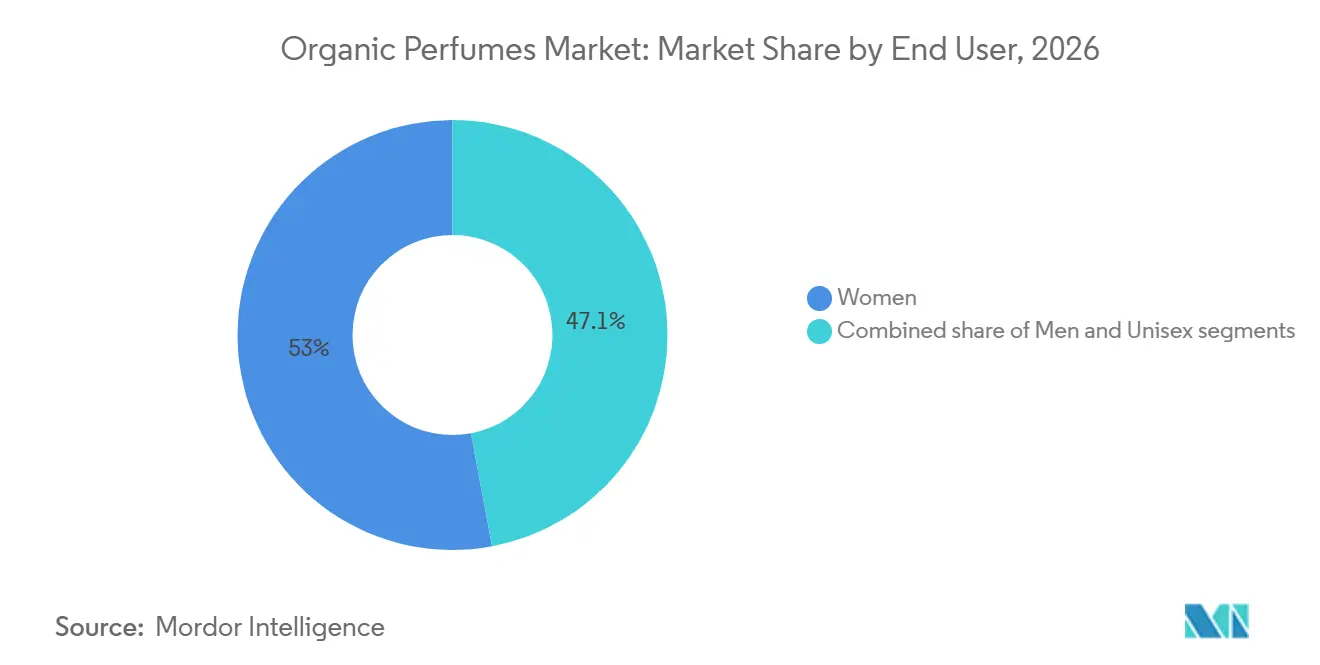
- By end user, Women held 52.95% share in 2026, while Unisex is forecast to grow at an 11.39% CAGR from 2027 to 2032.
- By distribution channel, Specialty Stores held 39.78% share in 2026, while Online Retail is forecast to grow at a 12.14% CAGR from 2027 to 2032.
- By geography, North America held 43.94% share in 2026, while Asia-Pacific is forecast to grow at an 11.53% CAGR from 2027 to 2032.
Note: Market numbers in this report are based on Mordor Intelligence's proprietary estimation framework, which combines nine months of actuals with Q4 projections for base year 2026.
Market Trends and Insights
Drivers Impact Analysis of Organic Perfumes Market*
| Driver | (~) % Impact on CAGR Forecast | Geographic Relevance | Impact Timeline |
|---|---|---|---|
| Growing demand for clean and transparent fragrance formulations | +1.5% | Global; highest intensity in North America and Northern Europe | Short term (≤ 2 years) |
| Increasing willingness to pay premiums for certified organic fragrances | +2.2% | North America and Western Europe; emerging in Asia premium urban markets | Medium term (2–4 years) |
| Expansion of digital fragrance discovery and social commerce | +1.8% | Global; most acute in Asia-Pacific (TikTok-led markets) and North America | Short term (≤ 2 years) |
| Growing adoption of refillable and sustainable perfume packaging | +1.0% | Europe (regulatory-driven); North America | Medium term (2–4 years) |
| Rising demand for wellness-oriented and aromatherapy fragrances | +1.4% | Global; concentrated in North America and Asia-Pacific urban centres | Medium term (2–4 years) |
| Advancements in biotechnology-enabled natural fragrance ingredients | +0.8% | Global; commercialization led in Europe and North America | Long term (≥ 4 years) |
| Source: Mordor Intelligence | |||
Growing Demand for Clean and Transparent Fragrance Formulations
Increasing consumer awareness of product composition and ingredient safety is encouraging demand for cleaner and more transparent fragrance formulations. NSF (National Sanitation Foundation) reported that 74% of Canadian consumers consider organic ingredients important in personal care products, and 65% want clear ingredient lists[1]. The findings highlight the growing importance of ingredient visibility and formulation transparency in personal care purchasing decisions. This preference is encouraging manufacturers to provide clearer information about product composition and incorporate more recognisable ingredients into their formulations. Consequently, ingredient transparency is becoming an increasingly important consideration in fragrance product development and consumer purchasing preferences.
Increasing Willingness to Pay Premiums for Certified Organic Fragrances
Growing consumer interest in product quality, ingredient authenticity, and organic credentials is creating greater willingness to pay premium prices for certified personal care products. According to a March 2025 survey by NSF (National Sanitation Foundation), 45% of American consumers are willing to pay more for certified personal care products containing organic ingredients, with this proportion increasing to 62% among consumers aged 18–29[2]. These findings indicate that credible organic credentials can strengthen perceived product value and support consumer acceptance of higher prices. This willingness to pay for certified organic personal care products creates favourable conditions for premium positioning in the organic perfumes market, particularly as consumers increasingly associate certification with product quality and ingredient authenticity.
Expansion of Digital Fragrance Discovery and Social Commerce
The increasing influence of digital platforms on consumer product discovery and purchasing is creating new opportunities for organic perfume brands to expand their reach and engage potential buyers. According to a February 2026 study by the Retailers Association of India (RAI), conducted in collaboration with Meta, social media influences 77% of retail purchase decisions, highlighting the growing role of digital content and creator-led engagement in consumer shopping journeys[3]. In the fragrance industry, platforms such as Instagram, TikTok, and YouTube are facilitating product discovery through fragrance reviews, recommendations, demonstrations, and user-generated content. These developments are strengthening the role of digital channels in building product awareness, encouraging fragrance exploration, and supporting online purchasing.
Growing Adoption of Refillable and Sustainable Perfume Packaging
Increasing environmental awareness and growing interest in resource-efficient consumption are encouraging the adoption of refillable and sustainable packaging across the fragrance industry. Consumers and manufacturers are increasingly recognising the potential of reusable perfume bottles, refill formats, recycled materials, and lightweight packaging to reduce packaging waste and resource consumption. This shift is encouraging fragrance brands to rethink conventional single-use packaging and incorporate refill systems into their product offerings. Refillable formats also allow consumers to retain their original perfume bottles while replenishing the fragrance, supporting repeated product use and reducing the need for complete packaging replacement. These developments are strengthening the integration of circular packaging practices into fragrance product design and supporting the market's transition towards more sustainable packaging solutions.
Restraints Impact Analysis of Organic Perfumes Market*
| Restraint | (~) % Impact on CAGR Forecast | Geographic Relevance | Impact Timeline |
|---|---|---|---|
| Seasonal volatility in botanical raw material supply | -0.5% | Global; most acute in Southern Europe (lavender, rose) and South Asia (sandalwood, vetiver) | Short term (≤ 2 years) |
| Allergen-related safety risks in natural fragrance ingredients | -0.7% | Europe (regulatory focus); North America; spill-over to Asia-Pacific and Middle East and Africa | Medium term (2–4 years) |
| Fragmented organic certification and labelling requirements | -0.3% | Global; cross-border complexity most acute for multi-region brands | Medium term (2–4 years) |
| Regulatory changes affecting fragrance ingredient classification and compliance | -0.4% | Europe (primary); North America (secondary, via retailer restricted-substance lists) | Long term (≥ 4 years) |
| Source: Mordor Intelligence | |||
Seasonal Volatility in Botanical Raw Material Supply
The organic perfumes market is dependent on the availability of botanical raw materials, making production vulnerable to seasonal variations and fluctuations in agricultural output. The cultivation and harvesting of natural fragrance ingredients are influenced by weather conditions, temperature changes, rainfall patterns, and crop cycles, which can affect both raw material availability and quality. Variations in harvest volumes may create inconsistencies in sourcing and procurement, requiring manufacturers to manage inventory and maintain alternative supply arrangements. Furthermore, the dependence on specific growing seasons can complicate production planning and procurement schedules. These factors can create uncertainty in raw material sourcing, affect production continuity, and influence the overall cost structure of organic perfume manufacturing.
Allergen-Related Safety Risks in Natural Fragrance Ingredients
The use of naturally derived fragrance ingredients presents safety considerations associated with the presence of allergenic compounds in botanical extracts and essential oils. Certain naturally occurring substances can trigger skin sensitisation, allergic reactions, or irritation among susceptible consumers, making ingredient selection and formulation management important considerations for manufacturers. The concentration and composition of these compounds can also vary depending on the botanical source, extraction method, and processing conditions, creating additional challenges in maintaining consistent product formulations. Manufacturers must therefore carefully assess ingredient safety and manage allergen exposure while developing fragrance products. These considerations can increase formulation complexity, necessitate additional testing, and constrain the use of certain natural ingredients in organic perfume formulations.
*Our forecasts treat driver/restraint impacts as directional, not additive. The impact forecasts reflect baseline growth, mix effects, and variable interactions.
Organic Perfumes Market Segment Analysis
By Product Type:
Concentrated Formulas Reshape the Value PropositionEau de parfum holds the largest share of the organic perfumes market, accounting for 49.83% in 2026. Its leading position is supported by established consumer familiarity and its balance between fragrance concentration, scent longevity, and everyday usability. The format appeals to consumers seeking lasting fragrance performance while maintaining versatility across different occasions. Its established presence in the broader fragrance industry and suitability for diverse consumer preferences further support its market position. Continued demand for versatile fragrance formulations is expected to sustain the segment's leading contribution to market revenue.
Extrait de parfum is the fastest-growing product type, registering a projected CAGR of 11.62% during 2027–2032. Growth is supported by increasing consumer interest in concentrated fragrance formulations that offer greater scent intensity and longer-lasting performance. The segment also benefits from demand for distinctive fragrance experiences and formulations with higher perceived product value. Manufacturers are increasingly focusing on formulation development and ingredient innovation to improve fragrance performance and expand product offerings. These factors are expected to support the segment's growth over the forecast period.

By Price Tier:
Premium Dominates, Mass Remains the Underdeveloped FrontierThe premium price tier holds the largest share of the organic perfumes market, accounting for 63.31% in 2026, and is also the fastest-growing segment, registering a projected CAGR of 11.78% during 2027–2032. Its leading position reflects consumer preference for higher-value fragrance products and the perceived quality associated with organic formulations. Demand is further supported by interest in differentiated fragrance experiences, product quality, and specialised formulations. Continued consumer interest in premium beauty products is expected to sustain the segment's strong market position and growth.
The mass price tier represents an opportunity for broader market penetration as awareness and acceptance of organic fragrance products increase. Growing availability of organic formulations and continued product development may improve accessibility across different consumer groups. Manufacturers can support expansion in this segment by introducing more affordable offerings while maintaining product quality and formulation standards. Increasing familiarity with organic personal care products is also expected to support wider consumer adoption, contributing to the segment's development over the forecast period.
By End User:
Gendered Demand Transitions Toward Identity-Led FragranceThe women segment holds the largest share of the organic perfumes market, accounting for 52.95% in 2026. Its leading position reflects established demand for fragrance and personal care products among female consumers, alongside growing interest in ingredient transparency and naturally derived formulations. Consumer preference for organic beauty products and greater attention to product composition further support demand within this segment. The established role of fragrance in personal care routines is expected to sustain women's contribution to the organic perfumes market.
The unisex segment is the fastest-growing end-user category, registering a projected CAGR of 11.39% during 2027–2032. Its growth is supported by changing consumer preferences towards fragrance products that are not restricted by traditional gender classifications. Increasing interest in individual expression and personalised fragrance choices is encouraging demand for versatile scent profiles. Manufacturers are responding to this shift by developing fragrance offerings that appeal to a wider consumer base, supporting the expansion of unisex organic perfumes.
By Distribution Channel:
Physical Trial Anchors Share, Digital Rewrites GrowthSpecialty stores hold the largest distribution share of the organic perfumes market, accounting for 39.78% in 2026. Their leading position is supported by the importance of in-person product evaluation and personalised purchasing experiences in fragrance selection. These outlets allow consumers to explore different scent profiles, assess product characteristics, and receive guidance during purchasing decisions. Their specialised product assortments and focused customer engagement further strengthen their relevance in the distribution of organic perfumes. Continued preference for direct product evaluation is expected to support the segment's leading market position.
Online retail is the fastest-growing distribution channel, registering a projected CAGR of 12.14% during 2027–2032. Growth is supported by increasing digital shopping adoption and the expanding availability of fragrance products through online platforms. Digital channels provide consumers with convenient access to diverse product offerings, detailed product information, and customer reviews. The growing use of digital marketing and online product discovery is also helping manufacturers reach broader consumer groups. These factors are expected to strengthen online retail's contribution to the organic perfumes market over the forecast period.
Geography Analysis
North America
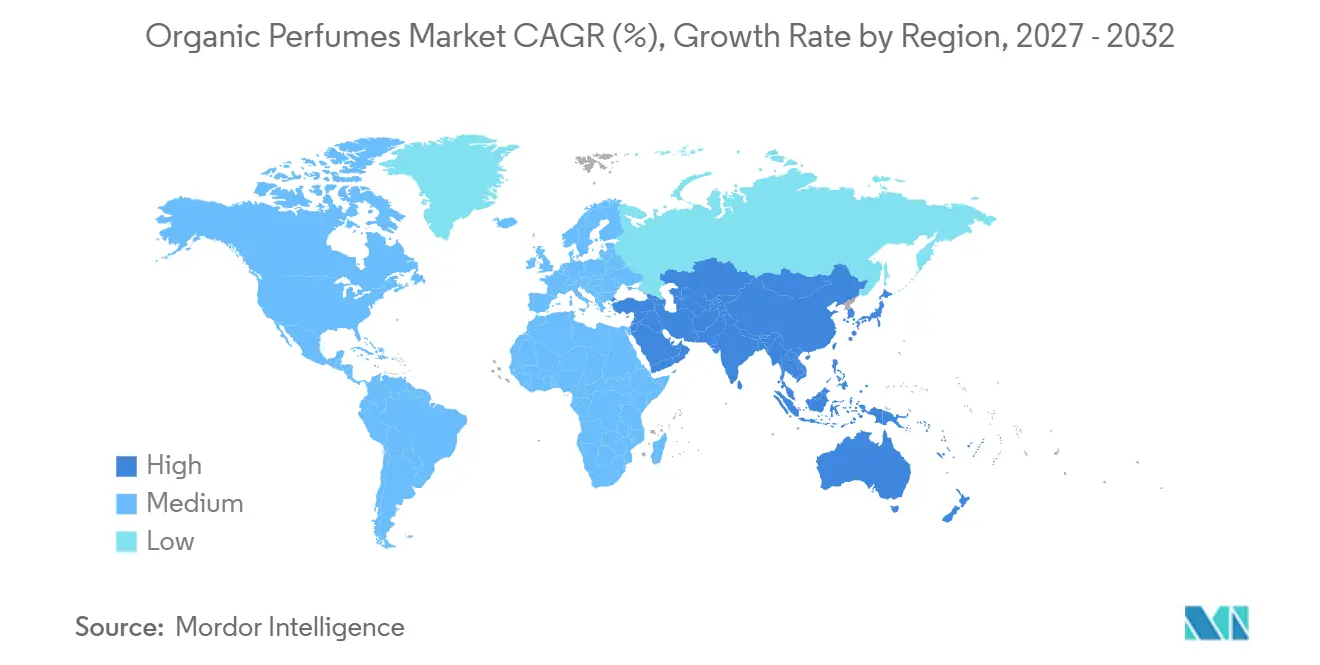
North America holds the largest share of the organic perfumes market, accounting for 43.94% in 2026. The region's leading position is supported by growing consumer awareness of clean beauty products, increasing preference for naturally derived ingredients, and established demand for premium personal care offerings. Rising interest in product transparency and evolving fragrance preferences are further supporting market adoption. The growing presence of specialised retail channels and expanding digital purchasing opportunities are also improving product accessibility and consumer engagement. Additionally, continued innovation in organic fragrance formulations and increasing interest in sustainable beauty products are expected to support regional market growth.
Asia-Pacific
Asia-Pacific is the fastest-growing regional market for organic perfumes, registering a projected CAGR of 11.53% during 2027–2032. Growth is supported by increasing consumer awareness of organic personal care products, rising disposable incomes, and expanding adoption of premium beauty offerings. Growing digital retail penetration and changing consumer purchasing preferences are further improving access to fragrance products and supporting market expansion. Additionally, increasing interest in naturally derived ingredients and evolving personal care routines are contributing to the adoption of organic fragrances. Continued development of retail infrastructure and expanding consumer awareness are expected to sustain regional market growth over the forecast period.
Europe, South America, and Middle East and Africa
Europe's organic perfumes market is supported by established demand for natural beauty products, strong consumer awareness of ingredient composition, and a well-developed cosmetics industry. Growing interest in organic personal care offerings and established fragrance consumption patterns are further supporting market development. South America is experiencing increasing interest in premium beauty products and naturally derived ingredients, supported by evolving consumer preferences and expanding access to specialised personal care offerings. Meanwhile, the Middle East and Africa market benefits from established fragrance consumption patterns and growing interest in premium and natural fragrance products. Improving retail accessibility, expanding digital commerce, and rising consumer awareness of organic beauty formulations are creating further opportunities across these regions.
Competitive Landscape
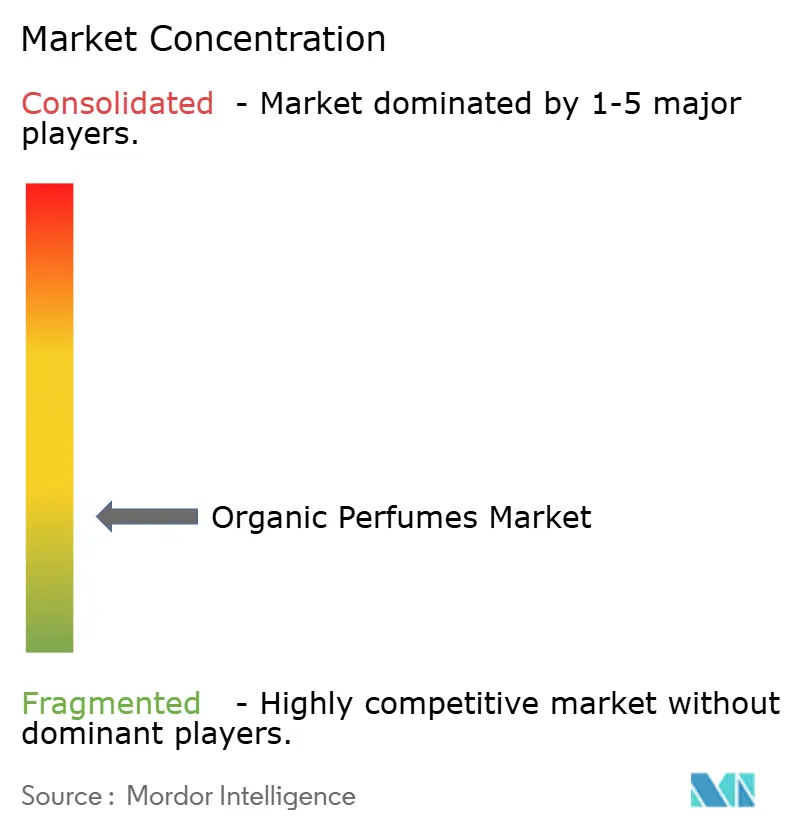
The organic perfumes market is fragmented, with competition distributed across established fragrance companies, organic personal care brands, and specialist natural perfume manufacturers. Market participants compete through product formulation, organic certification, ingredient sourcing, brand positioning, and distribution reach. Key companies operating in the market include Florame, Nocibé, Terre d'Oc Evolution, Fleurance Nature, and Berdoues Parfums et Cosmétiques. These companies participate through differentiated fragrance portfolios and established positions across specialised beauty, personal care, and retail channels.
Leading players focus on strengthening their market positions through product portfolio development, formulation improvements, brand positioning, and distribution expansion. Established companies leverage their experience in fragrance development and personal care products to address consumer demand for naturally derived ingredients and organic formulations. Their competitive strategies also involve maintaining product quality, strengthening retail relationships, and expanding access to consumers through online and offline channels.
Emerging opportunities are concentrated among smaller specialist brands and companies developing certified organic fragrances, naturally derived formulations, and differentiated product offerings. These participants can build market presence by addressing demand for ingredient transparency, distinctive fragrance profiles, and accessible organic products. Partnerships with ingredient suppliers and expansion through specialised retail and online distribution channels can further support their market entry and development. Brands positioned between premium specialist fragrances and mass-market products may also find opportunities to reach a wider consumer base.
Organic Perfumes Industry Leaders
-
Florame
-
Nocibé
-
Terre d'Oc Evolution
-
Fleurance Nature
-
Berdoues Parfums et Cosmétiques
- *Disclaimer: Major Players sorted in no particular order
Organic Perfumes Market Companies Covered in this Report
- Comptoir des Lys
- Florame
- Surfcloud Lda
- Nocibé
- Terre d'Oc Evolution
- Tadé Pays du Levant
- Secrets d'Aloyse
- Laboratoires Bio Seasons
- Flora S.r.l.
- Fleurance Nature
- Berdoues Parfums et Cosmétiques
- Les Douces Angevines
- Maison Osiris
- Parfums par Nature La Production
- Derme&Co
- LUB & FLOR SARL
- Fleur d'Armille
- Comme Avant
- Le Secret Naturel
- Laboratoire Aimée
Recent Industry Developments in Organic Perfumes Market
- April 2026: Vanessa Megan launched its first Eau de Parfum collection, converting six of its existing botanical fragrances into longer-lasting alcohol-based perfumes. The formulations use certified organic ingredients and certified organic sugarcane alcohol, with no synthetic fragrance ingredients.
- August 2025: Aaron Terence Hughes relaunched its fragrance brand under the Reborn identity, introducing Hombre, a COSMOS-certified organic Extrait de Parfum with 35% fragrance concentration. The launch also included new packaging formats and an expanded organic personal care range.
Global Organic Perfumes Market Report Scope
The organic perfumes market covers fragrances formulated using naturally derived and organically sourced ingredients, catering to consumers seeking alternatives to conventional fragrance products. The market is segmented by product type, including Extrait de Parfum, Eau de Parfum, Eau de Toilette, and more; price tier, including mass and premium; end user, including women, men, and unisex; distribution channel, including supermarkets/hypermarkets, specialty stores, online retail stores, and more; and geography, including North America, Europe, Asia-Pacific, South America, and the Middle East and Africa. Forecasts are provided in value, measured in USD.
Segmentation Overview
| Extrait De Parfum |
| Eau De Parfum |
| Eau De Toilette |
| Eau De Cologne |
| Others |
| Mass |
| Premium |
| Women |
| Men |
| Unisex |
| Supermarkets/Hypermarkets |
| Specialty Stores |
| Online Retail Stores |
| Other Distribution Channels |
| North America | United States |
| Canada | |
| Mexico | |
| Rest of North America | |
| Europe | Germany |
| United Kingdom | |
| Italy | |
| France | |
| Spain | |
| Netherlands | |
| Poland | |
| Belgium | |
| Sweden | |
| Rest of Europe | |
| Asia-Pacific | China |
| India | |
| Japan | |
| Australia | |
| Indonesia | |
| South Korea | |
| Thailand | |
| Singapore | |
| Rest of Asia-Pacific | |
| South America | Brazil |
| Argentina | |
| Colombia | |
| Chile | |
| Peru | |
| Rest of South America | |
| Middle East and Africa | South Africa |
| Saudi Arabia | |
| United Arab Emirates | |
| Nigeria | |
| Egypt | |
| Morocco | |
| Turkey | |
| Rest of Middle East and Africa |
| By Product Type | Extrait De Parfum | |
| Eau De Parfum | ||
| Eau De Toilette | ||
| Eau De Cologne | ||
| Others | ||
| By Price Tier | Mass | |
| Premium | ||
| By End User | Women | |
| Men | ||
| Unisex | ||
| By Distribution Channel | Supermarkets/Hypermarkets | |
| Specialty Stores | ||
| Online Retail Stores | ||
| Other Distribution Channels | ||
| By Geography | North America | United States |
| Canada | ||
| Mexico | ||
| Rest of North America | ||
| Europe | Germany | |
| United Kingdom | ||
| Italy | ||
| France | ||
| Spain | ||
| Netherlands | ||
| Poland | ||
| Belgium | ||
| Sweden | ||
| Rest of Europe | ||
| Asia-Pacific | China | |
| India | ||
| Japan | ||
| Australia | ||
| Indonesia | ||
| South Korea | ||
| Thailand | ||
| Singapore | ||
| Rest of Asia-Pacific | ||
| South America | Brazil | |
| Argentina | ||
| Colombia | ||
| Chile | ||
| Peru | ||
| Rest of South America | ||
| Middle East and Africa | South Africa | |
| Saudi Arabia | ||
| United Arab Emirates | ||
| Nigeria | ||
| Egypt | ||
| Morocco | ||
| Turkey | ||
| Rest of Middle East and Africa | ||
Key Questions Answered in the Report
What is the projected value of the organic perfumes market by 2032?
The category is forecast to reach USD 30.87 billion by 2032, expanding at a 9.98% CAGR from 2027 to 2032.
Which product format leads organic fragrance sales?
Eau de Parfum led with a 49.83% share in 2026, while Extrait de Parfum is forecast to grow at an 11.62% CAGR through 2032.
Which sales channel is growing fastest for organic perfume brands?
Online Retail is projected to expand at a 12.14% CAGR from 2027 to 2032.
Which region is expected to record the fastest growth?
Asia-Pacific is forecast to grow at an 11.53% CAGR from 2027 to 2032.