
Oregano Seasoning Market Size and Share
Market Overview
| Study Period | 2022 - 2032 |
|---|---|
| Market Size (2027) | USD 254.37 Million |
| Market Size (2032) | USD 391.27 Million |
| Growth Rate (2027 - 2032) | 9.01 % |
| Fastest Growing Market | Europe |
| Largest Market | North America |
| Market Concentration | Medium |
Major Players *Disclaimer: Major Players sorted in no particular order Image © Mordor Intelligence. Reuse requires attribution under CC BY 4.0. | |
Oregano Seasoning Market Analysis by Mordor Intelligence
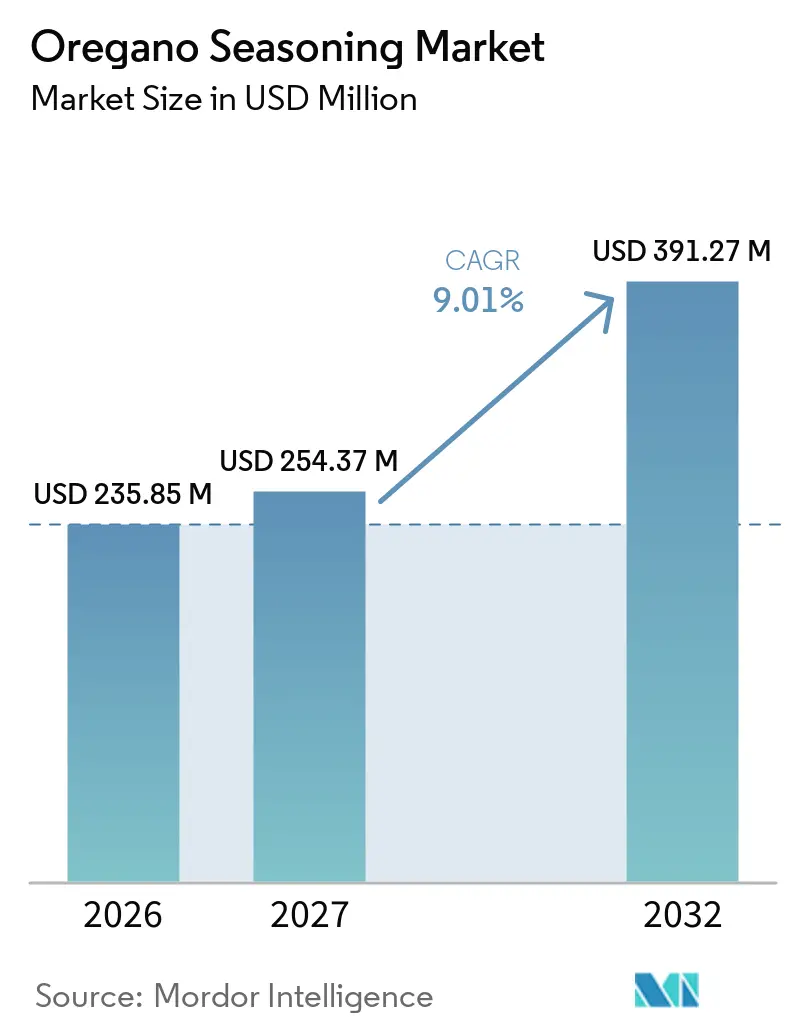
The oregano seasoning market size is projected to expand from USD 235.85 million in 2026 and USD 254.37 million in 2027 to USD 391.27 million by 2032, and is expected to grow at a CAGR of 9.01% from 2027 to 2032. Mediterranean and Italian dishes have become everyday menu choices in North American and European restaurants, which supports recurring demand for oregano in pizza, pasta, marinades, salads, and dips. Processed-food producers are also using oregano in shelf-stable foods and seasoning systems, giving suppliers a demand base that is less dependent on retail purchases alone. Clean-label requirements are raising the value of products with clear origin records and reliable quality controls. The oregano seasoning market also faces a supply risk because weather disruption in Turkey can affect availability and procurement costs for buyers that depend on a limited number of origins. Product authentication has become a commercial issue as well as a food-safety issue, since verified suppliers can protect their pricing and maintain access to industrial customers.
Key Report Takeaways
- By form, ground oregano held 67.49% revenue share in 2026 in the oregano seasoning market, while flakes are projected to grow at a 10.25% CAGR through 2032.
- By category, conventional oregano accounted for 66.48% of 2026 value in the oregano seasoning market, while organic oregano is forecast to expand at an 11.24% CAGR through 2032.
- By end user, retail held 65.38% of the oregano seasoning market share in 2026, while industrial use is projected to grow at a 10.78% CAGR through 2032.
- By geography, North America accounted for 45.38% of 2026 value in the oregano seasoning market, while Europe is forecast to advance at an 11.36% CAGR through 2032.
Note: Market numbers in this report are based on Mordor Intelligence's proprietary estimation framework, which combines nine months of actuals with Q4 projections for base year 2026.
Global Oregano Seasoning Market Trends and Insights
Drivers Impact Analysis*
| Driver | (~) % Impact on CAGR Forecasts | Geographic Relevance | Impact Timeline |
|---|---|---|---|
| Growing popularity of Italian and Mediterranean cuisine | +2.5% | North America, Europe, APAC emerging | Medium term (2–4 years) |
| Increasing demand for convenient and ready-to-use seasonings | +1.8% | Global, with strongest gains in North America and Europe | Short term (≤ 2 years) |
| Rising use of oregano in processed foods and ready meals | +1.5% | Europe, North America, growing in APAC | Medium term (2–4 years) |
| Increasing demand for natural herbs and spices | +1.2% | Europe and North America core; spill-over to MEA | Medium term (2–4 years) |
| Expansion of the foodservice industry and quick-service restaurants | +1.0% | Global, with intensity in North America and APAC | Short term (≤ 2 years) |
| Rising demand for clean-label seasoning formulations | +0.8% | North America and EU, spill-over to APAC | Long term (≥ 4 years) |
| Source: Mordor Intelligence | |||
Growing Popularity of Italian and Mediterranean Cuisine
Mediterranean cuisine is now a regular part of foodservice menus in North America and Europe, supporting steady use of oregano as a core herb. CAVA exceeded USD 1 billion in annual sales in 2025, expanded its unit count by nearly 19%, and reported same-store sales growth of nearly 11% in its most recent quarter. The same category momentum was visible in 2025 sales growth at Nick the Greek, Great Greek Mediterranean Grill, and Spitz Mediterranean Street Food. This restaurant activity broadens oregano demand because the herb appears in a wide range of dishes rather than a narrow group of specialty products. Foodservice expansion also supports demand for bulk formats used in kitchens, pizza operations, and seasoning mixes.
Increasing Demand for Convenient and Ready-to-Use Seasonings
Consumers are choosing formats that remove the need to combine several herbs before cooking, which supports demand for dried and ready-to-use oregano products. UK spending on dried herbs and spices rose by GBP 27.80 million in 2025, while volume increased 4.40%, even as jarred cooking-sauce volume declined by 4.20 million kilos. Ground and flaked oregano fit this behavior because they are easy to use in home cooking, meal kits, and sachet-based recipes. Convenience demand is therefore relevant to both retail jars and the commercial blends used by food manufacturers. This pattern gives the oregano seasoning market a route to growth through simple formats that suit inexperienced and time-constrained cooks.
Rising Use of Oregano in Processed Foods and Ready Meals
Oregano offers flavor stability during processing and can support natural ingredient positioning in processed foods and ready meals. McCormick reported Flavor Solutions operating profit of USD 359 million in fiscal 2025, up 9.00% year over year, supported by demand for customized flavor solutions from food manufacturers. German food manufacturer Dr. Oetker produces close to 3 million frozen pizzas annually in its German facilities, illustrating the industrial scale at which oregano can be used in prepared foods[1]. These applications create recurring purchasing needs through supply contracts and make industrial demand less exposed to short-term changes in household buying. The oregano seasoning market gains a more stable demand base when suppliers serve bakery, sauce, meat, and ready-meal producers.
Increasing Demand for Natural Herbs and Spices
Ingredient scrutiny is moving herb procurement toward products with reliable source records and certification. An AstraRicerche survey for Cannamela found that 65.50% of Italian consumers had increased herb and spice use over 5 years, with oregano among the 3 most-used herbs. This consumer preference supports organic products and makes traceability more important in conventional supply as well. Clean-label seasoning formulations add to this requirement, particularly in North America and the European Union. The oregano seasoning market can benefit when buyers prioritize verified ingredients rather than choosing only on price. Stronger documentation also helps suppliers address food-manufacturing procurement standards and retailer quality requirements.
Restraints Impact Analysis*
| Restraint | (~) % Impact on CAGR Forecasts | Geographic Relevance | Impact Timeline |
|---|---|---|---|
| Adulteration and quality inconsistencies in oregano products | -1.5% | Europe (highest risk), North America, Global supply chains | Short term (≤ 2 years) |
| Fluctuations in the prices of oregano and other raw material costs | -1.2% | Global, concentrated in Turkey-dependent supply chains | Short term (≤ 2 years) |
| Competition from other herbs and seasoning alternatives | -1.0% | North America and Europe | Medium term (2–4 years) |
| Price competition from low-cost seasoning blends and substitutes | -0.8% | Price-sensitive channels globally; especially APAC and South America | Medium term (2–4 years) |
| Source: Mordor Intelligence | |||
Adulteration and Quality Inconsistencies in Oregano Products
Oregano is exposed to adulteration risk, which can weaken buyer confidence and allow poor-quality products to compete at lower prices. The UK Food Standards Agency found extraneous leaf matter in 5 of 30 oregano samples in its 2024/25 retail surveillance program[2]. A 2025 study showed that AP-MALDI-MS could identify olive-leaf adulteration with accuracy above 85%. These risks favor suppliers that can document product authenticity through testing, certification, and traceable sourcing. They also encourage food manufacturers to use more rigorous supplier approval processes, which can increase compliance costs for smaller importers.
Fluctuations in the Prices of Oregano and Other Raw Material Costs
Turkey is a major source of traded oregano, so crop disruption there can quickly affect availability and pricing across the supply chain. Dry weather, frost damage, reduced acreage, and limited carry-over stocks disrupted the 2025 Turkish crop and pushed FOB prices toward USD 3.90 per kilogram. The 2026 crop outlook improved to 11,000 to 12,500 finished tonnes, but the episode showed the cost of dependency on a single leading origin. Buyers can reduce this exposure by qualifying sources in Greece, Albania, Egypt, Peru, and Chile. Low-cost seasoning blends and alternative herbs can intensify price pressure when raw material costs rise, especially in price-sensitive channels.
*Our forecasts treat driver/restraint impacts as directional, not additive. The impact forecasts reflect baseline growth, mix effects, and variable interactions.
Segment Analysis
By Form: Ground Oregano Retains Dominance, Flakes Scale Into Specialty Channels
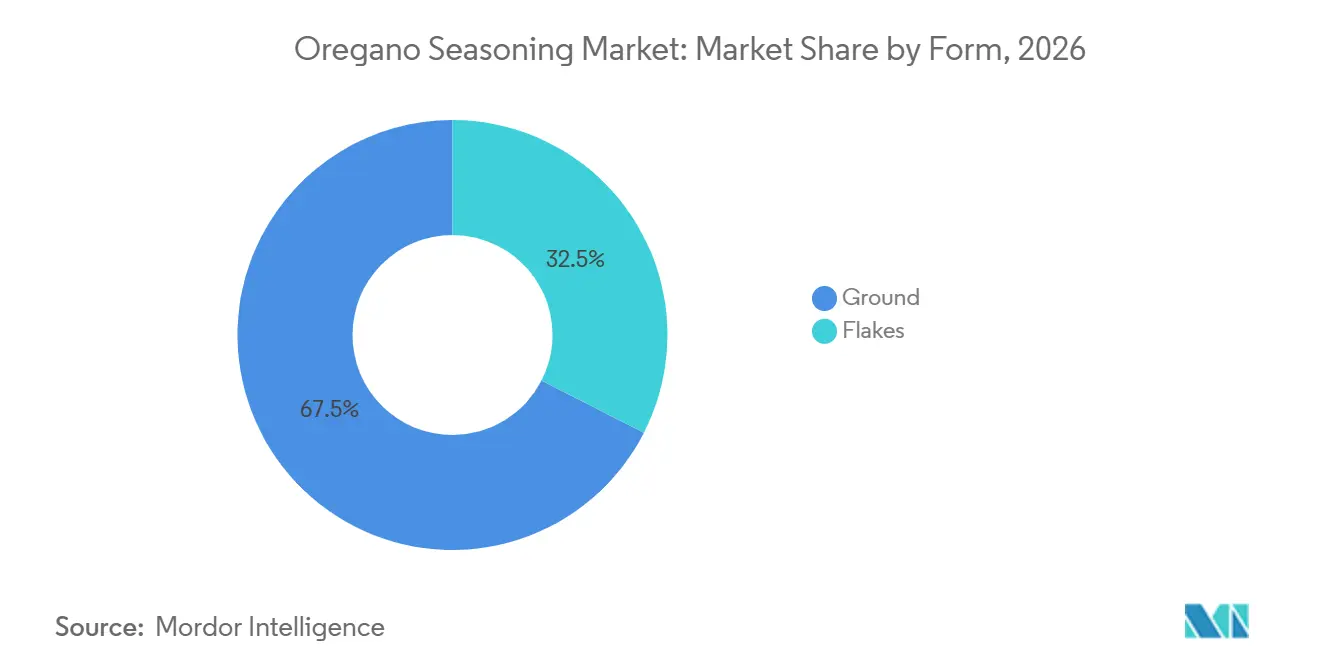
Ground oregano held 67.49% of the oregano seasoning market in 2026, reflecting its broad use in retail packs, commercial blends, and automated food-manufacturing processes. Buyers use the ground format because it provides consistent flavor release and can be incorporated easily into dry seasoning systems. It also fits retail cooking needs because consumers can add it directly to sauces, marinades, and pizza dishes. This format gives manufacturers a familiar ingredient for products that need uniform flavor distribution. Ground oregano remains important to the oregano seasoning industry because its use extends from household jars to high-volume industrial procurement. Its established role supports volume demand even when customers adjust product packaging or distribution channels.
Flakes are forecast to grow at a 10.25% CAGR through 2032, supported by demand from premium retail, foodservice garnish uses, and artisan pizza outlets. Their visible leaf structure and aroma after crushing give them a different role from ground oregano in finished dishes. The expansion of Mediterranean fast-casual and Italian quick-service restaurants supports tableside and kitchen use of flakes. Meal-kit providers also use precisely measured herb sachets to create a clear culinary cue for customers. The European Spice Association specifies a quality minimum of 1.50 milliliters of volatile oil per 100 grams for dried oregano, a characteristic that can be more readily assessed in flake form. The oregano seasoning market size for flakes is supported by customers that value visible quality, controlled portions, and a more distinctive presentation.

By Category: Conventional Anchors Volume, Organic Commands Price Premium and Faster Growth
Conventional oregano accounted for 66.48% of 2026 value because it remains the primary choice for large industrial users and private-label retail products. Its established sourcing base gives processors access to large volumes for blends, prepared foods, and standard retail packs. Conventional products remain central where purchasers are focused on price, reliable supply, and consistent specifications. However, documentation requirements are becoming more important even in conventional procurement. Buyers are increasingly seeking proof of origin, control of contaminants, and reliable testing practices. The oregano seasoning market continues to rely on conventional supply for scale, but quality verification is becoming a clear requirement for participation.
Organic oregano is projected to grow at an 11.24% CAGR through 2032, making it the fastest-growing category. European retail prices ranged from EUR 120 to EUR 400 per kilogram for organic oregano, compared with EUR 60 to EUR 190 per kilogram for conventional product. This price difference supports investment in certification, origin records, and traceability systems. Frontier Co-op provides a supply model that links growers in spice-producing countries with USDA Organic-certified retail and institutional buyers. EU controls on pyrrolizidine alkaloids in Turkish oregano add to buyer interest in better-documented sources. Organic growth indicates that the oregano seasoning industry is developing a premium channel where compliance and supply assurance matter alongside flavor.
By End User: Retail Leads in Value, Industrial Segments Gain Share Through Food Manufacturing Integration
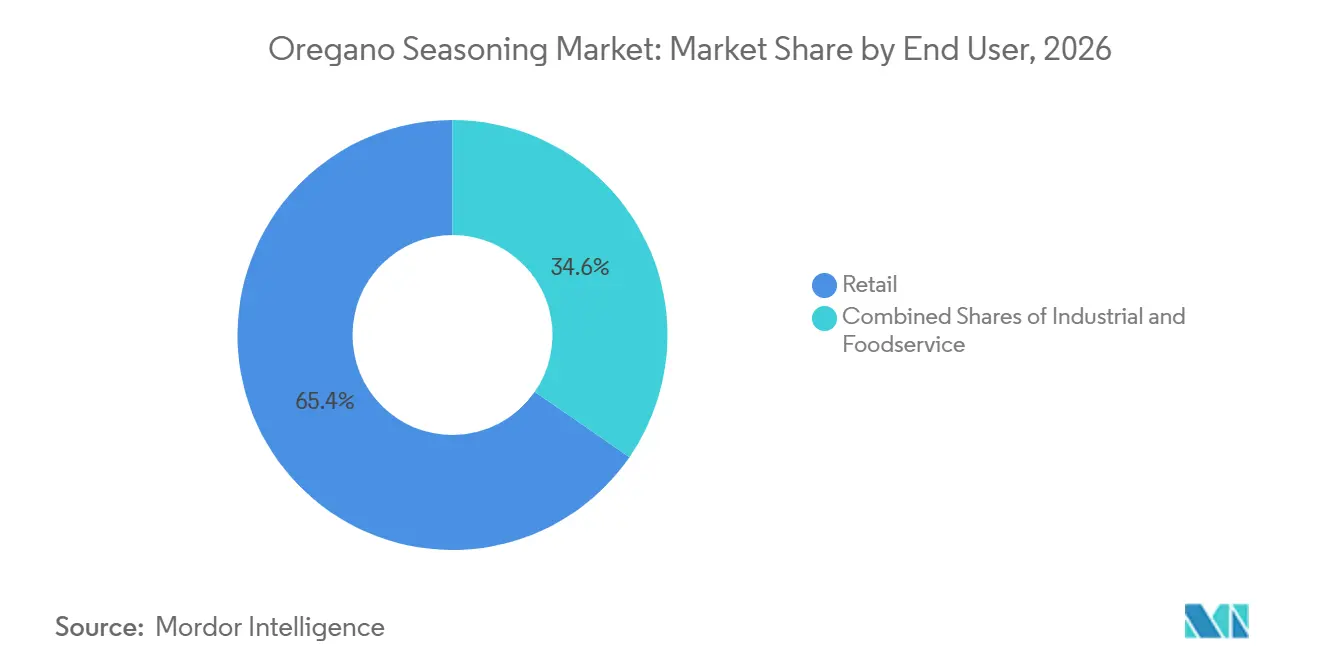
Retail held 65.38% of 2026 value across supermarkets, hypermarkets, convenience stores, online channels, and other retail outlets. Home cooking supports this position because dried oregano is a shelf-stable, affordable ingredient used in a wide range of recipes. Retail also gives consumers access to premium, organic, and origin-specific products that may not be widely stocked in foodservice supply channels. Online channels are widening product discovery for specialty oregano products and reducing reliance on physical shelf space. B&G Foods, Badia Spices, and The Spice Hunter serve retail customers at different price points and with different product offerings. The oregano seasoning market share held by retail reflects both routine household use and the growing availability of differentiated formats.
Industrial use is forecast to grow at a 10.78% CAGR through 2032 as food manufacturers increase oregano use in bakery items, sauces, dressings, and meat and poultry products. Oregano appears frequently in pizza sauce, pasta sauce, dry marinades, crackers, focaccia, and savory snacks. These applications allow suppliers to sell through recurring flavor-system and ingredient contracts rather than relying only on individual consumer purchases. Foodservice and HoReCa operations connect retail and industrial demand because professional kitchen preferences can influence packaged food development. Fuchs Gruppe, Euroma, and Kerry Group operate in industrial and foodservice procurement, where customization and dependable supply are important. The oregano seasoning market benefits from this channel because manufactured food volumes can provide steadier purchase patterns than occasional retail promotions.
Geography Analysis
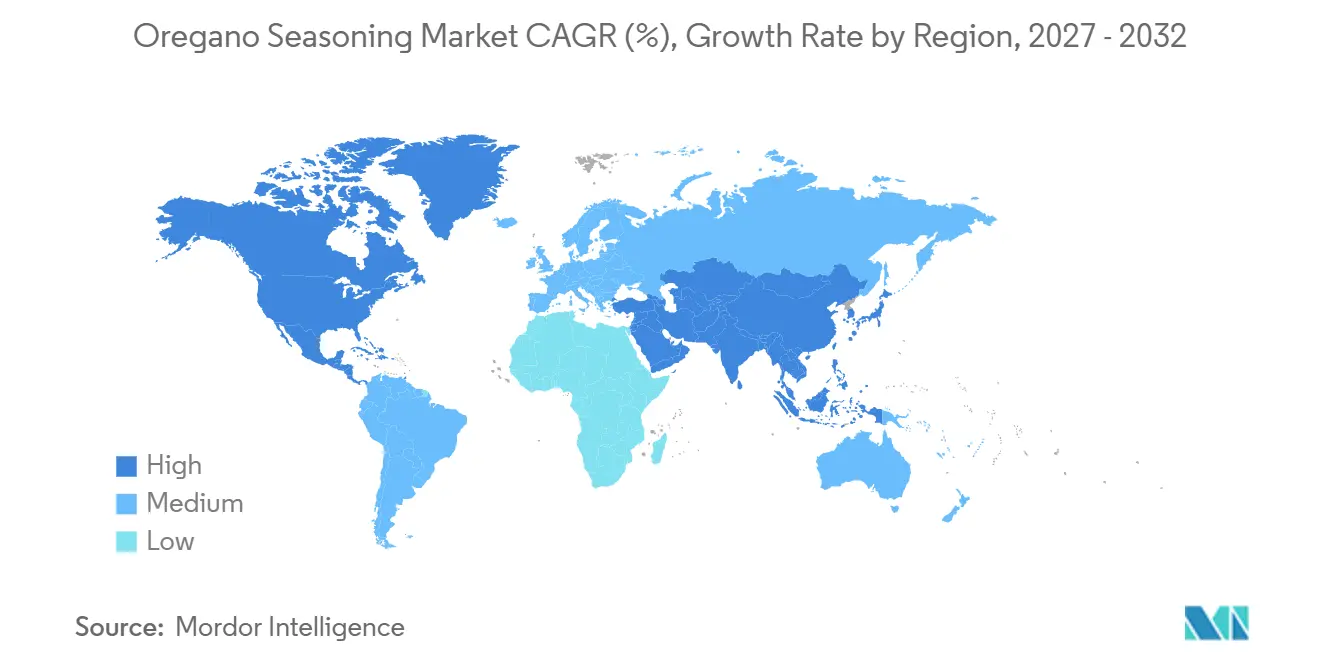
North America accounted for 45.38% of 2026 value, supported by Italian-American food traditions, dense pizza and pasta restaurant networks, and household use of herb seasonings. The United States was Turkey's top destination for spice exports during January to October 2025, receiving USD 26.60 million in shipments. Canada and Mexico add to regional demand through home cooking, foodservice, and packaged food consumption. McCormick completed the purchase of an additional 25.00% stake in McCormick de Mexico in January 2026 for USD 750 million, raising its ownership to 75.00%. This transaction strengthens its Latin American distribution position and creates additional routes for spice and condiment products. North America's oregano seasoning market size rests on both established culinary use and the ability of large branded suppliers to serve several channels.
Europe is forecast to grow at an 11.36% CAGR through 2032, making it the fastest-growing regional market. Germany, the United Kingdom, Italy, and Spain each contribute different sources of demand through retail, foodservice, organic products, and prepared foods. In Italy, 65.50% of surveyed consumers increased their herb and spice use during the prior 5 years, and oregano remained among the 3 most-used herbs. Since January 2025, the European Commission has required testing of 30.00% of Turkish dried-oregano shipments for pyrrolizidine alkaloids at EU borders[3]. This requirement makes compliance records and testing capability more important to suppliers serving European purchasers. Europe gives the oregano seasoning market a strong growth channel, but it also raises the standard for product documentation and quality assurance.
Asia-Pacific, South America, and the Middle East and Africa account for the remaining demand, with different roles in consumption and sourcing. Asia-Pacific demand is tied to urban growth and the spread of Italian-style pizza and pasta in cities across China, India, Japan, and Australia. South America serves both as a consumer area and a potential supply base for European buyers looking to diversify away from Turkey. Peru is represented by Aromático Inversiones S.A.C. and offers a traceable, price-competitive source. The United Arab Emirates, Saudi Arabia, and South Africa support demand through foodservice growth and Italian or Mediterranean flavor preferences. Nigeria represents a longer-term opportunity as restaurant activity deepens in Lagos and Abuja. These areas broaden the oregano seasoning market beyond its largest current regional bases while also providing alternative sourcing options.
Competitive Landscape
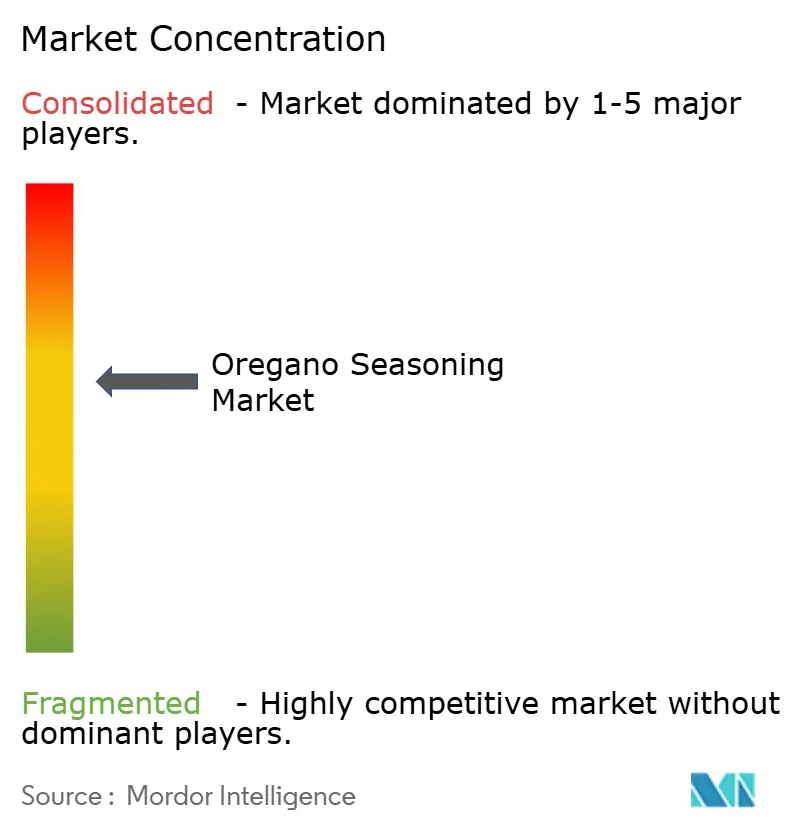
The oregano seasoning market is fragmented, with a medium concentration. Competition includes global spice companies, regional herb processors, private-label manufacturers, and organic specialists. McCormick has the widest branded distribution footprint and serves retail, foodservice, and food-manufacturing customers. Its Flavor Solutions operating profit rose 9.0% to USD 359 million in fiscal 2025, showing the relevance of its business-to-business flavor platform. This move gives the company a stronger regional platform for spices, condiments, and related products.
European participants are pursuing innovation, manufacturing capacity, and supply-chain improvement to compete for retail and industrial customers. Fuchs Gruppe completed a doubling of production and storage capacity at its Curtea de Argeș site in Romania, with an investment of more than EUR 8 million. Euroma refreshed its international identity in September 2025 and positioned itself as a flavor-solutions partner for food manufacturers. Verstegen entered into a cooperation agreement to develop a Dutch regenerative herb supply chain, targeting 40 to 50 farms and 10 herb varieties annually by 2032. They also reinforce the importance of serving food manufacturers that need dependable supply and product specifications.
Verified quality is becoming a competitive requirement because adulteration can create both reputational and commercial risk for food companies. Suppliers with testing capability and traceable supply can compete more effectively for contracts that require product authentication. The 2025 AP-MALDI-MS research supports the use of analytical methods to distinguish genuine oregano from adulterated material. Organic specialists and regional processors can therefore address a clear opening by supplying certified, pyrrolizidine alkaloid-compliant oregano to European industrial buyers. Private-label producers can also compete where retailers need customized pack sizes, acceptable pricing, and documented quality.
Oregano Seasoning Industry Leaders
-
McCormick & Company
-
Badia Spices
-
Associated British Foods (AB World Foods)
-
Fuchs Gruppe
-
B&G Foods
- *Disclaimer: Major Players sorted in no particular order
Recent Industry Developments
- May 2026: Catch Salt & Spices, a brand owned by Dharampal Satyapal Group, expanded its sprinkler portfolio with oregano, pizza pasta seasoning, chilli flakes, mixed herbs, and other seasoning variants. The expansion extended the brand's range beyond traditional salt and pepper products into convenient, ready-to-use seasonings.
- February 2026: Zeste Seasoning announced that it had become Türkiye's one of the largest bulk oregano exporter based on volumes achieved in 2025. The company attributed its growth to investments in contract-farming partnerships, cleaning and sorting infrastructure, processing capabilities, and export-focused quality control.
- September 2025: Verstegen Spices & Sauces signed a cooperation agreement with Schevichoven Droogt to pilot the first Dutch regenerative herb supply chain, with a target of partnering with 40–50 farms growing approximately 10 different herb varieties annually by 2032, embedding soil health and biodiversity metrics into upstream procurement.
Global Oregano Seasoning Market Report Scope
The oregano seasoning market is segmented by form into ground and flakes. By category, the market is divided into organic and conventional products. By end user, the market is classified into foodservice/HoReCa, retail, and industrial applications. The retail segment includes supermarkets/hypermarkets, convenience stores, online retail channels, and other distribution channels. Industrial applications comprise bakery and snacks, sauces and dressings, meat and poultry products, and other industrial applications. Geographically, the market covers North America, Europe, Asia-Pacific, South America, and the Middle East and Africa. The market sizing has been done in value terms in USD for all the abovementioned segments.
| Ground |
| Flakes |
| Organic |
| Conventional |
| Foodservice/HoReCa | |
| Retail | Supermarkets/Hypermarkets |
| Convenience Stores | |
| Online Retail Channels | |
| Other Distribution Channels | |
| Industrial | Bakery and Snacks |
| Sauces and Dressing | |
| Meat and Poultry Products | |
| Other Industrial Applications |
| North America | United States |
| Canada | |
| Mexico | |
| Rest of North America | |
| Europe | Germany |
| United Kingdom | |
| France | |
| Italy | |
| Spain | |
| Netherlands | |
| Rest of Europe | |
| Asia-Pacific | China |
| India | |
| Japan | |
| Australia | |
| Rest of Asia-Pacific | |
| South America | Brazil |
| Argentina | |
| Rest of South America | |
| Middle East and Africa | United Arab Emirates |
| Saudi Arabia | |
| South Africa | |
| Nigeria | |
| Rest of Middle East and Africa |
| By Form | Ground | |
| Flakes | ||
| By Category | Organic | |
| Conventional | ||
| By End User | Foodservice/HoReCa | |
| Retail | Supermarkets/Hypermarkets | |
| Convenience Stores | ||
| Online Retail Channels | ||
| Other Distribution Channels | ||
| Industrial | Bakery and Snacks | |
| Sauces and Dressing | ||
| Meat and Poultry Products | ||
| Other Industrial Applications | ||
| By Geography | North America | United States |
| Canada | ||
| Mexico | ||
| Rest of North America | ||
| Europe | Germany | |
| United Kingdom | ||
| France | ||
| Italy | ||
| Spain | ||
| Netherlands | ||
| Rest of Europe | ||
| Asia-Pacific | China | |
| India | ||
| Japan | ||
| Australia | ||
| Rest of Asia-Pacific | ||
| South America | Brazil | |
| Argentina | ||
| Rest of South America | ||
| Middle East and Africa | United Arab Emirates | |
| Saudi Arabia | ||
| South Africa | ||
| Nigeria | ||
| Rest of Middle East and Africa | ||
Key Questions Answered in the Report
What is the projected value of the oregano seasoning sector by 2032?
The oregano seasoning market is projected to reach USD 391.27 million by 2032, rising from USD 257.11 million in 2027 at a 9.01% CAGR.
Which oregano format holds the largest revenue share?
Ground oregano leads with a 67.49% revenue share in 2026 because it is widely used in retail packs, seasoning blends, and food manufacturing.
Which oregano category is growing fastest?
Organic oregano is projected to grow at an 11.24% CAGR through 2032, supported by demand for traceable and certified products.
Which end-user channel is expanding fastest for oregano products?
Industrial users are forecast to grow at a 10.78% CAGR through 2032 as manufacturers use oregano in sauces, bakery products, snacks, and meat products.