
Orange Oil Market Size and Share
Market Overview
| Study Period | 2021 - 2031 |
|---|---|
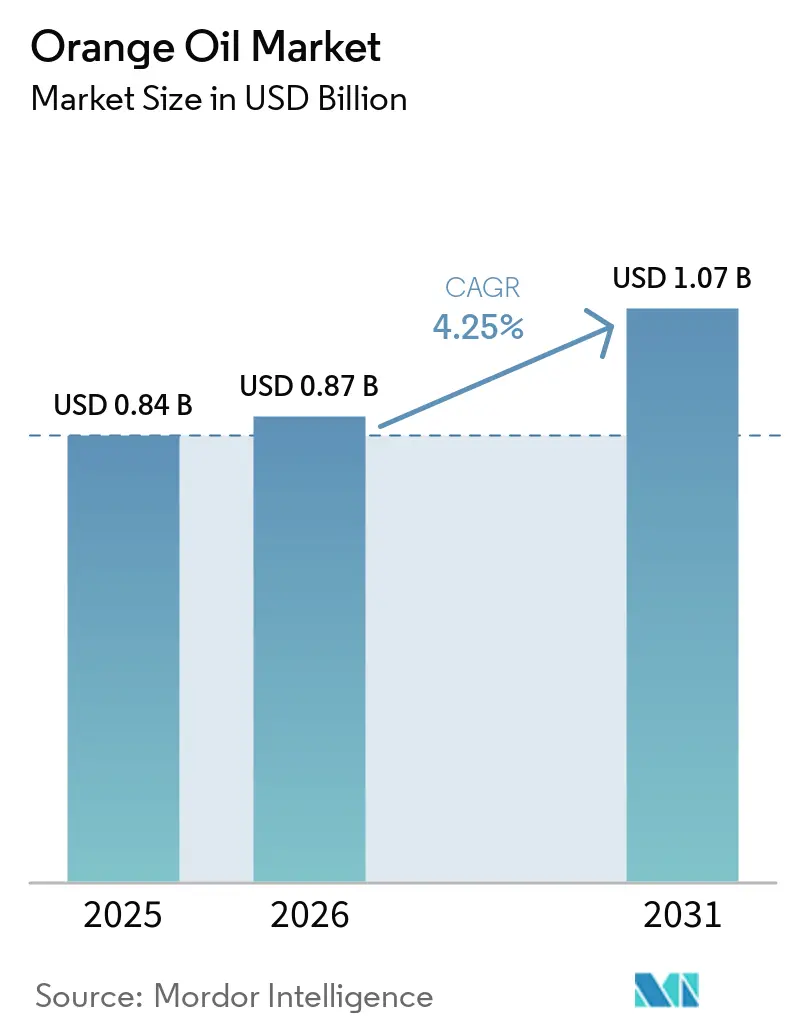
| Market Size (2026) | USD 0.87 Billion |
| Market Size (2031) | USD 1.07 Billion |
| Growth Rate (2026 - 2031) | 4.25% CAGR |
| Fastest Growing Market | Middle East and Africa |
| Largest Market | Europe |
| Market Concentration | Medium |
Major Players *Disclaimer: Major Players sorted in no particular order Image © Mordor Intelligence. Reuse requires attribution under CC BY 4.0. | |
Orange Oil Market Analysis by Mordor Intelligence
The Orange Oil Market size was valued at USD 0.84 billion in 2025 and is estimated to grow from USD 0.87 billion in 2026 to reach USD 1.07 billion by 2031, at a CAGR of 4.2% during the forecast period (2026-2031). Demand is supported by food and beverage producers replacing synthetic citrus flavors with natural alternatives and by broader clean-label requirements. Orange oil also serves several end uses, including flavoring, fragrance, personal care, and cleaning products, which limits dependence on a single demand source. Specialty pharmaceutical and organic uses are gaining importance, while commodity-grade demand remains more price sensitive. Supply conditions remain important because oil output is linked to orange juice processing and citrus crop conditions. Companies are responding through traceable sourcing, more specialized extraction, and measures that reduce dependence on constrained orange oil volumes.
Key Report Takeaways
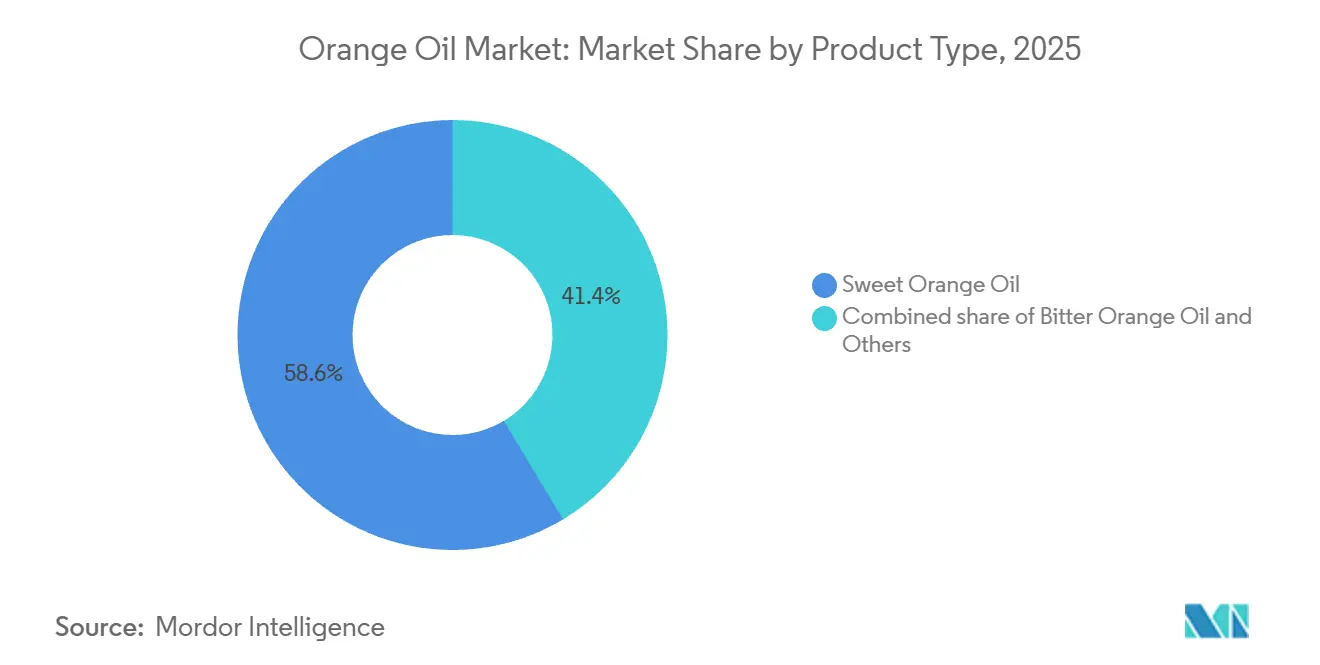
- By product type, Sweet Orange Oil led with 58.6% of the orange oil market share in 2025, while Bitter Orange Oil is forecast to grow at a 5.2% CAGR through 2031.
- By nature, Conventional orange oil held 75.3% of the orange oil market share in 2025, while Organic orange oil is projected to advance at a 6.5% CAGR through 2031.
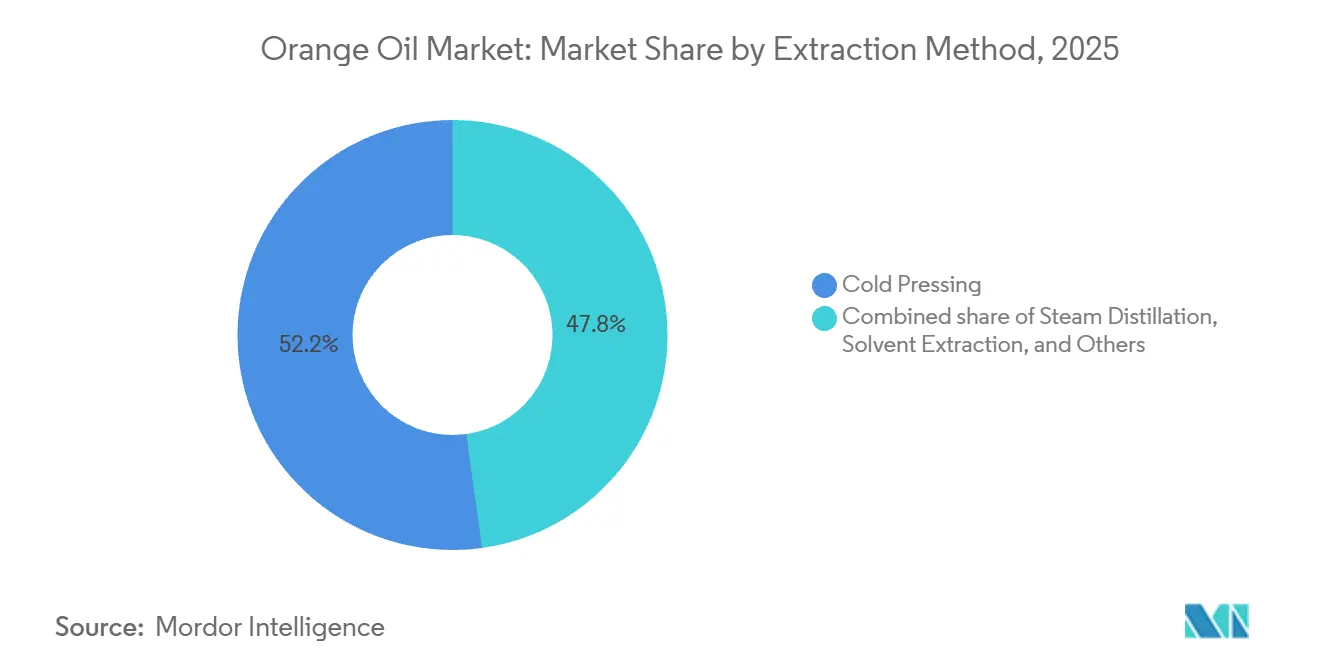
- By extraction method, Cold Pressing accounted for 52.2% of the orange oil market size in 2025, while Solvent Extraction is expected to grow at a 4.9% CAGR through 2031.
- By application, Home Care and Industrial Cleaning held 25.2% of the orange oil market size in 2025, while Pharmaceuticals and Nutraceuticals is projected to expand at a 5.8% CAGR through 2031.
- By geography, Europe accounted for 32.6% of the orange oil market share in 2025, while Middle East and Africa is expected to grow at a 6.2% CAGR through 2031.
Note: Market size and forecast figures in this report are generated using Mordor Intelligence’s proprietary estimation framework, updated with the latest available data and insights as of January 2026.
Global Orange Oil Market Trends and Insights
Drivers Impact Analysis*
| Drivers | (~) % Impact on CAGR Forecast | Geographic Relevance | Impact Timeline |
|---|---|---|---|
| Rising Demand for Natural Ingredients | +1.4% | Global, with strongest pull in Western Europe and North America | Medium term (2-4 years) |
| Growing Use in Food and Beverage Flavoring | +0.9% | North America, Europe, and Asia-Pacific | Short term (≤ 2 years) |
| Rising Adoption in Cosmetics and Personal Care | +0.7% | Europe, including Germany, the United Kingdom, and France, and North America | Medium term (2-4 years) |
| Consumer Preference for Clean-Label Products | +0.6% | EU-wide, particularly France, Germany, Italy, Spain, and Poland | Short term (≤ 2 years) |
| Innovation in Extraction and Formulation | +0.3% | North America, Europe, and emerging Asia-Pacific markets | Long term (≥ 4 years) |
| Popularity in Hospitality and Ambient Scenting | +0.2% | Middle East and Africa, especially Gulf states and the UAE, and Asia-Pacific luxury hospitality | Medium term (2-4 years) |
| Source: Mordor Intelligence | |||
Rising Demand for Natural Ingredients
Consumer demand for plant-derived, clean-label, and minimally processed ingredients continues to support the orange oil market across multiple end uses. The Centre for the Promotion of Imports reported that more than 75% of consumers in France, Germany, Italy, Spain, and Poland avoid ultra-processed foods. It also stated that the global clean-label ingredients sector is on track to reach EUR 180 billion by 2035[1]Source: Centre for the Promotion of Imports, “What Is the Demand for Natural Food Additives in Europe?”, cbi.eu.. This shift encourages manufacturers to use natural ingredients in food, beverages, personal care products, and household formulations. Orange peel oil, which is commonly obtained as a by-product of citrus processing, is used in natural fragrance ingredients, beverage flavoring, and bio-based cleaning solvents. Its wide application base can help stabilize demand when growth slows in one application area. Producers with strong traceability records and sustainability certifications can also differentiate their material from conventional, undifferentiated supply, especially as buyers place greater emphasis on responsible sourcing and product transparency.
Growing Use in Food and Beverage Flavoring
The orange oil market benefits from its wide use in food and beverage formulations, where manufacturers use it as a natural flavoring and functional ingredient. Orange oil helps mask off-notes in fortified drinks, supports bakery preservation, and adds a fresh citrus profile to confectionery products and carbonated beverage concentrates. In 2024, U.S. essential oil imports reached USD 5.6 billion, with citrus oils accounting for the largest share of import volume, primarily due to strong demand from food manufacturers[2]Source: U.S. Department of Agriculture, “The Aromatic Trade: Tracking U.S. Essential Oil Exports”, fas.usda.gov.. Beverage companies are also reformulating products as retail policies and supply chain reporting place greater emphasis on naturally derived ingredients and cleaner labels. As a result, orange oil is becoming a recurring formulation input rather than a discretionary flavor choice. FDA listings further support its use by providing regulatory clarity for orange oil in food applications.
Rising Adoption in Cosmetics and Personal Care
The orange oil market continues to benefit from rising demand in the cosmetics and personal care industries, especially as brands increase the use of natural and plant-based ingredients. Limonene, a key component of orange oil, offers antimicrobial and antioxidant properties, which support its use in products such as cleansers, soaps, shampoos, and other rinse-off formulations. The Cosmetic Ingredient Review safety assessment concluded that citrus-derived peel oils are safe for use in rinse-off cosmetics when used appropriately. European personal care brands are also increasing their purchases of cold-pressed orange oil with verified origin, driven by stronger demand for traceable and high-quality ingredients. This trend is creating distinct quality specifications for premium-grade material. As a result, suppliers with documented and certified supply chains are better positioned to meet these requirements and serve premium personal care manufacturers.
Consumer Preference for Clean-Label Products
Clean-label reformulation is supporting the orange oil market across food, personal care, and home care products, as brands increasingly use naturally derived ingredients to meet consumer demand for simpler and more transparent product labels. U.S. essential oil exports increased by 21% between 2019 and 2024, reflecting the broader shift in manufacturer ingredient portfolios toward natural materials. Manufacturers usually plan reformulation contracts well before product launches, which helps create more predictable procurement demand. This early planning can also reduce exposure to short-term price fluctuations for some buyers. Flavor and fragrance companies use long-term supply agreements to secure certified orange oil and improve supply reliability. Symrise has pursued long-term citrus sourcing relationships in Europe to support supply continuity.
Restraints Impact Analysis*
| Restraint | (~) % Impact on CAGR Forecast | Geographic Relevance | Impact Timeline |
|---|---|---|---|
| Feedstock Supply Volatility | -0.8% | Global, with acute exposure in North America and European dependence on Brazilian imports | Short term (≤ 2 years) |
| Regulatory Scrutiny in Personal Care and Food Uses | -0.5% | Europe and North America | Medium term (2-4 years) |
| Allergen and Skin Irritation Concerns | -0.3% | Global, with greater sensitivity in Europe and North America | Medium term (2-4 years) |
| Flammability and Handling Limitations | -0.2% | Industrial and logistics hubs globally, including Asia-Pacific markets with developing safety infrastructure | Long term (≥ 4 years) |
| Source: Mordor Intelligence | |||
Feedstock Supply Volatility
Supply risk in the orange oil market remains high because orange oil is mainly produced as a byproduct of orange juice processing. As a result, oil availability depends more on orange juice production and fruit processing volumes than on cultivation decisions made only to meet oil demand. In 2024/25, Brazil’s São Paulo and Minas Gerais citrus belt recorded its smallest harvest in more than 30 years, at 230.9 million 40.8-kilogram boxes, a 21.8% decline from 2023/24. Drought, extreme temperatures, and citrus greening reduced yields for five consecutive seasons, tightening the availability of oranges for processing. Florida Valencia orange production fell by 38% in 2024/25, while total US orange production declined by 8% to 2.46 million tons, adding further pressure to global supply. Although Cutrale and Citrosuco have started new plantings in Brazil, these trees will take time to reach commercial harvest levels. Therefore, near-term supply relief is expected to remain limited, keeping supply risk elevated in the orange oil market.
Regulatory Scrutiny in Personal Care and Food Uses
Regulatory requirements shape how manufacturers use orange oil in personal care and food-related applications. In personal care, IFRA restricts the use of expressed bitter orange peel oil in several leave-on products and fragrance categories because it may cause phototoxic reactions when skin is exposed to sunlight. As a result, formulators must review usage limits, adjust concentrations, or use alternative citrus ingredients to meet safety standards. In the European Union, regulations allow expressed sweet orange oil as an animal feed additive, but they do not permit its use in feed for cats, dogs, ornamental fish, and birds due to irritancy findings. Companies serving pet-care-related applications must manage product labels, safety documentation, and specifications carefully to avoid compliance risks. Certified and fully documented orange oil can command a premium in the market, especially among buyers that require traceability and regulatory assurance, but suppliers must invest in testing, quality control, and traceability systems to support these claims.
*Our forecasts treat driver/restraint impacts as directional, not additive. The impact forecasts reflect baseline growth, mix effects, and variable interactions.
Segment Analysis
By Product Type: Sweet Oil Supports Volume While Bitter Oil Serves Pharmaceutical and Fine Fragrance Uses
Sweet Orange Oil held 58.6% of the orange oil market share in 2025, supported by its broad use in food flavoring, beverage formulations, and bio-based cleaning solvents. Its d-limonene content gives formulators citrus flavor and useful degreasing performance from the same raw material. That dual function supports recurring use in food, beverage, home care, and industrial cleaning products with different formulation needs. IFF’s LMR Naturals sources cold-pressed sweet orange oil from Huelva, Spain, and works with growers using experimental fields to improve aldehyde levels and varietal consistency. Terpeneless and folded oils serve heat-stable beverage syrups and industrial flavor concentrates, where a standard full-profile oil can be less suitable during processing.
Bitter Orange Oil is projected to grow at a 5.2% CAGR from 2026 to 2031, making it the fastest-growing product type in the orange oil market. Pharmaceutical formulators and fine fragrance houses value its more complex profile, which combines sharper citrus, floral, aldehydic, and slightly woody notes. It is generally used as a modifier in premium formulations rather than as a bulk flavor ingredient. Research into limonene-based drug delivery has increased interest in citrus-derived inputs for pharmaceutical uses. Bitter orange peel oil has FEMA GRAS recognition for food flavoring use, which supports food-grade applications, although IFRA phototoxicity limits still constrain leave-on personal care formulations.



By Nature: Conventional Supply Supports Scale While Organic Oil Gains Premium Demand
Conventional orange oil held 75.3% of the orange oil market by nature in 2025, reflecting cost efficiency and the scale of Brazil’s integrated citrus processing infrastructure. Large home care, food processing, and industrial buyers use conventional grades because they need dependable volume and cost control. Citrosuco is an important supplier to global flavor houses through its integrated citrus processing operations. Traceability records and sustainability certifications are becoming more relevant even within the conventional supply base. European requirements create quality differences among suppliers based on pesticide residue profiles, oxidation markers, and the supporting documentation buyers require.
Organic orange oil represented 24.7% of the orange oil market in 2025 and is projected to grow at a 6.5% CAGR through 2031. Personal care and aromatherapy brands in Germany, France, and the United Kingdom are important demand sources for certified organic material. These buyers increasingly specify organic oil to meet retailer requirements and support natural beauty and sustainability claims. Organic certification provides documented supply-chain integrity and can allow producers to secure higher-value business where the required standards are met. Young Living expanded its organic citrus essential oil range in 2025, emphasizing sustainable farming and organic certification for wellness consumers.
By Extraction Method: Cold Pressing Leads Premium Uses While Solvent Extraction Supports Specialized Fractions
Cold Pressing held 52.2% of the orange oil market size in 2025, making it the leading extraction method. Food-grade and premium fragrance applications prefer the method because it maintains the oil’s volatile profile. It preserves aldehydic notes, monoterpene ratios, and limonene levels that beverage formulators and fragrance creators associate with an authentic citrus profile. Brazil’s São Paulo citrus belt and Florida processing operations hold a substantial share of cold-press capacity. Steam distillation, the second-largest method, produces terpeneless and fractionated oils for concentrated and heat-stable food applications where specialized processing characteristics are needed.
Solvent Extraction is projected to grow at a 4.9% CAGR from 2026 to 2031, the fastest rate among extraction methods. Pharmaceutical and nutraceutical formulators use the process where they need precise and high-purity bioactive fractions. Cold pressing cannot selectively yield those fractions at commercial scale. A 2026 study reported that orange oil nanoemulsions induced apoptosis in colorectal cancer cells and identified fabrication parameters that could support scale-up. A 2025 review also discussed limonene’s anticancer, anti-inflammatory, antidiabetic, and antioxidant research profile, along with nanoformulations and 3D-printed delivery systems.
By Application: Home Care Leads Current Demand While Pharmaceutical Uses Grow Faster
Home Care and Industrial Cleaning accounted for 25.2% of the orange oil market size in 2025. D-limonene supports use as a bio-based degreaser, fragrance carrier, and surface-active ingredient in institutional and consumer cleaning formulations. The combination of cleaning performance and citrus scent makes orange oil useful across household and industrial products. Food and Beverages, Personal Care and Cosmetics, Aromatherapy and Wellness, and Fragrances and Fine Fragrance provide separate demand pools with different product requirements. This application mix makes the orange oil market less exposed to a slowdown in any single end-use category.
Pharmaceuticals and Nutraceuticals are projected to grow at a 5.8% CAGR from 2026 to 2031, the fastest rate among applications. This use requires specialized orange oil with greater consistency than food-grade or home care material. The 2025 review identified limonene research across anticancer, anti-inflammatory, antidiabetic, and antioxidant mechanisms. The 2026 nanoemulsion study also supported orange oil’s compatibility with scalable pharmaceutical fabrication. Buyers need purity certificates, consistent limonene content, and validated extraction methods, creating an opening for specialty processors that can meet these specifications.
Geography Analysis
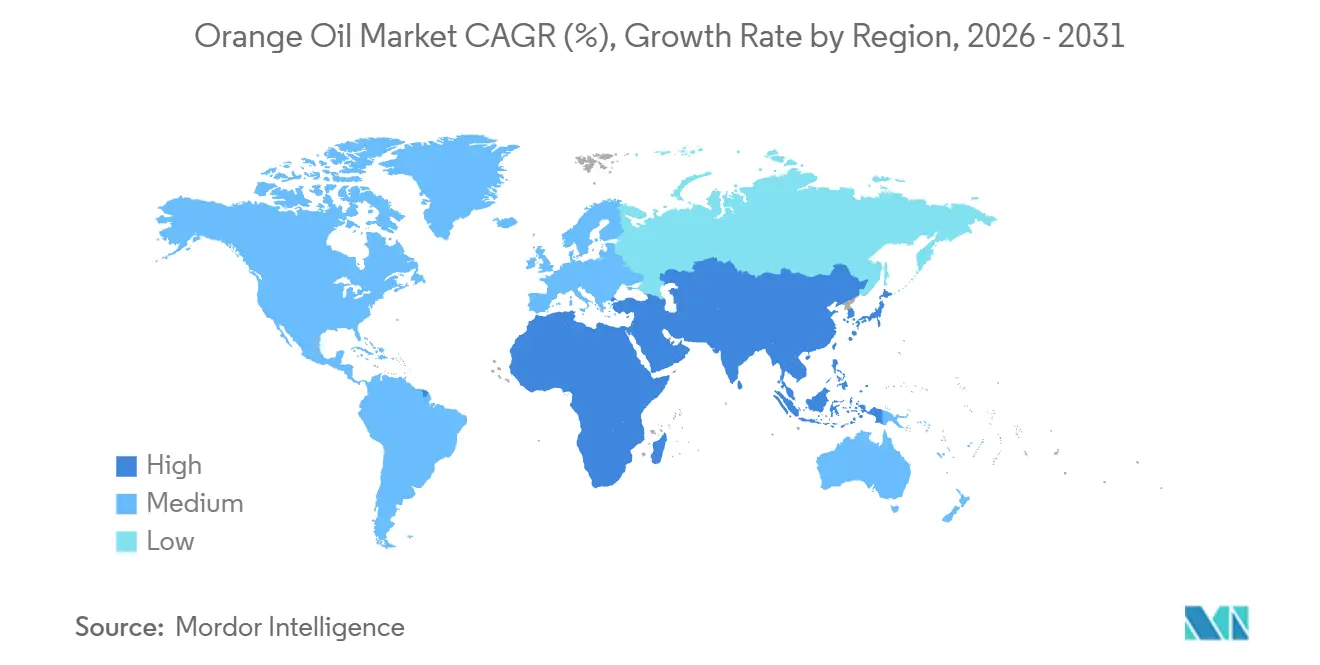
Europe held 32.6% of the orange oil market share in 2025. Germany’s flavor and fragrance manufacturing base, France’s perfumery sector, and the United Kingdom’s organic personal care demand support regional consumption. Germany, France, Italy, Spain, and the Netherlands use orange oil in food, beverage, fragrance, and personal care applications. Sweden, Belgium, and Poland are growing consumer markets for aromatherapy and natural cleaning products. CBI reported strong consumer interest in less processed foods across 5 major European markets. Spain is both an orange cultivation area and an important food and beverage market.
North America is a substantial consumer and producer region for the orange oil market. U.S. essential oil exports reached USD 2.5 billion in 2024, and citrus oil accounted for 19% of those exports. Florida Valencia production fell 38% in 2024/25, increasing reliance on Brazilian imports. IFF has developed oil extenders and upcycled orange oil from retail juicing operations to diversify supply. Asia-Pacific is a growing secondary region, led by China, India, Japan, Indonesia, and Australia. Its demand is linked to natural personal care, functional beverages, and aromatherapy products.
Middle East and Africa is projected to grow at a 6.2% CAGR from 2026 to 2031. Saudi Arabia and the UAE support demand through fragrance culture, luxury personal care, hospitality, ambient scenting, premium cleaning products, and spa products. South Africa, Egypt, Morocco, Nigeria, and Turkey form a diverse secondary cluster. Egypt’s orange production was estimated at 3.7 million metric tons in MY 2024/25, down 12% because of high temperatures and higher production costs. Its juice processing base can support essential oil co-extraction. Rising urban middle-class consumption in Nigeria and South Africa supports natural cleaning and personal care demand.

Competitive Landscape
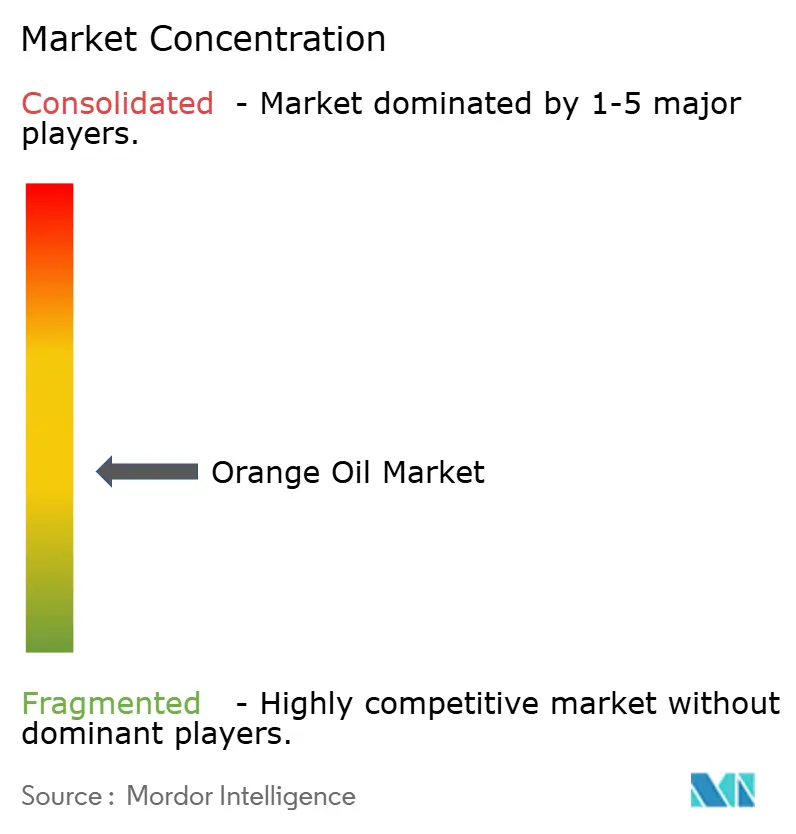
The orange oil market has a concentration score of 4 out of 10 and a two-tier structure. Vertically integrated producers, including Citrosuco, Cutrale, and Florida Chemical Company, control extraction and raw material quality. Flavor houses, essential oil traders, and consumer brands compete through formulations, application development, and brand positioning. Givaudan, IFF, Symrise, and MANE are active in value-added applications. IFF’s 30,000-square-foot Citrus Innovation Center at Florida Polytechnic University has identified more than 16,000 orange flavor compounds.
IFF’s CURE platform, comprising Core and Uncommon Replacements and Extenders, helps maintain citrus profiles while reducing dependence on orange oil volumes. This reflects the need to manage feedstock exposure as demand grows. Tradebe is expected to acquire CitraSource from IFF in July 2026, after acquiring Florachem in April 2025, creating an integrated North American citrus ingredients business with USD 210 million in combined revenue and more than 300 employees. The company will sit between commodity processors and larger flavor houses.
Symrise is expected to enter a put option agreement in July 2026 to acquire Floral Concept in Grasse, France, adding orange blossom, jasmine, rose, ambrette, and blackcurrant capabilities to its premium naturals position. Citrosuco is expected to welcome PSP Investments as a strategic shareholder in December 2025 to support orchard expansion and its Evera division. Demand for pharmaceutical-grade orange oil with validated limonene purity remains fragmented among specialty processors, while distribution of traceable material in the Middle East and Africa remains less organized than regional demand. These conditions create opportunities for specialty suppliers with reliable sourcing and documented extraction practices.
Orange Oil Industry Leaders
Citrosuco
Cutrale
Symrise AG
Citrus and Allied Essences Ltd.
Givaudan SA
- *Disclaimer: Major Players sorted in no particular order

Recent Industry Developments
- July 2026: Tradebe completed the acquisition of CitraSource, a Winter Haven, Florida-based natural citrus oil and extract producer, from IFF. The deal follows Tradebe’s April 2025 acquisition of Florachem and created an integrated North American citrus ingredient business with approximately USD 210 million in combined revenue and more than 300 employees.
- July 2026: Symrise entered an agreement to acquire Floral Concept, a Grasse-based premium naturals company specializing in jasmine, rose, orange blossom, ambrette, and blackcurrant. The transaction builds on Symrise’s Maison Lautier 1795 naturals house and strengthens its premium naturals position.
- June 2026: IFF’s Citrus Innovation Center at Florida Polytechnic University reported identifying more than 16,000 orange flavor compounds. The center also developed upcycled orange oil from retail juicing operations.


Global Orange Oil Market Report Scope
| Sweet Orange Oil |
| Bitter Orange Oil |
| Others |
| Organic |
| Conventional |
| Cold Pressing |
| Steam Distillation |
| Solvent Extraction |
| Others |
| Food and Beverages |
| Personal Care and Cosmetics |
| Home Care and Industrial Cleaning |
| Aromatherapy and Wellness |
| Pharmaceuticals and Nutraceuticals |
| Fragrances and Fine Fragrance |
| North America | United States |
| Canada | |
| Mexico | |
| Rest of North America | |
| Europe | Germany |
| United Kingdom | |
| Italy | |
| France | |
| Spain | |
| Netherlands | |
| Poland | |
| Belgium | |
| Sweden | |
| Rest of Europe | |
| Asia-Pacific | China |
| India | |
| Japan | |
| Australia | |
| Indonesia | |
| South Korea | |
| Thailand | |
| Singapore | |
| Rest of Asia-Pacific | |
| South America | Brazil |
| Argentina | |
| Colombia | |
| Chile | |
| Peru | |
| Rest of South America | |
| Middle East and Africa | South Africa |
| Saudi Arabia | |
| United Arab Emirates | |
| Nigeria | |
| Egypt | |
| Morocco | |
| Turkey | |
| Rest of Middle East and Africa |
| By Product Type | Sweet Orange Oil | |
| Bitter Orange Oil | ||
| Others | ||
| By Nature | Organic | |
| Conventional | ||
| By Extraction Method | Cold Pressing | |
| Steam Distillation | ||
| Solvent Extraction | ||
| Others | ||
| By Application | Food and Beverages | |
| Personal Care and Cosmetics | ||
| Home Care and Industrial Cleaning | ||
| Aromatherapy and Wellness | ||
| Pharmaceuticals and Nutraceuticals | ||
| Fragrances and Fine Fragrance | ||
| By Geography | North America | United States |
| Canada | ||
| Mexico | ||
| Rest of North America | ||
| Europe | Germany | |
| United Kingdom | ||
| Italy | ||
| France | ||
| Spain | ||
| Netherlands | ||
| Poland | ||
| Belgium | ||
| Sweden | ||
| Rest of Europe | ||
| Asia-Pacific | China | |
| India | ||
| Japan | ||
| Australia | ||
| Indonesia | ||
| South Korea | ||
| Thailand | ||
| Singapore | ||
| Rest of Asia-Pacific | ||
| South America | Brazil | |
| Argentina | ||
| Colombia | ||
| Chile | ||
| Peru | ||
| Rest of South America | ||
| Middle East and Africa | South Africa | |
| Saudi Arabia | ||
| United Arab Emirates | ||
| Nigeria | ||
| Egypt | ||
| Morocco | ||
| Turkey | ||
| Rest of Middle East and Africa | ||


Key Questions Answered in the Report
What is the projected value of the orange oil sector by 2031?
The orange oil market is projected to reach USD 1.07 billion by 2031, expanding at a 4.25% CAGR from 2026.
Which orange oil product type leads demand?
Sweet Orange Oil led with 58.6% share in 2025 because it is widely used in food, beverages, and cleaning products.
Which end use is growing fastest for orange oil?
Pharmaceuticals and Nutraceuticals is forecast to grow at a 5.8% CAGR through 2031, supported by research into limonene-based applications.
Which region is expected to grow fastest through 2031?
Middle East and Africa is projected to expand at a 6.2% CAGR, supported by hospitality, fragrance, and personal care demand.
Page last updated on:






