
Oman STEM Education Market Size and Share
Market Overview
| Study Period | 2022 - 2032 |
|---|---|
| Forecast Data Period | 2027 - 2032 |
| Base Year Market Size (2026) | USD 174.56 Million |
| Market Size (2027) | USD 192.56 Million |
| Market Size (2032) | USD 315.01 Million |
| Growth Rate (2027 - 2032) | 10.34 % |
| Market Concentration | Low |
Major Players *Disclaimer: Major Players sorted in no particular order Image © Mordor Intelligence. Reuse requires attribution under CC BY 4.0. | |
Oman STEM Education Market Analysis by Mordor Intelligence
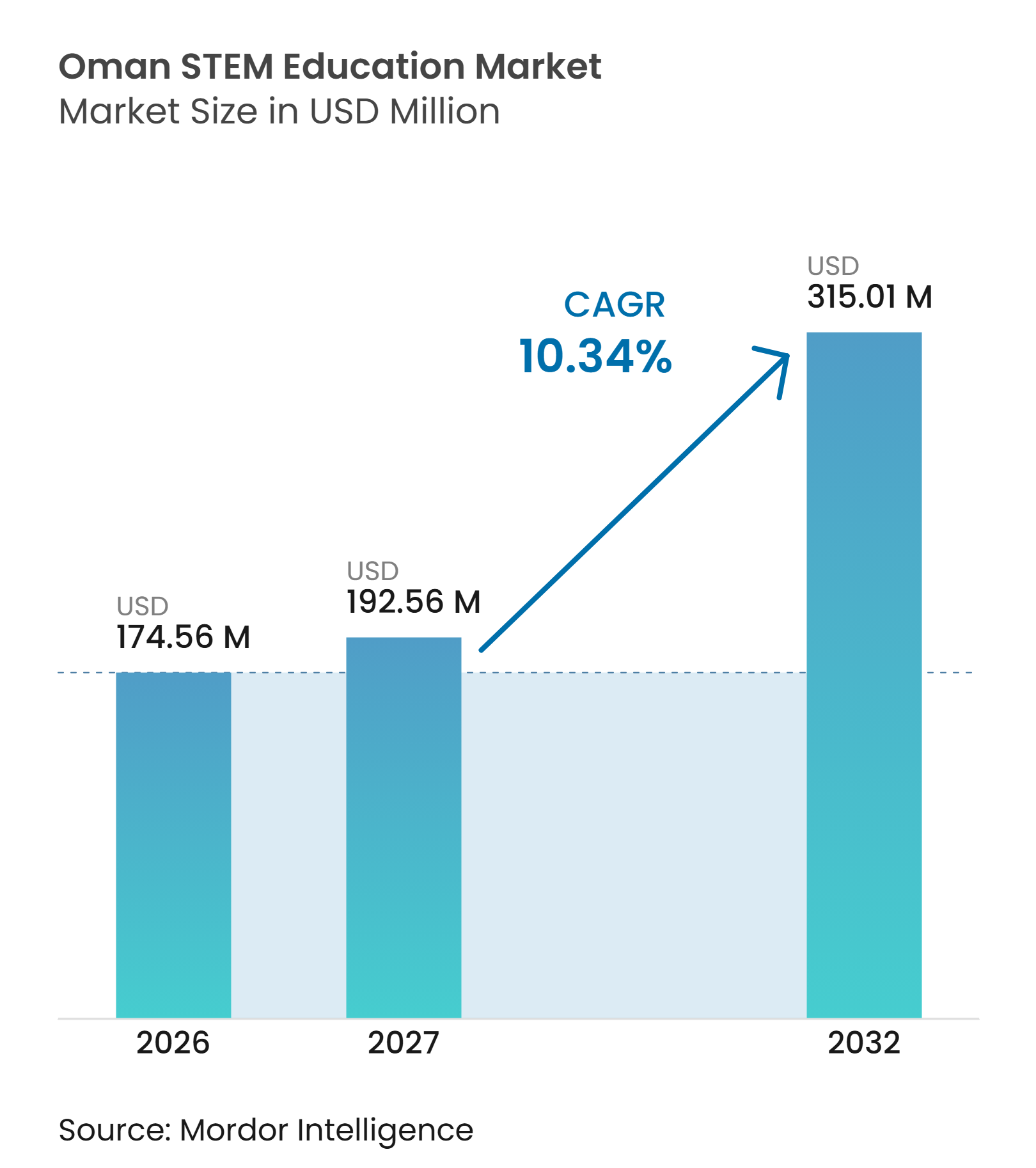
The Oman STEM education market size was valued at USD 174.56 million in 2026 and is estimated to grow from USD 192.56 million in 2027 to reach USD 315.01 million by 2032, at a CAGR of 10.34% during the forecast period (2027-2032). Oman Vision 2040 identifies education, scientific research, and national capabilities as priorities, aligning STEM education with public-sector planning and workforce development. The Ministry of Education expands digital learning through the Noor platform, digital curriculum initiatives, virtual laboratories, and classroom technology. Employer demand for artificial intelligence, data analytics, automation, and cybersecurity skills is increasing the role of corporate learning and supplementary education programs. Public procurement drives demand, while corporate partnerships improve access to equipment, connectivity, and applied learning facilities. The market offers opportunities for providers that align bilingual content, teacher support, and assessment tools with Ministry requirements.
Key Report Takeaways
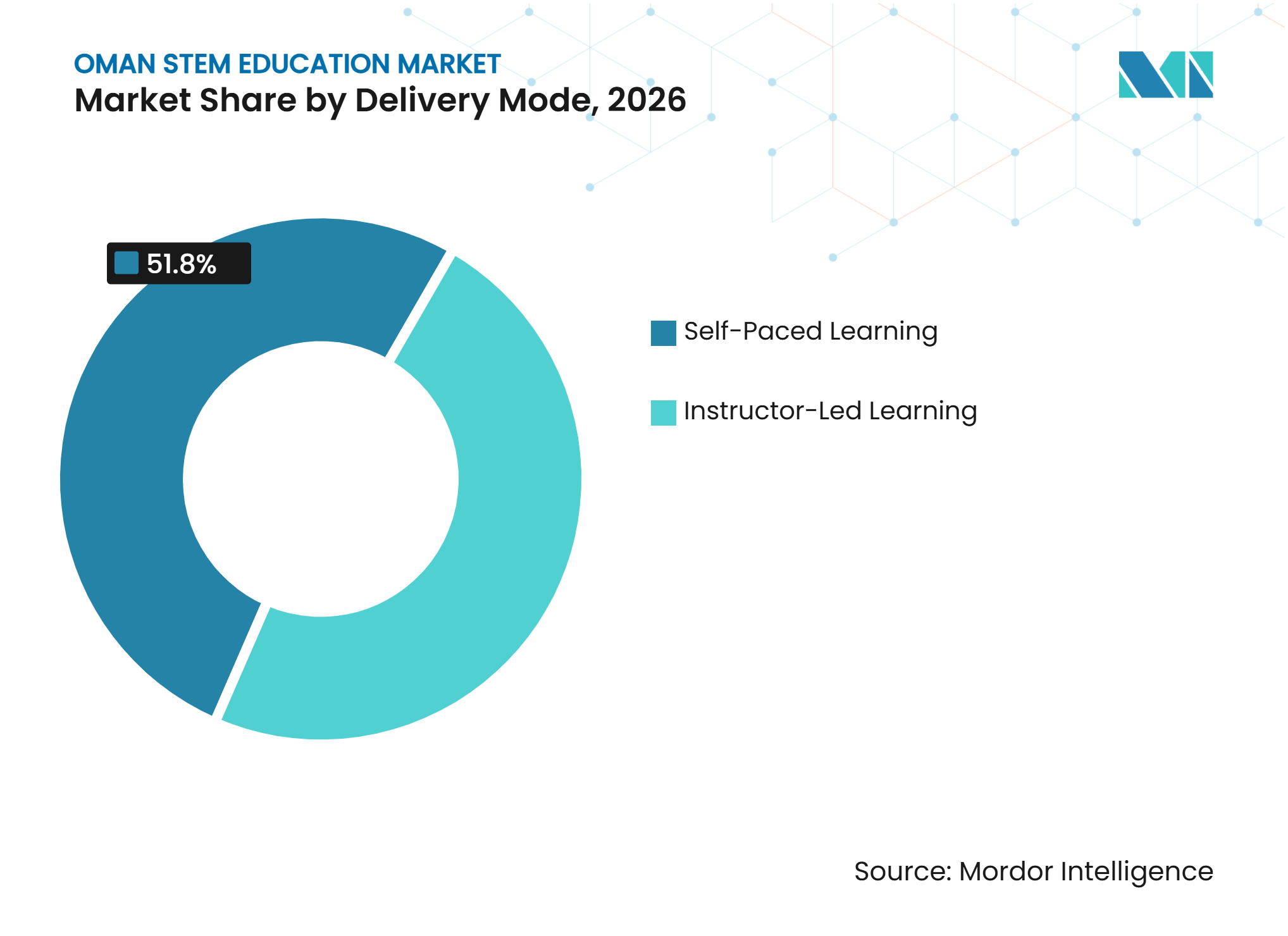
- By delivery mode, Self-Paced Learning accounted for 51.80% of the Oman STEM education market share in 2026 and is projected to grow at a 12.42% CAGR through 2032.
- By offering, Curriculum and Instructional Content accounted for 30.90% of the Oman STEM education market share in 2026, while STEM Learning Software is projected to grow at a 10.70% CAGR through 2032.
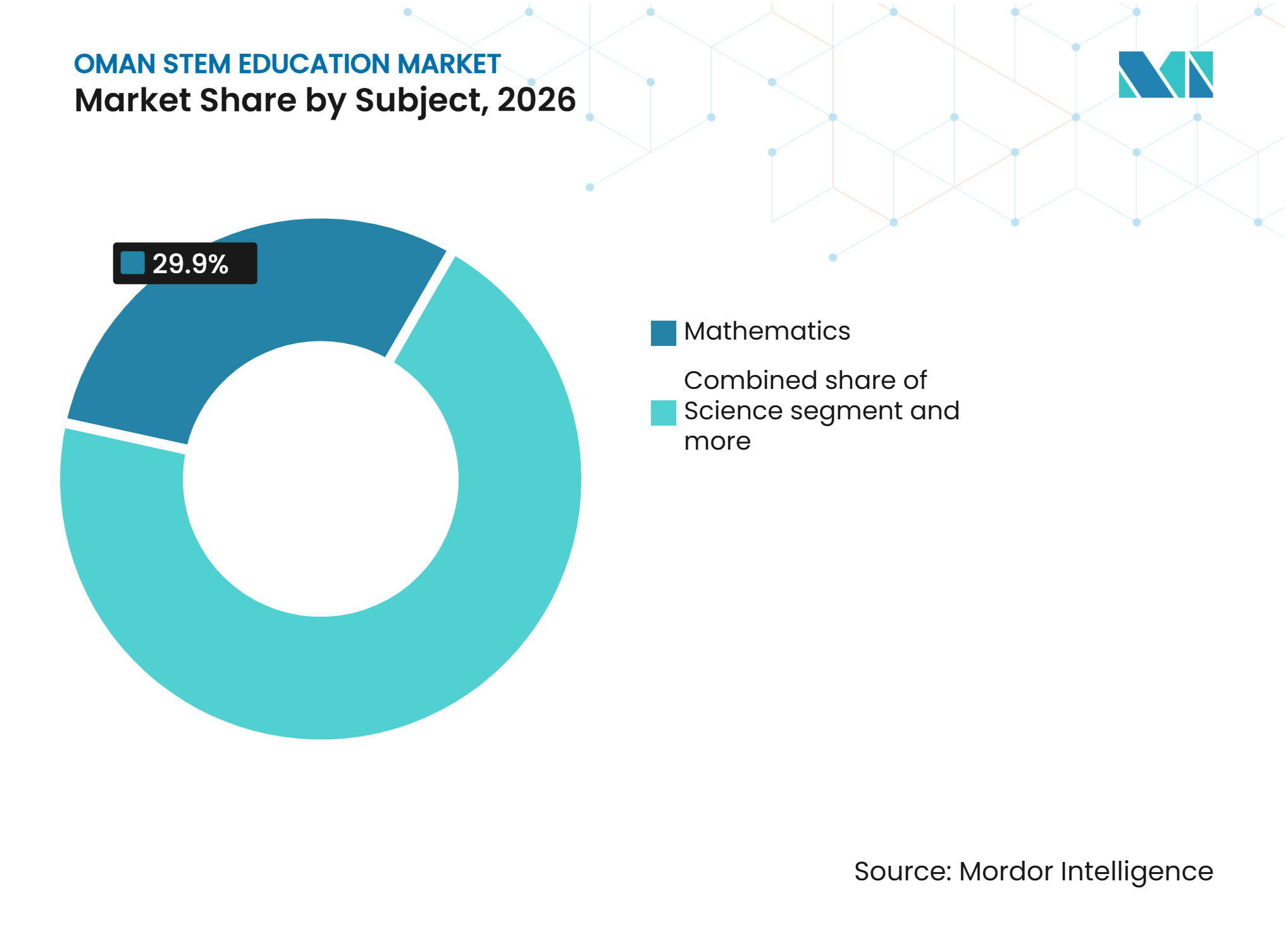
- By subject, Mathematics accounted for 29.90% of the Oman STEM education market share in 2026, while Technology and Computer Science is projected to grow at a 10.60% CAGR through 2032.
- By end user, K-12 Schools accounted for 60.40% of the Oman STEM education market share in 2026, while Corporate and Professional Training is projected to grow at a 13.12% CAGR through 2032.
- By geography, Muscat accounted for 44.90% of the Oman STEM education market share in 2026, while Al Batinah North is projected to grow at an 11.37% CAGR through 2032.
Note: Market numbers in this report are based on Mordor Intelligence's proprietary estimation framework, which combines nine months of actuals with Q4 projections for base year 2026.
Market Trends and Insights
Drivers Impact Analysis of Oman STEM Education Market*
| Driver | (~) % Impact on CAGR Forecast | Geographic Relevance | Impact Timeline |
|---|---|---|---|
| Oman Vision 2040 Skills and Knowledge Economy Priorities | +2.4% | National, concentrated in Muscat and Al Batinah North | Long term (≥ 4 years) |
| Ministry-Led Curriculum Digitization and Noor Platform Expansion | +2.3% | National, with early gains in Muscat, Dhofar, Al Dakhiliyah, and Al Batinah North | Medium term (2-4 years) |
| Employer Demand for AI, Automation, and Digital Skills | +2.0% | Muscat, with spillover to Al Batinah North and Dhofar | Medium term (2-4 years) |
| Corporate and Telecom-Funded STEM Access Programs | +1.5% | Muscat, Dhofar, and industrial governorates | Medium term (2-4 years) |
| Rural Reach Through Mobile, Virtual, and After-School Delivery | +1.1% | Al Dakhiliyah, Al Sharqiyah, Al Wusta, and Al Dhahirah | Long term (≥ 4 years) |
| Oman-Specific Localization of Arabic-English STEM Content | +1.0% | National, with early adoption in public schools | Long term (≥ 4 years) |
| Source: Mordor Intelligence | |||
Oman Vision 2040 Skills and Knowledge Economy Priorities
Oman Vision 2040 identifies education, scientific research, and national capabilities as priority development areas. It integrates school education, research activities, and workforce preparation within a unified national framework. The National Framework for Future Skills includes data management, computational thinking, and problem-solving across basic, applied, and technical competency streams. Between 2021 and 2025, 188 schools were constructed or renovated, and a national curriculum digitization plan covered grades 1 through 12[1]. Providers aligning curricula, teacher training, and assessment products with these competency areas may be better positioned for Ministry procurement. This policy framework supports the Oman STEM education market by linking classroom instruction with practical technical skills.
Ministry-Led Curriculum Digitization and Noor Platform Expansion
The Ministry of Education made digital delivery a core component of the Oman STEM education market. In its first two phases, the Noor platform reached 578 government schools, providing access to 96% of teachers and 65% of students and including more than 1,100 digital educational elements. Its third phase expanded coverage to 730 schools and introduced C-Help, an AI-enabled support feature[2]. The Ministry also launched a project to digitize Omani curricula for grades 1-12 using interactive content, simulations, and other digital formats. These initiatives raised the baseline for digital content, virtual experiments, and support services in public schools. Commercial providers need to differentiate through engaging content, bilingual design, implementation support, or performance analytics.
Employer Demand for AI, Automation, and Digital Skills
Employer requirements are driving demand for learning programs in artificial intelligence (AI), data, software, and cybersecurity. The Ministry of Transport, Communications and Information Technology reported that the Makeen initiative had trained more than 11,000 professionals in advanced digital skills by 2025[3]. Omantel partnered with TeKnowledge to strengthen employee skills in artificial intelligence and data science. These developments support demand for structured corporate and professional learning beyond school-based programs. They also create opportunities for training providers to serve employers seeking applied, certification-linked skills. The Oman STEM education market benefits as employers convert talent gaps into ongoing learning budgets.
Corporate and Telecom-Funded STEM Access Programs
Corporate programs are expanding STEM access beyond conventional school procurement. The Ministry of Education and Omantel formed a strategic partnership to support digital education and interactive classroom delivery. The partnership deployed more than 1,730 interactive whiteboards and 1 Gbps connectivity across more than 900 schools through fiber-optic and 5G networks. OQ Refineries and Petroleum Industries opened the Al Buraimi Science and Innovation Centre in May 2026 after investing OMR 618,000 (USD 1.61 million) in the facility. The center serves 54 educational institutions and targets more than 18,000 students through robotics hubs, laboratories, a science museum, and a planetarium. These investments expand the Oman STEM education market beyond school budgets.
Restraints Impact Analysis of Oman STEM Education Market*
| Restraint | (~) % Impact on CAGR Forecast | Geographic Relevance | Impact Timeline |
|---|---|---|---|
| Shortage of STEM-Qualified and Digitally Confident Teachers | -0.5% | National, most acute in rural and semi-urban governorates | Medium term (2-4 years) |
| High Total Cost of Ownership for Labs, Kits, and Device Refresh | -0.3% | National, with a greater effect on Public school budgets | Medium term (2-4 years) |
| Uneven Connectivity and Implementation Capacity Outside Core Hubs | -0.3% | Al Wusta, Al Dhahirah, and Al Sharqiyah South | Long term (≥ 4 years) |
| Procurement, Licensing, and Curriculum-Alignment Friction | -0.2% | National, with early administrative gains in Muscat | Short term (≤ 2 years) |
| Source: Mordor Intelligence | |||
Shortage of STEM-Qualified and Digitally Confident Teachers
Teacher capability can constrain returns on investments in devices, platforms, and laboratories. A study of more than 200 Omani teachers, published in 2025, identified professional development duration, resistance to change, and fear of technology as key barriers to digital literacy. A Sultan Qaboos University study found that competency-based STEM training improved teachers’ pedagogical content knowledge. These findings highlight the need for sustained professional development rather than one-time onboarding for new tools. Ministry training through the STEM Oman program and on smart robotics indicates specialist development remains a priority. The Oman STEM education market depends on teachers having sufficient time, confidence, and subject-specific training to apply these tools effectively in classrooms.
High Total Cost of Ownership for Labs, Kits, and Device Refresh
Physical STEM delivery requires recurring spending on robotics kits, laboratory equipment, coding devices, consumables, and replacements. Government digital transformation spending covers platforms, infrastructure, and classroom technology, which can limit funding for specialist equipment refresh cycles at individual schools. The United Nations Conference on Trade and Development (UNCTAD) states that stronger collaboration between public institutions and companies is needed to advance technology adoption in Oman. Imported specialist hardware also increases institutions’ dependence on supply channels and ongoing maintenance. Consequently, the Oman STEM education market favors software-based learning in budget-constrained schools, while private schools and science centers can sustain hardware-intensive models.
*Our forecasts treat driver/restraint impacts as directional, not additive. The impact forecasts reflect baseline growth, mix effects, and variable interactions.
Student & Learner Behavior Analysis
Oman’s public-school enrollment reached 876,117 students across 1,298 government schools in the 2026-2027 academic year, driving demand for curriculum-aligned learning resources, teacher support, and scalable digital delivery platforms. 65% student access during its early phases highlights the importance of platform reach. The enrollment base creates opportunities for education technology providers offering Arabic-language content, accessible interfaces, and resources suited to diverse school settings. Reaching remaining learners requires attention to device access, connectivity, implementation capacity, and integration with public education systems.
RoboThink Oman offered a five-day summer STEM camp for OMR 115 (USD 298.20) per child aged 4-13 in 2025 and half-day camps for OMR 46 (USD 119.28) per week in 2026, showing varied price points across extracurricular learning formats. The programs combine robotics, engineering, and AI activities, supporting practical, skills-oriented enrichment. Shorter, lower-cost programs can broaden participation, while longer-format camps can serve families seeking more intensive experiences.
Education Performance Intelligence
Oman recorded approximately 980,000 school students and 88,000 teachers in 2025-2026. Student enrollment increased by 3.4% year on year, while teacher numbers rose by 5.5%, improving the average ratio to 11 students per teacher. However, overall staffing growth did not ensure specialized STEM expertise. In December 2024, the Ministry of Education trained 20 science teachers from six educational directorates through STEM Oman and aimed to expand the program to more than 50 government schools by 2025. This created demand for continued teacher training, robotics resources, and curriculum-aligned STEM support.
Oman had 2,567 schools in 2025-2026. North Al Batinah accounted for 19% of government schools, followed by Muscat at 14.7% and Al Dakhiliyah at 12.9%. Meanwhile, 47 international schools served 66,200 students, representing a distinct segment for learning solutions. Providers can prioritize high-density governorates for pilot programs and partnerships while aligning public-school offerings with national curricula and scalable procurement requirements.
Oman STEM Education Market Segment Analysis
By Delivery Mode:
Self-Paced Formats Reshape Oman’s STEM Learning ArchitectureSelf-Paced Learning accounted for a 51.80% revenue share in 2026. Noor provides students and teachers with access to digital educational resources through the centrally managed platform. This format supports learning across different times and locations and allows schools to distribute videos, interactive activities, and digital assignments without requiring learners to attend specialized laboratories. RoboThink Oman delivers online E-STEAM (Science, Technology, Engineering, Art, and Mathematics) programs in coding and robotics, supporting supplementary learning and students outside physical program centers.
Self-Paced Learning is projected to grow at a 12.42% CAGR through 2032. Instructor-led learning remains important for coaching, collaboration, and supervised practical work. Omantel Academy offers structured learning and professional skills development programs. Corporate learners and higher education students value feedback, peer interaction, and mentor support. Blended programs combine self-paced content with instructor support for complex tasks as the Oman STEM education market expands across school and workforce applications.



By Offering:
Curriculum Content Anchors Revenue While Software AcceleratesCurriculum and instructional content accounted for a 30.90% revenue share in 2026, making it the largest offering in the Oman STEM education market. Ministry-approved materials benefit from school adoption and teacher familiarity. The Ministry’s digitization project expands curriculum content into interactive digital formats for grades 1 through 12. Content supports lessons, assessments, and teacher planning, with Arabic-English alignment and compliance with national learning outcomes remaining critical. Providers can retain value by integrating content with classroom tools, learner feedback, and professional development.
STEM learning software is projected to grow at a 10.70% CAGR through 2032. PNX Labs developed 387 virtual science labs for Oman’s Ministry of Education, covering general science, physics, chemistry, and biology across school grades. The project supports curriculum-aligned digital experiments and complements practical laboratory instruction[4]. This deployment supports virtual experiments and related digital learning services. Assessment and analytics tools may gain relevance as schools assess engagement and learning performance in digital environments. BCT Learning combines school technology, robotics, and instructional services. Hardware kits and laboratory equipment require higher capital investment and maintenance costs than software-led offerings.
By Subject:
Mathematics Leads as Technology Streams AccelerateMathematics accounted for a 29.90% revenue share in 2026, supported by its inclusion across educational stages and close link to assessment outcomes. Its role in coding, data analysis, engineering, and scientific inquiry continues to support demand. The Ministry updated information technology curricula for grades 5 and 11 to include data science, programming, cybersecurity, and artificial intelligence. These updates connect mathematics-based skills with technology applications. Digital practice tools support individualized learning for students with different readiness levels. Mathematics content also suits self-paced formats, as platforms provide practice, feedback, and progress tracking.
The technology and computer science segment is forecast to grow at a 10.60% CAGR through 2032. The curriculum update provides a clearer framework for teaching programming, data science, cybersecurity, and artificial intelligence. The engineering and robotics segment remains important in after-school programs because they provide hands-on applications of these skills. STEAM Leaders Oman operates Robofest Oman, linking robotics competitions with international learning opportunities. The Ministry also trained teachers to use smart robotics for interactive classroom activities. Science education increasingly uses virtual laboratories, mobile labs, and digital classroom resources.

By End Users:
K-12 Institutions Define the Core Demand BaseK-12 schools accounted for 60.40% of the Oman STEM education market share in 2026. Public schools served as the primary channel for the national curriculum, digital infrastructure, and teacher training programs. The Ministry launched the third phase of Noor across 730 schools, expanding the core K-12 digital delivery platform. Private schools represented a separate buyer base for laboratories, enrichment programs, and international-curriculum resources. National enrollment growth increased demand for core science, mathematics, and technology content. K-12 demand supported centrally procured resources and locally delivered supplementary programs.
Corporate and professional training is forecast to grow at a 13.12% CAGR through 2032. Makeen trained more than 11,000 professionals in advanced digital skills by 2025, demonstrating the scale of formal upskilling in Oman. Employers adopted training partnerships aligned with business needs, including artificial intelligence and data science. Higher education institutions also drove demand for advanced tools, practical laboratories, and applied technical curricula. Middle East College published the proceedings of its 2025 student research conference on artificial intelligence and cybersecurity. After-school providers and vocational programs served learners seeking skills beyond standard school hours.
Geography Analysis
Muscat accounted for 44.90% of the Oman STEM education market in 2026. The governorate includes ministry offices, corporate headquarters, private and international schools, higher education institutions, and parent-funded enrichment programs. The Omantel-Ministry partnership supports school technology infrastructure through interactive classrooms and high-speed connectivity programs. Its proximity to public procurement centers enables providers to engage in pilot projects and partnerships. Muscat remains the primary location for institutional and parent-funded demand.
Al Batinah North is projected to grow at a CAGR of 11.37% through 2032. The governorate participated in Noor’s early rollout and the Grades 11 and 12 vocational education pilot. A 2025 study found that post-basic science teachers were ready to use augmented reality, although exposure to tangible technologies remained limited. This supports demand for teacher training and classroom technology.
Dhofar participated in Noor’s early rollout and vocational education pilot, including travel and tourism specializations. Omantel’s Digital Hero initiative in Salalah used Minecraft-based activities during Khareef Dhofar 2025 to introduce children to programming and data analysis. Mobile laboratories support areas by developing STEM lab capacity.
Competitive Landscape
Market Concentration
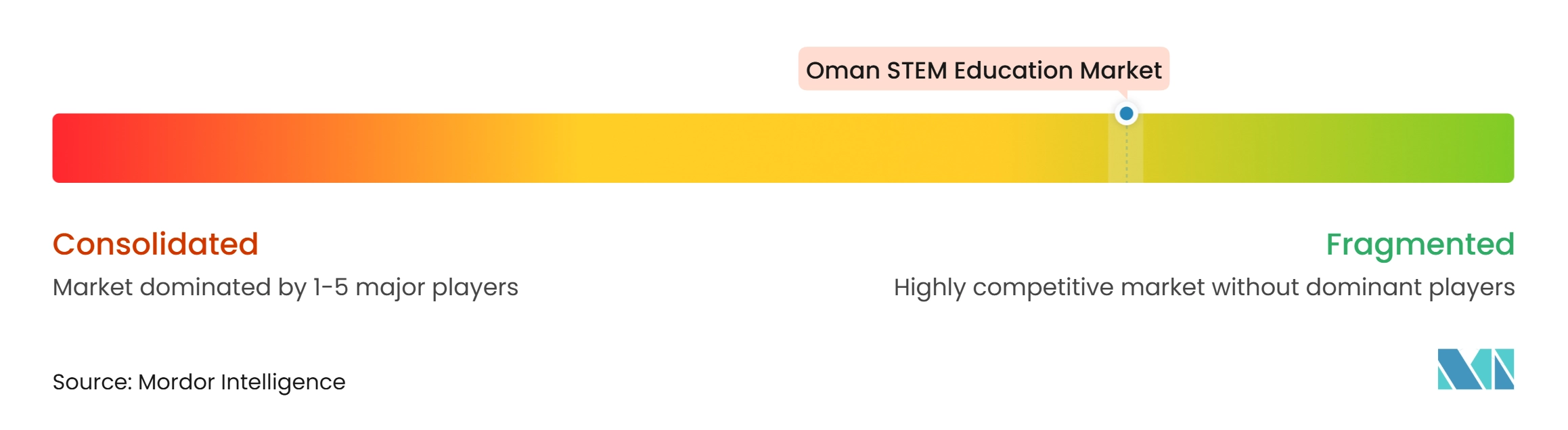
The Oman STEM education market is moderately fragmented, with no provider dominating curriculum content, hardware, software platforms, and teacher development. BCT Learning offers STEM and robotics resources, lab design, instructional content, and teacher support. STEAM Leaders, RoboThink Oman, and AITECHOM provide enrichment, artificial intelligence, and robotics solutions. Sultan Qaboos University is developing a national STEM teacher competency framework, which may influence teacher training requirements. The market offers opportunities for local specialists and partnership-based entrants.
Bilingual Arabic-English materials and Ministry curriculum alignment remain important in K-12 procurement. The Ministry’s digitization initiative emphasizes approved learning outcomes and locally suitable content. Omantel’s education partnership supports school connectivity and classroom technology. Opportunities remain for cost-effective assessment, analytics, and Arabic-language professional development providers. International providers can enter through local partnerships. ACI Learning signed a two-year tender with OMREN and the Ministry of Higher Education, Research and Innovation for IT and cybersecurity Skill Labs across universities. Entrants must meet Ministry approval, local delivery, and quality assurance requirements.
Oman STEM Education Industry Leaders
-
BCT Learning
-
STEAM Leaders
-
RoboThink Oman
-
AITECHOM
-
Engineering Village
- *Disclaimer: Major Players sorted in no particular order
Oman STEM Education Market Companies Covered in this Report
- AITECHOM
- American International School of Muscat
- ABA Oman International School
- BCT Learning
- Beaconhouse School Muscat
- British School Muscat
- 3C Coding School
- Engineering Village
- Fischer Technik
- Indian School Muscat
- Knowledge Gate International School
- Matatalab
- Middle East College
- National University of Science and Technology, Oman
- Oman Cables Industry SAOG
- Omantel
- RoboThink Oman
- STEAM Leaders
- Sultan Qaboos University
- PNX Labs
Recent Industry Developments in Oman STEM Education Market
- May 2026: OQ invested OMR 618,000 (USD 1.61 million) in the Al Buraimi Science and Innovation Centre, inaugurated under the patronage of Oman’s Education Minister. Spanning 61,000+ m², it features robotics labs, a planetarium, and a science museum, targeting 18,000+ learners across 54 institutions.
- September 2025: ACI Learning signed a two-year tender with OMREN and the Ministry of Higher Education, Research and Innovation (MOHERI) at COMEX 2025 to provide virtual IT and cybersecurity Skill Labs across Omani universities, supporting the General Studies Degree Computing Module and preparation for Cisco, CompTIA, ISC2, Microsoft and Oracle certifications.
- September 2025: Oman’s Ministry of Education launched Phase 3 of the Noor e-learning project, targeting 730 schools across 11 governorates. Enhancements include AI-enabled C-Help support, expanded teacher training, and planned integration with virtual labs and the digital atlas.
- August 2025: Omantel hosted its eight-day Digital Hero initiative at Salalah Grand Mall during Khareef Dhofar, using Minecraft to teach programming, data analysis, and digital safety. The initiative attracted approximately 2,400 child visitors.
Oman STEM Education Market Report Scope
The Oman STEM education market report analyzes STEM education products, services, and learning solutions across Oman. The market is segmented by delivery mode, offering, subject, end user, and region. The study examines key drivers, including Oman Vision 2040’s skills and knowledge-economy priorities, ministry-led curriculum digitization, employer demand for AI and digital skills, corporate-funded STEM initiatives, and the expansion of Arabic-English learning content. It also assesses restraints such as shortages of STEM-qualified teachers, high costs of laboratory equipment and learning kits, uneven connectivity, and procurement and curriculum-alignment challenges.
The report evaluates government education spending, private-sector investment, education infrastructure, student–teacher ratios, institutional distribution, student enrollment, tuition fees, and education spending. It provides market size and growth forecasts by delivery mode, offering, subject, end user, and region, with detailed regional forecasts for Muscat, Al Batinah North, Dhofar, and other governorates. The study also covers regulatory developments, technological trends, competitive forces, market concentration, market shares, strategic moves, and company profiles. It explores opportunities in Arabic-English STEM content aligned with Omani learning outcomes and affordable assessment and analytics solutions for public schools. Market estimates and forecasts are presented in value (USD).
Segmentation Overview
Key Questions Answered in the Report
What is the projected growth rate for STEM education in Oman?
The Oman STEM education market is projected to grow at a 10.34% CAGR from 2027 to 2032, rising from USD 192.56 million in 2027 to USD 315.01 million by 2032.
Which delivery mode leads STEM learning in Oman?
Self-paced learning led with 51.80% share in 2026, supported by digital resources and access through the Noor platform.
Why are K-12 schools important for STEM providers in Oman?
K-12 schools represented 60.40% of 2026 demand and are the main channel for public curriculum, platforms, classroom technology, and teacher training.
Which part of Oman is growing fastest for STEM education?
Al Batinah North is forecast to grow at an 11.37% CAGR through 2032, supported by school density, Noor rollout, and vocational education activity.
What is driving corporate technical training in Oman?
Employer needs in artificial intelligence, data, and digital skills are supporting corporate and professional training, which is forecast to grow at a 13.12% CAGR through 2032.
What limits wider STEM adoption in Oman?
Teacher capability, recurring equipment costs, unequal connectivity, and curriculum approval requirements can slow the use of tools and platforms outside leading institutions.