
Oil and Gas Electric Submersible Pump Market Size and Share
Market Overview
| Study Period | 2022 - 2032 |
|---|---|
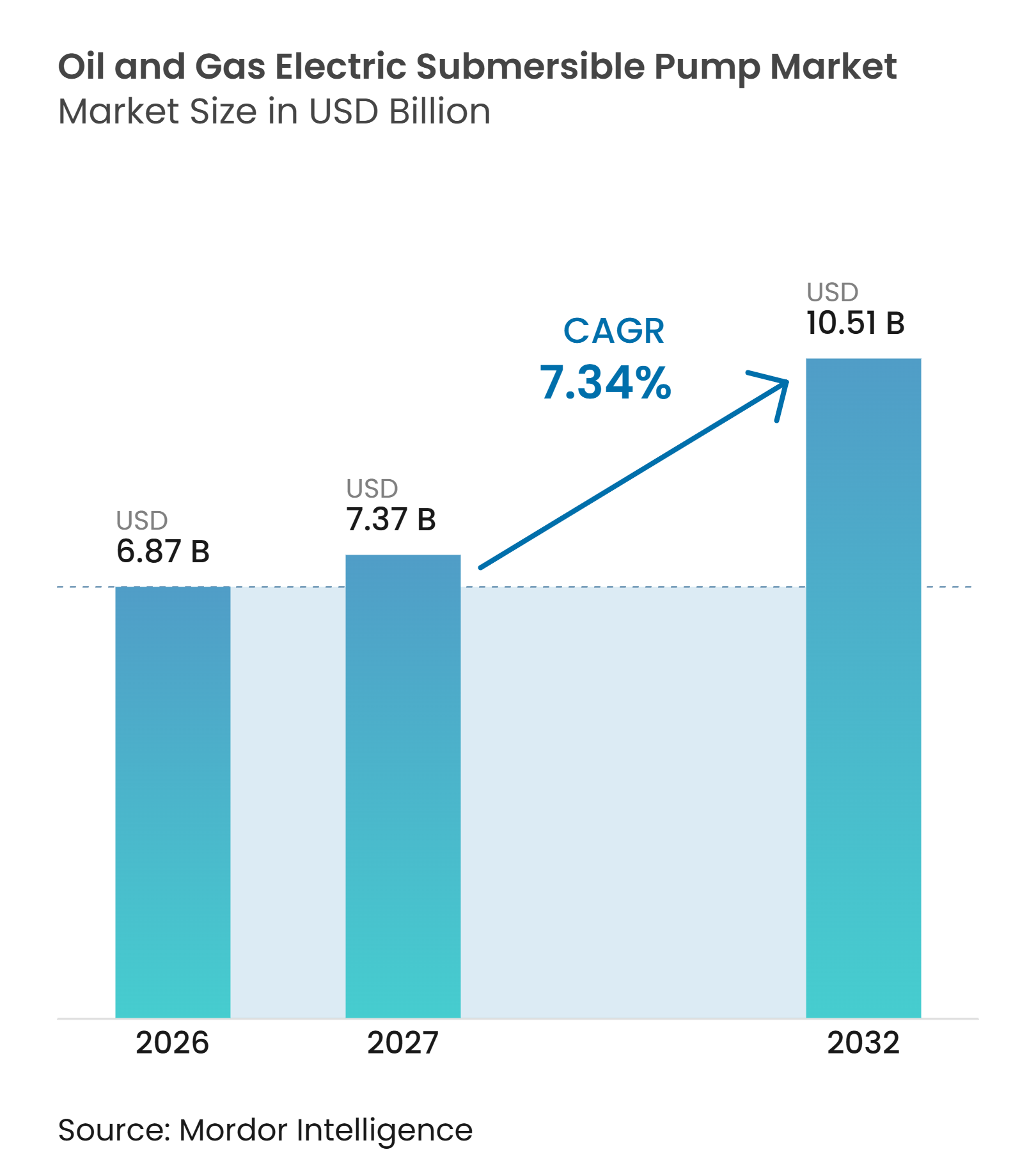
| Market Size (2027) | USD 7.37 Billion |
| Market Size (2032) | USD 10.51 Billion |
| Growth Rate (2027 - 2032) | 7.34 % |
| Fastest Growing Market | Asia-Pacific |
| Largest Market | North America |
| Market Concentration | Medium |
Major Players *Disclaimer: Major Players sorted in no particular order Image © Mordor Intelligence. Reuse requires attribution under CC BY 4.0. | |
Oil and Gas Electric Submersible Pump Market Analysis by Mordor Intelligence
The global oil and gas electric submersible pump market size is projected to expand from USD 6.87 billion in 2026 and USD 7.37 billion in 2027 to USD 10.51 billion by 2032, at a CAGR of 7.34% between 2027 and 2032. Pressure decline in mature oil fields is sustaining demand for artificial lift because operators need to preserve output without pursuing costly field redevelopment. Deepwater projects are increasing the value of installed systems because high-rate wells require specialized equipment, monitoring, and intervention planning. Digital monitoring and energy-efficient motors are shifting competition toward suppliers that can support performance over the operating life of a well. The Oil and Gas Electric Submersible Pump market also benefits from horizontal well activity because wells can require artificial lift shortly after initial production. Suppliers that combine equipment, service, and surveillance are better positioned to address operating risk and recurring replacement demand.
Key Report Takeaways
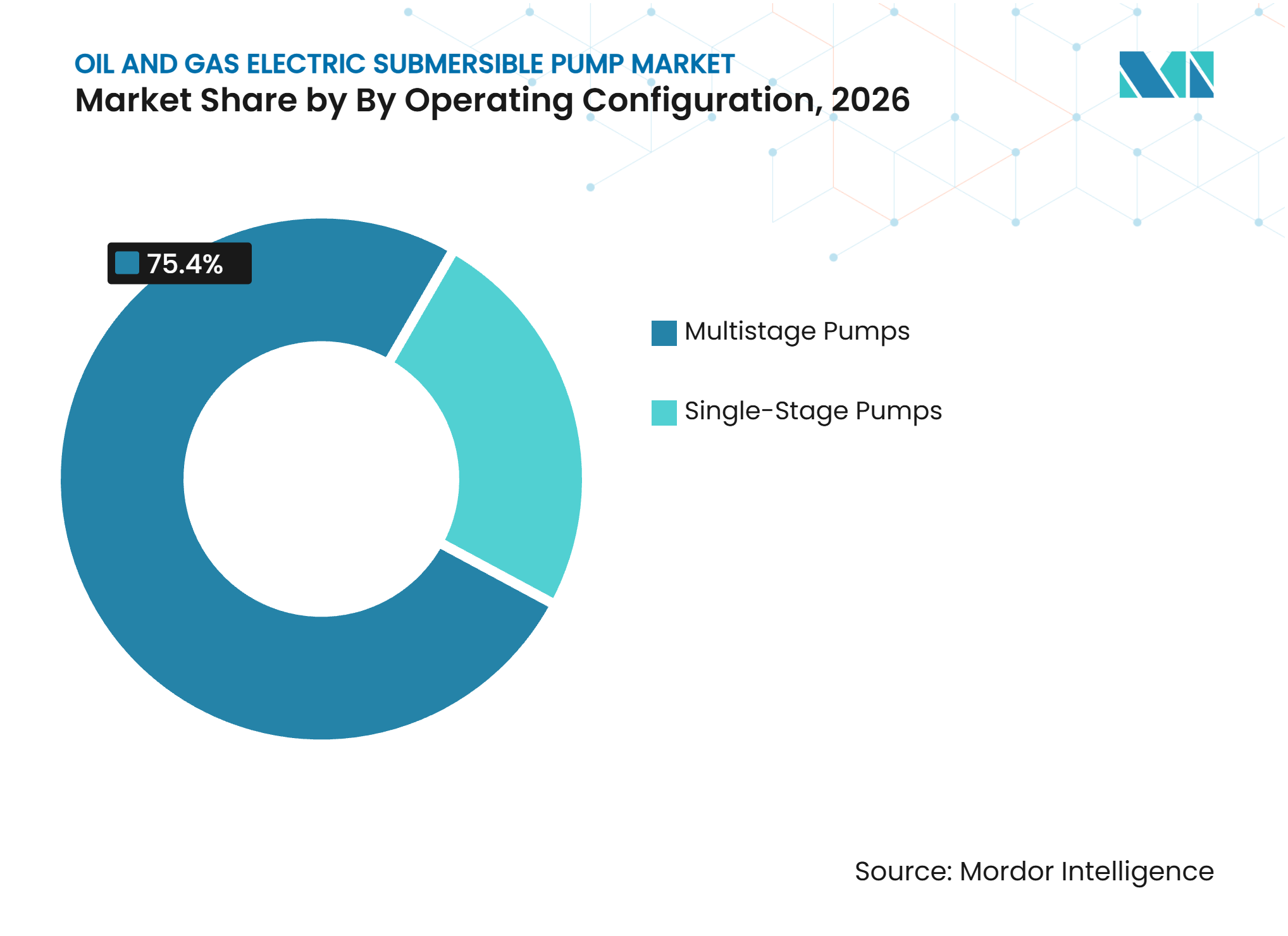
- By operating configuration, multistage pumps held 75.4% of Oil and Gas Electric Submersible Pump market share in 2026 and are projected to grow at a 7.5% CAGR through 2032.
- By deployment type, onshore installations accounted for 59.2% of global revenue in 2026, while offshore installations are forecast to grow at an 8.2% CAGR through 2032.
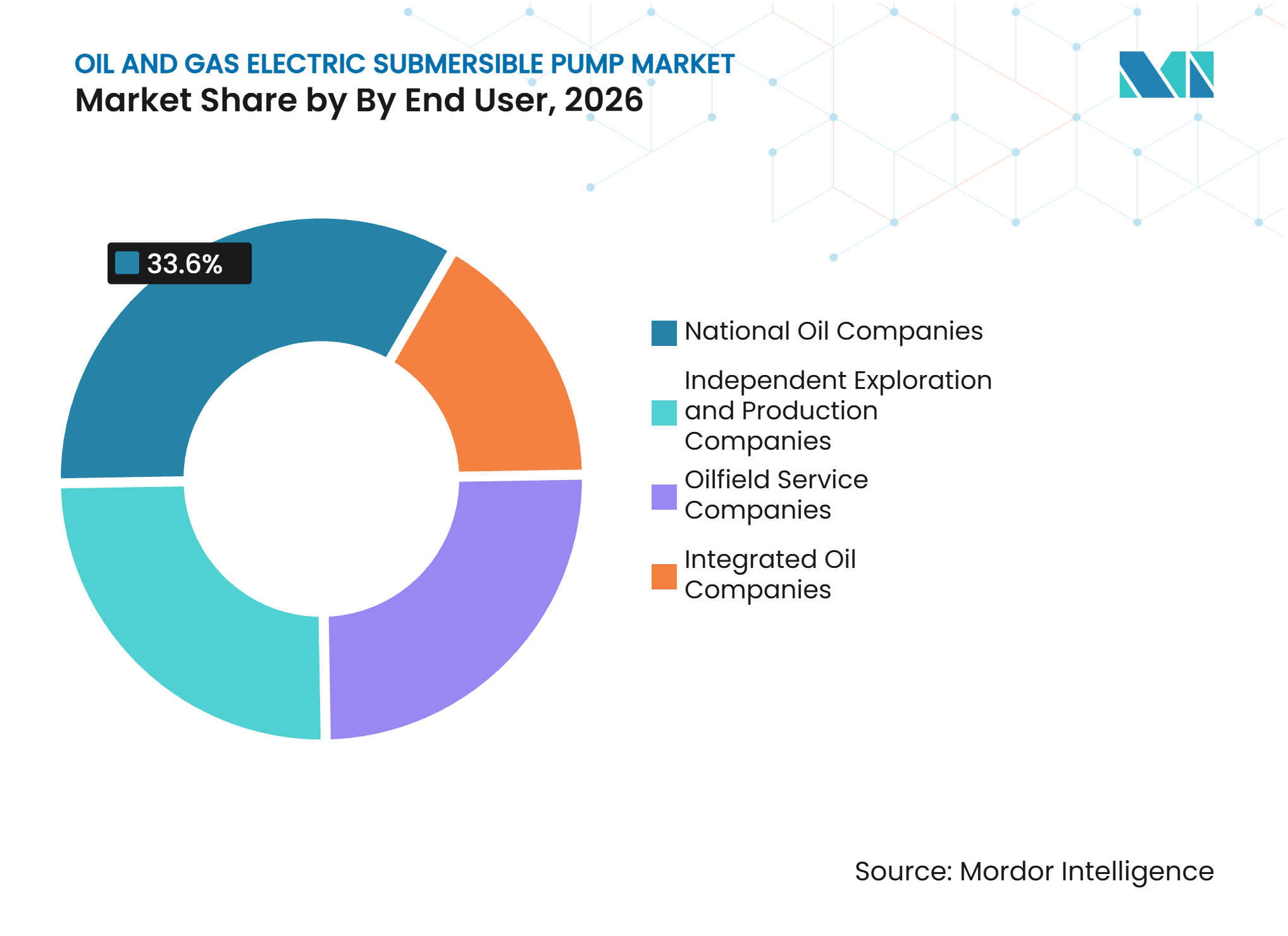
- By end user, national oil companies held 33.6% of global revenue in 2026, while independent Exploration and Production (E&P) companies are expected to grow at a 7.6% CAGR through 2032.
- By geography, North America accounted for 31.3% of the Oil and Gas Electric Submersible Pump market share in 2026, while Asia-Pacific is projected to grow at a 7.9% CAGR through 2032.
Note: Market numbers in this report are based on Mordor Intelligence's proprietary estimation framework, which combines nine months of actuals with Q4 projections for base year 2026.
Market Trends and Insights
Drivers Impact Analysis of Oil and Gas Electric Submersible Pump Market*
| Driver | % Impact on CAGR Forecast | Geographic Relevance | Impact Timeline |
|---|---|---|---|
| Mature-Field Pressure Decline and Brownfield Revitalization | +1.1% | Global; concentrated in Middle East, Russia, and Latin America | Medium term (2–4 years) |
| Deepwater and High-Rate Artificial Lift Deployment | +1.0% | Brazil, Gulf of Mexico, West Africa, Southeast Asia | Long term (≥ 4 years) |
| Shale, Tight-Oil and Horizontal-Well Production | +0.9% | North America (Permian Basin, Bakken, Eagle Ford) | Short term (≤ 2 years) |
| Digital ESP Surveillance and Predictive Failure Avoidance | +0.8% | Global; early gains in North America and Middle East | Medium term (2–4 years) |
| Energy-Efficient Permanent-Magnet Motors and Variable-Speed Drives | +0.7% | Global, with spill-over to Southeast Asia and Latin America | Medium term (2–4 years) |
| Rigless Retrieval and Intervention Economics | +0.6% | Global; offshore gains strongest in North Sea and Brazil | Long term (≥ 4 years) |
| Source: Mordor Intelligence | |||
Mature-Field Pressure Decline and Brownfield Revitalization
Reservoir pressure decline in fields that have produced for 20 years or more remains a durable demand driver for the Oil and Gas Electric Submersible Pump market. Natural flow becomes less effective as bottom-hole pressure falls, increasing the importance of systems that can lower intake pressure close to the producing formation. Brownfield activity supports a more recurring demand pattern than greenfield development because installed equipment needs replacement, service, and upgrades during the life of the well. This operating pattern can protect service demand when operators limit broader capital spending during changes in oil prices. Libya’s National Oil Corporation directed Sirte Oil Company to pilot a performance-based leasing model for electric submersible pumps in April 2026.[1] The pilot reduces the operator’s initial equipment ownership burden and links supplier compensation to operating results. The Oil and Gas Electric Submersible Pump market can therefore favor designs with longer run life when service providers assume more maintenance responsibility. Such agreements also make the supplier’s field support capacity more important during tender evaluation.
Deepwater and High-Rate Artificial Lift Deployment
Deepwater systems account for fewer installations than onshore systems, but their equipment value is materially higher because of operating conditions and production requirements. The supplied evidence indicates that 5% of installations serve critical deepwater and subsea wells, where systems can lift up to 40,000 barrels per day. High-horsepower equipment, subsea interfaces, and remote surveillance raise the technical requirements for those projects. SLB OneSubsea secured contracts from PTTEP in October 2025 for subsea production systems at Malaysia’s Block H and Kikeh fields.[2] Those projects cover deepwater assets in water depths of 1,100 to 1,300 meters and show how offshore investment becomes equipment and service demand. The Oil and Gas Electric Submersible Pump market gains value from this work even when project volumes remain limited. Capacity constraints for specialized suppliers can increase the importance of existing engineering and service qualifications.
Digital Electric Submersible Pump (ESP) Surveillance and Predictive Failure Avoidance
Unplanned failures can create both intervention expense and deferred production, which is increasing interest in continuous monitoring. Heavy-duty land-rig workovers can cost USD 50,000 to USD 100,000 per day, according to a 2025 peer-reviewed report.[3] The same source describes cable-deployed approaches that seek to reduce intervention time and avoid some rig-related cost exposure. In the Permian Basin, a Vital Energy deployment across more than 200 wells delivered a 2% to 4% oil uplift using autonomous optimization methods.[4] Monitoring tools can help operators change pump settings before damaging operating conditions create a shutdown. The Oil and Gas Electric Submersible Pump market is therefore placing more value on suppliers that provide useful data and practical failure analysis. Digital surveillance also affects purchasing decisions because operators can compare suppliers on expected run life rather than equipment price alone.
Energy-Efficient Permanent-Magnet Motors and Variable-Speed Drives
Permanent-magnet motor systems and variable-speed drives are changing how operators assess the value of electric submersible pumping equipment. Baker Hughes states that its Magnefficient motor can reduce system energy consumption by 20% and motor power loss by up to 67% compared with conventional induction-motor configurations. Higher power density can remove the need for tandem motor connections and allow deeper placement near producing intervals. This can support both energy performance and operational reliability where well conditions require greater lift capability. The Oil and Gas Electric Submersible Pump market is seeing higher revenue per installed well when operators replace older motor assemblies with advanced packages. The transition does not depend only on new installations because mature wells can also receive upgraded motors and drives. Suppliers that demonstrate lower power demand can strengthen their position where electricity cost and equipment reliability are material operating concerns.
Restraints Impact Analysis of Oil and Gas Electric Submersible Pump Market*
| Restraint | % Impact on CAGR Forecast | Geographic Relevance | Impact Timeline |
|---|---|---|---|
| High Installation, Workover and Failure-Recovery Cost | -1.0% | Global; most acute in offshore and remote onshore fields | Short term (≤ 2 years) |
| Gas Interference, Solids, Scale and Corrosive-Fluid Exposure | -0.7% | Global; concentrated in high-GOR shale, sour-gas Middle East, and heavy-oil Latin America | Medium term (2–4 years) |
| Electricity Dependence and Power-Quality Constraints in Remote Fields | -0.6% | Sub-Saharan Africa, remote Southeast Asia, inland Latin America | Long term (≥ 4 years) |
| Competition from Gas Lift, Rod Lift, PCP and Hybrid Lift | -0.5% | North America (deeper Delaware Basin), heavy-oil Canada, sand-prone West Africa | Medium term (2–4 years) |
| Source: Mordor Intelligence | |||
High Installation, Workover and Failure-Recovery Cost
Electric submersible pump workovers are capital-intensive interventions for upstream operators, particularly when heavy-duty rigs are needed. Heavy-duty rig rates can range from USD 50,000 to USD 100,000 per day, and constrained markets can extend scheduling timelines. Large national and international operators can manage this risk more effectively when they have access to dedicated service fleets. Independent producers can face greater exposure because they often depend on spot rig availability and shorter operating budgets. Rigless systems can reduce intervention time, although the equipment may require an initial rig-based installation and higher upfront cost. Baker Hughes states that its Access Electric Submersible Pump (ESP) system supports rigless deployment and retrieval options for selected applications. The Oil and Gas Electric Submersible Pump market must address this cost barrier through designs that reduce failure frequency and shorten recovery work.
Gas Interference, Solids, Scale and Corrosive-Fluid Exposure
Gas interference can reduce hydraulic efficiency and shorten system life in wells with high gas-oil ratios. Conventional separators operate reliably up to 25% gas content under the conditions described in the supplied research. China’s first offshore high-gas electric submersible pump was commissioned at the Bozhong 19-2 Field in January 2025. The project raised the operating gas-content ceiling to 70% through a gas-treatment impeller developed for the application. Scale, corrosive formation water, and produced sand add further failure mechanisms that require field-specific equipment selection. The Oil and Gas Electric Submersible Pump market must therefore balance production targets with operating conditions that can change during a well’s life. Reliable performance in severe fluid environments matters because large national operators track failure records during vendor reviews.
*Our forecasts treat driver/restraint impacts as directional, not additive. The impact forecasts reflect baseline growth, mix effects, and variable interactions.
Oil and Gas Electric Submersible Pump Market Segment Analysis
By Operating Configuration:
Multistage Systems Lead Through Higher CapabilityMultistage pumps held 75.4% of 2026 revenue and are projected to expand at a 7.5% CAGR through 2032. The segment leads because deep wells and high-volume applications need multiple pumping stages to generate the required lift. Its position is also supported by upgraded systems that combine permanent-magnet motors with variable-speed drives. These packages can replace older induction-motor assemblies within existing well populations. The resulting increase in equipment value can lift revenue per well even when installation counts change slowly. The Oil and Gas Electric Submersible Pump market size for multistage systems benefits from operators seeking deeper placement, greater drawdown control, and more stable production. In practice, these systems are selected where well depth, fluid volume, and operating complexity exceed the practical range of simpler configurations. Their installed base also supports continued demand for servicing and replacement components in the Oil and Gas Electric Submersible Pump market.
Single-stage pumps remain relevant in shallow, high-productivity wells and selected horizontal shale completions. They can be suited to cases where a straight-section landing zone restricts the length of the equipment string. Their revenue position is nevertheless under pressure as well depth and completion complexity increase in many producing regions. Multistage equipment offers a wider response to changing conditions because stage count can support more demanding lift requirements. SLB reported a compact ultra-high-speed system for Ecuador’s MDC Field that was 70% to 75% shorter than a conventional string. The company reported that the system could operate in wellbores with dogleg severity above 1° per 100 feet and reduce installation time by 83%. This type of design supports multistage adoption where well geometry limits conventional equipment choices. It also shows why suppliers compete on placement flexibility and operating performance, not only pump capacity.


By Deployment Type:
Onshore Installations LeadsOnshore installations accounted for 59.2% of global revenue in 2026, reflecting the broad base of land-based producing wells. The segment is supported by artificial lift activity in the Permian Basin, West Siberia, and the Arabian Peninsula. Onshore operations provide the largest number of potential installations because mature fields and unconventional developments contain many individual wells. They also create recurring demand for monitoring, workovers, and replacement equipment. The Oil and Gas Electric Submersible Pump market size onshore is supported by the need to maintain production in wells that no longer flow naturally. Operators can select equipment from a wider group of suppliers than they can for offshore work. This makes service availability, lead time, and historical run life important buying criteria. The wide installation base also gives the Oil and Gas Electric Submersible Pump market large operating data sets that can improve configuration and monitoring practices.
Offshore installations are forecast to grow at an 8.2% CAGR through 2032, the highest rate among deployment types. Deepwater fields require specialized systems that integrate subsea equipment, remote monitoring, and high-power pumping capacity. Their value per installation exceeds that of many onshore applications because the operating environment is harder to access and less forgiving. SLB OneSubsea’s August 2025 contract for Equinor’s Fram Sør project covers a 12-well all-electric subsea production system. The project uses four subsea templates and 12 all-electric trees tied back to the Troll C platform. All-electric architecture raises the specification level of equipment and can reduce reliance on hydraulic control lines. Offshore work therefore remains concentrated among suppliers that have established subsea engineering and project-execution capabilities. The Oil and Gas Electric Submersible Pump market benefits from these awards even when offshore unit volume remains below onshore volume.
By End User:
National Oil Companies Lead While Independents Grow FasterNational oil companies held 33.6% of global revenue in 2026, the largest position among end users. Their role reflects ownership and investment control in many of the largest mature and offshore producing fields. These operators often run large procurement programs that can influence supplier capacity and product planning. Baker Hughes announced a multi-year Kuwait Oil Company award in December 2025 covering equipment, installation, surveillance, and maintenance. The award also includes FusionPro intelligent production drives and the Leucipa automated platform. Such contracts show that large operators are increasingly purchasing integrated support rather than isolated equipment. The Oil and Gas Electric Submersible Pump market, therefore, rewards suppliers that can combine hardware, digital tools, and field services in a single offering.
Independent Exploration and Production (E&P) companies are expected to grow at a 7.6% CAGR through 2032, the fastest rate among end-user groups. Their demand is linked to the drilling pace in North American unconventional fields and the need to minimize nonproductive time. These operators may not have the same internal engineering depth as larger integrated companies or national oil companies. Practical surveillance tools and equipment that can manage difficult well conditions can therefore be particularly important. Oilfield service companies remain part of the demand base because they support equipment deployment and intervention activity for operators. Integrated oil companies can also influence technology selection through joint ventures and field trials. Their direct share may not capture this influence because practices can transfer to national operator partners in the Oil and Gas Electric Submersible Pump market. The Oil and Gas Electric Submersible Pump industry is thus shaped by both the purchasing scale of national operators and the operating urgency of independent producers.

Geography Analysis
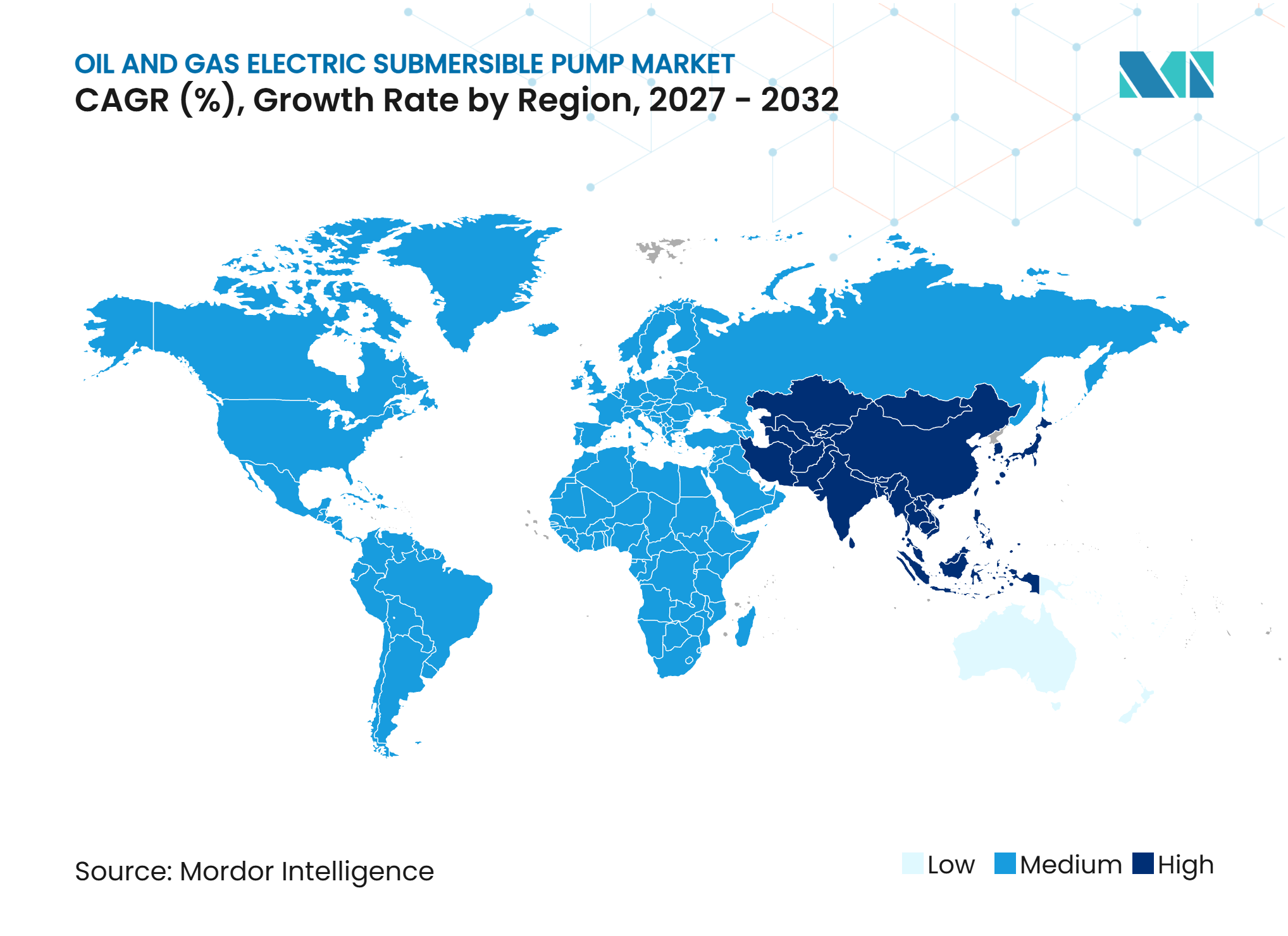
North America accounted for 31.3% of global revenue in 2026, making it the largest regional contributor. Horizontal shale completions in the Permian Basin, Bakken, and Eagle Ford support a large installed base. Artificial lift can be required soon after initial production in these wells, creating regular equipment and service demand. Vital Energy’s deployment across more than 200 Permian wells achieved a 2% to 4% oil uplift through autonomous optimization. This operating evidence supports demand for monitoring systems that can adjust pump settings as well conditions evolve. Canada’s oil sands and Argentina’s Vaca Muerta add further regional demand with different reservoir and completion characteristics. Mexico contributes replacement activity across onshore and shallow-water assets.
Asia-Pacific is projected to expand at a 7.9% CAGR through 2032, the fastest regional growth rate in the Oil and Gas Electric Submersible Pump market. China’s offshore expansion is creating demand for systems that can operate in higher gas-content conditions. The January 2025 Bozhong 19-2 installation demonstrated an operating gas-content ceiling of 70% in an offshore setting. Indonesia also provides a distinct mature-field case through Pertamina EP’s linear electric submersible pump work at Lirik Field. The supplied trial doubled oil productivity from 18 barrels of oil per day (BOPD) to 36 BOPD using a double-acting plunger mechanism. India, Malaysia, Vietnam, and Australia provide further demand across mature onshore fields and offshore developments. This geographic mix limits the region’s dependence on a single country or production setting.
Europe’s highest-value activity is concentrated in the North Sea, where Norwegian and UK continental shelf projects require sophisticated subsea equipment. South America is supported by Brazil’s deepwater pre-salt developments and Argentina’s unconventional activity. The Middle East combines large national operator programs with the need to maintain output from mature fields. Africa has substantial reservoir potential, but remote locations and electricity constraints can limit equipment economics. The Oil and Gas Electric Submersible Pump market has different regional priorities because reservoir conditions, power availability, and intervention access differ materially. Suppliers must therefore adapt product configuration and field support rather than relying on a single global offer. In the Oil and Gas Electric Submersible Pump market, regions with deepwater activity place greater weight on technical qualification and project delivery capacity. Regions with mature onshore fields place greater weight on run life, service response, and the cost of recurring interventions.
Competitive Landscape
Market Concentration
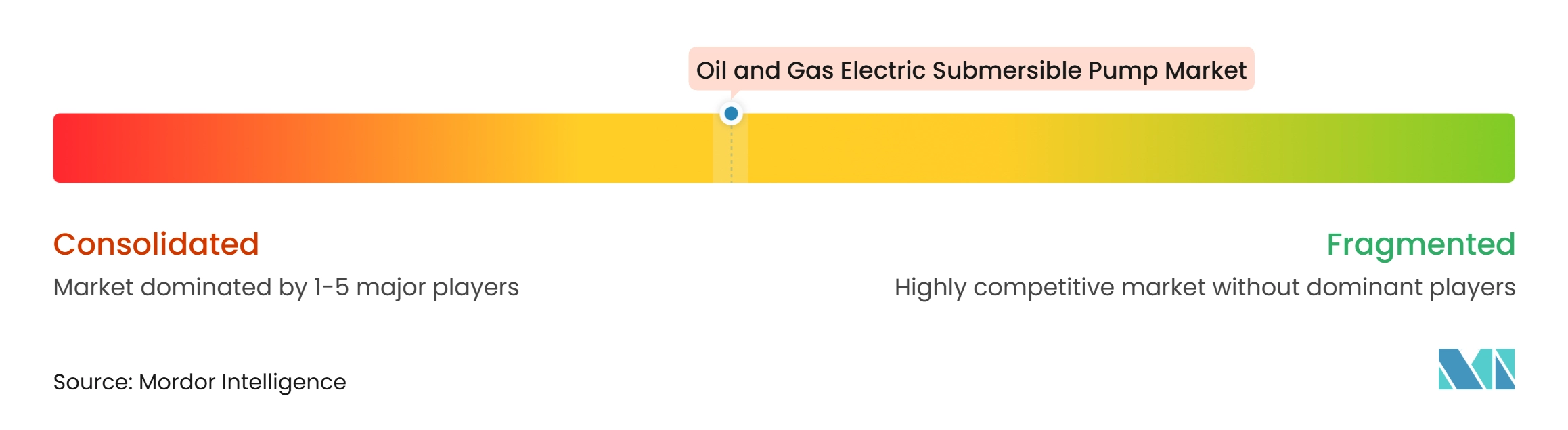
The Oil and Gas Electric Submersible Pump market is moderately concentrated in premium applications and more fragmented in regional and mid-market work. SLB, Baker Hughes, and Halliburton set a competitive benchmark through equipment, monitoring, and field-service capabilities. Their integrated approach can make direct hardware price comparisons less useful for procurement teams. Suppliers increasingly compete on production support, reliability, and the ability to interpret operating data. Baker Hughes combines electric submersible pump technology with intelligent drives and automated production software in its Kuwait Oil Company award. This approach connects equipment supply with surveillance and maintenance obligations. Regional manufacturers such as Borets and Novomet remain relevant where local relationships, engineering capacity, and import-substitution policies shape buying decisions.
Competitive advantage in offshore work depends on qualifications that smaller suppliers may find difficult to establish quickly. SLB OneSubsea’s Malaysia awards demonstrate the importance of broad subsea project capability in deepwater developments. The contracts cover systems that include subsea trees, umbilicals, and controls, which require expertise beyond the pump itself. In the United States Gulf of America, SLB OneSubsea received an Engineering, Procurement, and Construction (EPC) contract for bp’s Tiber deepwater project in November 2025. The award followed a related Kaskida contract and used a standardized high-pressure subsea pump solution. These programs show how repeatable designs can strengthen a supplier’s position when operators pursue similar deepwater developments. The Oil and Gas Electric Submersible Pump market rewards firms that can carry technical responsibility across the equipment and service lifecycle.
Opportunities remain in performance-based contracts, surveillance tools for independent operators, and systems designed for high-gas wells. The Libya pilot provides an example of a contract structure that transfers more maintenance responsibility to suppliers. Suppliers that can document run life and reduce intervention needs may be better placed for such arrangements. High-gas applications can also create room for differentiated equipment because conventional systems can face gas locking and lower efficiency. Baker Hughes reported a Bakken deployment that increased production by 30% to 1,350 barrels of fluid per day (BFPD) while reducing current swings by 32%. These examples show why gas handling and digital support are central areas of competition. The Oil and Gas Electric Submersible Pump market remains open to regional specialists, but premium projects continue to favor companies with broad engineering and service resources.
Oil and Gas Electric Submersible Pump Industry Leaders
-
SLB
-
Baker Hughes Company
-
Halliburton Company
-
Weatherford International plc
-
Novomet
- *Disclaimer: Major Players sorted in no particular order
Oil and Gas Electric Submersible Pump Market Companies Covered in this Report
- SLB
- Alkhorayef Petroleum Company
- Atlas Copco AB
- Baker Hughes Company
- Borets International Limited
- Canadian Advanced ESP
- ChampionX Corporation
- DOS Canada Inc.
- EBARA Corporation
- Extract Production Services LLC
- FlexLift
- Flowserve Corporation
- Halliburton Company
- JJ Tech
- National Oilwell Varco, Inc. (NOV)
- Novomet
- Petro Lift Systems
- Sulzer Ltd
- Summit ESP
- Weatherford International plc
Recent Industry Developments in Oil and Gas Electric Submersible Pump Market
- December 2025: Baker Hughes announced a multi-year Kuwait Oil Company award covering electric submersible pump supply, installation, surveillance, maintenance, FusionPro drives, and the Leucipa platform.
- November 2025: SLB OneSubsea received an Engineering, Procurement, and Construction (EPC) contract from bp for a subsea boosting system at the Tiber deepwater project in the Gulf of America, following a related award for Kaskida.
- October 2025: SLB OneSubsea secured Engineering, Procurement, and Construction (EPC) contracts from PTTEP for subsea production systems covering the Block H gas development and Kikeh oil field offshore Malaysia.
- August 2025: SLB OneSubsea secured an Engineering, Procurement, and Construction (EPC) contract from Equinor for a 12-well all-electric subsea production system at the Fram Sør field on the Norwegian Continental Shelf.
Global Oil and Gas Electric Submersible Pump Market Report Scope
Electric submersible pumps (ESPs) are electrically driven pumping systems designed to lift fluids from underground wells to the surface by using a motor-powered pump assembly installed below the fluid level. In the oil and gas industry, ESPs are primarily used in artificial lift applications to increase production from oil and gas wells when natural reservoir pressure is insufficient to bring fluids to the surface at the required flow rate. These systems typically consist of a downhole electric motor, multistage centrifugal pump, seal section, and power cable, with supporting surface equipment such as variable speed drives and control systems. ESPs are deployed in onshore and offshore oilfields to handle varying production rates, well depths, fluid properties, and operating conditions, helping improve hydrocarbon recovery, production efficiency, and well productivity.
The Global Oil and Gas Electric Submersible Pump Market is segmented by operating configuration, deployment type, and end user. By operating configuration, the market is segmented into single-stage pumps and multistage pumps. By deployment type, the market is segmented into onshore and offshore applications. By end user, the market is segmented into integrated oil companies, national oil companies, independent exploration and production companies, and oilfield service companies. The report also covers the market size and forecasts for the global oil and gas electric submersible pump market across 26 countries in key regions, including North America, Europe, Asia-Pacific, South America, and the Middle East and Africa. For each segment, market sizing and forecasts are provided on the basis of value (USD).
Segmentation Overview
| Single-Stage Pumps |
| Multistage Pumps |
| Onshore |
| Offshore |
| Integrated Oil Companies |
| National Oil Companies |
| Independent Exploration and Production Companies |
| Oilfield Service Companies |
| North America | United States |
| Canada | |
| Mexico | |
| Europe | Germany |
| France | |
| Italy | |
| Spain | |
| United Kingdom | |
| Norway | |
| Russia | |
| Rest of Europe | |
| Asia-Pacific | China |
| India | |
| Japan | |
| South Korea | |
| Australia | |
| Indonesia | |
| Vietnam | |
| Thailand | |
| Rest of Asia-Pacific | |
| South America | Brazil |
| Argentina | |
| Chile | |
| Rest of South America | |
| Middle East and Africa | Saudi Arabia |
| United Arab Emirates | |
| Nigeria | |
| Kuwait | |
| Oman | |
| Egypt | |
| South Africa | |
| Morocco | |
| Rest of Middle East and Africa |
| By Operating Configuration | Single-Stage Pumps | |
| Multistage Pumps | ||
| By Deployment Type | Onshore | |
| Offshore | ||
| By End User | Integrated Oil Companies | |
| National Oil Companies | ||
| Independent Exploration and Production Companies | ||
| Oilfield Service Companies | ||
| By Geography | North America | United States |
| Canada | ||
| Mexico | ||
| Europe | Germany | |
| France | ||
| Italy | ||
| Spain | ||
| United Kingdom | ||
| Norway | ||
| Russia | ||
| Rest of Europe | ||
| Asia-Pacific | China | |
| India | ||
| Japan | ||
| South Korea | ||
| Australia | ||
| Indonesia | ||
| Vietnam | ||
| Thailand | ||
| Rest of Asia-Pacific | ||
| South America | Brazil | |
| Argentina | ||
| Chile | ||
| Rest of South America | ||
| Middle East and Africa | Saudi Arabia | |
| United Arab Emirates | ||
| Nigeria | ||
| Kuwait | ||
| Oman | ||
| Egypt | ||
| South Africa | ||
| Morocco | ||
| Rest of Middle East and Africa | ||
Key Questions Answered in the Report
What is the projected growth rate for oil and gas electric submersible pumps?
The report projects a 7.34% CAGR from 2027 to 2032, with the value reaching USD 10.51 billion by 2032.
Which configuration holds the largest share?
Multistage pumps hold 75.4% of 2026 revenue and are projected to grow at a 7.5% CAGR through 2032.
Why are offshore applications growing faster?
Offshore installations are forecast to grow at an 8.2% CAGR because deepwater projects need high-value, specialized systems.
Which region has the largest contribution?
North America holds 31.3% of 2026 revenue, supported by extensive horizontal shale activity and artificial lift demand.
Which region is expected to grow fastest?
Asia-Pacific is forecast to expand at a 7.9% CAGR through 2032, supported by offshore and mature-field activity.
What operating issues limit electric submersible pump performance?
High intervention costs, gas interference, solids, scale, and corrosive fluids can reduce run life and raise recovery costs.