
Offshore Wind Substation (HVAC & HVDC Platform) Market Size and Share
Market Overview
| Study Period | 2022 - 2032 |
|---|---|
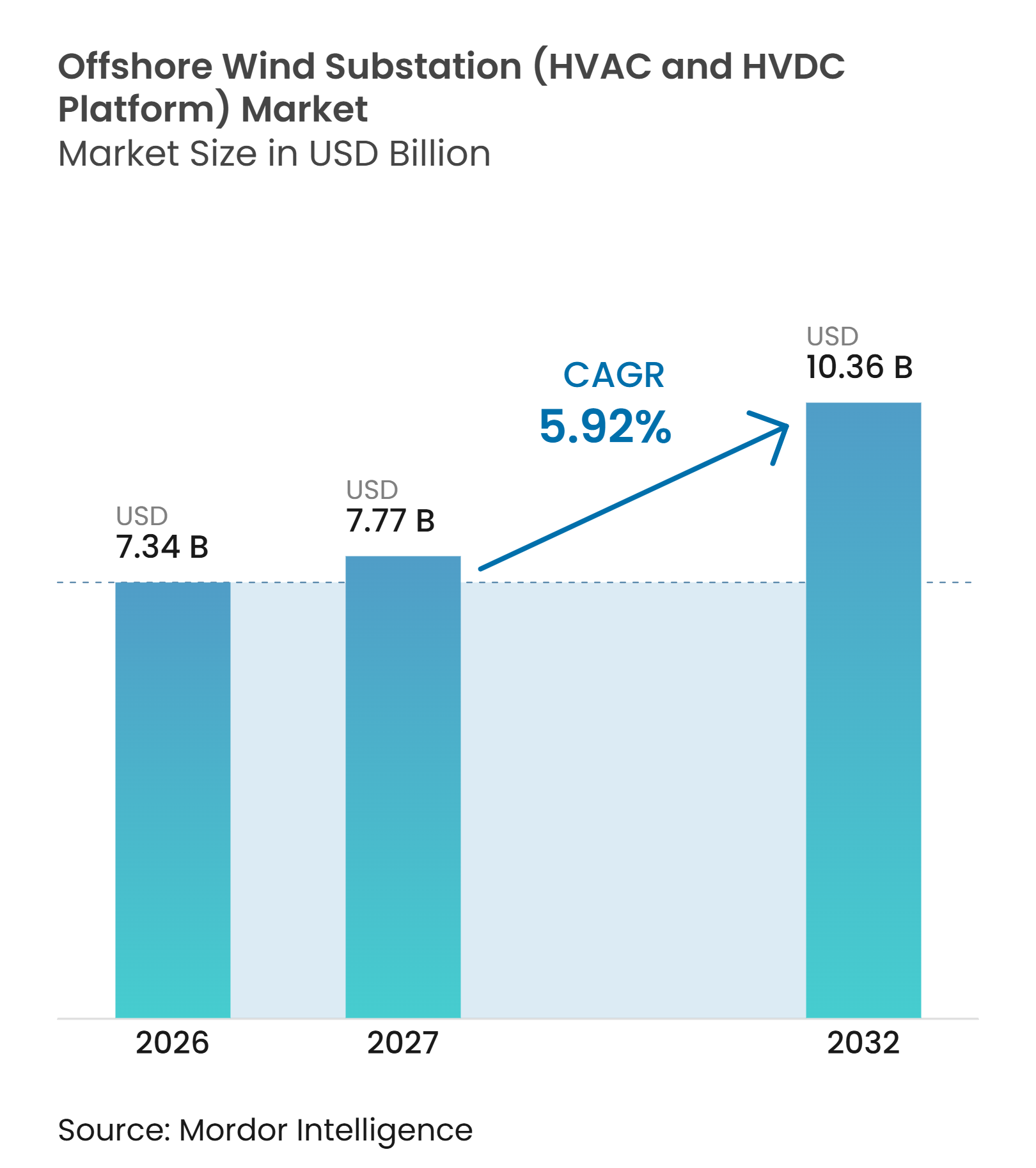
| Market Size (2027) | USD 7.77 Billion |
| Market Size (2032) | USD 10.36 Billion |
| Growth Rate (2027 - 2032) | 5.92 % |
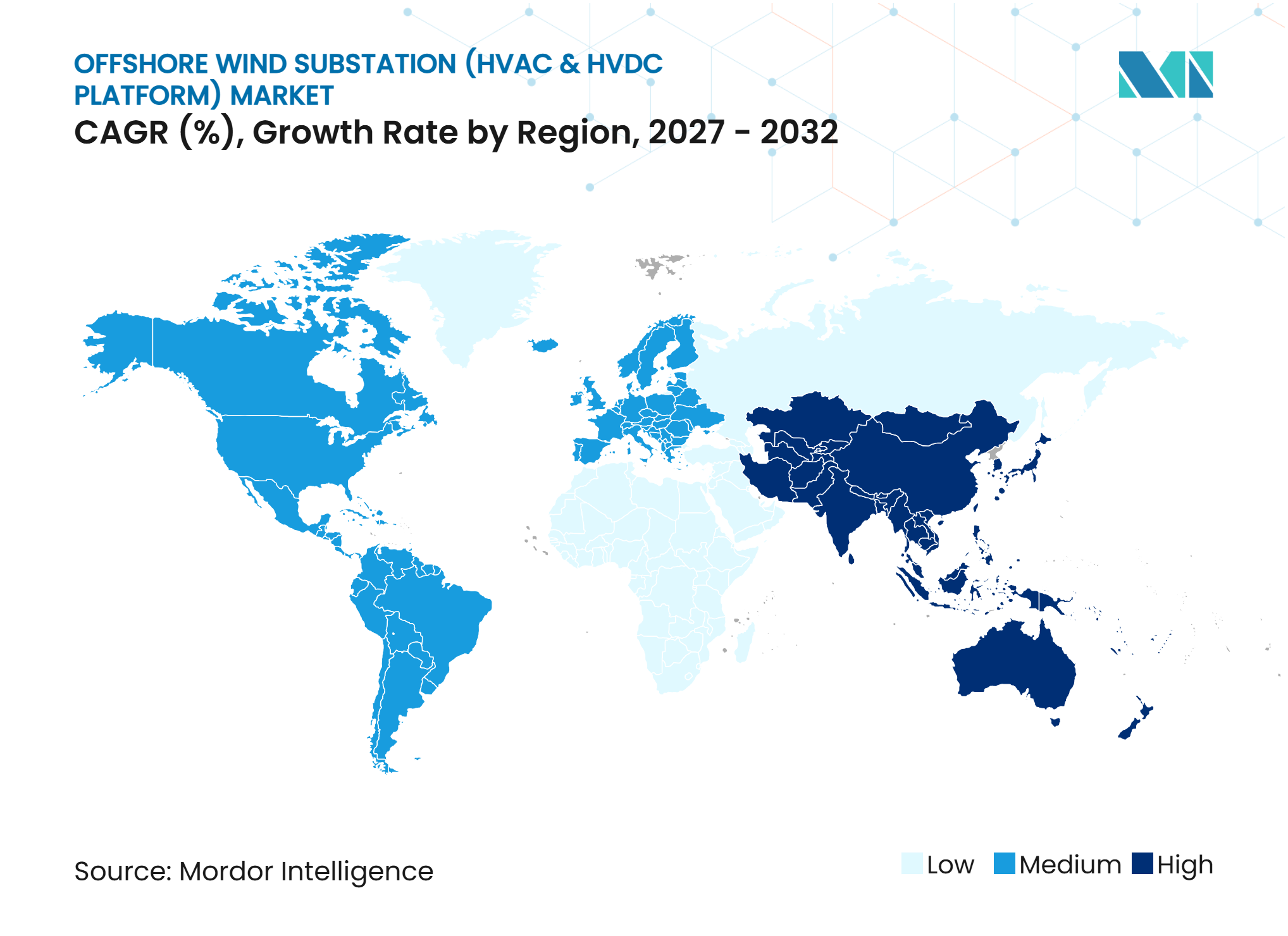
| Fastest Growing Market | Asia-Pacific |
| Largest Market | Europe |
| Market Concentration | Medium |
Major Players *Disclaimer: Major Players sorted in no particular order Image © Mordor Intelligence. Reuse requires attribution under CC BY 4.0. | |
Offshore Wind Substation (HVAC & HVDC Platform) Market Analysis by Mordor Intelligence
The global offshore wind substation market size is expected to grow from USD 7.34 billion in 2026 to USD 7.77 billion in 2027 and is forecast to reach USD 10.36 billion by 2032 at 5.92% CAGR over 2027-2032. The Offshore Wind Substation (HVAC & HVDC Platform) market is supported by offshore grid programs in Europe and Asia-Pacific, where longer distances from shore require more capable transmission infrastructure. New wind capacity, binding renewable-energy plans, and the retirement of conventional generation continue to create demand for offshore electrical platforms. Standardized 2 GW HVDC connections are changing procurement because they concentrate higher-capacity conversion equipment into fewer, larger projects. Lean unmanned-platform designs and digital monitoring are also reducing operating demands while increasing the importance of reliable remote-control systems. Project cancellations, delayed auctions, supplier stress, and limited installation capacity can defer orders, even where long-term grid plans remain in place.[1][2]
Key Report Takeaways
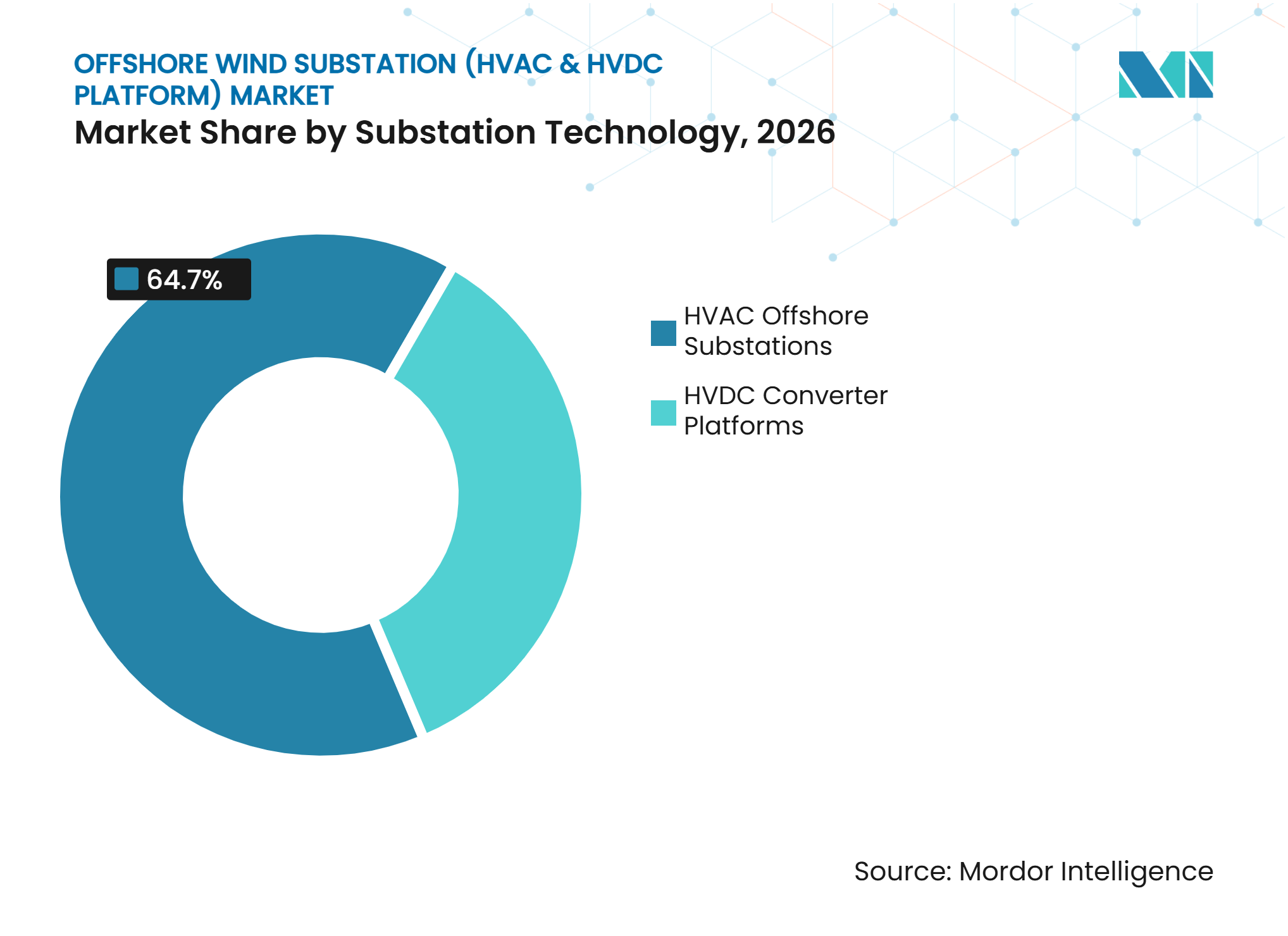
- By substation technology, High Voltage Alternating Current (HVAC) Offshore Substations held 64.7% of the offshore wind substation market size in 2026, while HVDC Converter Platforms are projected to grow at a 6.2% CAGR through 2032.
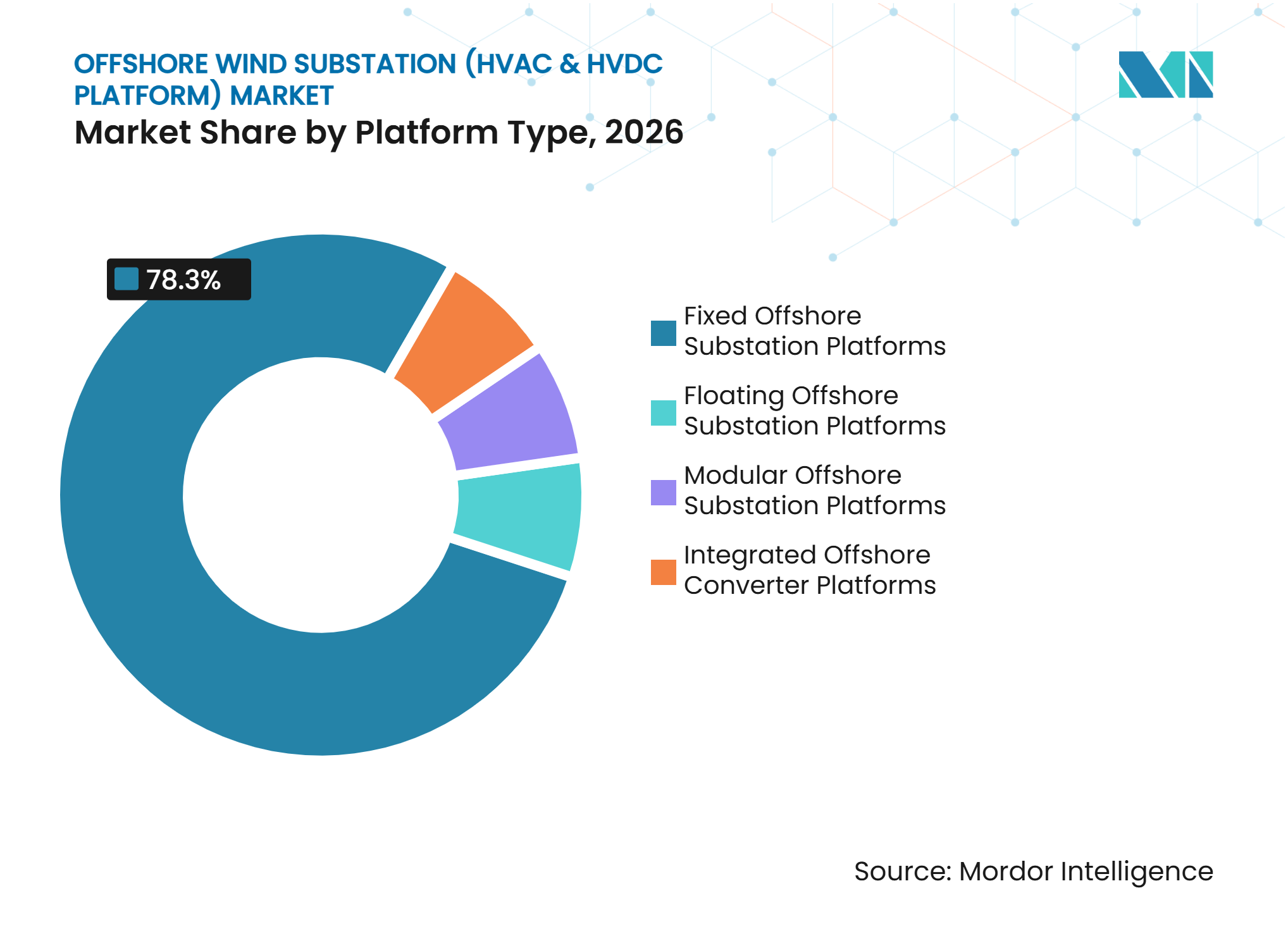
- By platform type, fixed offshore substation platforms accounted for 78.3% of the global offshore wind substation market size in 2026, while floating offshore substation platforms are forecast to advance at a 7.3% CAGR through 2032.
- By geography, Europe held 55.4% of the offshore wind substation market share in 2026, while Asia-Pacific is projected to expand at a 6.8% CAGR through 2032.
Note: Market numbers in this report are based on Mordor Intelligence's proprietary estimation framework, which combines nine months of actuals with Q4 projections for base year 2026.
Market Trends and Insights
Drivers Impact Analysis of Offshore Wind Substation (HVAC & HVDC Platform) Market*
| Driver | (~) % Impact on CAGR Forecast | Geographic Relevance | Impact Timeline |
|---|---|---|---|
| Offshore Wind Capacity Expansion and Grid-Connection Build-Out | +2.5% | Global, led by Europe and Asia-Pacific | Short term (≤ 2 years) |
| HVDC Adoption for Far-Shore and Multi-Gigawatt Links | +1.2% | North Sea, China deep-water zones | Medium term (2-4 years) |
| Standardization of 2 GW-Class Offshore Grid Connections | +0.8% | EU North Sea, including Germany, the Netherlands, Belgium, and Denmark | Medium term (2-4 years) |
| Floating Wind Deployment in Deeper Waters | +0.5% | United Kingdom, Norway, Japan, South Korea, and the Mediterranean | Long term (≥ 4 years) |
| Offshore Energy-Island and Multi-Project Grid Architectures | +0.4% | Denmark, Belgium, the Netherlands, and Germany | Long term (≥ 4 years) |
| Digital Monitoring and Unmanned-Platform Design | +0.3% | Global | Short term (≤ 2 years) |
| Source: Mordor Intelligence | |||
Offshore Wind Capacity Expansion and Grid-Connection Build-Out
Each offshore wind farm above 100 MW requires dedicated offshore substation infrastructure, tying platform demand closely to capacity additions. TenneT plans 14 HVDC grid-connection systems in the German and Dutch North Sea by 2032 under its 2 GW program. China’s National Energy Administration required new offshore wind projects to locate at least 30 km from shore or in water deeper than 30 m in its January 2025 notice.[2] These siting rules place more projects in operating conditions that require purpose-built substations and more extensive export systems. The Offshore Wind Substation (HVAC & HVDC Platform) market therefore benefits when project development moves from nearshore sites toward deeper or more distant areas. European coordination also remains important because the proposed Trans-European Networks for Energy (TEN-E) update seeks to guide offshore grid development across North Sea corridor countries.[3]
HVDC Adoption for Far-Shore and Multi-Gigawatt Links
High Voltage Direct Current (HVDC) Converter Platforms are becoming more relevant as projects move beyond the distances where AC transmission is economical. International Electrotechnical Commission (IEC) Technical Report (TR) 63411:2025 addresses grid connection of offshore wind through voltage-source converter (VSC) HVDC systems. For the Offshore Wind Substation (HVAC & HVDC Platform) market, the technical guidance gives transmission operators a shared reference for procurement and system design. VSC-HVDC systems can provide active power-flow control and support functions that are increasingly relevant to grid operators. The Offshore Wind Substation (HVAC & HVDC Platform) market gains value per platform when converters must perform more than basic power transfer. European network-code work on HVDC requirements also points toward broader grid-support obligations for these systems.
Standardized 2 GW Connections and Offshore Grid Architecture
TenneT’s 2 GW program uses 525 kV DC connections and provides a common reference point for large offshore transmission projects. Standardization can reduce repeated engineering work and allows suppliers to plan capacity around a stable technical specification. In the Offshore Wind Substation (HVAC & HVDC Platform) market, the approach also directs investment toward European manufacturing for high-value HVDC equipment. These favors established suppliers with relevant production capacity and proven grid-connection experience. Amprion and 50Hertz issued shared offshore grid connection requirements in July 2025 for German DC-connected offshore wind facilities. Energy-island designs and multi-project hubs support the Offshore Wind Substation (HVAC & HVDC Platform) market and extend the same logic by allowing offshore electrical infrastructure to serve more than one wind farm.
Floating Wind Deployment and Digital Platform Design
Floating wind development creates a longer-term need for offshore substations that can operate under platform motion and dynamic cable loading. Prysmian introduced a 245 kV HVAC dynamic cable system in March 2025, supporting higher-voltage power transmission for floating projects. The Offshore Wind Substation (HVAC & HVDC Platform) market can initially benefit from floating HVAC designs because their electrical topsides draw on established fixed-platform equipment. Floating HVDC systems require further qualification and are expected later in the development cycle. Remote monitoring and unmanned operation remain relevant in both fixed and floating designs because offshore access is costly and weather-dependent. These features support the Offshore Wind Substation (HVAC & HVDC Platform) market and shift competition toward control systems, predictive maintenance, compact equipment, and reliable communications.
Restraints Impact Analysis of Offshore Wind Substation (HVAC & HVDC Platform) Market*
| Restraint | (~) % Impact on CAGR Forecast | Geographic Relevance | Impact Timeline |
|---|---|---|---|
| High Capital Intensity and Long Project Lead Times | -1.5% | Global, most acute in the United States and emerging Asia-Pacific markets | Short term (≤ 2 years) |
| Specialized HVDC Supplier and Installation-Vessel Capacity Constraints | -1.2% | North Sea, Taiwan Strait, and United States East Coast | Medium term (2-4 years) |
| Offshore Wind Auction Undersubscription and Project Repricing | -0.8% | Europe and the United States | Short term (≤ 2 years) |
| Interface and Liability Complexity Across TSO, Developer, and EPC Contracts | -0.4% | Global, most prominent in multi-party North Sea projects | Medium term (2-4 years) |
| Source: Mordor Intelligence | |||
High Capital Intensity, Long Lead Times, and Limited Execution Capacity
Offshore substations routinely cost USD 300 million to USD 600 million per unit, while 2 GW High Voltage Direct Current (HVDC) Converter Platforms can exceed USD 1 billion. Siemens Energy’s Bornholm Energy Island award covered four HVDC converter systems and was valued at EUR 2.3 billion or USD 2.53 billion, with project commissioning planned for the mid-2030s. Long contracts expose suppliers to financing, delivery, and interface risks before revenue is realized. TenneT partially terminated Petrofac’s scope in October 2025 and replaced it through a Hitachi Energy and Larsen & Toubro consortium arrangement. The Offshore Wind Substation (HVAC & HVDC Platform) market is also limited by the number of qualified HVDC suppliers, fabrication yards, and heavy-lift vessels. The Offshore Wind Substation (HVAC & HVDC Platform) market can face delayed orders because these constraints can move project schedules even when demand and regulatory support remain in place.
Auction Repricing and Contract-Interface Risk
Steel costs, HVDC equipment lead times, and vessel day rates can raise project costs faster than auction frameworks adjust. Germany’s August 2025 offshore wind tenders for 2,000 MW and 500 MW drew no bids, highlighting the pressure on project economics. Delayed awards postpone substation fabrication orders and disrupt utilization at yards in Europe and Asia. The Offshore Wind Substation (HVAC & HVDC Platform) market also faces contractual complexity where transmission operators, developers, technology suppliers, fabricators, and installers carry separate responsibilities. A technical or financial problem in one package can affect the timing of the entire grid connection. Clear allocation of design, delivery, and liability responsibilities is therefore important for predictable execution in the Offshore Wind Substation (HVAC & HVDC Platform) market.
*Our forecasts treat driver/restraint impacts as directional, not additive. The impact forecasts reflect baseline growth, mix effects, and variable interactions.
Offshore Wind Substation (HVAC & HVDC Platform) Market Segment Analysis
By Substation Technology:
HVAC Remains the Larger Segment While HVDC ExpandsHigh Voltage Alternating Current (HVAC) Offshore Substations held a 64.7% share in 2026. The segment serves nearshore and intermediate-distance wind farms, where AC connections remain practical below 80 km from shore. It benefits from simpler topside architecture and a wider base of qualified fabricators. Belgium’s Princess Elisabeth Zone required HVAC infrastructure for 2.1 GW, and HSM Offshore Energy started module fabrication in June 2025. China’s NB/T 31115-2025 standard widened the applicable AC voltage range to 500 kV and introduced compact-design provisions, supporting higher-specification units in the Offshore Wind Substation (HVAC & HVDC Platform) market.
High Voltage Direct Current (HVDC) Converter Platforms are projected to grow at a 6.2% CAGR from 2027 to 2032. TenneT’s 14-platform program, Hornsea 3, and Bornholm Energy Island support demand for high-capacity conversion platforms. GE Vernova’s Ostwind 4 bipole design can maintain 50% capacity after a single-cable fault. The Offshore Wind Substation (HVAC & HVDC Platform) market size for HVDC platforms is supported by larger unit values and expanding performance requirements.



By Platform Type:
Fixed Structures Retain Scale While Floating Platforms AdvanceFixed offshore substation platforms accounted for 78.3% of the offshore wind substation industry in 2026. They remain the established choice in shallow and intermediate water depths because installation methods and supply chains are mature. Dogger Bank C completed the three-substation program in May 2025 with a lean design that reduced topside weight per MW. Heerema started construction of the IJmuiden Ver Beta jacket in September 2025 for a TenneT 2 GW platform. Modular designs in China and Taiwan can shorten schedules through parallel structural and electrical assembly, while integrated converter platforms remain under evaluation for farshore projects.
Floating offshore substation platforms are forecast to grow at a 7.3% CAGR from 2027 to 2032. The Offshore Wind Substation (HVAC & HVDC Platform) market can benefit as wind projects move into deeper waters where fixed structures are less attractive. Prysmian’s 245 kV dynamic cable system supports higher-voltage transmission for floating projects. Floating HVAC systems can use equipment similar to fixed platforms, while qualification of dynamic cables and electrical fatigue remains necessary before broader deployment.

Geography Analysis
Europe
Europe accounted for a 55.4% regional share in 2026. The North Sea pipeline is supported by a joint 300 GW offshore wind ambition for 2050. Germany’s 2 GW procurements and the July 2025 ONAR requirements create a common technical base for DC-connected facilities.The United Kingdom’s Offshore Transmission Owner (OFTO) framework continues to shape investment, and Ofgem set a 98% availability target for HVDC assets in December 2025. Belgium’s Princess Elisabeth project demonstrates an energy-hub model that allows shared offshore infrastructure to serve several wind farms.
Asia-Pacific
Asia-Pacific is projected to grow at a 6.8% CAGR from 2027 to 2032. China’s 2025 siting requirements direct new projects farther from shore or into deeper water, which increases the need for dedicated electrical infrastructure. Taiwan’s 60% local-content policy supports domestic capability, while Semco Maritime, PTSC M&C, and DEME received Formosa 4 project awards in 2025. South Korea’s Shinan-Ui project selected Ramboll for HVAC substation design, and Japan provides a later opportunity as its pipeline develops. Chinese standards and Taiwan’s localization requirements remain key compliance factors for the Offshore Wind Substation (HVAC & HVDC Platform) market.
North America and Remaining Markets
North America’s planned offshore wind pipeline fell from 56 GW to 25.4 GW following United States policy changes in 2025, including constraints on new leasing and project activity. Sunrise Wind progressed toward offshore substation installation in 2025, while Seatrium installed the Empire Wind offshore substation in United States waters in January 2026. Canada, Brazil, Chile, and Colombia present longer-term opportunities as their regulatory frameworks, leasing approaches, and project pipelines develop. The Middle East and Africa remain at an early feasibility stage, although Gulf fabrication capability is developing through projects such as GE Vernova’s Ostwind 4, for which Drydocks World fabricated the topside. These markets will depend on clearer transmission rules, local supply-chain development, and sustained project commitments before they create recurring offshore substation orders.
Competitive Landscape
Market Concentration
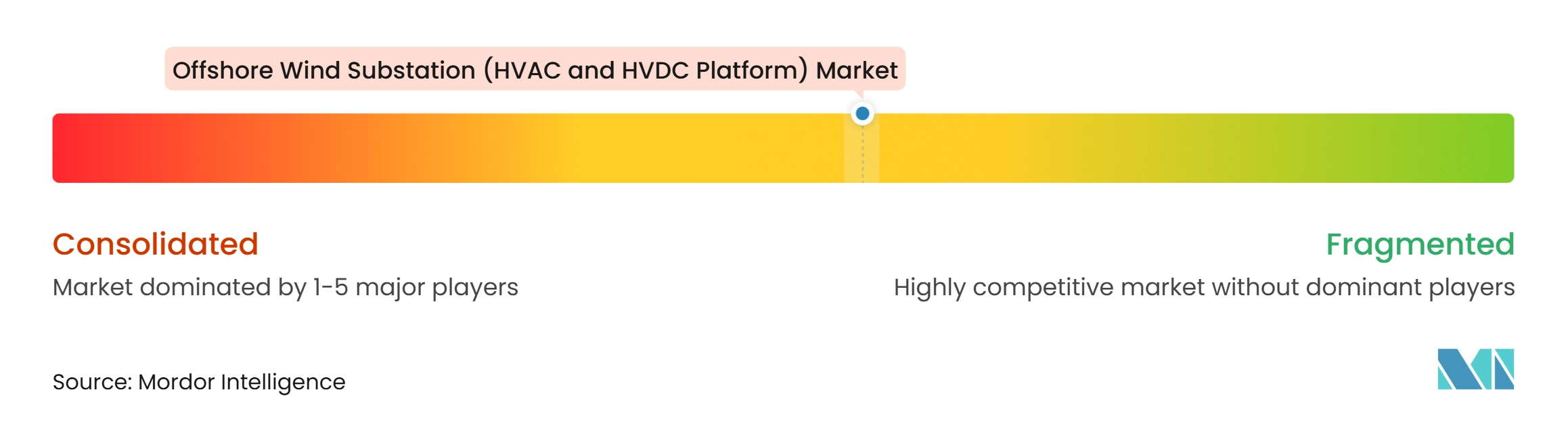
The offshore wind substation industry is moderately consolidated. HVDC platform work is concentrated among a limited group of technology providers and Engineering, Procurement, And Construction (EPC) contractors, while HVAC fabrication has more regional suppliers. Siemens Energy, GE Vernova, and Hitachi Energy supply core HVDC technology, while Aibel and Seatrium are key fabrication partners. This model requires close coordination across converter suppliers, fabricators, cable suppliers, and installation contractors. Proven delivery experience is important because grid-compliance requirements are demanding.
GE Vernova and Seatrium secured the 2.2 GW BalWin5 contract from TenneT in December 2025. Siemens Energy received the Bornholm Energy Island HVDC converter-system contract from Energinet and 50Hertz in 2025. TenneT’s reassignment of Petrofac’s scope to the Hitachi Energy and Larsen & Toubro arrangement showed the importance of delivery capacity and financial resilience. Semco Maritime and Navantia Seanergies formed a European partnership in April 2025 to combine electrical-system and steel-fabrication capabilities. These moves show that framework agreements and partnerships are important routes to offshore work.
The floating segment is more open because commercial floating substation deliveries have not established a clear leader. Digital monitoring, predictive maintenance, and adaptable grid configurations are becoming more important in the Offshore Wind Substation (HVAC & HVDC Platform) market. Seatrium’s OSS-500A is a scalable platform family for different applications. International Electrotechnical Commission (IEC) Technical Report (TR) 63411:2025 and European HVDC requirements raise qualification barriers for new converter suppliers.
Offshore Wind Substation (HVAC & HVDC Platform) Industry Leaders
-
Hitachi Energy Ltd.
-
Siemens Energy AG
-
GE Vernova Inc.
-
Seatrium Limited
-
Aibel AS
- *Disclaimer: Major Players sorted in no particular order
Offshore Wind Substation (HVAC & HVDC Platform) Market Companies Covered in this Report
- Aibel AS
- Bladt Industries A/S
- China State Shipbuilding Corporation Limited
- CIMC Raffles Offshore (Yantai) Co., Ltd.
- Dajin Heavy Industry Co., Ltd.
- DEME Group
- GE Vernova Inc.
- Heerema Marine Contractors Nederland SE
- Hitachi Energy Ltd.
- HSM Offshore Energy B.V.
- Mammoet Holding B.V.
- Petrofac Limited
- Prysmian S.p.A.
- Qingdao McDermott Wuchuan Offshore Engineering Co., Ltd.
- Saipem S.p.A.
- Seatrium Limited
- Semco Maritime A/S
- Siemens Energy AG
- Technip Energies N.V.
- Van Oord N.V.
Recent Industry Developments in Offshore Wind Substation (HVAC & HVDC Platform) Market
- November 2026: Copenhagen Infrastructure Partners (CIP) has signed an engineering, procurement, and construction (EPC) contract for the offshore substation (OSS) of the 600 MW Fengmiao II Offshore Wind Farm (OWF) in Taiwan. Under the agreement, Semco Maritime will oversee the engineering, procurement, and installation of the substation's electrical systems, while PTSC Mechanical & Construction (PTSC M&C) will handle the fabrication of the structures.
- June 2026: China issued NB/T 31115-2025, revising the offshore substation design standard. The revision extended the applicable voltage range to 500 kV and introduced compact, lightweight design requirements, effective June 2026.
- December 2025: Aibel’s Hornsea 3 Link 2 platform arrived in Haugesund for final outfitting with Hitachi Energy HVDC equipment. The platform was scheduled for 2026 sailaway.
- April 2025: Semco Maritime and Navantia Seanergies formed a European offshore substation partnership for fixed-bottom HVAC projects in Europe and North America.
Global Offshore Wind Substation (HVAC & HVDC Platform) Market Report Scope
An Offshore Wind Substation (OSS), also known as an offshore transformer or converter platform, is a marine structure that collects electricity generated by offshore wind turbines, steps up the voltage, and exports it to the onshore electrical grid.
The offshore wind substation (HVAC & HVDC platform) market is segmented into substation technology, platform type, and geography. By substation technology, the market is segmented into HVAC offshore substations and HVDC converter platforms. By platform type, the market is divided into fixed offshore substation platforms, floating offshore substation platforms, modular offshore substation platforms, and integrated offshore converter platforms. The report also covers the market size and forecasts for the global offshore wind substation (HVAC & HVDC platform) market across 22 countries in key regions. For each segment, the market sizing and forecasts have been provided on the basis of value (USD).
Segmentation Overview
| HVAC Offshore Substations |
| HVDC Converter Platforms |
| Fixed Offshore Substation Platforms |
| Floating Offshore Substation Platforms |
| Modular Offshore Substation Platforms |
| Integrated Offshore Converter Platforms |
| North America | United States |
| Canada | |
| Rest of North America | |
| Europe | Germany |
| United Kingdom | |
| Netherlands | |
| Denmark | |
| Belgium | |
| France | |
| Norway | |
| Poland | |
| Rest of Europe | |
| Asia-Pacific | China |
| Taiwan | |
| Japan | |
| South Korea | |
| India | |
| Australia | |
| Rest of Asia-Pacific | |
| South America | Brazil |
| Colombia | |
| Chile | |
| Rest of South America | |
| Middle East and Africa | Saudi Arabia |
| United Arab Emirates | |
| South Africa | |
| Rest of Middle East and Africa |
| By Substation Technology | HVAC Offshore Substations | |
| HVDC Converter Platforms | ||
| By Platform Type | Fixed Offshore Substation Platforms | |
| Floating Offshore Substation Platforms | ||
| Modular Offshore Substation Platforms | ||
| Integrated Offshore Converter Platforms | ||
| By Geography | North America | United States |
| Canada | ||
| Rest of North America | ||
| Europe | Germany | |
| United Kingdom | ||
| Netherlands | ||
| Denmark | ||
| Belgium | ||
| France | ||
| Norway | ||
| Poland | ||
| Rest of Europe | ||
| Asia-Pacific | China | |
| Taiwan | ||
| Japan | ||
| South Korea | ||
| India | ||
| Australia | ||
| Rest of Asia-Pacific | ||
| South America | Brazil | |
| Colombia | ||
| Chile | ||
| Rest of South America | ||
| Middle East and Africa | Saudi Arabia | |
| United Arab Emirates | ||
| South Africa | ||
| Rest of Middle East and Africa | ||
Key Questions Answered in the Report
What is the forecast growth rate for offshore wind substations?
The Offshore Wind Substation (HVAC & HVDC Platform) market is projected to grow at a 5.92% CAGR from 2027 to 2032, reaching USD 10.36 billion as offshore grid programs expand across established and emerging offshore wind regions worldwide over the forecast period.
Why are HVDC converter platforms expanding faster than HVAC substations?
HVDC converter platforms are projected to grow at 6.2% CAGR because distant, high-capacity wind farms need efficient long-distance power transmission and stronger grid control.
Which platform type has the largest share of offshore substation demand?
Fixed offshore substation platforms account for 78.3% of 2026 demand because fixed-bottom wind farms remain the prevailing design in suitable water depths.
Which region leads offshore wind substation activity?
Europe holds 55.4% of 2026 demand, supported by North Sea grid plans, 2 GW HVDC projects, and established regulatory frameworks.
What is driving floating offshore substation deployment?
Floating platforms are projected to grow at 7.3% CAGR as wind projects move into deeper waters and suppliers improve dynamic cables and fatigue-qualified designs.
What are the main execution risks for offshore substation projects?
High capital requirements, scarce HVDC suppliers and installation vessels, auction repricing, and complex responsibilities across transmission operators, developers, fabricators, and installers can delay orders. These risks affect project schedules even where long-term grid plans and renewable capacity targets support demand.