
North America Prefabricated Bathroom Modules Market Size and Share
Market Overview
| Study Period | 2020 - 2031 |
|---|---|
| Forecast Data Period | 2026 - 2031 |
| Base Year Market Size (2025) | USD 0.58 Billion |
| Market Size (2026) | USD 0.62 Billion |
| Market Size (2031) | USD 0.88 Billion |
| Growth Rate (2026 - 2031) | 7.26 % |
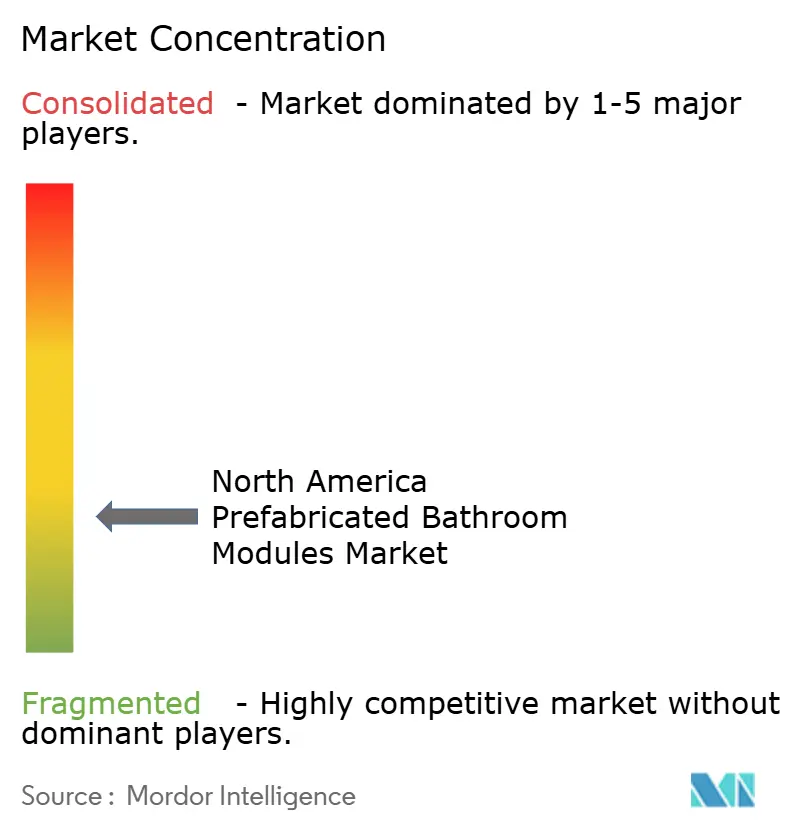
| Market Concentration | Low |
Major Players *Disclaimer: Major Players sorted in no particular order Image © Mordor Intelligence. Reuse requires attribution under CC BY 4.0. | |
North America Prefabricated Bathroom Modules Market Analysis by Mordor Intelligence
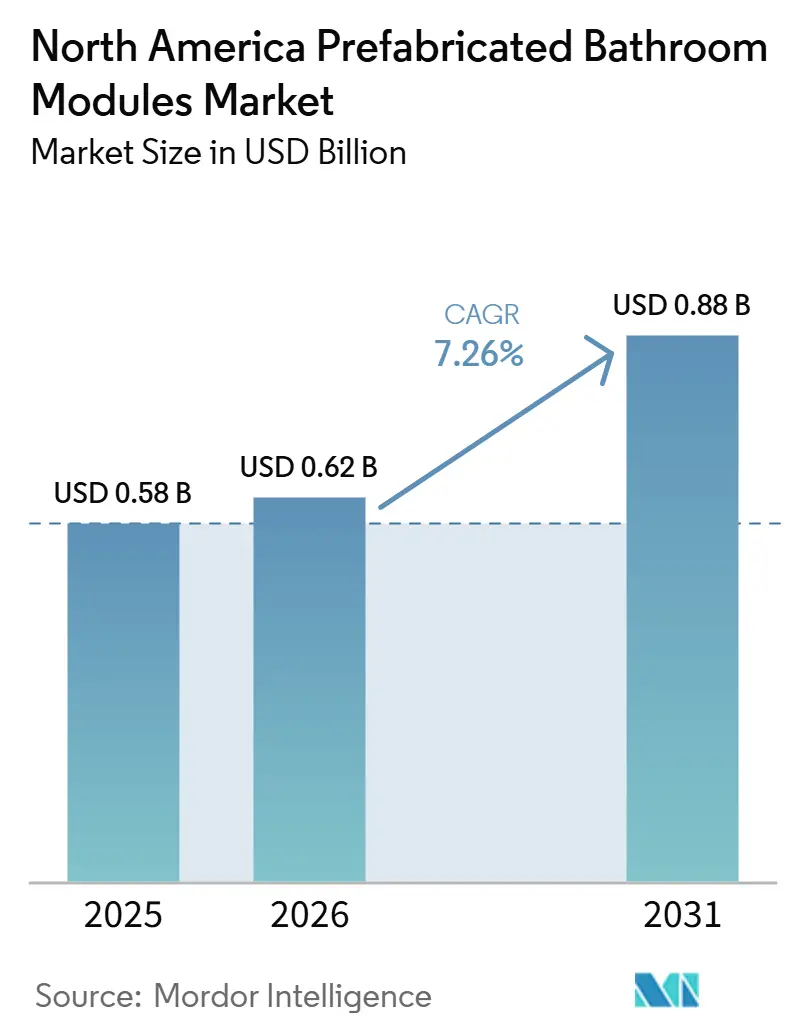
The North America Prefabricated Bathroom Modules Market size was valued at USD 0.58 billion in 2025 and is estimated to grow from USD 0.62 billion in 2026 to reach USD 0.88 billion by 2031, at a CAGR of 7.26% during the forecast period (2026-2031).
The market is growing faster than the broader modular construction base in the region because bathroom pods address a concentrated set of labor, quality, and scheduling problems within a single factory-finished unit. Developers are using these modules to shift plumbing, electrical, tiling, carpentry, and finishing work away from hard-to-manage jobsites and into controlled production lines where inspection and sequencing are easier to manage. Demand is no longer centered solely on hospitality, as healthcare systems and multifamily developers are now using the same offsite logic to standardize wet-room delivery across multiple room formats. Labor shortages across mechanical, electrical, and plumbing (MEP) and finishing trades remain the clearest support factor for adoption, while BIM-led coordination is reducing the design mismatch risk that once limited pods to more uniform projects[1]Associated Builders and Contractors, “ABC, Construction Industry Must Attract 439,000 Workers in 2025,” ABC, abc.org. The North America prefabricated bathroom modules market is therefore expanding most steadily, where owners commit early to design coordination, repeatable specifications, and procurement models that value delivery certainty over simple line-item installation cost.
Key Report Takeaways
- By product type, steel framed modules held 39.20% of the North America prefabricated bathroom modules market share in 2025, while hybrid modules are forecast to expand at an 8.60% CAGR through 2031.
- By installation type, new build accounted for 71.50% of revenue in 2025, while retrofit and renovation are projected to grow at a 8.10% CAGR through 2031.
- By end user, hospitality accounted for 29.80% of the North America prefabricated bathroom modules market size in 2025, while healthcare is expected to grow at an 8.90% CAGR through 2031.
- By country, the United States accounted for 81.60% of regional revenue in 2025, while Mexico is forecast to record the highest CAGR of 8.50% through 2031.
Note: Market size and forecast figures in this report are generated using Mordor Intelligence’s proprietary estimation framework, updated with the latest available data and insights as of January 2026.
Market Trends and Insights
Drivers Impact Analysis of North America Prefabricated Bathroom Modules Market*
| Drivers | (~) % Impact on CAGR Forecast | Geographic Relevance | Impact Timeline |
|---|---|---|---|
| Rising Demand for Faster Project Delivery | +1.8% | Highest impact in the United States and Canada urban markets | Short term (≤ 2 years) |
| Labor Shortages in MEP and Finishing Trades | +1.6% | North America wide, with acute pressure across the United States and Canada | Short term (≤ 2 years) |
| Standardized Wet Room Solutions Improve Consistency | +0.9% | United States and Canada hospitality and healthcare chains | Medium term (2-4 years) |
| Reduced Rework and Defect Risks | +0.8% | Strongest in the United States healthcare and multifamily projects | Medium term (2-4 years) |
| Building Code Compliance Supports Factory Tested Modules | +0.7% | United States and Canada accessible and regulated construction programs | Long term (≥ 4 years) |
| Early BIM Integration Improves Design Coordination | +0.6% | Led by the United States and Canada, commercial and institutional projects | Medium term (2-4 years) |
| Source: Mordor Intelligence | |||
Rising Demand for Faster Project Delivery
The North America prefabricated bathroom modules market is also benefiting from the growing value owners place on schedule certainty. Bathroom pods are built in parallel with structural work and site preparation, which removes a major sequencing bottleneck from the interior delivery program. SurePods reported that pod-based delivery at Sierra College’s 354-bed student housing project reduced on-site bathroom construction by nearly 3 weeks per floor[2]SurePods, “Prefab Assembled Outside California, A Case Study in Quality and Compliance,” SurePods, surepods.com. That time saving matters beyond the bathroom itself because earlier bathroom completion allows furniture installation, commissioning, and closeout work to begin sooner. The schedule case is strongest on large hotel, healthcare, and student housing projects where room turnover dates carry direct financial consequences.
Labor Shortages in MEP and Finishing Trades
The North America prefabricated bathroom modules market is being driven by a labor problem that now appears structural rather than temporary. The AGC and NCCER 2025 workforce survey found that 92% of construction firms had difficulty filling open roles, and 45% said worker shortages were the main cause of project delays. That pressure is especially important in bathroom construction because plumbing, electrical, tiling, and finishing work usually depend on several trade crews arriving in the right order. Pod procurement reduces that dependency by moving those scopes into a factory setting, where staffing is easier to organize and output is easier to monitor. This is also opening the North America prefabricated bathroom modules market to smaller regional contractors and mid-market developers that previously relied on conventional field labor for hospitality and multifamily work.
Standardized Wet Room Solutions Improve Consistency
Standardized wet-room solutions are supporting growth in the North America prefabricated bathroom modules market by helping owners deliver consistent bathroom layouts, finish quality, and compliance standards across multi-site projects. This is especially important in hospitality and healthcare, where standardized room layouts allow developers to use a single approved pod design across multiple properties rather than revising bathroom details each time. SurePods has supplied bathroom pods to hotel brands including Marriott, Hilton, Hyatt, InterContinental, and Choice Hotels, demonstrating how standardized specifications support large room-count programs with better quality control and more predictable installations. BLOX stated that it has delivered more than 10,000 healthcare modules in the United States, underscoring the value of repeatable, code-compliant bathroom delivery in regulated care projects. As this model expands, developers reduce design changes, limit coordination gaps, and improve consistency from one project to the next.
Reduced Rework and Defect Risks
The North America prefabricated bathroom module market is gaining support from owners seeking to reduce punch-list work and finish-related defects. SurePods reported that prefabricated pods averaged 2.92 punch-list items per unit on a 500-unit hospitality project, while conventionally built bathrooms averaged 34.13 items per unit. This gap matters because bathroom rework often affects waterproofing, tile alignment, fixtures, access clearances, and plumbing interfaces after surfaces are already closed. HBI estimated in 2025 that skilled labor shortages cost the United States residential sector USD 10.8 billion annually, including USD 8.1 billion in lost construction volume tied to delays and rework. Standardized bathroom pods are therefore becoming more attractive to healthcare networks and hotel groups seeking repeatable quality across successive sites. The North America prefabricated bathroom modules market is advancing in part because factory inspections help reduce the cost and disruption of correcting errors after installation.
Restraints Impact Analysis of North America Prefabricated Bathroom Modules Market*
| Restraints | (~) % Impact on CAGR Forecast | Geographic Relevance | Impact Timeline |
|---|---|---|---|
| High Upfront Factory Investment | -1.5% | North America wide, most acute for smaller developers and cost-sensitive programs | Medium term (2-4 years) |
| Site-Specific Design Constraints in Retrofit Work | -0.8% | United States urban cores, dense Canadian cities, older building stock | Long term (≥ 4 years) |
| Freight Damage and Complex Last-Mile Delivery | -0.7% | United States and Canada dense urban sites and remote locations | Short term (≤ 2 years) |
| Limited Contractor Familiarity in Secondary Markets | -0.6% | Secondary cities across the United States South, the Midwest, and Mexico | Medium term (2-4 years) |
| Source: Mordor Intelligence | |||
High Upfront Factory Investment
High factory setup costs remain a clear restraint on the North America prefabricated bathroom modules market, as only well-capitalized manufacturers can build and scale certified production lines. Bathroom pod plants require precision-fabrication equipment, climate-controlled space, testing and inspection systems, and experienced MEP labor before a supplier can deliver to a consistent standard. This narrows the supplier base and reduces pricing pressure in cost-sensitive construction programs such as affordable housing or lower-budget regional developments. HBI estimated that longer construction timelines linked to labor shortages created USD 2.7 billion in carrying costs for the United States residential sector in 2025, which helps explain why some owners accept pod premiums when lifecycle delivery benefits are clear. Even so, many buyers still evaluate pods against upfront unit cost rather than total delivery cost over the project cycle. The North America prefabricated bathroom modules market will continue to face adoption friction where procurement teams are not set up to value reduced delay risk, lower rework, and long-term maintenance consistency.
Site-Specific Design Constraints in Retrofit Work
Site-specific design constraints in retrofit work are limiting adoption in the North America prefabricated bathroom modules market because many older buildings were not designed around the dimensional tolerances needed for pod installation. Existing structures often have uneven floor plates, fixed service routes, non-standard room grids, and limited access points, making it harder to install factory-built bathroom units without design adjustments. This challenge is more visible in renovation projects than in new build programs because structural geometry and plumbing locations are already fixed before the pod supplier enters the project. A 2026 study in the Journal of Building Rehabilitation noted that BIM-enabled prefabricated construction helps reduce design clashes before fabrication, which shows why poor early coordination has historically held back pod adoption in retrofit settings. SurePods also showed that sectional and demountable pod formats are better suited to renovation work because they can move through standard openings with less structural disruption, but this still does not address the broader challenge of building-specific design mismatches.
*Our forecasts treat driver/restraint impacts as directional, not additive. The impact forecasts reflect baseline growth, mix effects, and variable interactions.
North America Prefabricated Bathroom Modules Market Segment Analysis
By Product Type:
Hybrid Modules Gains Ground as Steel Framed Modules Holds Structural AdvantageHybrid modules are the fastest-growing product type in the North America prefabricated bathroom modules market, with an 8.60% CAGR projected for 2026 to 2031. Developers are using these systems to balance lower weight with the acoustic performance, fire ratings, and finish quality expected in premium hospitality and healthcare buildings. A hybrid pod usually combines a structural steel chassis with composite, GRP, or tiled wall systems and a coordinated floor assembly, giving project teams greater flexibility in performance specifications. BLOX stated that its Design Manufacture Construct process for healthcare bathrooms can support manufacturing output of 10 units per day and installation output of 10 units per day with a 4-person crew[3]BLOX, “Modular Healthcare Bathrooms,” BLOX, bloxbuilt.com. That production logic makes hybrid configurations appealing where owners want speed without giving up finish control or compliance documentation.
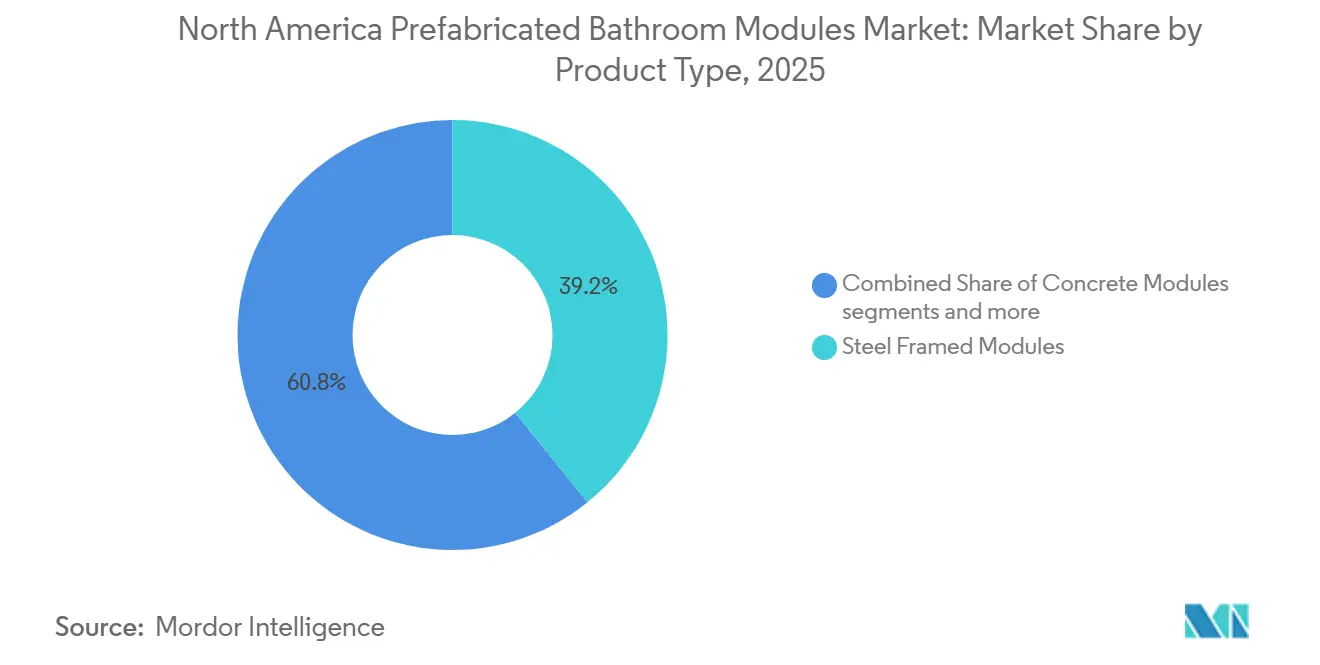
Steel framed modules captured 39.20% of the North America prefabricated bathroom modules market share in 2025. Their lead reflects the need for rigid stacking tolerances and dependable MEP routing in mid-rise and high-rise projects where bathroom modules must align precisely floor after floor. Steel frames also make it easier to meet ADA grab bar loading requirements without additional wall reinforcement, helping reduce field modification work after installation. GRP modules are gaining interest in healthcare settings because their surfaces are durable, moisture-resistant, and easier to maintain. At the same time, concrete and timber-based formats remain more selective options tied to specific durability or low-carbon project priorities.



By Installation Type:
New Build Anchors Volume, Retrofit and Renovation Captures Fastest GrowthNew build held 71.50% of the North America prefabricated bathroom modules market size in 2025. This leads to the fact that bathroom pods work best when manufacturers are involved during schematic design and can coordinate frame openings, stack positions, and module tolerances before fabrication begins. That design-early process fits new construction much better than existing buildings, where structural geometry and service routes are already fixed. Roche Constructors stated in late 2025 that medical buildings accounted for more than 40% of all United States healthcare construction, supporting a large pipeline of standardized room programs suited to pod delivery. Temporary and relocatable units also serve a smaller but growing niche in workforce housing and emergency response applications where movable bathroom capacity is important.
Retrofit and renovation is the fastest-growing installation path in the North America prefabricated bathroom modules market, with an 8.10% CAGR projected through 2031. Growth is being supported by aging hotel room stock, bathroom upgrade cycles, and compliance-driven renovation work that rewards sectional pod designs. SurePods has supplied bathroom pods to major hotel brands, including Marriott, Hilton, Hyatt, InterContinental, and Choice Hotels, demonstrating the product's integration into hospitality renovation thinking. Demountable GRP pod systems that can pass through standard openings are especially useful in renovation projects because they reduce room downtime and avoid the level of demolition that conventional bathroom replacement often requires.
By End User:
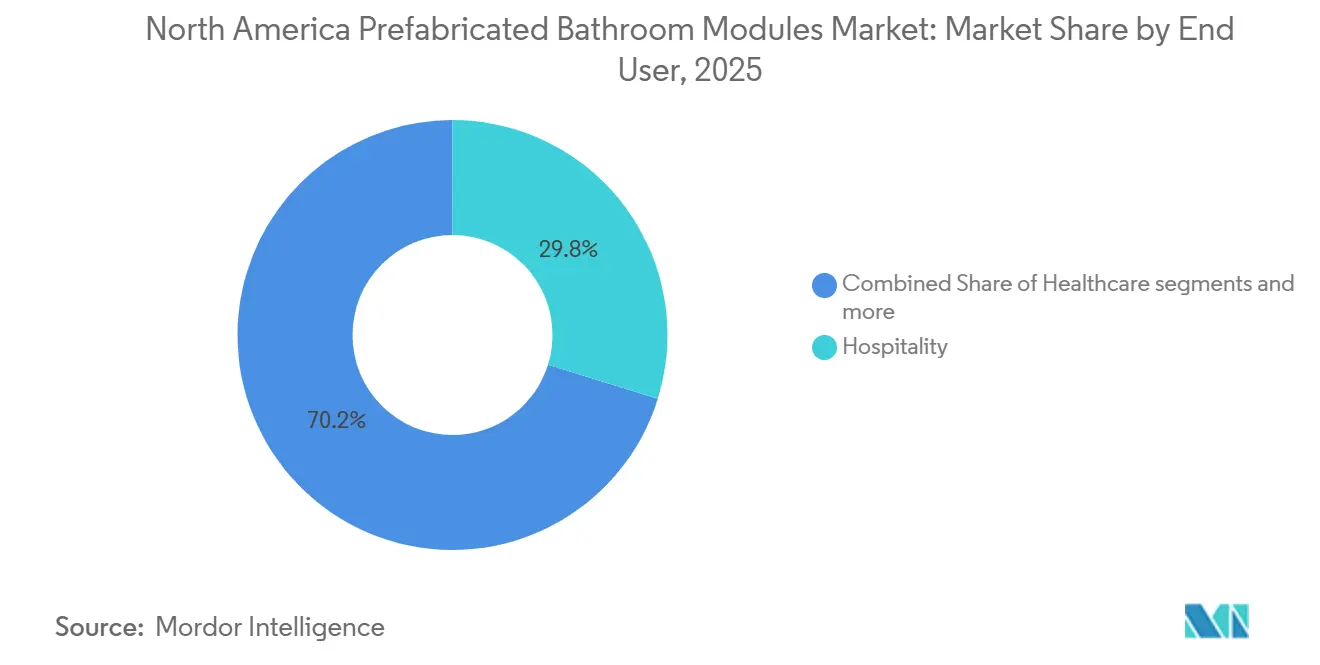
Hospitality Anchors Share, Healthcare Recalibrates the Growth BenchmarkHospitality held 29.80% of revenue in the North America prefabricated bathroom modules market in 2025. This position reflects years of standardized hotel bathroom templates, repeat room counts, and opening schedules that leave little room for delays in interior deliveries. SurePods entered the United States hospitality pod segment in 2006 and has worked with brands including Marriott, Hilton, Hyatt, InterContinental, and Choice Hotels, which supports the category’s installed base and procurement familiarity. Residential demand is also broadening across multifamily, student housing, and senior living because repetitive room layouts make off-site bathroom delivery easier to scale. That keeps hospitality as the largest demand pool while giving the North America prefabricated bathroom modules industry a wider base of recurring residential volume.
Healthcare is the fastest-growing end-user group in the North America prefabricated bathroom modules industry, with an 8.9% CAGR projected for 2026 to 2031. By late 2025, Roche Constructors described prefabrication in bathroom modules, MEP racks, and headwall systems as a standard feature of hospital design. They pointed to the USD 1.8 billion inpatient tower at Ohio State Wexner Medical Center, which opened in early 2026, as a marker of project scale. BLOX stated that it has delivered more than 10,000 healthcare modules across the United States, demonstrating the depth of its repeatable offsite delivery in regulated care environments. Commercial office demand remains lower because flexible workspace trends have reduced the high-density occupancy patterns that once made large bathroom programs more common.
Geography Analysis
United States Prefabricated Bathroom Modules Market
The United States accounted for 81.60% of regional revenue in 2025 and remained the largest geography in the North America prefabricated bathroom modules market. Demand is concentrated in high-density metro areas where hospitality, healthcare, and multifamily programs intersect with the strongest shortages in MEP and finishing trades. Those labor constraints matter because bathrooms are among the most coordination-intensive interior zones, and they can delay turnover if any trade slips behind schedule. Healthcare carries particular weight in the United States outlook because hospital programs require consistent quality, strict compliance controls, and reliable commissioning dates. Roche Constructors stated that prefabrication in bathroom modules, MEP racking, and headwall systems is now a standard part of major hospital design thinking, which supports deeper bathroom pod use in regulated institutional work. SurePods’ HCAI approval for California healthcare facility bathroom pods also strengthens the position of suppliers that can move through state approval pathways with less friction.
Canada Prefabricated Bathroom Modules Market
Canada remained the second-largest country market in the North America prefabricated bathroom modules market. Demand is centered on urban multifamily activity in Toronto, Vancouver, and Montreal, as well as on remote workforce housing tied to industrial and resource-sector sites in Alberta and British Columbia. ATCO’s acquisition of NRB brought 4 modular production facilities under one owner with strong experience in remote site delivery, broadening modular bathroom supply access beyond the largest cities. Canada’s accessible-ready housing standard, CAN-ASC-2.8:2025, also supports a planning environment that is more receptive to standardized modular bathroom solutions in suitable residential settings.
Mexico Prefabricated Bathroom Modules Market
Mexico is forecast to expand at an 8.50% CAGR through 2031 and stands out as the fastest-growing geography in the North America prefabricated bathroom modules market. Its demand pattern differs from that of the United States and Canada because nearshoring is creating concentrated housing needs around industrial expansion corridors. The planned addition of 128 industrial parks between 2024 and 2030 points to a sizable pipeline for housing and related bathroom installation demand in northern cities where stock has historically been limited. Tourism and broader construction activity are also expanding hotel and residential opportunities in the Pacific and Caribbean corridors. This gives early movers with localized manufacturing, local partnerships, or peso-denominated supply chains a better chance to build a position before the supplier base becomes more crowded.
Competitive Landscape
The North America prefabricated bathroom modules market remains fragmented in nature, with multiple regional and specialized manufacturers serving hospitality, healthcare, multifamily residential, and institutional projects. Competition is distributed across suppliers with different end-user strengths rather than concentrated in a few dominant companies. Oldcastle SurePods is a notable participant with a broad project portfolio across hospitality, healthcare, and multifamily developments. BLOX differentiates itself through its integrated Design Manufacture Construct model, combining design, fabrication, and installation for healthcare bathroom programs to simplify project coordination. Bathsystem USA focuses on a fully United States-based manufacturing platform and structurally engineered bathroom pods with 14-gauge steel framing for multifamily, healthcare, and hospitality applications. Across the market, competitive advantage depends less on price and more on manufacturing capacity, regulatory approvals, design-assist capabilities, and the ability to deliver repeat programs for large developers and institutional clients.
Technology adoption is becoming an increasingly important source of differentiation in the North America prefabricated bathroom modules market. BIM-enabled production workflows help manufacturers resolve dimensional conflicts before fabrication, improving quality control while reducing costly on-site modifications. SurePods' comparison of a 500-unit hospitality project, which reported 2.92 punch-list items per pod versus 34.13 for conventionally built bathrooms, demonstrates the operational advantages that suppliers use to support value-based selling. BLOX has also established a track record through the delivery of more than 10,000 healthcare modules, reinforcing its position in projects where repeatability, quality assurance, and regulatory compliance are critical. These capabilities are particularly valuable across healthcare, hospitality, and high-volume residential developments, where construction delays and quality issues can significantly affect project outcomes.
Strategic developments highlight how suppliers are expanding capabilities and strengthening long-term customer relationships across the North America prefabricated bathroom modules market. ATCO broadened its Canadian modular manufacturing footprint through the acquisition of NRB, enhancing its ability to serve both urban and remote construction projects. SurePods has continued to demonstrate its design-assist and approval-driven delivery model through projects such as Sierra College and AdventHealth Minneola, helping convert individual projects into repeat business opportunities. At the same time, opportunities remain for specialized manufacturers serving retrofit accessibility programs, affordable housing, and workforce housing in northern Mexico, reflecting the fragmented nature of the regional market where no single supplier dominates the overall opportunity.
North America Prefabricated Bathroom Modules Industry Leaders
Oldcastle SurePods
Bathsystem USA
BLOX, LLC
Castle Modular
B&T Manufacturing
- *Disclaimer: Major Players sorted in no particular order
North America Prefabricated Bathroom Modules Market Companies Covered in this Report
- Oldcastle SurePods
- Bathsystem USA
- BLOX, LLC
- Castle Modular
- B&T Manufacturing
- Guerdon Modular Buildings
- Volumetric Building Companies (VBC)
- NRB Modular Solutions
- Z Modular
- Ramtech Building Systems
- Champion Modular
- VESTA Modular
- Modular Genius
- Silver Creek Industries
- Triumph Modular
- MODLOGIQ
- SurePods Canada
- Oldcastle Infrastructure
- EcoReadyBath
- Guerdon Modular Systems

Recent Industry Developments in North America Prefabricated Bathroom Modules Market
- July 2026: SurePods successfully installed all 132 prefabricated bathroom pods for the Tampa General Hospital Surgical, Neuroscience, and Transplant Pavilion in Tampa, Florida, led by Gilbane Building. The project was executed on a logistically constrained waterfront site on Davis Island, adjacent to an operating hospital, where limited laydown space and access routes made offsite prefabrication essential to maintain schedule certainty and minimize disruption to active clinical operations. The deployment signals deepening adoption of prefabricated bathroom modules in large-scale, complexity-intensive healthcare construction in the United States.
- April 2026: B&T Manufacturing of Rapid City, South Dakota, publicly validated its H3 Bathroom Pods in extreme subsurface conditions, with units confirmed operational at 4,850 feet below ground in an underground research facility. The development underscores the structural robustness and environmental resilience of the company's FRAMECAD light-gauge steel prefabricated bathroom pod design, broadening the addressable market for modular bathroom modules beyond conventional commercial and residential segments into specialized industrial and government applications.
- January 2026: Modular Genius Inc. was awarded a USD 543,000 firm-fixed-price delivery order by the U.S. Department of Homeland Security's Federal Law Enforcement Training Center (FLETC) on January 22, 2026, for the installation of a leased modular shower and locker building adjacent to the FLETC campus in Joppa, Maryland. The contract, issued under a full and open competition, highlights the growing role of prefabricated modular bathroom and wet-room structures within the United States federal procurement channels.


North America Prefabricated Bathroom Modules Market Report Scope
The North America Prefabricated Bathroom Modules Market Report is Segmented by Product Type (Steel Framed Modules, Concrete Modules, Hybrid Modules, and More), Installation Type (New Build, and More), End User (Hospitality, Healthcare, Residential, Commercial Offices, and Others), and Country (United States, Canada, and Mexico). The Report Provides Market Forecasts in Terms of Value (USD).
| Steel Framed Modules |
| Concrete Modules |
| Hybrid Modules |
| Glass Reinforced Plastic Modules |
| Timber-Based Modules |
| New Build |
| Retrofit and Renovation |
| Temporary and Relocatable Units |
| Hospitality |
| Healthcare |
| Residential |
| Commercial Offices |
| Others |
| United States |
| Canada |
| Mexico |
| By Product Type | Steel Framed Modules |
| Concrete Modules | |
| Hybrid Modules | |
| Glass Reinforced Plastic Modules | |
| Timber-Based Modules | |
| By Installation Type | New Build |
| Retrofit and Renovation | |
| Temporary and Relocatable Units | |
| By End User | Hospitality |
| Healthcare | |
| Residential | |
| Commercial Offices | |
| Others | |
| By Country | United States |
| Canada | |
| Mexico |


Key Questions Answered in the Report
What is the 2026 to 2031 growth outlook for prefabricated bathroom modules in North America?
The North America prefabricated bathroom modules market is forecast to grow from USD 0.62 billion in 2026 to USD 0.88 billion by 2031 at a 7.26% CAGR.
Which application is expanding fastest across North America?
Healthcare is the fastest-growing end-user segment, with an 8.90% CAGR through 2031, supported by larger hospital programs and stricter compliance needs.
Why are developers shifting bathroom construction into factories?
The main reasons are labor shortages, tighter schedules, and lower rework risk. Factory delivery also reduces dependence on sequential MEP and finishing crews.
Which installation model currently leads demand?
New build leads with 71.50% of 2025 revenue because pod manufacturers can coordinate structural and service requirements early in design.
Which country offers the strongest expansion potential through 2031?
Mexico has the fastest projected growth at 8.50% CAGR, supported by nearshoring-linked housing demand and a larger industrial park pipeline.
Page last updated on:





