
North America Modern Methods Of Construction (MMC) Market Size and Share
Market Overview
| Study Period | 2021 - 2032 |
|---|---|
| Forecast Data Period | 2027 - 2032 |
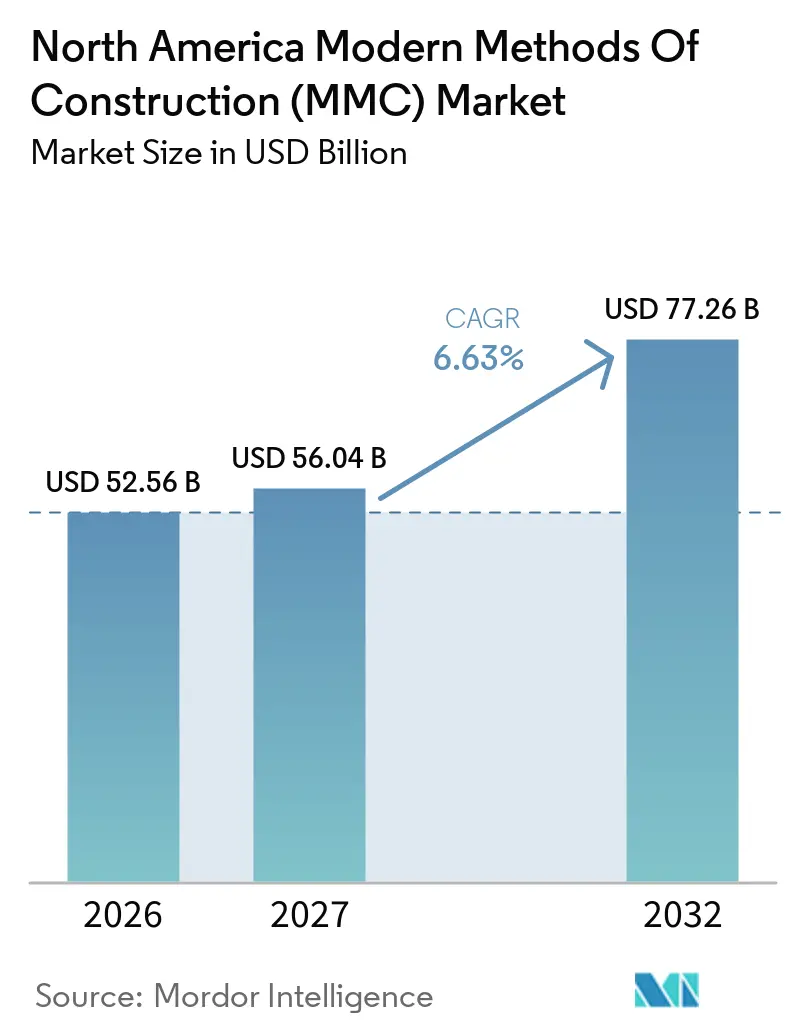
| Base Year Market Size (2026) | USD 52.56 Billion |
| Market Size (2027) | USD 56.04 Billion |
| Market Size (2032) | USD 77.26 Billion |
| Growth Rate (2027 - 2032) | 6.63 % |
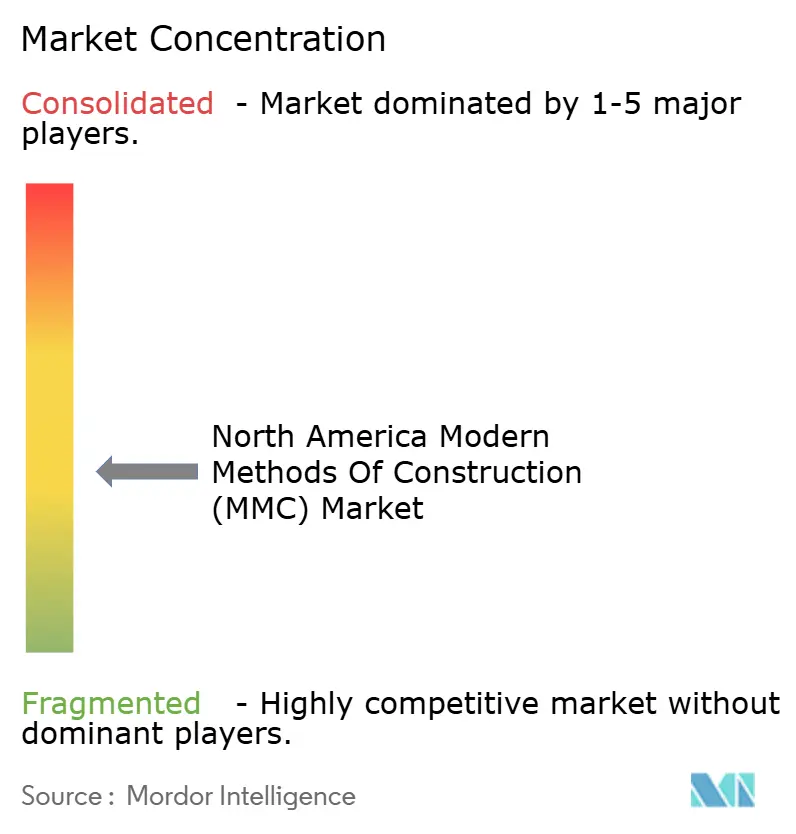
| Market Concentration | Medium |
Major Players *Disclaimer: Major Players sorted in no particular order Image © Mordor Intelligence. Reuse requires attribution under CC BY 4.0. | |
North America Modern Methods Of Construction (MMC) Market Analysis by Mordor Intelligence
The North America Modern Methods Of Construction Market size was valued at USD 52.56 billion in 2026 and is estimated to grow from USD 56.04 billion in 2027 to reach USD 77.26 billion by 2032, at a CAGR of 6.63% during the forecast period (2027-2032).
The North America modern methods of construction (MMC) market is driven by the need to deliver housing and public buildings while reducing reliance on on-site labor. Factory-based production can improve schedule control when stakeholders coordinate design, procurement, and approvals before installation begins. Housing shortages, labor constraints, public procurement initiatives, and standardized designs are strengthening the case for off-site construction delivery. However, the market faces practical limitations, as factories require consistent order volumes and modules must remain cost-effective to transport and install. Larger suppliers are responding by expanding retail networks, establishing financing partnerships, developing new factories, and forming project partnerships. In contrast, smaller single-factory operators remain vulnerable to gaps in their order books.
Key Report Takeaways
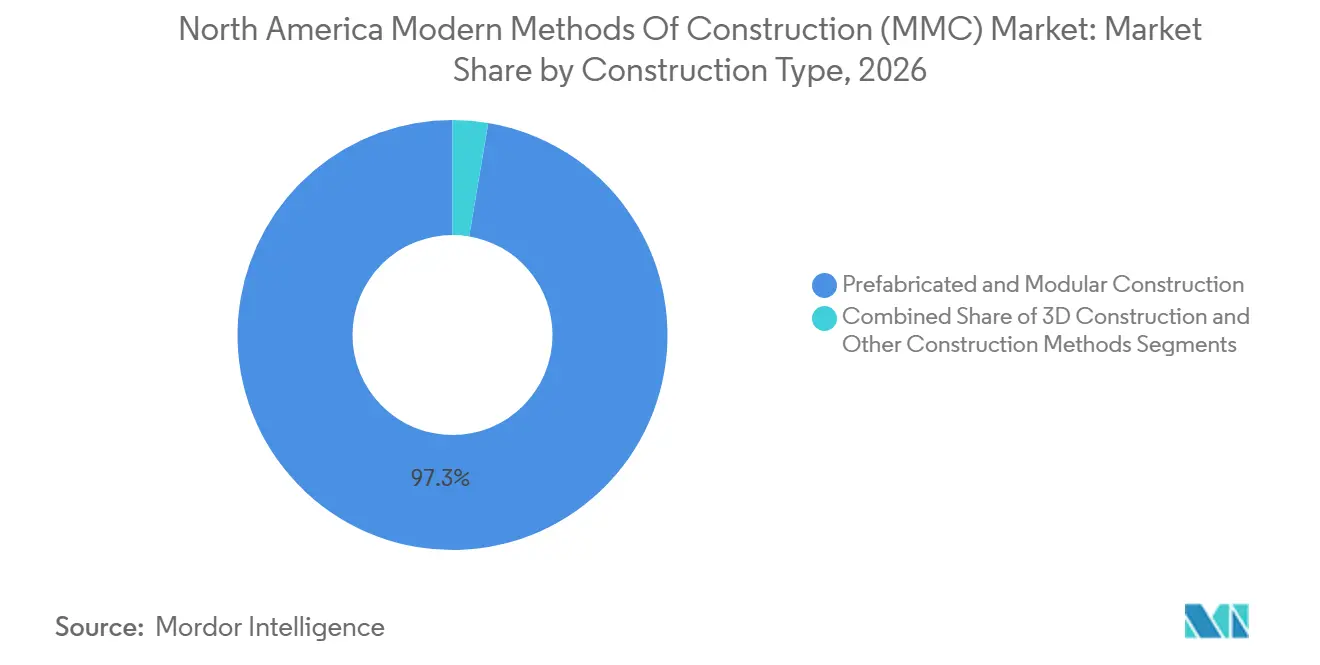
- By construction type, prefabricated and modular construction held 97.34% of the North America modern methods of construction (MMC) market share in 2026, while 3D construction is projected to grow at a 33.7% CAGR through 2032.
- By material type, concrete accounted for 35.42% of the North America modern methods of construction (MMC) market size in 2026, while timber is forecast to expand at a 7.41% CAGR through 2032.
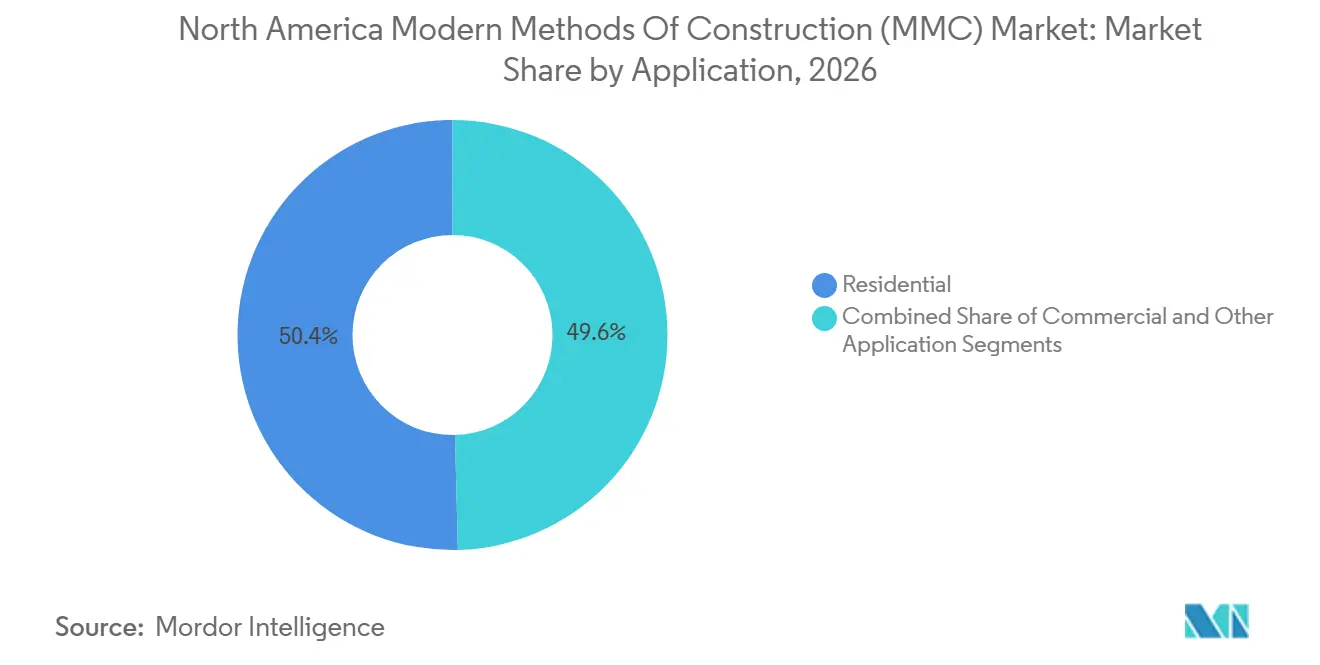
- By application, residential accounted for 50.35% of the North America modern methods of construction (MMC) market size in 2026, while commercial is forecast to expand at a 7.12% CAGR through 2032.
- By geography, the United States held 71.35% of the North America modern methods of construction (MMC) market share in 2026, while Mexico is forecast to expand at a 7.62% CAGR through 2032.
Note: Market numbers in this report are based on Mordor Intelligence's proprietary estimation framework, which combines nine months of actuals with Q4 projections for base year 2026.
North America Modern Methods Of Construction (MMC) Market Trends and Insights
Drivers Impact Analysis*
| Drivers | (~) % Impact on CAGR Forecast | Geographic Relevance | Impact Timeline |
|---|---|---|---|
| Housing Shortages in Major Metropolitan Areas | +1.8% | North America-wide, most acute in Northeast and West Coast metropolitan areas | Medium term (2-4 years) |
| Off-Site Construction for Workforce and Affordable Housing | +1.4% | United States and Canada, with the highest impact in high-cost coastal markets | Medium term (2-4 years) |
| Labor Shortages in Skilled Construction Trades | +1.2% | National, with acute pressure in the Sun Belt and Mountain West | Short term (≤ 2 years) |
| Federal and State Infrastructure and Public-Building Programs | +0.8% | Primarily the United States, with spillover into Canada | Short term (≤ 2 years) |
| Demand for Energy-Efficient and Low-Carbon Buildings | +0.6% | North America-wide, with strength in California, British Columbia, and Quebec | Long term (≥ 4 years) |
| Building Information Modeling-Enabled Design Standardization and Factory Integration | +0.5% | Factory clusters in the Pacific West and Mountain States | Medium term (2-4 years) |
| Source: Mordor Intelligence | |||
Housing Shortages in Major Metropolitan Areas
The shortage of affordable rental homes remains a key demand driver for the North America modern methods of construction (MMC) market. The National Low Income Housing Coalition reported a shortage of 7.1 million homes affordable to extremely low-income renters in 2025, affecting every state and major metropolitan area[1]. Off-site construction systems can enable faster project delivery when project teams use repeatable unit designs and validate demand before initiating factory production.
MMC offers the greatest practical value for developers delivering multifamily or workforce housing projects that can accommodate standardized floor plans. However, factories must be sufficiently close to project sites to keep transportation costs manageable. Therefore, housing demand alone does not guarantee MMC revenue, as production location and site accessibility continue to influence project feasibility.
Off-Site Construction for Workforce and Affordable Housing
Canada plans to launch Maisons Canada, also known as Build Canada Homes, in September 2025, with prefabricated, modular, and mass timber construction identified as primary delivery methods. The program’s initial pipeline includes 4,000 prefabricated homes across six federal sites[2]. Its planned framework emphasizes shorter construction schedules, lower construction-period emissions, and more predictable delivery through bulk purchasing and long-term financing. For the North America modern methods of construction (MMC) market, this type of procurement could offer a clearer order pipeline than individual project awards. Workforce housing for teachers, health care workers, and first responders may be particularly well suited to repeatable modular designs. However, realizing this opportunity will require early coordination of land, utilities, and permitting, in addition to factory production capacity.
Labor Shortages in Skilled Construction Trades
Labor availability is a near-term factor driving developer interest in the North American modern methods of construction (MMC) market. The 2025 AGC and NCCER Craft Workforce Survey found that 92% of responding firms faced difficulty filling open positions, while 45% reported project delays due to worker shortages[3]. Factory-based construction can divide the building process into narrower, repeatable tasks that are easier to teach than many site-based roles. This model may help firms recruit workers who do not pursue traditional trade apprenticeships. It can also improve staffing consistency and quality control when factories operate on stable production schedules. However, these advantages diminish when plants lack sufficient committed work to retain trained employees and maintain active production lines.
Federal and State Infrastructure and Public-Building Programs
Public projects can help normalize off-site building systems when agencies adopt repeatable specifications and commit to multiple similar developments. U.S. housing legislation slated for enactment in July 2026 would make the permanent chassis optional for HUD-code manufactured homes. Clayton Homes stated that this change would support multi-story designs, improve curb appeal, and reduce material waste. It would also expand design options for manufacturers serving dense urban and suburban sites. Public procurement can create tested design libraries that private developers can subsequently adopt with lower technical uncertainty. The growth impact will be strongest when government requirements align with realistic approval timelines and long-term manufacturing capacity.
Restraints Impact Analysis*
| Restraints | (~) % Impact on CAGR Forecast | Geographic Relevance | Impact Timeline |
|---|---|---|---|
| Divergent State, Provincial, and Municipal Building Codes | -1.0% | North America-wide, with the greatest effect on multi-state manufacturers | Medium term (2-4 years) |
| High Factory Utilization Requirements and Capital Intensity | -0.8% | North America-wide, acute in high-cost factory markets including California and British Columbia | Short term (≤ 2 years) |
| Oversized-Module Transport and Urban Site-Access Constraints | -0.5% | Urban cores including New York, Los Angeles, Toronto, and Vancouver | Medium term (2-4 years) |
| Financing and Insurance Caution Toward Modular Assets | -0.5% | North America-wide, with the greatest effect among first-time modular lenders | Short term (≤ 2 years) |
| Source: Mordor Intelligence | |||
Divergent State, Provincial, and Municipal Building Codes
Regulatory variation can constrain the North America modern methods of construction (MMC) market, as manufacturers often need to adapt a single design to meet multiple approval systems. Differences in plan reviews, inspections, and local acceptance requirements can reduce the cost and time savings associated with standardized production. According to Modular Building Institute guidance, building information modeling can establish a single source of information for off-site execution, improving coordination among design, factory, and site teams. However, digital coordination cannot eliminate legal and regulatory differences across jurisdictions. Manufacturers must therefore evaluate code compliance pathways before selecting factory locations or introducing standardized products across multiple regions. Broader adoption of common off-site construction standards would enable factories to use designs and approvals more efficiently.
High Factory Utilization Requirements and Capital Intensity
Factories incur fixed costs for buildings, specialized equipment, quality systems, and skilled workforces. As a result, the North American modern methods of construction (MMC) market remains sensitive to order gaps, even when housing demand is high. Factory operators require committed order volumes before deploying significant capital. Larger platforms can mitigate this risk by serving multiple building types, operating across several channels, or integrating manufacturing with retail and financing. New entrants require anchor customers, public commitments, or other long-term order structures to support plant utilization.
*Our forecasts treat driver/restraint impacts as directional, not additive. The impact forecasts reflect baseline growth, mix effects, and variable interactions.
Segment Analysis
By Construction Type: Prefabricated and Modular Construction Provides the Base While 3D Construction Expands.
Prefabricated and modular construction is expected to account for 97.34% of the North American modern methods of construction (MMC) market in 2026. This segment includes panelized systems, volumetric modules, and hybrid approaches that combine factory-built elements with on-site construction. Panelized systems may use structural insulated panels, timber-frame panels, or light-gauge steel panels. Volumetric modules may use steel, timber, precast, or monolithic structures. Hybrid systems enable developers to combine repeatable modules with site-specific foundations, common areas, or exterior work.
These formats remain central to the North American MMC market because they are already used across housing, hospitality, institutional buildings, and select commercial projects. Steel-framed modules remain relevant for projects requiring higher structural loads or greater floor-to-floor heights. Timber-framed units remain common where design requirements, costs, and local building codes support their use. The segment’s scale provides established manufacturers with advantages in supply relationships, production expertise, and project delivery experience.
3D construction is forecast to grow at a CAGR of 33.70% from 2027 to 2032, representing the fastest growth rate among construction types. Its extrusion method uses automated placement of layered materials, while power bonding remains at an earlier stage of commercialization. The technology has progressed beyond isolated demonstrations in select housing projects. Eco Material Technologies reported that Zuri Gardens in Houston began an 80-home printed housing project in November 2025 using PozzoSlag and PozzoCem materials.
The North American MMC market will test whether these projects can replicate cost, quality, and schedule performance across communities. This method may be well suited to low-rise designs with consistent wall layouts. However, it remains less proven for projects requiring frequent design changes, dense mechanical systems, or complex site conditions. Larger developers and established contractors are more likely to have the capital and risk tolerance required to scale 3D construction. Its future contribution will depend on repeatable production performance rather than the novelty of printed buildings.

By Material Type: Concrete Leads Current Demand While Timber Grows Faster
Concrete is projected to account for 35.42% of the North America modern methods of construction (MMC) market in 2026. It is used in precast and monolithic volumetric modules, insulated precast systems, insulated concrete forms, and aerated concrete blocks. Concrete supports applications that require durability, fire resistance, and structural capacity. Metal continues to serve industrial and energy-related modular applications, where steel framing accommodates equipment-heavy layouts. Glass is used in factory-built curtain-wall systems for commercial and hospitality buildings that require tight installation tolerances. Timber, metal, glass, and other materials account for the remainder of the North America modern methods of construction (MMC) market. Material selection depends on code requirements, logistics, project height, fire performance, and end-user design needs. Manufacturers must also consider the availability of qualified suppliers and their ability to transport finished components without damage.
Timber is forecast to grow at a CAGR of 7.41% from 2027 to 2032, the highest rate among the materials analyzed. Its adoption is linked to the integration of cross-laminated timber in volumetric modular projects. Rather than replacing modular systems, timber can complement them. It also supports projects that prioritize lower embodied carbon and visible wood finishes. However, market adoption will continue to depend on building code acceptance, insurance requirements, and buyers’ willingness to pay for specific design attributes. Concrete will retain a significant role in applications where load-bearing capacity, durability, or system familiarity are the primary considerations. Therefore, the North America modern methods of construction (MMC) market can support both concrete-led volumes and increased timber adoption, without one material displacing the other across all applications.
By Application: Residential Holds the Largest Base While Commercial Gains Pace
Residential is projected to account for 50.35% of the total market value in 2026. The segment includes attainable single-family homes, affordable multifamily housing, and manufactured homes available for ownership or rental. Its large share reflects established factory-built housing networks and the continued need for faster housing delivery. Clayton Homes is expected to report the construction of more than 59,000 homes nationwide in 2025. Integrated manufacturers can combine design, factory production, retail access, and financing, creating a more predictable customer journey than project-by-project construction models. However, demand in this segment remains dependent on land availability, local approvals, mortgage access, and transportation costs. Residential suppliers must balance standardized production with local requirements related to building appearance, utilities, and site work.
Commercial applications are forecast to grow at a CAGR of 7.12% through 2032. Hospitality, quick-service restaurants, data center fit-outs, and light industrial projects can benefit from off-site construction when repeatable layouts and schedule certainty are critical. Repeatable low-rise formats offer a clear use case for off-site construction methods. Other applications include industrial, institutional, energy and utilities, and infrastructure projects. Fluor’s joint venture with JGC Corporation is expected to receive a notice to proceed for LNG Canada Phase 2 in June 2026. Fluor’s share of the project is valued at USD 7.5 billion, and the project plans to use large prefabricated modules. These projects demonstrate that commercial and industrial demand can support off-site construction methods when stakeholders manage logistics and project sequencing at scale.
Geography Analysis
The United States accounted for 71.35% of the total market value in 2026. This leadership reflects the depth of manufactured housing supply, the presence of regional modular producers, and the broad application of modern construction methods across housing and public-building projects. Chassis-optionality legislation enacted in July 2026 expanded design flexibility for HUD-code manufactured homes. In September 2026, Cavco introduced its chassis-free Grande Arbor design, which supports ground-set and multi-story configurations. The company also broke ground on a 616,000-square-foot manufacturing facility in El Mirage, Arizona, with operations expected to begin by mid-2027.
Canada is strengthening its market position through national housing procurement initiatives and a preference for prefabrication, modular systems, and mass timber construction. Maisons Canada identified an initial pipeline of 4,000 prefabricated homes across six federal sites. This pipeline provides suppliers with a clear example of how public-sector demand can support factory capacity planning. It may also enable suppliers to develop repeatable designs for affordable and workforce housing. Canada’s growth will depend on provincial approvals, available factory capacity, and effective coordination between federal landowners and local authorities.
Mexico is forecast to grow at a CAGR of 7.62% during 2027-2032, representing the fastest growth rate in the region. The North America modern methods of construction (MMC) market has growth opportunities in the Mexico City, Querétaro, and Monterrey corridors, where urban housing demand and labor constraints are driving interest in faster construction methods. Local steel supply could support modular construction; however, specialized factory capacity remains limited. Municipal permitting processes and standardized regulations for factory-built structures will influence the pace at which suppliers can scale operations in the country.
Competitive Landscape
The North America modern methods of construction (MMC) market is moderately fragmented, with regional modular manufacturers, large engineering and construction firms, and emerging 3D-printing specialists serving different project types. Clayton Homes, Champion Homes, Cavco Industries, Guerdon, Plant Prefab, FullStack Modular, and MODLOGIQ compete based on product offerings, regional coverage, and control over downstream channels. Clayton Homes integrates home design, factory production, retail distribution, and mortgage financing, enabling participation across multiple stages of the customer journey. Cavco’s Grande Arbor and new Arizona facility demonstrate its focus on product flexibility and expanded production capacity.
Large engineering, procurement, and construction firms, including Bechtel, Fluor, Skanska, Bouygues Construction, Lendlease, and Balfour Beatty, compete primarily in industrial and infrastructure projects. These firms use modular fabrication when lower on-site labor requirements and greater schedule certainty justify the added logistics complexity. Fluor’s selection for LNG Canada Phase 2 followed its deployment of 215 prefabricated process modules during Phase 1. This experience provides large contractors with an advantage in planning module fabrication, transportation, and installation across complex project sites. ICON and HiveASMBLD represent a different competitive approach through concrete-printing systems designed for low-rise housing.
The key competitive factor is the ability to maintain factory utilization while ensuring quality and delivery reliability. Companies with diversified product lines, retail networks, public-sector programs, or long-term customer agreements are better positioned to manage demand fluctuations. WillScot plans to introduce its Quick-Connect Canopy in July 2026 to expand its covered-workspace offering for compatible modular units at construction, energy, and infrastructure worksites. The North America modern methods of construction (MMC) market therefore rewards companies that combine manufacturing capabilities with reliable channels, repeatable products, and stable project pipelines.
North America Modern Methods Of Construction (MMC) Industry Leaders
-
WillScot Holdings Corporation
-
ATCO Ltd.
-
Guerdon, LLC.
-
Clayton Homes
-
Zekelman Industries
- *Disclaimer: Major Players sorted in no particular order
Recent Industry Developments
- September 2026: Cavco Industries unveiled the Grande Arbor at the 2026 HUD Innovative Housing Showcase in Washington, D.C. The first HUD-code manufactured home built without a permanent steel chassis supports ground-set installation and multi-story configurations.
- July 2026: The United States legislation eliminated the mandatory permanent chassis requirement for HUD-code manufactured homes. Clayton Homes stated that the change enables multi-story designs, improved curb appeal, and reduced material waste.
- May 2026: Cavco Industries announced and broke ground on a 616,000-square-foot, temperature-controlled manufacturing facility in El Mirage, Arizona. Operations are targeted for mid-2027, and the site is designed to produce HUD-code manufactured and modular single-family homes.
North America Modern Methods Of Construction (MMC) Market Report Scope
| Prefabricated & Modular Construction | Panelized Systems | Structural Insulated Panels (SIPs) |
| Timber / Wood Frame Panels | ||
| Light Gauge Steel (LGS) Panels | ||
| Others | ||
| Volumetric Modules | Steel-Framed Volumetric Modules | |
| Timber-Framed Volumetric Modules | ||
| Concrete (Precast/Monolithic) Volumetric Modules | ||
| Others | ||
| Hybrid Modular Construction | ||
| 3D Construction | Extrusion Method | |
| Power Bonding Method | ||
| Others | ||
| Other Construction Methods | ||
| Concrete |
| Glass |
| Metal |
| Timber |
| Other Material Type |
| Residential |
| Commercial |
| Other Application (Industrial, Institutional, Energy and Utilities, Infrastructure) |
| United States |
| Canada |
| Mexico |
| By Construction Type | Prefabricated & Modular Construction | Panelized Systems | Structural Insulated Panels (SIPs) |
| Timber / Wood Frame Panels | |||
| Light Gauge Steel (LGS) Panels | |||
| Others | |||
| Volumetric Modules | Steel-Framed Volumetric Modules | ||
| Timber-Framed Volumetric Modules | |||
| Concrete (Precast/Monolithic) Volumetric Modules | |||
| Others | |||
| Hybrid Modular Construction | |||
| 3D Construction | Extrusion Method | ||
| Power Bonding Method | |||
| Others | |||
| Other Construction Methods | |||
| By Material Type | Concrete | ||
| Glass | |||
| Metal | |||
| Timber | |||
| Other Material Type | |||
| By Application | Residential | ||
| Commercial | |||
| Other Application (Industrial, Institutional, Energy and Utilities, Infrastructure) | |||
| By Geography | United States | ||
| Canada | |||
| Mexico | |||
Key Questions Answered in the Report
What is the forecast growth rate for modern methods of construction in North America?
The sector is forecast to grow at a 6.63% CAGR from 2027 to 2032, reaching USD 77.3 billion by 2032.
Which construction method is growing fastest?
3D construction is the fastest-growing construction type, with a projected 33.7% CAGR through 2032.
Which material leads demand for MMC projects?
Concrete leads the material group with a 35.42% share in 2026, while timber has the highest forecast CAGR at 7.41%.
What is the main risk for modular construction factories?
Factories need dependable order volumes to cover fixed costs, particularly when equipment, facilities, and skilled production teams are already in place.
Which North American country is growing fastest for MMC?
Mexico is the fastest-growing country segment, with a forecast CAGR of 7.62% from 2027 to 2032.