
North America Household Cleaners Market Size and Share
Market Overview
| Study Period | 2021 - 2031 |
|---|---|
| Forecast Data Period | 2026 - 2031 |
| Base Year Market Size (2025) | USD 46.40 Billion |
| Market Size (2026) | USD 48.17 Billion |
| Market Size (2031) | USD 60.26 Billion |
| Growth Rate (2026 - 2031) | 4.58 % |
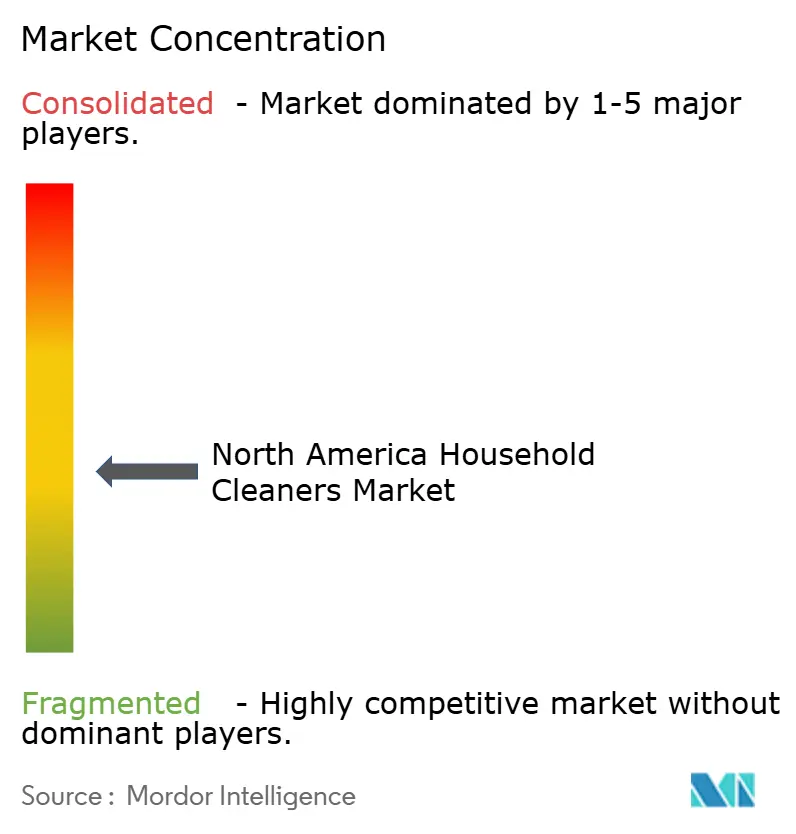
| Market Concentration | Medium |
Major Players *Disclaimer: Major Players sorted in no particular order Image © Mordor Intelligence. Reuse requires attribution under CC BY 4.0. | |
North America Household Cleaners Market Analysis by Mordor Intelligence
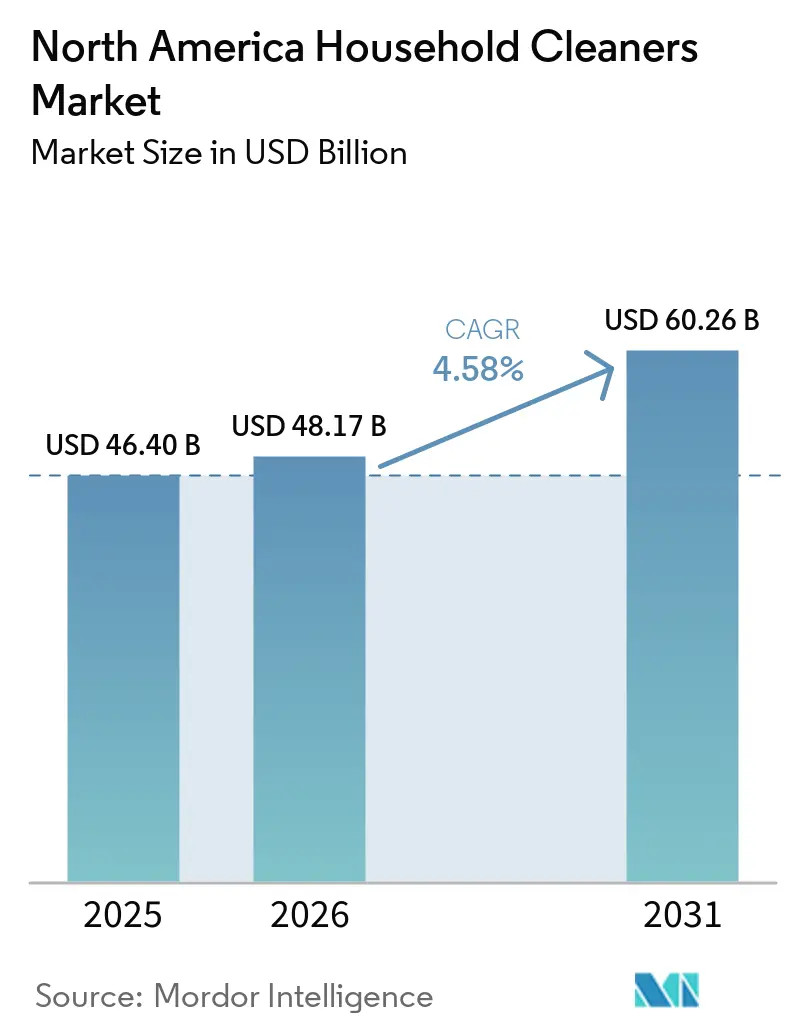
The North America household cleaners market size is expected to grow from USD 46.40 billion in 2025 to USD 48.17 billion in 2026 and is forecast to reach USD 60.26 billion by 2031 at a 4.58% CAGR over 2026-2031. The market is driven by sustained consumer focus on hygiene, health, and home cleanliness, supported by high product penetration across residential households. Demand is increasingly shifting toward premium, multifunctional, and environmentally responsible cleaning solutions as consumers prioritize product performance alongside sustainability. The continued expansion of e-commerce and omnichannel retailing is improving product accessibility and encouraging the adoption of new formats and formulations. Ongoing product innovation, evolving consumer preferences, and growing interest in certified and plant-based cleaners continue to shape the competitive landscape across the region.
Key Report Takeaways
- By product type, laundry care held 33.44% of the 2025 North America household cleaners market value, while dishwashing is forecast to record the fastest CAGR of 5.65% during 2026 to 2031.
- By form, liquids accounted for 46.46% of the 2025 regional value, while powders are projected to grow at the fastest CAGR of 5.85% during 2026 to 2031.
- By formulation, synthetic products represented 78.76% of the 2025 regional value in the market, while natural and organic formulations are expected to expand at the fastest CAGR of 6.24% during 2026 to 2031.
- By distribution channel, supermarkets and hypermarkets captured 44.55% of the 2025 regional value in the North America household cleaners market, while online retail stores are set to advance at the fastest CAGR of 6.45% during 2026 to 2031 across the region.
- By geography, the United States held 84.82% of the North America household cleaners market in 2025, while Mexico is projected to post the fastest CAGR of 5.64% during 2026 to 2031.
Note: Market size and forecast figures in this report are generated using Mordor Intelligence’s proprietary estimation framework, updated with the latest available data and insights as of January 2026.
Market Trends and Insights
Drivers Impact Analysis of North America Household Cleaners Market*
| Driver | (~) % Impact on CAGR Forecast | Geographic Relevance | Impact Timeline |
|---|---|---|---|
| Rising hygiene awareness is increasing demand for disinfectants and cleaners | +1.1% | Global, strongest in United States and Mexico | Short term (≤ 2 years) |
| Growing preference for eco-friendly and non-toxic formulations | +0.9% | United States and Canada core, spill-over to Mexico | Medium term (2–4 years) |
| Product innovation and multifunctional formulations | +0.8% | United States led, Canada following | Medium term (2–4 years) |
| Innovation in packaging formats such as refills and concentrates | +0.6% | United States led, expanding to Canada | Medium term (2–4 years) |
| Increasing adoption of subscription-based purchasing | +0.5% | United States concentrated, early adoption in Canada | Long term (≥ 4 years) |
| Heightened awareness of indoor air quality is accelerating demand for low-VOC and fragrance-free cleaning products | +0.5% | United States (California, Northeast), Canada | Medium term (2–4 years) |
| Source: Mordor Intelligence | |||
Rising Hygiene Awareness Is Increasing Demand for Disinfectants and Cleaners
Growing consumer awareness of the link between household cleanliness and overall well-being is driving sustained demand for disinfectants and household cleaning products across North America. According to the American Cleaning Institute's (ACI) 2025 Cleaning Survey, 97% of Americans believe cleaning and hygiene are important for public health and the health of their communities, highlighting the widespread importance of routine cleaning practices[1]. The survey also found that 74% of Americans have changed their cleaning habits to improve their health, indicating a lasting shift toward more frequent and deliberate cleaning behaviors. Additionally, 91% of respondents agreed that cleaning positively impacts their physical health, while 84% said it benefits their mental health, reinforcing the role of cleaning products beyond basic household maintenance. Among health-focused cleaning activities, 61% of Americans prioritized handwashing, 56% regularly cleaned toilets and showers, 51% disinfected frequently touched surfaces, and 47% identified laundry as an important hygiene practice, supporting consistent demand for a broad range of household cleaners and disinfectants.
Growing Preference for Eco-Friendly and Non-Toxic Formulations
Growing consumer preference for environmentally responsible and non-toxic household cleaning products is driving manufacturers to expand their portfolios with plant-based ingredients, biodegradable formulations, and reduced use of harsh chemicals. Consumers are increasingly seeking products that combine effective cleaning performance with safer ingredient profiles, reflecting greater awareness of environmental sustainability and indoor air quality. This is also encouraging the adoption of products with recognized environmental and safety certifications, as shoppers place greater importance on ingredient transparency and responsible sourcing. In response, manufacturers are investing in formulation innovation, sustainable packaging, and concentrated product formats to meet evolving consumer expectations while supporting broader sustainability goals across the household cleaners market.
Product Innovation and Multifunctional Formulations
Manufacturers are increasingly developing household cleaning products that combine multiple cleaning functions, improved efficacy, and added performance benefits within a single formulation, allowing consumers to address several household tasks with fewer products. According to the American Cleaning Institute's 2025 Spring Cleaning Survey, 13% of United States consumers who spring clean considered a product being multipurpose the most important quality when choosing cleaning products, ranking it among the top three product qualities after effectiveness and price[2]. This preference is encouraging manufacturers to develop multi-surface, stain-removing, disinfecting, deodorizing, and other multifunctional formulations that combine convenience with cleaning performance.
Innovation in Packaging Formats Such as Refills and Concentrates
Innovation in packaging formats is supporting growth in the North America household cleaners market as manufacturers introduce refill systems, concentrated formulations, and other resource-efficient solutions that improve convenience while reducing packaging waste. Consumers are increasingly adopting these formats as they offer easier storage, lower transportation requirements, and reduced plastic consumption without compromising cleaning performance. This shift is also encouraging brands to redesign packaging for improved usability and compatibility with reusable containers, in line with evolving sustainability expectations. Continued advancements in packaging design and product delivery formats are strengthening product differentiation and supporting the adoption of more environmentally responsible household cleaning solutions.
Restraints Impact Analysis of North America Household Cleaners Market*
| Restraint | (~) % Impact on CAGR Forecast | Geographic Relevance | Impact Timeline |
|---|---|---|---|
| Fluctuating raw material prices increasing production costs | -0.7% | Global, concentrated impact in United States and Canada | Short term (≤ 2 years) |
| Growing concerns over chemical exposure | -0.5% | United States, Canada (urban markets) | Medium term (2–4 years) |
| Regulatory restrictions on harmful ingredients | -0.4% | United States (California, OTC states), Canada | Medium term (2–4 years) |
| Availability of homemade and DIY cleaning alternatives | -0.3% | United States and Canada | Long term (≥ 4 years) |
| Source: Mordor Intelligence | |||
Fluctuating Raw Material Prices Are Increasing Production Costs
Volatility in the prices of key raw materials continues to pose a significant challenge for household cleaner manufacturers across North America. Ingredients such as surfactants, solvents, specialty chemicals, fragrances, and packaging materials are subject to price fluctuations driven by changes in energy prices, supply chain disruptions, and global commodity markets. Rising input costs increase production expenses and pressure manufacturers to balance profitability with competitive pricing, particularly in price-sensitive product categories. As a result, companies are increasingly focusing on supply chain optimization, strategic sourcing, and formulation efficiencies to mitigate cost pressures while maintaining product quality and performance.
Growing Concerns Over Chemical Exposure
Concerns over exposure to chemicals in household cleaning products are increasing as consumers become more aware of potential health risks associated with improper handling and repeated exposure. According to America's Poison Centers, household cleaning substances accounted for 87,031 pediatric exposures among United States children aged 5 years and under in 2024, representing 10.1% of all reported substances in this age group[3]. These exposure risks are encouraging households to seek safer formulations, clearer usage instructions, child-resistant packaging, and products with reduced levels of potentially harmful chemicals. This shift can restrain demand for conventional household cleaners that rely on ingredients perceived as harsh or potentially hazardous, while increasing scrutiny of product labels, ingredient transparency, and safety claims.
*Our forecasts treat driver/restraint impacts as directional, not additive. The impact forecasts reflect baseline growth, mix effects, and variable interactions.
North America Household Cleaners Market Segment Analysis
By Product Type:
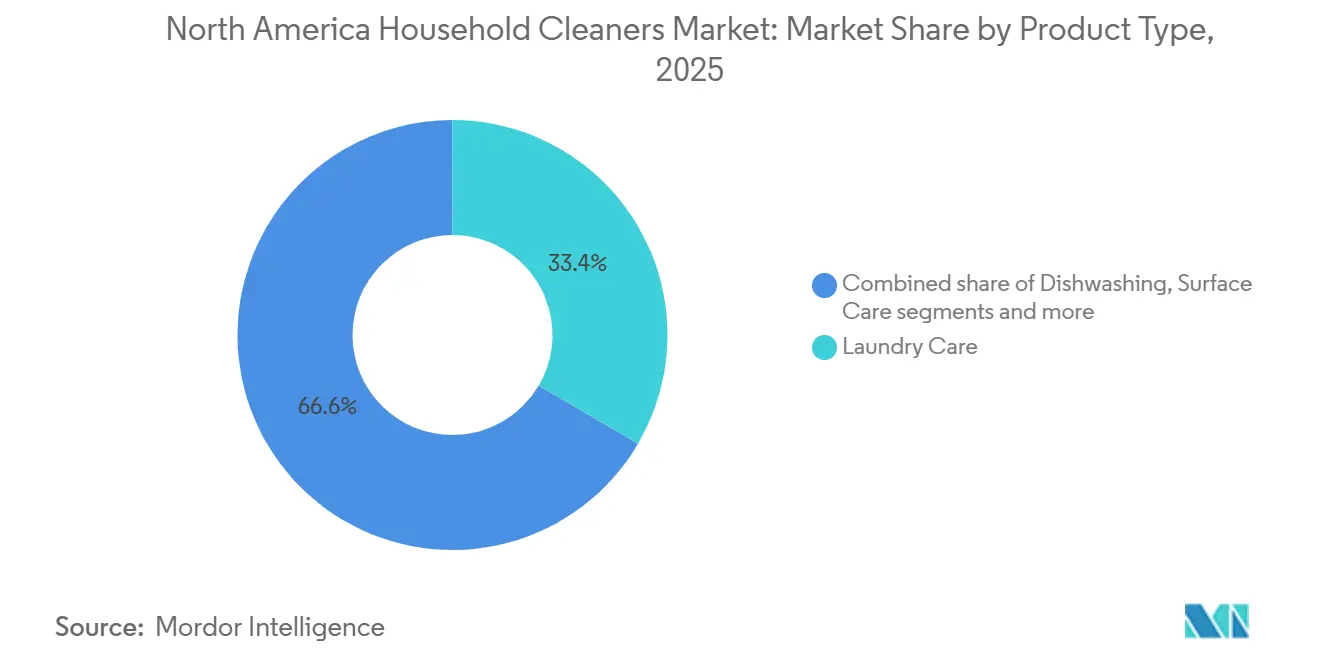
Laundry Care Dominates, but Dishwashing Dynamics Signal PremiumizationLaundry care accounted for the largest share of the North America household cleaners market, representing 33.44% of revenue in 2025. The segment's position is supported by high purchase frequency, widespread household adoption, and consistent replacement demand across the region. Consumers continue to prefer products that combine effective stain removal, fabric care, and convenience. Ongoing innovation in formulations, concentrated products, and sustainable packaging further supports demand. Premium and multifunctional laundry solutions are also contributing to value growth within the segment.
Dishwashing is projected to be the fastest-growing product type, registering a CAGR of 5.65% during 2026–2031. Growth is driven by increasing adoption of automatic dishwashers, rising consumer preference for convenient cleaning solutions, and growing demand for high-performance detergents in pod, tablet, and liquid formats. Manufacturers are also introducing formulations designed to improve cleaning efficiency while reducing water and energy consumption, supporting broader adoption across residential households.

By Form:
Rising hygiene awareness is increasing demand for disinfectants and cleaners Growing preference for eco-friendly and non-toxic formulations Product innovation and multifunctional formulations Innovation in packaging formats such as refills and concentrates Increasing adoption of subscription-based purchasing Heightened awareness of indoor air quality is accelerating demand for low-VOC and fragrance-free cleaning productsLiquids accounted for the largest share of the North America household cleaners market by form, representing 46.46% of revenue in 2025. This segment's dominance is driven by widespread consumer familiarity, ease of application, and compatibility across a broad range of household cleaning products. Liquid formulations are widely preferred for their convenience, effective cleaning performance, and versatility across laundry care, surface care, and dishwashing applications. Continued improvements in formulation and dispensing systems are further supporting demand for liquid cleaners.
Powders are projected to be the fastest-growing form, registering a CAGR of 5.85% during 2026–2031. Growth is supported by increasing adoption of concentrated and water-efficient cleaning formats that offer improved storage, transportation, and packaging efficiency. Consumers are also showing greater interest in products that reduce plastic waste while maintaining cleaning performance, encouraging manufacturers to develop solid and concentrated formulations. This is contributing to the growing adoption of powder-based household cleaning products across the region.
By Formulation:
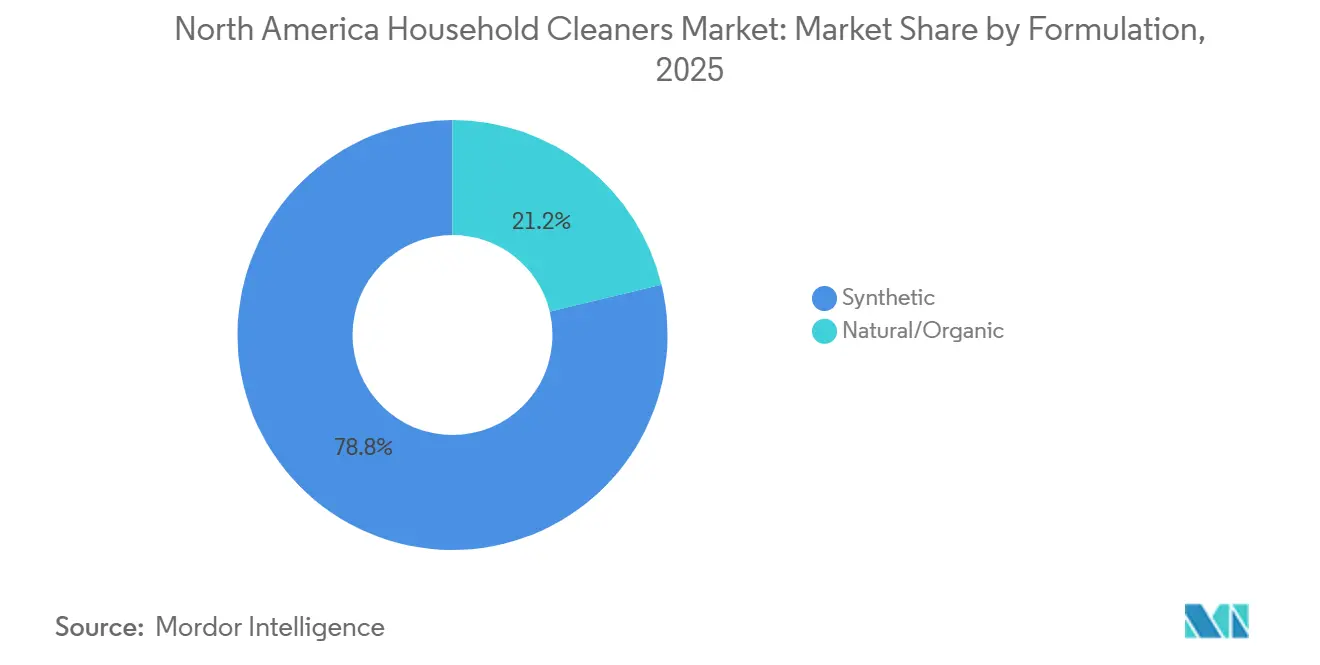
Synthetic Supremacy Coexists With Natural/Organic's GrowthSynthetic formulations accounted for the largest share of the North America household cleaners market by formulation, representing 78.76% of revenue in 2025. This segment's dominance is supported by broad product availability, cost-effectiveness, and consistent cleaning performance across a wide range of household applications. Synthetic formulations are widely used due to their ability to effectively remove stains, grease, and microorganisms. Their established presence across multiple product categories further reinforces their dominant market position.
Natural and organic formulations are projected to be the fastest-growing segment, registering a CAGR of 6.24% during 2026–2031. Growth is driven by increasing consumer preference for plant-based ingredients, lower-toxicity formulations, and environmentally responsible ingredients. Rising awareness of ingredient transparency, sustainability, and indoor health is encouraging consumers to shift toward safer household cleaning products. In response, manufacturers are expanding their portfolios with natural and organic formulations to meet evolving consumer preferences and regulatory expectations.
By Distribution Channel:
Supermarkets Anchor Share as Online Reshapes Category EconomicsSupermarkets/hypermarkets accounted for the largest share of the North America household cleaners market by distribution channel, representing 44.55% of revenue in 2025. The segment's dominance is supported by extensive product availability, broad brand assortments, and the convenience of one-stop shopping for household essentials. Consumers prefer these retail formats for comparing products, accessing promotional offers, and purchasing cleaning products alongside their regular grocery shopping. Strong retail networks across the region further reinforce the channel's position.
Online retail stores are projected to be the fastest-growing distribution channel, registering a CAGR of 6.45% during 2026–2031. Growth is driven by increasing consumer adoption of e-commerce, improved product accessibility, and the convenience of home delivery. The expansion of omnichannel retailing, subscription-based purchasing options, and direct-to-consumer sales is further supporting online sales of household cleaners. Additionally, digital platforms enable manufacturers to offer a wider product range and reach consumers seeking specialized and sustainable cleaning solutions.
Geography Analysis
United States Household Cleaners Market
The United States accounted for the largest share of the North America household cleaners market, representing 84.82% of regional revenue in 2025. The country's position is supported by high household product penetration, a well-developed retail network, and strong consumer demand for a broad range of cleaning products. Market growth is increasingly driven by premiumization, product innovation, and growing preference for sustainable and multifunctional formulations. Continued expansion of omnichannel retailing and consumer willingness to adopt value-added products further support market development.
Mexico Household Cleaners Market
Mexico is projected to be the fastest-growing country in the region, registering a CAGR of 5.64% during 2026–2031. Growth is driven by rising household spending on home care products, increasing hygiene awareness, and expanding availability of branded cleaning solutions through modern retail and e-commerce channels. Consumers are also showing greater interest in products that combine cleaning performance with safer ingredients and environmental sustainability. This is encouraging manufacturers to expand their product portfolios and strengthen their presence in the country.
Canada Household Cleaners Market
Canada represents a mature and steadily growing market, supported by high consumer awareness of hygiene, widespread adoption of premium household cleaners, and increasing demand for environmentally responsible products. Growth is further supported by rising preference for plant-based formulations, refillable packaging, and products with transparent ingredient labeling. Continued innovation in formulations and sustainable product offerings is expected to support long-term market development in the country.
Competitive Landscape
The North America household cleaners market is moderately fragmented. Key players include The Procter & Gamble Company, The Clorox Company, S. C. Johnson and Son, Inc., Reckitt Benckiser Group PLC, and Church and Dwight Co., Inc. These companies maintain strong market positions through extensive product portfolios, established distribution networks, and continuous investments in product innovation, marketing, and brand development, enabling them to serve diverse household cleaning needs across the region. Their broad brand presence across categories such as surface cleaners, dishwashing products, laundry detergents, and disinfectants supports their participation in multiple household cleaning segments.
Leading market participants are increasingly focusing on expanding premium product portfolios, developing multifunctional and environmentally responsible formulations, and introducing packaging formats such as refills and concentrates to strengthen their competitive positions. Companies are also investing in ingredient transparency, sustainable packaging, and omnichannel distribution strategies to address evolving consumer preferences while improving product accessibility across both offline and online retail channels. These initiatives allow manufacturers to differentiate their offerings through product convenience, specialized cleaning functions, and packaging options designed to reduce material use.
The market also includes a growing number of regional manufacturers and niche brands specializing in eco-friendly, plant-based, and non-toxic household cleaning products. These companies compete through differentiated formulations, sustainable packaging, and direct-to-consumer business models, contributing to product innovation and intensifying competition across the North America household cleaners market. Their focused product positioning and appeal to consumers seeking alternatives to conventional cleaning products enable smaller brands to compete alongside established manufacturers in selected categories and customer segments.
North America Household Cleaners Industry Leaders
-
The Clorox Company
-
S. C. Johnson and Son, Inc.
-
Reckitt Benckiser Group PLC
-
Church and Dwight Co., Inc.
-
The Procter & Gamble Company
- *Disclaimer: Major Players sorted in no particular order
North America Household Cleaners Market Companies Covered in this Report
- The Procter & Gamble Company
- The Clorox Company
- S. C. Johnson and Son, Inc.
- Reckitt Benckiser Group PLC
- Church and Dwight Co., Inc.
- Unilever PLC
- Henkel AG and Co. KGaA
- Colgate-Palmolive Company
- Ecolab Inc.
- Kao Corporation
- Seventh Generation Inc.
- Method Products
- Bona AB
- Zep Inc.
- Grove Collaborative, Inc.
- The Libman Company
- Jelmar, LLC
- GOJO Industries, LLC
- McBride plc
- Weiman Products, LLC.
- Rust-Oleum Corporation
- Blueland, Inc.
Recent Industry Developments in North America Household Cleaners Market
- March 2026: The Procter & Gamble Company introduced a redesigned Dawn Platinum refill jug alongside an upgraded Platinum dishwashing formula in North America. The launch features an ergonomic refill system and an enhanced grease-fighting formulation designed to improve user convenience, encourage refill adoption, reduce plastic waste through bottle reuse, and strengthen the brand's premium dishwashing portfolio.
- March 2026: Reckitt Benckiser Group PLC launched Finish Ultimate Quantum, an advanced dishwasher detergent formulated to deliver enhanced cleaning performance and improved value per wash. The launch strengthens the company's premium dishwashing portfolio by addressing growing consumer demand for high-performance, cost-effective, and convenient automatic dishwashing solutions.
- February 2026: The Procter & Gamble Company launched Tide evo, a first-of-its-kind fiber-detergent tile designed to deliver concentrated cleaning performance in a waterless format. The launch expands the company's laundry care portfolio with an innovative, cold-water-compatible solution featuring recyclable paper packaging, supporting growing consumer demand for convenient, high-performance, and more sustainable household cleaning products.
North America Household Cleaners Market Report Scope
The North America household cleaners market comprises products used for cleaning, disinfecting, and maintaining hygiene in residential households. The market is segmented by product type into dishwashing, laundry care, surface care, and toilet care. By form, the market is categorized into liquids, powders, bars, and others. By formulation, the market is divided into synthetic and natural/organic products. By distribution channel, the market is segmented into supermarkets/hypermarkets, convenience stores, online retail stores, and others. Geographically, the market covers the United States, Canada, Mexico, and the Rest of North America. For each segment, the market sizing and forecasting have been done in value terms (USD billion).
Segmentation Overview
| Dishwashing |
| Laundry Care |
| Surface Care |
| Toilet Care |
| Liquids |
| Powders |
| Bars |
| Others |
| Synthetic |
| Natural/Organic |
| Supermarkets/Hypermarkets |
| Convenience Stores |
| Online Retail Stores |
| Other Distribution Channels |
| United States |
| Canada |
| Mexico |
| Rest of North America |
| By Product Type | Dishwashing |
| Laundry Care | |
| Surface Care | |
| Toilet Care | |
| By Form | Liquids |
| Powders | |
| Bars | |
| Others | |
| By Formulation | Synthetic |
| Natural/Organic | |
| By Distribution Channel | Supermarkets/Hypermarkets |
| Convenience Stores | |
| Online Retail Stores | |
| Other Distribution Channels | |
| By Country | United States |
| Canada | |
| Mexico | |
| Rest of North America |
Key Questions Answered in the Report
What is the 2031 outlook for household cleaners in North America?
The North America household cleaners market is forecast to reach USD 60.26 billion by 2031 from USD 48.17 billion in 2026, at a CAGR of 4.58%.
Which product category leads regional demand?
Laundry care led with 33.44% of 2025 value.
Which category is growing the fastest through 2031?
Dishwashing is expected to record the fastest CAGR at 5.65% during 2026 to 2031.
Which country matters most, and which one is growing fastest?
The United States held 84.82% of 2025 regional value, while Mexico is forecast to grow the fastest at 5.64% CAGR during 2026 to 2031.