
North America Fresh Herbs Market Size and Share
Market Overview
| Study Period | 2021 - 2031 |
|---|---|
| Forecast Data Period | 2026 - 2031 |
| Base Year Market Size (2025) | USD 1.52 Billion |
| Market Size (2026) | USD 1.62 Billion |
| Market Size (2031) | USD 2.18 Billion |
| Growth Rate (2026 - 2031) | 6.12 % |
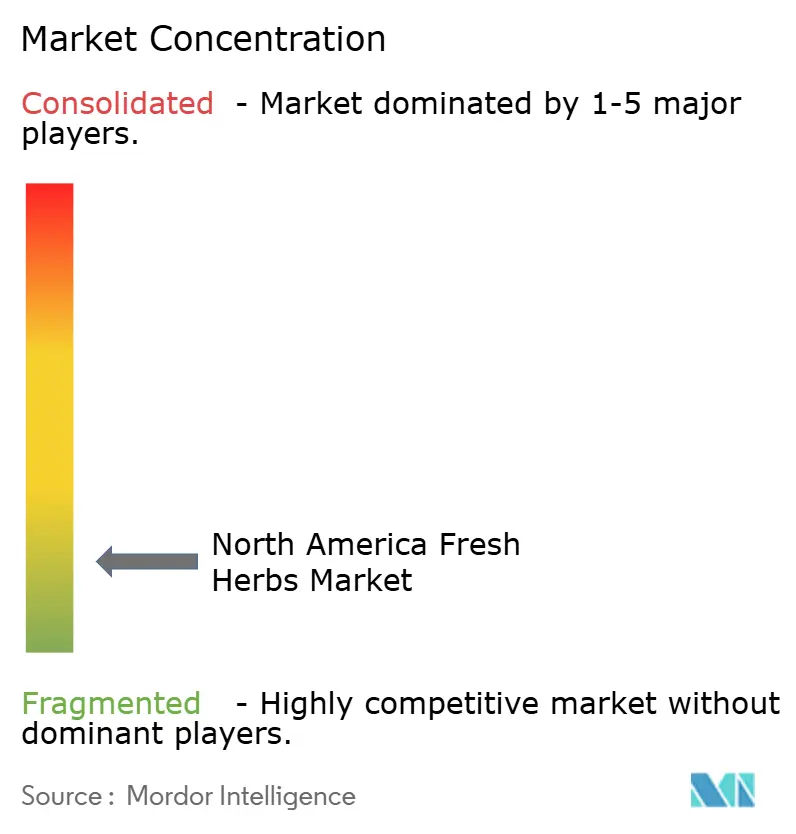
| Market Concentration | Low |
Major Players *Disclaimer: Major Players sorted in no particular order Image © Mordor Intelligence. Reuse requires attribution under CC BY 4.0. | |
North America Fresh Herbs Market Analysis by Mordor Intelligence
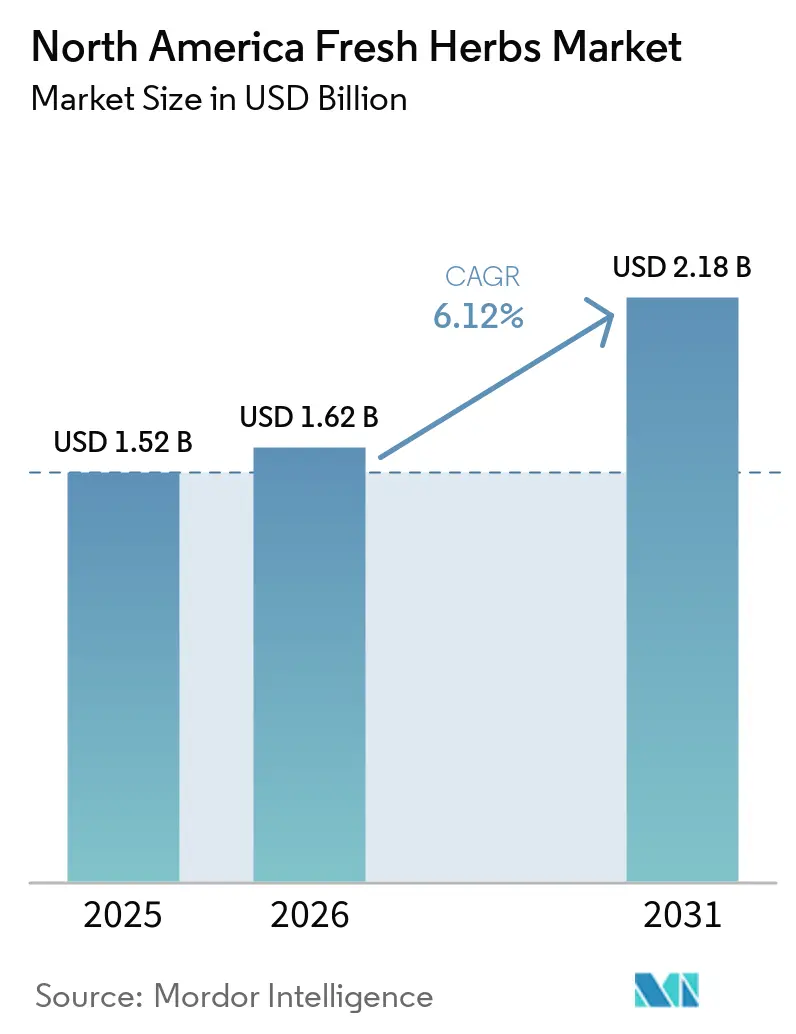
The North America fresh herbs market size was valued at USD 1.52 billion in 2025 and is forecast to grow from USD 1.62 billion in 2026 to USD 2.18 billion by 2031, at a CAGR of 6.12% from 2026 to 2031. Demand is supported by consumer preference for recognizable ingredients, increased use of fresh herbs in prepared foods, and the need for a reliable year-round supply. Controlled-environment agriculture is influencing supplier selection, as growers can offer consistent quality, traceability, and shorter delivery times. Retailers and foodservice buyers are increasingly entering direct supply arrangements with certified growers, particularly for organic programs. Field production remains important for volume, while indoor and greenhouse facilities address seasonal gaps and reduce exposure to disruptions in concentrated growing areas.
Key Report Takeaways
- By product type, basil accounted for 49% of the North America fresh herbs market share in 2025 and is forecast to grow at a CAGR of 6.9% from 2026 to 2031.
- By category, conventional herbs accounted for 72% of the North America fresh herbs market size in 2025, while organic herbs are forecast to grow at a CAGR of 8.1% from 2026 to 2031.
- By cultivation method, open-field cultivation accounted for 55% of the market share in 2025, while vertical indoor cultivation is forecast to grow at a CAGR of 11.5% from 2026 to 2031.
- By end user, foodservice accounted for 44% of the market share in 2025 and is forecast to grow at a CAGR of 7.6% from 2026 to 2031.
- By geography, the United States accounted for 67.8% of the North America fresh herbs market share in 2025, while Mexico is forecast to grow at a CAGR of 7.5% from 2026 to 2031.
Note: Market size and forecast figures in this report are generated using Mordor Intelligence’s proprietary estimation framework, updated with the latest available data and insights as of January 2026.
Market Trends and Insights
Drivers Impact Analysis of North America Fresh Herbs Market*
| Driver | (~) % Impact on CAGR Forecast | Geographic Relevance | Impact Timeline |
|---|---|---|---|
| Clean-Label and Natural Ingredient Demand | +1.3% | North America, with greatest relevance in United States and Canada retail channels | Short term (≤ 2 years) |
| Foodservice Menu Penetration | +1.2% | United States and Canada, with relevance for Mexico urban foodservice centers | Short term (≤ 2 years) |
| Organic Fresh Herb Adoption | +1.0% | United States and Canada, with early premium retail adoption in Mexico | Medium term (2-4 years) |
| Controlled-Environment Agriculture Deployment | +1.1% | United States, Canadian greenhouse regions, and Mexico | Medium term (2-4 years) |
| Hyper-Local Micro-Fulfillment and Regional Sourcing | +0.9% | United States urban and suburban corridors | Short term (≤ 2 years) |
| Downy Mildew-Resistant Seed Commercialization | +0.6% | United States Southeast and humid production corridors | Long term (≥ 4 years) |
| Source: Mordor Intelligence | |||
Clean-Label and Natural Ingredient Demand
Consumer attention to ingredient lists has encouraged food manufacturers and retailers to use fresh herbs in products positioned around recognizable ingredients. Produce accounted for 33% of U.S. organic food sales in 2024, reflecting continued demand for fresh, whole ingredients across food purchases[1]. Fresh herbs can add flavor to meal kits, prepared salads, and refrigerated sauces without relying on less familiar flavoring ingredients. Suppliers are also facing stronger requirements for traceability and pesticide-residue compliance from clean-label product teams. These requirements favor certified controlled-environment growers and make anonymous wholesale supply less attractive to buyers. Retailers are also expanding fresh-produce assortments that emphasize simple ingredient profiles and minimal processing, creating additional points of sale for fresh herbs. This shift can support demand for herbs used as both standalone produce and ingredients in prepared food products.
Foodservice Menu Penetration
Fresh herbs have moved beyond a garnish role in many foodservice kitchens and are used as recurring flavor ingredients across restaurant formats. Basil, cilantro, and mint serve quick-service, fast-casual, hotel, institutional, and fine-dining operations with differing menu requirements. Foodservice buyers value regular delivery schedules because herb availability affects menu execution and preparation routines. Controlled-environment growers located near major cities can shorten delivery distances and support more frequent supply to retail and foodservice customers. This proximity can support higher prices because foodservice customers value predictable quality and usable shelf life. Direct agreements between restaurant groups and greenhouse operators can also reduce the role of traditional wholesale intermediaries in the North America fresh herbs market. The expansion of fresh-prepared meals, salads, sauces, and other ready-to-serve offerings is also increasing the range of foodservice applications for fresh herbs. As menu formats diversify, suppliers may need to provide consistent volumes and specifications across different customer requirements.
Organic Fresh Herb Adoption
Organic fresh herbs are gaining space in retail programs because certified growers can supply a consistent product across seasons. Indoor operators can combine organic certification with controlled growing conditions and provide the documentation that large grocery buyers require. This has created a supply structure in which larger certified indoor growers can protect margins while seasonal field suppliers compete more directly on volume. Retail private-label programs are an important route for organic herb distribution because they can use multi-year supply agreements. The broader availability of organic herbs at more competitive prices supports household adoption beyond premium grocery formats. The North America fresh herbs market benefits when suppliers can maintain organic quality through periods that previously depended on seasonal field availability. Greater retail availability also gives consumers more opportunities to purchase organic basil, cilantro, mint, and other commonly used herbs as part of routine grocery shopping. Continued adoption will depend on factors such as price differences, product availability, and retailers’ ability to maintain a consistent organic supply.
Controlled-Environment Agriculture Deployment
Controlled-environment agriculture includes greenhouse, hydroponic, aeroponic, and vertical indoor systems that enable year-round herb production. These systems help reduce seasonal dependence on field production in California, Hawaii, and Florida, where weather-related disruptions can leave northern and inland markets vulnerable to supply gaps. Water efficiency is another advantage of these production systems: research published in Materials Today: Proceedings indicates that hydroponic farming can reduce water use by 70%-80% compared with soil-based farming systems[2]. In addition to improving resource efficiency, controlled-environment production can support more localized supply chains by bringing cultivation closer to major distribution centers and consumption markets. For example, Eden Green's vertically grown herbs can reach retail customers within 48 hours of harvest, illustrating the potential to shorten delivery times and maintain product freshness. The United States Department of Agriculture supports research on growing, postharvest, and food-safety practices to improve the viability of local herb production in controlled environments. By enabling growers to adjust production cycles and environmental conditions to crop requirements, these systems can improve output consistency across seasons. Greater supply reliability and shorter distribution times can help growers meet the procurement requirements of retailers and foodservice operators, potentially supporting longer-term supply agreements and strengthening the North America fresh herbs market.
Restraints Impact Analysis of North America Fresh Herbs Market*
| Restraint | (~) % Impact on CAGR Forecast | Geographic Relevance | Impact Timeline |
|---|---|---|---|
| Short Shelf Life and Post-Harvest Shrink | -1.3% | North America, especially last-mile retail and non-refrigerated distribution points | Short term (≤ 2 years) |
| Weather-Driven Price Volatility | -1.0% | United States field production areas and Mexico export corridors | Short term (≤ 2 years) |
| DNA Metabarcoding Authentication Costs | -0.5% | United States and Canada premium and organic channels | Medium term (2-4 years) |
| Stricter Maximum-Residue Limits and Compliance Costs | -0.8% | United States, Canada, and Mexico cross-border trade corridors | Medium term (2-4 years) |
| Source: Mordor Intelligence | |||
Short Shelf Life and Post-Harvest Shrink
Basil, cilantro, and parsley generally have shelf lives of 7 to 14 days under suitable cold-chain conditions. Wilting, bruising, yellowing, and the presence of pathogens can reduce the usable selling period to 3 to 5 days when temperature and humidity controls are inconsistent. The Food and Drug Administration detected Cyclospora cayetanensis in 18 of 812 samples tested and Salmonella spp. in 17 of 1,358 samples tested in its fresh herbs sampling assignment[3]. These findings highlight the need for careful post-harvest hygiene and continuous cold-chain management. Modified-atmosphere packaging and active monitoring can reduce shrink, but their costs are difficult for small regional suppliers to absorb. This limits the ability of smaller growers and distributors to participate evenly in growth across the North America fresh herbs market.
Weather-Driven Price Volatility
Field herb production is concentrated in California, Florida, and northwestern Mexico, making prices sensitive to local drought, frost, heat, and hurricanes. Buyers of basil, cilantro, parsley, and mint can face procurement uncertainty when adverse weather affects a limited number of producing areas. Foodservice operators and retailers require stable input costs for menu pricing and promotional planning. These conditions encourage buyers to seek multi-year arrangements with controlled-environment growers that can offer a more predictable supply. Field growers retain a cost-per-pound advantage during stable weather, but face a disadvantage when buyers prioritize price consistency. Climate variability, therefore, remains a meaningful constraint on field-dependent suppliers in the North America fresh herbs market.
*Our forecasts treat driver/restraint impacts as directional, not additive. The impact forecasts reflect baseline growth, mix effects, and variable interactions.
North America Fresh Herbs Market Segment Analysis
By Product Type:
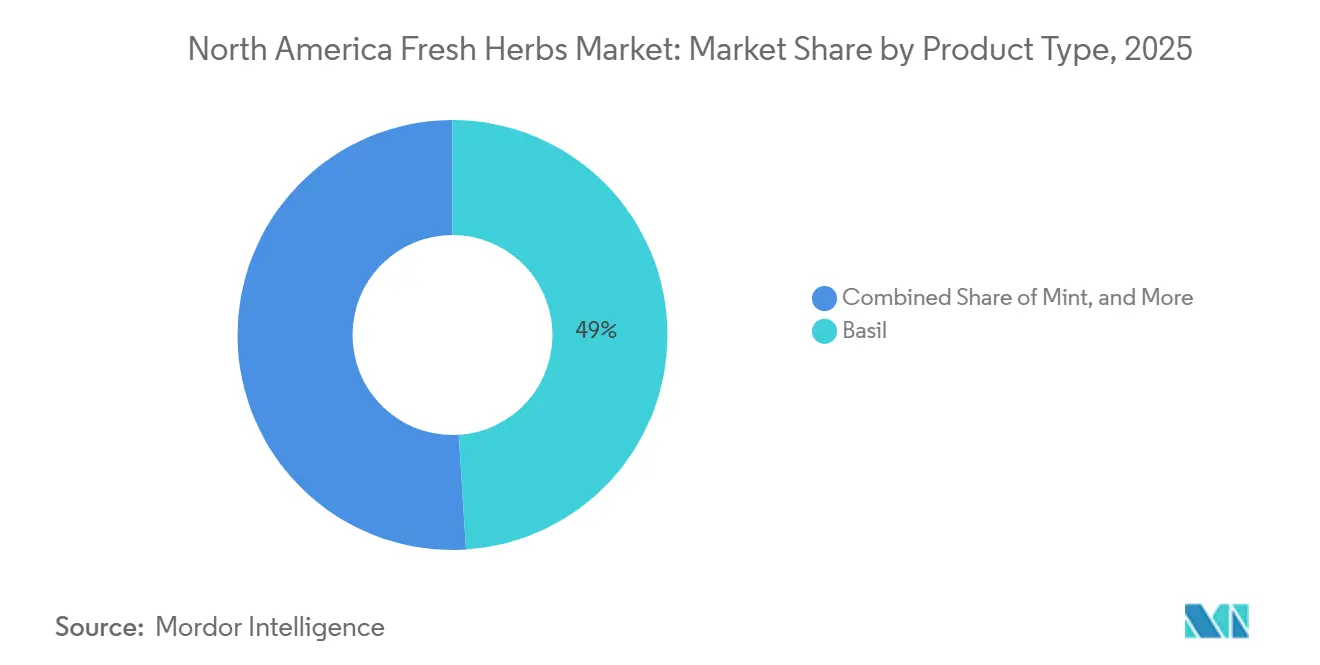
Basil Leads the Market and Is Forecast to Grow the FastestBasil accounted for 49% of the North America fresh herbs market share in 2025 and is forecast to grow at a CAGR of 6.9% from 2026 to 2031. Its position reflects demand from retail, foodservice, and food processing applications. Italian-American, Mediterranean, and Southeast Asian food traditions have supported basil use in the United States and Canada. Cilantro and parsley are also widely used across retail and foodservice applications, with cilantro playing a major role in winter imports from Mexico. Mint, chives, oregano, rosemary, thyme, sage, and dill serve more specialized retail and foodservice uses.
Its relevance to premium fresh herb programs also attracts investment from controlled-environment operators. Field-grown basil has meaningful exposure to downy mildew, which has supported interest in controlled growing conditions. Indoor growers can provide stable quality and supply. United States Department of Agriculture-supported research indicates that controlled-environment herb production can improve yield stability, shelf life, and local availability.

By Category:
Conventional Retains Scale While Organic Expands FasterConventional fresh herbs accounted for 72% of the North America fresh herbs market size in 2025, supported by the relatively lower production costs associated with field cultivation. This cost advantage makes conventionally grown herbs suitable for mass-market retail and high-volume foodservice operations, where buyers prioritize affordability, consistent availability, and large-volume procurement. Food retailers, food processors, and institutional foodservice operators require substantial herb volumes while managing input costs, reinforcing demand for conventionally grown products. Consequently, conventional production remains the primary contributor to the market's overall volume.
The organic segment of the North America fresh herbs market is forecast to grow at a CAGR of 8.1% from 2026 to 2031, driven by demand for reliable, year-round supplies of certified organic herbs. Controlled-environment production can help growers maintain consistent output across seasons, provided that their growing practices and inputs comply with applicable organic certification standards. These facilities can also maintain the production records and traceability documentation required by large grocery retailers. Together, consistent availability and documented compliance can help growers meet private-label procurement requirements and secure supply agreements spanning multiple seasons. As a result, the organic segment is forecast to grow faster than the conventional segment, reflecting the value buyers place on dependable supplies of certified organic herbs.
By Cultivation Method:
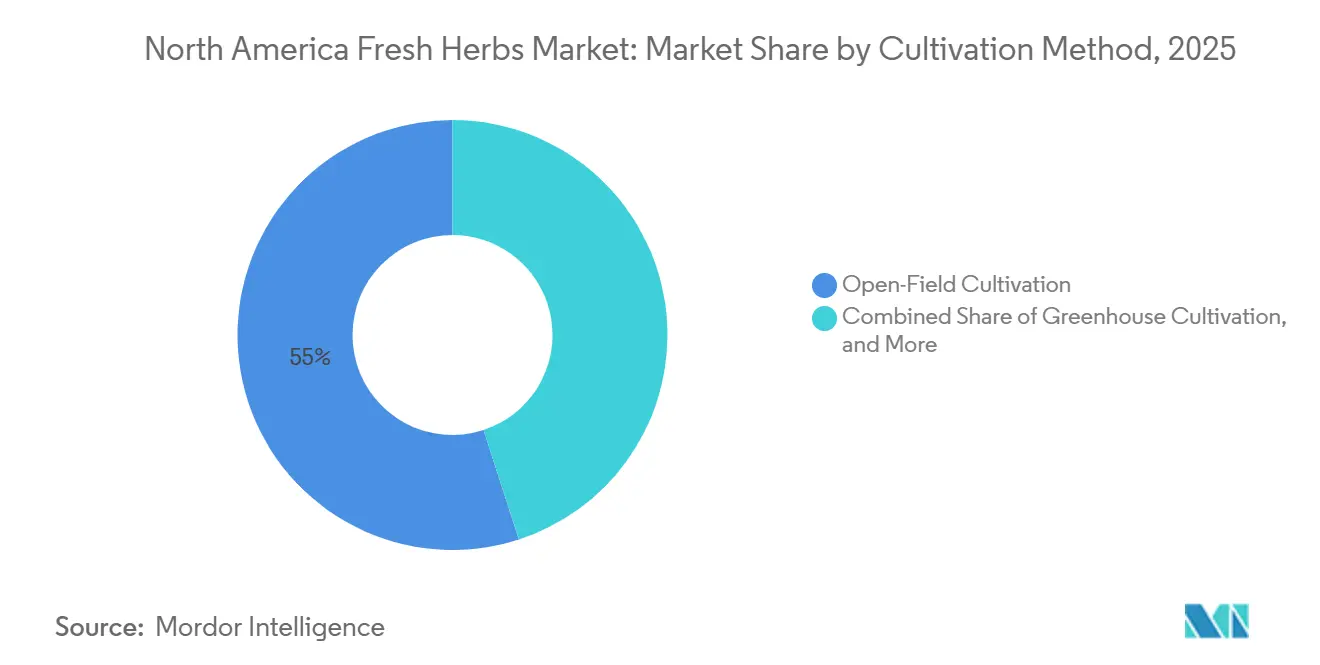
Open-Field Cultivation Leads, While Vertical Indoor Cultivation Grows FasterOpen-field cultivation accounted for 55% share of the market in 2025, supported by the scale and cost advantages of growing cilantro, parsley, and conventional basil outdoors. California, Florida, and northwestern Mexico are important locations for high-volume field production. Greenhouses enable year-round cultivation and play an important role in herb production in British Columbia, while hydroponic and aeroponic systems serve regional buyers in the U.S. Northeast and Midwest. These production methods offer alternatives to open-field cultivation by allowing growers to manage growing conditions and maintain supplies beyond traditional field-production seasons.
Vertical indoor cultivation is forecast to grow at a CAGR of 11.5% from 2026 to 2031. Its growth is supported by improvements in lighting efficiency and climate-control systems, as well as the ability to locate production closer to customers. By growing herbs in multiple layers, vertical farms can increase output in limited space and provide consistent supplies to retail and foodservice buyers year-round. On-site packing and proximity to distribution networks can further shorten delivery times and help maintain product freshness. However, high energy consumption remains a challenge, although efficient lighting and access to renewable electricity can help reduce operating costs.
By End User:
Foodservice Leads the Market and Is Forecast to Grow the FastestFoodservice accounted for 44% of the North America fresh herbs market share in 2025 and is forecast to grow at a CAGR of 7.6% from 2026 to 2031. Restaurants, hotels, cafeterias, quick-service chains, and institutional kitchens use fresh herbs for flavor, garnishing, and menu differentiation. Consistent quality and reliable year-round availability support demand, particularly among multi-location foodservice operators that require standardized ingredients and regular deliveries.
Food retail supplies fresh herbs for household consumption, while food processing uses them in sauces, meal kits, and refrigerated condiments. Pharmaceutical and nutraceutical applications use selected herbs for their bioactive compounds, with traceability and quality being important considerations. Other end users, including meal-kit providers, contribute additional demand for fresh herbs.
Geography Analysis
United States Fresh Herbs Market
The United States accounted for 67.8% of the North America fresh herbs market share in 2025, supported by its large food consumption base and increasing investment in controlled-environment agriculture. Indoor herb operators are expanding distribution across mass-market, premium, and regional grocery channels. Edible Garden expanded the distribution of its United States Department of Agriculture (USDA) Organic herb line to Target stores nationwide and Walmart stores across the Mid-Atlantic region in 2026. California's Salinas Valley remains important for cilantro, parsley, and conventional basil, though drought and heat are driving diversification in procurement.
Mexico and United States Fresh Herbs Market
Mexico is forecast to be the fastest-growing geographic market in North America, with a CAGR of 7.5% from 2026 to 2031. Export-oriented cilantro and parsley production is concentrated in Sonora, Sinaloa, and Baja California. Border logistics through Nogales, Arizona, and El Paso, Texas, along with lower labor costs, support conventional bulk supply. Compliance investment is also becoming increasingly important for Mexican exporters serving US buyers. Green Herbs International sources cilantro, basil, and mint from Baja California, while Gourmet Xpress combines US and Mexican production for distribution.
Canada Fresh Herbs Market
Canada's fresh herbs market is supported by greenhouse expansion in British Columbia and Ontario, which helps maintain winter supply and reduce dependence on imports. Houweling's Home Harvest supplies a broad range of herbs from British Columbia, while Windset Farms produces certified living organic basil in the province.
Competitive Landscape
The North America fresh herbs market is fragmented, with a large number of suppliers operating across field production, controlled-environment agriculture, and specialty distribution. Gotham Greens Holdings, Edible Garden, Soli Organic, Infinite Herbs, and Goodness Gardens are among the key companies operating in the market. Smallholder field growers, regional greenhouse operators, and specialty distributors account for a substantial portion of the supplier base. Large suppliers compete through direct grocery agreements, private-label organic programs, and broader production footprints.
In August 2026, Edible Garden expanded a multi-year private-label supply agreement with a major Midwest big-box retailer through December 2028. The agreement covers more than 20 fresh herbs and specialty produce products, illustrating the value of broader product offerings in retail contracts. In July 2026, Edible Garden also announced fresh-cut herb distribution with Walmart across the Mid-Atlantic. Large suppliers pursue national retail relationships while regional competitors serve local accounts. Company strategies combine branded distribution, private-label supply, and controlled production capacity.
Regional markets outside the 10 largest U.S. metropolitan areas have less-developed controlled-environment herb supply, creating opportunities for localized production. Precision cultivation technologies, including computer vision, predictive analytics, and automated seeding and harvesting, can improve operational efficiency and reduce costs. Overall, competition in the North America fresh herbs market is shaped by retailers’ quality requirements, distribution efficiency, and the ability to secure reliable supply contracts.
North America Fresh Herbs Industry Leaders
-
Gotham Greens Holdings, LLC
-
Edible Garden AG Incorporated
-
Soli Organic Inc.
-
Infinite Herbs
-
Goodness Gardens, Inc.
- *Disclaimer: Major Players sorted in no particular order
North America Fresh Herbs Market Companies Covered in this Report
- Gotham Greens Holdings, LLC
- Edible Garden AG Incorporated
- Eden Green Technology, Inc.
- Infinite Herbs
- Rocket Farms, Inc.
- Goodness Gardens, Inc.
- Houweling’s Home Harvest
- Superior Fresh, LLC
- The Chef's Garden, Incorporated
- Urbanize, LLC
- Fresh Origins
- The Fresh Herb Company, LLC
- North Shore Living Herbs (Living Herbs, LLC)
- Soli Organic Inc.
- Windset Farms
Recent Industry Developments in North America Fresh Herbs Market
- August 2026: Edible Garden AG Incorporated entered into an expanded multi-year supply agreement with a major Midwest big-box retailer, extending the relationship through December 31, 2028. The agreement expands the retailer's private-label fresh herb program across its Midwest footprint and covers more than 20 fresh herbs and specialty products.
- July 2026: Edible Garden AG Incorporated announced an expansion of its fresh-cut herb distribution with Walmart across the Mid-Atlantic region. The expanded program is anticipated to increase the availability of Edible Garden's fresh-cut herbs at Walmart stores in the region, with initial shipments scheduled to commence in the third quarter of 2026.
- February 2025: Hoffmann Family of Companies acquired a controlling stake in Bay Area Herbs & Specialties, a specialty produce supplier based at San Francisco's Golden Gate Produce Terminal. The acquisition expanded Hoffmann's agricultural portfolio and created synergies with its Worldwide Farms operations.
North America Fresh Herbs Market Report Scope
The fresh herbs market refers to the production and commercialization of fresh culinary and aromatic herbs. It covers fresh herbs supplied through various distribution channels for foodservice, retail, food processing, pharmaceutical and nutraceutical, and other applications.
The North America fresh herbs market report is segmented by product type (basil, cilantro/coriander, mint, parsley, chives, oregano, rosemary, thyme, sage, dill, and other fresh herbs), by category (conventional and organic), by cultivation method (open-field cultivation, greenhouse cultivation, hydroponic cultivation, aeroponic cultivation, and vertical indoor cultivation), by end user (foodservice, food retail, food processing, pharmaceutical and nutraceutical, and other end users), and by geography (United States, Canada, Mexico, and rest of North America). The market sizes and forecasts are provided in value (USD).
Segmentation Overview
| Basil |
| Cilantro/Coriander |
| Mint |
| Parsley |
| Chives |
| Oregano |
| Rosemary |
| Thyme |
| Sage |
| Dill |
| Other Fresh Herbs |
| Conventional |
| Organic |
| Open-Field Cultivation |
| Greenhouse Cultivation |
| Hydroponic Cultivation |
| Aeroponic Cultivation |
| Vertical Indoor Cultivation |
| Foodservice |
| Food Retail |
| Food Processing |
| Pharmaceutical and Nutraceutical |
| Other End Users |
| North America | United States |
| Canada | |
| Mexico | |
| Rest of North America |
| By Product Type | Basil | |
| Cilantro/Coriander | ||
| Mint | ||
| Parsley | ||
| Chives | ||
| Oregano | ||
| Rosemary | ||
| Thyme | ||
| Sage | ||
| Dill | ||
| Other Fresh Herbs | ||
| By Category | Conventional | |
| Organic | ||
| By Cultivation Method | Open-Field Cultivation | |
| Greenhouse Cultivation | ||
| Hydroponic Cultivation | ||
| Aeroponic Cultivation | ||
| Vertical Indoor Cultivation | ||
| By End User | Foodservice | |
| Food Retail | ||
| Food Processing | ||
| Pharmaceutical and Nutraceutical | ||
| Other End Users | ||
| By Geography | North America | United States |
| Canada | ||
| Mexico | ||
| Rest of North America | ||
Key Questions Answered in the Report
What is the size of the North America fresh herbs market?
The North America fresh herbs market size was valued at USD 1.52 billion in 2025 and is forecast to grow from USD 1.62 billion in 2026 to USD 2.18 billion by 2031, at a CAGR of 6.12% from 2026 to 2031.
What is driving demand for fresh herbs in North America?
Recognizable ingredients, foodservice demand, and the need for reliable year-round supply are supporting category growth.
Which fresh herb product type leads the market?
Basil led with a 49% share in 2025 and is forecast to grow at a 6.9% CAGR from 2026 to 2031.
Why are controlled-environment growers gaining relevance?
They can support year-round production, traceability, shorter delivery times, and more consistent quality for retail and foodservice buyers.
Which cultivation method is expanding fastest?
Vertical indoor cultivation is forecast to grow at the fastest rate, with a CAGR of 11.5% from 2026 to 2031.