
North America Expanded Polypropylene Foam Market Size and Share
Market Overview
| Study Period | 2021 - 2031 |
|---|---|
| Forecast Data Period | 2026 - 2031 |
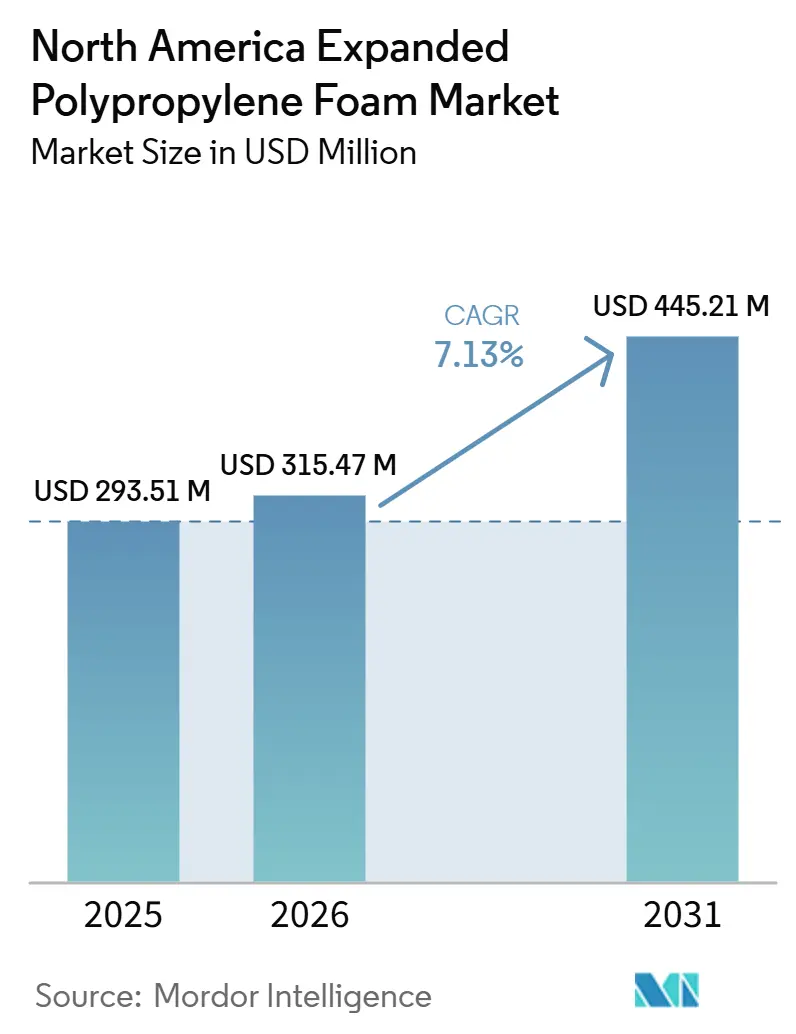
| Base Year Market Size (2025) | USD 293.51 Million |
| Market Size (2026) | USD 315.47 Million |
| Market Size (2031) | USD 445.21 Million |
| Growth Rate (2026 - 2031) | 7.13 % |
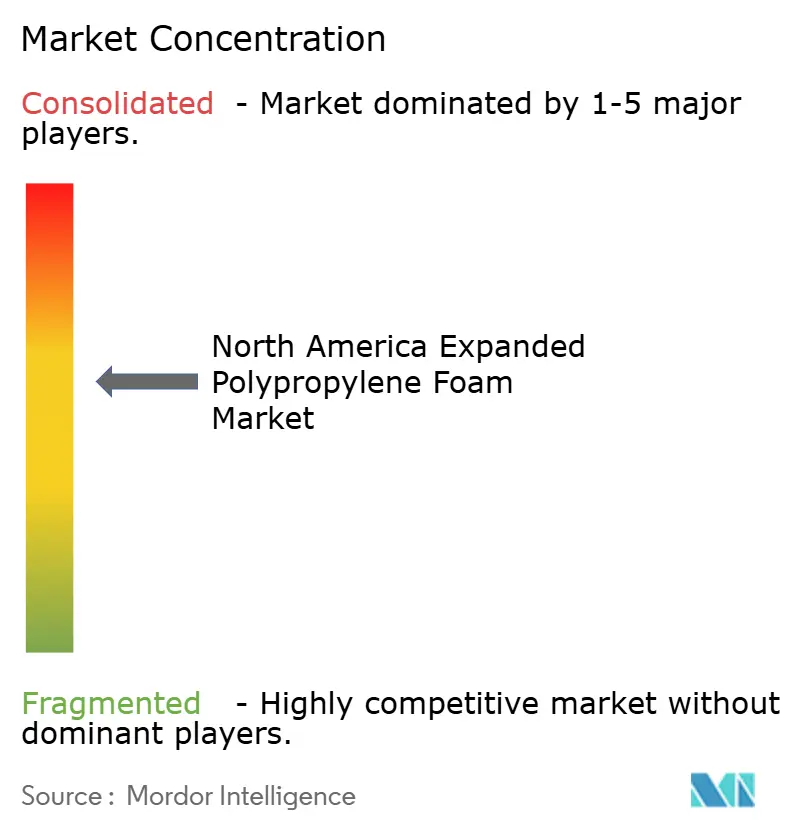
| Market Concentration | Medium |
Major Players *Disclaimer: Major Players sorted in no particular order Image © Mordor Intelligence. Reuse requires attribution under CC BY 4.0. | |
North America Expanded Polypropylene Foam Market Analysis by Mordor Intelligence
The North America expanded polypropylene foam market size was valued at USD 293.51 million in 2025 and estimated to grow from USD 315.47 million in 2026 to reach USD 445.21 million by 2031, at a CAGR of 7.13% during the forecast period (2026-2031). The North America expanded polypropylene foam market is supported by automotive demand because vehicle manufacturers need lighter components that also meet safety and durability requirements. Electric vehicle programs widen the use of expanded polypropylene (EPP) in battery protection and thermal management, where component weight, chemical resistance, and dimensional stability matter together. Returnable packaging gives the North America expanded polypropylene foam market an additional path for growth as automotive suppliers replace disposable inserts in repeat shipping loops. Capacity investments in Mexico and the United States are intended to shorten supply routes for automotive, aerospace, and packaging customers. Feedstock volatility and lower-cost substitute foams continue to limit adoption outside applications where EPP performance justifies its higher initial cost.
Key Report Takeaways
- By raw material, synthetic polypropylene held 88.62% of the North America expanded polypropylene foam market share in 2025, while bio-based polypropylene is forecast to grow at an 11.25% CAGR through 2031.
- By foam type, molded EPP accounted for 65.47% of the North America expanded polypropylene foam market share in 2025 and is projected to advance at a 7.83% CAGR through 2031.
- By application, automotive accounted for 48.65% of the North America expanded polypropylene foam market share in 2025 and is expected to grow at an 8.47% CAGR through 2031.
- By geography, the United States held 76.48% of the North America expanded polypropylene foam market share in 2025, while Mexico is projected to grow at an 8.61% CAGR through 2031.
Note: Market size and forecast figures in this report are generated using Mordor Intelligence’s proprietary estimation framework, updated with the latest available data and insights as of January 2026.
North America Expanded Polypropylene Foam Market Trends and Insights
Drivers Impact Analysis*
| Driver | (~) % Impact on CAGR Forecast | Geographic Relevance | Impact Timeline |
|---|---|---|---|
| Growing Demand for Lightweight Materials in Automotive and Transportation Applications | +2.5% | National, concentrated in Michigan, Kentucky, and Mexico's automotive manufacturing clusters | Short term (≤ 2 years) |
| Increasing Adoption of EPP Foam for Electric Vehicle Battery Protection and Thermal Management | +2.0% | United States and Mexico (EV OEM hubs), spill-over to Canada | Medium term (2–4 years) |
| Rising Use of Reusable Protective Packaging and Industrial Dunnage Solutions | +0.8% | National, elevated uptake in Midwest manufacturing corridors and Mexico border zones | Medium term (2–4 years) |
| Expansion of Closed-Loop Recycling and Bead Recovery Systems in Automotive Manufacturing | +0.8% | United States and Canada | Long term (≥ 4 years) |
| Advancements in Steam-Chest Molding Technologies for Customized and Complex EPP Components | +0.7% | National, R&D concentration in US Midwest manufacturing centers | Long term (≥ 4 years) |
| Source: Mordor Intelligence | |||
Growing Demand for Lightweight Materials in Automotive and Transportation Applications
The North America expanded polypropylene foam market benefits from vehicle programs that seek lower component mass without reducing crash protection. The Corporate Average Fuel Economy framework sets requirements that encourage manufacturers to improve fleet efficiency through vehicle design and component selection[1]U.S. National Highway Traffic Safety Administration, “Corporate Average Fuel Economy,” U.S. National Highway Traffic Safety Administration, nhtsa.gov. EPP can reduce bumper-system weight by 1.2-1.8 kg per vehicle when compared with conventional energy-absorbing materials. Its ability to recover after repeated impacts also supports use in delivery-vehicle loading panels and bulkhead padding. This use can reduce replacement needs where vehicles face frequent dock contact. Automotive production in the southern United States also broadens demand beyond the traditional Michigan-centered supply base.
Increasing Adoption of EPP Foam for Electric Vehicle Battery Protection and Thermal Management
Battery packs need materials that absorb vibration, resist electrolyte exposure, and remain stable at operating temperatures. EPP meets these needs in battery module housings and can reduce the need for separate protective liners. JSP Corporation completed an ARPRO EPP plant in Ramos Arizpe, Mexico, in December 2025 to serve North American automotive demand[2]JSP Corporation, “Notice Concerning the Establishment of New Plants in India and in Mexico,” JSP Corporation, marketscreener.com. The facility provides a local source for EPP components used by vehicle manufacturers and their suppliers. This performance allows the North America expanded polypropylene foam market to gain content in electric vehicle platforms beyond traditional bumper and headrest uses.
Rising Use of Reusable Protective Packaging and Industrial Dunnage Solutions
Returnable EPP trays are replacing disposable expanded polystyrene inserts in some automotive supply loops. The North America expanded polypropylene foam market gains from this change because EPP trays can operate through 100 or more cycles. ORBIS provides precision-molded EPP inserts for parts that include fuel pumps, circuit boards, headlights, and glass. Knauf Automotive also supplies custom-shaped EPP dunnage designed for automotive transport. These programs protect components in internal and long-distance transport while supporting collection and reuse. The shift also makes reverse logistics a more important element of supplier agreements.
Expansion of Closed-Loop Recycling and Bead Recovery Systems in Automotive Manufacturing
EPP is a single-polymer bead foam, which can make recovery simpler than the recovery of foam products with mixed materials. Toyoda Gosei introduced horizontal recycling technology in May 2025 that used 50% end-of-life vehicle polypropylene in impact-resistant glove boxes and reported up to 40% lower CO2 emissions per part. The result shows why automotive suppliers are assessing recycled polypropylene streams for new parts. The EPP Loop initiative reported more than 7,400 metric tons of EPP waste recycled in 2024, creating a reference point for closed-loop collection systems. Bead recovery can also lower reliance on virgin polypropylene when feedstock prices move sharply. Controls intended to limit pellet and bead loss further strengthen the case for collection systems at pre-expansion and compounding facilities.
Restraints Impact Analysis*
| Restraint | (~) % Impact on CAGR Forecast | Geographic Relevance | Impact Timeline |
|---|---|---|---|
| Propylene Price Volatility and Feedstock Dependence | -0.8% | National, most acute along US Gulf Coast propylene supply chains | Short term (≤ 2 years) |
| Substitution by Lower-Cost EPS, EPE, and Polyurethane Foams | -0.6% | National, concentrated in price-sensitive packaging and furniture segments | Short term (≤ 2 years) |
| Pellet-Loss Controls and Fragmented EPP Collection Infrastructure | -0.3% | United States and Canada | Long term (≥ 4 years) |
| Source: Mordor Intelligence | |||
Propylene Price Volatility and Feedstock Dependence
The North America expanded polypropylene foam market remains exposed to changes in polymer-grade propylene pricing. Supply is concentrated in 4 Texas-based propane dehydrogenation units, which makes values sensitive to outages, propane costs, and transport disruptions. A March 2026 analysis also described trade-related pressure on propane costs and North American Liquefied Petroleum Gas (LPG) exports. Automotive supply agreements can leave converters exposed when price-adjustment clauses lag spot movements by 1-2 quarters. This risk directly affects margins because propylene is the core feedstock for synthetic polypropylene beads.
Substitution by Lower-Cost EPS, EPE, and Polyurethane Foams
Expanded polystyrene retains a cost advantage over EPP in commodity uses. That price difference supports EPS in food packaging and furniture, even where EPP provides better reuse and impact recovery. EPP cold-chain containers can be reused 10-15 times, compared with 2-3 uses for EPS, but EPP units cost USD 8-12 compared with USD 3-5 for EPS. Polyurethane remains established in vehicle seating, furniture, and bedding because softness and price are important in those uses. This restraint does not displace EPP from established automotive safety applications, where vehicle specifications and crash requirements support its use. It instead limits the North America expanded polypropylene foam market in adjacent applications that are highly sensitive to initial purchase cost.
*Our forecasts treat driver/restraint impacts as directional, not additive. The impact forecasts reflect baseline growth, mix effects, and variable interactions.
Segment Analysis
By Raw Material: Bio-Based Polypropylene Gains Ground in Sustainability-Driven Procurement
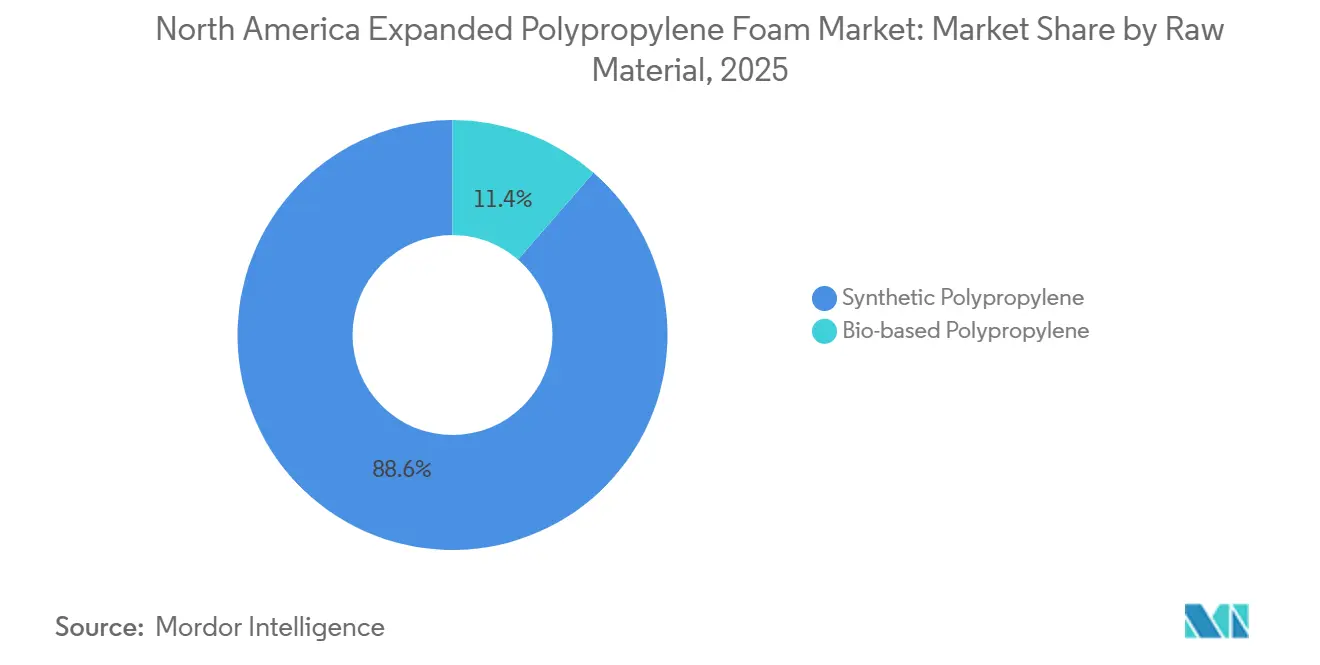
Synthetic polypropylene accounted for 88.62% of the North America expanded polypropylene foam market share in 2025. The segment benefits from established petrochemical infrastructure and the cost-volume economics of conventional propylene supply. Synthetic material continues to serve automotive and packaging customers who need a dependable supply at large volumes. Its feedstock base is closely linked to existing regional propylene production and processing networks. This relationship explains why fossil-derived polypropylene remains the dominant raw material for the North America expanded polypropylene industry. It also leaves producers exposed to the feedstock volatility described in the restraints section.
Bio-based polypropylene is forecast to grow at an 11.25% CAGR between 2026 and 2031. Braskem, I'm green PP, and investment in bio-propylene technologies provides a potential feedstock path for bio-based EPP. Higher prices currently limit use to premium automotive interiors, consumer electronics housings, and selected packaging formats. The bio-based polypropylene can cost up to 3 times fossil-derived polypropylene. Automaker Scope 3 procurement goals support interest in these materials as suppliers seek lower-carbon feedstock options.


By Foam Type: Molded EPP Extends Its Lead as EV Component Complexity Rises
Molded EPP held 65.47% of the foam-type segment in 2025 and is projected to grow at a 7.83% CAGR through 2031. This share reflects the need for precision components that can combine impact protection and thermal management in one part. Steam-chest molding produces near-net-shape parts with controlled dimensions for battery trays and structural bumper cores. The method supports vehicle designs that require complex shapes and repeatable part quality. Research published in 2025 found that low-melting-point polyethylene in PP bead formulations could widen the molding pressure window and reduce cycle energy. These production improvements can help protect molded EPP's position as component requirements become more demanding.
Fabricated EPP remains useful for insulation boards, simple packaging inserts, and construction infill. These applications can avoid the tooling cost required for molded forms and can offer shorter lead times for simple shapes. Other foam types include density-gradient EPP and co-expanded EPP or polyolefin blends used in aerospace, sports equipment, and medical devices. Zotefoams serves this premium area with ZOTEK and T-FIT materials made through a supercritical nitrogen foaming process. The process avoids residual blowing-agent compounds, which matters in certification-sensitive applications. Molded EPP still has the stronger position where automotive parts require precise integrated functions.
By Application: Automotive Maintains Dual Leadership
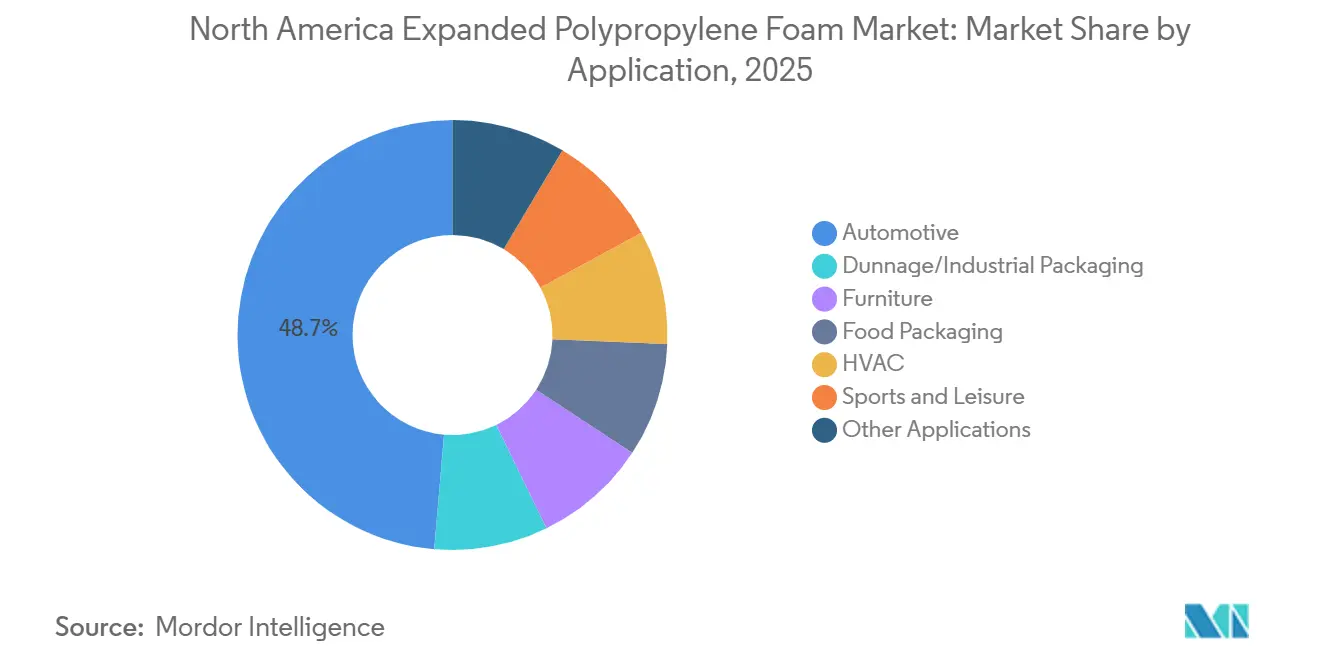
Automotive accounted for 48.65% of the North America expanded polypropylene foam market share in 2025 and is expected to grow at an 8.47% CAGR through 2031. Vehicle makers use EPP in bumpers, headrests, battery module housings, and thermal-management inserts. Electric vehicle launches create demand for EPP content that was not part of older vehicle designs. This extends the addressable use of EPP beyond established energy-absorption parts. Automotive applications, therefore, remain the central source of revenue for the North America expanded polypropylene foam market.
Automotive manufacturers are formalizing returnable EPP tray specifications for high-cycle component movements. Knauf Automotive illustrates this model through customized EPP dunnage for original equipment manufacturer transport programs. Furniture, sports, and leisure applications depend more on consumer wellness and renovation activity. Food packaging faces a cost barrier from EPS, although reusable cold-chain formats support EPP where reverse logistics are available. Heating, Ventilation, and Air Conditioning (HVAC) uses rely on EPP thermal properties but face competition from mineral wool and polyurethane products with established building approvals.

Geography Analysis
The United States held 76.48% of the North America expanded polypropylene foam market share in 2025. Automotive original equipment manufacturers and Tier 1 suppliers are concentrated in Michigan, Kentucky, Tennessee, and the southeastern corridor. This production footprint supports regional demand for bumper, interior, packaging, and battery-related EPP components. Zotefoams completed an expansion in Walton, Kentucky, in 2026 that increased North American output by more than 20%. The project added compounding, expansion, and finishing capability at the site. U.S. automotive production and a wider range of electric vehicle models continue to support domestic requirements for protective and lightweight foam parts.
Mexico is projected to be the fastest-growing geography at an 8.61% CAGR between 2026 and 2031. JSP commissioned its Ramos Arizpe facility in December 2025, creating a local EPP bead foam source for automotive programs. Local EPP supply can reduce cross-border shipment needs for suppliers in Nuevo León and Guanajuato. USMCA rules of origin also encourage deeper regional sourcing for vehicle programs.
Canada contributes the remaining regional revenue. Ontario's automotive cluster supports demand for components used in North American vehicle platforms. The country also has a demand for returnable packaging as suppliers seek alternatives to disposable inserts. Federal changes to single-use plastics rules in 2024 increased the relevance of reusable packaging systems for Canadian plants. EPP dunnage can support compliance where suppliers collect and reuse trays over multiple delivery cycles. The North America expanded polypropylene foam market, therefore, has a different demand base in Canada, with automotive integration and packaging practices both shaping purchases.
Competitive Landscape
The North America expanded polypropylene foam market is moderately concentrated. JSP's ARPRO plant in Mexico is a strategic move that places production nearer to regional automotive and electric vehicle customers. Kaneka competes through its Eperan product range and established application expertise. Zotefoams uses supercritical nitrogen foaming to address aerospace, medical, defense, and advanced packaging requirements. Its Walton expansion adds end-to-end capacity and shortens supply routes for North American customers.
Specialty processors, including UFP Technologies, Plastomer Corporation, Foam Products Corporation, and Woodbridge, compete through precision molding and co-development with automotive Tier 1 suppliers. Knauf Automotive has a defensible position in returnable dunnage because it is integrated with automotive packaging specifications. Bradford Company and DS Smith participate in protective packaging programs where EPP is one component of a wider packaging system. This structure gives established suppliers room to compete on customer service, part design, and local processing capability. It also makes direct price competition less decisive in applications with demanding safety or handling requirements. The North America expanded polypropylene foam market remains open to specialists who can meet a customer's specific part and process needs.
Bio-based EPP remains an open area because no North American producer has reached commodity automotive volumes. A supplier that secures bio-propylene and receives vehicle approvals could establish a position in this emerging space. Patent application US20240157614 describes integrated skin-and-insert molding in a single EPP steam-chest cycle. Research on radio-frequency sintering has also shown EPP parts with 50-70% recycled content at industrial quality. These developments place greater importance on processing innovation and recycled-content capability. Companies that do not invest in these capabilities may face margin pressure as larger producers extend their engineering advantages.
North America Expanded Polypropylene Foam Industry Leaders
JSP
Woodbridge
Kaneka Corporation
Knauf Industries
Plastomer Corporation
- *Disclaimer: Major Players sorted in no particular order

Recent Industry Developments
- July 2025: JSP commenced operations at its second manufacturing facility in Ramos Arizpe, Coahuila, Mexico, expanding its EPP foam production capacity. The 14,000-square-meter facility was established to meet growing demand from the automotive and packaging sectors.
- March 2025: EFP, LLC, announced a USD 31.5 million expansion of its Bishopville, South Carolina, facility, adding 200,000 square feet to increase production capacity for expanded polypropylene (EPP) solutions. The investment strengthens North American EPP manufacturing capacity and supports growing demand from protective packaging, automotive, and cold chain applications.


North America Expanded Polypropylene Foam Market Report Scope
Expanded polypropylene (EPP) foam is a lightweight, closed-cell thermoplastic foam known for its excellent impact resistance, energy absorption, thermal insulation, and recyclability. It is widely used in automotive, packaging, consumer goods, and industrial applications where durability, weight reduction, and reusable performance are important.
The North America Expanded Polypropylene Foam Market is segmented by raw material, foam type, application, and geography. By raw material, the market is segmented into synthetic polypropylene and bio-based polypropylene. By foam type, the market is segmented into molded EPP, fabricated EPP, and other foam types. By application, the market is segmented into automotive, dunnage/industrial packaging, furniture, food packaging, HVAC, sports and leisure, and other applications. The report also covers the market size and forecasts for expanded polypropylene foam in 3 countries across the region. For each segment, the market sizing and forecasts have been done on the basis of value (USD).
| Synthetic Polypropylene |
| Bio-based Polypropylene |
| Molded EPP |
| Fabricated EPP |
| Other Foam Types |
| Automotive |
| Dunnage/Industrial Packaging |
| Furniture |
| Food Packaging |
| HVAC |
| Sports and Leisure |
| Other Applications |
| United States |
| Canada |
| Mexico |
| By Raw Material | Synthetic Polypropylene |
| Bio-based Polypropylene | |
| By Foam Type | Molded EPP |
| Fabricated EPP | |
| Other Foam Types | |
| By Application | Automotive |
| Dunnage/Industrial Packaging | |
| Furniture | |
| Food Packaging | |
| HVAC | |
| Sports and Leisure | |
| Other Applications | |
| By Geography | United States |
| Canada | |
| Mexico |


Key Questions Answered in the Report
What is the size of the North America expanded polypropylene foam market?
The North America expanded polypropylene foam market stands at USD 315.47 million in 2026 and is projected to reach USD 445.21 million by 2031.
Which application leads demand for the North America expanded polypropylene foam market?
Automotive led with 48.65% revenue share in 2025 and is projected to grow at an 8.47% CAGR through 2031.
Why is EPP used in electric vehicle battery systems?
EPP provides vibration absorption, chemical resistance, and thermal stability near 130 °C.
Which raw material is expected to grow fastest through 2031?
Bio-based polypropylene is projected to expand at an 11.25% CAGR forecast through 2031.
Page last updated on:





