
North America DIN Rail-Mounted Signal Processing Solutions Market Size and Share
Market Overview
| Study Period | 2021 - 2032 |
|---|---|
| Forecast Data Period | 2027 - 2032 |
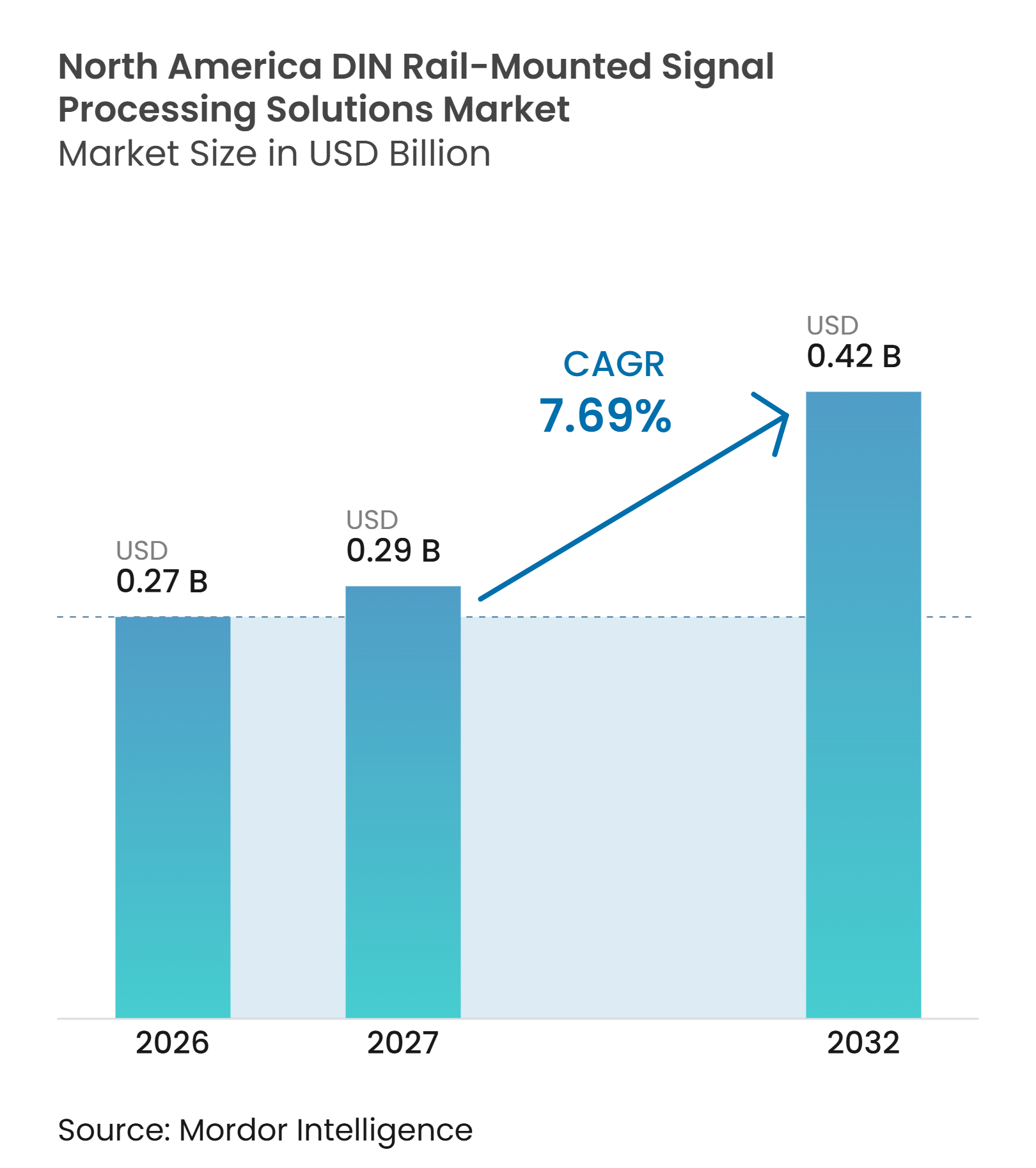
| Base Year Market Size (2026) | USD 0.27 Billion |
| Market Size (2027) | USD 0.29 Billion |
| Market Size (2032) | USD 0.42 Billion |
| Growth Rate (2027 - 2032) | 7.69 % |
| Market Concentration | Medium |
Major Players *Disclaimer: Major Players sorted in no particular order Image © Mordor Intelligence. Reuse requires attribution under CC BY 4.0. | |
North America DIN Rail-Mounted Signal Processing Solutions Market Analysis by Mordor Intelligence
The North America DIN Rail-Mounted Signal Processing Solutions market size is valued at USD 0.27 billion in 2026 and is projected to reach USD 0.42 billion by 2032, registering a CAGR of 7.69% between 2027 and 2032. Manufacturing incentives, grid modernization funding, and investment in energy-transition assets are increasing orders for panels and marshalling cabinets across the region. These systems require modules that isolate, convert, and route field signals into control and safety systems. Replacement demand remains important because many refineries, chemical plants, and water facilities retain 4-20 mA instruments during control-system upgrades. Suppliers are also competing through slimmer designs, certified safety products, and configurable functions that can reduce cabinet space and qualified-part complexity. The North America DIN Rail-Mounted Signal Processing Solutions market faces substitution in new facilities from digital field devices and remote I/O, although installed analog infrastructure supports continuing retrofit demand.
Key Report Takeaways
- By form factor, DIN rail-mounted modules accounted for 100% of the North America DIN Rail-Mounted Signal Processing Solutions market in 2026, while edge-connected DIN rail modules are projected to expand at an 8.26% CAGR through 2032.
- By signal/input type, 4-20 mA inputs held 29.63% revenue share in 2026, while strain gauge, load cell, and bridge inputs are projected to expand at an 8.31% CAGR through 2032.
- By output signal, analog current output accounted for a 33.33% share in 2026, while HART-transparent and networked output is projected to expand at an 8.27% CAGR through 2032.
- By application, process control and automation held a 37.04% share in 2026, while condition monitoring and predictive maintenance is projected to expand at an 8.18% CAGR through 2032.
- By end-user industry, oil and gas accounted for an 18.52% share in 2026, while semiconductor and electronics manufacturing is projected to expand at an 8.34% CAGR through 2032.
- By technology, analog signal conditioners held a 40.74% share in 2026, while edge-connected and IIoT-enabled signal conditioners are projected to expand at an 8.42% CAGR through 2032.
- By safety and certification, general-purpose modules accounted for a 48.15% share in 2026, while SIL-rated and functional-safety modules are projected to expand at an 8.38% CAGR through 2032.
- By geography, the United States held a 77.78% share in 2026, while Mexico is projected to expand at an 8.44% CAGR through 2032.
Note: Market numbers in this report are based on Mordor Intelligence's proprietary estimation framework, which combines nine months of actuals with Q4 projections for base year 2026.
Market Trends and Insights
Drivers Impact Analysis of North America DIN Rail-Mounted Signal Processing Solutions Market of North America DIN Rail-Mounted Signal Processing Solutions Market*
| Driver | (~) % Impact on CAGR Forecast | Geographic Relevance | Impact Timeline |
|---|---|---|---|
| Brownfield Control-System Modernization | +2.1% | National, concentrated in U.S. Gulf Coast and Midwest refining and chemical corridors | Medium term (2-4 years) |
| Expansion of Semiconductor, Data Center, and Life Sciences Capacity | +1.9% | U.S.-led in Texas, Utah, Oregon, and Arizona, with expansion in Ontario and Monterrey | Medium term (2-4 years) |
| Hazardous-Area and Functional-Safety Instrumentation | +1.4% | National, concentrated in the U.S. Gulf Coast and Western Canada oil sands | Long term (≥ 4 years) |
| Cabinet-Space Optimization and Higher Channel Density | +1.2% | National, with early adoption in U.S. semiconductor and pharmaceutical clusters | Short term (≤ 2 years) |
| Predictive Maintenance and Edge-Connected Diagnostics | +0.9% | National, with early gains in U.S. energy and advanced-manufacturing hubs | Medium term (2-4 years) |
| Retrofit Demand From Electrification and Grid Modernization | +0.7% | National, with early gains in the U.S. Northeast, Texas, and Western Canada grid corridors | Long term (≥ 4 years) |
| Source: Mordor Intelligence | |||
Brownfield Control-System Modernization
The North America DIN Rail-Mounted Signal Processing Solutions market is supported by upgrades from older distributed control systems to newer control and safety platforms. Many projects retain existing 4-20 mA field instruments rather than replacing every device at once. Signal conditioners provide the interface between these older loops and modern control or safety architectures. Replacement modules often need the same SIL rating as the target safety function. That requirement raises the value of replacement channels compared with general-purpose products. Panel builders also prefer qualified module families that cover multiple input and output requirements. Standardization can reduce engineering work across multi-year turnaround programs. The installed base in Gulf Coast refining and Midwest chemicals provides recurring demand when plants schedule instrumentation refreshes. This work is less exposed to changes in greenfield capital spending. UL 508 listings remain relevant because North American panel builders use them in product qualification.
Expansion of Semiconductor, Data Center, and Life Sciences Capacity
New semiconductor facilities require large numbers of temperature, pressure, flow, and load-measurement channels. Texas Instruments announced a USD 60 billion program across seven manufacturing sites in Texas and Utah in June 2025.[1] GlobalFoundries announced a USD 16 billion investment in New York and Vermont facilities during the same month.[2] The U.S. Department of Commerce also announced preliminary terms for awards to Analog Devices and Coherent in early 2025. MACOM announced a long-term capital investment plan for facilities in Massachusetts and North Carolina. These projects create initial orders for instrumented production systems and later create service and upgrade demand. The North America DIN Rail-Mounted Signal Processing Solutions market benefits as facilities use load cells to monitor material handling, process pressure, and high-accuracy manufacturing steps. Life sciences and data-center projects also add demand for monitored utilities and resilient panel infrastructure.
Hazardous-Area and Functional-Safety Instrumentation
Hazardous-area systems require modules that meet both electrical protection and functional-safety requirements. Phoenix Contact introduced the MINI Analog Pro Ex family in June 2025 with SIL 3 1oo1 capability under IEC 61508. The company stated that the family also carries Class I Division 2, ATEX, and IECEx approvals. Combining intrinsic safety and functional safety in one module can reduce the need for separate barriers and safety relays. This approach can also reduce the space required for hazardous-area loops. The North America DIN Rail-Mounted Signal Processing Solutions market gains from this requirement in refining, chemicals, oil sands, and wastewater applications. IEC 61508 provides a recognized framework for functional-safety management across electrical and programmable systems. NAMUR recommendations also support interoperable field-device connections in process facilities.
Cabinet-Space Optimization and Higher Channel Density
Control rooms and marshaling cabinets often have fixed physical footprints in older facilities. Automation upgrades increase channel counts even where room for new cabinets is limited. Slim DIN rail modules can therefore add more channels within the same panel width. Phoenix Contact launched its VIP I/O-Marshalling system in September 2026. The company said the system combines signal conditioning and marshaling in a compact plug-and-play design. Phoenix Contact also stated that its design can reduce complex project lead times by up to 30%.[3] Software-defined channel assignments can reduce spare-part inventories. They can also help maintenance teams restore service without holding a separate module for each signal type. This design direction supports shorter installation and testing schedules for panel builders and OEMs.
Restraints Impact Analysis of North America DIN Rail-Mounted Signal Processing Solutions Market of North America DIN Rail-Mounted Signal Processing Solutions Market*
| Restraint | (~) % Impact on CAGR Forecast | Geographic Relevance | Impact Timeline |
|---|---|---|---|
| Integrated Remote I/O and Smart Instruments Bypass Standalone Modules | -0.9% | National, most acute in greenfield U.S. semiconductor and life sciences projects | Short term (≤ 2 years) |
| Certification and Validation Cost for Specialized Configurations | -0.6% | National, amplified in U.S. pharmaceutical and food processing environments | Medium term (2-4 years) |
| Shutdown-Dependent Purchasing Cycles in Process Industries | -0.4% | U.S. Gulf Coast and Western Canada refining clusters | Medium term (2-4 years) |
| Interchangeability Limits Across Footprints, Terminals, and Software | -0.3% | National, across mixed-vendor installed bases in end-user sectors | Long term (≥ 4 years) |
| Source: Mordor Intelligence | |||
Integrated Remote I/O and Smart Instruments Bypass Standalone Modules
Ethernet-APL devices and distributed remote I/O can reduce the need for standalone conditioners in newly built facilities. Digital field devices can send live values directly to control-system input cards. This changes the hardware requirement for projects that would otherwise use analog conversion at the marshaling layer. IEC 61508 and IEC 62443 requirements can slow deployment in safety-critical plants. Many operators therefore continue to use qualified 4-20 mA architectures for critical loops. Smart transmitters with HART capability may retain isolation and loop-power needs while reducing demand for multifunction conditioners. Customers also consider firmware licenses, configuration tools, and connectivity subscriptions when choosing a digital architecture. The North America DIN Rail-Mounted Signal Processing Solutions market must respond with modules that preserve analog compatibility while offering clear diagnostic value. The installed base limits the speed of substitution, but it does not remove the risk in greenfield projects.
Certification and Validation Cost for Specialized Configurations
SIL-rated, marine-approved, and cryogenic-range configurations require detailed validation records. The validation process can extend project schedules and make mid-project supplier changes less attractive. Pharmaceutical and food operators use formal change-control processes for hardware substitutions. FDA 21 CFR Part 11 establishes requirements for electronic records and signatures in regulated settings. IEC 61511 sets lifecycle expectations for safety instrumented systems in process applications. Contractors may absorb validation expenses to meet bid requirements for specialized projects. The result is slower switching in high-specification applications. Long replacement cycles support incumbent volumes but can limit near-term revenue from premium-module upgrades. These constraints are especially relevant in regulated production sites where documentation must remain consistent through commissioning.
*Our forecasts treat driver/restraint impacts as directional, not additive. The impact forecasts reflect baseline growth, mix effects, and variable interactions.
North America DIN Rail-Mounted Signal Processing Solutions Market Segment Analysis
By Form Factor:
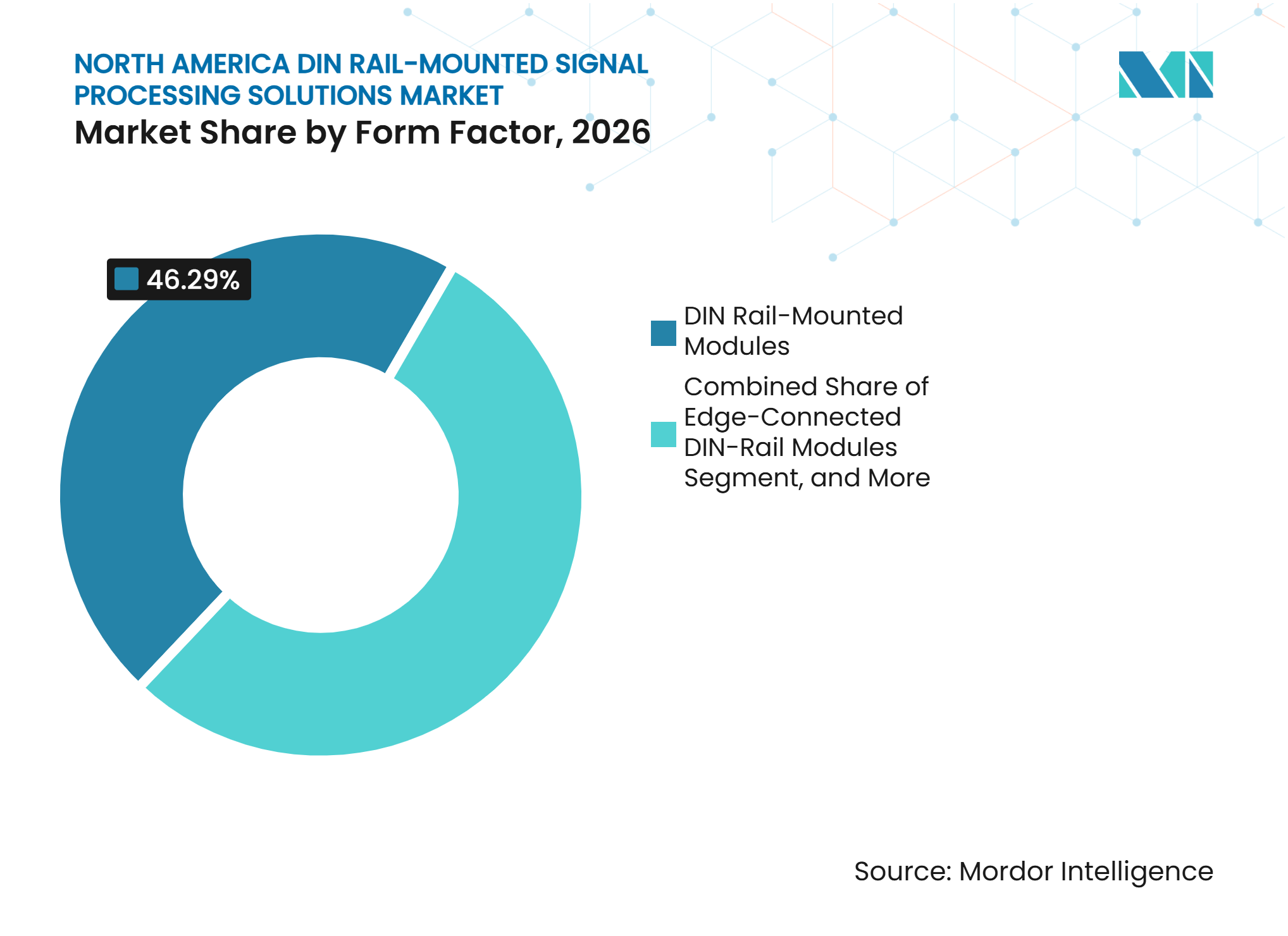
DIN Rail Leads, Edge-Connected Variants Gain MomentumDIN rail-mounted modules represent 46.29% of the form factor segment in 2026 because the report scope covers solutions built around the standard 35 mm rail. This mounting system remains familiar to North American panel builders and control-system installers. It supports modular placement of isolators, converters, transmitters, and safety interfaces within cabinets. Conventional modules remain central to replacement work in refinery, chemical, water, and factory control panels. Their continued use reflects an installed infrastructure that has been in place for decades. Panel builders can replace individual devices without redesigning the entire enclosure. The North America DIN Rail-Mounted Signal Processing Solutions industry also relies on consistent terminal layouts and recognized approvals during panel qualification. Those practical requirements favor established DIN rail architectures in brownfield installations.
Edge-connected DIN rail modules are projected to expand at an 8.26% CAGR through 2032. These products place Ethernet, OPC UA, or MQTT communication capabilities closer to field signals. They can support earlier access to diagnostics without removing the familiar DIN rail installation method. Phoenix Contact's VIP I/O-Marshalling launch showed how termination, signal conditioning, and universal I/O support can be combined. Rack and backplane products remain relevant where PLC-integrated systems need very high I/O density. Stand-alone and plug-in products also serve specialized applications. However, panel builders increasingly use DIN rail systems as a standard configuration. Vendors that offer slim housings and configurable functions can reduce the number of modules that customers must stock.



By Signal/Input Type:
4-20 mA Anchors Volume, Strain Gauge AcceleratesThe 4-20 mA input category held 29.63% of the regional signal processing solutions segment in 2026. Its position reflects the large base of current-loop instruments in refineries, chemical plants, and water treatment facilities. Operators have retained these loops through multiple control-system upgrades because they are proven and widely supported. Conditioners isolate and convert those signals before they enter modern DCS or safety-system hardware. Temperature inputs, including RTD and thermocouple channels, also support large volumes in heat exchangers and power panels. Process voltage inputs serve instrumentation and cabinet-level measurement duties. Each of these input types remains important where analog field devices are still installed. The segment continues to benefit from maintenance work that does not require wholesale replacement of field assets.
Strain gauge, load cell, and bridge inputs are projected to expand at an 8.31% CAGR through 2032. Their use is rising in semiconductor test equipment, precision production, force measurement, and weigh-in-motion systems. These applications often need accurate calibration and specific configuration settings. That technical requirement can support a higher value per channel than standard isolators. LVDT, RVDT, and displacement inputs continue to serve aerospace testing and machine alignment. Frequency, pulse, and AC RMS inputs support power-quality monitoring and renewable-energy interconnection. The North America DIN Rail-Mounted Signal Processing Solutions market benefits where manufacturers add high-accuracy measurement points to automated production systems. Suppliers with broad input coverage can support customers that want a single qualified product family.
By Output Signal:
Analog Current Dominant, HART-Transparent Output RisesAnalog current output accounted for 33.33% of the output signal segment in 2026. It is widely used where conditioned 4-20 mA signals feed directly into DCS analog input cards. This configuration remains common in continuous-process facilities with extensive legacy control loops. Analog voltage output continues to support short cable runs and cabinet-internal routing requirements. Digital, pulse, and frequency outputs are used in flow totalization and batch-control applications. Relay and alarm output modules also remain useful for basic threshold switching and legacy interlock functions. These options show that analog systems still need several output formats. The North America DIN Rail-Mounted Signal Processing Solutions market retains a broad output requirement even within the established 4-20 mA installed base.
HART-transparent and networked output is projected to expand at an 8.27% CAGR through 2032. HART passthrough allows a communicator or asset-management system to access transmitter diagnostics while the analog control signal remains active. That feature helps a conditioner function as both an interface and a point for asset-health visibility. Pepperl+Fuchs identifies the K-System as a portfolio spanning isolated barriers and signal conditioners for process applications. The same company describes SIL 3 coverage across signal types within this product family. Software-selectable output modes can also reduce the number of separate products a panel builder must qualify. This capability offers practical value where customers want flexibility without increasing spare inventories.
By Application:
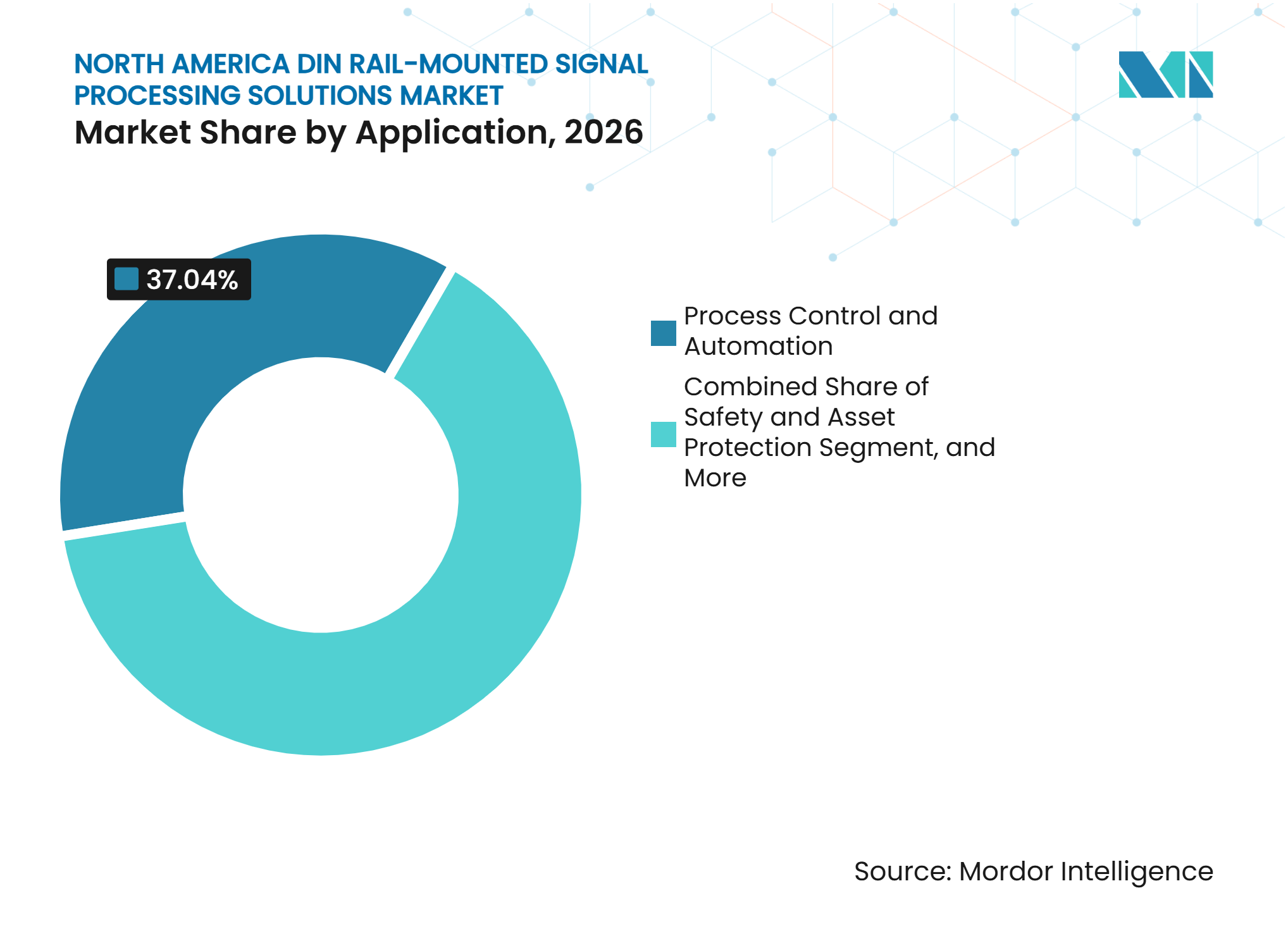
Process Control Anchors Revenue, Predictive Maintenance AcceleratesProcess control and automation held 37.04% of the application segment in 2026. Refining, chemicals, and power generation account for much of the installed base behind this position. These facilities use conditioned signals for control, monitoring, shutdown functions, and operator displays. Their requirements favor reliable products with recognized approvals and long product lifecycles. Data acquisition and test measurement remain relevant in laboratories, calibration benches, and production test systems. Energy and power-quality monitoring is also gaining use where facilities add submetering and SCADA connections. Safety and asset-protection systems require high-specification modules and supporting documentation. The North America DIN Rail-Mounted Signal Processing Solutions market continues to serve both large continuous plants and smaller specialized testing environments.
Condition monitoring and predictive maintenance is projected to expand at an 8.18% CAGR through 2032. Automotive, semiconductor, and food plants are moving from fixed maintenance intervals toward condition-based programs. These programs require permanent monitoring of vibration, temperature, load, and other operating variables. Edge-connected modules can make diagnostic data available closer to critical equipment. This can help reduce the delay between a field event and a maintenance response. Power-quality monitoring also benefits from signal conversion and isolation when sensors connect to building automation or SCADA systems. Configurable hardware can serve data acquisition, process control, and safety functions through different firmware settings. That flexibility reduces rigid boundaries between application categories and favors unified product families.

By End-User Industry:
Oil and Gas Commands Share, Semiconductor Grows FastestOil and gas accounted for 18.52% of the end-user segment in 2026. Gulf Coast refining, Permian Basin gas processing, and Gulf-region LNG construction support demand for certified signal interfaces. These applications use conditioning hardware for process measurement, flare monitoring, and emergency shutdown loops. Hazardous-area requirements increase the importance of intrinsic safety and SIL-rated products. Chemical and petrochemical plants provide a related base of demand with similar control and safety needs. Water and wastewater systems also require monitored signals for treatment and discharge processes. Power generation and utilities add demand through replacement work and instrumentation upgrades. The North America DIN Rail-Mounted Signal Processing Solutions market remains closely tied to long-life industrial assets that need periodic control-system modernization.
Semiconductor and electronics manufacturing is projected to expand at an 8.34% CAGR through 2032. New fabrication facilities require many measurement points for gas flow, chemical delivery pressure, and temperature control. Texas Instruments and GlobalFoundries announced significant U.S. semiconductor capacity investments in 2025. Food and beverage and pharmaceutical operations provide consistent but specification-intensive orders. Pharmaceutical facilities use controlled change processes that can restrict product substitution. Aerospace, defense, automotive, and transportation applications add requirements for specialized reliability testing. This mix allows suppliers to serve both high-volume process systems and precision manufacturing environments.
By Technology:
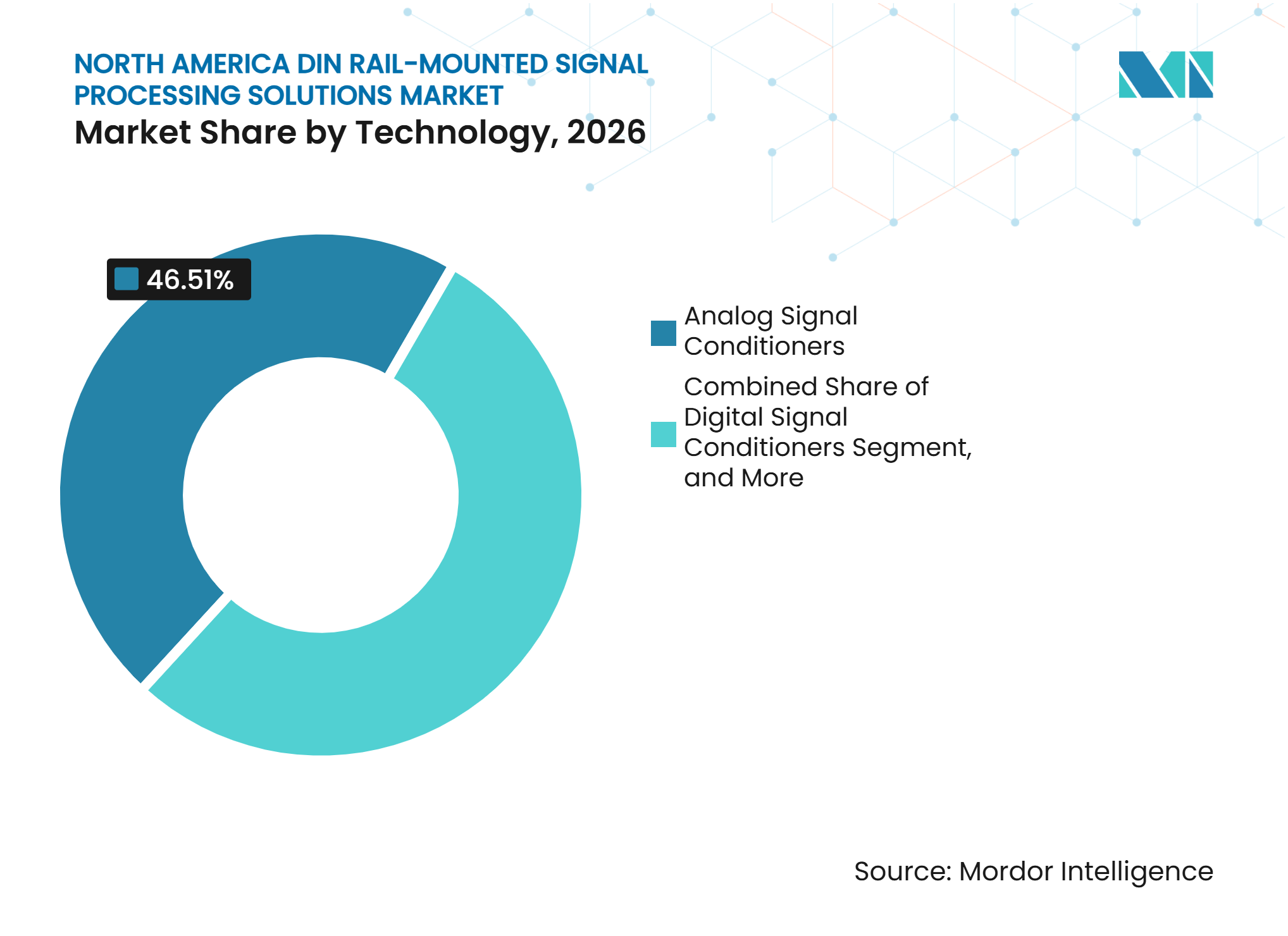
Analog Conditioners Hold Ground, Edge-Connected Models Lead GrowthAnalog signal conditioners accounted for 40.74% of the technology segment in 2026. Their position reflects the large installed base of current-loop architectures in continuous-process operations. Many plants have not replaced analog field systems at the same pace as investment in industrial Ethernet technologies. Analog conditioners still provide isolation, scaling, conversion, and protection for established control loops. Digital signal conditioners hold the second-largest position within the technology landscape. They are used in PLC and DCS applications that receive HART, Foundation Fieldbus, or PROFIBUS PA communications. Hybrid products combine analog conditioning with digital connectivity. These products provide a practical bridge for facilities that need to retain existing field infrastructure during gradual modernization.
Edge-connected and IIoT-enabled conditioners are projected to expand at an 8.42% CAGR through 2032. They can process selected information locally before forwarding it to supervisory software. This approach can reduce network traffic and support faster response in applications where remote data processing creates delay. Local analysis can support anomaly detection and maintenance scoring when it is matched to a specific application. The North America DIN Rail-Mounted Signal Processing Solutions market therefore includes a path from conventional interface hardware to software-enabled functions. Firmware subscriptions, data-forwarding licenses, and configuration applications can supplement hardware sales. However, adoption depends on interoperability, cybersecurity, and a clear operational benefit. Analog compatibility remains important because many customers will modernize in stages rather than replace existing loop infrastructure at once.
By Safety and Certification:
General-Purpose Modules Dominate, SIL-Rated Modules AccelerateGeneral-purpose modules accounted for 48.15% of the safety and certification segment in 2026. They serve nonhazardous applications in food processing, light manufacturing, building automation, and commercial power distribution. These customers do not always require a functional-safety certification for each instrument loop. The category benefits from broad uses across standard control panels and monitoring systems. Intrinsically safe and hazardous-area modules represent the next major requirement in oil and gas, chemicals, and wastewater. Their specification depends on classified-area conditions and the applicable installation rules. Marine and transportation-approved modules serve narrower applications in offshore platforms, shipbuilding, and rail traction systems. These specialist products require approvals that can become a contract requirement for the end user.
SIL-rated and functional-safety modules are projected to expand at an 8.38% CAGR through 2032. Process operators are applying safety functions beyond traditional emergency shutdown valves. Monitoring points, environmental loops, and predictive shutdown triggers can also require documented safety performance. IEC 61508 remains a key basis for functional-safety product assessment. IEC 62061 addresses functional safety in machinery control systems. The North America DIN Rail-Mounted Signal Processing Solutions industry benefits when compliance needs extend into discrete manufacturing and logistics automation. Suppliers with established certification records can have an advantage because new entrants must build equivalent approval portfolios. The resulting shift favors modules that combine functional safety, compact installation, and a documented lifecycle.
Geography Analysis
United States
The United States accounted for 77.78% of the North America DIN Rail-Mounted Signal Processing Solutions market share in 2026. Gulf Coast and Midwest refining and chemical sites provide a large base of legacy instrumentation and recurring modernization work. Semiconductor and data-center construction from Texas through Arizona and Oregon adds demand for new panels and high-density measurement systems. Texas Instruments announced a USD 60 billion manufacturing program across Texas and Utah, while GlobalFoundries announced USD 16 billion for New York and Vermont sites. Water and wastewater operators also require monitored systems as they manage discharge and treatment processes. UL-listed panel builders form an established channel for specifying and installing DIN rail hardware. UL 508A provides a recognized framework for industrial control panel construction. AMUR and HART practices influence how process-industry customers evaluate interoperability. The North America DIN Rail-Mounted Signal Processing Solutions market size in the United States is supported by both new construction and modernization of long-life plants.
Mexico
Mexico is projected to expand at an 8.44% CAGR through 2032. Manufacturing activity around Monterrey, Querétaro, and Saltillo supports new demand from electronics assembly, automotive production, and near-shore chemical operations. Multinational manufacturers often require Mexican facilities to use equipment specifications comparable to those used at U.S. sites. This supports the use of IEC-aligned and UL-specified instrumentation practices in new panel designs. Mexico has a younger and less dense installed base of signal conditioners than the United States. Demand is therefore more closely linked to greenfield production lines than to extensive brownfield replacement work. Medical device and pharmaceutical production in the Bajío region adds demand for documented and safety-rated hardware. FDA 21 CFR Part 820 outlines quality-system requirements for medical devices entering the U.S. market. The combination of new facilities and rising specification needs makes Mexico a significant expansion area for suppliers.
Canada and the Regional Mix
Canada provides steady demand from Alberta oil sands projects, British Columbia LNG assets, and municipal water infrastructure. These facilities can require intrinsically safe modules and documented functional-safety performance. CSA requirements for hazardous locations are a compliance factor in Canadian industrial projects. Real-time effluent monitoring and remote substation automation add demand in Ontario and British Columbia. Offshore facilities near Newfoundland require both marine-related and hazardous-area approvals. This creates a distinct demand pattern because project lifecycles can extend for decades. Mexico provides the highest forecast rate within the regional mix, while the United States continues to account for the bulk of installed demand. The North America DIN Rail-Mounted Signal Processing Solutions market share remains concentrated in the United States, but growth opportunities are increasingly linked to Mexican manufacturing capacity and Canadian energy and utility applications.
Competitive Landscape
Market Concentration
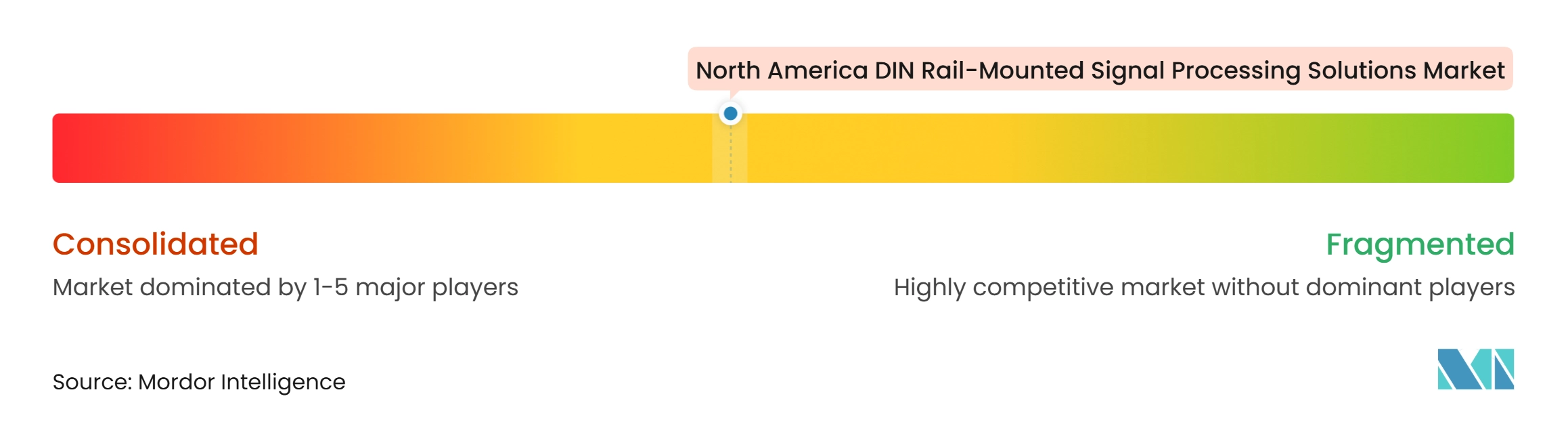
The North America DIN Rail-Mounted Signal Processing Solutions market is moderately consolidated. Phoenix Contact, Pepperl+Fuchs, and Weidmüller compete with Siemens, ABB, and Emerson for specification-led panel-builder and OEM orders. These companies compete through product approvals, application coverage, channel support, and the ability to meet panel-builder requirements. European suppliers have a strong position because DIN rail practices rooted in European industrial standards became well established in North American panel work. Phoenix Contact introduced the MINI Analog Pro Ex family in June 2025 with SIL 3 1oo1 capability and Class I Division 2 approval. The stated 6.2 mm housing and up to 160 isolators per meter address customer demand for greater channel density. Slim, certified products can therefore influence both cabinet design and supplier selection.
The North America DIN Rail-Mounted Signal Processing Solutions market also rewards suppliers that can simplify configuration and spare-part management. Universal-input products with software-selectable functions can reduce the number of qualified parts required by an integrator. Phoenix Contact's September 2026 VIP I/O-Marshalling system combines signal conditioning and signal marshaling for universal I/O systems. This strategy addresses commissioning time and cabinet complexity rather than only the price of a single module. Pepperl+Fuchs positions its K-System around isolated barriers and signal conditioners for process-industry uses. These offerings support customers that need a wide range of inputs, outputs, and approval options from one supplier. Qualification lock-in is significant because a platform change can require rewiring, software changes, and recertification. This can protect established suppliers even when panel builders face pricing pressure.
The North America DIN Rail-Mounted Signal Processing Solutions market has room for products that combine edge diagnostics with recognized safety approvals. Equipment that detects abnormal conditions at the signal layer can be useful to semiconductor, pharmaceutical, and data-center facilities seeking to reduce unplanned downtime. Suppliers must still show that digital functions are compatible with existing controls, cybersecurity requirements, and validation procedures. IEC 61508 certification and UL 508 listings remain important competitive requirements. The leading vendors are therefore likely to compete on compact certified hardware, configurable channels, and credible local technical support. Smaller specialists can compete where customers need high-accuracy measurement, unusual inputs, or application-specific engineering. The competitive structure remains consistent with a moderately consolidated market rather than a market controlled by a single supplier.
North America DIN Rail-Mounted Signal Processing Solutions Industry Leaders
-
Phoenix Contact GmbH & Co. KG
-
Siemens AG
-
ABB Ltd.
-
Schneider Electric SE
-
WAGO Kontakttechnik GmbH & Co. KG
- *Disclaimer: Major Players sorted in no particular order
North America DIN Rail-Mounted Signal Processing Solutions Market Companies Covered in this Report
- Phoenix Contact GmbH & Co. KG
- Siemens AG
- ABB Ltd.
- Schneider Electric SE
- WAGO Kontakttechnik GmbH & Co. KG
- Weidmuller Interface GmbH & Co. KG
- Rockwell Automation, Inc.
- Pepperl+Fuchs SE
- Emerson Electric Co.
- Yokogawa Electric Corporation
- OMEGA Engineering, Inc.
- Acromag, Inc.
- AMETEK, Inc.
- Analog Devices, Inc.
- National Instruments Corporation
- Eaton Corporation plc
- Turck Inc.
- Advantech Co., Ltd.
- Moore Industries-International, Inc.
- Red Lion Controls, LLC
- M-System Co., Ltd.
- PCB Piezotronics, Inc.
- Interface, Inc.
- HBK - Hottinger Bruel & Kjaer
Recent Industry Developments in North America DIN Rail-Mounted Signal Processing Solutions Market
- September 2026: Phoenix Contact GmbH and Co. KG launched VIP I/O-Marshalling, combining signal conditioning and signal marshalling in a single compact plug-and-play system compatible with universal I/O controllers from Schneider Electric, Honeywell, and Siemens. The company stated the system reduces complex process automation project lead times by up to 30%, lowering total investment costs and reducing the need for dedicated marshalling cabinets.
- July 2026: PCB Piezotronics introduced the next-generation 482D27 and 482D64 four-channel signal conditioners, featuring USB-C and Ethernet digital control, improved noise performance, and increased gain for test-and-measurement applications.
- March 2026: AutomationDirect, in collaboration with Define Instruments, introduced a portfolio of digital panel meters, signal conditioners, and temperature transmitters. The range supports current, temperature, voltage, potentiometer, and pulse inputs, with signal scaling, linearization, and optional analog retransmission.
- February 2026: Alliance Sensors Group launched the S2A CyberSecure Smart AC-LVDT Signal Conditioner for power generation and critical infrastructure applications. It supports LVDT, RVDT, and inductive half-bridge sensors, with RS-485 remote configuration, hot-swapping, self-diagnostics, and tamper detection.
North America DIN Rail-Mounted Signal Processing Solutions Market Report Scope
The North America DIN Rail-Mounted Signal Processing Solution Market refers to the regional market for compact, modular electronic devices, signal conditioners, isolators, transmitters, converters, splitters, and limit alarms designed to be snap-mounted on standard 35 mm DIN rails within industrial control cabinets, automation panels, and process control systems across the United States, Canada, and Mexico.
The North America DIN Rail-Mounted Signal Processing Solutions Market Report is Segmented by Form Factor (DIN Rail-Mounted Modules, Rack / Backplane-Mounted Modules, Stand-Alone / Panel Modules, and Plug-In / Compact Modules), Signal / Input Type (Temperature Inputs (RTD Inputs and Thermocouple Inputs), Process Voltage and Current Inputs (4-20 mA Inputs and 0-10 V and Related Standard Analog Inputs), Frequency, Pulse and AC RMS Inputs, Strain Gauge, Load Cell and Bridge Inputs, LVDT/RVDT and Displacement Inputs, and Other Signal / Input Types), Output Signal (Analog Current Output, Analog Voltage Output, Digital, Pulse and Frequency Output, Relay and Alarm Output, and HART-Transparent and Networked Output), Application (Data Acquisition and Test Measurement, Process Control and Automation, Condition Monitoring and Predictive Maintenance, Energy and Power-Quality Monitoring, and Safety and Asset Protection), End-User Industry (Oil and Gas, Chemical and Petrochemical, Water and Wastewater, Power Generation and Utilities, Including Renewable Energy, Food and Beverage, Metals and Mining, Pharmaceutical and Life Sciences, Semiconductor and Electronics Manufacturing, Automotive and Transportation, Aerospace and Defense, and Other End-User Industries), Technology (Analog Signal Conditioners, Digital Signal Conditioners, Hybrid Signal Conditioners, and Edge-Connected and IIoT-Enabled Signal Conditioners), Safety and Certification (General-Purpose Modules, Intrinsically Safe and Hazardous-Area Modules, SIL-Rated and Functional-Safety Modules, and Marine- and Transportation-Approved Modules), and North America (United States, Canada, and Mexico). The Market Forecasts Are Provided in Terms of Value (USD).
Segmentation Overview
| DIN Rail-Mounted Modules |
| Rack / Backplane-Mounted Modules |
| Stand-Alone / Panel Modules |
| Plug-In / Compact Modules |
| Temperature Inputs | RTD Inputs |
| Thermocouple Inputs | |
| Process Voltage and Current Inputs | 4-20 mA Inputs |
| 0-10 V and Related Standard Analog Inputs | |
| Frequency, Pulse and AC RMS Inputs | |
| Strain Gauge, Load Cell and Bridge Inputs | |
| LVDT/RVDT and Displacement Inputs | |
| Other Signal / Input Types |
| Analog Current Output |
| Analog Voltage Output |
| Digital, Pulse and Frequency Output |
| Relay and Alarm Output |
| HART-Transparent and Networked Output |
| Data Acquisition and Test Measurement |
| Process Control and Automation |
| Condition Monitoring and Predictive Maintenance |
| Energy and Power-Quality Monitoring |
| Safety and Asset Protection |
| Oil and Gas |
| Chemical and Petrochemical |
| Water and Wastewater |
| Power Generation and Utilities, Including Renewable Energy |
| Food and Beverage |
| Metals and Mining |
| Pharmaceutical and Life Sciences |
| Semiconductor and Electronics Manufacturing |
| Automotive and Transportation |
| Aerospace and Defense |
| Other End-User Industries |
| Analog Signal Conditioners |
| Digital Signal Conditioners |
| Hybrid Signal Conditioners |
| Edge-Connected and IIoT-Enabled Signal Conditioners |
| General-Purpose Modules |
| Intrinsically Safe and Hazardous-Area Modules |
| SIL-Rated and Functional-Safety Modules |
| Marine- and Transportation-Approved Modules |
| United States |
| Canada |
| Mexico |
| By Form Factor | DIN Rail-Mounted Modules | |
| Rack / Backplane-Mounted Modules | ||
| Stand-Alone / Panel Modules | ||
| Plug-In / Compact Modules | ||
| By Signal / Input Type | Temperature Inputs | RTD Inputs |
| Thermocouple Inputs | ||
| Process Voltage and Current Inputs | 4-20 mA Inputs | |
| 0-10 V and Related Standard Analog Inputs | ||
| Frequency, Pulse and AC RMS Inputs | ||
| Strain Gauge, Load Cell and Bridge Inputs | ||
| LVDT/RVDT and Displacement Inputs | ||
| Other Signal / Input Types | ||
| By Output Signal | Analog Current Output | |
| Analog Voltage Output | ||
| Digital, Pulse and Frequency Output | ||
| Relay and Alarm Output | ||
| HART-Transparent and Networked Output | ||
| By Application | Data Acquisition and Test Measurement | |
| Process Control and Automation | ||
| Condition Monitoring and Predictive Maintenance | ||
| Energy and Power-Quality Monitoring | ||
| Safety and Asset Protection | ||
| By End-User Industry | Oil and Gas | |
| Chemical and Petrochemical | ||
| Water and Wastewater | ||
| Power Generation and Utilities, Including Renewable Energy | ||
| Food and Beverage | ||
| Metals and Mining | ||
| Pharmaceutical and Life Sciences | ||
| Semiconductor and Electronics Manufacturing | ||
| Automotive and Transportation | ||
| Aerospace and Defense | ||
| Other End-User Industries | ||
| By Technology | Analog Signal Conditioners | |
| Digital Signal Conditioners | ||
| Hybrid Signal Conditioners | ||
| Edge-Connected and IIoT-Enabled Signal Conditioners | ||
| By Safety and Certification | General-Purpose Modules | |
| Intrinsically Safe and Hazardous-Area Modules | ||
| SIL-Rated and Functional-Safety Modules | ||
| Marine- and Transportation-Approved Modules | ||
| By Geography | United States | |
| Canada | ||
| Mexico | ||
Key Questions Answered in the Report
What is the size of the North America DIN rail-mounted signal processing solutions sector?
It is valued at USD 0.27 billion in 2026 and is projected to reach USD 0.42 billion by 2032 at a 7.69% CAGR.
Which form factor is most widely used for signal processing solutions in North America?
DIN rail-mounted modules account for 100% of the defined form factor segment in 2026 because the scope focuses on 35 mm DIN rail installations.
Which end-user application has the highest share for DIN rail signal processing solutions?
Oil and gas accounts for 18.52% of end-user demand in 2026, supported by refining, gas processing, LNG, and hazardous-area control applications.
What is driving demand for signal conditioners in semiconductor facilities?
New fabs require extensive temperature, pressure, flow, and load measurement, which supports demand for conditioned and isolated signals in production controls.
Why are SIL-rated DIN rail modules becoming more important?
SIL-rated and functional-safety modules are projected to expand at an 8.38% CAGR through 2032 as safety functions extend across more monitored processes.
Which country has the fastest projected expansion in North America?
Mexico is projected to expand at an 8.44% CAGR through 2032, supported by electronics, automotive, medical device, and near-shore manufacturing investment.