
North America Bottling Line Cleaning Machinery Market Size and Share
Market Overview
| Study Period | 2021 - 2032 |
|---|---|
| Forecast Data Period | 2027 - 2032 |
| Base Year Market Size (2026) | USD 8.49 Million |
| Market Size (2027) | USD 8.97 Million |
| Market Size (2032) | USD 11.12 Million |
| Growth Rate (2027 - 2032) | 4.39 % |
| Market Concentration | Medium |
Major Players *Disclaimer: Major Players sorted in no particular order Image © Mordor Intelligence. Reuse requires attribution under CC BY 4.0. | |
North America Bottling Line Cleaning Machinery Market Analysis by Mordor Intelligence
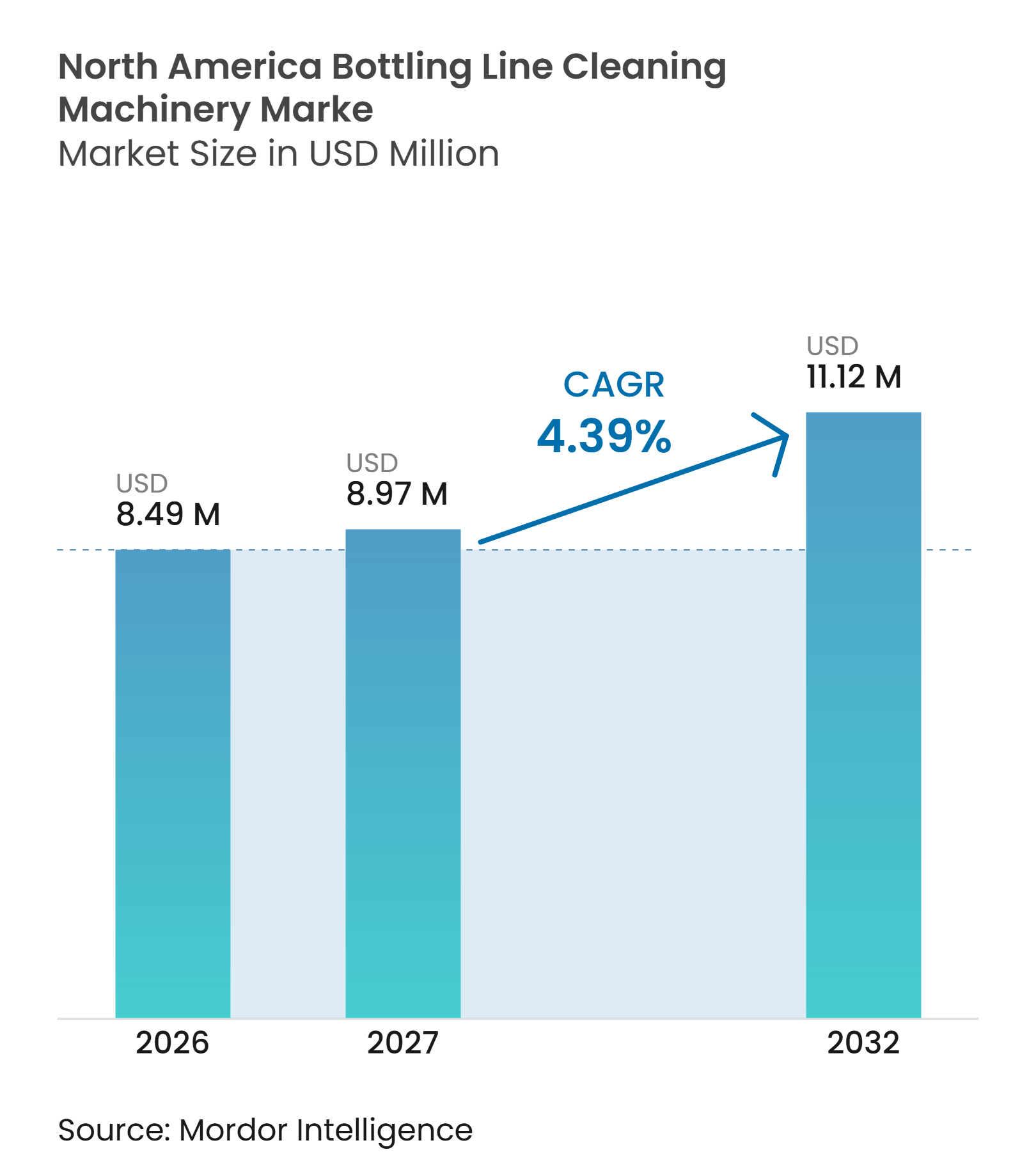
The North America Bottling Line Cleaning Machinery Marke Market size is expected to increase from USD 8.49 million in 2026 to USD 8.97 million in 2027 and reach USD 11.12 million by 2032, growing at a CAGR of 4.39% over 2027-2032.
Food, beverage, and pharmaceutical producers treat validated cleaning as a compliance requirement because sanitation controls must be documented under Food and Drug Administration requirements. The North America bottling line cleaning machinery market therefore benefits from replacement demand as facilities update older lines with equipment that can record and verify cleaning cycles. Returnable glass programs and capacity additions in Mexico add demand for high-throughput washing systems. Buyers are also placing greater weight on water, energy, chemical use, and connected monitoring when they select equipment. Established original equipment manufacturers compete through integrated washing lines and service support, while modular systems and digital clean-in-place tools give smaller facilities more upgrade options.
Key Report Takeaways
- By machine type, rotary bottle washers held 26.05% of the North America bottling line cleaning machinery market share in 2026, while combined washer-dryer systems are projected to expand at a 5.79% CAGR through 2032.
- By automation level, fully automatic systems accounted for 67.68% of the North America bottling line cleaning machinery market size in 2026 and are expected to record the highest projected CAGR through 2032.
- By bottle material, glass bottles accounted for 51.18% of revenue in 2026 in the North America bottling line cleaning machinery market, while metal and aluminum containers are projected to expand at a 5.54% CAGR through 2032.
- By end user, breweries and soft-drink producers held 33.94% of revenue in 2026 in the North America bottling line cleaning machinery market, while pharmaceutical manufacturers are projected to expand at a 5.47% CAGR through 2032.
- By geography, the United States accounted for 77.65% of revenue in 2026 in the North America bottling line cleaning machinery market, while Mexico is projected to expand at a 5.36% CAGR through 2032.
Note: Market numbers in this report are based on Mordor Intelligence's proprietary estimation framework, which combines nine months of actuals with Q4 projections for base year 2026.
Market Trends and Insights
Drivers Impact Analysis of North America Bottling Line Cleaning Machinery Market*
| Driver | (~) % Impact on CAGR Forecast | Geographic Relevance | Impact Timeline |
|---|---|---|---|
| Stringent Food Safety and Sanitation Requirements | +1.1% | National, strongest in U.S. food and pharmaceutical manufacturing corridors | Short term (≤ 2 years) |
| Beverage Production Automation and Labor Scarcity | +0.9% | National, with early gains in U.S. Midwest and Southeast bottling hubs | Medium term (2-4 years) |
| Growth of Returnable Glass and Packaged Beverages | +0.8% | U.S. Pacific Northwest and Northeast, Mexico urban bottling centers | Medium term (2-4 years) |
| Water, Energy and Chemical Efficiency Requirements | +0.6% | National, with relevance in California, Texas, and Arizona | Medium term (2-4 years) |
| Retrofitting Legacy Lines for Digital Monitoring and Predictive Maintenance | +0.4% | United States and Canada, existing large-scale beverage plants | Long term (≥ 4 years) |
| Lightweight-Container Handling and Recycled-Content Variability | +0.2% | National, with spillover to Mexico border manufacturing zones | Long term (≥ 4 years) |
| Source: Mordor Intelligence | |||
Stringent Food Safety and Sanitation Requirements
Sanitation requirements continue to make cleaning equipment a necessary capital item for bottling facilities, as a cleaning failure can become both a product-quality and an audit issue. The Food and Drug Administration requires covered food facilities to implement risk-based preventive controls, including sanitation controls where relevant, within a written food safety plan. Bottled-water operations also face current good manufacturing practice requirements that link equipment sanitation and microbiological controls to product safety, placing the condition of food-contact equipment within routine quality management. Pharmaceutical operations must maintain equipment that can be cleaned and maintained to prevent contamination under current good manufacturing practice requirements, where consistent execution and documented evidence are integral to release processes. These obligations favor systems that provide repeatable cycles, automated records, defined parameters, and evidence for internal and external audits across product runs. They also make retrofit projects more relevant where legacy washers cannot provide the documentation, repeatability, or process visibility expected by quality teams.
Beverage Production Automation and Labor Scarcity
Labor constraints support investment in automated washing and clean-in-place systems across the North America bottling line cleaning machinery market because sanitation work requires trained personnel and must be completed consistently between production runs. More than 70% of food and beverage manufacturers plan to invest in automation and control systems over the next 3 years, although many expect it will take more than 4 years to reach their target level of automation. PMMI reported that only 42% of consumer packaged goods companies automate loading and unloading, leaving many production and sanitation tasks dependent on limited labor availability and manual coordination. Fully automatic washers reduce the need for operators to set up and verify each cleaning cycle, while helping facilities run standardized wash programs across shifts. Equipment suppliers are responding with multilingual human-machine interfaces, guided operating procedures, remote diagnostics, and maintenance information to reduce the operational burden on plant teams. Canada also faces a structural workforce gap, with its food and beverage manufacturing sector expected to require 173,000 new hires by 2034, reinforcing the regional case for automation.[1]
Growth of Returnable Glass and Packaged Beverages
Returnable glass programs create a direct need for high-throughput bottle-washing capacity because every returned container must be inspected, cleaned, and prepared for refilling before it can re-enter the production system. Revino operates a commercial reuse model for wine bottles and works with more than 100 winery partners in the United States, demonstrating the scale a coordinated reuse system can achieve. Standardized reusable bottles can make soil loads more consistent and improve the utilization of high-capacity washing equipment, particularly when producers manage return flows through shared formats. Sidel supplied Grupo GEPP with returnable PET and glass bottling lines that include Hydra double-end bottle washers, showing the equipment needed for large returnable-container operations and high-speed processing. The North America bottling line cleaning machinery market gains when bottle reuse moves from small pilots to permanent collection, washing, refill, and distribution networks. Heavy-duty washing capacity also helps producers protect bottle quality through repeated cycles, reducing the risk that a reuse program is constrained by cleaning throughput.
Water, Energy and Chemical Efficiency Requirements
Water and energy consumption have become material buying criteria for bottling plants, particularly where utilities are costly, water availability is constrained, or corporate operating targets place more attention on resource use. Kersia reported that its Optimall 360 Total Cost of Ownership program can reduce cleaning costs by up to 20% and carbon dioxide emissions by 76% compared with traditional hot caustic clean-in-place processes. Krones stated that its Lavasonic HI washer can reduce fresh-water use by 20%, thermal energy by 30%, and carbon dioxide emissions by 35% through ultrasonic pretreatment, linking mechanical design to measurable operating benefits. Ecolab reported that CIP IQ deployments achieved 15% capacity efficiency gains and 20% water reduction per cleaning cycle by using fluid-sensing technology to improve process control. These results allow plant managers to evaluate a washer based on lifecycle operating costs, utility use, chemical demand, and processing time rather than on purchase price alone. Systems that measure fluid conditions and adjust cleaning steps can support more consistent resource use across changing production schedules and varied soil loads.
Restraints Impact Analysis of North America Bottling Line Cleaning Machinery Market*
| Restraint | (~) % Impact on CAGR Forecast | Geographic Relevance | Impact Timeline |
|---|---|---|---|
| High Capital and Installation Costs | -1.3% | National, most acute for small and mid-size independent bottlers | Short term (≤ 2 years) |
| Complex Cleaning Validation and Production Downtime | -0.9% | National, highest impact in pharmaceutical and dairy segments | Medium term (2-4 years) |
| Skilled Service and Maintenance Shortages | -0.5% | National, more severe in rural and secondary manufacturing markets | Medium term (2-4 years) |
| Variable Soil Loads From Recycled and Returnable Containers | -0.3% | United States and Mexico returnable-bottle markets | Long term (≥ 4 years) |
| Source: Mordor Intelligence | |||
High Capital and Installation Costs
High equipment and integration costs can delay purchases by contract packagers, small wineries, and independent bottled-water producers, especially where production volumes do not justify a rapid payback from a large automated system. A fully automatic rotary or double-end washer requires more than the machine itself because facilities may need utility connections, floor modifications, drainage work, controls integration, and clean-in-place connections before the equipment enters service. PMMI identified capital availability and uncertain returns as leading factors delaying automation projects, which also affect sanitation equipment upgrades. Imported stainless-steel-intensive equipment may face input cost uncertainty, making capital approval more difficult for smaller buyers that require clear cost visibility. Lower-cost semi-automatic washers offer an alternative for plants with modest throughput requirements or a limited range of bottle formats. This price gap separates buyers who prioritize documented compliance, automation, and long-term operating efficiency from buyers who prioritize the initial equipment cost.
Complex Cleaning Validation and Production Downtime
Validation can extend the time between installation and full production use, especially in pharmaceutical and dairy facilities where cleaning performance must be demonstrated before normal output can resume. ISPE defines automated washer validation as a documented process that demonstrates reliable cleaning results for the intended application.[2] Pharmaceutical plants may need to qualify the washing and depyrogenation steps before glass containers proceed to aseptic filling, adding protocols, review work, and monitoring beyond the equipment purchase. Food and beverage operations also need to document changes to clean-in-place programs under their quality systems before revised procedures are adopted. Multi-product lines may require more complex cleaning sequences when handling allergens, flavors, or reusable containers with varied residues and soil profiles. These requirements can increase the risk of downtime, extend commissioning work, and make phased upgrades more attractive than a full replacement.
*Our forecasts treat driver/restraint impacts as directional, not additive. The impact forecasts reflect baseline growth, mix effects, and variable interactions.
North America Bottling Line Cleaning Machinery Market Segment Analysis
By Machine Type:
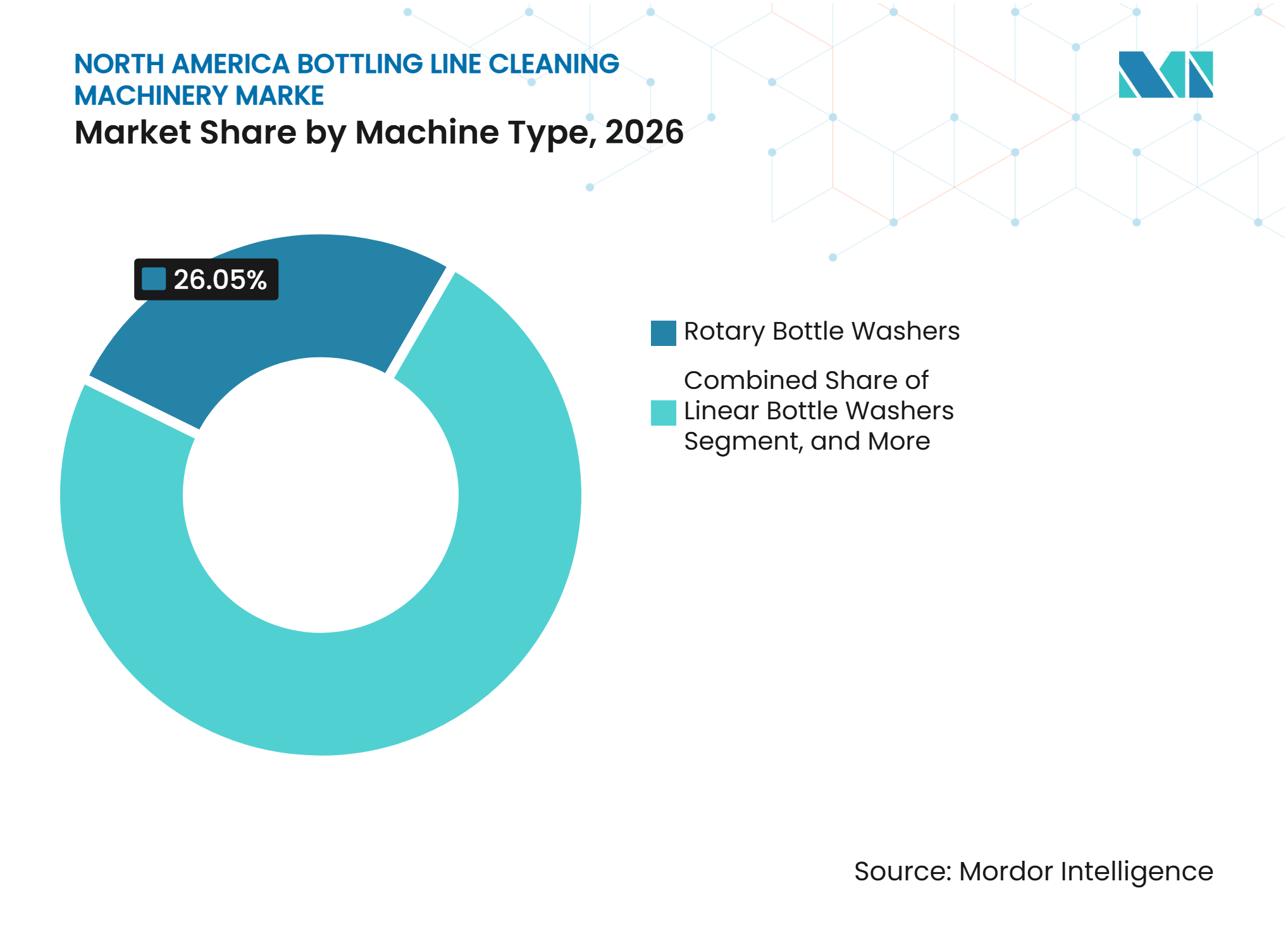
Rotary Systems Lead, Combined Formats Scale FastRotary bottle washers held 26.05% of the North America bottling line-cleaning machinery market share in 2026 because they meet the throughput requirements of large breweries, soft-drink plants, and commercial water bottlers. Their configuration supports repeatable processing and direct integration with high-speed filling lines. Krones introduced the Lavasonic HI in September 2025 with ultrasonic pretreatment and selectable cleaning programs for varying soil loads. The company reported that the design can shorten treatment time by up to 40% and lower thermal energy use by 30%. Reduced mechanical stress can also preserve returnable glass bottles through repeated wash cycles.
Combined washer-dryer systems are projected to grow at a 5.79% CAGR through 2032 as processors seek to combine cleaning and drying in a smaller footprint. These systems can reduce transfers between machines and simplify layouts in new facilities and retrofits. Linear bottle washers suit craft breweries and specialty producers that need format flexibility without the cost of a full rotary system. Tunnel washers serve high-volume pharmaceutical filling environments, while immersion washers support smaller operations with basic sanitation needs. Bottle rinsers and blowers can provide waterless or low-water pretreatment before final washing or filling.



By Automation Level:
Fully Automatic Systems Define the SegmentFully automatic systems represented 67.68% of revenue in 2026 in the North America bottling line cleaning machinery market and also form the fastest-expanding automation tier. Their position reflects a need to reduce manual intervention in cycle setup, verification, and recordkeeping. Ecolab launched CIP IQ in September 2025, featuring fluid-sensing technology that can integrate with existing clean-in-place infrastructure. The platform illustrates that cleaning automation now includes sensing, data capture, and recommended actions alongside mechanical equipment. PMMI identified embedded interfaces, predictive maintenance links, and simpler changeovers as priority features for facilities with limited staffing.
Semi-automatic systems retain a role in contract packaging, craft brewing, food, and dairy plants where product diversity makes full automation difficult to justify. These systems allow producers to add control without replacing the entire line. Manual washers remain relevant in small pharmaceutical compounding and artisanal winery applications where validated reproducibility matters more than high output. The semi-automatic installed base offers a retrofit opportunity because plants can add controls, monitoring, and modular functions over time. Manufacturers that offer a path from manual operation to digital clean-in-place functions can address this demand.
By Bottle Material:
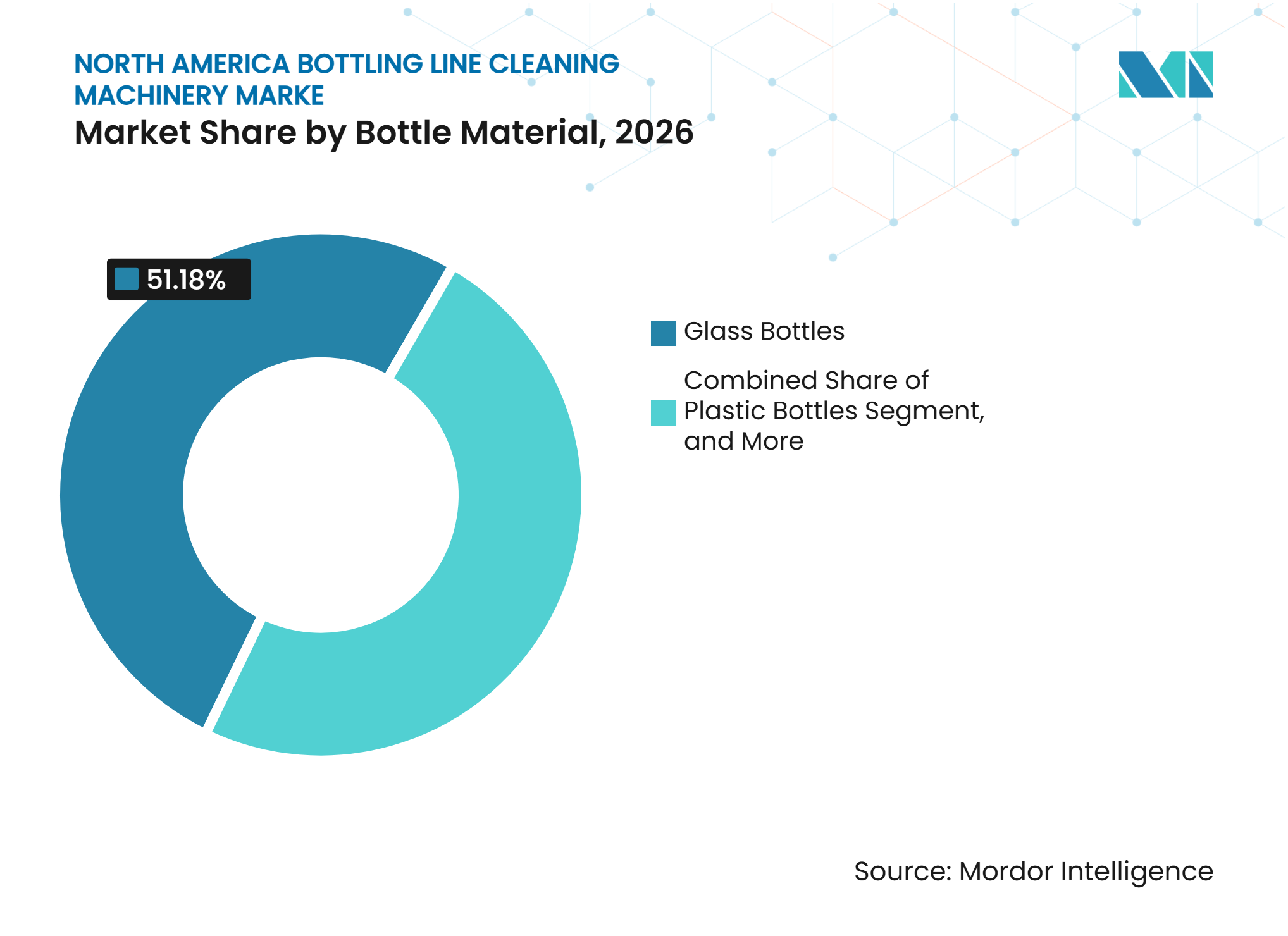
Glass Leads, Metal and Aluminum Gain GroundGlass bottles accounted for 51.18% of revenue in 2026, supported by returnable programs in brewing, wine, and carbonated soft drinks. Glass also remains important in pharmaceutical operations that require controlled handling and validated washing. Solenis stated that returnable glass bottles generally need 10 to 20 reuse cycles to realize lifecycle cost and carbon benefits. Washer quality therefore affects asset use in refillable programs. Plastic bottles remain in demand for water and carbonated beverage production, while returnable PET is relevant in Mexico because collection systems support reuse.
Metal and aluminum containers in the North America bottling line cleaning machinery market are projected to expand at a 5.54% CAGR through 2032. Premium beverage brands use aluminum bottles in functional drinks, water, craft spirits, and formats that value lightweight distribution and recyclability. VMI introduced its Bottle Rinser to the American market in April 2025 for aluminum bottle applications, with capacity of 1,100 bottles per minute. The launch shows that suppliers are tailoring rinsing systems to this container category. Metal packaging may require cleaning steps to remove lubricants and metal fines before subsequent production processes.

By End User:
Brewing Leads Demand, Pharmaceutical Manufacturing AcceleratesBreweries and soft-drink producers accounted for 33.94% of revenue in the North America bottling line-cleaning machinery market in 2026 because high bottling volumes and returnable glass programs require dependable cleaning capacity. Fermented beverages also need consistent sanitation to protect product quality across repeated cycles. Bottled water producers operate under food safety and current good manufacturing practice controls that keep equipment sanitation central to their operations. Contract packagers add demand because they process diverse bottle materials and customer product lines. Flexible washers can help these operators manage changeovers and variable soil loads.
Pharmaceutical manufacturers are projected to record a 5.47% CAGR through 2032. Their equipment decisions are shaped by cleaning validation, endotoxin control, and documented performance prior to containers entering aseptic filling. ISPE guidance identifies the need to validate the performance of automated washers for pharmaceutical applications. Food and dairy producers use washers for glass jars, plastic dairy bottles, and specialty containers that require residue and allergen control. Wineries and distilleries add demand as reusable glass programs move beyond local collection models.
Geography Analysis
United States
The United States accounted for 77.65% of revenue in 2026 in the North America bottling line cleaning machinery market. Its regulated food, beverage, and pharmaceutical manufacturing base supports broad demand for documented cleaning performance. Food and Drug Administration requirements place sanitation controls within broader food safety systems. Bottled-water facilities also operate under microbiological testing and sanitation requirements. Revino's network of more than 100 winery partners demonstrates interest in commercial bottle reuse.
Mexico
Mexico is projected to register a 5.36% CAGR through 2032. Heineken committed USD 2.75 billion to Mexican projects through 2028, including a Yucatán brewery with an initial capacity of 4 million hectoliters. Arca Continental confirmed an MXN 18,000 million capital allocation for 2026, equivalent to USD 895 million, with 50% directed to Mexico operations. Sidel supplied Grupo GEPP with lines that included high-capacity Hydra double-end washers. Returnable PET and glass remain important structural factors in the country.
Canada
Canada faces workforce and productivity conditions that encourage automation. Food Processing Skills Canada expects the food and beverage manufacturing sector to require 173,000 new hires by 2034. Food manufacturing productivity declined by an average of 0.17% annually from 2015 to 2024, while unit labor costs rose 36%. These conditions favor fully automatic washers and connected clean-in-place systems.
Competitive Landscape
Market Concentration
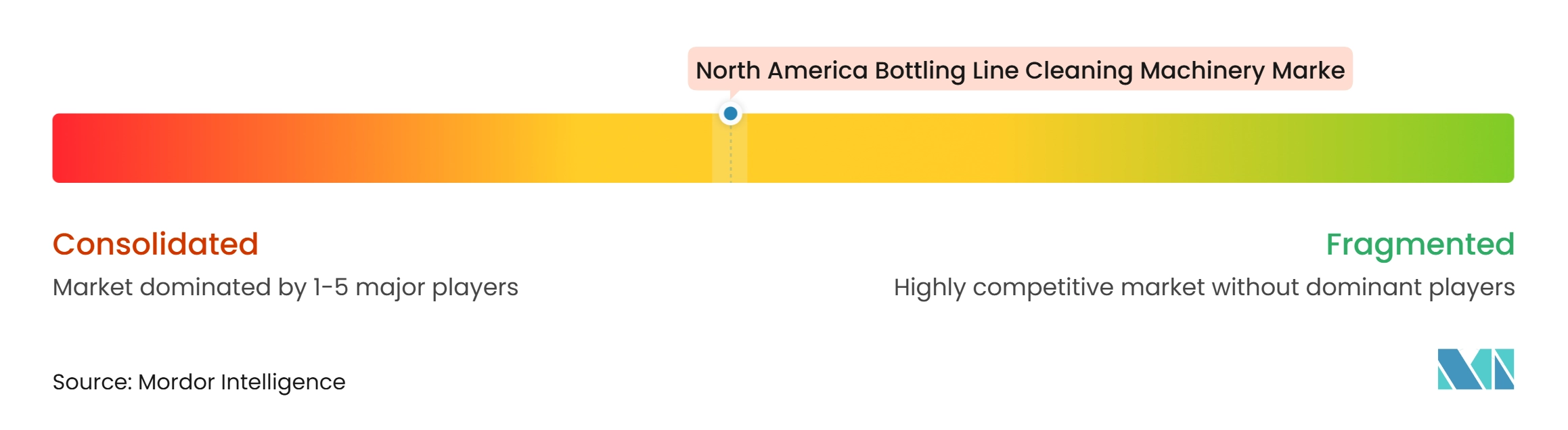
The North America bottling line cleaning machinery market is moderately consolidated at the premium end. Large European manufacturers with North American sales and service networks supply many high-throughput rotary and double-end washer systems. They compete through lifecycle cost, process performance, digital tools, and service coverage. Krones launched the Lavasonic HI in September 2025 and reported up to 40% lower treatment time, 30% lower thermal energy use, and 35% lower carbon dioxide emissions. KHS introduced a new bottle-washing generation in 2025 that emphasizes a reduced equipment footprint and more serviceable components.
KHS positioned its returnable-glass line technology around upgrades that reduce energy use and simplify maintenance.[3] GEA introduced its AdaptAx modular orbital cleaner platform in 2026, reporting up to 30% higher cleaning performance than its earlier design. This approach broadens competition from stand-alone washing units toward integrated cleaning capability across production lines. Equipment qualifications for food-contact, dairy, and pharmaceutical use impose stricter entry requirements for new suppliers. The competitive field varies by plant size, bottle format, automation needs, and documentation requirements.
Mid-market competition in the North America bottling line cleaning machinery market remains fragmented because many customers need incremental upgrades rather than a complete original equipment manufacturer line. Ecolab introduced CIP IQ in 2025 to add sensing and digital monitoring to existing clean-in-place infrastructure. JBT Marel introduced the CIPure Cleaning System in 2025 for facilities that need modular, digitally controlled cleaning. Regional integrators can compete by offering customized installations, shorter response times, and phased upgrades.
North America Bottling Line Cleaning Machinery Industry Leaders
-
Krones AG
-
KHS GmbH
-
Tetra Laval International S.A.
-
GEA Group AG
-
ProMach, Inc.
- *Disclaimer: Major Players sorted in no particular order
North America Bottling Line Cleaning Machinery Market Companies Covered in this Report
- Krones AG
- KHS GmbH
- Tetra Laval International S.A.
- GEA Group AG
- Alfa Laval AB
- SPX FLOW, Inc.
- Ecolab Inc.
- ProMach, Inc.
- Fogg Filler
- Akomag S.r.l.
- Aquatech-BM Inc.
- Accutek Packaging Equipment Companies, Inc.
- APACKS
- In-Line Packaging Systems, Inc.
- Torq Packaging USA
- Géninox
- Entech Fabrications
- Carleton Helical Technologies
- Velocity H2O Solutions
- Steelhead Inc.
Recent Industry Developments in North America Bottling Line Cleaning Machinery Market
- November 2026: GEA Group unveiled its AdaptAx modular orbital cleaner platform at BrauBeviale 2026 in Nuremberg, Germany, with up to 30% higher cleaning performance versus the prior generation and a componentized design allowing individual element replacement. GEA confirmed a market launch target of early 2027.
- November 2026: KHS presented an integrated glass bottling line solution at BrauBeviale 2026 featuring the Innoclean Cascade-D as its cleaning centerpiece alongside the LESS, Liquid Efficiency Spraying System, retrofit that cuts spray pump energy consumption by up to 40%, positioning the offering as a service-led modernization path for returnable glass infrastructure.
- May 2026: Kersia launched its Optimall 360° Total Cost of Ownership program for the soft drinks industry, combining optimized clean-in-place chemistry with operational audits. Published results demonstrated up to 20% cost savings and 76% carbon dioxide reduction versus traditional hot caustic clean-in-place in customer trials.
- March 2026: Kersia launched its Optimall 360° Total Cost of Ownership program for the soft drinks industry, combining optimized clean-in-place chemistry with operational audits. Published results demonstrated up to 20% cost savings and 76% carbon dioxide reduction versus traditional hot caustic clean-in-place in customer trials.
North America Bottling Line Cleaning Machinery Market Report Scope
The North America bottling line cleaning machinery market refers to the market for equipment and integrated machinery systems used to wash, rinse, clean, sanitize, and dry bottles and containers before filling, capping, and packaging across the beverage, food and dairy, pharmaceutical, and other liquid packaging industries in the region.
The North America Bottling Line Cleaning Machinery Market Report is Segmented by Machine Type (Rotary Bottle Washers, Linear Bottle Washers, Tunnel Bottle Washers, Immersion Bottle Washers, Bottle Rinsers and Blowers, Combined Washer-Dryer Systems, ad Other Machine Types), Automation Level (Manual, Semi-Automatic, and Fully-Automatic), Bottle Material (Glass Bottles, Plastic Bottles, and Metal and Aluminum Containers), End User (Breweries and Soft-Drink Producers, Bottled Water Producers, Wineries and Distilleries, Food and Dairy Producers, Pharmaceutical Manufacturers, and Contract Packaging and Bottling Companies), and Geography (United States, Canada, and Mexico). The Market Forecasts are Provided in Terms of Value (USD).
Segmentation Overview
| Rotary Bottle Washers |
| Linear Bottle Washers |
| Tunnel Bottle Washers |
| Immersion Bottle Washers |
| Bottle Rinsers and Blowers |
| Combined Washer-Dryer Systems |
| Other Machine Types |
| Manual |
| Semi-automatic |
| Fully-automatic |
| Glass Bottles |
| Plastic Bottles |
| Metal and Aluminum Containers |
| Breweries and Soft-Drink Producers |
| Bottled-Water Producers |
| Wineries and Distilleries |
| Food and Dairy Producers |
| Pharmaceutical Manufacturers |
| Contract Packaging and Bottling Companies |
| United States | Canada |
| Mexico |
| By Machine Type | Rotary Bottle Washers | |
| Linear Bottle Washers | ||
| Tunnel Bottle Washers | ||
| Immersion Bottle Washers | ||
| Bottle Rinsers and Blowers | ||
| Combined Washer-Dryer Systems | ||
| Other Machine Types | ||
| By Automation Level | Manual | |
| Semi-automatic | ||
| Fully-automatic | ||
| By Bottle Material | Glass Bottles | |
| Plastic Bottles | ||
| Metal and Aluminum Containers | ||
| By End User | Breweries and Soft-Drink Producers | |
| Bottled-Water Producers | ||
| Wineries and Distilleries | ||
| Food and Dairy Producers | ||
| Pharmaceutical Manufacturers | ||
| Contract Packaging and Bottling Companies | ||
| By Geography | United States | Canada |
| Mexico | ||
Key Questions Answered in the Report
What is the North America bottling line cleaning machinery market size?
The market is valued at USD 8.49 million in 2026 and is projected to reach USD 11.12 million by 2032 at a 4.39% CAGR.
Which machine type leads bottling line cleaning equipment demand in North America?
Rotary bottle washers lead with 26.05% of revenue in 2026 because they fit high-throughput bottling operations.
Why are fully automatic bottle washing systems gaining adoption?
Fully automatic systems held 67.68% of revenue in 2026 and reduce manual cycle oversight while supporting cleaning records.
Which bottle material creates the largest equipment demand?
Glass bottles held 51.18% of revenue in 2026, supported by brewing, wine, soft drinks, pharmaceutical packaging, and reuse programs.
Which end user is expected to expand fastest through 2032?
Pharmaceutical manufacturers are projected to expand at a 5.47% CAGR because validated cleaning is important before aseptic filling.
Which country is expected to expand fastest in North America?
Mexico is projected to expand at a 5.36% CAGR through 2032, supported by beverage capacity investments and returnable packaging lines.